
Note: This article contains affiliate links. If you click on these links and make a purchase, we may earn a small commission at no extra cost to you. This helps support our research and content. Read our full affiliate disclosure here.
Finding the right space heater for a nursery matters because infants need consistent, gentle warmth without noise, strong drafts, or safety hazards. You want a heater that maintains stable temperature, has reliable safety features, and runs quietly so it does not disturb sleep. This guide shortlists the top options for use in a nursery and explains the evaluation criteria we used, including safety systems, temperature control, noise, and ease of use. Read on for a clear overview to help you pick a heater that keeps a baby comfortable and a parent reassured.
Top Picks at a Glance
| Best Overall The best all-around choice for most situations | Vornadobaby Tempa Nursery Heater |  |
| Best Quality Built to a higher standard if you want something more solid | De'Longhi ComfortTemp Radiant Heater EW7707CM |  |
| Best Value The sweet spot between price and what you get | Amazon Basics Ceramic Space Heater |  |
| Best Budget The cheapest option that still gets the job done reliably | Amazon Basics Ceramic Mini Heater |  |
| Top Rated A top-rated pick with lots of positive feedback | DREO Space Heater HSH006 |  |
| Most Popular A crowd favorite that many people choose with confidence | GiveBest Portable Space Heater PTC-905 |  |
| Best Seller A high-volume bestseller chosen again and again | DREO Atom One Space Heater |  |
Vornadobaby Tempa Nursery Heater

| Heating Coverage | 100 sq ft |
|---|---|
| Heat Output | 900 watts |
| Number of Speeds | 2 |
| Max Temperature Setting | 125 °F |
| Power Source | Corded Electric |
The Vornadobaby Tempa is a small corded electric nursery heater that combines gentle forced-air circulation with child-focused safety features for everyday use in a baby's room. It offers two heat settings plus a fan-only mode and an adjustable thermostat that aims to maintain steady warmth across up to 100 square feet using a 900 W output. The unit emphasizes safety: a cool-touch exterior, concealed cord storage, tamper-resistant controls, tip-over protection and automatic high-temperature shutoff make it straightforward to place near a crib or changing area without obvious hazards. Practical benefits include simple controls, two fan modes (continuous and auto) for quieter, intermittent operation at night, and a compact, stable base that is easy to move between rooms. Limitations are inherent to its size and power: it is built for small rooms and will not replace central heating or warm larger spaces quickly, and the 900 W output means it may run longer to reach a desired temperature in poorly insulated rooms. For parents wanting a safe, easy-to-use supplemental heater for a nursery, Tempa focuses on predictable warmth and child safety rather than high-powered performance.
Best for: Parents who need a safe, low-profile supplemental heater to keep a nursery or small bedroom comfortably warm while prioritizing child safety and simple operation.
Less Ideal for: People who need to heat large rooms, open floor plans, or poorly insulated spaces where higher wattage or whole-home solutions are required.
- Child-focused safety features including tamper-resistant controls, cool-touch exterior, tip-over protection and automatic shut-off
- Two heat settings plus fan-only and auto circulation modes for flexible, quieter operation
- Compact, portable floor-mounted design with hidden cord storage for tidy placement in a nursery
- 900 watt heat output is intended for small rooms only and won’t heat larger or poorly insulated spaces quickly
- Only two speed/settings options limit granular temperature control
Verdict: Buy this if you want a compact, safety-focused nursery heater that delivers gentle whole-room circulation for small bedrooms.
De'Longhi ComfortTemp Radiant Heater EW7707CM

| Heat Output | 1500 watts |
|---|---|
| Heating Method | Radiant |
| Number of Speeds | 3 |
| Min Temperature Setting | 44 °F |
The De'Longhi EW7707CM is an oil-filled radiator that provides quiet, steady radiant heat for small to medium rooms without a fan, making it suitable for bedrooms and nurseries. It runs at up to 1500 watts with three heat settings and an adjustable thermostat, and includes a ComfortTemp mode that modulates power to maintain temperature more efficiently. The sealed diathermic oil reservoir never needs refilling and the thermal slot design aims to improve heat flow while keeping surface temperatures relatively low. Mobility is straightforward thanks to an integrated handle and snap wheels, and built-in safety features include thermal cut-off and fully enclosed heating elements. Practical benefits are silent operation that does not blow dust, consistent background warmth, and simple mechanical controls that are easy to set. Limitations are the slower warm-up time typical of oil radiators and the lack of advanced digital controls, timers, or remote operation that some buyers might expect for fine-grained scheduling or remote adjustments.
Best for: Buyers who prioritize steady, quiet background heat and safety for sleeping spaces and want a low-maintenance heater that preserves air quality.
Less Ideal for: People who need rapid spot heating, precise programmable schedules, or remote control features should consider other heater types.
- Quiet, fanless radiant heating suitable for bedrooms and nurseries
- ComfortTemp mode improves efficiency by adjusting power to maintain set temperature
- Sealed oil reservoir requires no maintenance or refilling
- Built-in safety features including thermal cut-off and enclosed heating elements
- Slower to heat a room compared with fan-forced heaters
- No digital display, timer, or remote for precise scheduling
Verdict: Choose this oil-filled radiator if you want silent, low-maintenance, and safety-focused radiant heat for a nursery or bedroom.
Amazon Basics Ceramic Space Heater

| Heat Output | 1500 watts |
|---|---|
| Number of Speeds | 3 |
| Power Source | Corded Electric |
| Max Temperature Setting | 130 °F |
| Heating Method | Convection |
This compact ceramic heater delivers quick, localized warmth for small rooms such as a nursery or home office. It offers three modes — high (1500W), low (900W) and fan-only — plus an adjustable thermostat so you can dial in the temperature for short-term comfort. The unit is lightweight and portable, making it easy to move between rooms, and its ceramic convection element heats up fast with relatively low noise. Safety features include tip-over and overheat protection and a power indicator light, which are useful for family spaces. Limitations to consider are the non-oscillating design, which concentrates heat directionally rather than spreading it, and the recommendation to avoid high-moisture rooms, so it should not be used in bathrooms or laundry areas.
Best for: Parents or caregivers who need an affordable, easy-to-move heater to provide quick, localized warmth in a nursery or small bedroom while prioritizing safety features.
Less Ideal for: People seeking whole-room, evenly distributed heating or a heater rated for humid spaces should look at other models with oscillation or moisture-tolerant designs.
- Fast ceramic convection heating for quick warm-up in small rooms
- Three settings including 1500W high and 900W low for adjustable output
- Lightweight and portable design easy to move between rooms
- Built-in tip-over and overheat protection with power indicator for safer operation
- Non-oscillating output concentrates heat in one direction rather than distributing it
- Not suitable for use in high-humidity rooms
Verdict: A compact, safety-minded heater that delivers fast, adjustable warmth for a nursery or other small room.
Amazon Basics Ceramic Mini Heater
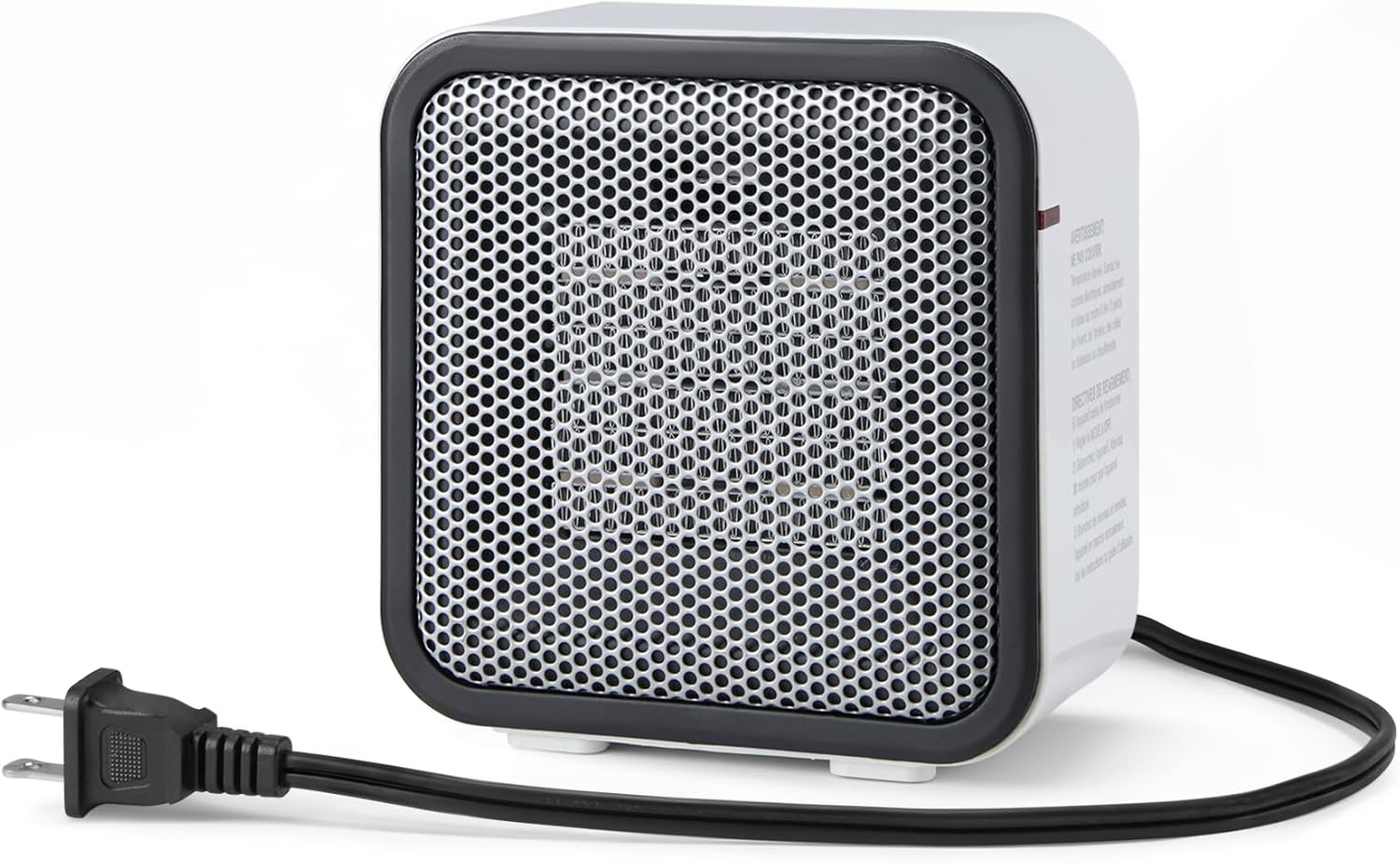
| Heat Output | 500 watts |
|---|---|
| Heating Method | Convection |
| Heating Coverage | 107.6 square feet |
| Power Source | Corded Electric |
| Special Features | Tip-Over Protection |
This small ceramic heater provides targeted warmth for a desk, nursery corner, or bedside without taking up much space. At 500 watts it heats quickly for a single-user area using convection and ceramic coils, and its low 48 dB noise level helps keep rooms quiet during use. The unit is lightweight and portable so you can move it where needed, and built-in tip-over protection automatically cuts power if knocked over, which is important around children. Controls are simple with a single speed and plug-in power source, but that simplicity means there are no thermostatic adjustments or multiple heat levels for finer temperature control. Its heating coverage is limited to very small rooms, so it works best as a supplemental heater rather than a primary source for larger spaces. For a nursery the quiet operation and safety shutoff are practical, but parents should monitor placement and avoid relying on it as the sole heat source.
Best for: Parents or caregivers seeking an inexpensive, low-noise supplemental heater for very small nursery spaces who prioritize portability and simple safety features.
Less Ideal for: People needing precise temperature control, larger nursery spaces, or a primary heating solution for cold rooms should consider higher-output or thermostatic heaters instead.
- Compact footprint fits on a desk or nightstand
- Quick ceramic heating for fast, localized warmth
- Built-in tip-over protection for added safety
- Lightweight and easy to move between rooms
- Quiet operation suitable for sleeping areas
- Single heat output with no adjustable thermostat or multiple settings
- Designed only for very small rooms, not whole-room heating
Verdict: A budget-friendly, quiet, and portable mini heater that offers fast, localized warmth and basic safety features ideal as a supplemental nursery heater.
DREO Space Heater HSH006

| Heat Output | 1500 watts |
|---|---|
| Heating Coverage | 200 sq.ft |
| Heating Element | PTC Ceramic |
| Number of Speeds | 4 |
| Min-Max Temperature | 41 °F – 95 °F |
This DREO tower heater is designed to deliver quick, controllable heat for small rooms up to about 200 sq ft. It uses a 1500W PTC ceramic element and a brushless DC motor to move warm air with reduced noise, and offers multiple modes (Power, ECO, Fan Only), four fan speeds, and a 12-hour timer for scheduled use. The thermostat is precise, adjustable from 41 to 95°F in 1°F increments, which helps maintain a steady nursery temperature without constant adjustments. Built-in safety features include tip-over detection, overheat protection, flame resistant materials, child lock, and an ETL listing, all useful for peace of mind in a child space. It is lightweight and easy to move, and the included remote and memory function add convenience. Expect a compact coverage area and typical ceramic-heater warmth rather than radiant heat, and the unit can produce audible fan noise at higher settings despite its quiet rating at low speeds.
Best for: Parents or caregivers who prioritize safe, controllable heating for a nursery and want a compact, easy-to-move heater with precise temperature control and safety features.
Less Ideal for: Homes needing to heat large or open-plan areas or buyers who prefer radiant or convection baseboard style heat for longer-lasting warmth.
- 1500W PTC ceramic element for quick warm-up
- Precise adjustable thermostat with 1°F increments
- Multiple modes, timer, and remote for easy control
- Comprehensive safety features including tip-over and overheat protection
- Coverage suitable for small rooms only (around 200 sq ft)
- Fan-driven warmth rather than radiant heat, which some may find less cozy
Verdict: A compact, safety-minded heater with precise thermostat control that fits nursery use where quiet, controllable warmth and built-in protections are top priorities.
GiveBest Portable Space Heater PTC-905

| Heat output | 1500 watts |
|---|---|
| Secondary output | 750 watts |
| Heating coverage | 200 sq.ft |
| Number of speeds | 2 |
| Max temperature setting | 158 °F |
The GiveBest PTC-905 is a small ceramic space heater designed to heat a single room quickly without much fuss. It offers two heat levels (1500W and 750W) plus a cool-fan setting, and an adjustable electronic thermostat that cycles the unit on and off to maintain a set temperature. The PTC ceramic element and high-speed fan warm air rapidly for rooms up to about 200 sq ft, and the unit is light and portable with a built-in carry handle for moving between bedroom, nursery, or home office. Safety is a clear focus: the heater uses flame-retardant ABS, automatic overheat shutoff, and tip-over protection that beeps and cuts power if knocked over. Noise is relatively low compared with many compact heaters, making it reasonable for overnight use. Limitations are typical for a small plug-in heater: it only warms a localized area rather than whole-house heating and uses a standard two-prong cord, so placement near floor outlets matters. For parents wanting a simple, safety-minded heater for a nursery, it provides practical, no-frills warmth with sensible protections.
Best for: Parents or caregivers who want a compact, safety-focused heater to keep a nursery or small bedroom comfortably warm without running central heat.
Less Ideal for: Homes needing to heat large open areas or those that require whole-house solutions should choose a larger heater or HVAC option instead.
- Two heat settings (1500W/750W) plus cool fan for year-round use
- Adjustable electronic thermostat that maintains a preset temperature automatically
- Multiple safety features including overheat shutoff and tip-over protection
- Compact, lightweight design with a carry handle for easy repositioning
- Quiet operation suitable for bedrooms or nurseries
- Heats only a localized area and is not suitable for whole-home heating
- Standard two-prong cord limits placement without a nearby outlet
Verdict: A compact, safety-minded ceramic heater that delivers quick, quiet warmth for a nursery or small bedroom.
DREO Atom One Space Heater
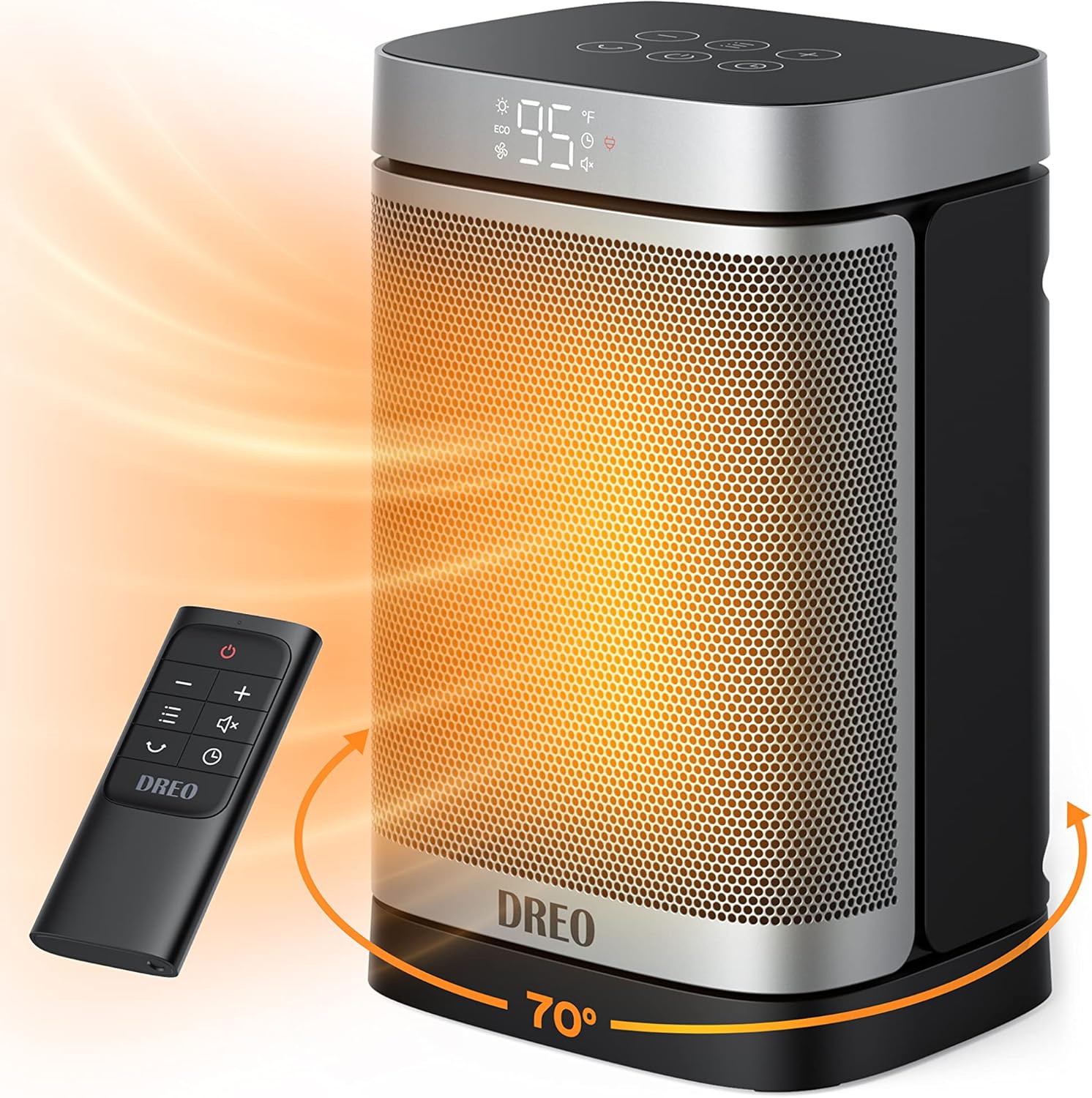
| Heating Coverage | 200 sq.ft |
|---|---|
| Heat Output | 1500 watts |
| Heating Method | Forced Air, PTC Ceramic |
| Number of Speeds | 5 |
| Min Temperature Setting | 41 °F |
The DREO Atom One is a small tower heater that delivers quick, targeted warmth using a 1500W PTC ceramic element and forced-air circulation. It is designed for bedrooms and small rooms and can sit on the floor or a low table to warm a crib area or nursery perimeter. Key features include a programmable digital thermostat that adjusts from 41 to 95 F in 1 F increments, 70 degree oscillation to spread heat more evenly, a 1–12 hour timer, ECO mode to reduce energy use, and a detachable filter for basic dust control. The unit also prioritizes safety with ETL listing, tip-over and overheat protections, and flame-retardant materials, and it runs quietly thanks to a brushless motor and aerodynamic blades. Practical limits are its 200 sq ft coverage—appropriate for small rooms but not large open areas—and a fan-forced design that circulates warm air rather than providing radiant or deep-warming heat. Overall it is a feature-rich compact heater focused on safety, precise temperature control and quiet operation for close-range use.
Best for: Parents or caregivers who want a compact, safety-focused heater for a small nursery or bedroom and value precise temperature control and quiet operation.
Less Ideal for: Large rooms, open-plan spaces, or users seeking radiant-style heating for deep, passive warmth should consider a different heater type.
- 1500W PTC ceramic heating for fast warm-up
- Programmable digital thermostat with 1°F increments for precise comfort
- 70° oscillation spreads heat across the room
- Built-in safety features including tip-over and overheat protection and ETL listing
- Quiet operation suitable for sleeping infants or nursery environments
- Designed for rooms up to about 200 sq ft so not suitable for large spaces
- Forced-air heater may move dust and create airflow rather than radiant warmth
Verdict: A compact, safety-oriented 1500W heater with precise thermostat control and quiet operation that fits small nurseries and bedrooms.
Choosing the Right Space Heater for Nursery: Key Factors to Consider
Built-in Safety Protections
Safety systems like tip-over shutoff, overheat protection, and cool-touch housing are essential in a nursery. Babies and toddlers can be unexpectedly curious, and furniture or toys might knock a heater over. A reliable tip-over cutout removes power immediately if the unit falls, while overheat sensors prevent internal components from reaching dangerous temperatures. Cool-touch exteriors and guarded outlets reduce the risk of burns if an older child gets close. When evaluating safety, consider both the presence of these features and how robust they are, such as whether the tip-over switch is mechanical or electronic and whether the housing stays noticeably cool under continuous operation.
Also think about placement options and how the heater's footprint and stability affect the chance of accidental contact. Units with wide, low centers of gravity are less likely to tip. Finally, look for clear, simple indicators that show when safety modes are active so caregivers have confidence the unit is operating safely.
Temperature Control and Consistency
Accurate temperature control matters because infants are more sensitive to fluctuations in room temperature than adults. A heater with a precise thermostat or digital temperature setting helps maintain a consistent environment, avoiding cycles of overheating and cooling that can disturb sleep or create discomfort. Variable output settings or multiple wattage options let you match the heater's output to room size and insulation.
Evaluate how a heater regulates heat over time and whether it maintains set temperatures within a narrow band. Look for models that display temperature or allow you to set a target degree. A well-performing unit should heat steadily without large spikes in surface temperature or room air temperature. If night-time use is a priority, check that the heater's overnight behavior minimizes temperature drift while conserving energy.
Noise and Sleep Disruption
Nurseries require very quiet operation to avoid disrupting naps and nighttime sleep. Mechanical fans, cycling relays, or loud blowers can wake infants or reduce sleep quality. Heaters that rely on convection or low-speed fans tend to be quieter, while some radiant or oil-filled designs operate silently.
When assessing noise, prioritize models with documented lower decibel ratings at typical operating settings and those that offer low-power or silent modes. Consider the sound character as well as the level; low-frequency hums are often less disruptive than intermittent clicks or sudden changes in fan speed. If the heater includes a timer or sleep mode, confirm that these features do not introduce extra noise.
Energy Use and Runtime Cost
Because a nursery may need heating for long overnight periods, energy efficiency affects both operational cost and how often you need to adjust settings. Heaters with multiple wattage settings, eco modes, or programmable schedules can reduce energy use while keeping temperatures within a comfortable range. Some units modulate power to maintain a set temperature rather than running at full power continuously.
Consider the room size and insulation when judging required wattage. A more efficient heater in a small, well-insulated nursery will save more energy than a high-wattage unit that cycles on and off excessively. Also weigh whether the heater supports lower-power steady heating versus short bursts of high-power output, as steady low-power heating is often better for sleep and efficiency.
Physical Size, Placement, and Portability
The heater's physical footprint and portability influence where you can place it and how safe it is in a nursery setting. A compact, stable design fits easily on a low surface out of reach or on the floor against a wall. Models with handles or light weight are easy to move between rooms, which is helpful if you use the unit in multiple spaces.
Also consider cord length and orientation for safe placement relative to outlets and crib zones. Units designed for vertical mounting or that include hardware for secure placement can reduce trip hazards. Think about storage when not in use and whether the heater's size will fit closet or shelf space safely and conveniently.
Controls, Timers, and Usability
Simple, intuitive controls are important when you need to adjust settings in low light or while holding a baby. Large buttons, clear displays, and tactile knobs reduce fumbling. Programmable timers and memory settings let you set overnight schedules and avoid manual adjustments. Remote controls or app-based control can be useful but should be reliable and straightforward.
Consider how the display behaves in a dark room; overly bright LEDs can disturb sleep, while no display can leave you uncertain about current settings. Look for units that include child locks or control covers to prevent accidental changes.
Best Placement Practices for a Nursery Heater
Position the heater on a stable, flat surface away from crib rails, bedding, curtains, and any flammable materials. Keep a clearance of at least a few feet on all sides according to the unit's safety guidance and ensure cords are routed so they cannot be pulled or tripped over.
Avoid placing the heater directly on soft surfaces such as carpets or blankets that can restrict airflow. If possible, locate the unit near an external wall or corner to help distribute warm air without creating hot spots near the crib. Check the heater periodically during initial use to confirm it maintains a consistent, safe surface temperature.
- Keep heater at least 3 feet from crib and soft furnishings
- Use cord covers or clips to prevent tripping or pulling
- Do not block vents or air intakes
Nighttime Settings and Sleep-Friendly Modes
Many nursery-appropriate heaters offer sleep modes, dimmed displays, and lower fan speeds. Use these features to maintain a steady temperature with minimal light and noise. Set a gentle target temperature and allow the heater to maintain it rather than switching between extremes.
If your heater offers a programmable timer, consider setting it to warm the room before bedtime and then keep it at a lower steady temperature overnight. Avoid frequent manual adjustments during the night; consistent ambient temperature supports better infant sleep.
- Enable dim or off display options for overnight use
- Prefer steady low-power operation to aggressive cycling
- Use timers to avoid leaving the heater at maximum output all night
Maintenance and Cleaning Tips
Regular maintenance keeps a nursery heater operating safely and efficiently. Unplug the unit before cleaning and follow the manufacturer's guidance for filter replacement or dust removal. Dust buildup can reduce airflow and potentially increase surface temperatures.
Wipe down cool-touch exteriors with a damp cloth and use compressed air to clear vents if needed. Periodically inspect the cord and plug for wear and replace the unit if you find frayed wiring or exposed conductors.
- Dust vents monthly to maintain airflow
- Check power cord integrity before each season of use
- Store heater in a dry place when not in use
Room Size and Insulation Considerations
Match heater wattage and output to the nursery's square footage and insulation quality. Small rooms with good insulation require less power to maintain a comfortable temperature, while larger or poorly insulated rooms demand higher output or supplemental heating.
Calculate required wattage by considering roughly 10 watts per square foot as a starting point for average insulation, then adjust up or down depending on ceiling height, window area, and climate. Better insulation reduces run time and energy consumption, which is beneficial for overnight heating.
- Estimate wattage needs before selecting a heater
- Improve insulation or seal drafts to reduce heater workload
- Consider supplemental localized heating if a single unit cannot maintain temperature
When to Use Thermostats Versus Timers
Thermostats help keep a stable ambient temperature by automatically modulating power based on current room temperature. They are a good choice if you want the heater to maintain a precise target without manual intervention. Timers, by contrast, are useful for scheduling heating periods, such as warming the room before bedtime and lowering output during morning hours.
For nursery use, combining both can be effective: use a timer to define active heating windows and a thermostat to prevent temperature swings within those windows. Ensure the thermostat's placement reflects the nursery's actual temperature rather than a spot that overheats due to direct airflow from the unit.
- Place thermostat sensors away from direct heater airflow
- Use timers to avoid running at full power all night
- Prefer digital thermostats for finer temperature control
How We Chose the Best Space Heater for Nursery
We focused on features that directly affect safety, sleep quality, and temperature stability in small childcare spaces. Primary evaluation criteria included built-in safety protections, temperature control accuracy, noise output, energy efficiency for continuous use, and usability for parents. For safety we prioritized tip-over shutoffs, cool-touch surfaces, and adjustable overheat protection. Temperature control assessment emphasized accurate thermostats or digital temperature setting with minimal fluctuation during steady-state operation. Noise testing criteria looked at measured or reported operating decibel levels when running at typical nursery settings. Energy efficiency and run cost considered wattage options and available eco or low-power modes suitable for overnight use. Finally, we evaluated usability features such as easy-to-read controls, timers, remote or app control, and straightforward cleaning/maintenance. We excluded units intended solely for industrial or large-space heating, space heaters lacking basic safety features, and products with inconsistent claims about child-safe surfaces. The result is a curated list emphasizing models that balance reliable temperature control, low noise, and rigorous safety features appropriate for a nursery environment.
Our full evaluation process is outlined in our review methodology.
FAQ
Is it safe to leave a space heater running overnight in a nursery?
Often it is safe if the heater includes certified safety features such as tip-over and overheat protection, a cool-touch exterior, and you follow proper placement guidelines. Use a model designed for continuous operation and keep clearances from bedding and cribs.
What is the best temperature to keep a baby's room with a heater?
A comfortable nursery temperature usually falls within a moderate range that avoids overheating. Exact settings depend on clothing and bedding, but aim for a steady, comfortable ambient temperature rather than very high heat. Use a thermostat to maintain consistency.
Should I choose a fan-based heater or an oil-filled/radiant style for a nursery?
It depends on priorities. Oil-filled or radiant styles are typically quieter and provide steady heat without a fan, which is better for sleep. Fan-based units heat a room faster and can be more compact, but they may produce more noise.
How do I reduce the risk of burns or accidents with a nursery heater?
Place the heater out of reach, use models with cool-touch surfaces and protective grilles, secure cords, and avoid placing toys or fabrics nearby. Choose units with automatic safety shutoffs and check these features regularly.
Will a small heater raise humidity or dry out the air in a baby's room?
Most electric space heaters do not add moisture and can slightly reduce relative humidity by warming the air. If dry air is a concern, consider using a humidifier in conjunction with the heater and monitor humidity levels.
Final Verdict
When choosing a space heater for a nursery, prioritize safety features, temperature consistency, and low noise above raw heating power. Consider the room size and insulation to select the appropriate output, and favor units with reliable thermostats, timers, and cool-touch housings. Balance energy use and overnight behavior by preferring steady, low-power heating modes that maintain a set temperature. Ultimately, pick a heater that confidently covers the nursery's square footage, offers robust safety protections, and operates quietly so sleep is undisturbed. That approach will help you keep the room comfortable while minimizing risk and nighttime interruptions.