
Note: This article contains affiliate links. If you click on these links and make a purchase, we may earn a small commission at no extra cost to you. This helps support our research and content. Read our full affiliate disclosure here.
If you spend time working in a cold shed you need a heater that warms the space quickly, runs safely around tools and flammable materials, and tolerates damp conditions. Choosing the right electric heater for an outdoor shed matters because small, enclosed spaces heat differently than rooms in the house and because safety and durability are higher priorities. This guide presents seven shortlisted options that fit common shed layouts and usage patterns. We evaluate each pick by heat output, safety features, weather resistance, and running cost so you can match a heater to your shed size and how often you use it.
Top Picks at a Glance
| Best Overall The best all-around choice for most situations | Briza Infrared Patio Heater IT-HEQQ-1831 |  |
| Best Quality Built to a higher standard if you want something more solid | InoKraft 7,500W Garage Heater |  |
| Best Value The sweet spot between price and what you get | Nfccra UEH510 Infrared Tower Heater |  |
| Best Budget The cheapest option that still gets the job done reliably | AEscod NFJ-9 Pedestal Heater |  |
| Top Rated A top-rated pick with lots of positive feedback | MOMOKOVA Hanging Patio Heater |  |
| Most Popular A crowd favorite that many people choose with confidence | Heat Storm Phoenix HS-1500-PHX-WIFI |  |
| Best Seller A high-volume bestseller chosen again and again | DR. INFRARED HEATER DR-238 |  |
Briza Infrared Patio Heater IT-HEQQ-1831
| Heat Output | 1500 watts |
|---|---|
| Heating Coverage | 800 – 1000 ft² (indoor), 100 (outdoor) |
| Heating Method | infrared heating |
| Voltage | 120 volts |
| Number of Speeds | 3 |
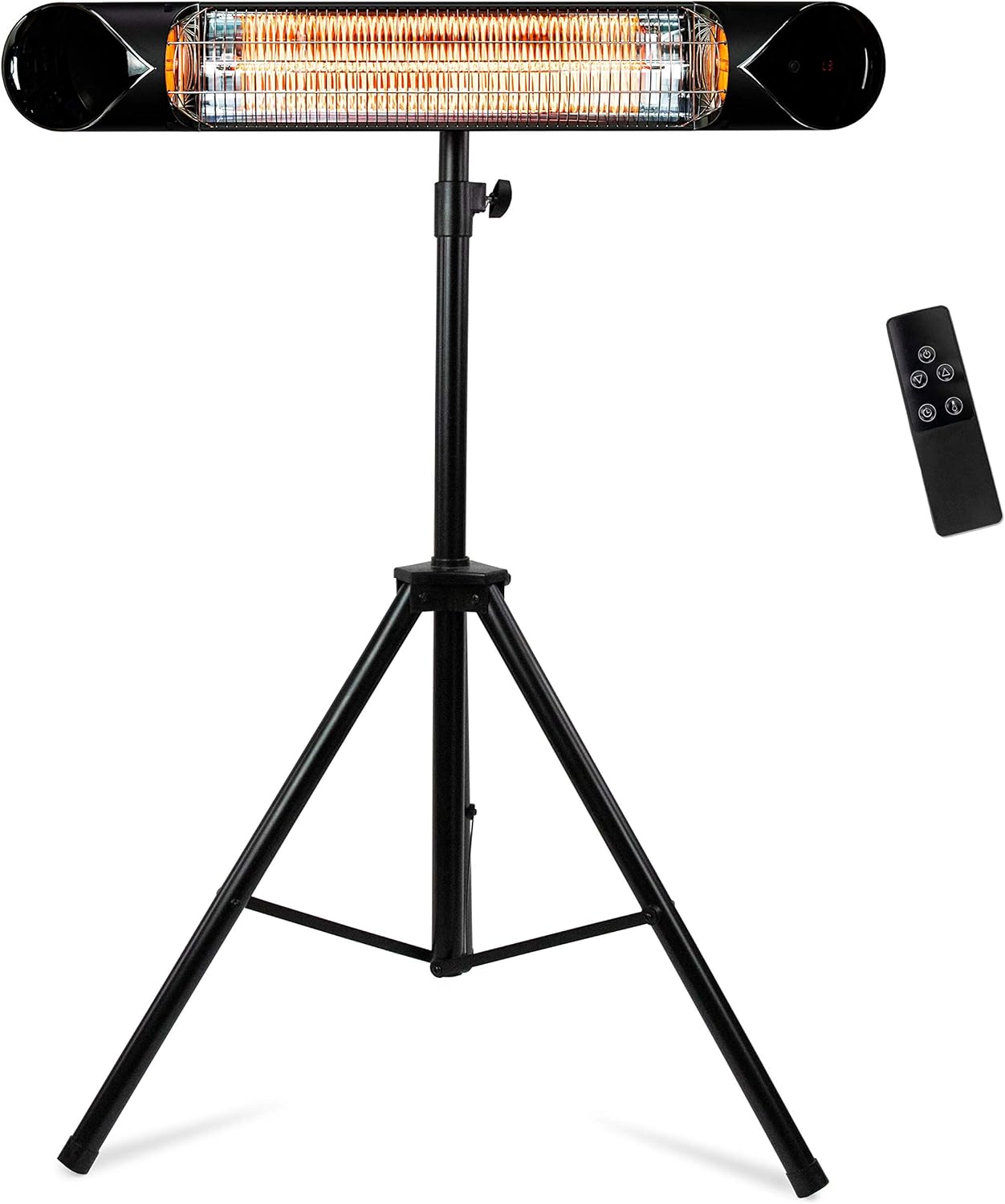
The Briza Infrared Patio Heater is a portable 1500W electric radiant heater designed for patio and outbuilding use and can be ceiling- or wall-mounted or placed on the included adjustable tripod. It uses carbon infrared elements to deliver directional radiant heat that warms people and surfaces quickly rather than heating air, and offers three power settings (900W, 1200W, 1500W) plus a timer controllable by remote for up to nine hours. The unit includes mounting hardware and a remote for convenient placement and operation, and safety features such as a tip-over shutoff and an IP55 rating for resistance to rain, snow, dust, and sand. For a shed or garage this heater provides focused, near-instant warmth without needing ducting or fuel, but as an infrared unit its warmth is strongest where the beam reaches and it will not evenly heat large open-air spaces on its own. The corded design requires a nearby 120V outlet and fixed placement if mounted, and users should plan layout so the radiant panel faces the work or seating area for best results.
Best for: A practical buyer who wants a movable, weather-resistant electric heater to provide fast, localized warmth in a workshop, garage, or outdoor shed and values simple remote control and safety features.
Less Ideal for: Not the best choice for people needing to heat large, open outdoor areas evenly or those who require whole-room convection heating.
- Portable design with included adjustable tripod and hardware for wall or ceiling mounting
- Carbon infrared element provides fast, directional radiant heat that warms people and surfaces
- Three power levels (900W, 1200W, 1500W) and a remote-controlled 1–9 hour timer for flexible operation
- IP55 rating makes it suitable for exposed shed or patio environments and adds weather resistance
- Built-in tip-over safety shutoff reduces fire risk during use
- Radiant heating is directional and will not uniformly heat large or open-air spaces
- Requires a nearby 120V outlet and is not a gas or vented heater
Verdict: A weather-resistant, remote-controlled infrared heater that delivers fast, focused warmth ideal for sheds, garages, and covered patios.
InoKraft 7,500W Garage Heater
| Heat Output | 7500 watts |
|---|---|
| Heating Coverage | 750 sq ft |
| Power Source | Corded Electric |
| Min Temperature Setting | 40 °F |
| Max Temperature Setting | 99 °F |
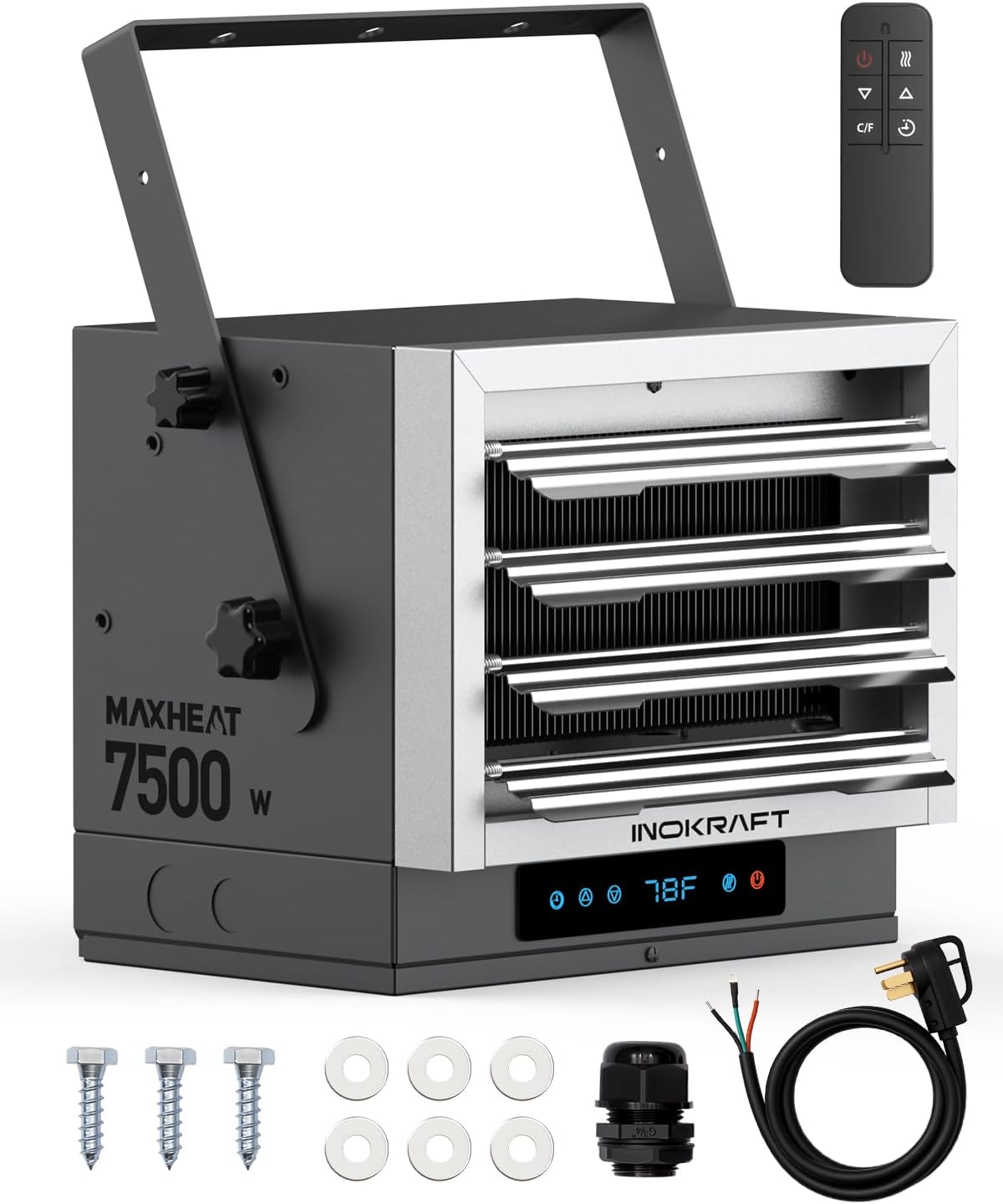
This InoKraft 7,500W heater is a powerful hardwired-style electric forced-air unit intended for ceiling or wall mount in large garages, workshops, or sheds. It delivers strong, rapid heating from 40 to 99 degrees F using selectable high/low heat plus an ECO mode that modulates output to save energy while maintaining a setpoint. The built-in digital thermostat and 1–24 hour timer let you schedule and hold comfortable temperatures, and the remote control adds convenient operation from across the room. Installation is aimed at permanent 240V supply with a NEMA 14-50P connection or hardwire, so expect professional electrical work. Safety features include CSA certification, overheat shutdown, and a fan delay that runs for 90 seconds after shutdown to clear heat from the unit. Trade-offs are typical of high-output heaters: it requires a 240V circuit and proper mounting, and its fan-forced airflow and 65 dB operating noise level are noticeable in quiet spaces. For anyone needing fast, room-filling heat in a large outbuilding, this unit performs reliably when installed correctly.
Best for: Buyers who prioritize fast, high-output heating for large sheds or workshops and are prepared to install a permanent 240V circuit for reliable performance.
Less Ideal for: People looking for a plug-and-play, low-voltage heater for small or lightly insulated outdoor sheds should consider simpler portable units instead.
- High 7,500W output suitable for heating spaces up to about 750 sq ft
- Digital thermostat with 1–24 hour timer and remote control for precise temperature management
- ECO mode that adjusts high/low settings to reduce energy use
- Safety-minded design with CSA certification, overheat protection, and post-shutdown fan delay
- Requires a 240V installation and professional electrician for safe setup
- Fan-forced operation produces audible noise around 65 dB during use
Verdict: Choose this unit when you need high-output, thermostat-controlled electric heat for a large shed or workshop and can provide a 240V installation for reliable performance.
Nfccra UEH510 Infrared Tower Heater

| Heat Output | 1200 watts |
|---|---|
| Power Source | ac |
| Heating Method | Radiant |
| Voltage | 120 volts |
| Max Temperature Setting | 120 °F |
The Nfccra UEH510 is a compact tower-style infrared heater intended to provide quick, targeted warmth for patios, garages, workshops, and sheds. It uses carbon fiber infrared elements to produce sun-like radiant heat that warms people and objects directly rather than heating all the air, so it feels fast and efficient for small outdoor or semi-enclosed spaces. The unit runs on 1200 watts at 120 volts, includes tip-over and overheat shutdown, and is IPX5 weatherproofed for light rain exposure. A widened weighted base and a carrying grip make it reasonably stable and portable around a worksite or porch. Practical buyers will appreciate the quiet operation and simple plug-in setup, though the radiant pattern is best for focused zones rather than heating large open areas, and the 1200W draw limits use on heavily loaded circuits. Overall it is a straightforward, durable option for adding immediate warmth to a shed or covered outdoor workspace when you need localized, energy-conscious heat.
Best for: Buyers wanting a practical, energy-conscious heater to add immediate, localized warmth to a shed, garage, or covered patio while prioritizing portability and safety.
Less Ideal for: People who need to heat large, uninsulated outdoor buildings or whole workshops should consider higher-capacity or forced-air solutions instead.
- Infrared radiant heating delivers quick, targeted warmth to people and objects
- IPX5 rating and aluminum alloy frame suited for light outdoor exposure
- Tip-over and overheat automatic shutoff for safer use in workshops and sheds
- Weighted base and ergonomic handle improve stability and portability
- Quiet operation with no combustion, smoke, or odors
- 1200W output is best for small zones and will not heat large open sheds effectively
- Requires a dedicated 120V circuit when used alongside other tools or appliances
Verdict: A portable, weatherproof infrared tower that delivers quick, focused warmth for sheds and small outdoor work areas where efficiency and safety matter.
AEscod NFJ-9 Pedestal Heater

| Heat Output | 1500 watts |
|---|---|
| Power Settings | 3 (Fan, 750W, 1500W) |
| Voltage | 120 volts |
| Power Source | Corded Electric |
This AEscod NFJ-9 pedestal heater delivers straightforward, budget-friendly warmth for small indoor spaces and enclosed work areas such as a shed. It runs on standard 120V and has three modes: fan (about 20W), low heat (750W) and high heat (1500W), so you can switch between mild airflow and quick spot heating. The 90° tilt and carry handle make it easy to aim heat where you need it in a cramped workspace, and the unit includes automatic overheat protection for safety during extended use. It heats up quickly and operates relatively quietly, which helps while you work on projects. Limitations include its small form factor and standard cord power, so it is best for warming a single small shed or localized zone rather than a larger uninsulated space, and it requires a heavy-duty outlet or short-run wiring if your shed circuit is limited. Assembly is required for the base, and the exposed surfaces get hot in use, so placement and clearance matter for safety.
Best for: A practical choice for budget-minded users who need a portable, quick source of heat for a small shed, workshop, or single-zone workspace and value ease of aiming and basic safety features.
Less Ideal for: Not a good fit for heating large, uninsulated outdoor sheds or multi-zone barns where a higher-output or hardwired heater is required.
- Three power modes including a 1500W high setting for fast local heat
- 90° tilt and carry handle allow targeted positioning in tight spots
- Built-in overheat protection adds a safety shutoff
- Quiet operation suitable for working or sleeping nearby
- Not intended to heat large or poorly insulated sheds effectively
- Surfaces become hot during operation so careful placement is required
Verdict: If you want an inexpensive, portable heater to warm a small shed or single workspace quickly, this compact 1500W pedestal unit is an efficient, no-frills solution.
MOMOKOVA Hanging Patio Heater

| Heat Output | 1500 watts |
|---|---|
| Heating Method | Radiant |
| Indoor Outdoor Usage | Outdoor |
| IP Rating | IP55 |
| Number of Speeds | 3 |
The MOMOKOVA hanging patio heater is a 1500W ceiling-mounted infrared unit intended to warm patios, gazebos, garages, and sheds without fumes or fans. It uses a carbon-fiber/halogen heating element to deliver instant, 360-degree radiant heat that feels direct and quiet, so it does not blow dust or disturb a work area. The unit is rated IP55 against water and dust, which makes it suitable for year-round outdoor exposure, and it includes overheat protection and tip-over safety for added peace of mind. Installation is straightforward: the heater is lightweight and hangs from an adjustable chain for targeted placement above seating or work zones. Controls offer three heat settings for basic output control, but there is no pull-cord so operation relies on mounted switches or wiring. For a shed or small workshop this heater provides fast, direct warmth with minimal noise, though it is focused on spot heating rather than warming large, open areas evenly.
Best for: Buyers who prioritize a dependable, weather-resistant electric heater to provide fast, quiet spot warmth in a shed, garage, or covered outdoor workspace.
Less Ideal for: People who need to heat very large, fully open outdoor areas or want advanced temperature controls and remote operation.
- 1500W infrared output provides quick, direct radiant heat
- IP55 rating for protection against rain and dust
- Quiet, fanless operation that does not blow dust
- Built-in overheat protection and safety features
- Designed for targeted spot heating rather than heating very large open areas
- Controls are basic with three speeds and no pull-cord switch included
Verdict: A weatherproof, quiet 1500W ceiling-mounted infrared heater well suited to reliably warm sheds and small covered outdoor workspaces.
Heat Storm Phoenix HS-1500-PHX-WIFI
| Power | 1500 W |
|---|---|
| Voltage | 110 volts |
| Heating Method | Infrared |
| Heating Coverage | 150 ft² primary, 750 ft² secondary |
| Max Temperature Setting | 99 °F |
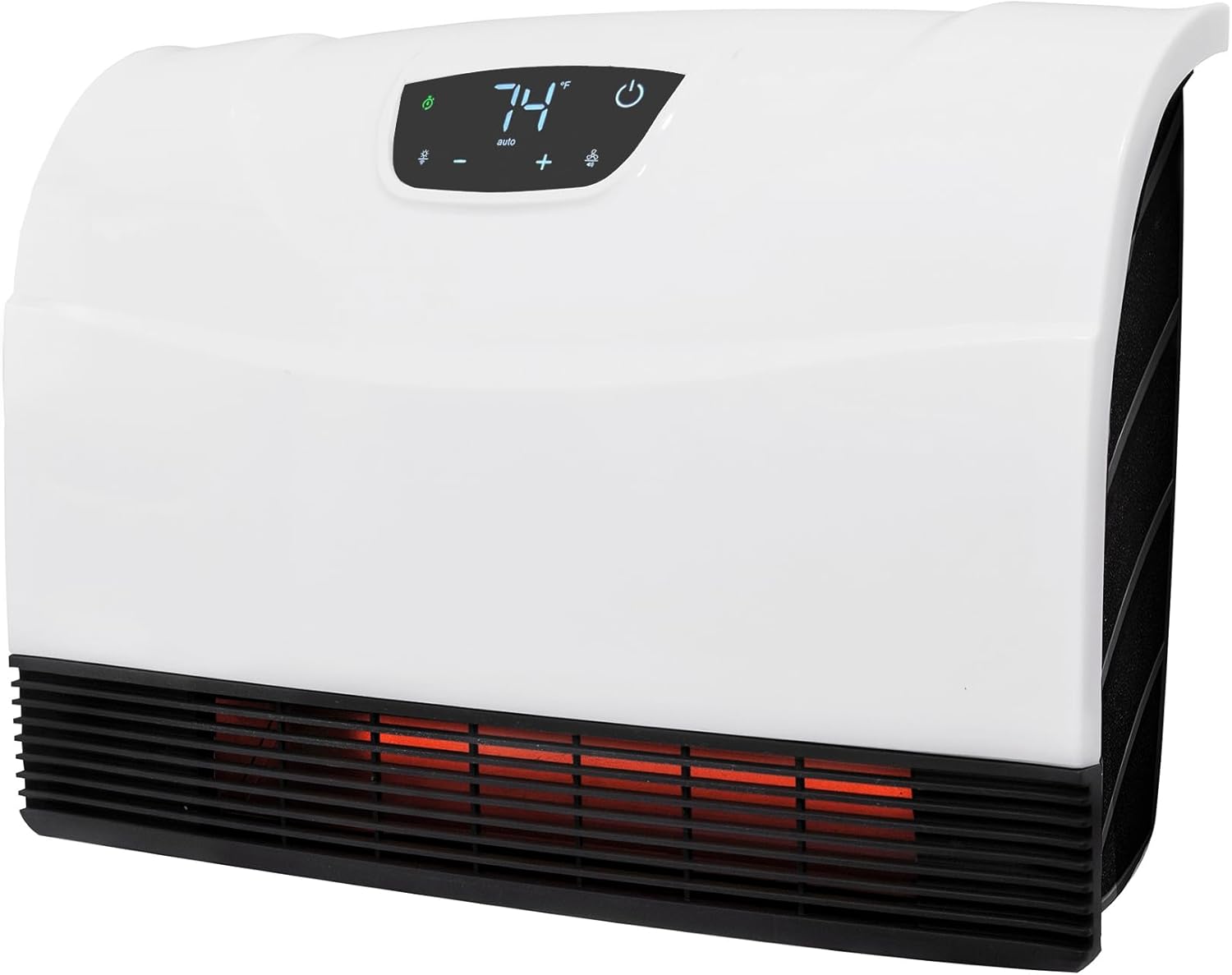
The Heat Storm Phoenix HS-1500-PHX-WIFI is a 1500‑watt infrared wall heater that mounts to a wall and plugs into a standard 110V outlet, intended to warm small rooms without taking floor space. It uses radiant heating to provide a focused zone of warmth and includes Wi‑Fi and one‑touch Bluetooth for remote scheduling and control from a phone, plus a touchscreen thermostat and a handheld remote for quick local adjustments. Installation is straightforward and it can be mounted above an outlet so the cord is hidden. The unit is marketed for bedrooms, bathrooms, offices, garages and similar small spaces and claims primary coverage around 150 sq ft with higher secondary coverage depending on insulation. Safety features include tip‑over shutoff for nonwall setups and a cool‑to‑the‑touch grill. Limitations are typical of wall infrared units: it is best as a zone heater rather than whole‑building heat and its rated max temperature is modest, so performance depends on room insulation and placement. If you need compact, app‑enabled spot heating for a small enclosed shed or workspace, it delivers useful control and space savings.
Best for: Buyers who want a compact, mountable electric heater with smart control for heating a single small enclosed workspace or shed zone and who value remote scheduling and neat installation.
Less Ideal for: People needing whole‑building heat, high temperature output for very cold uninsulated spaces, or a portable freestanding heater for moving between areas.
- Wall‑mount design preserves floor space and hides the cord when installed over an outlet
- Wi‑Fi plus Bluetooth one‑touch setup allows remote control and scheduling from a phone
- 1500W infrared radiant element provides quick, focused zone heating
- Includes touchscreen thermostat and a remote for easy local adjustments
- Built with safety features like cool‑to‑the‑touch grill and tip‑over shutoff for added protection
- Designed as a zone heater so it is not intended to heat large or poorly insulated buildings
- Max temperature setting is limited to 99°F which may not suit very cold climates
Verdict: A compact, Wi‑Fi controlled 1500W wall infrared heater that is a smart, space‑saving choice for heating a single small shed or workspace zone.
DR. INFRARED HEATER DR-238

| Power settings | 900W, 1200W, 1500W |
|---|---|
| Voltage | 120 volts |
| Amperage | 12.5 A |
| Number of speeds | 3 |
| IP rating | IP55 |
The DR-238 is a corded electric carbon infrared heater meant to mount on a wall or ceiling and deliver targeted radiant warmth to patios, garages, and sheds. It runs on standard 120V and offers three power settings (900W, 1200W, 1500W) so you can match output to conditions, and it includes mounting brackets and a remote for convenient control. The unit is built from weatherproof anodized aluminum, IP55-rated for outdoor use, and uses a reflective aluminum surface to focus heat efficiently toward people and work areas rather than heating the entire air volume. That makes it effective for spot heating a workbench or a small shed interior without long warmup times. Limitations are its fixed mounting format and targeted radiant style, which means it works best when aimed at occupants and will not evenly warm large open spaces; you also need a safe, accessible 120V circuit for installation. For buyers who want straightforward, instant infrared warmth in a small outdoor building, this is a practical, weather-rated option.
Best for: Buyers who prioritize reliable, weather-rated instant heat for a small shed, garage, or covered patio and want a low-maintenance mounted solution that heats people and work areas directly.
Less Ideal for: Not a good fit for users who need to uniformly heat a large open workshop or uninsulated building where whole-space convection heating is required.
- Three power settings (900W, 1200W, 1500W) for adjustable heat output
- IP55-rated, weatherproof anodized aluminum housing suited to outdoor locations
- Wall or ceiling mounting with included brackets saves floor space
- Remote control included for easy operation from a distance
- Infrared radiant design provides instant, targeted warmth with minimal warm-up time
- Radiant spot heating will not evenly heat larger or poorly insulated spaces
- Must be hard-mounted and requires accessible 120V power and proper installation
Verdict: A weatherproof, wall- or ceiling-mounted infrared heater that gives instant, adjustable spot warmth—ideal for safely heating a small shed or garage.
Choosing the Right Electric Heater for Outdoor Shed: Key Factors to Consider
Shed Size and Insulation
Accurately estimate your shed's square footage and account for ceiling height when picking heater capacity. A small, lightly insulated shed can lose heat rapidly, so a higher wattage or a unit with a thermostat and multiple power settings will maintain a stable temperature.
Insulation level changes the effective coverage of a heater more than unit style does. If the shed is poorly insulated, choose a heater rated for a larger area than the floor plan suggests, or plan to add draft sealing and insulation to improve efficiency.
Weather Resistance and Placement
Outdoor sheds often experience humidity, condensation, and occasional exposure to rain or snow. Look for heaters with corrosion-resistant housings, sealed controls, and materials rated for damp or semi-outdoor use. Wall-mounted or elevated installations can reduce direct exposure to standing moisture and debris.
Placement also affects warmth distribution and safety. Keep heaters away from flammable materials, tool benches, and pathways. Consider mounting options, airflow patterns, and whether the unit blows heat directly or relies on infrared warming when deciding where to install it.
Safety Features
Sheds frequently store chemicals, paints, and combustible materials, and they can be cramped workspaces. Safety features like tip-over shutoff, overheat protection, cool-touch housings, and automatic shutoff timers lower the chance of fires or burns. A thermostat with accurate temperature control helps prevent continuous high-power operation that could stress circuitry.
Also consider wiring and circuit capacity. Many sheds have limited electrical service, so confirm the heater's amperage and avoid tripping breakers by matching the heater to a dedicated circuit or selecting lower-wattage settings.
Energy Use and Operating Cost
Electric heaters convert electricity directly to heat, so wattage determines both the warmth delivered and the operating cost. Choose a unit with adjustable settings or an integrated thermostat to avoid running at full power constantly. Timers and smart controls reduce wasted runtime when the shed is unoccupied.
If you use the shed sporadically, a model with fast warm-up capability will reach comfortable temperatures quickly and reduce total energy consumed. For continuous occupancy, consider units designed for steady, lower-power operation to balance comfort and cost.
Mounting and Installation Options
Consider whether you need a freestanding, wall-mounted, or ceiling-mounted heater based on shed layout and floor space. Wall or ceiling mounts free up bench and floor area and can improve heat distribution in small rooms. Freestanding units are easier to reposition but must be placed securely to avoid tipping.
Check the power cord length and whether hardwiring is required. Some heaters need permanent wiring and a qualified installer, while others are plug-and-play. Installation complexity affects both upfront cost and flexibility to move the unit later.
Maintenance and Longevity
Sheds accumulate dust and fine debris that can clog air pathways and reduce heater efficiency. Choose a heater with accessible filters or an easy way to clean intake grilles. Durable finishes and protective coatings help prevent rust when the heater operates in humid conditions.
Long-term reliability also depends on fan quality and heating element type. Simpler, convection-style units have fewer moving parts and may require less service than fan-forced models, while infrared or ceramic elements have different maintenance and lifespan characteristics to weigh.
Sizing Your Heater to Shed Layout
Heat distribution depends on both heater capacity and where the unit sits in the shed. For benches and workstations, place the heater so warm air reaches the occupied zone rather than only warming the shed perimeter. Ceiling-mounted units are effective for larger footprints where floor space is limited.
If your shed has partitions or open shelving, account for airflow obstructions and aim the heater to create comfortable zones rather than trying to heat every cubic foot equally. In very small sheds, a compact, targeted heater often outperforms a larger unit placed in a corner.
- Measure floor area and ceiling height to estimate volume.
- Place heaters to warm the occupied workspace first.
- Use reflective surfaces or insulation to improve heat retention.
Power Supply and Circuit Considerations
Confirm your shed's electrical capacity before choosing a heater. High-wattage electric heaters can draw significant current and may require a dedicated circuit or a lower-wattage setting to avoid overloads. If the shed wiring is older or limited, plan for an electrician to assess whether an upgrade is necessary.
Cord length and outlet placement determine where a plug-in unit can sit. Hardwired options free you from cord routing but reduce portability and typically need professional installation.
- Verify breaker amperage and matching heater draw.
- Avoid using extension cords unless rated for heater load.
- Consider hardwiring if you need a permanent solution.
Installation Tips for Longevity and Safety
Mount heaters according to clearance specifications and keep them clear of flammable items, rags, and solvent containers. Secure wall and ceiling mounts to strong framing members to prevent sagging or vibration that could loosen electrical connections.
Provide adequate ventilation for combustion-free electric units to prevent moisture buildup and to maintain a safe working environment. Regularly inspect for corrosion, loose wiring, or damaged cords and replace or service components promptly.
- Follow manufacturer clearance and mounting height guidelines.
- Position units away from direct moisture exposure.
- Schedule periodic inspections for dust accumulation and wiring integrity.
Smart Controls and Timers
Thermostats, programmable timers, and remote controls let you run the heater only when needed, which lowers operating costs and extends equipment life. For occasional shed use, preheating on a timer is convenient and efficient. For continuous workshop use, a thermostat prevents temperature swings and constant full-power operation.
Some heaters offer simple mechanical timers while others integrate with smart home systems. Choose the control type that matches how you access the shed and how precisely you want to manage temperature.
- Use timers for scheduled preheating.
- Prefer thermostats for steady temperature maintenance.
- Remote and smart control options add convenience but check compatibility with shed connectivity.
Noise, Comfort, and Air Movement
Fan-forced heaters warm a space quickly but produce noise and movement that can blow dust around. If you work on fine tasks or prefer a quieter environment, consider convection or radiant styles that provide gentler airflow. Noise level is especially relevant if the shed doubles as a hobby space.
Air movement affects how warmth is perceived. A low, steady airflow can improve comfort by mixing warm and cool pockets, while direct infrared heat is better for targeted personal warmth without significantly warming the whole space.
- Select low-noise options for quiet work.
- Balance fast warm-up versus steady, silent heat.
- Consider local heat sources for specific workstations.
How We Chose the Best Electric Heater for Outdoor Shed
We focused on features and performance attributes that matter most for heating outdoor sheds. First, heat output and coverage were primary filters because many sheds are poorly insulated; we prioritized units rated to heat the square footage typical of garden workshops and storage sheds. Safety features were mandatory in the selection process. Units were screened for tip-over protection, overheat shutoff, and surface temperature management to reduce fire and burn risk in confined spaces with tools, rags, and flammable liquids. Weather resistance and corrosion-resistant finishes were also required for any heater intended to operate in unconditioned or semi-exposed spaces. Energy efficiency and operating cost were evaluated by looking at wattage options, adjustable thermostats, and controllable heat settings. Ease of installation and placement flexibility mattered because shed layouts vary widely. Finally, durability and maintenance needs were considered to ensure long service life in dusty or damp environments. We excluded heaters designed exclusively for indoor living rooms or those lacking basic safety protections or any moisture-resistant design. The remaining selections balance warming capacity, safety, and practical durability for outdoor shed use.
Our full evaluation process is outlined in our review methodology.
FAQ
Can I use a standard indoor electric heater in an outdoor shed?
Often indoor-only heaters lack the corrosion resistance and sealed controls needed for damp or semi-exposed sheds. Using a unit not rated for damp environments can shorten its life and increase safety risks, so choose models specified for outdoor or damp locations.
How big a heater do I need for a typical garden shed?
Heater size depends on volume and insulation. As a rule of thumb, calculate wattage per square foot based on insulation quality and ceiling height, and select a heater with adjustable settings so you can fine-tune output to actual conditions.
Are wall-mounted heaters better than freestanding units for sheds?
Wall-mounted heaters save floor space and reduce tip-over hazards, which makes them preferable for small, cluttered sheds. Freestanding units are more portable and easier to install but require stable placement and clearances.
What safety features should I prioritize for shed heating?
Prioritize tip-over shutoff, overheat protection, cool-touch housings, and accurate thermostatic control. Also verify the heater's recommended clearances and ensure the electrical circuit can handle the load safely.
Is a timer or thermostat more important for saving energy?
Both matter, but their roles differ. A thermostat prevents continuous high-power operation by maintaining a set temperature. A timer reduces runtime by turning the unit on only when needed. Together they provide the best energy savings.
Final Verdict
When choosing an electric heater for an outdoor shed focus on matching heat output to shed volume, prioritizing safety features, and selecting a unit rated to tolerate damp or semi-exposed conditions. Balance fast warm-up capability with efficient, controllable settings so you only run the heater when necessary. Prioritize units with appropriate mounting options for your layout and make sure your electrical supply can handle the load. By weighing coverage, safety, and operating cost you can pick a heater that keeps your shed comfortable and safe through colder months.