
Note: This article contains affiliate links. If you click on these links and make a purchase, we may earn a small commission at no extra cost to you. This helps support our research and content. Read our full affiliate disclosure here.
If you live in a hard-water area, selecting the right electric water heater can save you time, money, and headaches. Hard water accelerates scale buildup and corrosion inside tanks and heating elements, reducing efficiency and shortening service life. This guide focuses on the top shortlisted options built to handle mineral-heavy water and explains the features that matter most. Below are our top picks for electric water heaters for hard water, chosen for durability, serviceability, and scale-management features. Read on to understand the practical tradeoffs and which design elements matter for long-term performance.
Top Picks at a Glance
| Best Overall The best all-around choice for most situations | Orbek 14kW Tankless Water Heater |  |
| Best Quality Built to a higher standard if you want something more solid | WINTEMP WN27 27kW Tankless Water Heater |  |
| Best Value The sweet spot between price and what you get | ThermoMate ES800 8-Gallon Water Heater |  |
| Best Budget The cheapest option that still gets the job done reliably | xwdzswgs Tankless Electric Water Heater |  |
| Top Rated A top-rated pick with lots of positive feedback | Bosch Tronic 3000 T ES2.5 |  |
| Most Popular A crowd favorite that many people choose with confidence | Rheem RTEX-18 Tankless Electric |  |
| Best Seller A high-volume bestseller chosen again and again | Rheem RTEX-11 Tankless Electric Water Heater |  |
Orbek 14kW Tankless Water Heater

| Wattage | 14 KW |
|---|---|
| Voltage | 240 volts |
| Maximum Temperature | 140 °F |
| Heat Output | 14 KW |
| Water Connections | 1/2" NPT |
The Orbek 14kW tankless water heater is a compact, hard-wired unit intended to deliver instant hot water for small households or point-of-use locations. It heats quickly—advertised to begin delivering hot water in about three seconds—and the LED display lets you set temperatures between 86°F and 140°F with claimed ±1°F stability. The unit is ETL certified and includes protections for over-temperature, leakage, dry-fire, and separation of water and electricity for safer operation. With a maximum flow of about 3.38 GPM it can comfortably serve one shower or a couple of faucets at once, but it is not sized for whole-house high-flow demands. Installation requires a 240V/60A circuit and 6 AWG copper wiring, so expect a licensed electrician and plumber for a compliant hookup. The compact wall-mounted design saves space compared with tank heaters, and onboard filtering and scale-minimizing design help with longevity in harder water, though heavy mineral buildup will still require routine maintenance. This model is a practical, energy-efficient option for buyers who need reliable point-of-use hot water and are prepared for the electrical upgrade needed for safe installation.
Best for: Buyers who want a compact, energy-efficient point-of-use electric heater that delivers stable, on-demand hot water and are willing to arrange proper electrical and plumbing installation.
Less Ideal for: Large households or whole-house installs that require high simultaneous flow or those who want a unit that works on existing low-capacity electrical panels.
- Fast on-demand heating with a short start time and precise digital temperature control
- ETL certification and multiple safety protections including overheat and dry-fire shutdown
- Compact wall-mounted design that saves space compared with tank heaters
- Claims of scale-mitigation and a removable filter screen to help with hard-water maintenance
- Requires a 240V/60A dedicated circuit and 6 AWG wiring which typically needs professional electrical panel work
- Maximum flow around 3.38 GPM limits use to 1 shower or a few faucets simultaneously
Verdict: A space-saving, ETL-certified point-of-use tankless heater that delivers fast, precisely controlled hot water for small to medium needs when you can provide the required 240V/60A electrical circuit.
WINTEMP WN27 27kW Tankless Water Heater

| Wattage | 27000 watts |
|---|---|
| Voltage | 240 volts |
| Flow Rate | 6.5 gpm |
| Maximum Temperature | 140 °F |
| Mount Type | Wall |
The WINTEMP WN27 is a compact, whole‑house electric tankless heater designed to provide continuous hot water on demand. It heats water instantly using 27 kW at 240 V and adjusts output automatically based on incoming water temperature and flow, which helps maintain stable shower temperatures and reduce energy use. Typical use cases are residential showers, kitchens, and laundry where simultaneous low to moderate flows are needed; the unit supports up to about 6.5 gallons per minute, so it can handle 1–2 bathrooms comfortably in mild climates. Notable features include an LED display, temperature lock, multiple safety protections (leakage, overheat, dry‑fire), ETL certification, and Wi‑Fi remote control for setting temperatures without accessing the unit. Practical benefits are compact wall mounting that saves space, efficient self‑modulating operation that lowers standby and running energy, and built‑in protections that simplify safe installation. Important limitations are its high electrical demand—three 40 A double‑pole breakers and heavy gauge wiring are required—and its flow limit, which may be insufficient for large simultaneous high‑flow demands or very cold inlet water without stepping up capacity.
Best for: Buyers who prioritize strong on‑demand performance and efficiency for showering and everyday household hot water in homes that can support the necessary electrical upgrades.
Less Ideal for: Homes without the recommended electrical capacity or those needing very high simultaneous flow for multiple full bathrooms should consider higher‑capacity or gas options.
- High 27 kW heat output for steady hot water at moderate simultaneous demand
- Self‑modulating control improves energy efficiency by matching power to flow
- ETL certified with multiple safety protections including overheat and dry‑fire protection
- Compact wall‑mounted design saves space and includes Wi‑Fi remote temperature control
- Requires substantial electrical service and three 40 A double‑pole breakers with heavy gauge wiring
- Maximum flow of 6.5 GPM may not support multiple high‑flow fixtures at once
Verdict: If you want compact, high‑output on‑demand hot water with energy‑saving self‑modulation and built‑in safety, the WINTEMP WN27 is a strong performance choice for homes with adequate electrical service.
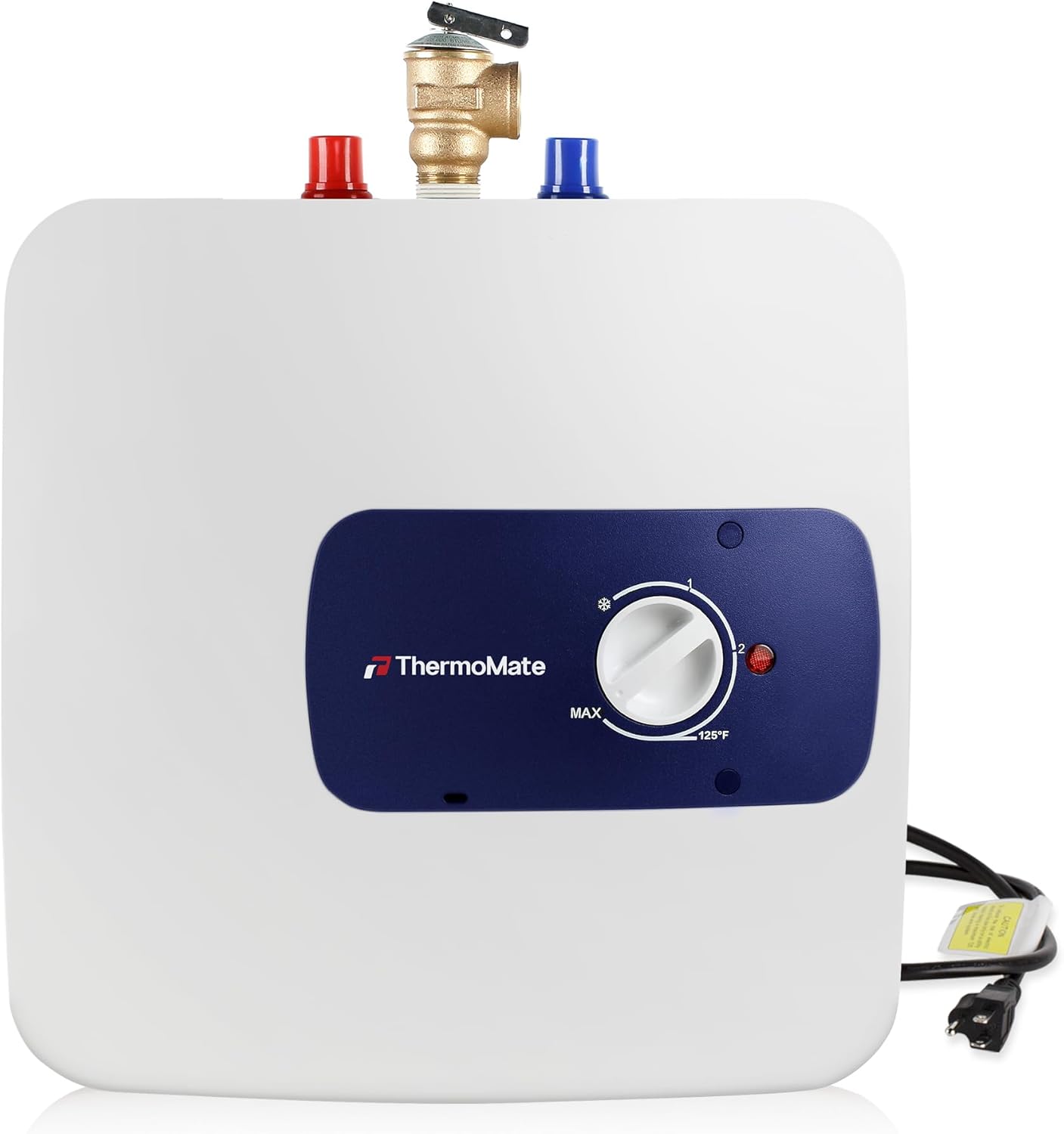
ThermoMate ES800 8-Gallon Water Heater
| Capacity | 8 gallons |
|---|---|
| Wattage | 1440 watts |
| Voltage | 120 volts |
| Maximum Temperature | 140 °F |
| Maximum Pressure | 150 psi |
The ThermoMate ES800 is an 8-gallon point-of-use electric tank water heater designed to supply near-instant hot water to a single faucet or to act as a booster on a short run. It plugs into a standard 120V outlet and uses a 1440W Incoloy 800 heating element to heat water up to about 140°F, with an adjustable thermostat and a 50-149°F range listed for the ES series. The unit installs on the wall or floor and includes a T&P valve and mounting kit, so it is suited for under-sink or compact utility locations. Notable durability features include a glass-lined three-layer tank, a thick anode rod to resist corrosion and scale, and UL-listed safety components. Practical benefits are reduced wait time for hot water, lower standby losses compared with routing long hot-water lines, and easy 120V plug-in installation where a dedicated 240V circuit is not available. Limitations are inherent to mini-tank design: it serves small flows only and is not intended for showers or multiple fixtures at once, and recovery is limited by the 8-gallon capacity and 1440W power. For hard-water areas, the glass lining and sacrificial anode help, but periodic maintenance is still needed to manage scale buildup.
Best for: Buyers who want a simple, compact hot-water booster for a single sink or short run and prioritize easy plug-in installation and durable internal protection for hard-water environments.
Less Ideal for: Homes needing whole-house hot water, shower supply, or multiple simultaneous fixtures should choose a larger tank or a proper tankless unit instead.
- Compact point-of-use design fits under sinks or in small spaces
- Plug-in 120V connection with included mounting hardware simplifies installation
- Incoloy 800 heating element offers improved corrosion resistance and heating efficiency
- Glass-lined tank and thick anode rod provide extra protection against corrosion in hard-water conditions
- UL-listed safety components and included T&P valve for pressure and temperature protection
- Not sized for showers or simultaneous multi-fixture use
- 8-gallon capacity means limited hot-water run time before recovery is required
- Recovery and flow capacity limited by 1440W power at 120V
Verdict: A compact, plug-in 8-gallon mini-tank with corrosion-resistant internals that is ideal as a durable under-sink booster in hard-water locations.
xwdzswgs Tankless Electric Water Heater

| Heat Output | 3000 watts |
|---|---|
| Power Source | ac (110V) |
| Maximum Temperature | 131 °F |
| Special Features | Dry Combustion Protection, LED Display, Lightweight |
This compact tankless unit delivers point-of-use hot water by heating on demand with a 3000W element and an LED temperature display. It is designed for vertical wall mounting under sinks or in small spaces and is best used for faucet, kitchen, or utility-sink needs rather than full showers. Notable features include IPX4 splash resistance, dry-burning and over-temperature protection, and a digital readout that switches between Fahrenheit and Celsius. Installation is straightforward for someone comfortable with basic plumbing and electrical work, using 1/2-inch NPT fittings and recommending a dedicated 32A circuit and 13 AWG wiring. The practical benefits are fast hot water without a storage tank and minimal footprint, which is handy in apartments, RVs, or workshops. Important limitations are the modest flow capacity—manufacturers state it is not suitable for showers—and the 110V/3000W rating means hot rise falls sharply at higher flow rates; professional wiring may be required for safe operation.
Best for: Buyers seeking an inexpensive, space-saving point-of-use heater for sinks, RVs, or small utility areas who prioritize low upfront cost and compact installation.
Less Ideal for: Homes needing whole-house or shower-capable hot water, or buyers who want high-flow continuous hot water for multiple fixtures at once.
- Compact vertical design saves under-sink or small-space real estate
- 3000W element with LED display allows quick temperature monitoring and switching between ℃ and ℉
- Built-in protections include IPX4 splash resistance, dry-burning protection, and over-temperature shutdown
- Simple 1/2-inch NPT connections and included mounting hardware make physical installation straightforward
- Not designed for shower use due to limited flow and heating capacity
- Requires a dedicated high-amperage circuit and specific wire size which may need professional installation
Verdict: A budget-friendly, compact tankless unit that gives fast point-of-use hot water where space and cost are the primary concerns.
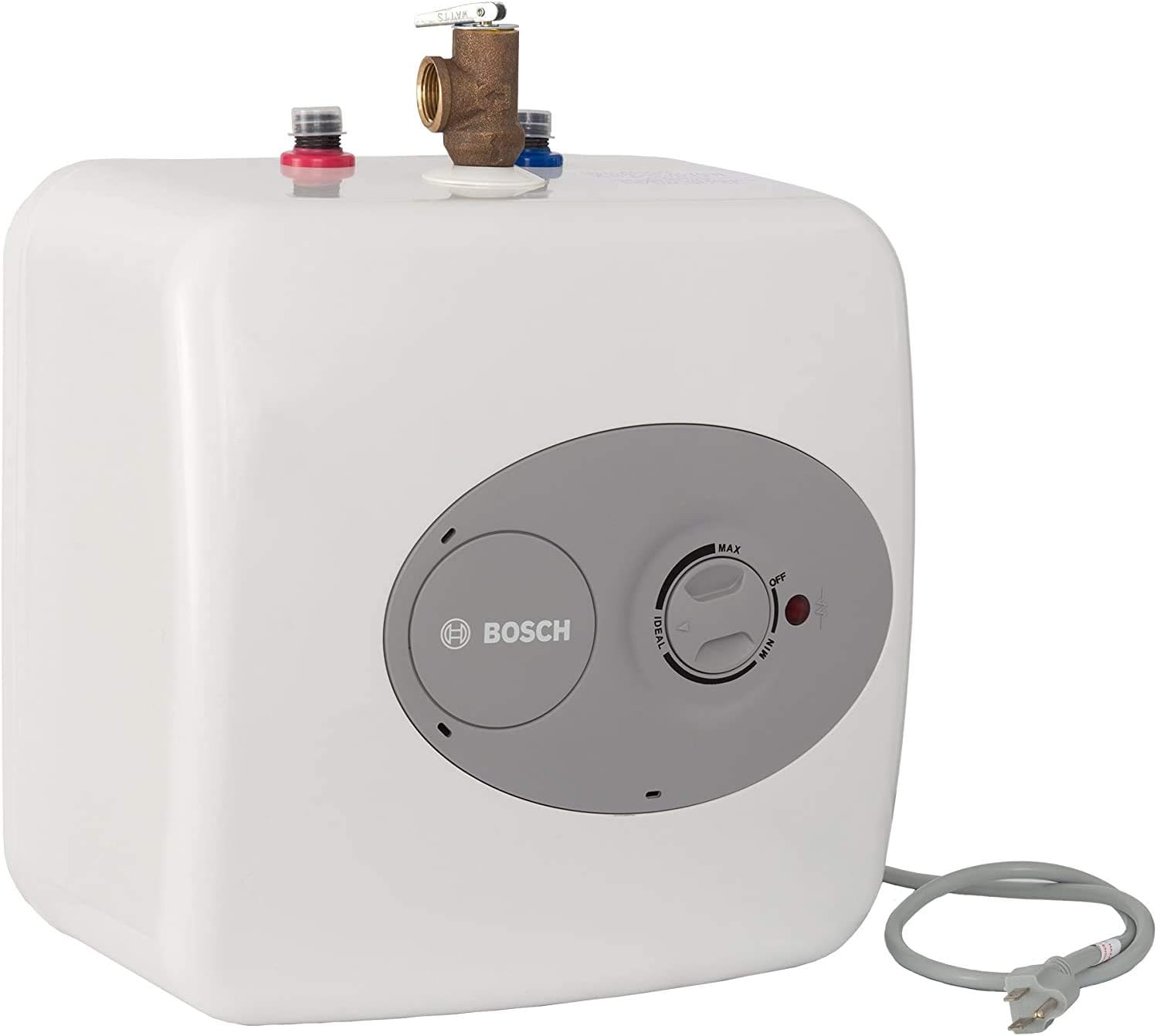
Bosch Tronic 3000 T ES2.5
| Capacity | 2.5 gallons |
|---|---|
| Wattage | 1440 watts |
| Voltage | 120 volts |
| Maximum Temperature | 140 °F |
The Bosch Tronic 3000 T ES2.5 is a compact point-of-use electric mini-tank that delivers near-instant hot water at a sink without running a full-house water heater. It mounts on a shelf, wall, or floor and can be plugged into a standard 120V outlet for independent installation or piped inline with a larger system. The glass-lined 2.5-gallon tank and 1440-watt element provide a fast recovery so two sinks can be served in many typical residential uses, and an external temperature dial plus a temperature-and-pressure relief valve make it easy to set and keep safe. Practical benefits include a small footprint that tucks under vanities, 98% thermal efficiency, and a simple plug-in installation that reduces labour for basic setups. Limitations are the small capacity—useful for point-of-use but not for extended simultaneous demand—and reliance on a 120V circuit which limits recovery speed compared with higher-voltage commercial units.
Best for: Buyers who prioritize a reliable, low-maintenance point-of-use heater to eliminate long waits for hot water at a sink and who want a simple, durable unit that installs with minimal electrical work.
Less Ideal for: Homes needing whole-house hot water, long showers, or frequent heavy simultaneous use should choose a larger or higher-voltage heater instead.
- Compact 2.5-gallon tank fits under sinks or mounts on a wall for point-of-use hot water
- Plugs into a standard 120V outlet for independent installation without special wiring
- Glass-lined tank enhances durability and corrosion resistance in hard water environments
- High reported thermal efficiency (98%) and 1440 W element deliver quick recovery for small demands
- Small capacity not suited for long or multiple simultaneous uses beyond sink-level needs
- 120V power limits maximum recovery rate compared with higher-voltage water heaters
Verdict: A durable, easy-to-install mini-tank that delivers fast, reliable point-of-use hot water where you need it most.
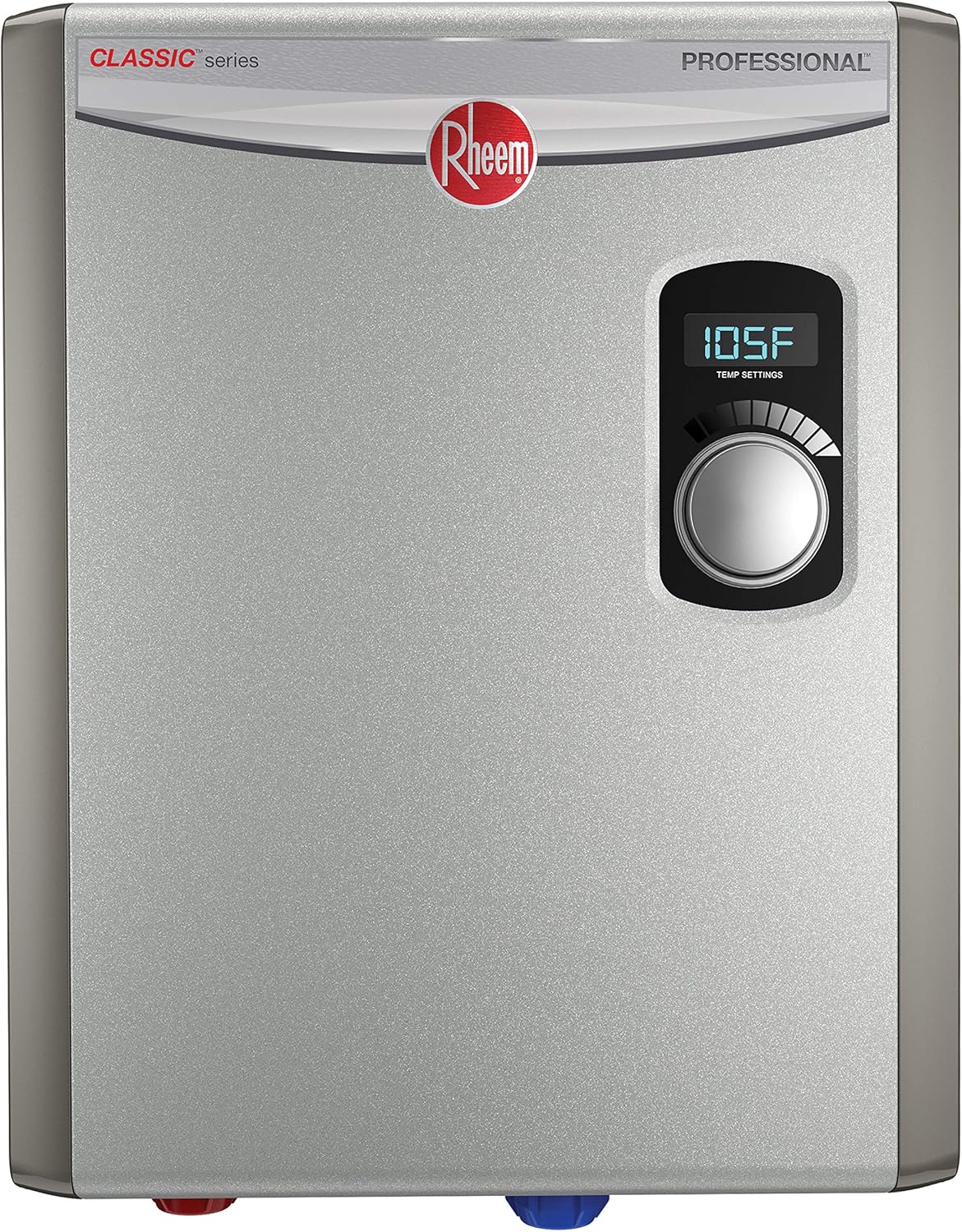
Rheem RTEX-18 Tankless Electric
| Wattage | 18000 watts |
|---|---|
| Voltage | 240 volts |
| Flow Rate | 4.4 gpm |
| Maximum Temperature | 140 °F |
| Efficiency | 99.8% |
The Rheem RTEX-18 is a whole-home tankless electric water heater designed to provide continuous on-demand hot water for mid‑range household use. It uses self-modulating electronics and two copper immersion heating elements to vary power output with flow, which helps maintain a steady outlet temperature while limiting wasted electricity. The front LED digital thermostat makes setpoint changes simple and the unit requires no venting, so it can be mounted on a wall close to plumbing runs. Practical benefits include space savings compared with a traditional tank and potential energy savings from heating only when water flows. The 18 kW rating supports moderate simultaneous demand — Rheem lists up to 4.4 gallons per minute — but performance depends on incoming groundwater temperature so output will be lower in very cold regions. Also the internal copper elements are field serviceable, though mineral-heavy hard water may accelerate scale buildup and require regular maintenance or a water softener to avoid reduced efficiency over time.
Best for: Buyers who prioritize a compact, energy-aware replacement for a conventional tank and want a proven, widely reviewed unit that supplies whole‑home hot water in moderate climates.
Less Ideal for: Homes in very cold regions or large households that regularly run multiple showers and high-flow appliances at once should consider higher-capacity solutions or additional units.
- Continuous on-demand hot water with up to 4.4 GPM flow rate
- Self-modulating power adjusts energy use to actual hot water demand
- Digital LED thermostat for precise temperature control
- Compact wall-mounted design requires no venting and saves space
- 18 kW output may be marginal in very cold inlet water or for multiple high-flow fixtures
- Copper heating elements can scale with hard water and need periodic maintenance
Verdict: Choose the RTEX-18 if you want a compact, energy‑modulating tankless electric that delivers continuous hot water for moderate whole‑home demand.
Rheem RTEX-11 Tankless Electric Water Heater

| Wattage | 11 KW |
|---|---|
| Voltage | 240 volts |
| Flow Rate | 2.68 gpm |
| Maximum Temperature | 140 °F |
| Efficiency | 99.8% |
The Rheem RTEX-11 is a compact, wall-mounted tankless electric unit designed for point-of-use applications like a bathroom or kitchen sink and light shower use. It heats on demand with an 11 kW element and digital thermostatic control that lets you set outlet temperature in 1-degree increments up to 140°F. Installation requires a 240V supply and a 50-amp double-pole breaker, but once wired it provides continuous hot water without venting and with high claimed efficiency. The small footprint saves space and is easy to tuck under a sink or in a closet, and the stainless steel body and LED display make monitoring simple. Practical limits are its 2.68 gpm max flow, so it will struggle with multiple high-flow fixtures running at once, and the electrical requirements mean a professional install is often necessary. For homes with hard water, the unit does not list built-in scale management, so routine maintenance or an external water-softening strategy will help preserve performance over time.
Best for: Buyers who prioritize reliable, compact on-demand hot water for a single sink or a light shower and want a straightforward, factory-quality electric solution with precise temperature control.
Less Ideal for: Households needing whole-house hot water or frequent simultaneous high-flow use should choose a higher-capacity model or a gas tankless alternative.
- Compact wall-mounted design saves space and fits point-of-use locations
- Digital thermostatic control with 1°F adjustments and LED display for precise temperature
- No venting required, simplifying indoor installation
- High efficiency operation that heats water only when needed
- Maximum flow rate of 2.68 gpm limits simultaneous use of multiple full-size fixtures
- Requires 240V, 50A circuit and professional electrical installation
Verdict: A compact, high-efficiency point-of-use electric tankless heater that gives precise on-demand hot water where space and reliability matter.
Choosing the Right Electric Water Heater for Hard Water: Key Factors to Consider
Corrosion Resistance and Tank Lining
A durable internal lining or corrosion-resistant materials slow tank deterioration caused by mineral-laden water. Hard water increases electrochemical activity and can pit or wear away unprotected steel, so choose tanks with ceramic, glass-lined, or advanced polymer coatings.
Beyond the liner material, look for sacrificial anode design and ease of anode replacement. Anodes can significantly extend tank life in hard-water conditions but will require periodic inspection and replacement to remain effective.
Scale Control and Heating Element Design
Scale forms on heating elements and tank walls, insulating heat transfer surfaces and forcing longer run times. Models that use larger-diameter, low-watt-density elements or have exposed-but-serviceable elements allow easier descaling or replacement, limiting long-term efficiency losses.
Some units include internal baffles or features that promote turbulence and reduce localized deposition. Consider how accessible the elements are for routine descaling and whether the element shape or location reduces accumulation compared with compact or hard-to-reach designs.
Tank Shape, Sediment Management, and Drain Access
Sediment from mineral precipitation settles at the tank bottom and accelerates corrosion and element failure. Tanks with conical bottoms, raised element locations, or generous drain valves make flushing easier and more effective.
Check whether the drain outlet is full-diameter and whether the installation allows straightforward periodic flushing. The easier it is to remove sediment, the less impact hard water will have on performance and longevity.
Serviceability and Replacement Parts
Frequent maintenance is common in hard-water areas, so choose units with accessible service panels and widely available replacement parts. Removable element ports and standard fittings reduce repair time and cost.
Also consider local service support and how simply technicians can perform common tasks such as anode replacement, element swap, and thermostat servicing. The less specialized the components, the simpler long-term upkeep will be.
Energy Efficiency and Heat Recovery
Scale reduces heat transfer efficiency, increasing energy consumption. Look for models with efficient insulation and tank designs that minimize standby heat loss so that even as some scaling occurs, operating costs remain reasonable.
Consider rated recovery and first-hour output under realistic conditions. While hard water can degrade performance over time, starting with a more efficient baseline reduces the cumulative energy penalty of scale buildup.
Installation Considerations in Hard-Water Areas
Proper installation reduces future maintenance headaches. Position the drain valve and access panels where they can be reached without removing the unit from its mounting. If the unit will be installed in a utility closet or attic, plan for clearances that allow element and anode replacement and for routine flushing.
Consider adding a sediment trap or pre-filter on the cold-water inlet to catch coarse particulates. Although pre-filters add one more maintenance task, they reduce the rate of accumulation inside the tank and on elements.
- Leave at least the manufacturer-recommended service clearance around the unit.
- Install a full-bore ball valve on the cold inlet to isolate the heater during service.
- If allowed by codes, add a sediment trap upstream of the heater.
Routine Maintenance Best Practices
Regular maintenance greatly extends service life in hard-water environments. Flush the tank according to the hardness level in your water, typically every 6 to 12 months for moderately hard supplies and more often for very hard water.
Inspect and replace sacrificial anode rods when they are more than 50 percent depleted. Check heating elements for heavy scale; if elements are heavily coated, descale or replace them to restore efficiency.
- Schedule an annual visual check of tank fittings and valves.
- Record water hardness and maintenance dates to tailor flushing frequency.
- Keep spare standard elements and anode rods on hand if access is limited.
Options for Reducing Scale Without Changing Plumbing
If whole-house water softening is not an option, there are equipment-level strategies to reduce scale impact. Look for electric water heaters designed with larger heating elements, increased flow patterns, or built-in scale-diffusing features that slow mineral adherence.
Magnetic or electronic descaling attachments are sold separately and can reduce the rate of scale formation in some situations. Performance varies with water chemistry, so treat these as supplemental measures rather than replacements for mechanical maintenance.
- Prefer units with replaceable, low-watt-density elements.
- Use periodic flushing and element inspection as primary defenses against scale.
- Treat auxiliary descalers as supplemental to mechanical maintenance.
Sizing for Performance When Mineral Load Is High
Higher mineral loads can reduce effective heating performance, so avoid undersizing the unit. Choose a capacity and recovery rating that provide sufficient first-hour delivery under peak demand while allowing extra margin for the efficiency losses that occur with scale.
If you have high simultaneous demand, consider a larger tank or a faster-recovery unit to avoid running short when scale has started to affect transfer efficiency.
- Base capacity on peak usage, not just average daily demand.
- Factor in a buffer for reduced efficiency over time.
- Consult local installers about typical mineral impact in your area.
How We Chose the Best Electric Water Heater for Hard Water
We evaluated candidates for their ability to withstand hard-water conditions and deliver dependable hot water over time. Our selection filters prioritized corrosion resistance, scale-control features, serviceability, energy efficiency under mineral-laden conditions, and warranty support specific to tank and heating components. We favored tanks with robust internal coatings or liners, accessible replaceable heating elements, and designs that minimize sediment accumulation at the tank bottom. Excluded from consideration were products that lacked documented corrosion protection for hard water, units that made unverified performance claims, and models without straightforward access to serviceable components. We also deprioritized designs that required niche installation practices likely to complicate maintenance in hard-water areas. The final shortlist balances real-world durability, ease of routine flushing and element replacement, and specifications that reduce scale formation while maintaining efficient heat transfer.
Our full evaluation process is outlined in our review methodology.
FAQ
How often should I flush an electric water heater in hard-water conditions?
It depends on hardness. For moderately hard water flush at least every 6 to 12 months. For very hard water, flush every 3 to 6 months. Increase frequency if you notice reduced hot flow or unusual noises.
Can I prevent scaling without installing a water softener?
You can reduce scaling with regular flushing, accessible low-watt-density elements, and pre-filter devices. Electronic or magnetic descalers may slow buildup for some water chemistries but are not a guaranteed replacement for mechanical maintenance.
Are certain heating elements better for hard water?
Yes. Larger-diameter, low-watt-density elements heat more slowly and are less prone to rapid scale buildup. Exposed and serviceable elements are also preferable because they can be descaled or replaced easily.
What maintenance parts should I keep on hand?
Keep a replacement anode rod, spare heating elements that match your unit, and a ball-valve isolation fitting. Having these on hand reduces downtime and simplifies routine service visits.
Will hard water void the heater warranty?
Warranties vary. Many manufacturers require proper maintenance such as periodic flushing and anode replacement. Failure to perform recommended maintenance could affect warranty coverage, so follow the service schedule outlined by the manufacturer.
Final Verdict
Pick a unit that emphasizes corrosion protection, easy element access, and straightforward sediment removal. Prioritize tanks with robust linings and replaceable anodes, and choose element designs that are easy to descale or swap out. Plan for a realistic maintenance schedule and size the heater with extra recovery capacity to offset efficiency loss from scale. With the right features and a modest maintenance routine, you can keep an electric water heater performing well even with hard water. Focus on serviceability and scale-management features to make ownership predictable and affordable over the long term.