
Note: This article contains affiliate links. If you click on these links and make a purchase, we may earn a small commission at no extra cost to you. This helps support our research and content. Read our full affiliate disclosure here.
If you run hydronic radiant floor heating, pairing that system with the right electric water heater makes a big difference in comfort and efficiency. The best electric water heaters for radiant floor heat provide stable output temperatures, dependable recovery when demand changes, and controls that integrate with mixing valves and pumps. This guide shortlists seven top-rated electric water heaters suited to supplying a radiant floor loop and explains the practical tradeoffs you should expect. Below you will find our top picks for different home sizes and use patterns, plus the technical criteria we used to evaluate them and key factors to weigh when choosing a unit for a radiant floor system.
Top Picks at a Glance
| Best Overall The best all-around choice for most situations | GE 18 Gallon Electric Water Heater |  |
| Best Quality Built to a higher standard if you want something more solid | Bosch Tronic 3000 T ES4 |  |
| Best Value The sweet spot between price and what you get | CAMPLUX ME60 6-Gallon Electric Heater |  |
| Best Budget The cheapest option that still gets the job done reliably | xwdzswgs 3000W Tankless Water Heater |  |
| Top Rated A top-rated pick with lots of positive feedback | Rheem RTEX-18 Tankless Electric Water Heater |  |
| Most Popular A crowd favorite that many people choose with confidence | Bosch Tronic 3000 T ES2.5 Mini-Tank |  |
| Best Seller A high-volume bestseller chosen again and again | Rheem RTEX-04T 3.5 kW Tankless Electric |  |
GE 18 Gallon Electric Water Heater

| Power Source | Electric |
|---|---|
| Wattage | 14400 watts |
| Voltage | 120 volts |
| Heat Output | 140 °F |
| Capacity | 45 liters |
This GE 18-gallon electric storage water heater is a compact point-of-use unit that can also act as a booster inline with another heater for longer plumbing runs or appliances like washing machines. It installs using standard 3/4-in NPT water connections and connects to any 120-volt supply, so placement is flexible in tight spaces such as bathrooms, laundry rooms, cabins, or garages. The unit has an adjustable thermostat for simple temperature control and stainless steel heating elements plus an anode rod to resist corrosion and extend service life. Practical benefits include easy installation, space savings where a full-size tank is impractical, and the ability to provide hotter water close to the fixture to reduce wait times and heat loss. Limitations to consider are the relatively small 18-gallon capacity, which limits continuous hot-water demand, and the 120-volt supply that will heat more slowly than higher-voltage models, so it is best suited for low-to-moderate flow systems or as a supplemental booster rather than a primary heater for large households.
Best for: Buyers who want a compact, easy-to-install electric tank to supply a single fixture or to boost hot water for a small home or specific run, prioritizing space savings and simple operation.
Less Ideal for: Homes with high simultaneous hot-water demand or systems that require fast recovery should choose a larger-capacity or higher-voltage primary water heater instead.
- Compact point-of-use design fits in tight spaces and allows on-location hot water delivery
- Standard 3/4-in NPT water connections and 120-volt power make installation straightforward
- Adjustable thermostat for easy temperature control at the unit
- Stainless steel heating element and anode rod improve corrosion resistance and longevity
- 18-gallon capacity limits run time for multiple simultaneous fixtures
- 120-volt operation provides slower recovery and lower output than 240-volt models
Verdict: Choose this compact GE unit when you need a simple, space-saving electric tank to provide point-of-use hot water or to boost an existing system for radiant floor or short-run applications.
Bosch Tronic 3000 T ES4
| Capacity | 4 gallons |
|---|---|
| Wattage | 1440 watts |
| Voltage | 120 volts |
| Temperature Range | 65-145°F |
| Water Pressure Range | 150 psi |
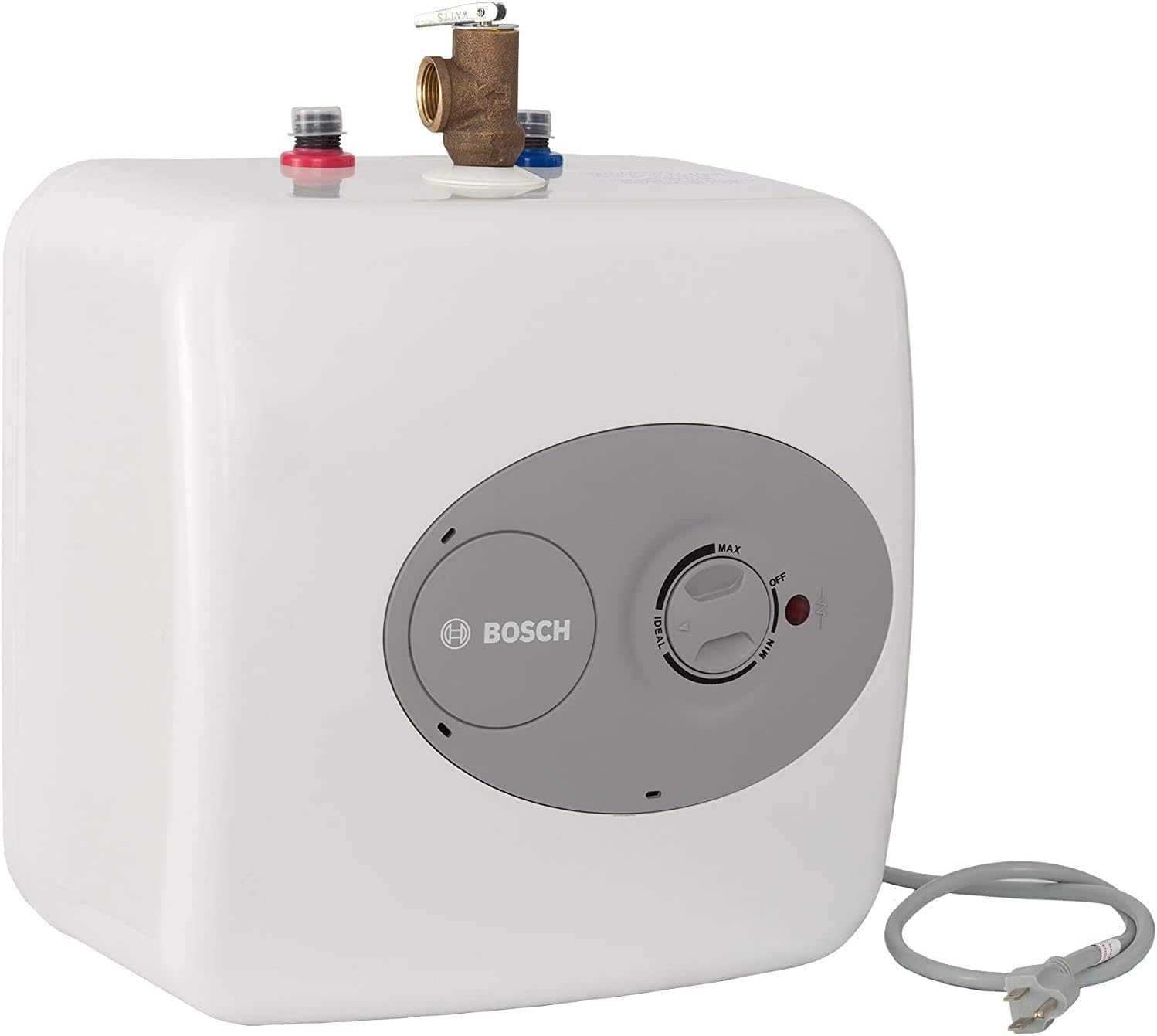
The Bosch Tronic 3000 T ES4 is a compact 4-gallon electric mini-tank that provides near-instant hot water where you install it, typically under a sink or on a wall bracket. It plugs into a standard 120 V outlet and uses a 1440 W element to heat water quickly, with a fast recovery rate that reduces wait time at fixtures located far from a primary heater. The glass-lined tank and thick CFC-free foam insulation help maintain temperature and resist corrosion, while an external dial lets you adjust outlet temperature and a temperature-and-pressure relief valve is included for safety. Mounting options are flexible—shelf, wall, or floor—so installation can be tailored to tight spaces. Because it is a small point-of-use unit, it is best used to supply one or two nearby fixtures rather than whole-house demands, and annual inspection of the sacrificial anode is recommended to avoid premature tank failure. For applications like supplemental heat delivery to a dedicated loop or a localized radiant manifold feed, the ES4 gives quick, reliable hot water without large plumbing changes.
Best for: Buyers who need a high-performance point-of-use heat source to eliminate long waits for hot water at a single fixture or to supply a small supplemental loop for localized radiant delivery.
Less Ideal for: Homes that require whole-house hot water or larger radiant manifolds should choose a larger tank or dedicated boiler instead of this mini-tank.
- Compact 4-gallon tank fits under sinks or on a wall bracket for point-of-use installation.
- Plug-in 120 V design (1440 W) enables independent installation without hardwiring.
- Glass-lined tank and thick foam insulation improve durability and reduce standby heat loss.
- External temperature dial and included T&P relief valve simplify control and safety.
- Small capacity limits use to one or two fixtures and is not suitable as a primary whole-house heater.
- Requires periodic anode rod inspection and replacement to prevent tank corrosion.
Verdict: A compact, fast-recovering point-of-use electric mini-tank that delivers reliable hot water at a specific fixture or small supplemental radiant loop.
CAMPLUX ME60 6-Gallon Electric Heater

| Capacity | 6 gallons |
|---|---|
| Wattage | 1440 watts |
| Voltage | 120 volts |
| Maximum Temperature | 140 °F |
| Maximum Pressure | 150 psi |
The CAMPLUX ME60 is a compact 6-gallon point-of-use electric mini-tank that provides near-instant hot water where installed. It is intended for wall or floor mounting under a sink or counter and plugs into a standard 120V outlet, making installation simple for retrofits or supplemental hot-water needs. The unit uses a glass-lined, foam-insulated tank and a 1440W heating element to reach temperatures up to 140°F with three thermostat settings, and it includes a temperature and pressure relief valve and basic safety protections such as overheat and high-pressure safeguards. Practical benefits include lower standby heat loss from the insulated small tank, easy placement close to the fixture to reduce wait time, and a plug-in electrical connection that avoids hardwiring in many installations. Limitations to note are the small 6-gallon capacity, which is best for single fixtures or low-flow radiant loops rather than whole-house demand, and the modest 1440W output that limits recovery rate compared with larger or hardwired units. Buyers should also plan mounting clearance and use the 3/4" NPT fittings when tying into plumbing.
Best for: Buyers who want a simple, energy-conscious way to add hot water at a single fixture or to supplement a small radiant floor loop with close, low-loss storage.
Less Ideal for: Homes needing high continuous flow or whole-house hot water delivery, or installers who require a high-output hardwired unit for larger radiant systems.
- Compact point-of-use design reduces wait time for hot water at a nearby fixture
- Plug-in 120V connection simplifies installation without mandatory hardwiring
- Insulated, glass-lined tank lowers standby heat loss compared with uninsulated tanks
- Includes T&P relief valve and built-in safety protections (overheat, high-pressure)
- 6-gallon capacity and 1440W output limit use to single fixtures or very small radiant loops
- Not suitable as a primary whole-house heater or for showers
Verdict: A compact, easy-to-install 6-gallon mini-tank that provides localized hot water with low standby loss, ideal for supplementing small radiant loops or single fixtures.
xwdzswgs 3000W Tankless Water Heater

| Wattage | 3000 watts |
|---|---|
| Voltage | 110 volts |
| Flow Rate | 0.5 gpm |
| Maximum Temperature | 131 °F |
| Mount Type | Wall |
This compact 3000W 110V tankless unit is a point-of-use under-sink heater designed to produce hot water almost instantly for small fixtures. It mounts vertically on the wall and uses a G1/2-inch inlet so it fits standard plumbing for sinks and similar low-flow outlets. The LED display shows set temperature and can toggle between Celsius and Fahrenheit, and built-in protections cover dry-burning, leakage, over-temperature shutoff, and basic waterproofing. In practice the heater works best at low flow rates and raises temperature quickly for single fixtures, but its rated flow is only 0.5 gpm so it cannot support whole-house or high-demand applications. Installation is straightforward for someone comfortable with electrical wiring and requires a 32A trip switch and heavier gauge wiring as recommended. The lightweight ABS housing and small footprint save space under a sink or in an RV, and the unit comes with basic mounting screws and a manual, but buyers should note the strict vertical-install requirement and limited flow when planning use.
Best for: Buyers on a tight budget who need a compact point-of-use heater for a single sink, RV, or small wash station and prioritize low cost and space savings over flow capacity.
Less Ideal for: Homes seeking a primary source for radiant floor heating or to supply multiple fixtures should choose a higher-capacity, continuous-flow unit designed for whole-house or hydronic systems.
- Instant on-demand heating for a single fixture with quick temperature rise
- Digital LED display with Celsius/Fahrenheit toggle
- Multiple safety features including dry-burn protection and automatic shutoff
- Compact, wall-mounted design saves space and is suitable for tight installations
- Includes standard 1/2-inch plumbing interface and mounting hardware
- Very low maximum flow rate (0.5 gpm) unsuitable for multiple fixtures
- Requires vertical installation and heavier gauge wiring plus a 32A trip switch
- 110V 3000W output limits usable temperature rise under higher flows
Verdict: A very affordable compact point-of-use tankless heater for single fixtures when budget and space are the top priorities.
Rheem RTEX-18 Tankless Electric Water Heater
| Wattage | 18000 watts |
|---|---|
| Voltage | 240 volts |
| Flow Rate | 4.4 gpm |
| Maximum Temperature | 140 °F |
| Mount Type | Wall |
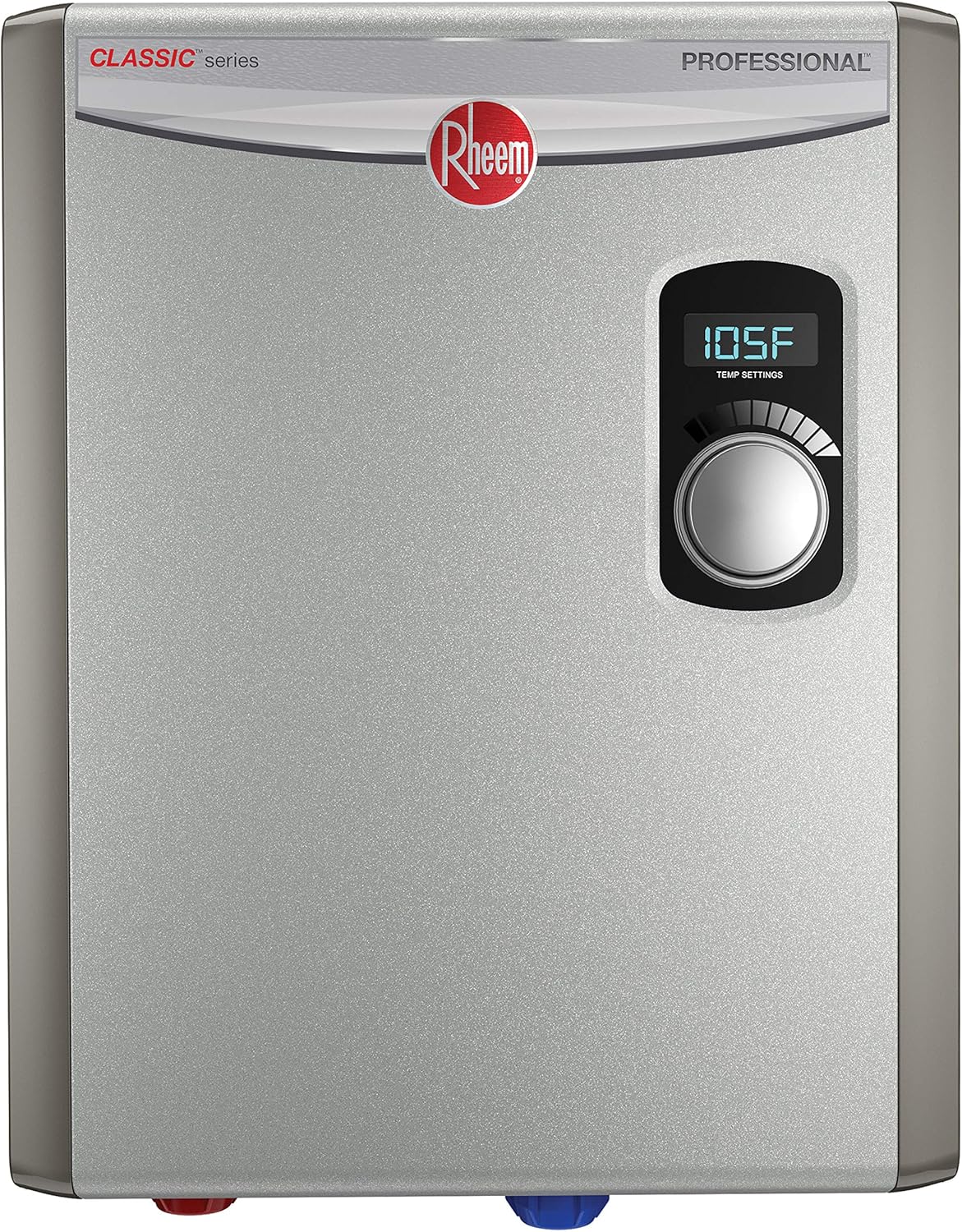
The Rheem RTEX-18 is a compact tankless electric unit designed to provide continuous hot water for mid‑range whole‑home applications and single shower setups. It uses two field‑serviceable copper heating elements and self‑modulating electronics that adjust power to match demand, which helps stabilize outlet temperature and reduce energy use when flow changes. The front LED thermostatic control gives precise setpoint adjustment and the unit supports up to about 4.4 GPM, making it capable of feeding a radiant floor loop for smaller systems or serving a single shower plus a sink in moderate climate regions. Installation is straightforward for an electrician or plumber familiar with high‑amp 240V connections and 3/4 inch NPT water fittings, and no venting is required. Limitations include the 18 kW ceiling, which restricts flow and temperature rise in cold climates or on larger radiant zones, so it is best where inlet water is not extremely cold or where multiple high‑flow fixtures are not used simultaneously. For reliability‑minded buyers, the RTEX-18's solid components and simple, serviceable design make it a dependable choice when sized appropriately.
Best for: Buyers who prioritize a straightforward, serviceable tankless unit for reliable on‑demand hot water in small radiant floor zones or single‑shower installations and who want precise temperature control.
Less Ideal for: Homes with large radiant floor systems, very cold groundwater, or multiple simultaneous high‑flow demands should consider higher‑kW units or dedicated boiler solutions instead.
- Self‑modulating control adjusts power to match hot water demand for steadier temperatures
- Digital LED thermostatic control with +/-1° accuracy for precise setpoint control
- Compact wall‑mount design needs no venting and saves space near a manifold or fixture
- Field‑serviceable copper heating elements simplify repairs and extend usable life
- 18 kW maximum limits flow and temperature rise for large radiant loops or cold inlet water
- Requires substantial 240V electrical circuit and appropriate breakers for safe operation
Verdict: A dependable, serviceable 18 kW tankless that gives precise, on‑demand hot water for small radiant floor zones when sized to the system's flow and inlet temperature.
Bosch Tronic 3000 T ES2.5 Mini-Tank
| Capacity | 2.5 gallons |
|---|---|
| Wattage | 1440 watts |
| Voltage | 120 volts |
| Maximum Temperature | 140 °F |
| Efficiency | 98% |
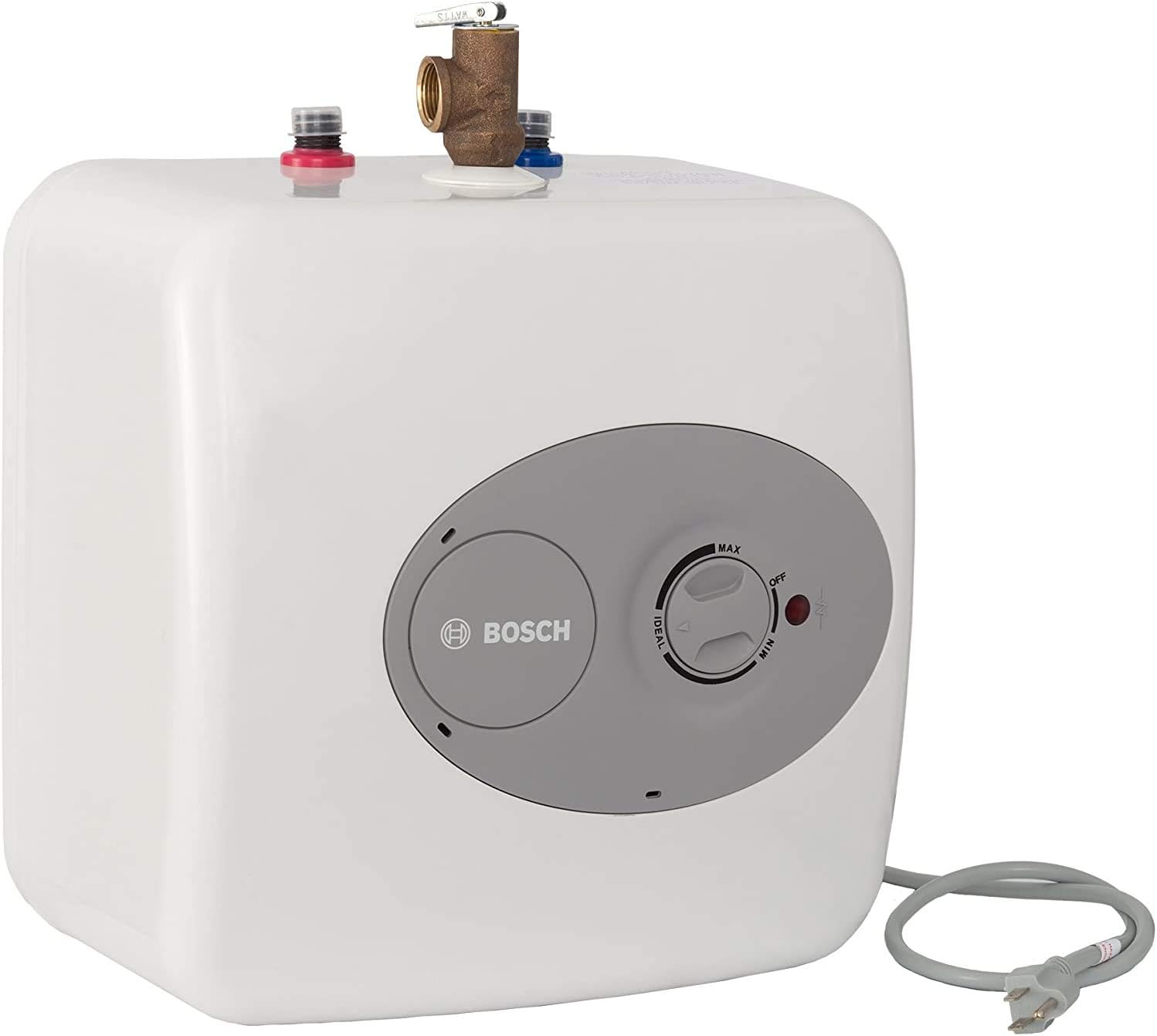
The Bosch Tronic 3000 T ES2.5 is a compact, plug-in electric mini-tank intended to deliver near-instant hot water at a single fixture or to supplement a larger system. It installs under a sink, on a shelf, or wall-mounted and can be plugged into a standard 120V outlet for independent operation or piped inline for on-demand use. With a 2.5 gallon glass-lined tank and a 1440-watt element, it heats quickly and its 98% thermal efficiency reduces standby losses. An external temperature dial and a temperature-and-pressure relief valve make it straightforward to set and keep safe, and the included bracket and cord simplify basic installation. Limitations include its small capacity, which is intended for point-of-use rather than whole-house supply, and the 120V/12.5A power means it will warm water more slowly than higher-voltage units; plan for demand sizing if you hope to serve multiple fixtures or radiant floor loops. For buyers wanting compact, reliable local hot water, this model is a practical, low-complexity choice.
Best for: Buyers who want a proven, compact point-of-use heater to eliminate wait time for hot water at a sink or to back up a larger system and who prioritize straightforward installation and reliable performance supported by many user reviews.
Less Ideal for: Do not choose this unit if you need sustained high flow for multiple fixtures, a dedicated radiant floor loop requiring larger volumes, or if you require faster recovery from a higher-voltage supply.
- Compact 2.5-gallon point-of-use tank fits under sinks or mounts on wall or shelf
- Glass-lined tank for durability and reduced corrosion risk
- Plugs into a standard 120V outlet for independent installation without special wiring
- External temperature dial and T&P relief valve provide simple control and basic safety
- High thermal efficiency (98%) reduces standby heat loss
- Small capacity only suitable for one or two nearby fixtures rather than whole-house demand
- Lower power (1440 W at 120V) means slower recovery compared with higher-voltage heaters
Verdict: A compact, reliable point-of-use electric mini-tank that delivers quick hot water at a single fixture with easy 120V installation.
Rheem RTEX-04T 3.5 kW Tankless Electric

| Wattage | 3500 watts |
|---|---|
| Voltage | 120 volts |
| Flow Rate | 0.9 gpm |
| Maximum Temperature | 140 °F |
| Capacity | 0.9 gallons |
The Rheem RTEX-04T is a compact 3.5 kW, 120V point-of-use tankless electric heater designed to supply on-demand hot water to a single sink or low-flow fixture. It mounts to the wall and uses digital thermostatic controls to set outlet temperature precisely between 80 and 140°F, which helps avoid scalding and keeps output consistent for small loads. Because it heats water only when a tap is open, it reduces standby energy loss compared with tank heaters and saves space under a sink or in a closet. Installation requires a 30-amp single-pole breaker and #10 AWG copper wiring, so expect to verify your electrical panel capacity before fitting it to a radiant floor loop or dedicated fixture. Its 0.9 gpm flow rating and 0.9 gallon capacity make it unsuitable for whole-house or high-flow radiant systems, but it is well suited as a localized source for small runs or when you need fast hot water at the point of use. The unit requires no venting and is stainless steel for indoor installations, though its limited flow and power mean it is best used only for small, low-demand applications.
Best for: A cautious buyer who wants a small, easy-to-place on-demand heater to supply a single sink or short radiant run and values stable, adjustable outlet temperature and simple indoor installation.
Less Ideal for: Not a good choice for heating larger radiant floor loops or multiple fixtures at once; those projects need higher-capacity or whole-home electric units.
- Compact point-of-use size saves space and allows under-sink or near-fixture installation.
- Digital thermostatic control with 1°F increments for accurate temperature setting.
- No venting required simplifying indoor installation.
- Heats water on demand which reduces standby energy loss compared with tank heaters.
- Low maximum flow rate (0.9 gpm) limits use to a single sink or very low-flow applications.
- Requires a dedicated 30A circuit and proper household electrical capacity for installation.
Verdict: Choose the RTEX-04T when you need a reliable, space-saving point-of-use electric heater with precise thermostatic control for a single low-flow application.
Choosing the Right Electric Water Heater for Radiant Floor Heat: Key Factors to Consider
Heating Capacity and Recovery Rate
Radiant floor heating depends on a water heater's ability to supply the required flow temperature and volume over time. Heating capacity indicates the maximum steady output the unit can sustain, while recovery rate tells you how quickly it can return to set temperature after the system draws heat. For homes with large floor areas or multiple heating zones, a higher continuous output and faster recovery mean more consistent floor temperatures and less cycling.
When sizing a unit, match the heater's kW or BTU output to the calculated heat loss of the conditioned area and the flow rate required by the manifold. Undersized heaters can cause slow warm-up and uneven floor temperatures, while oversized units may increase electrical infrastructure needs without offering proportional comfort benefits.
Temperature Control and Integration
Precise temperature control is critical for radiant floors to avoid overheating the floor surface or creating cold spots. Look for units that allow accurate setpoint adjustment and that support external sensors, remote thermostats, or control interfaces used by dedicated radiant controllers and mixing valves. Units with multiple element control stages or modulating outputs provide finer control when demand varies across zones.
Integration with mixing valves and pump relays ensures you can limit supply temperature to safe levels for flooring materials and tune system response during weather swings. Consider controls that allow differential settings or timed circulation to match daily heating patterns.
Electrical Requirements and Installation Flexibility
Electric water heaters for radiant systems can demand significant electrical service depending on their kW rating. Verify site electrical capacity, breaker sizing, and whether a single- or three-phase connection is required. Installation flexibility also covers physical footprint, inlet/outlet locations, and whether the unit supports external pump connections and sensor ports.
Units with modular or remote-mounted controllers simplify installation in tight mechanical rooms. Also consider whether the heater's mounting options and clearances work with your existing manifold and piping arrangement to minimize labor and additional hardware.
Durability, Serviceability, and Warranty
Radiant systems typically operate for long periods, so heater longevity and ease of service are important. Inspect construction materials, element accessibility, anode design where applicable, and whether common components are replaceable without major disassembly. A robust warranty and clear service documentation reduce long-term ownership risk.
Serviceability also includes how straightforward it is to flush the unit, replace heating elements, and access electrical connections. Easier maintenance reduces downtime and the cost of repairs over the system's life.
Energy Efficiency and Standby Losses
Although electric heaters do not have combustion efficiency ratings, they vary in standby heat loss and control sophistication. Lower standby losses help when the system maintains a baseline temperature through the day. Features such as enhanced insulation, programmable schedules, or staged element control can reduce energy consumption while preserving comfort.
Consider how often the radiant system needs reheating based on your climate and occupancy patterns. In milder climates or intermittently used spaces, minimizing standby losses can materially lower operating cost. For continuous heating situations, efficient modulation and responsive controls often matter more than marginal insulation improvements.
Sizing a Heater for Your Radiant Floor System
Accurate sizing starts with a heat-loss calculation for the area served by the radiant loops. That calculation produces a required steady-state heat load, typically expressed in BTU per hour or kilowatts. Once you know the load, choose a heater with continuous output comfortably above that number so it can maintain temperature during cold snaps and recover when multiple zones call for heat.
Also account for flow requirements. Radiant manifolds require a specific flow rate at a given temperature differential. Ensure the heater can supply the needed mass flow without dropping below target supply temperature when several loops operate at once.
- Match continuous kW/BTU output to calculated heat loss
- Allow margin for recovery and simultaneous zone use
- Verify pump and manifold flow compatibility with heater output
Controls, Mixing Valves, and Safety Settings
A mixing valve is essential to limit supply temperature to levels safe for flooring. Choose a heater whose control scheme works with an external mixing valve and supports a separate sensor for downstream temperature feedback. This setup helps maintain consistent surface temperatures and prevents scalding if the system shares domestic hot water circuits.
Look for built-in high-limit protection, adjustable differentials, and the ability to interface with typical radiant thermostats and pump controls. Those features let you fine-tune comfort across zones and reduce unnecessary cycling.
- Use a mixing valve to set safe maximum supply temperatures
- Prefer heaters that accept external sensor inputs and pump relays
- High-limit cutouts and adjustable differentials improve safety
Installation Tips for Mechanical Rooms
Plan the mechanical layout so the heater, pump, and manifold are close to minimize heat loss in piping runs. Insulate piping on both the supply and return side and include air separation and drain points for maintenance. Ensure electrical disconnects and junction boxes are accessible and sized for the heater's expected load.
When possible, position the heater to allow element or component access without removing adjacent equipment. Label circuits and valves during installation to speed future service and troubleshooting.
- Minimize piping runs between heater and manifold
- Provide accessible electrical disconnects sized to unit load
- Include service access for element replacement and flushing
Maintenance Practices to Preserve Performance
Regular maintenance keeps a heater operating reliably for radiant applications. Periodically inspect and flush the heater and system loop to remove sediment. Check electrical connections for tightness and signs of overheating and test safety switches and high-limit devices as recommended.
Schedule inspections of the mixing valve and manifold to confirm setpoints and flow balance remain correct. Keeping the mechanical room clean and dry also extends component life and reduces failure risk.
- Flush tank or loop annually depending on water quality
- Inspect electrical terminals and safety devices regularly
- Verify mixing valve calibration and manifold balancing
When to Consider Multiple Heaters or Buffer Tanks
Large or multi-zone radiant systems sometimes benefit from parallel heaters or a buffer tank to smooth cycling and match peak demand. A buffer tank increases effective thermal storage and reduces short cycling, which is especially useful when pumps and zones are frequently cycling on and off.
Multiple smaller heaters can provide redundancy and staged control, but they increase wiring and control complexity. Evaluate whether adding storage or staging aligns with your electrical capacity and mechanical space constraints.
- Buffer tanks reduce cycling and provide thermal inertia
- Parallel heaters offer redundancy and staged output
- Consider electrical and spatial tradeoffs before adding units
How We Chose the Best Electric Water Heater for Radiant Floor Heat
We focused on features and specifications that matter specifically to hydronic radiant floor systems rather than general domestic hot water use. Our evaluation prioritized recovery rate and heating capacity because radiant loops require steady BTU or kW output to maintain even floor temperatures. We looked for precise temperature control and compatibility with external thermostats, mixing valves, and circulation pumps so installers can maintain safe manifold temperatures. Durability and component quality were considered through construction factors such as tank materials, element accessibility, and warranty structure. Installation flexibility was another filter, including footprint, electrical service requirements, and available connection points for pumps and sensors. We also considered energy efficiency and standby losses, since continuous or frequent heating cycles are common with radiant systems. Units were excluded if they lacked adequate continuous output for typical radiant floor loads, did not offer reliable temperature control options, or were limited by unusually restrictive electrical or plumbing connections. The resulting picks reflect real-world serviceability, steady thermal performance, and installer-friendly features relevant to radiant floor heat.
Our full evaluation process is outlined in our review methodology.
FAQ
Can an electric water heater maintain even floor temperatures for large homes?
Often it can, provided the heater is sized correctly for the total heat loss and has sufficient recovery rate. For very large homes, designers may specify multiple heaters or a buffer tank to avoid short cycling and to ensure consistent supply temperatures during peak demand.
Do I need a mixing valve with an electric heater for radiant floors?
Usually yes. A mixing valve limits supply temperature to levels safe for flooring and occupants, and it helps the system maintain consistent surface temperatures. Pairing a mixing valve with external sensors and appropriate controls improves comfort and safety.
How important is electrical service capacity when choosing a unit?
Electrical capacity is critical because these heaters can draw high continuous current. Verify your panel and service can handle the heater's kW rating and determine whether single- or three-phase power is required. Upgrading electrical service can be a significant part of total installation cost.
What maintenance keeps an electric heater reliable in a radiant system?
Regular flushing to remove sediment, periodic inspection of electrical connections, testing high-limit controls, and checking mixing valve calibration all help maintain performance. Frequency depends on water quality and system usage patterns.
Is a tankless electric heater a good choice for radiant floor heat?
It depends on the system load. Tankless units can provide continuous heat but must be sized for peak simultaneous flow and temperature rise. For systems with large manifolds or high simultaneous demand, a tank-style heater or buffer tank can be more forgiving.
Final Verdict
Choosing the right electric water heater for a radiant floor system comes down to matching continuous output and recovery rate to the heat loss and flow requirements of your loops. Prioritize accurate temperature control and integration with mixing valves and pump controls to protect floor materials and keep surface temperatures comfortable. Also weigh installation constraints such as electrical capacity and service access, and consider buffer tanks or staged units for large or variable-load systems. Decide based on the system size, expected demand patterns, and how much control and redundancy you need. That approach will help you pick a heater that delivers reliable, even warmth from your radiant floors for years to come.