
Note: This article contains affiliate links. If you click on these links and make a purchase, we may earn a small commission at no extra cost to you. This helps support our research and content. Read our full affiliate disclosure here.
Choosing an energy efficient air conditioner matters because cooling is one of the largest contributors to home energy use. A more efficient unit can deliver the same comfort while using less electricity, reducing monthly bills and cutting household carbon footprint. You also get quieter operation, more consistent temperatures, and fewer temperature spikes when a system cycles less often. This guide shortlists five top energy efficient air conditioners and explains the attributes that matter most when comparing them. We evaluate units for real-world cooling performance, seasonal energy consumption, noise, and installation practicality to help you pick the best fit for your space. Read on for a concise breakdown before the product list.
Top Picks at a Glance
| Best Quality Built to a higher standard if you want something more solid | Senville LETO Mini Split 12000 BTU |  |
| Best Value The sweet spot between price and what you get | Midea U-Shaped Window AC 6,000 BTU |  |
| Best Budget The cheapest option that still gets the job done reliably | Windmill 5000 BTU Lite |  |
| Top Rated A top-rated pick with lots of positive feedback | Hisense 12,000 BTU Window AC |  |
| Most Popular A crowd favorite that many people choose with confidence | Midea EasyCool 5,000 BTU Window AC |  |
Senville LETO Mini Split 12000 BTU

| Cooling Power | 12000 british thermal units |
|---|---|
| Capacity | 1 tons |
| SEER | 20.8 |
| Voltage | 110 volts |
| Noise | 28 db |
The Senville LETO 12000 BTU mini split is a ductless inverter heat pump designed to cool, heat, dehumidify, and circulate air in a single-room or open-plan space. It pairs an indoor wall-mounted handler with an outdoor condenser and includes a remote, a 16 ft precharged line set, and app/voice control for Alexa so you can schedule or change setpoints remotely. The DC inverter delivers variable-speed compressor operation for quieter run times and better part-load efficiency, reflected in a high SEER of 20.8 and modest annual energy consumption. Practical benefits include quiet operation around 28 dB, multi-mode operation (cool, heat to about 5 F, fan, dehumidify), and factory precharging for typical short-line installs. Expect professional installation and electrical work, and note the unit is sized for roughly 700 sq ft so it is not meant for whole-house use; indoor weight and outdoor placement need planning. The LETO line comes with multi-year coverage on parts and the compressor, which is helpful for long-term ownership.
Best for: Buyers who prioritize energy-efficient operation and quiet, precise temperature control for a single room or open living area and want smart controls for remote scheduling and automation.
Less Ideal for: People looking to cool multiple rooms without installing separate units or those wanting a plug-and-play portable solution should consider other options.
- High seasonal efficiency (SEER 20.8) for lower operating costs
- DC inverter and variable-speed compressor for quieter, steadier temperature control
- Works with Alexa and app for remote control and scheduling
- Precharged 16 ft line set and included installation kit simplify installation logistics
- Requires professional installation and a compatible electrical circuit
- Rated for a single-zone area around 700 sq ft, not suitable for whole-house cooling
- Refrigerant type R-454B may limit DIY servicing options in some regions
Verdict: Choose the Senville LETO 12000 BTU when you want a quiet, high-SEER single-zone mini split with smart controls to minimize energy use and maintain steady comfort.
Midea U-Shaped Window AC 6,000 BTU

| Cooling Power | 6000 BTU |
|---|---|
| Floor Area | 250 square_feet |
| Noise | 32 db |
| Refrigerant | R-32 |
| Controls | App, Remote, Touch, Voice |
The Midea U-Shaped 6,000 BTU window air conditioner uses a U-shaped casing and inverter compressor to deliver efficient cooling for bedrooms and small living spaces. Its design lets the window remain partly open for airflow and a clearer view, while the included bracket and sidearms simplify installation in single- or double-hung windows. The inverter motor and R‑32 refrigerant yield a reported CEER/SEER-class efficiency and lower annual energy use compared with conventional window units, and the unit operates quietly at about 32 dB for nighttime comfort. Smart controls include app, voice, remote, and touch options so you can schedule or change settings remotely, and the unit supports Alexa and Google Assistant. Practical limitations are its 6,000 BTU capacity, which is intended for rooms up to roughly 250 square feet, and the weight and dimensions that require a sturdy window and helper for installation. For buyers focused on energy savings and low-noise operation in small spaces, this model balances usability and efficiency well.
Best for: Buyers who prioritize lower energy use and quiet performance in a small bedroom or living room and want smart controls for remote scheduling and voice operation.
Less Ideal for: Large rooms, open-plan areas, or users who need heating capability or much higher cooling capacity should consider larger or different unit types.
- U-shaped design allows partial open-window installation and improved view.
- Inverter compressor with R-32 refrigerant for higher energy efficiency and lower annual consumption.
- Very low operating noise around 32 dB, suitable for bedrooms.
- Multiple control options including app, voice, remote, and touch for flexible scheduling and remote operation.
- 6,000 BTU capacity limits effective cooling to small rooms up to about 250 sq ft.
- Relatively heavy and sizable unit that may need two people for safe installation.
Verdict: A quiet, energy-efficient inverter window AC built for small rooms that want smart control and lower power use.
Windmill 5000 BTU Lite
| Cooling Power | 5000 british thermal units |
|---|---|
| Floor Area | 150 square_feet |
| Noise | 51 db |
| Refrigerant | R-32 |
| Control Method | App |
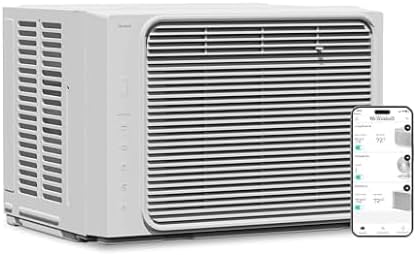
The Windmill 5000 BTU Lite is a compact window air conditioner intended for small rooms such as bedrooms or home offices where quiet, efficient cooling matters. It delivers 5,000 BTU of cooling for spaces up to about 150 square feet and starts at roughly 51 dB, making it unobtrusive during sleep or focused work. The unit supports remote app control and voice assistants, so you can adjust temperature and modes from your phone or smart speaker, and it includes a remote control for local use. Practical touches include an easy-access washable mesh filter plus an activated carbon filter, auto-dimming LED controls, and a full installation kit for standard single and double-hung windows. It uses R-32 refrigerant and is corded electric with no inverter, which keeps the design simple but means it lacks variable compressor efficiency found on inverter models. For budget-focused buyers seeking straightforward, low-noise cooling with smart controls, this unit balances features and ease of installation, though it is best suited to smaller rooms and will not match the runtime efficiency of higher-end inverter units.
Best for: Buyers looking for an affordable, easy-to-install window AC that cools small rooms quietly and offers smart-phone and voice control for convenient everyday use.
Less Ideal for: People who need to cool larger rooms or who prioritize maximum energy savings from inverter-driven compressors should consider other options.
- Quiet operation starting around 51 dB suitable for bedrooms and offices
- App and voice control plus included remote lets you adjust settings from anywhere
- Compact window installation with a complete kit for standard single and double-hung windows
- Easy-access washable mesh filter and activated carbon filter for basic air cleaning
- Non-inverter compressor limits peak energy efficiency compared with inverter models
- Designed for small rooms only and insufficient for larger spaces
Verdict: A budget-friendly, low-noise window AC with smart controls that reliably cools small rooms while keeping installation and operation simple.
Hisense 12,000 BTU Window AC

| Cooling Power | 12000 british thermal units |
|---|---|
| Wattage | 1120 watts |
| Noise | 35 db |
| Floor Area | 550 square_feet |
| Capacity | 31.2 pints |
This Hisense 12,000 BTU window air conditioner uses inverter technology to deliver steady cooling for larger rooms while drawing less energy than conventional units. It is typically installed in a standard window using the included bracket and managed via the ConnectLife app or the supplied remote, with three modes: cooling, fan, and dehumidifier. The inverter compressor modulates speed for more consistent temperatures and lower energy use, and the unit's casing and internal design reduce noise to around 35 dB for quieter operation. Maintenance is straightforward thanks to a washable mesh filter and removable panels, and four-way air direction helps distribute conditioned air across the room. Important trade-offs are its window-only installation and the unit weight that makes handling and installation a two-person job; the smart features require a compatible smartphone and network for remote control. For buyers prioritizing reliable, energy-efficient cooling in mid-to-large rooms, this unit balances performance and practical maintenance needs.
Best for: Buyers who want dependable, energy-conscious cooling for medium to large rooms and value quiet, app-enabled control and low-maintenance upkeep.
Less Ideal for: People who need portable or wall/through-the-wall solutions or those unable to accommodate a window installation should look elsewhere.
- Inverter compressor for stable temperatures and lower energy draw
- Wi‑Fi app control plus remote for convenient monitoring and adjustments
- Quieter operation engineered to reduce outdoor and operational noise
- Washable, removable mesh filter for easy upkeep
- Includes installation bracket and remote for straightforward setup
- Window-only form factor limits installation locations
- Unit is relatively heavy, requiring help to install
Verdict: Choose this Hisense window AC when you want energy-efficient, quiet, app-controlled cooling for rooms up to about 550 square feet.
Midea EasyCool 5,000 BTU Window AC
| Cooling Power | 5000 BTU |
|---|---|
| Floor Area | 150 square_feet |
| Refrigerant | R-32 |
| Control Method | Push Button |
| Wattage | 450 watts |
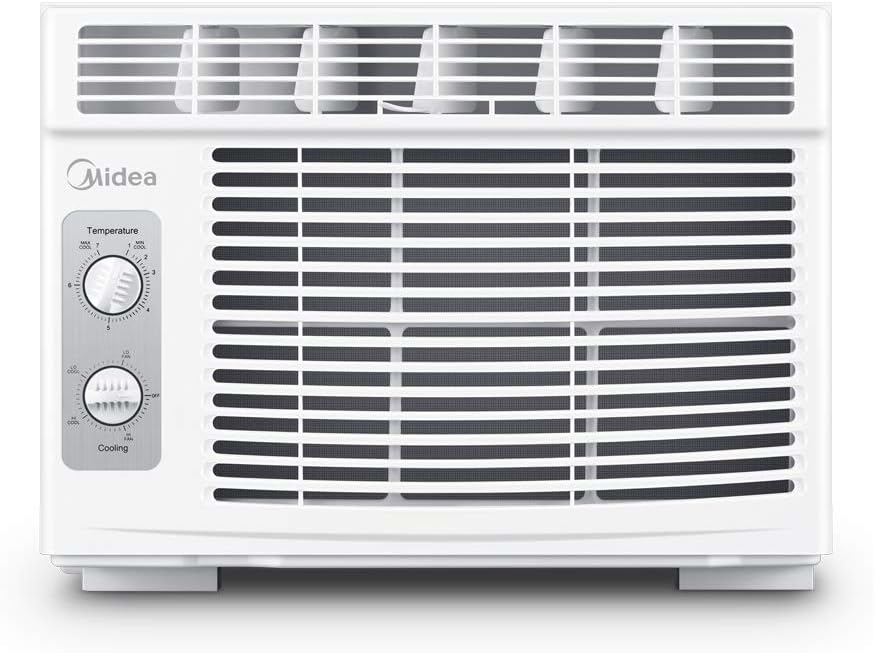
The Midea EasyCool 5,000 BTU window unit delivers straightforward cooling for small rooms and home offices. It uses mechanical push-button controls with three power levels and multiple temperature settings, so operation is simple without a remote or app. The washable filter is easy to remove and clean, helping keep dust and pet hair out of the airflow, and included mounting hardware fits most single-hung or double-hung windows in the specified range. At 5,000 BTU the unit cools roughly 150 sq. ft., and the manufacturer lists an efficiency rating (CEER/SEER equivalent) of about 11, so it is a reasonable choice when you want lower operating costs for occasional room cooling. Noise is noticeable on higher fan speeds and the unit is not inverter-based, so it cycles like a basic compressor AC rather than modulating output. Installation requires a screwdriver and some care with window fit and sealing. For buyers who want a simple, energy-conscious window AC without smart features, this unit offers dependable performance and easy maintenance.
Best for: Buyers who prioritize a reliable, low-complexity window AC that is easy to install and maintain and who value social proof from well-reviewed, budget-friendly models.
Less Ideal for: People seeking ultra-quiet operation, smart/wifi controls, or the highest-tier energy efficiency should consider other models with inverter technology or Energy Star certification.
- Compact 5,000 BTU capacity cools rooms up to about 150 sq. ft.
- Simple mechanical push-button controls with multiple temperature and fan settings are easy to use.
- Washable, removable filter simplifies maintenance and keeps dust and pet hair out of the unit.
- Included window bracket and standard 110V corded power make installation straightforward for most windows.
- Not inverter-equipped so compressor cycles on/off rather than modulating for finer efficiency and quieter operation.
- Higher fan/power levels produce noticeable noise compared with ultra-quiet models.
- Not Energy Star certified, so long-term energy savings may be less than tier-one efficient units.
Verdict: A practical, easy-to-use 5,000 BTU window AC that delivers dependable cooling and low-maintenance operation for small rooms while keeping energy use reasonable.
Choosing the Right Energy Efficient Air Conditioner: Key Factors to Consider
Seasonal Efficiency Ratings
Seasonal efficiency ratings quantify how much cooling output a unit delivers per unit of electricity over a typical cooling season. Higher ratings mean the air conditioner runs less often or uses less power to produce the same cooling, which lowers monthly energy use and operating costs. When comparing units, prioritize the rating that corresponds to your climate and expected runtime because short hot spells versus long hot seasons change the value of a higher rating.
Manufacturers publish these ratings in standardized formats so you can compare machines on a like-for-like basis. A modest increase in seasonal efficiency can translate into noticeable yearly savings, especially in hotter climates or homes where the AC runs many hours per day.
Correct Cooling Capacity
Cooling capacity needs to match the room size and heat load. An undersized unit will run continuously and fail to reach target temperatures, increasing wear and energy use. An oversized unit will cycle on and off frequently, which can waste energy and leave the space feeling humid. Calculate required British Thermal Units or the manufacturer-recommended room area coverage and choose the unit that best matches your conditioned space.
Consider unusual heat sources like large windows, high ceilings, or appliances that contribute extra heat. For open-plan areas, budget for a slightly higher capacity or consider multiple zoned units rather than one oversized single unit.
Measured Power Draw
Look at real-world power consumption numbers rather than just rated input wattage. Measured draw during steady-state cooling and at startup provides insight into how much electricity the unit actually uses. Some units have efficient compressors and variable-speed fans that reduce average consumption even if peak draw is similar.
If you have an electricity constraint or want predictable monthly bills, estimate run-hours per day and multiply by measured kilowatt draw to project usage. This helps compare not just theoretical efficiency but likely costs under your typical usage pattern.
Noise and Indoor Comfort
Noise affects how comfortable a cooling system feels in living areas and bedrooms. Look at steady-state decibel ratings and whether the unit has quieter modes for night. Lower noise often correlates with smoother, more efficient operation because variable-speed compressors run more continuously at lower speeds rather than short, noisy cycles.
Consider placement in relation to sleep and living spaces. A quieter unit can be placed closer to occupied rooms with less disruption. Remember that perceived noise depends on frequency content as well as decibel level, so user reports on real-world quietness are useful alongside manufacturer specs.
Installation Requirements
Installation affects total cost and the feasibility of a given unit in your home. Check electrical requirements such as voltage and dedicated circuits, the physical footprint for window or wall mounting, and whether the unit needs a drainage solution. Units designed for easy retrofit into existing openings can save on installation complexity and disruption.
Also verify clearance and ventilation needs so the unit can operate efficiently. Some high-efficiency units require more space around the condenser or additional support for wall sleeves. Planning for proper installation prevents performance loss and avoids unnecessary rework after purchase.
Sizing Your Room for Efficient Cooling
Accurate sizing is the first step toward energy-efficient cooling. Begin by measuring the room area in square feet and note ceiling height, numbers and orientation of windows, and common heat sources. Use those inputs to determine the recommended cooling capacity range rather than relying on a single number.
When in doubt, choose a unit slightly closer to the upper end of the recommended range for rooms with high sun exposure or many occupants. For open-plan spaces consider multiple units or a solution that allows zoning to avoid running a single large unit inefficiently.
- Measure floor area and note ceiling height
- Account for windows, insulation, and appliances
- Prefer correct capacity over simply buying the largest unit
Understanding Variable-Speed Vs Single-Speed Compressors
Variable-speed compressors adjust output to match cooling demand, which reduces on/off cycling and often improves seasonal efficiency. They maintain steadier temperatures and typically run quieter at lower speeds. Single-speed compressors switch fully on or off and can lead to short cycling if the unit is oversized.
For many homes, variable-speed units deliver better comfort and lower average power draw. However, initial installation requirements and compatibility with your home's electrical system should be checked before deciding.
- Variable-speed: steadier temps, lower average energy use
- Single-speed: simpler design, potential for short cycling
Placement and Ventilation Matter
Where you locate the indoor and outdoor parts affects both efficiency and noise. Ensure the outdoor condenser has unobstructed airflow and the indoor unit is placed to encourage even air distribution. Restricted airflow forces the compressor to work harder and can reduce seasonal efficiency.
Avoid placing indoor units behind furniture or in very small recessed spaces. Proper clearance reduces strain and helps maintain the unit's published efficiency under real operating conditions.
- Ensure clear airflow around condenser
- Place indoor unit for balanced air distribution
- Follow clearance guidelines to preserve efficiency
Smart Controls and Scheduling
Modern control features like programmable thermostats, Wi-Fi-enabled scheduling, and eco modes help reduce runtime and align cooling with occupancy. Using setback schedules for night or unoccupied periods minimizes energy waste without sacrificing comfort when you return.
Integration with simple smart-home routines can optimize run times around peak electricity pricing or daily routines. Even basic timers can cut hours of unnecessary operation and improve overall seasonal efficiency.
- Use scheduling to avoid cooling empty spaces
- Eco modes limit max compressor speed to save energy
- Remote controls let you pre-cool rather than run continuously
Maintenance Practices That Preserve Efficiency
Regular maintenance keeps an air conditioner running close to its rated efficiency. Clean or replace filters on the recommended schedule, clear debris from the outdoor unit, and ensure condensate drains are unobstructed. Neglected units can lose significant efficiency and deliver uneven cooling.
Annual checks of refrigerant charge and fan operation by a qualified technician catch issues that otherwise reduce seasonal efficiency. Simple homeowner tasks combined with periodic professional service extend useful life and maintain expected energy performance.
- Replace or clean filters regularly
- Keep outdoor condenser free of leaves and obstruction
- Schedule periodic professional checks for refrigerant and fans
How We Chose the Best Energy Efficient Air Conditioner
We focused on objective, measurable criteria that matter when choosing an energy efficient air conditioner. Key evaluation points included seasonal energy efficiency ratings to estimate yearly cooling power draw, verified cooling capacity relative to room size to avoid oversizing or undersizing, and real-world power consumption figures under typical load conditions. We also considered sound levels during steady-run and start-up, since quieter systems are more pleasant for living spaces. Installation flexibility and compatibility with common home electrical setups were examined to assess overall cost and convenience of getting a unit running. We excluded units that lack published efficiency specifications or that are designed only for industrial or commercial use. We also filtered out models with poor user feedback on reliability or widespread reports of performance shortfalls. The final list prioritizes units that balance strong seasonal efficiency with appropriate cooling capacity, reasonable noise, and straightforward installation. The scoring emphasized measurable performance metrics rather than marketing claims.
Our full evaluation process is outlined in our review methodology.
FAQ
How much can I expect to save with a more efficient air conditioner?
Savings depend on climate, runtime, and electricity cost. In hotter regions where the unit runs many hours, a higher efficiency rating usually leads to noticeably lower energy use. Estimate savings by comparing seasonal efficiency ratings and projected annual run-hours.
Is a variable-speed compressor worth the extra complexity?
Often yes for frequent-use scenarios because variable-speed compressors reduce cycling and lower average power draw. They also tend to be quieter and deliver more consistent comfort, but you should confirm installation compatibility and potential maintenance needs.
Can I improve efficiency on my current air conditioner without replacing it?
Yes. Improvements include cleaning or replacing filters, maintaining clear airflow around indoor and outdoor units, sealing duct or window openings, and using programmable schedules to reduce runtime. These steps can improve performance and reduce energy use without a full replacement.
Do smart thermostats really reduce cooling costs?
Smart thermostats and scheduling can reduce costs by limiting cooling during unoccupied periods and using setback temperatures at night. The effectiveness depends on how they are programmed and whether the system is sized correctly for the space.
What installation details most affect efficiency?
Correct electrical capacity, proper placement and clearance for the outdoor unit, secure mounting and sealing of the indoor unit, and correct refrigerant charge all affect efficiency. Poor installation can negate the benefits of a higher-efficiency unit.
Final Verdict
Prioritize matching cooling capacity to your space and selecting a unit with a high seasonal efficiency rating to reduce energy use over time. Balance efficiency with noise, installation complexity, and realistic power consumption estimates to find a unit that performs well in your specific home. Focus on proven efficiency metrics, correct sizing, and proper installation or maintenance. Those tradeoffs will guide you toward a practical choice that lowers operating costs while keeping living spaces comfortably cool.