
Note: This article contains affiliate links. If you click on these links and make a purchase, we may earn a small commission at no extra cost to you. This helps support our research and content. Read our full affiliate disclosure here.
Heating a large room efficiently matters for comfort and utility bills. If your living area, open-plan space, or large bedroom struggles to reach and hold a comfortable temperature, an energy-efficient electric heater designed for large rooms can make a big difference. You want steady, evenly distributed heat without excessive energy draw or noisy operation. This guide covers seven shortlisted, top-rated electric heaters suited to larger spaces and explains the criteria we used to evaluate them. Expect coverage of heat output, energy efficiency, thermostat and controls, safety features, and suitability for continuous use. Read on to find options that match your room size and heating priorities.
Top Picks at a Glance
| Best Overall The best all-around choice for most situations | Dr. Infrared Heater DR-968 |  |
| Best Quality Built to a higher standard if you want something more solid | EdenPURE CopperPLUS Infrared Heater 1500W |  |
| Best Value The sweet spot between price and what you get | Honeywell HeatGenius HCE840B |  |
| Best Budget The cheapest option that still gets the job done reliably | Amazon Basics Portable Eco-Smart Heater DF1501 |  |
| Top Rated A top-rated pick with lots of positive feedback | Lasko Ceramic Tower Heater 751320 |  |
| Most Popular A crowd favorite that many people choose with confidence | DREO Space Heater DR-HSH004 |  |
| Best Seller A high-volume bestseller chosen again and again | DREO Tower Space Heater DR-HSH003 |  |
Dr. Infrared Heater DR-968

| Wattage | 1500 Watts |
|---|---|
| Heating Coverage | 576 square feet |
| Number of Speeds | 3 |
| Voltage | 120 |
| Amperage | 12.5 A |
The Dr. Infrared Heater DR-968 combines a quartz infrared tube and PTC element with a high-pressure, low-noise blower to heat rooms quickly and evenly. It is typically used as a freestanding supplement to home heating in living rooms, bedrooms, home offices, or larger spaces where fast, targeted warmth is needed. Key features include an electronic thermostat (50 to 85 F), Auto energy-saving mode that cycles between high and low power, three power settings (Auto, Low 1000W, High 1500W), a 12-hour timer, caster wheels for repositioning, and an IR remote for convenient control. Built-in safety features such as tip-over protection and overheat auto shutoff make it suitable for households with children or pets. The unit is relatively quiet thanks to the blower design and claims wider heat spread than many standard 1500 W heaters, which helps warm larger rooms more effectively. Trade-offs are typical for a plug-in electric heater: it requires 12.5 amps at 120 V and is intended as supplemental heat rather than whole-house replacement, and its effectiveness depends on room insulation and layout.
Best for: Buyers who want an energy-conscious, portable electric heater that delivers fast, room-scale infrared warmth and convenient controls for living rooms, bedrooms, or home offices.
Less Ideal for: Those seeking a primary whole-house heating solution or lower-amp plug-and-play options for very small rooms should consider alternatives.
- Dual heating system (quartz infrared + PTC) for faster, more even heat transfer
- Auto energy-saving mode that cycles between high and low to maintain set temperature
- Electronic thermostat with remote control and timer for convenient temperature management
- Safety features including tip-over protection and overheat auto shutoff
- High-pressure low-noise blower for broader heat distribution with low sound
- Requires 12.5 A at 120 V, so continuous use can add noticeably to electric load
- Designed as supplemental room heater, so not a replacement for whole-home systems
Verdict: Choose the DR-968 when you want a portable, energy-conscious infrared heater that heats large rooms quickly with convenient thermostat control and strong safety features.
EdenPURE CopperPLUS Infrared Heater 1500W

| Power Source | Corded Electric |
|---|---|
| Heating Method | Radiant |
| Heating Coverage | 1000 square feet |
| Heat Output | 5000 BTU |
| Number of Speeds | 24 |
The EdenPURE CopperPLUS is a portable infrared zone heater built to warm large rooms without running central heat. It uses a copper PTC element and claims improved heat transfer to deliver steady radiant warmth at a high 1500W setting (also adjustable down), and includes 24 preset temperature levels for fine control between 40 and 90°F. Practical touches include a washable lifetime filter, a wireless remote, built-in caster wheels for room-to-room mobility, and multiple safety sensors including tip-over shutoff and dual overheat protection. The unit is aimed at energy-conscious users who want targeted zone heating to cut overall utility usage; using it in an occupied room will heat people and surfaces directly rather than blasting air. Limitations are typical of electric infrared heaters: output is focused on the occupied zone rather than whole-house heating, and effectiveness will vary with room layout and insulation. Noise is described as whisper quiet, but any fan-assisted circulation may still be audible at higher settings. Overall it is a practical, safety-minded option for large room zone heating with good control options and low maintenance filter care.
Best for: Buyers who prioritize efficient, performance-focused zone heating for large rooms and want precise temperature control and safety features in a portable unit.
Less Ideal for: Those who need to heat multiple rooms or an entire house consistently should look at whole-home heating solutions rather than a zone infrared heater.
- 1500W high-mode provides strong zone heating for large rooms up to 1000 sq ft
- Copper PTC heating element designed for efficient, steady radiant heat transfer
- 24 precision heat settings and remote give fine control over temperature and power use
- Washable lifetime filter eliminates replacement costs and reduces upkeep
- Built-in safety features including tip-over shutoff and dual overheat sensors
- Heats primarily by radiant zone warming so it may not evenly raise overall room air temperature for poorly insulated spaces
- Not intended to replace whole-house heating systems for consistent, whole-home warmth
Verdict: A high‑output, energy-conscious infrared zone heater that delivers strong, controllable warmth for large rooms while minimizing upkeep and safety concerns.
Honeywell HeatGenius HCE840B

| Heating Coverage | 200 square feet |
|---|---|
| Heat Output | 1500 watts |
| Number of Speeds | 6 |
| Heating Method | Convection |
The Honeywell HeatGenius HCE840B is a plug-in ceramic space heater intended to warm medium to large rooms using convection and a radiant heating element. It offers six comfort settings plus a programmable thermostat and a 2-hour heat phase timer so you can tailor output and runtime for occupied spaces. The unit oscillates and directs heat multi-directionally to spread warmth across a living room or bedroom, and its 1500-watt output is typical for portable room heaters aiming to supplement central heating. Safety is emphasized with triple overheat protection, thermal-insulated wiring, cool-touch housing, tip-over protection, and an auto-off option. Practical buyers will appreciate the energy angle: running one room heater and turning down central heat can reduce whole-house heating cost. The trade-offs are standard: at 1500 watts it uses significant electricity when running at full power, and it only warms the zone it sits in rather than delivering whole-home heat. Controls are straightforward, and the slim pedestal design fits tight spaces while providing directional airflow for improved coverage.
Best for: Buyers who want to lower whole-home heating use by efficiently heating the room they occupy and who prioritize programmable, safety-focused operation.
Less Ideal for: People seeking a whole-house solution or ultra-low electric consumption for very large, open-plan spaces should consider central or higher-capacity alternatives.
- Programmable thermostat with six comfort settings for precise room control
- Oscillating multi-directional heat helps distribute warmth across larger rooms
- Multiple safety features including 3x overheat protection, tip-over protection, and cool-touch housing
- Slim pedestal form factor fits small footprints and is easy to position
- Rated at 1500 watts so running at high output consumes notable electricity
- Heats only the immediate zone and cannot replace whole-house heating
Verdict: A programmable, safety-focused 1500W ceramic heater built to efficiently warm a single medium to large room and help reduce whole-house heating use.
Amazon Basics Portable Eco-Smart Heater DF1501

| Heat Output | 1500 watts |
|---|---|
| Heating Coverage | 160 square feet |
| Heating Method | Infrared Heating |
| Voltage | 120 volts |
| Special Features | Remote Control |
This Amazon Basics portable Eco-Smart heater is a cabinet-style infrared unit designed to warm single rooms up to roughly 160 square feet. It uses four infrared elements with 750W and 1500W settings plus an ECO-Smart mode to reduce energy use, and the adjustable electronic thermostat with LED readout and remote control makes temperature adjustments easy from across the room. The wood-look casing gives it a more furniture-like appearance than a plastic heater, and safety features include an overheat sensor and stable floor-mount design. In practice it performs as a straightforward supplemental heater: it heats quickly at 1500W but is best for focused spaces rather than whole-house heating, and the single-speed fan means fewer airflow settings. For buyers watching energy use, the ECO mode and two power settings give simple control over consumption, but if you need variable fan speeds, smart-home integration, or coverage for very large rooms, this unit will be limited.
Best for: Buyers who need an affordable, simple supplemental heater for a single room and want to reduce running costs with basic eco and lower-wattage settings.
Less Ideal for: People seeking whole-room heating for large open areas, multi-speed airflow control, or smart/home-automation features should consider higher-capacity or more feature-rich models.
- ECO-Smart setting plus 750W and 1500W power options for lower energy use
- Adjustable electronic thermostat with LED display and included remote for convenient control
- Infrared radiant heating that provides quick, direct warmth to people and objects
- Cabinet wood-style design that blends with home decor and a stable floor-mount form factor
- Built-in overheat sensor for added safety during use
- Rated coverage of about 160 sq ft limits effectiveness in very large rooms or open-plan spaces
- Only one fan speed and no smart connectivity for more granular control
Verdict: If you want an inexpensive, no-frills room heater that cuts running time with ECO and lower-wattage modes, this unit delivers practical, energy-conscious supplemental heat.
Lasko Ceramic Tower Heater 751320

| Heat Output | 1500 watts |
|---|---|
| Heating Method | Forced Air |
| Heating Element | Ceramic |
| Power Source | Corded Electric |
| Indoor Outdoor Usage | Indoor |
The Lasko Ceramic Tower Heater (model 751320) is a portable 1500-watt ceramic heater designed to warm small to medium rooms using a forced-air element and widespread oscillation. It runs from a standard 110V outlet and offers two heat settings plus an adjustable electronic thermostat and an auto-off timer you can control from the included remote, which stores on-board when not in use. The oscillation and elongated element help spread warm air around a room more evenly than a single-direction heater, and safety features such as overheat protection and cool-touch housing add peace of mind during extended use. Practical benefits include easy portability thanks to a built-in handle and simple electronic controls for nightly or scheduled heating. For energy-conscious buyers, the programmable thermostat and timer let you avoid overheating a space, but as a 1500W unit it is best suited for small to medium areas rather than large rooms where multiple units or a higher-capacity heater would be needed to reach and maintain higher temperatures efficiently.
Best for: Buyers who prioritize a dependable, easy-to-use portable heater with basic programmability and safety for everyday use in small to medium rooms.
Less Ideal for: People needing to heat large open rooms or whole-house spaces efficiently should consider higher-capacity or whole-home solutions instead.
- 1500W ceramic element delivers quick, perceptible warmth.
- Widespread oscillation helps distribute heat more evenly through a room.
- Programmable thermostat and 7-hour timer enable targeted, scheduled heating.
- Includes remote with on-board storage for convenient control from across the room.
- Built-in safety features like overheat protection and cool-touch housing.
- 1500 watts may be underpowered for large rooms if used alone.
- Only two heat settings limit fine-grained power control compared with multi-stage heaters.
Verdict: A reliable, safety-focused 1500W ceramic tower heater that delivers straightforward, programmable warmth for small to medium rooms.
DREO Space Heater DR-HSH004
| Heating Coverage | 200 sq.ft |
|---|---|
| Heat Output | 1500 watts |
| Heating Element | PTC Ceramic |
| Number of Speeds | 5 |
| Min Temperature Setting | 41 °F |
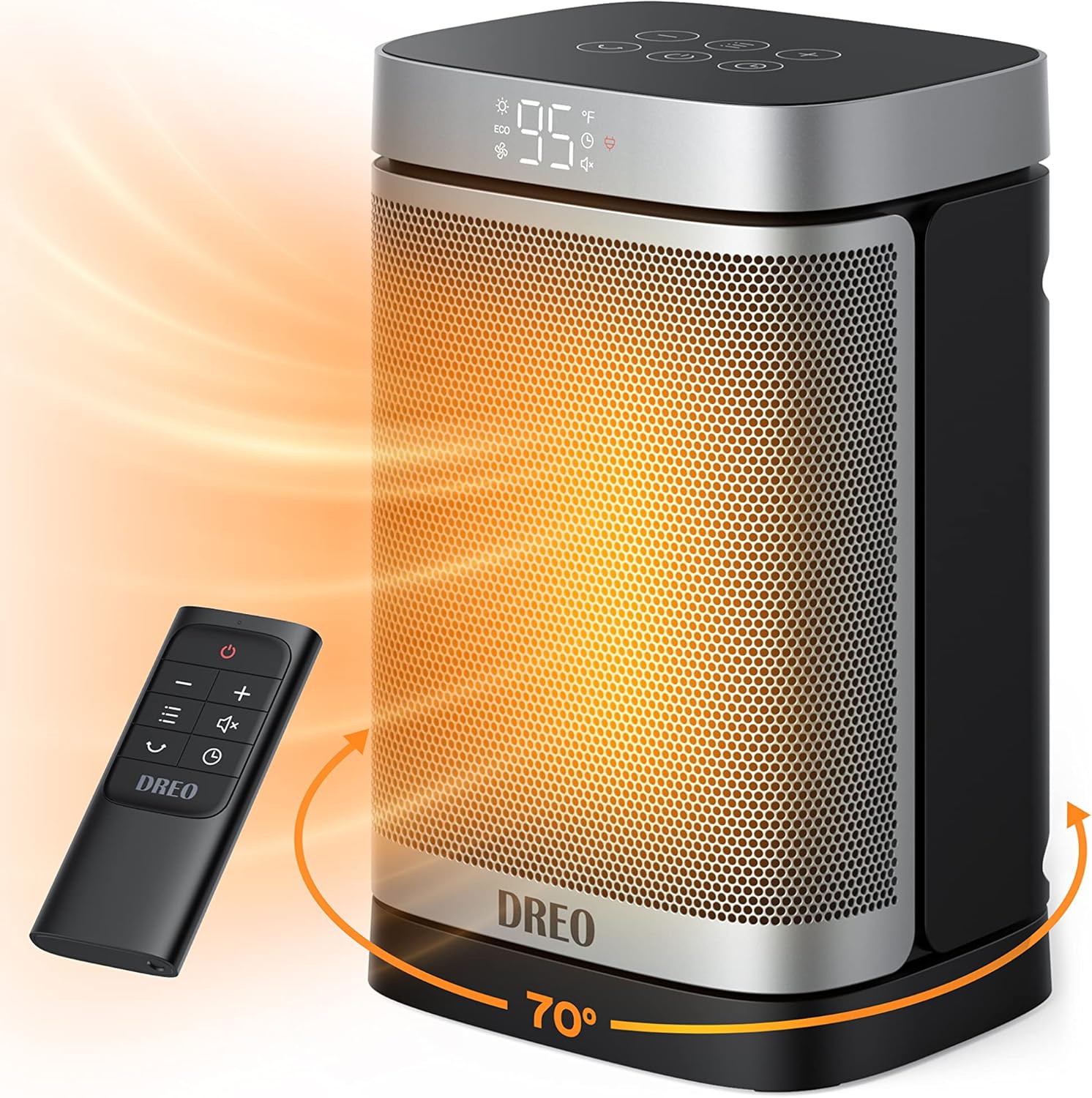
The DREO DR-HSH004 is a 1500W PTC ceramic tower heater designed to warm medium to large rooms with a programmable digital thermostat and 70° oscillation. It offers five power/speed modes plus an ECO mode that adjusts output to maintain a target temperature between 41 and 95°F in 1°F increments, and a 1–12 hour timer for scheduled run times. The unit includes a detachable filter, LED control panel and a remote for convenient adjustments from across the room. Safety features are robust for the category with ETL listing, tip-over and overheat protections and flame-retardant materials. Noise is low thanks to a brushless DC motor and multi-blade design, which helps for bedrooms or home offices. The main compromises are inherent to a 1500W electric heater: it requires full power for fastest heat and effectiveness depends on room insulation and layout, and it is not a whole-house solution. For buyers who prioritize controllable, energy-conscious heating in single rooms, this model balances features, safety and quiet operation well.
Best for: Buyers who want a safe, quiet, single-room heater with precise temperature control and energy-saving modes for large bedrooms or home offices and who rely on reviews and safety certifications when choosing appliances.
Less Ideal for: Homes seeking a primary or whole-house heating solution or buyers who need heating for very large open-plan spaces where multiple units or central systems are required.
- Up to 1500W PTC ceramic heating for quick warm-up
- Programmable digital thermostat adjustable in 1°F increments for precise comfort
- 70° oscillation and five modes including ECO to spread heat and save energy
- Detachable filter and remote control for easy maintenance and convenience
- ETL-listed safety with tip-over and overheat protection and flame-retardant materials
- Effectiveness limited by room size and insulation since it is a single-room 1500W heater
- Not intended to replace central heating for whole-house use
Verdict: A feature-rich, safety-focused 1500W tower heater that gives precise, energy-conscious room heating for buyers who want quiet, controllable warmth.
DREO Tower Space Heater DR-HSH003

| Heat Output | 1500 watts |
|---|---|
| Heating Coverage | 270 sq.ft. |
| Heating Element | PTC |
| Oscillation | 70° |
| Number of Speeds | 5 |
This DREO tower heater uses a PTC ceramic element and a 1500W output to warm rooms up to about 270 sq ft, with fast startup and a fan-forced/convection delivery. It includes a precise adjustable thermostat (41 to 95°F) and an ECO mode that shifts between roughly 1000W and 1500W to hold target temperature more efficiently, which helps reduce runtime and energy use. The unit oscillates 70 degrees on a low-noise fan (about 34 dB) for more even circulation, and practical controls include five fan speeds, a 12-hour timer and a small remote for hands-free adjustments. Safety features are thorough for cautious buyers: ETL listing, tip-over and overheat protection, flame-retardant materials and a grounded-length flat cord. Trade-offs are that maximum output is limited to 1500W so it is best for single large rooms rather than whole-house heating, and like most ceramic fan heaters it relies on airflow so it will move air rather than produce radiant warmth.
Best for: A cautious buyer who prioritizes safety and steady, energy-conscious heating for a single large room and wants quiet, controllable operation with remote and timer convenience.
Less Ideal for: Households needing to heat multiple rooms or very large open areas where higher-output or whole-home systems are required.
- 1500W PTC ceramic heating with fast warm-up suitable for rooms up to 270 sq ft
- ECO mode with a precise thermostat to moderate power between ~1000W and 1500W for improved energy efficiency
- 70° oscillation and five speeds for more even heat distribution
- Multiple safety features including ETL certification, tip-over and overheat protection, and flame-retardant materials
- Quiet operation (~34 dB) and a remote plus 12-hour timer for convenient, low-disruption use
- 1500W maximum limits performance to single-room heating rather than whole-home use
- Depends on forced-air circulation rather than radiant heat, which some users may find less immediately warming
Verdict: Choose this model if you want a safe, energy-conscious 1500W tower heater that quietly heats and circulates warm air across a large room with thermostat-controlled ECO savings.
Choosing the Right Energy-Efficient Electric Heater for Large Rooms: Key Factors to Consider
Rated Heat Output and Room Coverage
A heater's wattage and stated coverage area are the starting point for sizing a unit to a large room. Higher-rated output lets a heater raise and maintain temperature in bigger volumes of air, but raw wattage alone does not guarantee even warmth. Consider the room's ceiling height, insulation quality, window area, and whether it is open to adjacent spaces when matching rated coverage to real conditions.
Oversizing slightly can reduce run time and improve comfort, but extreme oversizing might cycle more aggressively and reduce efficiency. Look for clear coverage figures and guidance on ceiling height or open-plan use so you can pick a model that will actually heat the space you have.
Thermostat Accuracy and Programmable Controls
Accurate thermostatic control is one of the most important efficiency factors. A precise thermostat reduces on-off cycling and keeps the room within a narrow band of comfort, which lowers wasted energy. Programmable scheduling and setback options let you lower setpoints during unoccupied hours and raise them before you return, delivering measurable energy savings over time.
Also check for adaptive or learning thermostats that adjust to room dynamics, and for easy-to-read displays and remote control or app support if you prefer managing heat without approaching the unit.
Heat Distribution Method
How a heater transfers warmth affects how evenly and quickly a large room heats. Pure convection models rely on natural airflow and are quieter and often more energy efficient for steady-state heating. Fan-assisted or blower designs spread heat faster and can reduce warm-up time but may draw more power and produce noise. Radiant elements provide immediate warmth to nearby surfaces and people, helping with perceived comfort even if air temperature is still rising.
Consider a hybrid approach if you want both quick warm-up and efficient long-term hold: a unit that can use fan boost for startup then revert to quiet convection for maintenance will give the best of both behaviors.
Continuous-Run Durability and Maintenance
Large-room heaters are likely to run for extended stretches in cold weather, so build quality and maintenance needs matter. Look for robust construction, sealed heating elements or protected fins, and parts that tolerate repeated thermal cycling without premature failure. Ease of cleaning is also important; dust buildup on heating elements or fans reduces efficiency and can create odors or hotspots.
Check for accessible filters or tool-free panels, straightforward replacement parts, and clear manufacturer guidance on routine upkeep to keep the heater operating efficiently over multiple seasons.
Safety Features and Certifications
Safety is non-negotiable for units that operate unattended or continuously in large spaces. Essential protections include reliable overheat shutoff, tip-over cutoffs for portable designs, and cool-touch housings where occupants may brush against the unit. Thermal fuses and multiple redundancy layers for over-temperature protection are desirable in higher-output models.
Also verify relevant safety certifications from recognized testing bodies. Those marks indicate the unit has met national electrical and fire-safety standards and reduce the risk of field issues related to installation, continuous operation, or materials.
Operational Noise and Placement Flexibility
Noise becomes an important factor when a heater runs for long periods in rooms used for watching TV, working, or sleeping. Fan-assisted models tend to be louder; check measured decibel figures or look for quiet-mode settings. Placement flexibility matters because large rooms often require strategic positioning for even warmth. Portable units with caster wheels or handles offer more placement options, while wall-mounted or panel heaters save floor space and can provide more uniform convection flow.
Consider where you will place the heater relative to seating and traffic paths to avoid drafts, noise disturbances, or obstructed airflow that diminishes performance.
Sizing a Heater for High Ceilings and Open-Plan Spaces
High ceilings and open-plan layouts increase the effective volume you need to heat. Instead of relying solely on square footage, estimate cubic feet of air by multiplying floor area by ceiling height and choose a heater rated for that larger volume.
Positioning matters: place the unit where it can encourage circulation into adjacent zones, such as near doorways to open areas or paired with a ceiling fan on low speed to help distribute warm air downward.
- Measure room volume, not just area
- Use higher output or multiple units for very tall spaces
- Combine with low-speed ceiling fan to improve distribution
Balancing Startup Speed with Long-Term Efficiency
A common tradeoff is fast warm-up versus low steady-state draw. Fan-assisted heaters and models with high initial output reduce the time it takes to reach comfort, but they might be less efficient when left running. Look for units with multiple modes: a boost for startup and an eco or low-power mode for maintenance.
Thermostats that cycle intelligently will help you maintain comfort with minimal energy use, particularly when paired with setback scheduling.
- Use boost mode only to shorten warm-up periods
- Switch to eco mode or lower thermostat once comfortable
- Program setpoints to avoid unnecessary run time
Placement and Room Airflow Tips
Avoid placing a heater where furniture blocks airflow or where drafts from windows counteract its output. For convection units, give clearance on the intake and exhaust sides so air can circulate naturally. For fan-assisted units, point the flow toward the room's center to speed distribution.
Consider pairing the heater with simple passive measures such as draft sealing, heavier curtains at night, or area rugs that reduce heat loss through floors.
- Keep at least the recommended clearance per the manual
- Aim airflow toward open zones, not directly at walls
- Seal obvious drafts to reduce load on the heater
Energy-Saving Habits and Thermostat Strategies
Small behavioral changes reduce energy use significantly. Lowering the thermostat by a degree or two, using programmable setbacks, and limiting boost mode to brief periods all trim operating hours and cost. In large rooms, zoning the space by closing off unused areas or using door sweeps can concentrate heat where it is needed most.
If a unit supports remote control or app scheduling, set routines that reflect occupancy patterns so the heater runs less when the room is empty and preheats when needed.
- Use setbacks during sleeping or absent hours
- Avoid overheating; aim for steady comfort rather than high peaks
- Preheat briefly rather than long continuous runs when possible
Installation Options: Portable Versus Fixed
Portable electric heaters provide flexibility for moving heat where you need it, which is useful if you use multiple rooms at different times. Fixed or wall-mounted units free up floor space and can deliver more even, unobtrusive heat for a permanent large-room solution.
Consider cord routing, proximity to outlets, and whether the unit needs dedicated electrical circuits for high-wattage models. Professional installation may be warranted for hardwired units or if you have limited outlet capacity.
- Portables are good for multiuse households
- Wall-mounted units suit permanent large-space heating
- Check electrical requirements before deciding on placement
How We Chose the Best Energy-Efficient Electric Heater for Large Rooms
We selected units that specifically target larger living spaces and prioritize sustained heat delivery with reasonable energy consumption. Our editorial filters began with rated heat output and coverage claims to ensure each heater can handle larger rooms. We then assessed energy efficiency features such as programmable thermostats, adaptive thermostatic control, eco or low-power modes, and the presence of thermostatic setback or scheduling. We also evaluated build and heat distribution characteristics: whether the design supports convective flow, radiant assistance, or fan-assisted dispersion for faster room warm-up. Safety features were another essential filter, including tip-over and overheat protection, certified thermal cutouts, and cool-touch exteriors suitable for continuous household use. Noise level and ease of placement were considered because a large-room heater often runs for extended periods. Excluded from the list were compact personal heaters and models rated only for small rooms, low-powered decorative units, and products lacking fundamental safety certifications. The final picks represent a balance of sustained output, energy-saving controls, safe continuous operation, and installation or placement flexibility.
Our full evaluation process is outlined in our review methodology.
FAQ
How big of a heater do I need for a 300-square-foot room with 9-foot ceilings?
Estimate the room volume first and choose a heater rated to handle that cubic footage. For a 300-square-foot room with 9-foot ceilings, look for units that explicitly state suitability for larger rooms or provide higher wattage output and coverage guidance. Also factor in insulation quality and window area, which can increase required capacity.
Are fan-assisted heaters worth the extra noise in a large room?
Fan-assisted heaters warm a space faster and improve distribution, which is helpful for large rooms. The tradeoff is added noise and typically higher short-term power draw. If you need quick heat-up frequently, a fan option is useful; for quiet, steady maintenance, a convection-first approach is often preferable.
Can I leave an electric heater running overnight in a large room?
Leaving a heater running overnight is common, but choose a model with reliable overheat and tip-over protection and set the thermostat to a conservative setpoint. Using programmable setback and lower overnight temperatures reduces energy use while maintaining safety. Follow manufacturer safety guidance for unattended operation.
Will closing off adjacent rooms help a single heater warm a large open area?
Yes. Zoning by closing doors or blocking off unused spaces concentrates available heat and reduces the effective area the heater must serve. In open-plan spaces you may still need a higher-capacity unit or multiple units to achieve even warmth across the entire area.
Do energy-saving modes actually reduce consumption on electric heaters?
Energy-saving modes reduce consumption by lowering average power draw, using adaptive thermostatic control, or limiting fan use. Their effectiveness depends on how the heater manages cycling and whether it can maintain comfort at lower throughput. Combining an energy mode with good insulation and sensible thermostat settings yields the best results.
Final Verdict
When choosing an electric heater for a large room, match capacity to the actual volume you need to heat and prioritize accurate thermostatic control to avoid wasted cycling. Decide whether you need fast startup or quiet, steady maintenance and select a unit with the appropriate heat distribution method and usable modes. Safety certifications, reliable overheat protection, and practical placement options should guide your final choice. Focus on the tradeoffs between speed, noise, and continuous-run efficiency to pick the heater that best fits how you use the space.