
Note: This article contains affiliate links. If you click on these links and make a purchase, we may earn a small commission at no extra cost to you. This helps support our research and content. Read our full affiliate disclosure here.
If you need steady, space-focused heat without rewiring or ductwork, choosing the right electric wall heater matters. An energy-efficient electric wall heater can cut running costs and prevent temperature swings in commonly used rooms while keeping installation and maintenance straightforward. This guide shortlists the top seven options across common use cases and evaluates them on efficiency, heat delivery, and installation practicality. Read on to see which features and specs most affect operating cost and comfort, plus practical considerations to match a heater to your room and thermostat setup.
Top Picks at a Glance
| Best Overall The best all-around choice for most situations | ENVI Electric Panel Wall Heater LE5012P |  |
| Best Quality Built to a higher standard if you want something more solid | Cadet Energy Plus Wall Heater |  |
| Best Value The sweet spot between price and what you get | GiveBest Wall Heater UPH310M |  |
| Best Budget The cheapest option that still gets the job done reliably | GiveBest Smart Wall Heater 1500W |  |
| Top Rated A top-rated pick with lots of positive feedback | DREO Smart Wall Heater DR-HSH017S |  |
| Most Popular A crowd favorite that many people choose with confidence | Heat Storm Phoenix HS-1500-PHX-WIFI |  |
| Best Seller A high-volume bestseller chosen again and again | Dreo Smart Wall Heater WH719S |  |
ENVI Electric Panel Wall Heater LE5012P

| Heat Output | 500 watts |
|---|---|
| Heating Coverage | 150 sq. ft. |
| Voltage | 120 volts |
| Amperage | 4.17 A |
| Max Temperature Setting | 90 °F |
The ENVI LE5012P is a slim plug-in wall heater that delivers gentle, fanless convection heat for targeted zone warming. It is typically mounted on a wall to heat bathrooms, bedrooms, home offices, or garages up to about 150 sq. ft., running quietly and continuously without blowing dust or allergens. Notable features include a cool-to-the-touch exterior, an automatic wall-sense safety switch that kills power if the unit is removed, and an auto-dimming power light to reduce distraction. With a 500 watt heat output and 120V/4.17A electrical draw, it is built to supplement central heat or provide economical heat on generators or solar systems without tripping breakers. The installation is straightforward using the included mounting kit and template, and the fanless design means no moving parts to maintain. Trade-offs are its limited coverage compared with higher-wattage models and the lack of built-in smart controls on this version, which means relying on manual settings or separate thermostats for scheduling and remote control.
Best for: Buyers who want a low-wattage, quietly operating wall heater to provide steady zone heat in small rooms while minimizing maintenance and safety concerns.
Less Ideal for: People who need whole-room or large-space heating, integrated smart controls, or higher wattage output for rapid temperature changes should consider more powerful or smart-enabled models.
- Quiet fanless convection warms without moving parts or blowing allergens
- Cool-touch exterior and wall-sense safety switch for child and pet-safe operation
- Low 500W draw suitable for supplemental heating and use with generators or solar systems
- Slim 2-inch profile and included mounting kit make installation fast and low-impact
- Limited heating coverage (about 150 sq. ft.) compared with higher-wattage units
- No built-in Wi-Fi or app control on this model
Verdict: Choose the ENVI LE5012P when you want ultra-quiet, low-wattage wall-mounted zone heating that is safe for families and easy to install.
Cadet Energy Plus Wall Heater

| Heating Coverage | 30 square feet |
|---|---|
| Heat Output | 1500 watts |
| Heating Method | fan & forced air |
| Special Features | Programmable Thermostat |
| Max Temperature Setting | 1 °F |
The Cadet Energy Plus is a wall-mounted, fan-forced electric heater designed to replace existing wall cans and deliver controllable, efficient heat for small rooms. It automatically senses 120, 208, or 240 volts and provides up to 1000, 1500, or 1600 watts accordingly, while a backlit digital thermostat and variable-speed fan keep room temperature within about 1 degree. Typical use is in bedrooms, home offices, or studies where you want steady, quiet warmth and simple controls; the unit also offers fan-only mode for air circulation and one-touch Night and Away preset setbacks to save energy. The heater ships as a complete Com-Pak upgrade kit for straightforward replacement of compatible wall cans and includes tamperproof settings and high-temperature safety shutoff. Trade-offs are that it is a fixed wall installation requiring electrician hardwiring and it is sized for small coverage areas rather than whole-house heating.
Best for: Buyers who prioritize steady, efficient room heating and precise temperature control in bedrooms or home offices and who plan a permanent, hardwired wall installation.
Less Ideal for: People seeking portable or whole-house heating solutions or those who cannot accommodate a recessed, hardwired wall unit should look elsewhere.
- Auto-sensing multi‑volt input adapts to 120/208/240 V for correct wattage without manual configuration
- Built-in backlit digital thermostat with programmable Night and Away presets for precise control and energy savings
- Variable-speed fan and quiet motor maintain temperature within about 1 degree while reducing cycling noise
- Ships as a complete Com-Pak replacement for easier upgrade into existing wall cans
- Fan-only mode provides year-round air circulation separate from heating
- Meant for single-room, small-area heating rather than larger spaces
- Requires hardwired installation by a qualified electrician and wall recessing
Verdict: Choose the Cadet Energy Plus when you want a quiet, programmable wall heater that maximizes energy efficiency and precise temperature control for a single room.
GiveBest Wall Heater UPH310M

| Heat Output | 1500 watts |
|---|---|
| Heating Element | PTC |
| Heating Coverage | 200 sq.ft |
| Number of Speeds | 5 |
| Min Temperature Setting | 40 °F |
The GiveBest UPH310M is a wall-mounted 1500W electric space heater designed to deliver fast, targeted heat for bedrooms, bathrooms, offices, and similar rooms. It uses a PTC heating element and five operating modes (P1/P2/P3/ECO/Fan) so you can choose lower power or full 1500W output depending on need. The built-in thermostat is adjustable from 40 to 99°F in 1°F increments and an ECO mode will modulate output to hold a set temperature and reduce energy use. Controls are flexible: touch panel, included remote, mobile app over Wi‑Fi, or Alexa voice commands for preheating and remote adjustments. Practical safety features include ETL listing, overheat and tip-over protection, a child lock, and a muteable LED display for quiet nighttime use. This wall-mounted form saves floor space and is rated for about 200 sq ft coverage. Expect straightforward installation and useful energy-saving behavior, though wall wiring or mounting is required and the unit is optimized for single-room heating rather than whole-house use.
Best for: Buyers who prioritize efficient, controllable heating for a single room and want smart controls and energy-saving features to optimize runtime and convenience.
Less Ideal for: Those needing whole-house heating or portable floor heaters to move between rooms should consider different solutions.
- 1500W PTC heater with multiple power modes for quick, adjustable warmth
- Precise thermostat (41–95°F) and ECO mode to maintain temperature and reduce energy use
- Four control options: touch, remote, Wi‑Fi app, and Alexa voice control for convenience and preheating
- Wall-mounted design saves floor space and targets single-room heating
- Built-in safety features including ETL listing, overheat and tip-over protection, and child lock
- Requires wall mounting which needs a suitable spot and basic installation
- Designed for single-room coverage, not for heating large open areas
Verdict: Choose this wall-mounted heater if you want a smart, energy-conscious 1500W unit that keeps a single room comfortable with precise temperature control and multiple remote control options.
GiveBest Smart Wall Heater 1500W

| Heat Output | 1500 watts |
|---|---|
| Heating Coverage | 200sq.ft |
| Heating Element | PTC |
| Number of Speeds | 3 |
| Voltage | 120 volts |
The GiveBest Smart Wall Heater is a 1500W PTC electric wall-mounted unit designed to warm a single room quickly and efficiently. It offers three manual heat speeds plus ECO and fan-only modes, an adjustable thermostat with 1°F increments from 41°F to 95°F, and app and remote control for scheduling and preheating. Practical touches include an easy installation template, IP24 splash protection for bathroom mounting, an ALCI safety plug, child lock, tip-over and overheat cutoffs, and a 24-hour timer. In use the heater delivers steady forced-air warmth to well-insulated rooms up to about 200 sq ft, and the ECO mode helps limit runtime and energy use compared with running at full power constantly. Limitations are inherent to wall-mounted electric heaters: performance depends on insulation and room size so it is not suitable as primary heating for large or poorly insulated spaces, and wall installation is less portable than freestanding units. For buyers focused on energy efficiency and controllable, room-level heating, it is a practical, safety-minded option.
Best for: Buyers wanting an affordable, energy-conscious room heater that provides smart scheduling and precise thermostat control for a single well-insulated room.
Less Ideal for: People who need whole-home heating, portable heaters to move between rooms, or a solution for large, poorly insulated spaces should look elsewhere.
- Smart controls with app and remote for scheduling and remote preheating
- Precise thermostat (41°F–95°F) with 1°F increments for tighter temperature control
- Multiple operating modes including ECO to reduce energy consumption
- Built-in safety features: ALCI plug, IP24 splash protection, child lock, tip-over and overheat protection
- Limited effective coverage (up to about 200 sq ft) so not suitable for large or poorly insulated rooms
- Requires wall mounting so it is not portable between rooms
Verdict: A budget-friendly, energy-aware wall heater with smart controls and safety features ideal for efficiently heating a single well-insulated room.
DREO Smart Wall Heater DR-HSH017S

| Heat Output | 1500 watts |
|---|---|
| Heating Method | Forced Air, PTC |
| Heating Coverage | 150 sq ft (primary) / up to 750 sq ft (supplemental) |
| Min Temperature Setting | 41 °F |
| Max Temperature Setting | 95 °F |
The DREO Smart Wall Heater is a 1500-watt, wall-mounted electric heater designed to deliver steady forced-air warmth for bedrooms, home offices, and living spaces. It uses a PTC heating element and an 11.5 ft/s optimized airflow to move heat quickly while running quietly at about 28 dB, and a 30° manual oscillation helps direct warmth where you need it. Controls include a digital thermostat with 41 to 95°F range, an included remote, and app/Alexa support so you can schedule or adjust temperature remotely; ECO mode and temperature calibration aim to improve efficiency and accuracy. Safety features include overheat protection, flame-retardant materials, and an IP24 splash rating for added reliability. Installation is straightforward with a mounting template and a long power cord. Limitations are typical for a fixed wall unit: it requires a dedicated mounting location and is best used as a primary heater for smaller rooms or as supplemental heat for larger spaces rather than whole-house heating.
Best for: Buyers who prioritize dependable, energy-conscious heating for a specific room and want smart controls and safety features in a permanent wall-mounted solution.
Less Ideal for: People who need portable heaters for temporary use or those looking to heat large, open-plan areas as a primary source of warmth.
- Smart controls with app, remote, and Alexa support for convenient scheduling and adjustments
- PTC forced-air design with high airflow for quick warming and low noise (28 dB)
- ECO mode and temperature calibration for more efficient, accurate temperature control
- Built-in safety features including overheat protection and IP24 splash rating
- Wall-mounted form factor saves floor space and includes installation template and long cord
- Fixed wall installation limits placement and portability
- 1500-watt output is better suited to single rooms or supplemental heating rather than large open areas
Verdict: A reliable, energy-conscious wall-mounted heater with smart controls and safety-minded design ideal for keeping a single room efficiently warm.
Heat Storm Phoenix HS-1500-PHX-WIFI
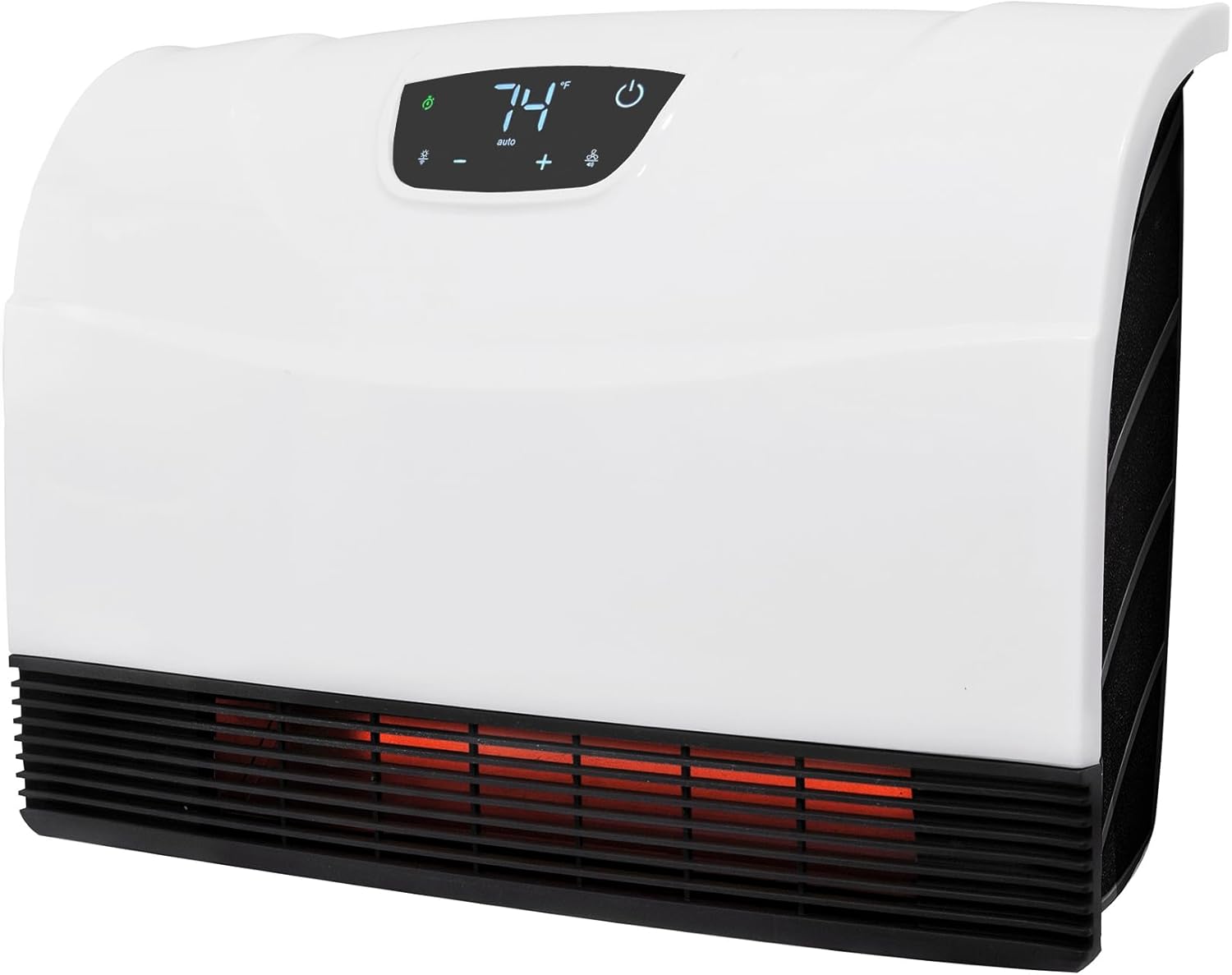
| Power | 1500 W |
|---|---|
| Voltage | 110 volts |
| Heating Coverage | 150 ft² primary, 750 ft² secondary |
| Heating Method | Infrared |
The Heat Storm Phoenix HS-1500-PHX-WIFI is a compact infrared wall heater that plugs into a standard 110V outlet and is intended for bathrooms, bedrooms, offices, and other small rooms where floor space is limited. It delivers 1500 watts (about 5200 BTU) of radiant heat and is rated to serve a primary zone up to roughly 150 sq ft or as supplemental heat for larger areas. You can mount it on the wall to save floor space and hide the cord by installing it over the outlet. The built‑in Wi‑Fi and one‑touch Bluetooth setup let you control temperature and schedules remotely, and a touchscreen plus included remote provides local control. Safety features noted include tip‑over shutoff behavior for the design, a cool‑to‑the‑touch grill, and washable filters. Practical benefits are straightforward: fast, targeted warmth without taking up floor space and the convenience of app scheduling. Limitations include its single-zone focus and fixed 1500W power, so it will not replace central heating for larger or poorly insulated spaces and requires a nearby outlet for plug‑in installation.
Best for: Buyers who want a space-saving, app-controlled heater to provide efficient zone warmth in a single room and who prioritize convenience and visible safety features.
Less Ideal for: Those seeking a primary whole‑house heating solution, heating for large or poorly insulated rooms, or a hardwired factory-style installation should consider other options.
- Wall‑mount design saves floor space and lets you hide the cord when installed over an outlet.
- Wi‑Fi and Bluetooth one‑touch setup enable remote control and scheduling from a phone.
- 1500W infrared output provides quick, focused radiant heat for small rooms.
- Touchscreen plus included remote give flexible local control options.
- Safety-minded features such as cool‑to‑the‑touch grill and washable filters add practical value.
- 1500W output is limited to zone heating and will not replace whole‑home systems.
- Requires a nearby standard outlet; not a hardwired installation option.
Verdict: A compact, Wi‑Fi enabled 1500W infrared wall heater ideal for efficient, space‑saving zone heating in small rooms.
Dreo Smart Wall Heater WH719S

| Heat Output | 1500 watts |
|---|---|
| Heating Coverage | 200-750 sq.ft. |
| Heating Method | Forced Air, PTC |
| Number of Speeds | 3 |
| Min-Max Temperature | 41 °F – 95 °F |
The Dreo Smart Wall Heater WH719S is a wall-mounted electric heater designed to warm bedrooms and living spaces up to several hundred square feet using a PTC ceramic element and forced-air output at 1500 watts. It mounts to the wall and offers 120° vertical oscillation to spread heat more evenly from floor to ceiling, three fan speeds, and a digital thermostat that adjusts between 41 and 95°F in 1°F increments for accurate room control. Smart features include Wi-Fi connectivity with an app for scheduling and remote control plus Alexa and Google Home voice commands, and the package includes a remote and mounting accessories. Practical benefits include fast warm-up from the PTC element, automated schedules to avoid wasted run time, and a dimmable display and low-noise operation that suit bedroom use. Limitations to consider are the need for a wall-mounted installation rather than plug-and-play portability and that it draws full 1500W when on high which may matter on electric bills if used continuously as a primary heat source in poorly insulated rooms.
Best for: Buyers who prioritize predictable, controllable heating and want a smart, permanently mounted solution for bedrooms or living areas that reduces time spent babysitting room temperature.
Less Ideal for: People who need a portable or temporary heater for different rooms or who cannot install a wall-mounted unit should look at freestanding alternatives.
- 120° vertical oscillation helps distribute heat across taller rooms and reduces cold spots
- Precise electronic thermostat with 1°F increments for accurate temperature control
- Wi-Fi app and voice assistant support plus remote and timer for convenient scheduling
- PTC ceramic plus forced-air design provides quick warm-up and steady output
- Includes reusable filter and mounting kit for straightforward installation and maintenance
- Requires permanent wall mounting so it is not easily moved between rooms
- Operates at up to 1500W which can be costly if used as the sole heat source in poorly insulated spaces
Verdict: Choose the Dreo WH719S when you want a smart, wall-mounted heater that delivers fast, evenly distributed warmth with precise thermostat control for worry-free daily use.
Choosing the Right Energy-Efficient Electric Wall Heater: Key Factors to Consider
Rated Wattage and Room Size Match
Matching a heater's rated wattage to the room size is central to efficient operation. A unit that is too large will cycle on and off frequently, which can reduce comfort and create inefficiencies. A heater that is too small will run continuously and still leave the space underheated, wasting energy in the process.
Estimate required wattage using room square footage and typical insulation levels, then choose a model with a rated output close to that need. Consider whether the heater supports multiple heat settings or a modulating output to better match varying loads throughout the day.
Thermostat Type and Control Accuracy
The thermostat's sensing accuracy and resolution directly affects runtime and energy use. A coarse thermostat that only switches at wide temperature bands will cause longer on/off cycles and temperature overshoot, increasing energy consumption. Models with digital thermostats or proportional control reduce cycling and hold setpoints more precisely.
Also consider control placement and sensor location. Wall-mounted sensors near drafts or heat sources can misread room temperature. If the heater supports external or remote sensors or integrates with programmable controls, you can improve control accuracy and reduce unnecessary runtime.
Installation Complexity and Electrical Requirements
Installation effort affects both upfront cost and long-term satisfaction. Some wall heaters require a dedicated circuit, hardwiring, and in-wall mounting that may need an electrician. Simpler drop-in or plug-in options reduce installation time but may limit maximum wattage or placement options.
Confirm line-voltage requirements, mounting clearances, and whether the heater fits existing wall cutouts or studs. If you plan to pair the heater with a smart thermostat or building control system, verify compatible wiring and terminal access before purchase.
Safety Protections and Build Quality
Safety features matter for any permanently mounted heater. Overheat cutoffs, thermal fuses, tip or tilt switches where applicable, and robust grille and element protection lower fire risk and extend service life. Build quality such as corrosion-resistant finishes and secure fastening hardware help the unit withstand daily use.
Look for clear access to serviceable parts and straightforward procedures for replacing fuses or thermostats. A heater with a proven safety design can reduce maintenance headaches and offers greater peace of mind when used in bedrooms or high-traffic spaces.
Operational Efficiency and Controls Integration
Operational efficiency depends not only on the heater element but also on how you control it. Programmable schedules, setback modes, and compatibility with room sensors or building controls allow lower run hours and reduce energy consumption during unoccupied periods. Some units offer eco or low-power modes that maintain baseline comfort with lower wattage.
Consider whether the heater supports integration with external timers, home automation platforms, or occupancy sensors to automate setbacks. The ability to fine-tune schedules and link to multiple sensors can materially reduce cycle time and electricity use over a heating season.
Sizing a Wall Heater for Different Room Types
Different room types need different heating strategies. Bedrooms generally require lower steady-state temperatures and benefit from precise thermostatic control, whereas living areas with higher ceilings or open plans need higher sustained output. Bathrooms often need a compact unit with short warm-up time and high safety ratings.
Use a room-by-room approach: calculate approximate wattage needs from floor area and insulation, then choose a heater that provides a small margin for cold snaps without oversizing. If you are uncertain, opt for a unit with adjustable output or multiple heat settings to fine-tune comfort.
- Bedrooms: prioritize quiet operation and accurate thermostat control
- Bathrooms: choose small footprint and strong safety protections
- Living rooms: select higher wattage or multiple units for even coverage
- Entryways and hallways: shorter run times and rapid warm-up matter
Placement, Venting, and Airflow Considerations
Correct placement ensures efficient heat distribution and reduces cold spots. Mount typical wall heaters low on the wall, away from curtains, furniture, and obstructions that block convective airflow. Leave recommended clearances above and to the sides to allow warm air to circulate and to prevent overheating.
Pay attention to adjacent airflow patterns from HVAC returns or supply registers. Strong drafts can disrupt thermostat sensing and force longer run times. In rooms with ceiling fans or open staircases, consider multiple smaller units or strategic placement to encourage even heating.
- Keep intake and discharge unblocked for best convection
- Avoid mounting behind doors or inside enclosed cabinetry
- Consider corner placement only if manufacturer clearance specs permit
Thermostat and Smart Control Options
Modern wall heaters can pair with digital thermostats or building automation for better energy performance. A thermostat with finer temperature resolution and the ability to program setbacks can reduce duty cycle and lower bills. If you plan to use occupancy sensors or integrate with a central control platform, verify compatibility first.
For rental units or rooms with irregular use, simple programmable schedules or remote sensors often give the best balance of convenience and efficiency. Hardwired thermostats tend to be more reliable than plug-in controllers for long-term installations.
- Digital thermostats provide tighter control than mechanical dials
- Remote or external sensors help avoid false readings near the heater
- Programmable setbacks reduce run hours during unoccupied periods
Maintenance, Longevity, and Serviceability
Routine maintenance keeps heaters running efficiently. Clean air intakes and grills regularly to prevent dust buildup that impedes airflow and increases cycle time. Check mounting hardware and electrical connections periodically to ensure safe operation.
Consider serviceability when choosing a unit. Models with accessible panels for thermostat or element replacement reduce future repair time. A robust warranty and clear user-serviceable parts list also aid long-term ownership and reduce lifecycle costs.
- Schedule annual visual inspections and grill cleaning
- Replace thermal fuses and thermostats only with compatible parts
- Prefer models with easy access to wiring terminals for upgrades
Noise and Comfort Tradeoffs
Some electric wall heaters use fan-assist while others rely on convection. Fan-assisted units heat up faster but can be noisier, which may be undesirable in bedrooms or media rooms. Purely convective units are quieter but may take longer to elevate room temperature.
Balance noise tolerance against the need for rapid warmth. If you frequently need quick heat, a unit with a low-noise fan and variable speed control can deliver a good compromise without excessive disruption.
- Choose convective models for quiet, gradual heat
- Select low-speed fan options for faster response with lower noise
- Check manufacturer decibel ratings where noise matters
How We Chose the Best Energy-Efficient Electric Wall Heater
We selected units that balance measured energy performance, real-world heat delivery, and installation practicality for typical room sizes. Primary filters included verified energy efficiency features and rated heat output relative to electrical draw. We prioritized models with responsive thermostats or compatibility with programmable controls, durable construction suited for wall mounting, and clear safety protections such as overheat cutoff and thermal fusing. Usability factors like straightforward wiring, accessible service panels, and straightforward control layouts were also weighed to reflect long-term ownership. We excluded specialty commercial units, heaters designed exclusively for outdoor or garage use, and any product that lacks published electrical specifications needed to estimate running cost. Final picks reflect units that score well across energy use, room coverage, control precision, safety features, and installation effort.
Our full evaluation process is outlined in our review methodology.
FAQ
How many watts does my room need for an electric wall heater?
Room wattage depends on size and insulation. A common rule of thumb is about 10 watts per square foot for a well-insulated space and 12 to 15 watts for poorly insulated rooms. Adjust upward for high ceilings, large windows, or exterior walls.
Can I install a wall heater myself?
DIY installation is possible for those comfortable with electrical work, but many wall heaters require a dedicated circuit and hardwiring. Hiring a licensed electrician is recommended if you are not experienced with in-wall wiring and local electrical codes.
Are fan-assisted wall heaters more efficient?
Fan-assisted heaters can warm a room faster, reducing warm-up time, but they are not inherently more energy-efficient over a full heating cycle. Efficiency gains come from better control and reduced runtime, not from the fan itself.
How do I reduce running costs with a wall heater?
Use a programmable or accurate thermostat with setback schedules, ensure proper sizing to avoid oversizing, and improve room insulation or draft sealing. Automated setbacks and occupancy sensors also cut unnecessary runtime.
What safety features should I look for?
Look for built-in overheat cutoff, thermal fuses, sturdy grille protection, and clear manufacturer-specified clearances. Units with thermal protection and robust mounting hardware reduce fire and overheating risks.
Final Verdict
Prioritize a heater that matches your room size and offers precise thermostat control to minimize runtime and lower operating costs. Factor in installation complexity and safety features, and prefer units that integrate with programmable or external sensors for automated setbacks. By balancing wattage, control accuracy, and serviceability, you can select an energy-efficient wall heater that provides consistent comfort while keeping electricity use under control.