
Note: This article contains affiliate links. If you click on these links and make a purchase, we may earn a small commission at no extra cost to you. This helps support our research and content. Read our full affiliate disclosure here.
If you want to shrink household energy costs without sacrificing frozen storage capacity, choosing an energy-efficient freezer matters. The right model keeps food frozen reliably, runs quietly, and uses substantially less electricity over its lifetime. This guide covers seven shortlisted, top-rated freezers chosen for low energy draw, practical storage layouts, and dependable temperature control. We evaluate each option for efficiency, usable storage, and real-world usability so you can pick the model that fits your kitchen or garage needs. Read on for the criteria we used and the features that separate the most efficient freezers.
Top Picks at a Glance
| Best Overall The best all-around choice for most situations | Frigidaire Upright Freezer 6.5 cu ft |  |
| Best Quality Built to a higher standard if you want something more solid | BLACK+DECKER 16.2 cu ft Chest Freezer |  |
| Best Value The sweet spot between price and what you get | Frigidaire Chest Freezer 2.0 Cu Ft |  |
| Best Budget The cheapest option that still gets the job done reliably | BODACIOUS Chest Freezer 3.5 Cu Ft |  |
| Top Rated A top-rated pick with lots of positive feedback | Igloo 3.5 Cu Ft. Upright Deep Freezer |  |
| Most Popular A crowd favorite that many people choose with confidence | Kismile Chest Freezer BD-80 |  |
| Best Seller A high-volume bestseller chosen again and again | BODACIOUS 7.0 Cu Ft Chest Freezer |  |
Frigidaire Upright Freezer 6.5 cu ft

| Capacity | 6.5 cubic feet |
|---|---|
| Wattage | 760 watts |
| Voltage | 120 volts |
| Number Of Shelves | 6 |
| Installation Type | Freestanding |
This Frigidaire upright freezer packs a useful 6.5 cu ft of storage into a compact, freestanding cabinet that fits flush against walls and works well in kitchens, dorms, RVs, or small offices. It uses manual temperature adjustment and six wire shelves to keep items organized and accessible, while the recessed handle and reversible door let you tailor installation to tight layouts. The vinyl-coated metal exterior and stainless-steel door material make the unit easy to clean and durable for everyday use. Practical touches such as adjustable front legs and a defrost drain simplify leveling and manual defrosting. Expect straightforward, no-frills operation: there are no frost-free features or digital controls, so occasional manual defrosting is required and temperature control is not as precise as on premium models. For buyers prioritizing simple layout, usable capacity, and reliable cold storage without advanced electronics, this freezer delivers solid performance and tidy organization in a small footprint.
Best for: Buyers who want straightforward, roomy frozen storage in small spaces and value durability and configurable placement over advanced electronics.
Less Ideal for: People who need a frost-free freezer, precise digital temperature control, or the lowest possible energy use should consider other models.
- Generous 6.5 cu ft capacity in a compact, flush-back design for tight spaces
- Six adjustable wire shelves for organized, visible storage
- Reversible door and recessed handle allow flexible placement in small rooms
- Durable vinyl-coated metal body and stainless steel door that are easy to clean
- Adjustable legs and a manual defrost drain simplify leveling and defrosting
- Manual defrosting required since it is not a frost-free model
- No digital temperature control or advanced energy management features
Verdict: A practical, space-saving upright freezer that delivers reliable, well-organized cold storage for buyers who prefer simple, durable appliances.
BLACK+DECKER 16.2 cu ft Chest Freezer

| Capacity | 16.2 cubic feet |
|---|---|
| Wattage | 95 watts |
| Voltage | 120 volts |
| Refrigerant | R600a |
| Installation Type | Freestanding |
This BLACK+DECKER 16.2 cu ft chest freezer provides substantial extra cold storage for a household that needs bulk freezing. It uses R600a refrigerant and a 95-watt compressor, with an exterior mechanical dial offering seven temperature settings and power and compressor indicator lights for simple monitoring. The top-opening design and two removable storage baskets make it straightforward to organize large items and oversized packages, while the manual defrost and built-in drain simplify occasional maintenance. The unit is freestanding and ETL listed, and its footprint is intended for basements, garages, or kitchens with clearance. Expect solid performance for long-term frozen storage, but note that defrosting is manual rather than automatic and the chest format requires bending to access lower items. For buyers prioritizing energy efficiency, R600a refrigerant and modest wattage help reduce operating draw compared with larger compressors, though run times will vary with placement and loading.
Best for: Buyers who need high-capacity, energy-conscious long-term frozen storage and prefer a simple, reliable chest freezer for bulk purchases and seasonal storage.
Less Ideal for: Users who want hands-free defrosting or frequent upright-style access to individual items should consider other freezer formats.
- Large 16.2 cu ft capacity for bulk frozen storage
- R600a refrigerant and 95-watt compressor for relatively low power draw
- External mechanical temperature dial with seven settings and indicator lights
- Two removable storage baskets for easy organization
- Manual drain and defrost system that simplifies maintenance
- Manual defrost requires periodic draining and thawing
- Chest layout makes accessing lower items less convenient
Verdict: A roomy, energy-conscious chest freezer that delivers large-capacity cold storage with straightforward controls and low electrical draw.
Frigidaire Chest Freezer 2.0 Cu Ft
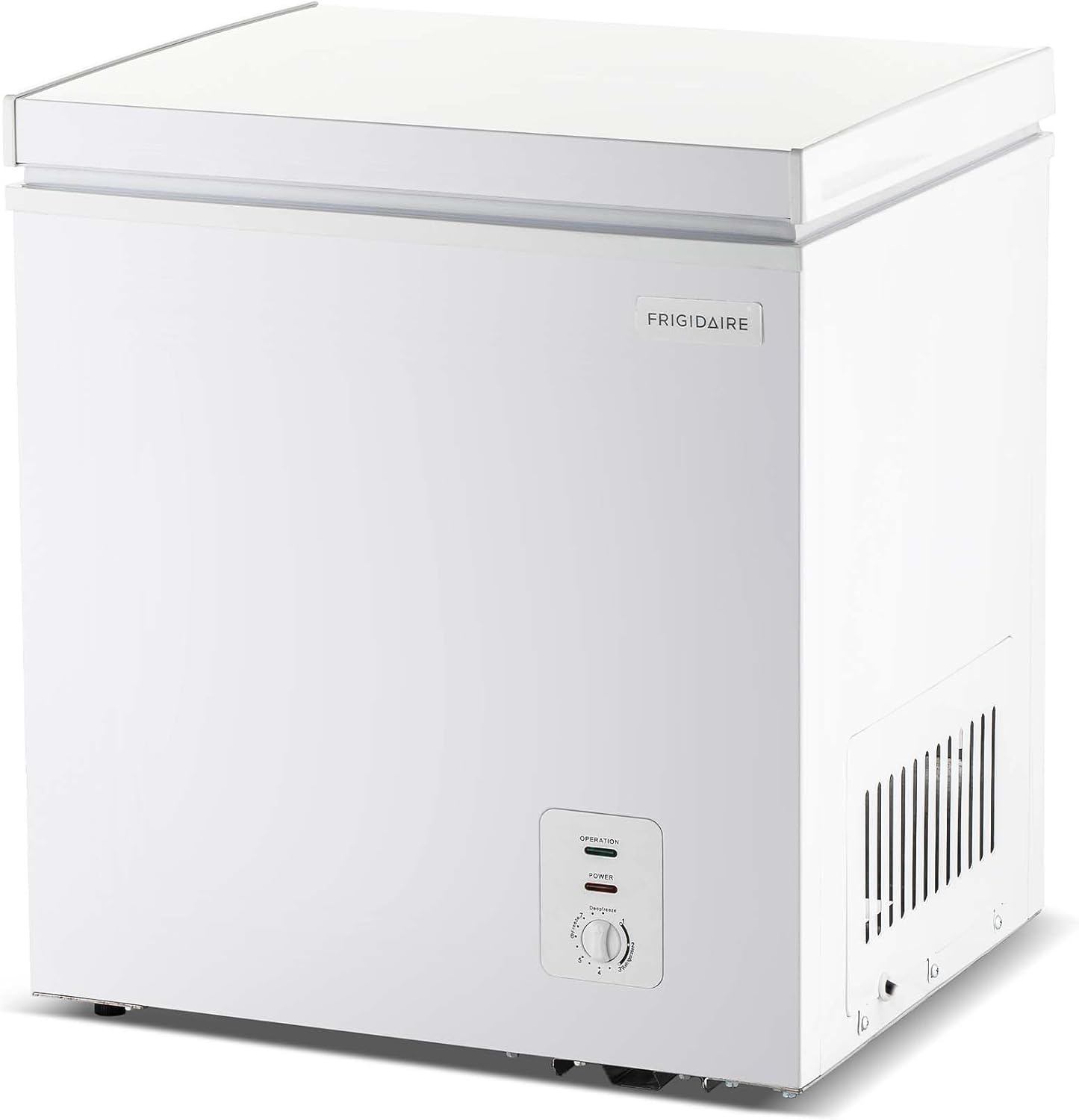
| Wattage | 300 watts |
|---|---|
| Voltage | 120 volts |
| Capacity | 2.1 cubic feet |
| Number Of Shelves | 1 |
| Installation Type | Freestanding |
This Frigidaire chest freezer provides a compact, energy-conscious option for adding freezer capacity to a garage, basement, or small kitchen. It uses a simple compressor-driven design with an exterior adjustable thermostat and a power-on indicator so you can monitor operation easily. Typical use is straightforward: flip up the top lid, store items on the removable vinyl-coated wire basket or below it, and set the temperature you need; manual defrost and an easy-access drain speed cleanup when ice builds up. The unit is built for practical durability with adjustable leveling legs and a recessed handle for frequent access. At roughly 2.0 cu ft capacity it fits small batches of meat, frozen meals, or seasonal produce but will not replace a full-size freezer. Buyers should expect manual defrost maintenance and a basic feature set rather than advanced temperature controls or frost-free operation, but the simple controls and small footprint make it efficient for light-duty, long-term cold storage.
Best for: Buyers looking to maximize cold storage in a small space who prioritize low operating complexity and straightforward, efficient performance.
Less Ideal for: People who need large-capacity or fully frost-free freezers or advanced temperature management for long-term bulk storage should consider larger or feature-rich models.
- Compact footprint that adds freezer space in small rooms or garages
- Adjustable exterior thermostat and power-on indicator for simple temperature control
- Removable vinyl-coated wire basket keeps small items organized and visible
- Manual defrost drain and easy-access drain speed defrosting and cleaning
- Manual defrost requires periodic maintenance as it is not frost-free
- Limited 2.0 cu ft capacity is only suitable for light storage needs
Verdict: A small, energy-conscious chest freezer that delivers simple, efficient cold storage for tight spaces and light household needs.
BODACIOUS Chest Freezer 3.5 Cu Ft

| Capacity | 3.5 cubic feet |
|---|---|
| Voltage | 110 volts |
| Number Of Shelves | 1 |
| Installation Type | Freestanding |
| Specification Met | ETL |
This small chest freezer delivers practical cold storage for apartments, garages, or RVs where space and energy use matter. It uses thick foam insulation and a low-power compressor to keep estimated annual energy costs low, while a turbo freeze mode can bring room-temperature items down quickly. The top-opening design includes a removable basket, built-in drain, and simple temperature control for straightforward organization and maintenance. Noise is kept under 40 dB, so it runs quietly near living areas. Because it is a basic chest freezer with manual defrost and a single shelf/basket, it lacks advanced features like automatic defrost, digital temperature readout, or interior lighting, but that simplicity helps keep purchase and running costs down. For buyers prioritizing compact, energy-efficient frozen storage, this unit is an economical, space-saving option.
Best for: Buyers who need an inexpensive, space-saving freezer that minimizes electricity use and fits tight spaces like apartments, garages, or RVs.
Less Ideal for: People who want large capacity, automatic defrost, or precise digital temperature controls should look at larger or higher-end models.
- Low estimated annual energy use for inexpensive operation
- Compact footprint that fits through narrow doors and under counters
- Quiet operation under 40 dB suitable for living spaces
- Removable basket and built-in drain for easier organization and defrosting
- Manual defrost only, which requires occasional thawing and maintenance
- No digital controls or advanced temperature monitoring
Verdict: If you want an affordable, compact freezer that keeps running costs low, this 3.5 cu ft chest freezer is a practical, energy-efficient choice.
Igloo 3.5 Cu Ft. Upright Deep Freezer

| Wattage | 100 watts |
|---|---|
| Door Orientation | Top |
| Number Of Shelves | 1 |
| Capacity | 3.5 cubic feet |
| Specification Met | ETL |
The Igloo 3.5 Cu Ft. Upright Deep Freezer is a compact, energy-conscious upright freezer designed for extra frozen storage in small spaces. It uses a D-type refrigeration tube and foam insulation to reach low temperatures quickly while the adjustable thermostat (range approx -15°F to 0°F) lets you set the cooling level for different foods. The upright layout and removable hanging wire basket make it easy to organize and access items without bending into a chest, and internal LED lighting improves visibility. Practical touches include a balanced hinge that holds the lid open for loading, front rollers for repositioning, and a drain plug to simplify defrosting. Noise levels are modest, so it can live in a garage, basement, or utility room without distraction. Limitations include modest 3.5 cu ft capacity that may be small for large households and a single shelf arrangement that reduces flexible shelving options, but for buyers prioritizing dependable, efficient secondary storage this freezer performs reliably and quietly.
Best for: Buyers who want a reliable, energy-conscious secondary freezer for garages, basements, or small kitchens and value quiet operation and straightforward temperature control.
Less Ideal for: Those needing large-capacity long-term storage or highly configurable internal shelving should consider larger upright or chest freezers instead.
- Quick-freezing D-type refrigeration tube helps reach low temperatures faster
- Adjustable thermostat for precise temperature control
- Removable hanging basket and LED light for easy organization and visibility
- Balanced hinge, front rollers, and drain plug for convenient use and maintenance
- Quiet operation and foam insulation that improve energy efficiency
- 3.5 cu ft capacity may be too small for families needing large long-term storage
- Single shelf/wire basket layout limits shelving flexibility
Verdict: A compact, quiet, and energy-minded upright freezer that delivers dependable extra frozen storage for small spaces.
Kismile Chest Freezer BD-80

| Capacity | 3.2 cubic feet |
|---|---|
| Door Orientation | Top |
| Number Of Shelves | 1 |
| Installation Type | Freestanding |
The Kismile BD-80 is a compact chest freezer intended for small kitchens, dorms, or offices where extra frozen storage is needed. It offers 3.2 cubic feet of internal space organized with two removable baskets that make short items easy to access. Temperature is controlled with a 7-grade adjustable thermostat that the brand rates from 6.8 F to -7.6 F, so you can choose milder or deeper freezing settings. Practical touches include a balanced hinge that holds the lid open at set angles and a convenient water drain for faster defrost clean-up. The unit uses a low-energy compressor and claims daily consumption of about 0.68 kWh, which helps keep running costs down and aligns with the article goal of energy-efficient options. Trade-offs are its small footprint and limited deep-freeze range compared with larger chest freezers, so it is best for regular household use rather than bulk long-term storage of large items.
Best for: Buyers who prioritize proven performance and lower running costs and want a compact, practical freezer backed by visible customer feedback.
Less Ideal for: People who need large-capacity or very low-temperature deep-freezing for long-term bulk storage should consider larger commercial-style freezers instead.
- Compact 3.2 cu ft capacity fits small spaces like dorms and kitchens
- Seven-level adjustable thermostat for flexible freezing needs
- Two removable baskets keep small items organized and accessible
- Low claimed energy consumption (about 0.68 kWh/day) for lower operating cost
- Balanced hinge lid with set-open angles and built-in water drain for easy defrosting
- Maximum low temperature is modest compared with larger deep freezers
- Small internal volume limits bulk storage for big households
Verdict: Choose this compact chest freezer if you want an energy-conscious, space-saving unit that delivers reliable everyday frozen storage with easy access and low operating cost.
BODACIOUS 7.0 Cu Ft Chest Freezer

| Capacity | 7 cubic feet |
|---|---|
| Voltage | 110 volts |
| Number Of Shelves | 2 |
| Door Orientation | Top |
| Specification Met | ETL |
This 7.0 cu ft chest freezer is built for straightforward home freezing needs, offering energy-saving operation and a quiet compressor suitable for apartments, garages, or small kitchens. It uses a six-position adjustable thermostat so you can dial in colder or milder settings depending on what you store, and a removable storage basket helps keep frequently used items accessible. The exterior defrost drain simplifies cleaning, and the unit is ETL listed and designed to be freestanding or countertop. Expect low running costs compared with larger units and a generally unobtrusive noise level, though the brand advises against running the temperature on the coldest setting continuously to avoid higher power draw and extra compressor wear. The compact footprint makes it easy to place in tight spots, but the top-opening chest format means you will bend to access items and organization is more limited than with an upright freezer. For buyers prioritizing energy efficiency and quiet everyday use, this freezer is a practical, no-frills choice.
Best for: Buyers who want a compact, energy-conscious freezer for extra food storage in small homes, apartments, or garages and prefer a quiet, simple appliance with basic controls.
Less Ideal for: Those who need upright-style shelving, frequent standing access, or large-capacity commercial storage should consider other freezer formats.
- Energy-efficient design aimed at lower daily power consumption compared with larger freezers
- Operates quietly, suitable for living spaces, garages, or offices
- Six-setting adjustable thermostat for flexible temperature control
- Removable basket and exterior defrost drain make day-to-day use and cleaning easier
- Top-opening chest layout requires bending to access contents and limits internal organization options
- Recommended to avoid continuous use on the coldest setting to prevent higher power draw and compressor strain
Verdict: A compact, quiet, and energy-conscious chest freezer that fits small spaces and everyday household freezing needs.
Choosing the Right Energy-Efficient Freezer: Key Factors to Consider
Energy Consumption and Efficiency Ratings
Energy consumption directly affects your ongoing operating costs. Look for documented annual energy use measurements or efficiency labels that indicate lower kilowatt-hour draws. A model that consumes fewer kilowatt-hours will recoup any incremental upfront cost through lower utility bills over time.
Beyond headline ratings, consider how real-world usage changes consumption. Frequent door openings, warm ambient locations, or large thaw-refreeze cycles increase energy draw. Models with smarter compressors or adaptive defrost cycles can reduce wasted run time and improve seasonal efficiency.
Usable Interior Layout
The internal organization determines how effectively you can store and retrieve items without losing cold air. Shelves, dividers, baskets, and removable bins let you keep a tidy load and minimize the time the door is open, which reduces energy waste.
Also pay attention to total usable cubic feet rather than gross capacity. Thick internal walls or awkward compartments can reduce usable space. Consider whether upright shelving or a chest layout better matches the types of items you freeze most often.
Temperature Control and Stability
A freezer that holds steady temperatures uses less energy long term than one that cycles widely. Look for reliable thermostat control and features that prevent hot spots, such as good airflow paths in upright units or tight seals in chest freezers.
Temperature stability matters for food safety and quality. Models that recover quickly after door openings reduce the period food spends in the danger zone, which helps preserve texture and flavor while limiting the need for extra cooling cycles.
Defrost System and Maintenance Needs
Automatic or adaptive defrost systems reduce manual maintenance but may add periodic energy spikes during defrost cycles. Manual defrost chest freezers can be more efficient overall if you maintain them properly, because they avoid frequent automatic defrost heating.
Consider how easy it is to access coils, drain pans, filters, and gaskets for cleaning and service. Poorly accessible components are more likely to be neglected, which degrades efficiency over time. Simpler designs often mean lower long-term upkeep.
Installation Location and Ambient Conditions
Where you place the freezer has a major impact on energy performance. Units installed in unconditioned spaces with wide temperature swings, such as garages, will run more often and draw more power than identical models in a cool, climate-controlled kitchen.
Allow for specified clearances around ventilation paths and avoid tight closets or sun-exposed areas. Proper installation also includes stable, level placement to minimize vibration and wear that can reduce efficiency.
Noise, Vibration, and Daily Usability
A highly efficient freezer that is loud or vibratory may not suit living spaces or attached garages. Compressor noise and vibration affect perceived quality and can indicate mechanical strain that reduces long-term efficiency.
Check for features such as variable-speed compressors, sound-dampening insulation, and secure shelving that reduce rattles. Usability elements like interior lighting, reversible doors, and well-marked controls improve everyday convenience without impacting energy performance significantly.
Upright Vs Chest: Which Fits Your Efficiency Goals
Upright freezers offer easier organization and quicker access to specific items, which reduces door-open time but may sacrifice some insulation performance compared with chest models. Chest freezers typically have tighter seals and less cold-air loss when opened, making them intrinsically efficient for long-term storage of bulk items.
Consider how you use the freezer. If you access it several times a day for single items, an upright design with organized shelving can lower total energy waste. If you store large amounts of frozen goods for extended periods, a chest model can offer better overall energy retention.
- Uprights: Easier access, better organization, typically more internal shelving.
- Chests: Superior cold retention, lower heat infiltration during brief openings.
- Choose based on access frequency and the types of items you store most.
Sizing Right: Capacity Versus Energy Use
Buying the correct capacity is a balance. Oversized freezers waste energy cooling empty space, while undersized units drive overpacking and inefficient temperature recovery. Match usable cubic feet to your expected weekly frozen volume and seasonal peaks.
If you anticipate occasional surges in frozen inventory, consider slightly larger capacity rather than frequent overfilling. Proper shelving and modular bins can make larger units feel organized and reduce energy loss from long door-open times.
- Estimate typical weekly frozen volume and add 20 to 30 percent for peak storage.
- Prioritize usable volume over gross capacity figures.
- Modular storage accessories can improve efficiency by minimizing empty space.
Maintaining Efficiency Over Time
Regular maintenance preserves a freezer's energy advantage. Clean condenser coils, check door gaskets for tight seals, and defrost according to the manufacturer recommendations. Even small air leaks around doors can force the compressor to run more frequently and increase energy use.
Monitor performance seasonally. If ambient temperatures change markedly, adjust setpoints to maintain safe storage without excessive cooling. Simple habits like grouping items and labeling shelves reduce time spent searching and lower cumulative door-open duration.
- Clean coils at least twice a year or as recommended.
- Inspect and replace worn gaskets to prevent air leakage.
- Organize contents to minimize door-open time and temperature recovery cycles.
Features That Improve Efficiency
Certain features materially affect energy performance. High-quality insulation, thicker cabinet walls, and well-sealed doors reduce heat gain. Variable-speed or inverter compressors run more efficiently across a range of loads compared with single-speed units.
Additional helpful features include adaptive or demand-driven defrost, LED interior lighting that minimizes heat, and intuitive controls that let you fine-tune setpoints and eco modes for lower energy use during low-demand periods.
- Look for thicker insulation and tight door seals.
- Inverter compressors often offer better part-load efficiency.
- Adaptive defrost and LED lighting help reduce wasted energy.
Placement and Ventilation Tips
Proper placement ensures the freezer can shed heat efficiently. Provide the recommended clearance for ventilation and avoid enclosed spaces that trap heat around the condenser. Elevated ambient temperatures increase compressor run time and energy consumption.
If placing a freezer in an unconditioned area, choose a model rated for that environment and expect somewhat higher energy use. Keep the area free of debris and maintain airflow to prolong component life and preserve efficiency.
- Follow clearance guidelines for air intake and exhaust.
- Avoid direct sunlight and hot surfaces near the cabinet.
- Keep the surrounding area clean to prevent dust buildup on coils.
How We Chose the Best Energy-Efficient Freezer
We shortlisted freezers that demonstrate measurable energy savings while retaining practical storage and temperature control. Our selection filters focused on tested energy consumption ratings and third-party efficiency certifications where available. We prioritized models with sensible internal layouts that reduce time with the door open, robust temperature stability across load conditions, and features that support efficiency such as improved insulation, low-power compressors, or adaptive defrost systems. Excluded from consideration were specialty units with highly restricted use cases, units lacking verifiable efficiency data, and models that sacrifice core freezing performance for marginal energy gains. We also screened for basic durability indicators including simple, serviceable components and accessible parts. The dimensions and storage formats were considered to ensure a representative range of cabinet and chest styles for different user needs. Final picks reflect a balance among measured energy draw, usable capacity, noise, and maintenance demands.
Our full evaluation process is outlined in our review methodology.
FAQ
How much energy can I realistically save with an energy-efficient freezer?
Savings depend on baseline usage and local electricity rates, but efficient models typically use noticeably fewer kilowatt-hours annually than older or poorly insulated units. Real-world savings also rely on correct sizing, installation, and maintenance.
Is an automatic defrost system better for efficiency than manual defrost?
Automatic defrost adds periodic heating cycles that spike energy use during defrost, but it reduces manual labor and frost buildup that otherwise reduces usable volume. Manual defrost chest freezers can be more efficient overall if you defrost them regularly and correctly.
Can I install an energy-efficient freezer in an unheated garage?
You can, but expect higher energy use if ambient temperatures swing widely. Select a model rated for unconditioned spaces and follow the manufacturer guidance on temperature ranges and ventilation to maintain performance and avoid damage.
How often should I check door gaskets and seals?
Inspect gaskets every few months for cracks, gaps, or compression set. A simple paper test can detect leaks. Replacing worn gaskets promptly prevents cold-air loss and keeps energy consumption from creeping upward.
Do inverter compressors make a big difference?
Inverter compressors generally run more efficiently across varying loads, reducing on-off cycles and lowering energy use in typical home conditions. They also tend to deliver quieter operation and gentler temperature control.
Final Verdict
Prioritize measurable energy consumption, usable storage, and stable temperature control when choosing an energy-efficient freezer. Balance capacity against expected use so you do not cool unnecessary empty space, and consider the installation location to avoid excessive ambient heat that undermines efficiency. Maintain the unit with regular coil cleanings and gasket inspections to preserve long-term performance. Focus on the tradeoffs between access convenience and insulation advantages to select the freezer that best meets your storage habits and energy goals.