
Note: This article contains affiliate links. If you click on these links and make a purchase, we may earn a small commission at no extra cost to you. This helps support our research and content. Read our full affiliate disclosure here.
Choosing the right energy-efficient portable electric heater matters if you want predictable warmth without wasting electricity or adding safety risk. The right heater can reduce runtime, cut energy consumption, and keep a room comfortable all evening while using less power. This guide focuses on top-performing energy-efficient portable electric heaters that balance heat output, controls, and safety so you can pick the right unit for bedrooms, home offices, or small living spaces. Below are our shortlisted top picks and the evaluation factors we used to compare them, followed by practical buying guidance to help you match a heater to your space and habits.
Top Picks at a Glance
| Best Overall The best all-around choice for most situations | Lasko Ceramic Tower Heater 751320 |  |
| Best Quality Built to a higher standard if you want something more solid | Dr. Infrared Heater DR-968 |  |
| Best Value The sweet spot between price and what you get | Amazon Basics Ceramic Space Heater DQ1927-Y |  |
| Best Budget The cheapest option that still gets the job done reliably | Jyxmor PTC-800BR Space Heater |  |
| Top Rated A top-rated pick with lots of positive feedback | DREO Space Heater DR-HSH004 |  |
| Most Popular A crowd favorite that many people choose with confidence | Aikoper NT15-20A Space Heater |  |
| Best Seller A high-volume bestseller chosen again and again | DREO Space Heater HSH006 |  |
Lasko Ceramic Tower Heater 751320

| Heat Output | 1500 watts |
|---|---|
| Heating Element | Ceramic |
| Power Source | Corded Electric |
| Indoor Outdoor Usage | Indoor |
| Recommended Uses For Product | Desk, Garage, Home |
The Lasko 1500W Ceramic Tower Heater is a slim, portable electric heater designed to warm small to medium rooms. It uses a ceramic heating element and forced-air output to deliver quick warmth, with widespread oscillation to spread heat more evenly across a room. Controls include two heat settings plus an adjustable electronic thermostat, a seven-hour auto-off timer, and a multi-function remote that stores on-board for convenience. Built-in safety features such as overheat protection and cool-touch housing make it suitable for bedrooms and living spaces, and the carry handle and narrow footprint make repositioning easy. Expect steady, noiseless operation on its low setting and more noticeable output on high; because it is a 1500-watt fan-forced heater it provides targeted zone heating rather than whole-house warmth and will increase electricity use while running at full power. The unit lacks advanced smart controls or a child lock on this model, but its straightforward controls and effective oscillation make it a practical choice for energy-conscious users who want adjustable, room-focused heat without complexity.
Best for: Buyers who want a simple, efficient portable heater for targeted room heating and who prioritize easy controls, safety features, and movable, space-saving design.
Less Ideal for: People seeking whole-house heating, smart-connected controls, or many heat-speed options should consider other solutions.
- 1500W ceramic element delivers quick, effective zone heating.
- Widespread oscillation helps distribute warmth across a room.
- Electronic thermostat and timer allow customized runtime and temperature control.
- Remote control with on-board storage for easy adjustments from a distance.
- Built-in safety features including overheat protection and cool-touch housing.
- No smart home connectivity or app control.
- Only two heat settings limit fine-grained power management.
Verdict: A straightforward, safety-focused 1500W ceramic tower heater that provides efficient, adjustable zone heating for small to medium rooms.
Dr. Infrared Heater DR-968

| Wattage | 1500 Watts |
|---|---|
| Heating Coverage | 576 square feet |
| Number of Speeds | 3 |
| Voltage | 120 |
| Amperage | 12.5 A |
The Dr. Infrared Heater DR-968 is a portable 1500 W space heater that uses a dual heating system (PTC plus infrared quartz) and a high-velocity low-noise blower to warm rooms quickly and evenly. It is typically used as a supplemental heater for bedrooms, living rooms, home offices, or other indoor spaces where fast, directed warmth is needed. Notable features include an electronic thermostat with a 50 to 85 F range, auto energy-saving mode that cycles between high and low power, three power settings (Auto/Low/High), tip-over and overheat protection, a 12-hour timer, caster wheels for moving the unit, and a remote control. Practical benefits are efficient heat transfer that targets objects rather than just air, relatively quiet operation (around 39 dB), and safety certifications for household use. Important limitations are that it is a plug-in electric heater limited to 1500 W output and designed for indoor spot or room heating rather than whole-house use, and it weighs about 19 pounds which is portable but not ultra-light. Buyers should also note it relies on the thermostat cycling behavior to save energy rather than variable power modulation.
Best for: Buyers who prioritize efficient, performance-oriented room heating and want a portable unit that delivers strong, fast warmth with safety features and quiet operation.
Less Ideal for: People seeking a lightweight travel heater, whole-house heating solution, or variable-power modulation beyond simple high/low cycling should look elsewhere.
- Dual heating system (PTC plus infrared quartz) for faster, more even heat transfer
- Energy-saving Auto mode that cycles between high and low settings to maintain set temperature
- Safety features including tip-over and overheat protection and UL certification
- Quiet high-pressure blower for broader heat distribution with low noise
- Remote control and timer for convenient operation from across the room
- Limited to 1500 W plug-in power so not suitable as the sole heat source for very large homes
- Relatively heavy compared with ultra-compact portable heaters
Verdict: Choose the DR-968 if you want a performance-focused portable heater that delivers fast, efficient infrared-plus-convection warmth with built-in safety and quiet operation.
Amazon Basics Ceramic Space Heater DQ1927-Y

| Heat Output | 1500 watts |
|---|---|
| Number of Speeds | 3 |
| Power Source | Corded Electric |
| Voltage | 120 volts |
| Max Temperature Setting | 130 °F |
This Amazon Basics ceramic heater delivers quick, focused heat for small rooms and workspaces using a 1500W ceramic element and convection airflow. It offers three modes—high (1500W), low (900W), and fan-only—so you can balance warmth and energy use depending on the room and how long you run it. A simple adjustable thermostat and an indicator light make operation straightforward, and built-in tip-over and overheat protection add practical safety for everyday placement on a desk or floor. The unit is lightweight and compact, so moving it between rooms is easy, and the manufacturer rates noise at about 43 dB, keeping it unobtrusive. Expect fast spot heating rather than whole-house warmth, and do not use it in very damp areas like bathrooms. For those who want a no-frills, energy-conscious supplemental heater for personal spaces, this model is predictable, safe, and easy to control.
Best for: Buyers who want a compact, no-frills supplemental heater to quickly warm a single room or workspace while keeping energy use manageable.
Less Ideal for: People needing to heat large open areas, whole apartments, or for use in damp environments should look for higher-capacity or moisture-rated options.
- Three heat modes (1500W, 900W, fan-only) for flexible energy use
- Adjustable thermostat for maintaining a target temperature
- Compact, lightweight design for easy room-to-room portability
- Built-in tip-over and overheat protection for safer operation
- Not designed for high-humidity rooms such as bathrooms or laundry areas
Verdict: A straightforward, portable ceramic heater that gives fast personal heating with simple controls and built-in safety for energy-conscious room-level use.
Jyxmor PTC-800BR Space Heater

| Heating Element | PTC Ceramic |
|---|---|
| Heat Output | 600 watts |
| Heating Coverage | 86–161.4 ft² |
| Number of Speeds | 2 |
| Max Temperature Setting | 55 °C |
This compact Jyxmor tower heater uses a PTC ceramic element and forced-air delivery to produce usable warmth within seconds, making it a practical personal heater for bedrooms, home offices, or desks. It offers two heat modes and a 1–12 hour timer so you can choose higher output for quick warm-up or a low setting to save energy while maintaining background heat. The heater covers roughly 86–161 sq ft, runs on 600 watts at 110 volts, and keeps noise low for work or sleep. Safety features include an internal overheat cutoff that shuts the unit off around 55°C, but the design lacks tip-over protection, so it must sit on a stable flat surface. Controls are simple and the small footprint and carry handle make it easy to move between rooms, though the Celsius-only display and limited protection features are worth noting if you need wall-to-wall coverage or use around pets and children.
Best for: Buyers seeking an inexpensive, energy-conscious personal heater for small rooms, desks, or bedside use who prioritize quick warm-up and portability over full-room heating.
Less Ideal for: People who need a heater with tip-over protection for use around pets or kids or those who want a unit powerful enough to heat large open living spaces.
- PTC ceramic heating element provides fast warm-up and steady heat
- Two heat modes plus 1–12 hour timer for flexible, energy-conscious use
- Compact, lightweight tower design with handle for easy portability
- Quiet operation suitable for bedrooms and home offices
- No tip-over protection, so it must be used only on flat, stable surfaces
- Temperature readout is Celsius only, which may confuse some U.S. users
Verdict: A budget-friendly, energy-efficient personal heater that delivers fast, quiet warmth for small rooms and desks.
DREO Space Heater DR-HSH004
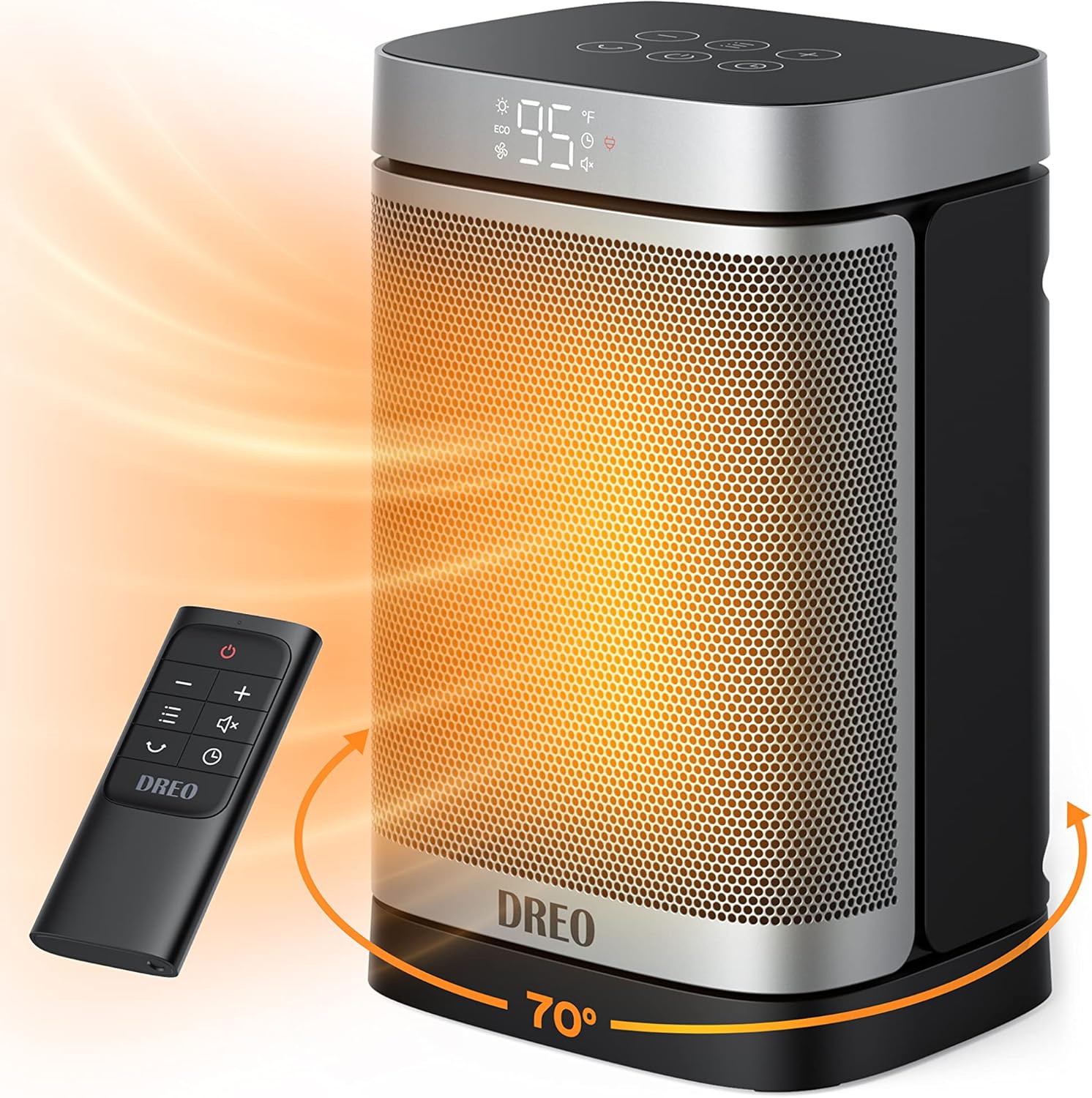
| Heat Output | 1500 watts |
|---|---|
| Heating Element | PTC Ceramic |
| Heating Coverage | 200 sq.ft |
| Special Features | Programmable Thermostat, 1-12h Timer, Oscillating, Detachable Filter |
| Number of Speeds | 5 |
The DREO DR-HSH004 is a compact tower heater designed to deliver fast, directed warmth for small to medium rooms. It uses a PTC ceramic element and up to 1500 watts of power with DREO Hyperamics technology to heat quickly, and the 70° oscillation helps spread warmth across a wider area rather than a single spot. Controls include a programmable 41–95°F digital thermostat (1°F increments), a 1–12 hour timer, ECO mode for automatic power adjustment, five fan speeds, an LED display, and a supplied remote for hands-off adjustments. Safety features are comprehensive for this class, including ETL listing, tip-over and overheat protection, an enhanced safety plug, and flame-retardant materials. Practical benefits include precise temperature control for energy-conscious use and a detachable filter for basic maintenance. Limitations are inherent to portable electric heaters: it requires a standard 120V outlet and is best suited for zones up to about 200 sq ft, so it is not a whole-house solution and will draw significant current at high settings.
Best for: Buyers who prioritize reliable, controllable space heating for a single room and want built-in safety features and energy-saving modes.
Less Ideal for: People seeking whole-home heating or a solution for very large, open-plan spaces should consider higher-capacity systems instead.
- Programmable digital thermostat with 1°F increments for precise temperature control
- ECO mode that adjusts heat automatically to conserve energy
- 70° oscillation and five speeds to distribute warmth across a room
- Multiple safety protections including tip-over and overheat shutoffs and ETL listing
- Includes remote control and 1–12 hour timer for convenient, hands-off operation
- 1500W maximum power means noticeable energy draw at highest setting
- Designed for rooms up to about 200 sq ft, so not effective for large open areas
Verdict: A compact, safety-focused portable heater that provides precise thermostat control and an ECO mode to heat single rooms efficiently.
Aikoper NT15-20A Space Heater

| Heat Output | 1500 watts |
|---|---|
| Heating Coverage | 150sq.ft |
| Number of Speeds | 3 |
| Voltage | 120 volts |
This compact Aikoper heater uses a PTC ceramic element and an integrated fan to deliver heat quickly across small rooms or personal zones. It offers three heat settings (low, medium, high) plus a fan-only mode and a manual thermostat dial for simple temperature control, making it handy on desks, bedside tables, or in small offices. Safety features include tip-over and overheat protection and ETL certification, which helps reduce worries about daily use around kids or pets. The unit is lightweight and has a built-in handle for easy moving, and the manufacturer claims it can warm up to about 150 square feet. Limits include basic mechanical controls rather than digital scheduling or precise setpoint readouts, and its small pedestal form is meant for single-room spot heating rather than whole-house use. Noise is reported to be low for normal tasks, but the fan still runs when heating so it is not completely silent. For anyone seeking a straightforward, safety-focused personal heater that warms quickly, this does the job without complicated setup.
Best for: Buyers who prioritize a fast, no-frills personal heater with clear safety features and many positive user reviews for everyday indoor use.
Less Ideal for: People who need digital controls, precise temperature programming, or a unit capable of heating multiple large rooms should consider larger or feature-rich alternatives.
- Rapid PTC ceramic heating for quick warm-up
- Three heat settings plus fan-only mode for flexible use
- Built-in safety: tip-over and overheat protection with ETL certification
- Compact, lightweight design with handle for easy portability
- Quiet operation suitable for bedrooms and offices
- Manual dial controls lack precise digital temperature display or scheduling
- Designed for small rooms and not suitable for heating larger areas
Verdict: Aikoper NT15-20A is a compact, safety-minded 1500W personal heater that delivers fast, energy-efficient spot warmth for small rooms.
DREO Space Heater HSH006

| Heat Output | 1500 watts |
|---|---|
| Heating Element | PTC Ceramic |
| Heating Coverage | 200 sq.ft |
| Number of Speeds | 4 |
| Built-in Timer | 1-12 H |
The DREO HSH006 is a compact tower space heater that delivers quick forced-air warmth using a PTC ceramic element and a brushless DC motor for quiet operation. It is designed for indoor rooms up to about 200 sq ft and offers multiple heat modes (including ECO and fan-only), a 12-hour timer, remote control, and precise thermostat control from 41 to 95 F in 1 F increments. Safety features include tip-over detection, overheat protection, flame-retardant materials and an ETL listing, which suit cautious households. In practice the 1500W output heats small living rooms or bedrooms rapidly and the timer plus memory and child-lock functions make it easy to run without fuss. The unit is lightweight and easy to move with its built-in handle, and the low noise level (about 34 dB) keeps it bedroom-friendly. Expect typical electric-heater energy draw at full power, so long-term running will add to utility use compared with whole-home heating, but the ECO mode and fine thermostat control help limit wasted energy when you only need localized warmth.
Best for: Buyers who want a safe, easy-to-use personal heater for bedrooms or small living areas and prioritize precise temperature control and quiet operation.
Less Ideal for: People needing to heat large open spaces or seeking the lowest possible running cost for whole-home heating should consider other solutions.
- Fast PTC ceramic heating with 1500W output for quick warmth in small rooms
- Precise thermostat (41–95 F in 1 F steps) and ECO mode to reduce unnecessary run time
- Multiple convenience features: remote control, 12-hour timer, memory and child lock
- Built-in safety: tip-over sensor, overheat protection, flame-retardant materials and ETL listing
- Quiet brushless DC motor operation around 34 dB suitable for bedrooms
- 1500W power means significant electricity draw at max heat compared with central heating
- Designed for rooms up to about 200 sq ft so effectiveness is limited in larger spaces
Verdict: A safety-focused, quiet 1500W tower heater that gives precise, efficient spot heating for bedrooms and small rooms.
Choosing the Right Energy-Efficient Portable Electric Heater: Key Factors to Consider
Thermostat and Temperature Control
A precise thermostat reduces runtime and prevents overshooting room temperature. Digital or accurate mechanical thermostats let the heater cycle on and off at appropriate intervals, which can cut energy use compared with units that run at fixed power levels. Variable heat settings and programmable timers let you match output to real living conditions, such as lower night settings and higher day settings, which leads to measurable savings over time.
Poor thermostat calibration can cause short cycling or extended run times, both of which increase energy consumption. Look for controls that allow small temperature increments and clear feedback so you can set and maintain a target room temperature without guessing.
Heating Technology and Energy Use
Different heating elements and distribution methods affect how quickly and efficiently a heater warms a room. Fan-forced ceramic elements heat quickly and distribute warmth more evenly, which often reduces the time the unit needs to run. Radiant elements and oil-filled radiators provide steady background heat useful for longer runs and may feel more comfortable at lower surface temperatures.
Energy-efficient models combine appropriate element type with controllable output levels. Also consider whether the unit has an eco or low-power mode, which lowers wattage while maintaining comfort. Matching the technology to your typical session length and room size helps reduce wasted electricity.
Safety Systems
Safety matters for any portable electric heater because these units run at high temperatures near combustible materials and are used unattended in many homes. Essential systems include tip-over shutoff, overheat protection, cool-touch housings, and well-managed cord strain relief. These features reduce fire risk and make continuous use safer in bedrooms and around pets.
Electrical safety also includes proper insulation, grounded plugs if required in your region, and clear spacing recommendations. A heater that cycles correctly and shuts off in fault conditions prevents damage that could otherwise lead to higher maintenance or replacement costs.
Size, Output, and Room Match
A heater's wattage and output profile determine whether it suits small bedrooms, medium living rooms, or tight work nooks. Oversized units waste energy by overheating a small room and cycling off frequently, while undersized heaters run constantly and still leave the space cold. Consider the unit's rated coverage area along with adjustable output so you can scale power to room size.
Also think about placement. Some designs direct airflow for spot heating, while others provide more diffuse warmth suitable for whole-room comfort. Choose a size and output that match how and where you plan to use the heater to avoid unnecessary electricity use.
Controls, Timers, and Programmability
Convenient controls and scheduling features let you limit run time and avoid wasting energy when heat is unnecessary. A programmable timer or daily schedule lets you turn the heater on shortly before you need it rather than leaving it running all day. Remote controls or app connectivity can add convenience but the core value is the ability to set and maintain efficient heat cycles.
Look for clear, reliable controls that do not require constant adjustment. Simpler interfaces with well-labeled settings are often better in practice than complex menus that users ignore.
Noise and Daily Comfort
Noise influences where a heater is appropriate. Fan-assisted units tend to be louder but warm up a room faster, which may be acceptable for living rooms. Radiant and oil-filled heaters are usually quieter, making them preferable for bedrooms or quiet workspaces. Noise impacts perceived comfort and can affect how long you are willing to run the heater.
Consider the tradeoff between faster warm-up and quieter operation. If you plan to run the heater overnight or during focused work, lower noise levels can justify choosing a slightly slower-heating yet more efficient design.
Sizing Your Heater to the Room
Calculate the approximate heat requirement by estimating the cubic footage and the typical temperature lift you need. As a rule of thumb, a small bedroom will need much less continuous wattage than an open-plan living area. Check manufacturer guidance for rated coverage but prioritize adaptable output so you can match conditions.
Also consider insulation and ceiling height. Poorly insulated rooms or tall ceilings increase the heating load and may require a unit with higher output or a supplemental heat source to maintain comfort efficiently.
- Measure room area and consider ceiling height
- Account for drafts, windows, and insulation
- Choose a unit with adjustable power settings
Placement and Ventilation Best Practices
Place the heater on a stable, level surface away from curtains, bedding, and other flammable items. Maintain the manufacturer-recommended clearance around the unit to ensure safe airflow and prevent hot spots. For fan-assisted units, avoid blocking the intake or outlet to preserve airflow efficiency.
Good placement also improves perceived warmth. Directing airflow toward the center of the room or toward occupied seating areas heats lived space faster, reducing overall runtime.
- Keep clearance in every direction per guidelines
- Avoid placing on soft surfaces like carpets or beds
- Position near where you spend time to reduce wasted heat
Using Timers and Thermostats to Save Power
Make use of timers and thermostats to limit runtime to when heat is needed. Set the heater to come on shortly before you wake or arrive home instead of leaving it on continuously. Modest temperature setbacks at night can yield real energy savings with minimal comfort loss.
For rooms used briefly, a short preheat cycle followed by a lower maintenance setting often uses less energy than running at high output continuously.
- Program schedules around occupancy patterns
- Use setback temperatures overnight
- Prefer units with accurate thermostat control
Noise Considerations for Different Rooms
If the heater will run in a bedroom or study, prioritize low-noise designs. Oil-filled and some radiant units operate nearly silently, making them better suited to sleeping environments. Fan-based heaters vary by fan speed and may include quiet modes that reduce airflow and noise.
For shared living areas where noise is less critical, faster-warming fan units can be acceptable and may reduce total runtime by quickly reaching the target temperature.
- Match noise level to room use
- Look for quiet or eco modes for night use
- Test noise at lower fan speeds when possible
Maintenance and Longevity Tips
Keep the heater free of dust and lint by vacuuming intake grills and wiping external surfaces. Dust buildup reduces airflow and can cause the unit to run hotter or trigger safety cutouts prematurely. Replace or clean any filters if your unit includes them.
Inspect the power cord and plug for damage periodically and avoid using extension cords long-term. Proper maintenance preserves performance and reduces the chance of faults that could require replacement.
- Clean intake grills regularly
- Check cords and plugs before each heating season
- Store the unit in a dry place during off-season
How We Chose the Best Energy-Efficient Portable Electric Heater
We prioritized features that directly affect running cost, comfort control, and safety. Efficiency measures included thermostat accuracy, variable power settings, and whether the heater uses more efficient heating elements or fan-assisted distribution. Control and usability covered the responsiveness of thermostats, presence of programmable timers, and ease of adjusting heat levels. Safety checks focused on tip-over protection, overheat shutoff, cool-touch surfaces, and reliable electrical insulation. Build and durability factors considered thermal-resistant materials and user-serviceable parts. Noise levels and airflow design were included because sound and heat distribution matter for bedrooms and workspaces. We excluded units that rely solely on gimmicky energy claims without specifying control features or safety systems. We did not consider large-space commercial units or fixed-install heaters because this roundup is limited to portable electric heaters appropriate for residential rooms. Final selections reflect a balance of documented efficiency features, practical safety systems, and user-friendly controls.
Our full evaluation process is outlined in our review methodology.
FAQ
How much will a portable electric heater increase my electricity use?
It depends on the heater wattage and how long you run it. A 1,500-watt unit running for one hour uses 1.5 kWh. Using thermostats and timers to limit run time and choosing efficient modes reduces total consumption.
Are fan heaters more energy-efficient than oil-filled radiators?
Fan heaters warm a room faster and may reduce run time, but they can be noisier. Oil-filled radiators provide steady heat with lower surface temperatures and can be more efficient for long, continuous use. Which is more efficient depends on how you use the heater.
Can I leave a portable electric heater on overnight?
Many modern units include overheat protection and tip-over shutoff, which make overnight use safer, but you should follow manufacturer guidance and keep clearance from bedding and curtains. Using lower thermostat settings and timer features reduces risk and energy use.
How do I choose the right wattage for my room?
Estimate the room area and consider insulation. Smaller, well-insulated rooms need less wattage. Look for adjustable output so you can lower power in small spaces and increase it in larger or poorly insulated rooms.
Do programmable timers really save energy?
Yes. Timers prevent unnecessary runtime by switching the heater on only when needed. Short preheat cycles and setback temperatures are effective tactics that reduce total energy use without compromising comfort.
Final Verdict
Prioritize accurate temperature controls, reliable safety features, and a heating technology that matches how you use the room. Smaller, well-insulated rooms benefit from lower-wattage units with precise thermostats, while larger or poorly insulated spaces may need higher output or faster-distributing designs. Consider noise, placement, and programmability together with energy modes to keep runtime and bills down. Use the evaluation criteria here to weigh tradeoffs and choose a portable electric heater that delivers safe, efficient, and dependable warmth.