
Note: This article contains affiliate links. If you click on these links and make a purchase, we may earn a small commission at no extra cost to you. This helps support our research and content. Read our full affiliate disclosure here.
If you use your garage for projects, storage, or as a workshop, the right heater makes the space usable through cold months. A heater for a 500 square foot garage must deliver enough continuous heat to maintain comfortable temperatures while running safely around vehicles and tools. It also needs efficient operation to avoid excessive energy waste and features that match your installation preferences. This guide shortlists the top heater options for a 500 square foot garage and explains the criteria used to evaluate them. You will see products that prioritize steady heat output, clear safety systems, and installation flexibility. Read on to find the kinds of heaters that fit your space and how to choose one that meets your needs.
Top Picks at a Glance
| Best Overall The best all-around choice for most situations | InoKraft 7,500W Garage Heater |  |
| Best Quality Built to a higher standard if you want something more solid | Mr. Heater Big Maxx F260550 |  |
| Best Value The sweet spot between price and what you get | Comfort Zone Ceiling Garage Heater CZ220 |  |
| Best Budget The cheapest option that still gets the job done reliably | Dura Heat EUH1465 1500W Heater |  |
| Top Rated A top-rated pick with lots of positive feedback | DR. Infrared Heater DR-968 |  |
| Most Popular A crowd favorite that many people choose with confidence | Heat Storm Phoenix HS-1500-PHX-WIFI |  |
| Best Seller A high-volume bestseller chosen again and again | Mr. Heater 30,000 BTU Vent Free Heater |  |
InoKraft 7,500W Garage Heater
| Heat Output | 7500 watts |
|---|---|
| Heating Coverage | 750 sq ft |
| Power Source | 240V corded electric |
| Temperature Range | 40–99 °F |
| Number of Speeds | 2 |
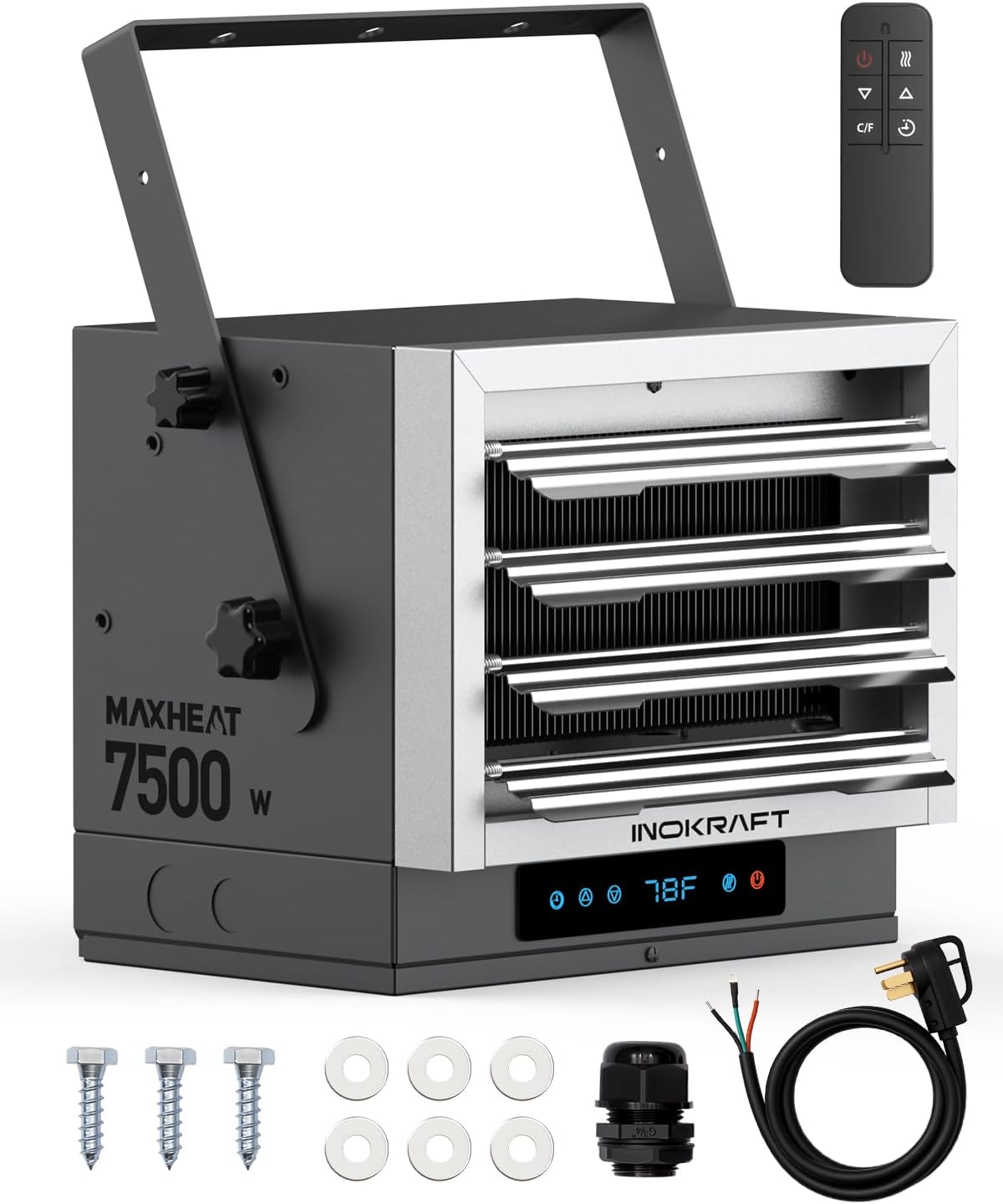
The InoKraft 7,500W garage heater is a hardwired 240V forced-air unit built to heat medium to large garages and workshops quickly. It offers manual high/low heat settings plus an ECO mode that adjusts output based on ambient temperature to save energy, and a digital thermostat with a 1–24 hour timer for set-and-forget operation. The unit mounts to a wall or ceiling and provides adjustable louvers and five angle positions to direct warm air where you need it. Safety features include overheat protection and a 90-second fan runout after shutdown. Installation requires professional wiring to a double-pole breaker and a NEMA 14-50 connection, so it is more of a fixed, permanent solution than a portable heater. Sound level is reported around 65 dB, so it is noticeable but acceptable for a garage or shop. Practical benefits are fast, even heat distribution, programmable control, and energy-saving automatic behavior, while trade-offs are the need for dedicated 240V wiring and permanent mounting which add installation complexity and cost.
Best for: Buyers who want a permanent, high-output heater to reliably warm a one- to two-car garage or workshop and who prioritize controllable, energy-aware heating over portability.
Less Ideal for: People who need a portable or plug-in heater, who lack access to a 240V circuit, or who prefer a no-installation, temporary solution.
- High 7,500W output suitable for heating garages up to ~750 sq ft
- ECO mode that modulates output to reduce energy use
- Digital thermostat with 1–24 hour timer and remote for convenient control
- Wall or ceiling mount with adjustable louvers for directed, space-saving heating
- Built-in safety features including overheat protection and post-shutoff fan runout
- Requires professional hardwiring to a 240V double-pole circuit, not plug-and-play
- Permanent installation limits portability and requires planning for placement
Verdict: If you want a powerful, permanently mounted garage heater that delivers programmable, energy-conscious warmth for roughly 500–750 sq ft, this 7,500W InoKraft unit is a solid choice.
Mr. Heater Big Maxx F260550

| Heat Output | 50,000 BTU |
|---|---|
| Heating Coverage | 1667 sq ft |
| Power Source | Natural Gas |
| Mounting Type | Ceiling Mount |
The Mr. Heater Big Maxx F260550 is a ceiling-mounted forced-air unit heater that delivers 50,000 BTU to heat large workspaces. It is typically installed in garages or workshops using the included angle brackets and wired to a standard 120V outlet, then connected to natural gas with an LP conversion kit available in the box. The high-powered fan and adjustable louvers push warm air across the space and the unit supports vertical or horizontal venting, which helps tailor airflow for different ceiling layouts. Safety features include a high temperature shut-off and gas flame safety shut-off, and the unit is compatible with standard 24V or Wi-Fi thermostats for temperature control. Practical benefits are rapid, wide-area heating and a low-profile ceiling mount that keeps floor space clear. Important limitations are its size and clearance requirements that assume a minimum 8 to 10 foot ceiling, and that a 50,000 BTU unit is larger than needed for a 500 sq ft garage so it may run shorter cycles or be less efficient in small spaces.
Best for: Buyers who prioritize strong, fast heating for workshop or garage projects and want a ceiling-mounted gas unit that integrates with thermostats for controlled, powerful output.
Less Ideal for: Those with low ceilings, limited venting options, or anyone seeking a compact, lower-output heater specifically optimized for small single-car garages.
- High 50,000 BTU output for rapid heating of large garages and workshops
- Ceiling mount design preserves floor space and spreads heat with a powerful fan
- Includes LP conversion kit and mounting brackets for flexible fuel and installation
- Compatible with standard 24V and Wi-Fi thermostats for modern control
- Intended for much larger areas which can make it oversized for a 500 sq ft garage
- Requires 8–10 foot minimum ceiling clearance and proper venting which may limit placement
Verdict: Choose the Big Maxx when you need powerful, ceiling-mounted gas heat that quickly warms large garages or workshops.
Comfort Zone Ceiling Garage Heater CZ220

| Power Source | Hard-Wired Electric |
|---|---|
| Heating Method | Forced Air |
| Heat Output | 17065 british thermal units |
| Voltage | 240 |
| Number of Speeds | 3 |
The Comfort Zone CZ220 is a ceiling‑mounted 240V fan‑forced heater built for garage and workshop use where floor space is at a premium. It hard‑wires into the electrical system and offers three heat settings (3,000, 4,000, 5,000W) selectable with simple front knobs and a manual thermostat, so you can aim for steady background heat or a stronger burst when you need it. Louvers and an adjustable mounting angle let you direct warm air toward a workstation or a drafty corner, and the heavy‑gauge steel body feels rugged enough for a rough garage environment. Safety features include an overheat sensor that shuts the unit off and a power indicator light for visual confirmation. The unit is best suited to rooms up to about 1,000 sq ft but is a particularly practical pick for a 500 sq ft garage because it frees up floor space and provides targeted airflow; it does require 240V hardwiring and professional or competent DIY installation, and it does not have remote control or Wi‑Fi thermostat integration.
Best for: Buyers seeking a durable, space‑saving heater to provide steady, directed warmth for a medium-sized garage and who prioritize simple manual controls and reliability over smart features.
Less Ideal for: People who need a portable or plug‑in heater, want app or remote control, or cannot accommodate a 240V hardwired installation should consider other options.
- Ceiling mount saves floor space and directs heat where needed.
- Three power settings let you choose low, medium, or high output.
- Rugged heavy‑gauge steel construction for durability in garage environments.
- Adjustable louvers and mounting angle for targeted heating.
- Built‑in overheat protection and a power indicator light for safer operation.
- Requires 240V hardwired installation, not plug‑and‑play.
- No smart controls or remote thermostat compatibility.
Verdict: A rugged, ceiling‑mounted 240V heater that saves floor space and delivers reliable, targeted heat for a 500 sq ft garage.
Dura Heat EUH1465 1500W Heater

| Heat Output | 5120 BTU |
|---|---|
| Power | 1500 Watts |
| Voltage | 120 volts |
| Cord Length | 6 Ft |
The Dura Heat EUH1465 is a portable forced-air electric heater that uses a PTC ceramic element and a high-velocity fan to deliver rapid warmth to small work areas. It is typically used on the floor or on its included base stand in garages, workshops, basements, or greenhouses where quick spot heating is needed. Notable features include a built-in adjustable thermostat, a fan-only mode for year-round circulation, a 6 ft polarized power cord, and an overheat shut-off for safety. In practice the unit is lightweight and easy to move, and the steel cabinet feels durable for shop use; the fan spreads heat quickly but the effective coverage is best for smaller zones rather than whole large garages. The heater runs at standard 120V and produces about 5,120 BTU (1500W), so it provides strong short-term heat but will not replace central heating in bigger spaces. If you need a simple, rugged electric heater for targeted warmth in a small workspace, this model is a practical, no-frills option.
Best for: Buyers seeking an inexpensive, portable heater to warm a workbench area, single bay garage corner, or small workshop quickly and with straightforward controls.
Less Ideal for: People who need to heat an entire 500 sq ft garage consistently or as a primary heat source should look for higher-capacity or whole-space heating solutions.
- Compact, lightweight steel body with carry handle for easy placement and transport
- PTC ceramic element and high-velocity fan provide fast warm-air circulation
- Built-in adjustable thermostat and fan-only mode for flexible use
- Safety-focused features including overheat shut-off and polarized 6 ft power cord
- Designed to heat up to about 250 sq ft, so it is underpowered for a full 500 sq ft garage
- Single speed fan limits finer control over airflow and noise
Verdict: A rugged, budget-friendly 1500W portable heater that delivers fast spot heat for small workshop areas but is not sized for heating a full 500 sq ft garage.
DR. Infrared Heater DR-968

| Power Source | Corded Electric |
|---|---|
| Wattage | 1500 Watts |
| Heating Coverage | 576 square feet |
| Number of Speeds | 3 |
| Voltage | 120 |
The DR. Infrared Heater DR-968 combines a quartz infrared tube and PTC element with a high-pressure low-noise blower to warm rooms quickly and evenly, making it suited to garages or large rooms up to the listed coverage. It offers three heat settings including an Auto energy-saving mode that cycles between high and low to hold a set temperature, plus a 12-hour timer and electronic thermostat with remote control for convenient operation from across the room. Safety features include tip-over and overheat protection and a housing that stays relatively cool to the touch, and the unit is UL certified. Practical benefits are fast radiant warmth that heats objects and people directly rather than just air, quieter operation around 39 dB, and caster wheels for moving the 19 lb unit where you need it. Limitations to consider are the 1500-watt power cap, which is standard for portable heaters but may struggle to maintain high temperatures in poorly insulated large garages in very cold climates, and it requires a dedicated 120V outlet drawing 12.5 amps.
Best for: Buyers who prioritize a dependable, safety-certified heater that delivers fast radiant warmth and quiet operation for a garage or large workspace where convenience and consistent temperature control matter.
Less Ideal for: People who need a hardwired high-output heater for very large or poorly insulated garages or those seeking whole-shop, continuous high-heat output should consider higher-capacity or dedicated garage heaters instead.
- Dual heating system (quartz infrared + PTC) for faster, more even heat delivery
- Auto energy-saving mode with electronic thermostat for temperature regulation
- UL-certified safety features including tip-over and overheat protection
- Quiet high-pressure blower around 39 dB makes it suitable for workspaces
- Remote control and caster wheels for easy positioning and operation
- 1500-watt limit may be insufficient to keep an uninsulated 500 sq ft garage very warm on extremely cold days
- Unit weight and size mean it is portable but not ideal for frequent long-distance moves
Verdict: A safe, quiet, and efficient 1500W infrared portable heater that reliably delivers fast, even warmth for a 500 sq ft garage when higher-capacity hardwired units are not needed.
Heat Storm Phoenix HS-1500-PHX-WIFI
| Power | 1500 W |
|---|---|
| Voltage | 110 volts |
| Heating Method | Infrared |
| Heating Coverage | 150 ft² primary, 750 ft² secondary |
| Max Temperature Setting | 99 °F |
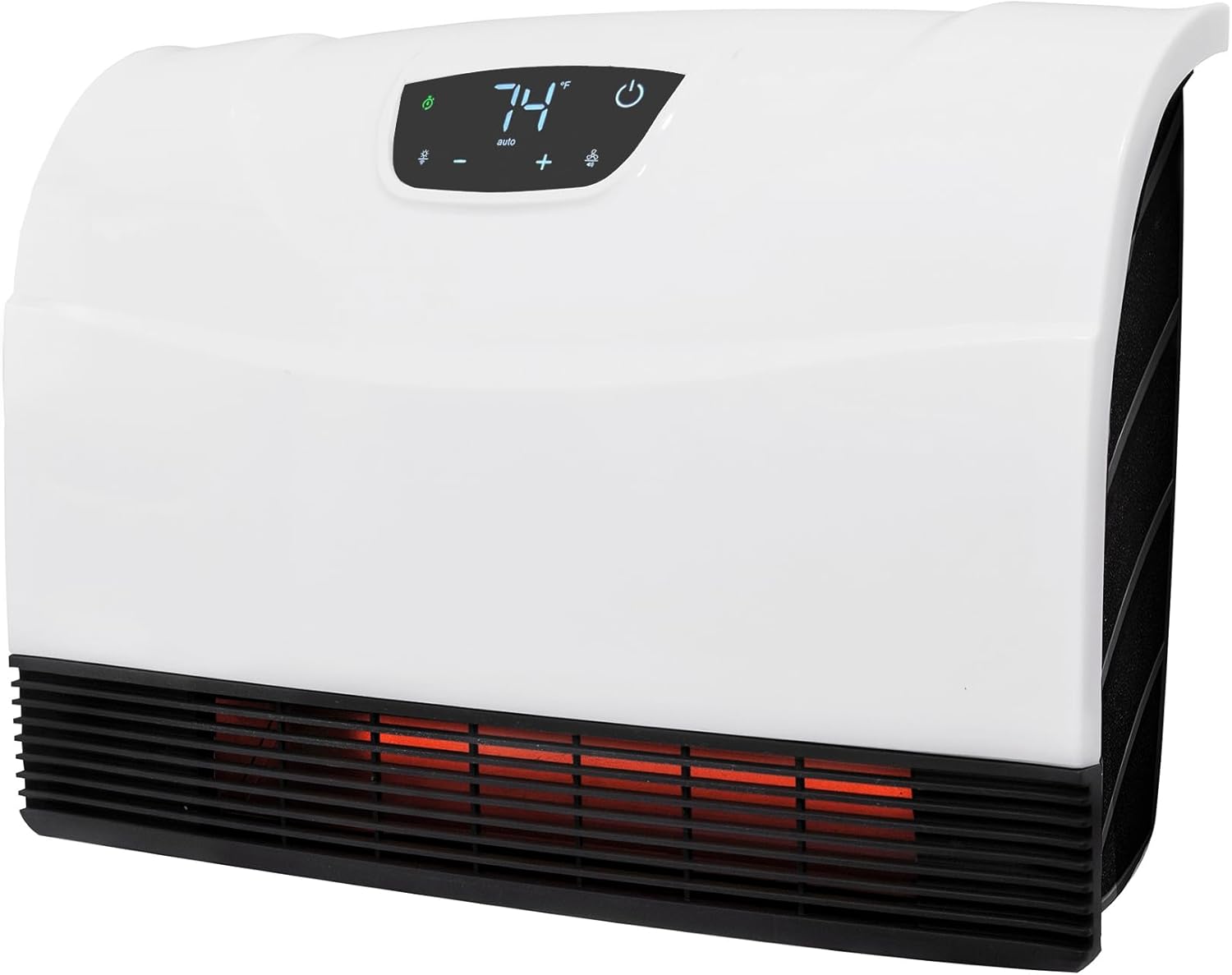
The Heat Storm Phoenix is a wall‑mounted 1500 watt infrared heater meant to provide supplemental zone warmth without taking up floor space. It uses radiant heating to warm objects and people directly rather than forcing hot air, and the built‑in Wi‑Fi and one‑touch Bluetooth setup let you control temperature and schedules from a phone or remote. Installation is straightforward: mount on the wall and plug into a standard 110V outlet, and the unit includes a touchscreen thermostat, remote, and washable filter. In practice it works well for heating single rooms, bathrooms, or small garages where you want on‑demand comfort and space saving. Because it is an infrared cabinet style, it heats nearby surfaces quickly but will not circulate warm air through large open areas, so it is better as a zone heater than as the sole heat source for a 500 sq ft garage unless your space is well insulated or you install multiple units. The unit stays cool to the touch, has tip‑over safety features, and is easy to mount; however buyers should plan mounting location and electrical load since it runs at 1500W on a 110V circuit.
Best for: Buyers who want a space‑saving, controllable zone heater to warm a single work area, garage corner, or small room and who value remote scheduling and quick radiant heat.
Less Ideal for: Those who need to heat an entire 500 sq ft uninsulated garage as a primary source of heat should consider higher capacity or forced‑air solutions instead.
- Wi‑Fi and Bluetooth one‑touch setup for remote scheduling and control
- Wall‑mounted cabinet design saves floor space
- 1500W infrared radiant heating provides fast localized warmth
- Includes touchscreen thermostat, remote, and washable filter for easier maintenance
- Radiant design does not effectively heat large, open garage spaces on its own
- Requires wall mounting and a dedicated 110V circuit for full power
Verdict: A compact, Wi‑Fi enabled 1500W infrared wall heater that is a smart, space‑saving choice for targeted garage zone heating.
Mr. Heater 30,000 BTU Vent Free Heater

| Heat Output | 30,000 BTU/hr |
|---|---|
| Heating Coverage | 1000 sq ft |
| Power Source | Natural Gas |
| Ignition | Battery operated electronic ignition |
| Special Features | Adjustable Temperature; Low oxygen safety shut-off |
This Mr. Heater vent-free unit delivers up to 30,000 BTU of convection heat for fast warming of enclosed spaces and can be mounted on a wall or used freestanding with included feet hardware. It runs on natural gas and requires no electricity for heat output, using a battery-operated ignition and an adjustable built-in thermostat for basic temperature control. The heater is intended for indoor use and features a low-oxygen safety shutoff and an oxygen depletion sensor for added protection, plus a wire guard to prevent contact with the burner. Practical benefits include strong heat output that can cover a typical garage and simple installation with wall-mount hardware included. Limitations to note are the need for a natural gas hookup, no included blower fan (sold separately) for forced-air circulation, and the vent-free design means it must be used only where local codes and ventilation permit it.
Best for: Buyers who prioritize straightforward, reliable heating for an enclosed workspace and want a low-maintenance gas heater with built-in safety features.
Less Ideal for: People without an existing natural gas supply or who need a heater for open or poorly ventilated spaces where vent-free units are not allowed or recommended.
- High heat output up to 30,000 BTU for rapid warming
- Covers up to 1,000 sq ft, suitable for typical single-car garages
- No electrical hookup required for heat, operates with natural gas and battery ignition
- Built-in adjustable thermostat and safety oxygen depletion shutoff increase ease of use and safety
- Can be wall mounted or freestanding with included mounting hardware
- Vent-free operation requires appropriate room ventilation and adherence to local codes
- Blower fan is not included so circulation may rely on natural convection
Verdict: A robust, no-electricity natural gas heater with strong coverage and built-in safety, ideal for reliably heating a typical 500 sq ft garage when vent-free units are permitted.
Choosing the Right Heater for 500 Square Foot Garage: Key Factors to Consider
Heat Output and Sizing
Correct heat output is the single most important factor for a 500 square foot garage. A heater with insufficient BTU or watt capacity will struggle to maintain set temperatures, especially on cold nights, while an oversized unit can cycle too frequently and reduce efficiency.
When assessing heat capacity, consider both the heater's maximum output and how the unit modulates output under thermostat control. For garages with minimal insulation or high ceilings, plan on higher capacity to overcome heat loss. Also account for how often you will run the heater and whether you need it to reach a specific working temperature quickly.
Energy Efficiency and Operating Cost
A heater that converts more fuel or electricity into usable heat will cost less to operate over time. Look for features that reduce wasted runtime, such as programmable thermostats, modulating heat levels, and insulated housings that reduce standby losses.
Understanding local energy costs and fuel availability is part of this factor. Electric heaters are nearly 100 percent efficient at point of use, but electricity rates vary. Combustion units may offer lower fuel cost per BTU but require ventilation and maintenance. Consider estimated runtime for your usage pattern to compare operating costs realistically.
Safety Features and Certifications
Garages contain flammable liquids, tools, and vehicles, so safety features are critical. Essential protections include automatic shutoff for overheating, tip-over switches on portable units, grounded cords and GFCI compatibility for electrical models, and certified clearances for wall or ceiling mounting.
Also verify relevant safety certifications from recognized testing organizations and follow installation guidelines closely. Proper placement away from fuel containers, use of approved venting for combustion models, and adherence to electrical code requirements help reduce risk.
Installation Options and Placement
How a heater installs will affect performance and convenience. Portable floor models require no permanent changes and can be moved, but they need clear floor space and may be more exposed to bumps. Wall- or ceiling-mounted units free floor area and provide more even distribution in a garage but require secure mounts and possibly professional installation.
Think about whether you need fixed wiring, venting runs for combustion units, or simply a grounded outlet for electric models. Accessibility for maintenance, fuel access, and clearance for garage doors and vehicle openings also influence the ideal placement.
Fuel Type and Availability
Fuel choice influences installation complexity, operating cost, and convenience. Electric heaters are straightforward to install where adequate circuits exist, while fuel-burning units use natural gas, propane, or kerosene and may require fuel hookups, tanks, or venting.
Consider local fuel availability, seasonal price volatility, and whether you want a plug-and-play option or a permanently plumbed system. Fuel type also affects indoor air quality and ventilation needs, which is an important safety consideration in enclosed garage spaces.
Durability and Maintenance
Garages often expose equipment to dust, dirt, and temperature swings, so durable construction matters. Look for corrosion-resistant finishes, sealed electrical components, and easily serviceable parts like accessible filters and user-serviceable burners or fans.
Regular maintenance tasks such as filter changes, vent inspections, and periodic checkups for combustion units will extend lifespan. Consider how easy it is to obtain replacement parts and whether the unit's design minimizes clogging or corrosion in a garage environment.
Choosing Between Electric and Fuel-Burning Models
Electric and fuel-burning heaters each have tradeoffs for a 500 square foot garage. Electric models are simple to install and require no venting, making them attractive for retrofit situations or where fuel hookups are impractical. Fuel-burning units typically deliver higher continuous heat output for lower fuel cost per BTU but require ventilation and more careful placement.
Think about the availability of appropriate electrical circuits if you consider high-wattage electric heaters. For fuel-burning heaters, plan for safe venting and adherence to local building and fire codes. Your final choice should balance installation complexity, ongoing fuel cost, and how you plan to use the space.
- Electric: easy installation, predictable indoor air, may need upgraded circuits
- Fuel-burning: higher continuous output, needs venting and more clearance
- Consider hybrid approaches if occasional heavy heating is required
Thermostats, Controls, and Zoning
A precise thermostat reduces runtime and keeps the garage at working temperatures without wasting energy. Look for units with reliable temperature sensing and simple programming. Remote or wired thermostats can provide better temperature placement than a control panel on the heater itself.
If you heat only part of the garage or use it irregularly, zoning strategies and programmable schedules help limit wasted heat. A good control strategy can change running costs significantly by avoiding unnecessary full-power operation.
- Programmable timers reduce idle runtime
- Remote thermostats often report more accurate ambient readings
- Multiple smaller units may enable better zoned control
Ventilation and Indoor Air Quality
Proper ventilation is a safety and comfort concern, especially for combustion heaters. Exhaust routing, fresh air intake, and maintaining clearances from flammable materials all affect air quality and safe operation. Even electric heaters can stir dust and fumes in a cluttered garage.
Ensure that combustion products are properly vented outdoors and that there is adequate fresh air for combustion where required. Consider adding a simple exhaust fan or ensuring periodic air exchange if the garage is tightly sealed and occupation is frequent.
- Verify venting requirements before choosing a combustion model
- Maintain clearance around heater intakes and exhausts
- Routine checks reduce buildup of dust and fumes
Installation Practicalities and Professional Help
Installation needs range from plug-and-play to permanently plumbed or hardwired setups. Ceiling or wall mounts often require studs, anchors, or roof penetrations for venting. Electrical upgrades for high-power electric heaters can be costly but are essential for safe operation.
If you are not comfortable with gas lines, venting, or high-voltage electrical work, hire a qualified technician. Professional installation can ensure safety clearances, proper venting, and code-compliant wiring, which are especially important in garages where vehicles and fuels are present.
- Check local codes for venting and gas connections
- Hire professionals for permanent installations or electrical upgrades
- Confirm required clearances and mounting materials before purchase
Maintenance Tips to Keep Heat Reliable
Regular maintenance keeps a garage heater operating safely and efficiently. For electric models, keep fans and heating elements free of dust. For combustion heaters, inspect burners, vents, and fuel lines and replace filters according to the maintenance schedule.
Keep the surrounding area clear of flammable materials, and perform seasonal inspections before the cold period begins. Create a simple checklist for filter cleaning, vent checks, and thermostat calibration to avoid unexpected failures.
- Clean or replace filters seasonally
- Inspect venting and fuel lines annually
- Test safety shutoffs and thermostats before heavy use
How We Chose the Best Heater for 500 Square Foot Garage
We focused on practical, measurable criteria that matter for heating a 500 square foot garage. First, sustained heat output was essential. We looked for units rated to reliably heat a space of roughly 500 square feet at typical winter temperatures, with clear BTU or watt ratings and usable temperature controls. Second, efficiency and operating cost were evaluated by considering available energy-efficiency features such as variable output, thermostat control, and fuel-to-heat conversion. Third, safety features were a priority because garages often contain flammable materials and vehicles. We favored heaters with tip-over protection, overheat shutoff, grounded electrical connections, and approved venting where required. Fourth, installation and versatility were weighed, including whether units support wall, ceiling, or portable floor placement and how simple maintenance and filter access are. We excluded units that lack published performance specifications or that are only intended for much smaller rooms. We also filtered out heaters without basic safety certifications or without clear installation instructions. The final selection emphasizes heat capacity, efficiency, safety, installation flexibility, and durability.
Our full evaluation process is outlined in our review methodology.
FAQ
How big a heater do I need for a 500 square foot garage?
Sizing depends on insulation, ceiling height, and local climate. As a rule of thumb, use the heater's BTU or watt rating paired with expected heat loss. Poorly insulated garages need higher capacity than well-insulated ones, and higher ceilings increase the required output.
Can I use a portable electric heater in a garage safely?
Yes if you follow safety guidelines. Place the unit on stable ground away from flammable materials, ensure it has tip-over and overheat protection, and use a dedicated outlet that matches the heater's power requirements. Avoid running extension cords with high-wattage units.
Do combustion heaters require venting in a garage?
Most combustion heaters require proper venting to the outdoors to remove exhaust gases. Some direct-vent designs seal combustion from the indoor air, but all combustion systems need correct installation and adherence to ventilation requirements for safety.
Will heating my garage damage stored items or vehicles?
Properly installed heaters designed for garages should not harm stored items or vehicles. Maintain recommended clearances, prevent exposure of sensitive materials to direct radiant heat, and control humidity when necessary to avoid condensation on vehicles or tools.
How can I reduce operating costs for garage heating?
Use programmable thermostats, improve insulation and weatherstripping, and heat only occupied zones. Choosing a heater with modulating output and good controls reduces runtime at full power and lowers overall energy use.
Final Verdict
For a 500 square foot garage, prioritize a heater with sufficient sustained output, clear safety features, and an installation style that fits your space. Balance operating cost against convenience by comparing fuel type, thermostat control, and efficiency features. Finally, account for ventilation and maintenance needs so your heater performs reliably over time. Choose the option that meets your heat-load needs, fits your installation constraints, and provides the safety features you require. With those priorities in mind, you can pick a heater that keeps your garage comfortable and safe through the cold season.