
Note: This article contains affiliate links. If you click on these links and make a purchase, we may earn a small commission at no extra cost to you. This helps support our research and content. Read our full affiliate disclosure here.
When space is tight but frozen storage is essential, choosing an energy-efficient small chest freezer can cut running costs and reduce household power use. You want a compact unit that holds a practical amount of food, runs quietly, and costs little to operate over months and years. This guide shortlists the top small chest freezers optimized for low power consumption and effective cold retention. We evaluated units across efficiency, usable storage, temperature stability, and noise so you can match a model to your space and usage pattern. Read on for the key differences that matter and practical guidance to pick the right compact freezer for your needs.
Top Picks at a Glance
| Best Overall The best all-around choice for most situations | BLACK+DECKER 2.0 Cu. Ft. Chest Freezer |  |
| Best Quality Built to a higher standard if you want something more solid | Arctic King 7.0 cu ft Chest Freezer |  |
| Best Value The sweet spot between price and what you get | WANAI 3.5 Cu.Ft Chest Freezer | 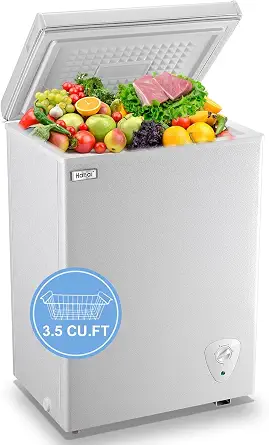 |
| Best Budget The cheapest option that still gets the job done reliably | 5 SUNDAY LIVING 3.5 Cu.ft Chest Freezer |  |
| Top Rated A top-rated pick with lots of positive feedback | Koolatron Chest Freezer KTCF99 |  |
| Most Popular A crowd favorite that many people choose with confidence | Kismile 3.2 cu ft Chest Freezer BD-80 |  |
| Best Seller A high-volume bestseller chosen again and again | BODACIOUS 7.0 Cu Ft Chest Freezer |  |
BLACK+DECKER 2.0 Cu. Ft. Chest Freezer

| Capacity | 2 cubic feet |
|---|---|
| Voltage | 115 volts |
| Number Of Shelves | 1 |
| Door Orientation | Top |
This BLACK+DECKER compact chest freezer provides straightforward extra frozen storage for kitchens, garages, or basements with a 2.0 cu. ft. capacity that holds up to about 70 pounds of food. It is operated with an exterior mechanical temperature dial offering seven settings and an indicator light so you can fine tune coldness without opening the lid, while a removable storage basket helps keep smaller items accessible. Maintenance is simple: the unit uses manual defrosting and an easy-access drain to speed cleanup. The compressor uses R600a refrigerant, which is common in efficient small freezers, and the unit is freestanding for flexible placement. Expect basic, reliable performance rather than advanced features like automatic defrost, digital controls, or Wi-Fi connectivity, and plan for occasional defrosting and manual temperature checks. For buyers who want a compact, no-frills secondary freezer that conserves floor space and stores a useful amount of frozen food, this model is a practical choice.
Best for: Buyers who want a reliable, space-saving secondary freezer for regular household use and value simple controls and straightforward maintenance.
Less Ideal for: Those who want low-maintenance automatic defrost, digital temperature management, or smart monitoring features should look elsewhere.
- Compact 2.0 cu. ft. capacity holds roughly 70 lbs. of frozen food
- Mechanical temperature control with seven settings and external dial
- Removable storage basket for organizing smaller items
- Manual defrost with easy-access drain simplifies maintenance
- Uses R600a refrigerant commonly found in efficient small freezers
- Manual defrost means periodic thawing and maintenance
- No digital controls, alarm, or smart features for remote monitoring
Verdict: A compact, no-frills chest freezer that delivers practical, energy-efficient extra frozen storage for everyday household use.
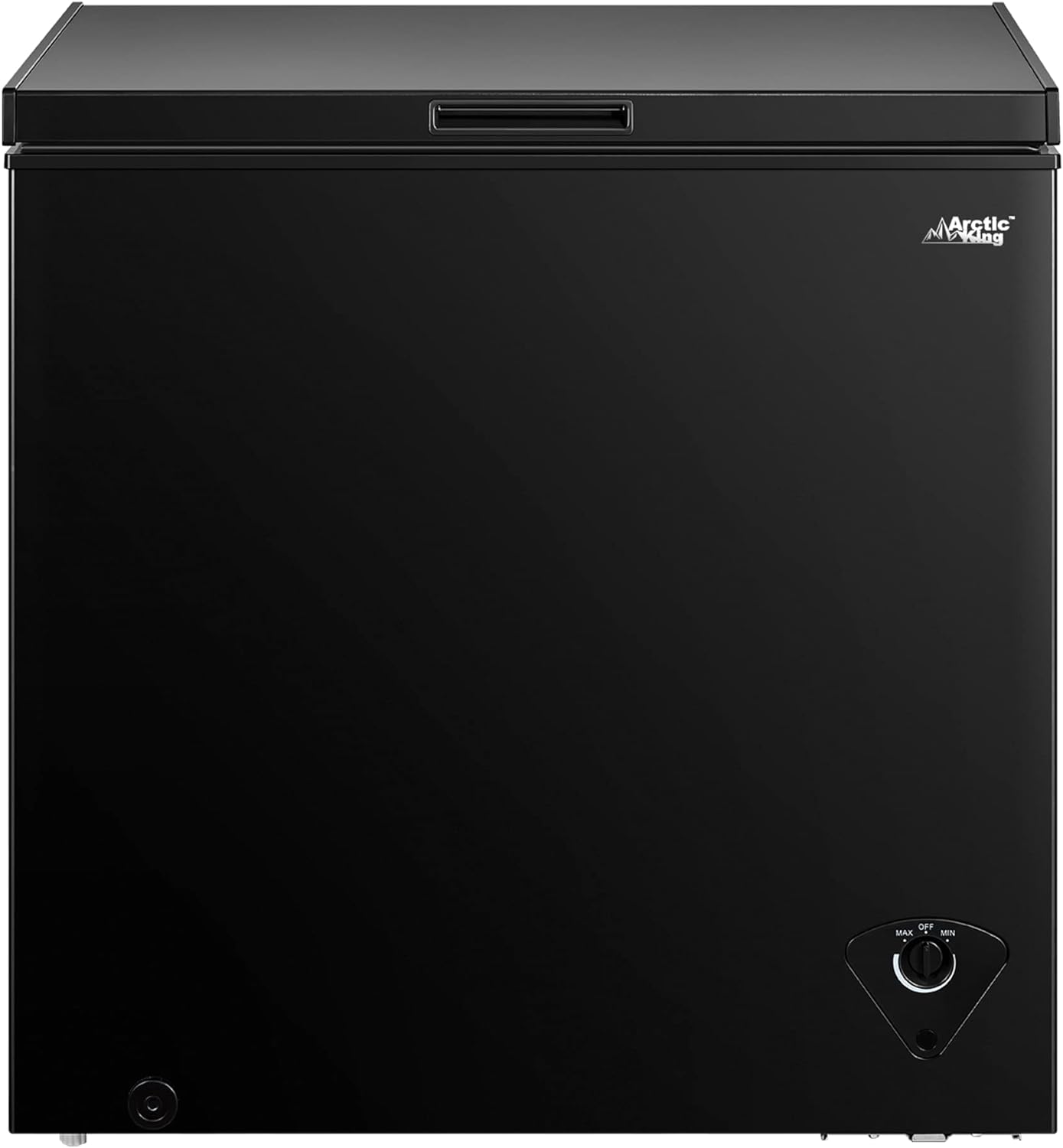
Arctic King 7.0 cu ft Chest Freezer
| Capacity | 7 cubic feet |
|---|---|
| Voltage | 115 volts |
| Installation Type | Freestanding |
| Door Orientation | Top |
The Arctic King 7.0 cu ft Chest Freezer is a simple, no-frills chest freezer intended for extra frozen storage in a garage, basement, or kitchen. It offers a top-opening door, a removable storage basket for small items, and an easy-access defrost drain that makes manual defrosting and cleaning less of a chore. In everyday use it keeps bulk groceries and seasonal items frozen reliably and the freestanding design means placement is flexible. The interior gasket and stainless-steel door area are straightforward to wipe down, and the 115-volt electrical design works on standard home circuits. Expect a basic mechanical thermostat rather than advanced energy-management features, so while it is efficient for its class it may not match the latest inverter or highly optimized models for long-term electricity savings. For buyers who want an affordable, compact chest freezer that is easy to maintain and provides solid storage capacity, this unit performs well; buyers seeking the absolute lowest energy consumption or advanced digital controls should consider other higher-end options.
Best for: Buyers who need dependable, compact extra freezer space and prioritize straightforward operation and easy maintenance over advanced controls.
Less Ideal for: Users who want the absolute lowest-running-cost freezer or who need precise digital temperature control for sensitive frozen goods.
- Compact 7.0 cu ft capacity provides useful extra frozen storage without a large footprint
- Removable storage basket keeps small items organized and easy to access
- Easy-access defrost drain and washable interior make cleaning and maintenance straightforward
- Freestanding design with standard 115-volt power works in typical home locations
- Manual defrost design lacks automatic or adaptive energy-saving modes
- Basic mechanical controls rather than digital temperature management
Verdict: A practical, easy-to-maintain 7.0 cu ft chest freezer that delivers reliable extra frozen storage for buyers focused on straightforward performance.
WANAI 3.5 Cu.Ft Chest Freezer

| Capacity | 3.5 cubic feet |
|---|---|
| Wattage | 70 watts |
| Voltage | 110 volts |
| Number Of Shelves | 1 |
| Installation Type | Freestanding |
This WANAI 3.5 cu ft chest freezer is a space-saving top-open unit aimed at apartments, dorms, and small kitchens. It uses an R600a compressor and a 7-level thermostat so you can set temperatures from near-refrigerator to deep-freeze, and the removable basket helps organize smaller items. The unit is freestanding, consumes about 0.56 kWh per day on the listed spec, and runs quietly under 45 dB, which makes it suitable for places where low noise and energy use matter. Installation is straightforward but the manual defrost design means you will need to empty and defrost it periodically; there is a water outlet to make this easier. Build and features are basic—one storage basket and a simple top door—but that keeps the footprint small and operation simple. Expect modest cooling capacity appropriate for frozen groceries, bulk items, or overflow storage rather than large quantities or long-term deep-freezing of big batches.
Best for: Buyers who prioritize a small, energy-conscious freezer for limited spaces and want a straightforward, low-noise unit for everyday frozen storage.
Less Ideal for: People who need large capacity, advanced organization, or a frost-free freezer for minimal maintenance should consider larger or automatic-defrost models instead.
- Compact footprint fits apartments, dorms, and small kitchens
- Adjustable 7-level thermostat for fridge-to-freezer temperature range
- R600a compressor and low listed daily energy use for efficient operation
- Low noise operation under 45 dB suitable for living spaces
- Removable basket and simple top-open design for easy access and organization
- Manual defrost requires periodic maintenance
- Single basket and one shelf limit internal organization options
Verdict: A compact, low-noise, energy-efficient chest freezer well suited for apartment and small-space buyers who want simple, reliable frozen storage.
5 SUNDAY LIVING 3.5 Cu.ft Chest Freezer

| Wattage | 58 watts |
|---|---|
| Voltage | 120 volts |
| Capacity | 3.5 cubic feet |
| Door Orientation | Top |
This compact chest freezer is designed for small spaces and basic frozen storage needs, using a compressor-driven system and seven adjustable temperature levels that range from about -7.6 to -22.2 Fahrenheit. Typical use is for extra freezer capacity in a kitchen, dorm, garage, or apartment where you need to store bulk items, frozen meals, or extra groceries; the top-opening lid and included removable basket make organizing small batches straightforward. At 58 watts it is relatively efficient for a compressor freezer in this size class, and the manufacturer highlights a quiet operation under 40 dB which helps when placed near living areas. Controls are simple to set and the freestanding installation makes placement flexible. Important limitations are its modest 3.5 cu ft capacity and basic feature set—there is no advanced insulation or smart control, and the unit is a straightforward, no-frills freezer that prioritizes value and compactness over premium performance.
Best for: Buyers seeking an inexpensive, space-saving secondary freezer for occasional bulk storage or overflow who prioritize low running power and quiet operation.
Less Ideal for: Those who need large-capacity freezing, advanced temperature monitoring, or premium energy-saving features for heavy daily use should consider larger or higher-end models.
- Compact 3.5 cu ft capacity fits small kitchens, dorms, and apartments
- Seven temperature settings allow finer control from mild to deep freeze
- Includes removable basket for organizing smaller items
- Low-power 58-watt compressor suitable for energy-conscious buyers
- Basic feature set with no smart controls or advanced insulation
- Limited storage volume for shoppers needing larger freezer capacity
Verdict: A budget-friendly, compact chest freezer that delivers simple, energy-conscious cold storage for small households and tight spaces.
Koolatron Chest Freezer KTCF99

| Capacity | 99 liters |
|---|---|
| Wattage | 125 watts |
| Voltage | 120 volts |
| Number Of Shelves | 1 |
The Koolatron 3.5 cu ft chest freezer is a straightforward compact deep freezer aimed at small households and space-conscious locations. It uses a low-vibration compressor to maintain temperatures from 0 to -24°C and has a front-mounted mechanical control dial so you can change settings without opening the lid. The flip-top lid stays open for hands-free loading and the removable wire basket keeps frequently used items accessible. Manual defrosting is managed via a front drain with a leak-proof plug, which simplifies cleaning but does require periodic maintenance compared with frost-free models. Its foam-insulated cabinet and magnetic seal help preserve cold and improve efficiency for steady storage. The unit runs quietly and has a narrow flat-back design that fits well in kitchens, apartments, garages, or cottages. If you prioritize a reliable, no-frills freezer with easy controls and a small footprint, this model delivers consistent cooling; if you need hands-off defrosting or larger capacity, look elsewhere.
Best for: Buyers who value a dependable, quiet, energy-conscious compact freezer for small homes or secondary storage and who do not need large capacity or automatic defrost.
Less Ideal for: Large families or users who want a maintenance-free frost-free freezer or substantially more storage space should consider larger or automatic-defrost models.
- Compact 3.5 cu ft capacity fits small spaces and apartments
- Reliable compressor cooling maintaining 0 to -24°C for consistent freezing
- Foam-insulated cabinet and magnetic lid seal help retain cold and improve efficiency
- Front-mounted mechanical temperature dial and stay-open lid for easy, hands-free access
- Manual defrost requires periodic draining and maintenance
- No frost-free feature, which means ice buildup over time
Verdict: A compact, reliable chest freezer that keeps frozen goods cold with efficient compressor cooling and simple mechanical controls, ideal for small-space secondary storage.
Kismile 3.2 cu ft Chest Freezer BD-80

| Capacity | 3.2 cubic feet |
|---|---|
| Door Orientation | Top |
| Number Of Shelves | 1 |
| Installation Type | Freestanding |
This Kismile 3.2 cu ft chest freezer is a small standalone deep-freeze solution for kitchens, dorms, offices, or bars where floor space is limited. It offers a seven-level adjustable thermostat that ranges roughly from 6.8°F to -7.6°F so you can pick between gentle cooling and deeper freezing, and indicator lights show power and run status. Two removable baskets make it easy to organize small items like ice packs, frozen meals, or breast milk and the balanced hinge-style lid holds open at several angles for loading. The unit advertises quick cooling from an efficient compressor and claims low noise under 40 dB and daily energy use around 0.68 kWh, which helps keep operating costs down. Practical limitations include the modest capacity that will not suit bulk storage and a temperature range that is sufficient for many household needs but not for ultra-low commercial freezing. The simple mechanical controls mean there is no digital display or precise temperature readout, so buyers who need exact setpoints should plan to use a separate thermometer.
Best for: Buyers who prioritize low running costs and a compact freezer for occasional or moderate household use, and who value straightforward mechanical controls over smart features.
Less Ideal for: People who need large-volume or commercial-grade freezing, or who require precise digital temperature control and monitoring.
- Compact footprint fits small spaces
- Seven-level adjustable thermostat for flexible cooling
- Two removable baskets for organized storage
- Low noise operation (under 40 dB) and modest daily energy use (0.68 kWh)
- Limited 3.2 cu ft capacity not suited for large bulk storage
- No digital temperature display for precise monitoring
Verdict: A space-saving, energy-conscious chest freezer that delivers simple, quiet freezing for small households and light use.
BODACIOUS 7.0 Cu Ft Chest Freezer

| Capacity | 7 cubic feet |
|---|---|
| Voltage | 110 volts |
| Number Of Shelves | 2 |
| Installation Type | Countertop, Freestanding |
| Specification Met | ETL |
This 7.0 cu ft BODACIOUS chest freezer is a straightforward compact deep freezer aimed at homeowners who need extra frozen storage without a big footprint or loud operation. It uses energy-saving design and claims low daily power use, making it a sensible choice for buyers prioritizing efficiency. The top-opening lid and removable storage basket make organizing and accessing items easy, and the exterior defrost water drain simplifies maintenance. Temperature is controlled via a six-position thermostat so you can tune settings for meats, vegetables, or long-term storage, though the brand warns against using the coldest setting continuously to protect compressor life. The unit is ETL listed and rated for countertop or freestanding installation, and the quiet operation suits apartments, garages, or basements. Expect a basic feature set rather than advanced smart controls or frost-free operation, so occasional manual defrosting and routine temperature checks are part of ownership.
Best for: Buyers who want a compact, energy-conscious secondary freezer with simple mechanical controls and low noise for everyday frozen storage.
Less Ideal for: People who require automatic defrost, remote monitoring, or large-capacity commercial freezers should look elsewhere.
- Energy-efficient design that reduces daily power consumption
- Quiet operation suitable for homes, apartments, and garages
- Adjustable 6-setting thermostat for tailored freezing needs
- Removable basket and exterior defrost drain for easier organization and maintenance
- Not frost-free, so manual defrosting is required periodically
- No smart features or advanced temperature monitoring
Verdict: A quiet, energy-efficient 7.0 cu ft chest freezer that delivers simple, reliable frozen storage for risk-averse buyers seeking low operating costs.
Choosing the Right Energy-Efficient Small Chest Freezer: Key Factors to Consider
Energy Consumption and Rated Power
The freezer's rated power draw and average running watts determine ongoing operating cost. Look for documented wattage or estimated annual kWh so you can compare running costs across models.
A lower-watt compressor reduces electricity use but also affects how quickly the unit can recover after the lid is opened. Consider whether your usage pattern involves frequent door openings or mostly long-term storage; frequent use favors slightly stronger compressors even at the cost of modestly higher energy use.
Insulation Quality and Lid Seal
Insulation thickness and the quality of the lid seal are primary drivers of how long a freezer runs and how stable its internal temperature remains. Better insulation reduces compressor cycles and preserves frozen goods longer during power interruptions.
A lip-style gasket that seals tightly and a solid, well-fitted lid minimize warm air infiltration. Check for descriptions of foam-injected walls or thicker panels in spec sheets because these features materially affect long-term efficiency.
Usable Capacity Versus Footprint
Nominal capacity figures can be misleading because basket layout, internal bracing, and compressor placement reduce usable space. Measure the footprint you can allocate and look at usable liters or cubic feet rather than gross capacity alone.
Consider how you plan to load the freezer. If you store many small packages, adjustable baskets and dividers improve organization. If you freeze bulk items, an open interior with minimal obstructions maximizes utility.
Defrosting and Maintenance Needs
Manual defrost freezers are common in compact chest designs and can be slightly more efficient than flawed auto-defrost systems. However, frost accumulation reduces usable volume and increases energy use, so understand the expected defrost frequency.
Ease of defrosting matters. Drain plugs, removable baskets, and simple interior surfaces speed the process and reduce the time the unit is out of service. Regular maintenance of the gasket and exterior condenser area keeps performance consistent.
Noise and Location Considerations
Compressor noise can be a deciding factor if the unit will sit in a garage near living areas or inside a small apartment. Look at decibel ratings where provided and read placement guidance.
A quieter unit may run slightly longer to maintain temperature, but the trade-off is often worthwhile in living spaces. Also consider vibration and stable leveling feet to prevent additional noise from resonance with flooring.
Sizing the Right Small Chest Freezer for Your Space
Begin by mapping the installation spot and leaving clearance for the lid to open fully. Small chest freezers vary in width and depth more than height, so confirming the horizontal footprint is critical. Make sure to allow recommended clearance on at least one side for ventilation and to ensure the lid can be opened easily.
- Measure doorway and stair clearances before delivery.
- Account for a small ventilation gap at the back or sides per manufacturer guidance.
- Plan lid access so you can reach items at the bottom without awkward bending.
How Insulation Type Affects Power Use
Chest freezers typically rely on thicker cabinet walls and a tight lid seal rather than constant active cooling. Units with injected foam insulation or thicker panels will run less frequently and handle power interruptions better. These construction details translate directly to lower average energy consumption and better long-term temperature stability.
- Foam-injected walls reduce thermal bridging.
- Magnetic or molded gaskets improve sealing performance.
- Thicker lids trap cold air and shorten recovery time after opening.
Organizing a Small Chest Freezer for Maximum Usability
Efficient organization lets you store more usable food without wasting energy on long lid-open times while hunting for items. Removable wire baskets, stackable bins, and clear labeling help keep everything accessible. For frequent-access foods, keep a top basket or shallow organizer to minimize digging and cold air loss.
- Use small baskets for individually wrapped items.
- Reserve the bottom for long-term bulk or overflow storage.
- Label items with dates to avoid prolonged searches.
Placement Tips to Minimize Energy Loss
Where you place the freezer affects how hard it must work. Avoid locations with direct sunlight, near heat sources, or in unconditioned spaces that drop below recommended ambient temperatures. Garages can be fine in temperate climates but may force the compressor to run harder in extreme hot or cold conditions.
- Keep the unit off damp ground and away from combustible materials.
- Allow airflow around the exterior compressor area.
- Avoid tight closets that trap heat around the cabinet.
Power and Safety Considerations
Verify the electrical circuit you plan to use can handle the freezer's startup draw, which is higher than its running wattage. Use a grounded outlet and avoid extension cords for long-term connections. Consider a dedicated circuit for larger compact units if your home's panel is near capacity.
- Check startup amperage in the spec sheet and match to your circuit.
- Use GFCI protection only where local code requires it, such as in garages or basements.
- Have a qualified electrician inspect older wiring if you see flickering lights when the compressor starts.
How We Chose the Best Energy-Efficient Small Chest Freezer
We prioritized products that minimize electrical consumption while still providing reliable frozen storage. Our selection filters focused on measurable efficiency characteristics and real-world usability. We examined official energy usage figures and typical running watts, then cross-referenced those numbers against usable interior volume to favor models that deliver more storage per watt. Temperature stability and insulation design were core criteria because a well-insulated cabinet reduces compressor run time and protects food quality. We also considered layout and access—baskets, lid seals, and basket placement affect how often cold air is lost during use. Quiet operation was included because many small freezers live in shared spaces where noise matters. Durability and serviceability rounded out our framework, with attention to cabinet construction and the accessibility of controls. Units that relied solely on marginal efficiency claims or lacked clear energy data were excluded. In short, we filtered for low power draw, high usable capacity, strong insulation, quiet operation, and practical daily usability.
Our full evaluation process is outlined in our review methodology.
FAQ
How much electricity does a small chest freezer typically use?
Usage varies by insulation and compressor size but small, energy-efficient chest freezers often draw significantly less power than upright models. Look for annual kWh or average running watts to estimate monthly costs; typical efficient units can be in the low hundreds of kWh per year depending on climate and usage.
Is manual defrost better for efficiency?
Manual defrost models are often simpler and can be more efficient because they lack automatic defrost heaters that add heat. However, frost buildup reduces efficiency over time, so regular defrosting is important to maintain low energy use.
Can a chest freezer be placed in an unheated garage?
It depends on the unit's ambient temperature rating. Some compact chest freezers are designed to operate in cooler spaces, but very low temperatures can prevent the thermostat from cycling properly. Check the operating temperature range before installing in an unconditioned space.
How often should I defrost a small chest freezer?
Defrost frequency depends on usage and humidity but expect to defrost when frost exceeds about a quarter-inch thickness or when airflow is impeded. For many households, this is once or twice per year; heavy use or humid environments may require more frequent defrosting.
Does the freezer need a special plug or circuit?
Most small chest freezers run on standard household circuits but pay attention to startup amperage. Avoid long extension cords and ensure the outlet is grounded. If your panel is already heavily loaded, consult an electrician to confirm the circuit is adequate.
Final Verdict
Prioritize energy consumption, insulation quality, and usable storage when choosing an energy-efficient small chest freezer. Tradeoffs are common: the most efficient cabinets use thicker insulation and run less often but can have slightly slower temperature recovery. Consider how you will use the unit—frequent access favors easier organization and stronger compressors, while long-term bulk storage rewards the best insulation. Focus on measurable specs such as running watts, annual kWh, and usable interior layout. Match the freezer size to your available space and place it where ambient conditions will not force excessive compressor runtime. With those priorities in mind, you can confidently choose a compact chest freezer that minimizes energy costs while meeting your storage needs.