
Note: This article contains affiliate links. If you click on these links and make a purchase, we may earn a small commission at no extra cost to you. This helps support our research and content. Read our full affiliate disclosure here.
Picking the right energy-efficient small freezer matters if you want reliable frozen storage with lower electricity bills and a smaller environmental footprint. Whether you need extra space for bulk buys, meal prep, or seasonal storage, the right compact unit balances usable capacity, insulation, and electrical draw so it performs well without spiking your utility costs. This guide covers seven shortlisted small freezers optimized for energy efficiency across typical home situations. We explain the evaluation criteria used and what features matter so you can match a compact freezer to your storage needs and space constraints. Read on to see concise reasons each type of unit made the list and how to prioritize features.
Top Picks at a Glance
| Best Overall The best all-around choice for most situations | DEMULLER Chest Freezer 3.5 cu ft |  |
| Best Quality Built to a higher standard if you want something more solid | Kismile 3.2 Cu Ft Chest Freezer |  |
| Best Value The sweet spot between price and what you get | WANAI 3.5 Cu Ft Chest Freezer | 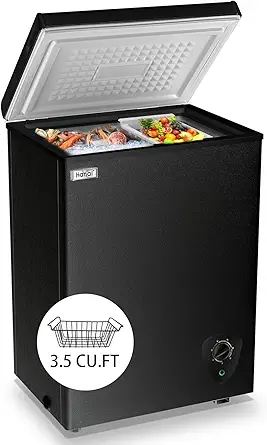 |
| Best Budget The cheapest option that still gets the job done reliably | Climate Choice 3.5 Cu.Ft Chest Freezer |  |
| Top Rated A top-rated pick with lots of positive feedback | DollarDash 3.5 Cu.Ft Chest Freezer |  |
| Most Popular A crowd favorite that many people choose with confidence | Whynter CUF-112SS Mini Freezer |  |
| Best Seller A high-volume bestseller chosen again and again | BODACIOUS 3.5 Cu Ft Chest Freezer |  |
DEMULLER Chest Freezer 3.5 cu ft

| Capacity | 3.5 cubic feet |
|---|---|
| Voltage | 115 volts |
| Number Of Shelves | 2 |
| Installation Type | Freestanding |
The DEMULLER 3.5 cu ft chest freezer is a compact freestanding unit designed to add extra frozen storage in small homes, apartments, garages, or basements. It uses an electronic control panel that lets you set temperatures precisely to 1°F across a wide -15°F to 41°F range, and the unit recommends starting at -15°F for rapid freezing. Two stainless steel hanging baskets help keep small items accessible while the top-opening lid stays propped open between 45 and 75 degrees for easier loading. The freezer supports manual defrost and includes a side drain for easier thawing. Practical benefits include fast-freeze capability to better preserve food quality and a small footprint that fits tight spaces. Important limitations are its modest 3.5 cu ft capacity and manual defrost requirement, which means more hands-on maintenance than self-defrosting models. For buyers prioritizing precise temperature control and compact, energy-conscious extra storage, this unit is a sensible choice.
Best for: Buyers who need a precise, energy-conscious secondary freezer for limited spaces and value controllable temperatures and organized small-item storage.
Less Ideal for: Users who plan to store large volumes of bulk food or want a frost-free, low-maintenance freezer should consider larger or automatic-defrost models instead.
- Digital temperature control accurate to 1°F with wide -15°F to 41°F range
- Compact 3.5 cu ft footprint fits small spaces like apartments or garages
- Two removable stainless steel hanging baskets keep small items organized
- Top-opening lid that stays open between 45 and 75 degrees for easier loading
- Manual defrost design requires periodic thawing and draining
- Small overall capacity limits large-batch or bulk storage
Verdict: A compact, precisely controlled chest freezer that gives energy-conscious buyers reliable extra frozen storage in tight spaces.
Kismile 3.2 Cu Ft Chest Freezer

| Capacity | 3.2 cubic feet |
|---|---|
| Door Orientation | Top |
| Number Of Shelves | 1 |
| Installation Type | Freestanding |
The Kismile 3.2 cu ft chest freezer is a space-saving deep freezer meant for small kitchens, dorms, or offices where energy use and quiet operation matter. It cools with a 7‑grade adjustable thermostat that ranges roughly from 6.8°F to -7.6°F, letting you choose between mild and deep freeze settings, while indicator lights show power and run status. Two removable wire baskets keep small items accessible and allow bulk items to sit beneath, and the balanced hinge top door can hold open at set angles for loading. Practical touches include a drain for fast defrost water removal and a low-noise compressor that the manufacturer rates under 40 dB and about 0.68 kWh per day. The unit is compact, so capacity limits what you can store long term, and the temperature span is suitable for everyday freezing but may not reach ultra-low commercial temps. Installation is simple since it is freestanding, though the power cord location should be checked before placement. For buyers prioritizing efficient, quiet performance in a small footprint, this freezer delivers sensible features without extra complexity.
Best for: Buyers who want an efficient, quiet small freezer for home use where space is limited and reliable everyday freezing performance is the priority.
Less Ideal for: People who need large capacity for bulk food storage or subzero temperatures for long term preservation should consider larger or commercial units.
- Seven‑step adjustable thermostat for flexible temperature control
- Low reported energy use at about 0.68 kWh per day
- Two removable baskets for organized storage and easy access
- Balanced hinge top door that can remain open at multiple angles
- Quiet operation rated below 40 dB for minimal disturbance
- Limited 3.2 cu ft capacity restricts long‑term bulk storage
- Temperature range tops out around -7.6°F, not suitable for specialty ultra‑low freezing
Verdict: A compact, energy‑minded chest freezer that delivers quiet, adjustable freezing for small spaces and everyday frozen storage needs.
WANAI 3.5 Cu Ft Chest Freezer

| Capacity | 3.5 cubic feet |
|---|---|
| Wattage | 70 watts |
| Voltage | 110 volts |
| Compressor | R600a |
| Installation Type | Freestanding |
This 3.5 cu ft WANAI chest freezer is a space-conscious unit that freezes, stores, and organizes small-batch groceries for apartments, garages, or home bars. It uses an R600a high-efficiency compressor and claims low energy consumption (about 0.56 kWh/24h), which makes it suitable for buyers focused on operating cost. The lid opens wide and includes a removable hanging basket to keep frequently used items accessible while the seven-step thermostat lets you range from a fresh-keeping mode up through deep-freeze temperatures. Installation is simple since it is freestanding and has adjustable leveling legs and rear rollers for moving into place. It is manually defrosted, so occasional thawing is required, and the advertised noise level is low but not silent. Build and door seals appear typical for budget compact freezers so dense long-term packing or heavy commercial use may expose limitations. For energy-conscious shoppers needing extra frozen storage in tight spaces, this unit balances efficiency, capacity, and straightforward controls.
Best for: Buyers who want an efficient, no-frills secondary freezer to add frozen storage in limited spaces while keeping operating costs low.
Less Ideal for: People who need large-capacity or commercial-grade continuous freezing or who want an auto-defrost, maintenance-free model.
- Energy-efficient R600a compressor with low reported consumption (~0.56 kWh/24h)
- Compact 3.5 cu ft capacity fits small spaces like apartments, offices, and RVs
- Seven-step adjustable thermostat for flexible fresh-keeping or deep-freeze control
- Removable hanging basket and wide-opening lid for easier organization and access
- Adjustable leveling legs and rear rollers simplify placement and installation
- Manual defrost requires periodic maintenance to remove ice buildup
- Not intended for heavy commercial use or very large-volume storage
Verdict: A compact, energy-conscious chest freezer that adds practical frozen storage with low running costs for tight spaces.
Climate Choice 3.5 Cu.Ft Chest Freezer

| Wattage | 58 watts |
|---|---|
| Voltage | 115 volts |
| Capacity | 4.2 cubic feet |
| Installation Type | Freestanding |
This compact chest freezer delivers practical frozen storage for apartments, garages, or offices where space and energy use matter. It offers seven temperature settings that range below freezing so you can tailor storage for everything from ice cream to long-term meat storage, and a removable basket keeps frequently used items organized near the top. The top-opening lid and two side handles make loading and moving easier, and a built-in drain simplifies occasional defrosting. At roughly 58 watts and rated to use about 0.37 kWh per 24 hours, it is noticeably energy efficient for its size and runs quietly under 40 dB, which helps in shared living spaces. Limitations include a modest 3.5 cu ft capacity that will not replace a full-size freezer and a basic feature set with no smart controls or advanced compartmenting, but for buyers focused on low running costs and small-footprint storage it covers the essentials well.
Best for: Buyers wanting an affordable, energy-conscious secondary freezer for tight spaces who prioritize low running costs and simple reliable freezing over extra features.
Less Ideal for: Families who need large-scale frozen storage or users who want connected features and multiple internal compartments should look at larger or feature-rich models.
- Compact footprint suitable for apartments, dorms, or garages
- Seven adjustable temperature settings for flexible freezing needs
- Removable storage basket for easy organization and access
- Low energy consumption (~0.37 kWh/24h) and quiet operation under 40 dB
- Small 3.5 cu ft capacity may be insufficient for larger households
- No smart features or advanced compartment options
Verdict: A budget-friendly, energy-efficient small chest freezer that delivers quiet, reliable frozen storage for compact living spaces.
DollarDash 3.5 Cu.Ft Chest Freezer

| Capacity | 3.5 cubic feet |
|---|---|
| Door Orientation | Top |
| Installation Type | Freestanding |
This compact chest freezer is built for small-space, steady cold storage rather than heavy-duty commercial use. It offers seven temperature levels (from about 32°F down to around -11.2°F) so you can switch between beverage chilling and long-term freezing, and the R600a compressor is designed for quiet, efficient operation around 38 dB. The removable storage basket and top-opening lid make everyday loading and organization simple, and the adjustable feet plus drainage port help with leveling and defrosting. Expect reliable, low-noise performance ideal for apartments, garages, or dorm rooms, and the straightforward mechanical control is easy to use. On the flip side this is a basic, freestanding unit without advanced features like digital controls, auto-defrost cycles, or smart monitoring, so it is best when you want an uncomplicated, energy-conscious freezer rather than high-end conveniences.
Best for: Buyers who prioritize a simple, dependably cold freezer for small spaces and low-noise, energy-conscious operation.
Less Ideal for: Not a good fit for users who need large capacity, precise digital controls, or connected smart features.
- Seven temperature settings let you tailor storage from chilled drinks to frozen meats
- Quiet R600a compressor supports low-noise operation suitable for living spaces
- Removable basket and drainage port simplify organization and cleaning
- Compact footprint fits tight spaces like apartments, dorms, and garages
- No digital thermostat or precise temperature readout
- Lacks advanced features such as smart controls or automatic defrost
Verdict: A compact, energy-conscious chest freezer that delivers quiet, reliable cold storage for small spaces.
Whynter CUF-112SS Mini Freezer

| Capacity | 1.1 cubic feet |
|---|---|
| Wattage | 79 watts |
| Temperature Range | -11° to 10.4°F |
| Number Of Shelves | 1 |
The Whynter CUF-112SS is a compact upright freezer intended for small spaces like kitchens, offices, garages, or basements. It uses a compressor-driven cooling system and an adjustable mechanical thermostat to maintain temperatures in the approximate -11°F to 10.4°F range, and a removable slide-out wire shelf gives basic organization for frozen goods. The unit includes a cylinder lock and two keys for secure storage and a reversible door for flexible placement. Manual defrost keeps the design simple and reduces service complexity, while the Energy Star rating and modest 79W power draw make it an economical choice for continuous use. Practical limitations include the very small 1.1 cubic foot capacity, which restricts it to short-term or limited-use storage, and the manual defrost means occasional maintenance to prevent frost buildup. The recessed handle and stainless door give it a tidy look for visible locations. For someone seeking a small, energy-conscious freezer that fits tight footprints, this model covers the basics reliably without extra frills.
Best for: Buyers who prioritize proven performance and energy efficiency in a compact freezer and want straightforward, well-reviewed equipment for a small space.
Less Ideal for: Families or users needing substantial frozen storage, long-term bulk freezing, or a frost-free maintenance-free freezer should look at larger automatic-defrost models.
- Energy Star rated for lower power consumption
- Reversible door for flexible placement
- Cylinder lock with two keys for secure storage
- Removable slide-out wire shelf for simple organization
- Very limited 1.1 cu ft capacity suitable only for small loads
- Requires manual defrost which needs periodic attention
Verdict: A compact, energy-efficient mini freezer that delivers reliable cold storage and a secure, space-friendly design for small-space buyers.
BODACIOUS 3.5 Cu Ft Chest Freezer

| Capacity | 3.5 cubic feet |
|---|---|
| Wattage | 58 watts |
| Voltage | 110 volts |
| Number Of Shelves | 1 |
| Specification Met | ETL |
The BODACIOUS 3.5 cu ft chest freezer is a small, energy-focused deep freezer intended for apartments, RVs, garages, or secondary kitchen use. It delivers low power draw (about 58 watts and an estimated 127.75 kWh/year) and claims quieter operation under 40 dB, so it can sit near living spaces without creating noticeable noise. The top-opening chest layout provides simple, unobstructed storage and includes removable baskets for organizing smaller items and a built-in frost drainage port to simplify occasional defrosting and cleaning. Temperature is adjustable across multiple settings so you can tune for fast freeze or longer-term storage. Expect the usual chest-freezer tradeoffs: accessing items requires opening the lid and bending over, and usable vertical organization is limited compared with an upright unit. For buyers prioritizing low energy use and quiet performance in a compact footprint, this unit offers sensible features and easy maintenance, though it is most useful as a supplemental freezer rather than a full primary freezer for large households.
Best for: Buyers who want a reliable, low-energy secondary freezer that stays quiet in small living spaces and emphasizes predictable, easy operation over high capacity.
Less Ideal for: Large families or users who need frequent, quick access to many items or who prefer upright shelving and door access for organization.
- Low annual energy consumption (~127.75 kWh/year) for lower running costs
- Whisper-quiet operation suitable for apartments and RVs
- Compact footprint fits tight spaces and offers freestanding or countertop placement
- Removable baskets and built-in frost drain make organization and cleaning easier
- Adjustable temperature control with multiple settings for different freezing needs
- Top-opening chest requires bending to access items and can make frequent access less convenient
- Limited internal shelving and vertical organization compared with upright freezers
Verdict: Choose this compact, whisper-quiet chest freezer if you want a low-energy, easy-to-maintain secondary freezer for small spaces.
Choosing the Right Energy-Efficient Small Freezer: Key Factors to Consider
Energy Consumption and Annual Running Cost
Energy consumption is the single most important factor for buyers prioritizing efficiency. Look for published annual kilowatt-hour usage or Energy Star–style ratings where available. Lower kWh numbers translate directly into smaller monthly bills, especially if the unit runs in a garage or utility room year round.
Also consider how compressor cycling and start-up draw affect household circuits. A freezer with low steady-state consumption but high frequent cycling can still cost more overall. Finally, regional electricity rates and how often you open the freezer will influence real-world running costs.
Usable Interior Capacity and Layout
The listed cubic-foot capacity is not the same as usable space. Shelf spacing, drawer or basket design, and how much usable volume is lost to thick insulation all change how much you can store. Measure the dimensions of common items you plan to freeze and compare to internal shelf heights or basket sizes.
Flexible internal organization matters when you need to separate prepared meals from raw items or keep long items like turkeys flat. Better layout can let you use a slightly smaller unit more effectively, reducing wasted energy for unused empty volume.
Insulation Quality and Temperature Stability
High-quality insulation reduces compressor run time by keeping cold in during door openings and power fluctuations. Look for units with thicker cabinet walls, higher R-value foam, or explicit claims about temperature hold time during power interruptions.
Temperature stability also protects food quality. A freezer that maintains a steady -10 to -20 degrees Fahrenheit with minimal cycling will both preserve food better and usually consume less power over time because the compressor runs less frequently.
Defrost System and Maintenance Needs
Manual defrost systems typically use less energy than automatic defrost cycles but require periodic user intervention to remove frost. Automatic defrost (or frost-free) models add convenience and prevent ice buildup but can use more energy due to periodic heating cycles.
Consider how often you want to defrost and whether you can accommodate the maintenance. Drainage and removable baskets simplify manual defrost. For frost-free units, check how the defrost timer and heater settings are managed to minimize unnecessary energy use.
Noise, Placement, and Installation
Noise matters if the unit will live in a laundry room, basement, or near living spaces. Look for published decibel ratings or user reports on steady-state noise. Lower vibration also helps prevent rattle noise and keeps the freezer from shifting over time.
Placement influences performance. Units in very hot garages or in direct sunlight work harder. Allow adequate clearance for ventilation around the compressor and condenser to maintain efficiency, and check whether the unit supports level feet or adjustable legs for stable installation.
Power Compatibility and Circuit Requirements
Confirm the freezer's electrical requirements to avoid overloading circuits. Small freezers often run on a standard 120V branch circuit but check startup amp draw, especially if you plan to place the unit on the same circuit as other appliances.
Also consider whether the unit has a power-on delay or soft-start feature that reduces compressor stress. If you are installing in a remote garage or shed, verify that the outlet is grounded and protected from moisture to reduce risk and maintain long-term reliability.
Chest Vs Upright Small Freezers
Chest-style and upright small freezers offer different tradeoffs for energy efficiency and usable storage. Chest freezers generally have better thermal retention because cold air stays low when opened, which can reduce compressor cycles. They also often provide more usable space for bulky items.
Upright freezers make organization easier with shelves and drawers and take up less floor space. However, each door opening lets cold air spill out more readily, which can increase energy use if you open the unit frequently. Consider how you access frozen goods and how much reorganizing you will do when choosing between the two formats.
- Chest units often have lower running costs for the same internal volume.
- Uprights are easier to organize and fit into tighter footprints.
- Think about how often you will open the door and what you typically store.
Optimizing Placement to Reduce Energy Use
Where you place a small freezer has a big effect on efficiency. Avoid uninsulated garages or spots that experience wide temperature swings if possible. High ambient temperatures force the compressor to run longer and increase wear.
Leave recommended clearance for ventilation around the unit. Crowding the back or sides can trap heat at the condenser and reduce efficiency. If the unit will be in a high-humidity location, check for corrosion-resistant coatings or elevation options to protect the base.
- Avoid direct sunlight, heaters, or hot appliances nearby.
- Leave proper clearance for airflow per the installation instructions.
- Place on a level, stable surface to reduce vibration and noise.
Organizing a Small Freezer for Maximum Usability
A compact freezer is most useful when organized for quick access. Use stackable containers, flat packs, and removable baskets to maximize vertical space and reduce the time the door is open. Label packages with dates to prevent overstocking and wasted space.
Group like items together and create a simple inventory system so you can find things quickly. Keeping frequently used items near the front reduces excessive door openings and helps maintain steady temperatures.
- Use flat freezing trays for soups and sauces to store vertically.
- Employ baskets for grouping similar items and rotating stock.
- Defrost and clean on a schedule to maintain airflow and efficiency.
Reading Energy Labels and Technical Specs
When comparing models, focus on published kWh per year and energy efficiency ratios if available. Also check declared interior volume, insulation thickness, and defrost mechanism because these specs affect long-term operating costs.
Take note of startup amp draw and recommended circuit requirements in the technical sheet. Those figures influence installation choices and whether an outlet shares the circuit with other appliances.
- Compare annual kWh figures to estimate running costs.
- Check insulation and cabinet construction details for temperature hold.
- Review electrical specs for safe circuit planning.
Maintaining Efficiency Over Time
Routine maintenance keeps a small freezer running efficiently. Clean condenser coils periodically to maintain heat exchange efficiency, check door gaskets for a tight seal, and remove heavy frost if you use a manual-defrost model.
Avoid overcrowding, which impedes air circulation, and replace failed gaskets promptly. For long outages, keep the door closed to maintain cold for as long as possible; a full freezer holds temperature longer than a partially filled one.
- Clean coils and vents every few months.
- Inspect and replace door seals as needed.
- Plan defrosting when frost exceeds recommended levels.
How We Chose the Best Energy-Efficient Small Freezer
We selected entries based on measurable energy and storage characteristics that matter in real-world home use. Primary filters included certified energy consumption ratings and average daily kilowatt-hour draw when idle and under moderate use. Insulation quality and cabinet design were evaluated through published insulation specifications and reported steady-state temperature hold times. Usable internal layout and capacity were assessed by measuring cubic feet of usable space and shelf or basket flexibility. Temperature control and defrost system type were included because they directly affect both energy use and convenience. Noise levels and compressor cycle efficiency were considered for units used near living areas or in enclosed spaces. We excluded models without published energy numbers or with unverified performance data, and we did not include chest versus upright distinctions as a preference; instead we judged each entry on how effectively it balanced power consumption, storage efficiency, and day-to-day usability. The result is a set of small freezers that prioritize low running costs, practical storage, and reliable temperature control.
Our full evaluation process is outlined in our review methodology.
FAQ
How much will a small energy-efficient freezer add to my electric bill?
It depends on the unit's annual kWh rating and your local electricity rate. Efficient small freezers often use significantly fewer kilowatt-hours than older models, but check the published kWh per year and multiply by your local rate to estimate monthly cost.
Is a frost-free small freezer less efficient than a manual-defrost model?
Usually frost-free models use periodic heating cycles to prevent ice buildup, which can increase energy use compared with manual-defrost units. However, frost-free units offer maintenance convenience that may be worth the tradeoff for some buyers.
Can I put a small freezer in an unheated garage?
You can, but extreme ambient temperatures can make the compressor work harder and may affect warranty coverage. Check the manufacturer's specified operating temperature range before placing the unit in an unheated space.
How often should I defrost a manual small freezer?
Defrost when frost buildup exceeds about a quarter-inch, or on a schedule based on use. Frequent door openings and high humidity mean you may need to defrost more often to maintain efficiency.
What maintenance keeps a small freezer running efficiently?
Regularly clean condenser coils and vents, check and replace door gaskets if they leak, and avoid overfilling the freezer. For manual-defrost units, remove frost build-up promptly to maintain airflow.
Final Verdict
Prioritize energy consumption, usable storage, and insulation when choosing a small freezer. Decide whether convenience features like frost-free defrosting are worth the extra running cost and match the cabinet type to how you organize frozen goods. Finally, account for installation location, ventilation, and electrical requirements to ensure efficient operation. Focusing on these tradeoffs will help you pick a compact freezer that keeps running costs low while meeting your storage needs.