
Note: This article contains affiliate links. If you click on these links and make a purchase, we may earn a small commission at no extra cost to you. This helps support our research and content. Read our full affiliate disclosure here.
Picking the right space heater matters because small differences in control, efficiency, and safety change how comfortable and costly winter evenings feel. An energy-efficient heater with a thermostat can maintain steady room temperature without constant cycling or wasted electricity, which is especially important in bedrooms, home offices, and smaller living spaces. This guide covers the seven top shortlisted space heaters in this category, focusing on real-world performance factors like energy consumption, thermostat accuracy, safety features, and quiet operation. Below you will find our evaluation criteria and practical notes to help you match a heater to your space and usage patterns.
Top Picks at a Glance
| Best Overall The best all-around choice for most situations | DR. Infrared Heater DR-968 |  |
| Best Quality Built to a higher standard if you want something more solid | De'Longhi ComfortTemp Radiant Heater EW7707CM |  |
| Best Value The sweet spot between price and what you get | Aikoper NT15-20A Space Heater |  |
| Best Budget The cheapest option that still gets the job done reliably | Amazon Basics Ceramic 1500W Heater |  |
| Top Rated A top-rated pick with lots of positive feedback | DREO Space Heater DR-HSH004 |  |
| Most Popular A crowd favorite that many people choose with confidence | Lasko Ceramic Tower Heater 751320 |  |
| Best Seller A high-volume bestseller chosen again and again | DREO Space Heater DR-HSH006 |  |
DR. Infrared Heater DR-968

| Wattage | 1500 Watts |
|---|---|
| Heating Coverage | 576 square feet |
| Number of Speeds | 3 |
| Voltage | 120 |
| Temperature Range | 50 °F to 85 °F |
The DR. Infrared Heater DR-968 is a freestanding 1500 W infrared space heater designed to heat medium to large rooms quickly by combining a quartz infrared tube with a PTC element and a high-pressure low-noise blower. You control temperature with an electronic thermostat (50 to 85 F), choose Auto/High/Low power modes, or set a 12-hour timer; the unit includes caster wheels and a remote for easy positioning and operation. Safety features are solid: tip-over protection, overheat auto shutoff, and a cool-touch exterior make it suitable for homes with children and pets. The heater emphasizes energy-efficient operation via an Auto mode that cycles between 1000 W and 1500 W to hold the set temperature, which can lower running costs compared with simple fixed-output heaters. Trade-offs are typical for a 1500 W unit: it cannot replace whole-house HVAC but is effective as a room supplement, and it weighs about 19 pounds so it is portable but not ultralight. Noise is low thanks to the blower design, but you will still hear some airflow at higher settings. Overall it is a practical, safety-focused option when you want a thermostat-controlled, energy-conscious space heater for living areas and bedrooms.
Best for: Buyers who want an energy-conscious room heater with a working thermostat and safety features for regular use in living rooms, bedrooms, or home offices.
Less Ideal for: People seeking a lightweight travel heater or a unit capable of replacing central heating for an entire home should look elsewhere.
- Dual heating system (quartz infrared + PTC) for faster, more even warmth
- Electronic thermostat with Auto mode that cycles power to save energy
- Remote control and timer for convenient hands-free operation
- Built-in safety features including tip-over and overheat shutoffs and cool-touch exterior
- Wheels and freestanding design make repositioning straightforward
- 1500 W output suitable for single rooms only and not whole-house heating
- At 19 pounds it is portable but heavier than small ceramic heaters
Verdict: Choose the DR-968 when you want a thermostat-controlled, energy-aware 1500 W heater that delivers fast, even room warmth with strong safety features.
De'Longhi ComfortTemp Radiant Heater EW7707CM

| Heat Output | 1500 watts |
|---|---|
| Heating Method | Radiant |
| Power Source | Corded Electric |
| Number of Speeds | 3 |
| Min Temperature Setting | 44 °F |
The De'Longhi EW7707CM is a 1500W oil-filled radiator designed to heat small to medium rooms quietly and efficiently. It uses a thermal slot design and permanently sealed diathermic oil to radiate steady warmth without a fan, so it does not stir up dust or dry the air—useful for bedrooms and home offices. Controls are straightforward: an adjustable thermostat, three heat settings, an anti-freeze mode, and the ComfortTemp energy-saving button that automatically maintains optimal power and temperature to reduce runtime. Built-in safety features include thermal cut-off and fully enclosed heating elements, and the low surface temperature and rounded body make it safer around pets and children. The unit is portable thanks to an integrated handle and snap wheels, and requires no maintenance or oil refilling. The main trade-offs are its slower warm-up compared with fan heaters and the fact that 1500W limits how quickly it will raise temperature in larger or poorly insulated spaces.
Best for: Buyers focused on steady, energy-conscious heating for bedrooms or home offices who prioritize quiet operation and a thermostat that limits wasted runtime.
Less Ideal for: If you need rapid heat recovery for large rooms or open floor plans, or want a lightweight instant-heat fan heater, look elsewhere.
- ComfortTemp thermostat reduces runtime for better energy efficiency
- Radiant, fanless heating minimizes dust circulation and dry air
- Permanently sealed oil reservoir requires no maintenance
- Multiple heat settings plus anti-freeze mode for flexible control
- Built-in safety features including thermal cut-off and low surface temperature
- Slower to heat a room compared with fan-forced heaters
- 1500W output may be underpowered for large or badly insulated spaces
Verdict: Choose this radiator if you want quiet, thermostat-driven radiant heat that lowers runtime and energy use for small to medium rooms.
Aikoper NT15-20A Space Heater

| Heat Output | 1500 watts |
|---|---|
| Heating Coverage | 150sq.ft |
| Number of Speeds | 3 |
| Voltage | 120 volts |
This compact Aikoper space heater uses PTC ceramic heating and a forced fan to deliver quick warmth for small rooms and desktop use. You select Low, Medium, or High heat or fan-only, then set the dial thermostat to maintain a comfortable temperature without constant monitoring. The unit is lightweight and has a built-in handle so it is easy to move between an office, bedroom, or living area. Safety features include ETL-listed overheat protection and a tip-over switch that cuts power if the heater is knocked over, which is useful around pets or children. It is rated for up to roughly 150 sq ft and runs on standard 120V power at a 1500-watt output, so it provides strong spot heating while avoiding the complexity of whole-home heating. Limitations are its small coverage area and basic mechanical controls—there is no digital display, timer, or Wi-Fi, and it will not replace central heating for larger spaces.
Best for: Buyers who want a simple, energy-conscious way to heat one frequently used spot or small room and prefer a straightforward, portable unit with reliable safety features.
Less Ideal for: People needing to heat large open rooms, those who want programmable or smart-connected heaters, or buyers looking to replace central heating for an entire home.
- Fast PTC ceramic heating that warms a small room quickly
- Adjustable thermostat with three heat settings plus fan-only for flexible use
- Compact, portable design with built-in handle makes it easy to move and place on a desk or table
- ETL-listed safety features including overheat and tip-over protection
- Designed for small spaces only, not effective as primary heating for large rooms
- Controls are manual without digital display, timer, or smart features
Verdict: Aikoper NT15-20A is a compact, safety-focused 1500W heater that delivers fast, energy-efficient spot heating for small rooms and workspaces.
Amazon Basics Ceramic 1500W Heater

| Heat Output | 1500 watts |
|---|---|
| Heating Coverage | 161.4 square_feet |
| Heating Method | Convection |
| Number of Speeds | 3 |
| Max Temperature Setting | 200 °F |
This small ceramic heater delivers fast, focused warmth for personal rooms and desks. It offers three modes — high (1500W), low (900W), and fan-only — plus an adjustable thermostat so you can dial in a target temperature rather than run the element full blast. The ceramic convection element heats quickly and quietly, making it a good option for home offices and bedrooms, and the unit includes tip-over and overheat protection and a power indicator for safer everyday use. Its tower tabletop form is lightweight and very portable so you can move it between rooms, but the compact footprint means it is best for single-room heating rather than whole-home use. The heater runs on 230V and does not oscillate, so warm airflow is steady rather than dispersed; also avoid using it in high-humidity rooms like bathrooms. For buyers focused on efficient, thermostat-controlled personal heat on a tight budget, this unit offers straightforward performance without extra bells and whistles.
Best for: Buyers prioritizing an inexpensive, energy-aware personal heater for single rooms who want a simple thermostat and basic safety features without extra smart functions.
Less Ideal for: People needing to heat large open areas, multiple rooms, or bathrooms should choose a higher-capacity or specially rated unit instead.
- Adjustable thermostat for maintaining a set temperature
- Three operation modes including lower-power 900W setting to save energy
- Ceramic convection element provides quick, quiet heat
- Built-in tip-over and overheat protection for safer operation
- Compact, lightweight tabletop design for easy portability
- Not suitable for large or multiroom heating due to compact output
- Not rated for use in high-humidity areas such as bathrooms
Verdict: A compact, budget-friendly ceramic heater that gives efficient, thermostat-controlled personal heat for single rooms.
DREO Space Heater DR-HSH004
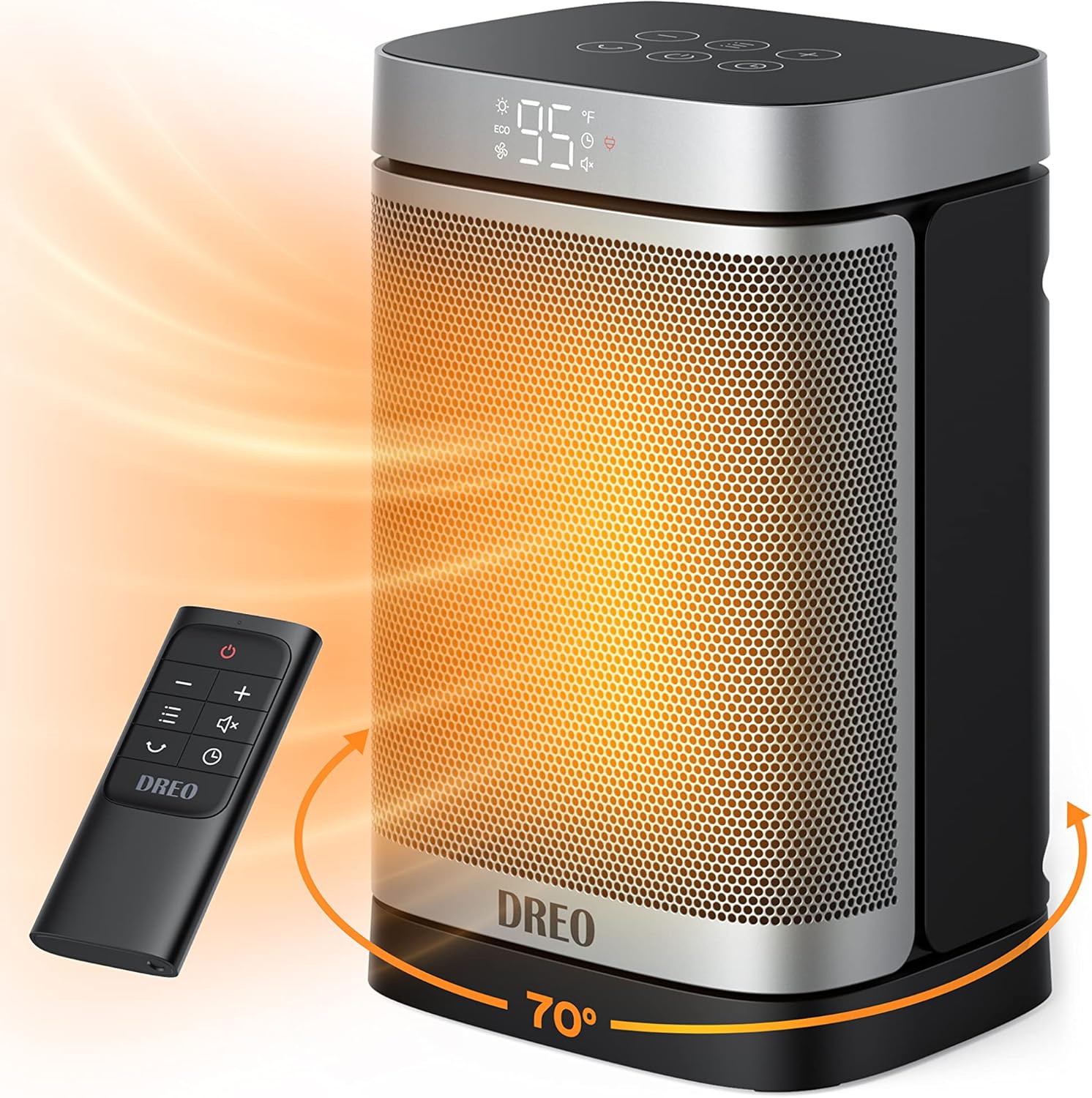
| Heat Output | 1500 watts |
|---|---|
| Heating Coverage | 200 sq.ft |
| Heating Method | PTC Ceramic, Forced Air |
| Programmable Thermostat | 41-95 °F (1°F increments) |
| Timer | 1-12 h |
The DREO DR-HSH004 is a compact, PTC ceramic forced-air tower heater designed to warm small to medium rooms quickly. It provides up to 1500 watts of heat with a programmable digital thermostat that can be set between 41 and 95 F in 1 F increments and an ECO mode that adjusts output to save energy while holding a target temperature. The unit offers 70 degree oscillation to spread warm air, five fan speeds, a 1–12 hour timer and a detachable filter for basic maintenance. Safety features include ETL-listed protections, tip-over and overheat safeguards and an enhanced safety plug. In everyday use it works well placed on the floor by seating or on a desk for personal-zone heating, and the included remote makes temperature and mode changes convenient. Trade-offs are its limited 200 sq ft coverage and the expected fan noise at higher settings, so it is best for targeted room heating rather than whole-house use.
Best for: Buyers who prioritize reliable, controllable, energy-conscious room heating for bedrooms, home offices, or similar single-room spaces and want built-in safety features.
Less Ideal for: Those looking to heat large open areas or an entire apartment should consider higher-capacity or whole-home systems instead.
- Accurate digital thermostat with 1 F increments and ECO mode for energy-focused temperature control
- 70° oscillation and five speeds distribute heat across a room
- Multiple convenience features: remote control, 1–12 hour timer and detachable filter for maintenance
- Built-in safety with ETL listing, tip-over and overheat protection and flame-retardant materials
- Rated coverage around 200 sq ft limits use to single rooms or personal zones
- Motorized fan can be noticeable on higher power or fast fan settings
Verdict: Choose this DREO heater if you want a safety-minded, thermostat-driven unit that balances quick 1500W warm-up with ECO energy control for single-room heating.
Lasko Ceramic Tower Heater 751320

| Heat Output | 1500 watts |
|---|---|
| Heating Element | Ceramic |
| Heating Coverage | 150 |
| Power Source | Corded Electric |
| Min/Max Temp | 60 °F to 85 °F |
The Lasko Ceramic Tower Heater (model 751320) is a portable electric tower heater built to warm small to medium rooms with a 1500-watt ceramic element and widespread oscillation. It uses forced-air ceramic heating combined with an adjustable electronic thermostat and an auto-off timer to maintain a set temperature while limiting runtime. Controls are available on the unit or via the included multi-function remote that stores on-board, and the slim profile plus built-in handle makes it easy to move between bedroom, office, or living room. Notable features include two heat settings, a seven-hour programmable timer, cool-touch housing, and multiple safety measures such as overheat protection and an ETL listing. The heater is reasonably quiet on low, and oscillation helps distribute warmth more evenly than a directional heater. Limitations are basic control granularity compared with digital smart thermostats and the lack of advanced eco modes or app integration for energy tracking, so users focused on precise scheduling or whole-home efficiency may want a connected option instead.
Best for: Buyers who prioritize straightforward, reliable space heating with basic programmable thermostat control and proven safety features, and who value social proof from a well-known brand when choosing an efficient room heater.
Less Ideal for: People who need app-based scheduling, multi-room integration, or highly granular temperature control should consider connected smart heaters instead.
- 1500W ceramic element delivers fast, effective room warming for small to medium spaces
- Adjustable electronic thermostat and timer let you set and maintain a target temperature
- Widespread oscillation spreads heat for more even coverage across a room
- Includes remote with onboard storage for convenient adjustments from anywhere in the room
- Built-in safety features including overheat protection and cool-touch housing
- Only two heat settings and no smart/home automation connectivity for advanced energy scheduling
- Timer and thermostat control are functional but lack fine-grain digital scheduling options
Verdict: A practical, safety-minded 1500W ceramic tower heater that delivers reliable, thermostat-controlled warmth for small to medium rooms.
DREO Space Heater DR-HSH006

| Heat Output | 1500 watts |
|---|---|
| Heating Element | PTC Ceramic |
| Heating Coverage | 200 sq.ft. |
| Min Temperature Setting | 41 °F |
| Max Temperature Setting | 95 °F |
This DREO tower heater delivers quick, controllable warmth for small to medium rooms using a 1500W PTC ceramic element and forced-air circulation. Its adjustable thermostat (41–95°F in 1°F increments) and multiple heat modes including ECO let you dial in temperature and run-time to avoid wasted energy, while the 12-hour timer and memory function make repetitive use simple. Built-in safety features such as tip-over detection, overheat protection, flame-retardant housing, and an ETL-listed design support everyday peace of mind. The unit is compact and light, so it is easy to move between bedroom, office, or kitchen and the brushless DC motor keeps noise low (about 34 dB) for overnight use. Expect strong performance for single-room heating but limited reach beyond the specified 200 sq. ft., and like all electric ceramic heaters it will increase local electricity use at higher settings compared with central heating. Controls are practical and the remote adds convenience, though the small footprint means it is best for spot heating rather than whole-home use.
Best for: Buyers who prioritize safe, energy-conscious spot heating for bedrooms or home offices and prefer a thermostat-driven unit they can set and forget.
Less Ideal for: Anyone needing to heat large open-plan spaces or replace central heating should consider a higher-capacity solution instead.
- 1500W PTC ceramic element for fast, efficient spot heating
- Precise adjustable thermostat with 1°F increments for energy-conscious temperature control
- Multiple modes and 12-hour timer to reduce runtime and save energy
- Comprehensive safety features including tip-over sensor and overheat protection
- Brushless DC motor design yields quiet operation around 34 dB
- Effective for single rooms up to about 200 sq. ft. and not intended for whole-house heating
- Higher power settings will still raise local electricity use compared with central systems
Verdict: A compact, safety-focused 1500W tower heater with a precise thermostat and timer that makes energy-conscious spot heating easy and reliable.
Choosing the Right Energy-Efficient with Thermostat Space Heater: Key Factors to Consider
Thermostat Accuracy And Control
A precise thermostat keeps room temperature within a narrow band of your setpoint and reduces unnecessary power cycling. Inaccurate thermostats can cause short cycles that use more energy while producing uneven comfort.
Look for heaters with digital thermostats, clear setpoint displays, and a small deadband between on and off cycles. Features like programmable schedules and adaptive learning modes further improve long-term energy use by avoiding overheating when rooms are unoccupied.
Power Rating And Energy Modes
The wattage rating indicates potential heating capacity but not efficiency. Energy-efficient models often offer multiple settings, lower-watt eco modes, or variable power that lets you trade heat output for lower consumption.
Consider typical room size and how long the heater will run. A heater with a lower maximum wattage but smart modulation can use less energy over a night than a higher-wattage unit that cycles on and off frequently. Look for explicit low-power modes and features that reduce standby draw.
Safety Systems And Certifications
Space heaters run hot and must include safeguards to reduce fire and burn risk. Essential safety systems include tip-over shutoff, overheat protection, cool-touch surfaces, and robust housing that resists damage from bumps or falls.
Check for recognized safety certifications and durable construction. Safety features matter more the longer a heater runs unattended, and they can influence where you safely place the unit in a home with pets or children.
Noise Level And Fan Design
Noise affects where you can comfortably use a heater. Models with fans can move heat faster but often generate audible noise; radiant or convection-only designs are usually quieter but may warm more slowly.
If you plan to use the heater in bedrooms or workspaces, prioritize models with low operational noise or fan speed control. Quiet eco modes and well-engineered fan blades or motor mounts reduce vibration and improve nighttime comfort.
Size, Mounting, And Portability
Physical size and mounting options determine where a heater will fit and how easy it is to move. Compact, lightweight units are easier to reposition, while wall-mount or panel-style heaters save floor space and reduce trip hazards.
Consider cord length, handle placement, and whether a heater has casters or a wall bracket. Portability matters if you move the heater between rooms; mounting and size matter if it must fit under desks or in closets when not in use.
Controls, Display, And Usability
Clear, intuitive controls reduce the chance of misuse and help you take advantage of energy-saving features. Digital displays, tactile buttons, and straightforward modes make it easier to set schedules, adjust thermostats, and switch energy modes.
Smart connectivity can add convenience but may increase background power draw. Evaluate whether app control or remote operation aligns with your habits and whether the added features justify any incremental energy cost.
Comparing Convection, Radiant, And Fan-Forced Types
Different heat delivery methods suit different rooms and routines. Convection heaters warm the air gradually and distribute heat passively, which is efficient for maintaining steady temperature in enclosed rooms. Radiant or infrared heaters send heat directly to objects and people and work well for spot heating or in drafty spaces. Fan-forced units circulate warm air quickly and are useful for fast warm-up but can be noisier.
- Convection: Quiet, steady heat for whole-room comfort.
- Radiant: Direct warmth ideal for close-range or short use.
- Fan-forced: Fast warm-up, adjustable airflow, higher noise potential.
Sizing Your Heater To Room Volume
Estimate heating needs by room volume rather than floor area alone. Higher ceilings require more output to achieve the same temperature rise. For most small rooms, modest output with good thermostat control suffices; larger or poorly insulated spaces demand higher continuous output or multiple units placed strategically.
- Measure room length, width, and ceiling height to calculate volume.
- Consider insulation quality and window area when sizing output needs.
- Plan for placement that avoids blocked vents and allows good airflow.
Placement And Clearance Best Practices
Where you place a heater affects safety and efficiency. Keep the unit on a stable, level surface away from flammable materials and allow the recommended clearance on all sides. Avoid placing heaters directly under shelves, near curtains, or against soft furnishings that trap heat.
- Maintain manufacturer-specified clearance around the heater.
- Position units to encourage airflow through the room rather than against walls.
- Avoid running cords under rugs or routing them through high-traffic areas.
Using Thermostats And Timers To Cut Run Time
Programmed schedules and accurate thermostats reduce total run time while maintaining comfort. Instead of running a heater at high output all night, set a lower overnight setpoint or use a schedule that lowers output when occupants are asleep or away. Some heaters include eco or setback modes that automatically reduce power when the room reaches target temperature.
- Use setback temperatures during sleeping hours to reduce energy use.
- Combine timers with thermostat control for automated energy savings.
- Avoid manually overriding eco modes for extended periods unless necessary.
Maintenance And Longevity Tips
Regular maintenance keeps a heater working efficiently and safely. Clear dust from air intakes and fan housings, check cords and plugs for wear, and verify that safety shutoffs function during periodic checks. Replace or repair damaged units rather than extending use of compromised devices.
- Vacuum vents and fan housings periodically to maintain airflow.
- Inspect power cords for frays or kinks and avoid extension cords when possible.
- Test tip-over and overheat cutoffs according to the manual to confirm operation.
How We Chose the Best Energy-Efficient with Thermostat Space Heater
We shortlisted products that deliver measurable energy savings and reliable thermostat control while meeting basic safety and usability expectations. Selection prioritized heaters with documented low standby draw or adaptive power modes, thermostats that hold setpoints within a narrow variance, and safety systems such as tip-over and overheat cut-offs. User-focused features like programmable schedules, eco modes, and quiet operation were weighted because they affect daily living and total energy use. We excluded units that rely solely on fixed high-wattage outputs without temperature regulation or that lack independent safety shutoffs. We also filtered out devices with poor build quality indicators such as flimsy housing or absent certifications. Our evaluation emphasized energy efficiency, thermostat accuracy, safety features, ease of use, and noise level as the core decision dimensions. Each product had to demonstrate competence in at least three of those areas to make the list.
Our full evaluation process is outlined in our review methodology.
FAQ
How much electricity does a typical thermostat-controlled space heater use?
It depends on the wattage and how long it runs. Most home space heaters draw between 750 and 1500 watts at full power. With a thermostat, runtime is reduced because the heater cycles on and off; effective energy use often ends up lower than continuous full-power operation.
Is a thermostat always more energy-efficient than fixed-output heaters?
Usually, yes. A thermostat prevents continuous full-power operation by maintaining a set temperature. However, a poorly calibrated thermostat or one with a wide deadband can negate savings, so accuracy matters as much as having a thermostat.
Can I safely use a space heater overnight?
Many modern heaters include overheat protection and tip-over shutoffs that make overnight use safer. Still, it is best to follow manufacturer clearance and placement guidance and to use heaters with proven safety features when running for extended periods.
Are quieter heaters less effective at heating a room?
Not necessarily. Radiant and convection models are often quieter and can be effective for maintaining comfortable temperatures. Fan-assisted heaters warm faster but at the cost of more noise. Choose based on how quickly you need heat and whether noise will be disruptive.
Do energy-saving modes noticeably reduce my electric bill?
Energy-saving modes and programmable setbacks can reduce run time and peak draw, which often lowers consumption. The actual bill impact depends on usage patterns and local electricity rates, but consistent use of eco modes typically yields measurable savings.
Final Verdict
When choosing an energy-efficient thermostat-equipped space heater, prioritize accurate temperature control and verified safety systems above raw wattage numbers. Look for models with adaptable energy modes and quiet operation if you will run them overnight or in workspaces. Balance output to room volume and insulation so you do not oversize and lose efficiency to cycling. Ultimately, opt for a heater that matches your usage pattern: precise thermostats and setback schedules for long-run background heating, or faster fan-assisted units when you need rapid warm-up. Focus on thermostat accuracy, safety features, and real-world energy modes to make a confident choice.