
Note: This article contains affiliate links. If you click on these links and make a purchase, we may earn a small commission at no extra cost to you. This helps support our research and content. Read our full affiliate disclosure here.
If you plan to pull café-quality shots and steam milk like a pro, choosing the right espresso machine matters. You need consistent extraction, reliable steaming power, and controls that fit your workflow. This guide shortlists the top machines suitable for barista use and explains the tradeoffs between temperature stability, steam performance, serviceability, and control options. Each pick was evaluated for the specific needs of baristas working in busy environments as well as serious home baristas refining technique. Read on for our top options, the evaluation criteria we used, and practical advice for selecting a machine that matches your workflow and skills.
Top Picks at a Glance
| Best Overall The best all-around choice for most situations | Gaggia Classic Evo Pro RI9380/46 |  |
| Best Quality Built to a higher standard if you want something more solid | Breville Barista Pro BES878BSS |  |
| Best Value The sweet spot between price and what you get | atatix EM3111 Espresso Machine |  |
| Best Budget The cheapest option that still gets the job done reliably | Neretva Espresso Machine PE3670U |  |
| Top Rated A top-rated pick with lots of positive feedback | Breville Barista Express BES870XL |  |
| Most Popular A crowd favorite that many people choose with confidence | CASABREWS CM5418 Espresso Machine |  |
| Best Seller A high-volume bestseller chosen again and again | Ninja Luxe Café Premier ES601 |  |
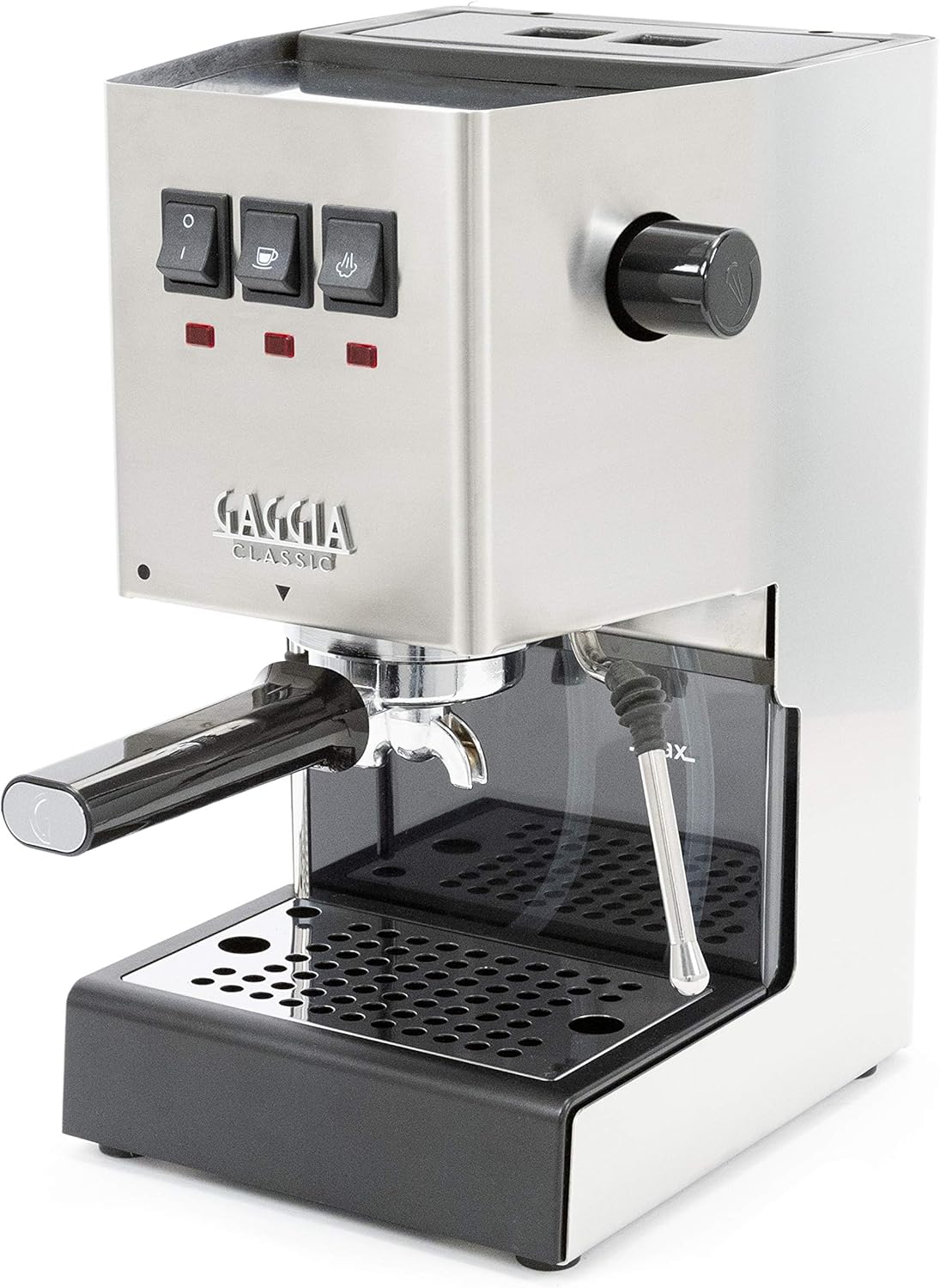
Gaggia Classic Evo Pro RI9380/46
| Operation Mode | Semi-Automatic |
|---|---|
| Output Pressure | 9 bar |
| Wattage | 1200 watts |
| Coffee Input Type | ground, pod |
| Capacity | 2.1 liters |
The Gaggia Classic Evo Pro is a compact prosumer espresso machine that brings commercial-style components to a home setup. It brews espresso at 9 bar pressure using a 58 mm stainless steel commercial portafilter and includes both commercial and pressurized baskets so you can use fresh grounds or pre-ground pods. The machine's commercial steam wand makes frothing and microfoam straightforward for latte art, and an updated pump mounting reduces noise during extraction. A 2.1 liter water reservoir and reusable filter support regular daily use, while the stainless steel housing and brass components aim for long-term durability. Notable practical benefits are the machine's ability to pull cafe-style shots and the flexibility between pressurized and non-pressurized baskets for learning and experimentation. Limitations include its semi-automatic workflow that requires some technique and a dedicated counter footprint, and while the boiler has anti-scale updates, regular maintenance is needed to preserve performance over time.
Best for: Buyers who want a durable, pro-style home machine to learn espresso skills and make cafe-quality shots and milk drinks without stepping up to a full commercial unit.
Less Ideal for: Casual users who prefer fully automatic, push-button convenience or those with very limited counter space should consider simpler machines instead.
- Commercial 58 mm stainless steel portafilter for cafe-style extraction
- 9-bar pump pressure for consistent espresso shots
- Commercial steam wand for good milk texturing and latte art
- Includes both commercial and pressurized filter baskets for flexibility
- Durable steel housing and serviceable commercial components
- Requires hands-on technique and practice to dial in shots
- Not as compact as entry-level machines and needs counter space
- Regular descaling and maintenance required to keep boiler and components in top condition
Verdict: Choose the Gaggia Classic Evo Pro if you want a durable, prosumer-level machine that produces café-quality espresso and lets you develop barista skills.
Breville Barista Pro BES878BSS

| Wattage | 1680 watts |
|---|---|
| Voltage | 120 |
| Coffee Input Type | whole bean, ground |
| Capacity | 2 liters |
| Filter Type | Reusable |
The Breville Barista Pro is a semi‑automatic espresso machine designed to deliver café‑style shots at home. It combines a built‑in conical burr grinder with 30 grind settings and dose control so you can grind directly into the portafilter, while the ThermoJet heating system and PID temperature control bring the machine up to extraction temperature in seconds for consistent shots. The 54mm portafilter and dual/single wall filters support full‑bodied 18g extractions, and the powerful steam wand produces microfoam suitable for latte art. An intuitive LCD interface shows grind and extraction guidance, which helps bridge the learning curve for beginners. Practical benefits include fast heat‑up, precise dosing, and professional milk steaming without needing separate equipment. Expect a moderately large footprint and a manual tamping workflow, so it suits users who want control rather than one‑touch automation; routine cleaning and periodic descaling are also required to keep the grinder and ThermoJet performing at their best.
Best for: Buyers who prioritize shot quality and control and are ready to learn basic espresso technique to dial in grind, dose, and milk texturing.
Less Ideal for: People who want fully automatic one‑touch drinks or a compact, low‑maintenance pod‑style machine should look elsewhere.
- Integrated conical burr grinder with 30 grind settings and dose control for precise dosing
- ThermoJet heating and PID temperature control for fast, consistent extraction temperature
- 54mm portafilter and dual/single wall filters support full‑bodied 18g shots
- Powerful steam wand capable of producing microfoam for latte art
- Intuitive LCD interface that displays grind and extraction guidance
- Requires manual tamping and some technique to get repeatable results
- Larger footprint and heavier than basic home machines
- Regular cleaning and maintenance needed for best performance
Verdict: Choose the Barista Pro if you want a fast‑heating, grinder‑equipped machine that gives hands‑on control to produce café‑quality espresso and textured milk at home.
atatix EM3111 Espresso Machine

| Operation Mode | Semi-Automatic |
|---|---|
| Wattage | 1350 watts |
| Voltage | 120 volts |
| Output Pressure | 20 bar |
| Filter Type | Reusable |
The atatix EM3111 is a compact semi-automatic espresso machine built to produce espresso-based drinks at home or in small offices. It uses a 20-bar pump and dual-wall portafilter filters to stabilize pressure for consistent extraction, while an NTC sensor plus PID algorithm holds brew temperature in the 90–96°C range so shots extract reliably after a quick warm-up. The included steam wand puts out focused steam for dense microfoam suitable for lattes and cappuccinos, and the stainless-steel exterior with a cup-warming top keeps the unit feeling like a step up from budget machines. It accepts whole-bean input with reusable filters and comes with one- and two-cup filters, a tamper, and a removable 45 oz water tank for easier refills and cleaning. Expect a learning curve for dialing in grind and tamp for best results, and the machine's compact footprint limits brew volume for larger households or continuous commercial use. For home baristas who want temperature control and a strong steam wand without a pro-sized footprint, it balances performance and convenience well.
Best for: Buyers who want a compact, practical home espresso setup that emphasizes consistent temperature control and a capable steam wand for milk drinks.
Less Ideal for: People who need a high-volume or commercial-capable machine or those seeking a fully automatic bean-to-cup workflow with one-touch drinks.
- 20-bar pump with dual-wall filters for stable extraction
- PID-controlled temperature with NTC sensor for consistent shot temperature
- Powerful steam wand capable of producing dense microfoam
- Detachable 45 oz water tank and removable drip tray for easier cleaning
- Includes portafilter, one- and two-cup filters, tamper, and scoop for a ready-to-use setup
- Compact design limits continuous output for larger households or high-volume use
- Requires manual dialing of grind and tamp to achieve best extraction
Verdict: If you want pro-style temperature control and a strong steam wand in a compact home machine, the EM3111 delivers consistent espresso and latte-ready microfoam without taking up much counter space.
Neretva Espresso Machine PE3670U

| Output Pressure | 20 bar |
|---|---|
| Wattage | 1350 watts |
| Operation Mode | Semi-Automatic |
| Coffee Input Type | Ground |
| Filter Type | Reusable |
The Neretva PE3670U is a compact semi-automatic espresso maker aimed at home baristas who want espresso and milk drinks without a bulky machine. It uses a 20-bar pump and a 1350 W boiler to produce pressure and steam, and includes a 51 mm portafilter with single and double pressurized filters for easier extraction from premade or freshly ground coffee. The machine offers a visible temperature display and a pre-infusion function to stabilize extraction, plus a powerful steam wand for frothing milk and a cup-warming area to help keep shots hotter. Setup and daily use are straightforward: fill the removable 1.31 L tank, tamp or use the pressurized basket, brew, then steam milk with the wand. Practical benefits include space-saving stainless steel construction and a useful accessory kit (tamper, dosing funnel, filters). Important limitations are that pressurized filters simplify dialing in espresso but limit advanced tuning, and compact machines like this can take longer between heavy steam or back-to-back drinks. For budget-minded buyers who want cappuccinos and lattes at home, it offers strong value and capable steam performance in a small footprint.
Best for: Home buyers on a budget who want a compact machine capable of reliable espresso and good milk steaming for lattes and cappuccinos without a steep learning curve.
Less Ideal for: Serious espresso enthusiasts seeking full commercial-level temperature stability, larger shot output, or machines built for continuous high-volume use should consider higher-end alternatives.
- 20-bar pump and 1350 W boiler deliver strong pressure and usable steam for milk drinks
- Removable 1.31 L water tank and compact footprint make it easy to fit in small kitchens
- Includes 51 mm portafilter, tamper, dosing funnel, and single/double pressurized filters for immediate use
- Visible temperature display and pre-infusion help stabilize extraction for more consistent shots
- Pressurized filter baskets limit fine-tuning for experienced users seeking full control
- Can require pauses between multiple steamed drinks due to compact boiler capacity
Verdict: A compact, budget-friendly semi-automatic espresso machine that delivers strong pressure and capable steaming for home lattes and cappuccinos.
Breville Barista Express BES870XL

| Wattage | 1600 watts |
|---|---|
| Voltage | 120 |
| Coffee Input Type | whole_beans |
| Filter Type | Reusable |
| Capacity | 1 cups |
The Breville Barista Express BES870XL combines an integrated conical burr grinder, 54mm portafilter, PID temperature control, and a steam wand in a single countertop unit to take you from whole beans to espresso and milk drinks without separate appliances. Typical use is grinding fresh beans directly into the portafilter, tamping, and pulling single or double shots using the thermocoil heating system for consistent extraction, then texturing milk with the steam wand to make lattes or cappuccinos. Notable features include 16 grind settings for dose control, low‑pressure pre‑infusion to even extraction, and both single and dual‑wall filter baskets for different user skill levels. Practical benefits are fresher espresso from on‑demand grinding, stable brew temperature for balanced flavor, and the steam wand's ability to produce microfoam for latte art. Limitations are that it is a manual workflow requiring some technique and the machine occupies counter space and needs routine cleaning and descaling to maintain reliability and performance.
Best for: Home coffee enthusiasts who value consistent, café‑quality espresso and are willing to learn manual technique to control grind, dose, and milk texturing for reliable results.
Less Ideal for: People who want one‑button convenience or fully automated drink programs, or who need a hands‑off machine for heavy commercial use.
- Integrated conical burr grinder with dose control for consistent fresh grinding
- PID temperature control and thermocoil heating for stable extraction
- 54mm stainless steel portafilter and dual/single wall baskets enable professional‑style shots
- Powerful steam wand for manual microfoam and latte art
- Includes useful accessories such as tamper, razor dosing tool, and cleaning tools
- Manual operation has a learning curve compared with fully automatic machines
- Requires regular cleaning, backflushing, and descaling to preserve performance
Verdict: Choose the Barista Express if you want a reliable, all‑in‑one semi‑automatic that grinds and steams to produce café‑quality espresso at home when paired with proper technique.
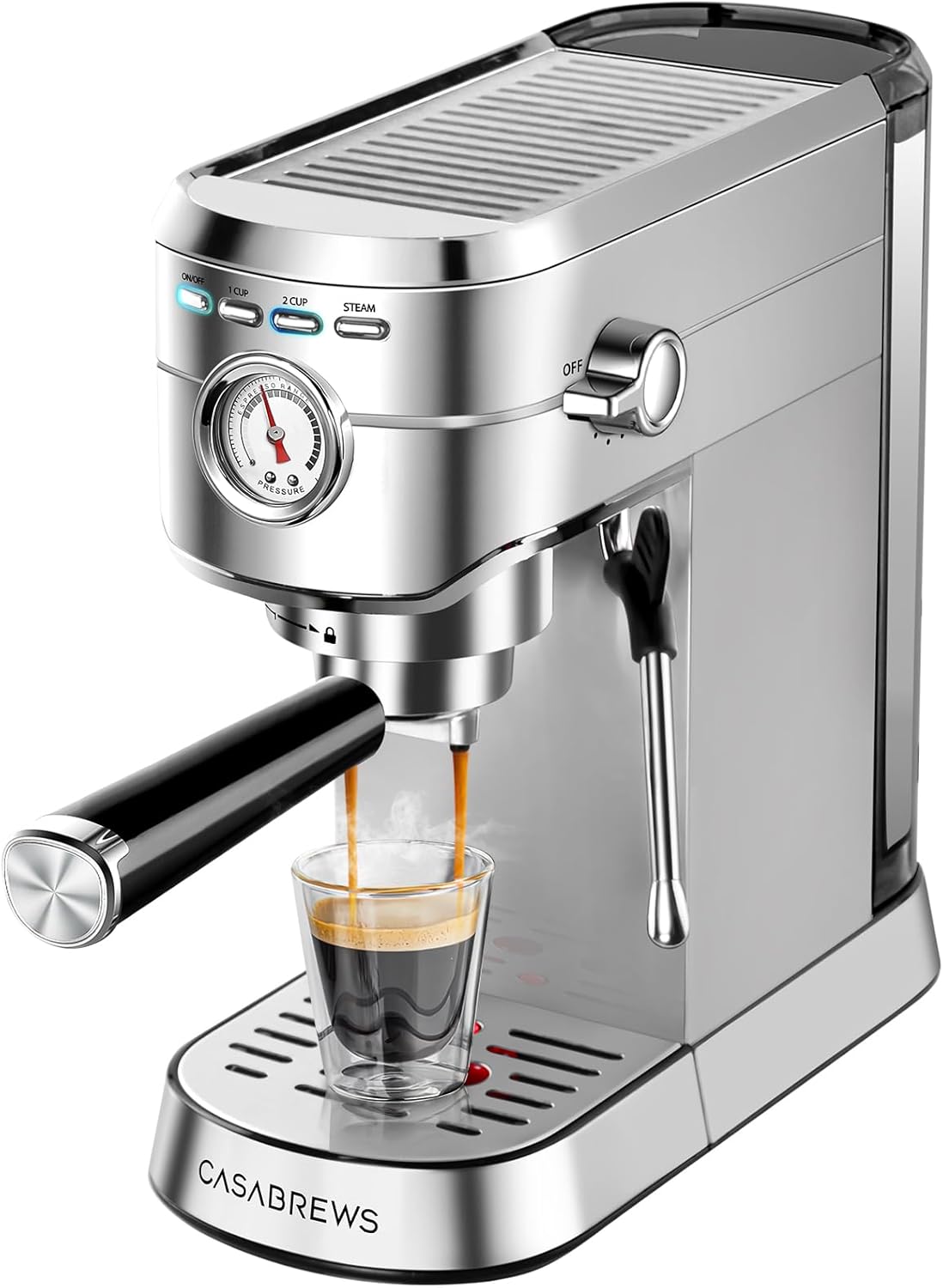
CASABREWS CM5418 Espresso Machine
| Operation Mode | Semi-Automatic |
|---|---|
| Wattage | 1350 watts |
| Output Pressure | 20 bar |
| Coffee Input Type | ground_coffee |
| Filter Type | Reusable |
The CASABREWS CM5418 is a compact semi-automatic espresso machine aimed at home users who want café-style drinks without a lot of counter space. It uses a 20-bar pump with a built-in pressure gauge and pre-infusion to help reach optimal extraction and produce a good crema, while buttons let you select single or double shot volumes. The machine includes a 51mm portafilter, a powerful steam wand for microfoam suitable for lattes and cappuccinos, and a removable 34 oz water tank that supports several cups before refilling. Practical touches include a cup warmer, removable drip tray for taller mugs, and reusable filter baskets. Expect learning and minor maintenance: you will need to dial in grind, dosing, and tamping to avoid slow extraction, and the manual warns not to brew immediately after steaming to avoid over-temperature protection. The single-boiler design means you must wait between steaming and brewing. For a kitchen-focused home barista, the CM5418 delivers most features needed to craft espresso and milk drinks with real control, though it requires some technique and routine upkeep to hit consistent results.
Best for: Buyers who want a countertop espresso machine that gives real control over extraction and milk texturing and are comfortable learning basic barista technique and regular maintenance.
Less Ideal for: Users who want fully automatic, no-hassle espresso with instant steam-to-brew switching or those who prefer a plug-and-play pod system for minimal involvement.
- 20-bar Italian pump with built-in pressure gauge for visible extraction feedback
- Powerful steam wand capable of producing microfoam for lattes and cappuccinos
- Compact stainless steel body with removable 34 oz water tank and cup warmer for practical everyday use
- Includes 51mm portafilter, single- and double-shot filter baskets, and a tamper so you can start brewing right away
- Single-boiler system requires cooldown time between steaming milk and pulling shots
- Requires manual dialing of grind, dose, and tamp to avoid slow or under-extracted pours
Verdict: A compact, feature-rich semi-automatic machine that gives home baristas pressure control and a strong steam wand for café-style espresso and milk drinks when you are willing to learn basic technique.
Ninja Luxe Café Premier ES601

| Operation Mode | Fully Automatic |
|---|---|
| Wattage | 1650 watts |
| Coffee Input Type | Ground, Whole Bean |
| Filter Type | Reusable |
The Ninja Luxe Café Premier ES601 combines an integrated conical burr grinder, assisted tamping, automated milk frothing, and guided Barista Assist software to simplify café-style drinks at home. You can pull single or double-style espresso shots, brew drip coffee in multiple cup sizes, or make rapid cold brew and cold-pressed espresso without separate devices. The machine's weight-based dosing and 25 grinder settings help produce consistent extraction, while the dual froth system (magnetic whisk plus automatic steamer) delivers hands-free microfoam for lattes and cappuccinos. Practical touches include a removable 70 oz water reservoir, built-in accessory storage, and a self-purging steam wand that reduces manual cleaning. At 1650 watts it is a substantial appliance and includes many accessories to get started. Expect a learning curve when dialing grind and drink presets and anticipate regular cleaning and descaling to keep the grinder and steam system performing. The ES601 is best for buyers who prefer guided automation and consistent results over tinkering with a pure manual machine.
Best for: A buyer who wants cafe-quality drinks with minimal manual skill and values guided automation and consistency over manual control.
Less Ideal for: People who prefer a compact single-purpose machine or hobbyists who want full manual control of every espresso variable.
- All-in-one 3-in-1 functionality: espresso, drip, and rapid cold brew from one machine
- Built-in conical burr grinder with 25 settings and weight-based dosing for consistent shots
- Assisted tamper and Barista Assist guide reduce guesswork for beginners
- Hands-free dual froth system with automatic steam wand for repeatable milk texture
- Removable large water reservoir and built-in accessory storage for daily convenience
- Large footprint and high power draw compared with single-function machines
- Requires routine cleaning and descaling to maintain grinder and steam performance
Verdict: Choose the ES601 if you want a guided, all-in-one solution that reliably produces cafe-style espresso, drip coffee, and cold brew with minimal barista skill.
Choosing the Right Espresso Machine for Barista: Key Factors to Consider
Boiler Type and Capacity
Boiler design affects how well a machine holds temperature and supports simultaneous brewing and steaming. Heat-exchange boilers let you brew and steam at the same time with a single boiler when properly managed, while dual-boiler systems separate brewing and steaming circuits for better temperature control.
Capacity matters for throughput. A small boiler may recover slowly between steam demands in a busy service setting, creating longer waits. For barista use you want a boiler that matches expected service volume so steam pressure stays consistent during peak periods.
Temperature Stability and Control
Stable brew temperature is critical to consistent extraction. Machines with PID temperature control let you fine-tune and maintain brew temperature to within narrow limits, which reduces shot-to-shot variation and helps dial in recipes.
Some machines rely on thermostat cycling, which is acceptable for low-volume contexts but can cause fluctuations during heavy use. Consider how easy it is to access and adjust temperature controls when you need to tweak for different beans or roast levels.
Steam Performance and Wand Usability
Strong steam power and a responsive steam wand are essential for microfoam and latte art. Look for machines with ample steam pressure, a well-designed wand joint that provides control, and steam frothing capacity that recovers quickly between pitchers.
Ergonomics matter. A wand that is awkward to position or that lacks a swivel joint increases fatigue and can slow service. Also consider the nozzle design and the range of motion relative to typical milk pitchers used in your workflow.
Grouphead and Portafilter Compatibility
Grouphead design and portafilter fit affect how evenly water is distributed through the puck and how well a machine replicates shot-to-shot behavior. Commercial-style groupheads and 58 mm portafilters are common on barista-focused machines because they offer predictable extraction and accommodate professional-standard baskets.
If you plan to use specific basket sizes or dosing accessories, ensure compatibility. Consistency of tamp depth and distribution tools also interacts with grouphead design to affect final cup quality.
Controls, Dosing, and Programmability
Control options influence how repeatable and efficient your workflow will be. Volumetric dosing or programmable shot settings let you standardize extraction across different operators, while pressure profiling and manual paddle controls give advanced users more flexibility for recipe development.
Consider whether you need simple push-button repeatability for high-volume service or fine-grained manual control for specialty preparation. The learning curve and training requirements for staff are an operational factor tied to control complexity.
Serviceability and Daily Maintenance
Machines used for barista work require routine maintenance. Easy access to group seals, removable drip trays, and straightforward backflush procedures reduce downtime. Machines that allow simple boiler or pump access speed repairs and extend service life.
Consider how simple it is to perform daily cleaning, change gaskets or showers, and carry out scheduled descaling. Availability of user-replaceable parts and clear maintenance instructions will lower long-term operating headaches.
Workflow Considerations for Busy Service
When you equip a barista station, think about the full service cycle: grinding, dosing, tamping, extraction, steaming, and milk finishing. A machine that makes one step slower can bottleneck the whole flow, so prioritize features that speed repeatable actions such as easy-to-reach steam wands and consistent volumetric dosing.
Layout and ergonomics are practical decisions. Positioning of the steam wand relative to the grouphead, the height of the cup platform, and the clearance for pitchers all influence efficiency and operator comfort. Consider how the machine will sit alongside grinders and tamping stations to minimize movement between tasks.
- Place grinders and knock boxes to minimize cross-room traffic.
- Ensure adequate clearance for pitchers and tamping tools.
- Choose controls that match staff skill level to reduce training time.
Heat Management and Recovery Times
Recovery time—the period it takes for the boiler to regain steam pressure after heavy use—directly affects how quickly you can produce successive milk pitchers. Machines with larger boilers or more efficient heating elements recover faster and support higher throughput without sacrificing steam quality.
Pay attention to published recovery specs and real-world reports about sustained steaming. If you expect to serve many milk-based drinks in a row, prioritize machines with robust steam capacity rather than those optimized solely for single-shot espresso quality.
- Larger boiler = faster steam recovery under load.
- Dual-boiler systems eliminate compromises between brewing and steaming.
- Heat-exchange systems require technique to manage simultaneous tasks.
Consistency: Taming Variables That Affect Extraction
Consistency is the result of controlling multiple variables: dose, grind, tamp, water temperature, and pressure. A machine that offers measurable control over temperature and dosing reduces guesswork and makes it easier to reproduce recipes across shifts.
Routine calibration and simple access to adjustments encourage consistent performance. Consider how a machine lets you adjust shot volume, fine-tune temperature, or monitor brew pressure during extraction.
- Use a reliable grinder and maintain burrs for consistent particle size.
- Record extraction times and weights to build repeatable recipes.
- Pick a machine with accessible controls for quick on-the-fly tweaks.
Space, Utilities, and Installation
Plan for the machine's footprint and utility needs before purchase. Boiler size, water connection options, and drain placement affect where the unit can sit. Some barista-level machines require direct water lines for long service runs, while others operate with a reservoir but need frequent refills.
Consider electrical requirements and ventilation. High-capacity boilers can draw more power, and steam can add humidity to the workspace. Ensure your counter and utility setup will support the machine's operational demands.
- Verify electrical circuit capacity for high-draw models.
- Check whether a plumbed water connection is needed for continuous service.
- Allow space for maintenance access and part replacement.
Training and Skill Development
A machine that offers advanced controls can unlock better beverages, but it also requires training. Factor in time to train staff on dosing, tamping, and steam technique. Consistent protocols around tamp pressure, puck prep, and milk temperature will keep quality stable across shifts.
Invest in simple documentation and quick-reference guides near the station so team members can reproduce recipes and troubleshoot common issues without interrupting service.
- Standardize tamping and dosing procedures for all staff.
- Practice milk texturing on similar pitchers to build muscle memory.
- Keep a maintenance checklist to preserve machine performance.
How We Chose the Best Espresso Machine for Barista
We focused on machines designed or commonly used in barista workflows and applied concrete, repeatable filters to build the shortlist. Key evaluation criteria included boiler and temperature stability, steam power and wand control, grouphead or portafilter consistency, and serviceability for frequent use. We also weighed control features such as volumetric dosing or programmable shot parameters, build quality and materials, and ease of maintenance for daily backflushes and descaling. We excluded consumer-only single-serve or pod-based machines and equipment intended solely for occasional home use. We prioritized units with proven thermal management, robust steam flow for textured milk, and accessible service points for routine maintenance. Machines that lacked clear control over extraction variables or that used unserviceable sealed components were not considered. The criteria above guided each selection and align directly with the scorecard metrics used on product pages.
Our full evaluation process is outlined in our review methodology.
FAQ
Do I need a dual-boiler machine for barista work?
Dual-boiler machines offer separate brew and steam circuits, which simplifies maintaining ideal brew temperatures while steaming. They are helpful in busy environments but add complexity and cost. Heat-exchange machines can work well if you manage workflow and accept some tradeoffs in thermal dynamics.
How often should I backflush and service a barista-level machine?
Daily backflushing with an appropriate detergent helps keep grouphead pathways clear. Routine maintenance tasks such as gasket checks and shower-screen cleaning should be done weekly or monthly depending on volume. Schedule professional service based on hours of use or if you notice pressure or temperature inconsistencies.
What steam wand features matter most for latte art?
Look for a wand with good steam power, a fine frothing tip, and a swivel joint for precise positioning. A responsive wand that creates consistent microfoam without large bubbles makes steaming and latte art repeatable across pitchers.
Can a barista-level machine be used at home?
Yes, many barista-grade machines can be used at home if you have the space and electrical capacity. Keep in mind they may require more maintenance and a steeper learning curve than consumer models. Their advantages are better temperature control and steam performance for advanced techniques.
How important is grouphead size and portafilter diameter?
Grouphead design and portafilter diameter affect basket compatibility and how water flows through the puck. Larger commercial-style portafilters provide stability for consistent puck prep and are commonly used in barista settings for predictable extraction behavior.
Final Verdict
Choosing an espresso machine for barista work comes down to balancing temperature control, steam power, serviceability, and the level of operator control you need. Prioritize machines that match your expected throughput and that provide stable brew temperatures and reliable steam recovery if you will be producing many milk drinks. Accepting tradeoffs is part of the decision: simpler machines are easier to operate and maintain, while more advanced models give finer control but require training and upkeep. Focus on the criteria that most directly affect daily workflow and drink consistency to make a confident choice.