
Note: This article contains affiliate links. If you click on these links and make a purchase, we may earn a small commission at no extra cost to you. This helps support our research and content. Read our full affiliate disclosure here.
If you want café-grade shots at home, an espresso machine with dual boiler heating puts temperature control and workflow power within reach. Dual boilers let you brew and steam at optimal temperatures at the same time, so you can pull a shot without sacrificing milk texture or forcing long waits between steps. That reliability matters for repeatable flavor, faster service, and a smoother learning curve when dialing in grind and dose. This guide shortlists the seven best dual-boiler espresso machines we considered for home and small-office use. Below are concise evaluations focused on the features that affect everyday use, plus buying factors and practical tips to help you pick the model that fits your routine and space.
Top Picks at a Glance
| Best Overall The best all-around choice for most situations | Breville Dual Boiler BES920XL |  |
| Best Quality Built to a higher standard if you want something more solid | Diletta Alto Dual Boiler |  |
| Best Value The sweet spot between price and what you get | Gevi Dual Boiler Espresso Machine |  |
| Best Budget The cheapest option that still gets the job done reliably | MAttinata ASSAPORA PRO CM1833L |  |
| Top Rated A top-rated pick with lots of positive feedback | Kismile Dual Boiler Espresso Machine |  |
| Most Popular A crowd favorite that many people choose with confidence | Gevi Dual Boiler Espresso Machine |  |
| Best Seller A high-volume bestseller chosen again and again | AIRMSEN BCM2308 Espresso Machine |  |
Breville Dual Boiler BES920XL

| Wattage | 1700 watts |
|---|---|
| Voltage | 110 volts |
| Operation Mode | Fully Automatic |
| Coffee Input Type | ground |
| Capacity | 5.3 pounds |
The Breville BES920XL Dual Boiler is a home espresso machine built for precise, repeatable shots and steam performance needed for milk drinks. Its dual stainless steel boilers let you pull an espresso and texture milk at the same time while the PID temperature control holds extraction temperature within a narrow band for consistent results. The 58mm portafilter and full-size filter baskets accept 19–22 g doses for fuller-bodied, cafe-style espresso, and the manual steam wand produces fine microfoam suited to latte art. The front LCD makes basic programming and routine adjustments straightforward, and the included dosing tool, tamper and milk jug mean you can start dialing shots right away. Expect a learning curve if you are new to dialing grind, dose and tamp, and the machine is large and relatively heavy, which affects counter placement. Power-hungry operation and the need for periodic maintenance are typical for dual-boiler machines, but for serious home users seeking control over extraction and steaming, this model is a strong performer.
Best for: Home users who want precise temperature control and the ability to steam milk and pull cafe-quality shots at the same time, and who are willing to learn shot dialing and routine upkeep.
Less Ideal for: People seeking a compact, low-maintenance or fully automatic pod-style espresso maker should consider simpler alternatives.
- True dual stainless steel boilers allow simultaneous extraction and steam
- PID temperature control keeps extraction temperature stable for consistent shots
- 58mm portafilter and full-size baskets accept 19–22 g dosing for fuller espresso
- Powerful steam wand produces fine microfoam suitable for latte art
- Includes useful accessories (tamper, dosing tool, milk jug, cleaning kit) to get started
- Large and heavy footprint requires substantial counter space
- High power draw and regular maintenance needs compared with simpler machines
Verdict: Buy this if you want a home dual-boiler espresso machine that delivers simultaneous extraction and steaming with precise PID temperature control for consistent, cafe-quality shots.
Diletta Alto Dual Boiler
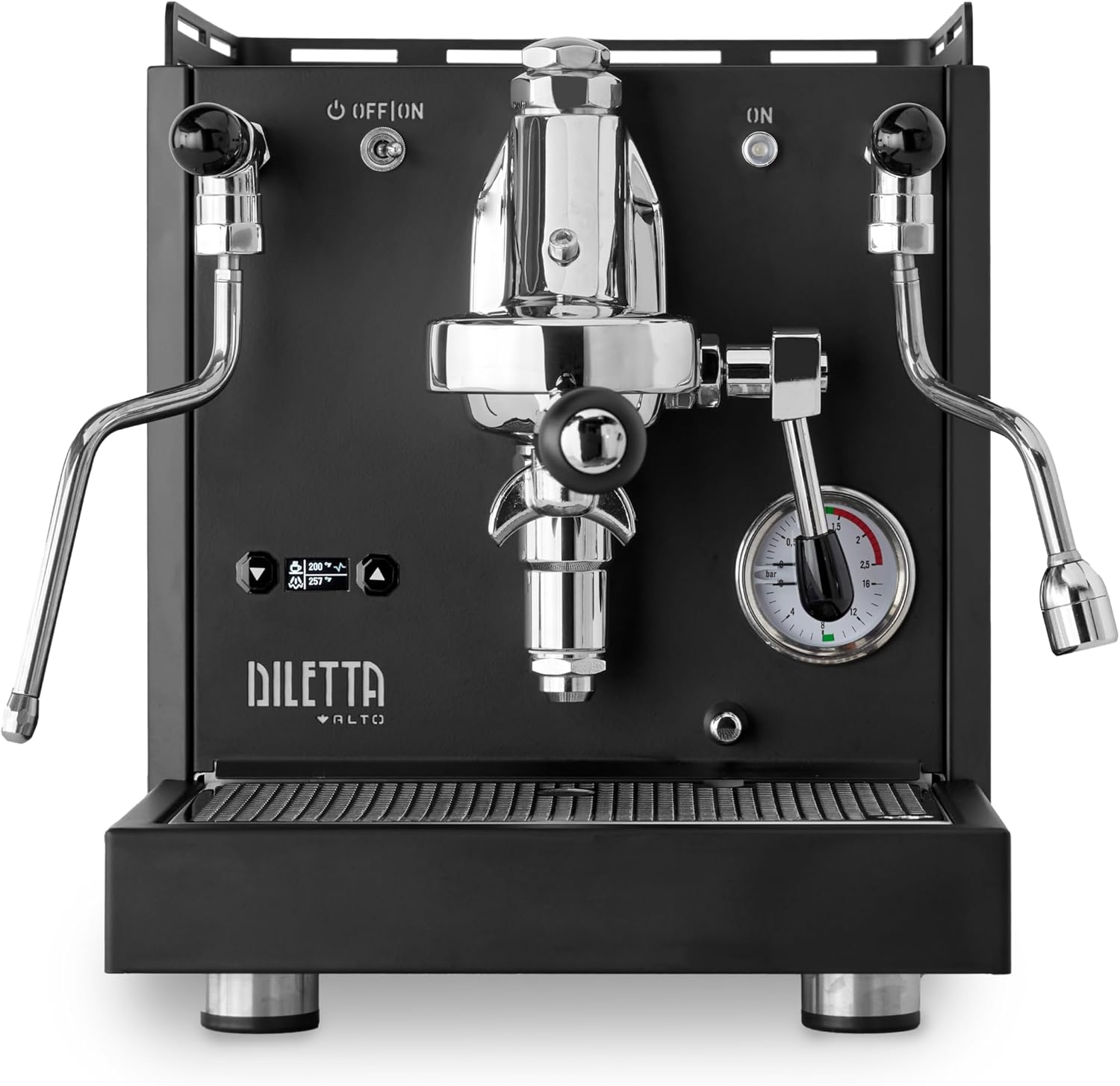
| Wattage | 1400 watts |
|---|---|
| Voltage | 120 volts |
| Capacity | 3 liters |
| Portafilter Size | 58mm |
The Diletta Alto is a dual-boiler, manual espresso machine built for experienced home baristas who want precise temperature and pressure control. It uses separate brew and steam boilers with front-mounted PID controls so you can set brew and steam temperatures to the degree, and the PID display also functions as a shot timer. Practical touches include pro-style steam and hot water paddles for quick one-handed activation, a 3L water reservoir, a 58mm portafilter and a top-accessible adjustable OPV for dialing brew pressure. The machine arrives with multiple portafilter baskets, a bottomless portafilter, tamper and backflushing basket so you can start dialing shots right away. Expect a roughly 22-minute warm-up to brew temperature and the ability to steam milk and brew simultaneously thanks to the separate boilers. Trade-offs are its manual dosing workflow and expert-level setup needs, plus a substantial footprint and weight compared with consumer machines, which means it suits a dedicated home barista rather than casual users.
Best for: Home baristas focused on performance and precise control who are willing to learn manual dosing and invest time dialing in shots.
Less Ideal for: Casual coffee drinkers who want push-button convenience or small kitchens where the machine's footprint and weight would be impractical.
- True dual-boiler design for simultaneous steaming and brewing
- PID temperature control with to-the-degree adjustments and built-in shot timer
- Professional steam and hot water paddles for ergonomic one-touch operation
- Includes a range of portafilters and baskets plus a tamper and backflushing basket to start dialling shots
- Top-accessible adjustable OPV for customizing brew pressure
- Manual operation requires practice to consistently dial espresso shots
- Large and heavy compared with typical consumer countertop machines
Verdict: Buy this if you want a hand-built dual-boiler machine with PID control and pro steam ergonomics for serious home espresso performance.
Gevi Dual Boiler Espresso Machine

| Operation Mode | Semi-Automatic |
|---|---|
| Coffee Input Type | ground, whole bean |
| Other Special Features | Adjustable Shot Volume, Pre-infusion, Cup Warmer, 58mm Portafilter, 0-30 Gears Adjustable Bean Box |
| Material | Stainless Steel |
This Gevi dual-boiler machine pairs a dedicated brew boiler and a separate steam boiler so you can extract espresso and texture milk simultaneously, which speeds workflow for at-home drinks. It includes a built-in burr grinder with 31 grind settings and a 58mm commercial-style portafilter, letting you dial shots from whole beans or preground coffee and use proper baskets. The PID/NTC temperature control helps keep extraction temps stable and pre-infusion plus adjustable shot volume give repeatable results once you learn the settings. The stainless steel housing, cup warmer, and professional steam wand make it feel like a compact prosumer unit, and removable water tank and drip tray ease cleaning. Expect a learning curve to master grind, dose, and steam technique, and built-in grinder controls are not a substitute for a dedicated high-end grinder for advanced users. At this price point it delivers the key benefits of true dual-boiler operation for home baristas who want faster milk drinks and consistent temperatures without upgrading to commercial equipment.
Best for: Buyers who want the performance of a dual-boiler machine for home use and prioritize faster workflow and temperature stability without moving to commercial equipment.
Less Ideal for: People who want a truly plug-and-play single-knob solution or those who prefer to use a separate professional grinder as part of a pro-level setup.
- True dual-boiler design lets you brew shots and steam milk at the same time
- Built-in burr grinder with 31 grind levels for on-demand whole-bean brewing
- 58mm commercial-style portafilter for stable extraction and compatibility with standard baskets
- PID and NTC temperature control for more consistent extraction temperatures
- Stainless steel build with removable water tank and drip tray for easier maintenance
- Integrated grinder is convenient but may not match the consistency of a dedicated high-end grinder
- Requires some dialing in of grind, dose, and steam technique to achieve consistent barista-level results
Verdict: If you want true dual-boiler performance at home for simultaneous brewing and steaming with built-in grinding, this Gevi delivers the core features prosumers need.
MAttinata ASSAPORA PRO CM1833L

| Operation Mode | Semi-Automatic |
|---|---|
| Wattage | 1350 watts |
| Output Pressure | 20 bar |
| Human Interface Input | Touchscreen |
| Coffee Input Type | Ground |
The MAttinata ASSAPORA PRO CM1833L is a compact dual-boiler semi-automatic espresso machine aimed at home users who want café-style drinks without a commercial footprint. It uses a 20 bar Italian ULKA pump, dual boilers and PID+NTC temperature control to keep extraction and steaming temperatures stable, while a touchscreen and programmable settings let you adjust brew volume and temperature. A removable milk tank and automatic milk frother deliver consistent microfoam for lattes and cappuccinos, and accessories such as a 51 mm portafilter, single and double baskets, tamper and scoop are included for out-of-box brewing. Practical benefits include fast heat-up, built-in pre-infusion for richer crema, and a self-cleaning design element that simplifies maintenance. Trade-offs are that it is a semi-automatic machine that still requires proper dosing and tamping for best results, the stainless steel compact body limits water capacity so frequent refills may be needed for heavy use, and some users will need to learn grind and dosing to reach peak flavor. For someone on a budget who wants dual-boiler convenience and milk-texturing without buying a prosumer unit, this machine packs a lot of capability into a small footprint.
Best for: Buyers seeking a cost-effective home espresso machine that delivers dual-boiler temperature stability and easy milk frothing for everyday café-style drinks.
Less Ideal for: Those who need a commercial‑grade, high-volume machine or want a fully automatic, hands-off brewing experience should consider other options.
- Dual-boiler system with PID+NTC control for steady brewing and simultaneous steaming
- 20 bar Italian ULKA pump and pre-infusion for improved crema and extraction consistency
- Built-in automatic milk frother with removable milk tank for easy latte and cappuccino preparation
- Touchscreen controls and programmable settings for quick customization
- Includes essential accessories (51 mm portafilter, single/double filters, tamper) for immediate use
- Smaller water tank capacity means more frequent refills during multiple consecutive drinks
- Semi-automatic operation requires learning proper dosing and tamping to achieve best results
- Not intended for high-volume commercial use despite dual boilers
Verdict: If you want dual-boiler temperature control and reliable milk steaming on a budget, this compact machine delivers barista-style capability for home use.
Kismile Dual Boiler Espresso Machine

| Output Pressure | 20 bar |
|---|---|
| Operation Mode | Semi-Automatic |
| Coffee Input Type | ground, whole bean |
| Material | Stainless Steel |
| Capacity | 2.8 liters |
This Kismile dual-boiler espresso machine combines a removable conical burr grinder, PID temperature control, and a dedicated steam boiler so you can grind, dose, extract, and froth from one compact unit. Typical use centers on daily espresso and milk-based drinks: grind fresh beans into the 58mm portafilter with up to 30 grind settings, choose single or double cup extraction via the LED controls, and steam milk with the hot steam wand or dispense hot water for americanos and tea. The dual boilers and PID keep brew and steam temperatures stable for consistent shots, and the pressure gauge and pre-infusion controls let you fine-tune extraction. Practical benefits include a removable water tank, cup warmer, descaling reminder, and a complete accessory kit for setup and maintenance. At this level you should expect a learning curve for dialing in grind and dose, and the machine's size and 2.8 L capacity mean it is better suited to home or small-office use rather than high-volume commercial brewing.
Best for: Buyers who prioritize consistent, cafe-style shots at home or in a small office and want a durable, temperature-stable dual-boiler machine with an integrated grinder.
Less Ideal for: People needing a commercial-scale machine for continuous heavy use or those who want a fully automatic, push-button espresso experience with minimal setup.
- Dual-boiler design with PID control for stable brew and steam temperatures
- Built-in conical burr grinder with 30 grind settings for fresh grounds
- 58mm portafilter and pressure gauge for hands-on shot control
- Removable water tank, cup warmer, and included accessories for easier setup and maintenance
- Not intended for high-volume commercial use due to countertop size and capacity
- Requires time to dial in grind, dose, and extraction for best results
Verdict: Choose this machine if you want a durable, dual-boiler system with PID control and a built-in grinder for reliably consistent café-style espresso at home or in a small office.
Gevi Dual Boiler Espresso Machine

| Operation Mode | Semi-Automatic |
|---|---|
| Wattage | 1500 watts |
| Voltage | 120 volts |
| Coffee Input Type | Whole Bean |
| Capacity | 2.8 liters |
The Gevi Dual Boiler is a countertop semi-automatic espresso machine that combines a built-in conical burr grinder with separate boilers for brewing and steaming, letting you pull shots and steam milk without long waits. It uses PID and NTC temperature regulation to keep extraction temperatures steady, and a 20-bar pump with a 9-bar extraction target and pre-infusion options to help produce consistent crema. The included 58mm commercial-style portafilter, two non-pressurized and two pressurized baskets, heavy-duty steam wand, and 31 grind settings make it suitable for making espresso, cappuccinos, and lattes at home. Practical benefits include a removable 2.8 L water tank for less frequent refills, a cup warmer, and user-friendly buttons for controls. Expect some learning curve dialing in grind and dose to hit ideal pressure and crema, and the machine is fairly heavy and sizable for small counters. For buyers prioritizing steady temperature control and back-to-back steaming, the dual-boiler setup delivers a more efficient workflow than single-boiler machines.
Best for: Buyers who want café-style control and consistent temperature stability at home and who value social proof and measurable performance in a dual-boiler setup.
Less Ideal for: Casual coffee drinkers who prefer plug-and-play single-serve convenience or those with very limited countertop space should consider simpler machines.
- Independent dual boilers allow simultaneous extraction and steaming for faster drink prep
- PID temperature control for consistent brew temperatures
- Built-in conical burr grinder with 31 grind settings for fresh grounds and dose control
- Commercial-style 58mm portafilter and multiple filter baskets included
- Large removable 2.8 L water tank reduces refill frequency
- Machine is relatively heavy and requires adequate counter space
- Requires time and adjustment to dial in grind size, dose, and pressure for optimal crema
Verdict: Choose this Gevi dual-boiler if you want stable PID-controlled extraction and simultaneous steaming for consistent, café-quality espresso at home.
AIRMSEN BCM2308 Espresso Machine

| Output Pressure | 20 bar |
|---|---|
| Wattage | 1350 watts |
| Operation Mode | Semi-Automatic |
| Capacity | 1.8 liters |
| Power Source | electric |
The AIRMSEN BCM2308 is a dual-boiler semi-automatic espresso machine designed to speed up home espresso, cappuccino, and latte prep. It pairs a 1350W extraction boiler with a 1000W milk boiler so you can pull shots and froth milk nearly simultaneously, and the 20-bar pump with pre-infusion aims to deliver concentrated extraction and richer crema. Operation is simplified by a full LED touchscreen, selectable single or double filters, and an automatic milk frother with a removable milk reservoir for easier cleaning. The stainless-steel exterior, removable 60 oz water tank, and detachable drip tray make maintenance straightforward for everyday use. Expect faster cycle times than single-boiler machines and consistent milk texture from the auto-frother, but the machine is still semi-automatic so dialing in grind, dose, and tamping affects shot quality. The unit is reasonably compact for a dual-boiler design, but it is not a fully commercial system and advanced users may miss manual steam control. For buyers who want reliable, faster home brewing with hands-off milk frothing, this model delivers practical performance without a steep learning curve.
Best for: Buyers who want a reliable home espresso machine that speeds up brewing with dual boilers and automated milk frothing while keeping operation and maintenance simple.
Less Ideal for: Users seeking a pro-level commercial machine or those who want fully manual steam wand control for custom milk texturing should look elsewhere.
- Dual boiler setup lets you brew espresso and froth milk at the same time for faster drink prep
- 20-bar pump with pre-infusion for stronger extraction and improved crema
- Automatic milk frother with detachable milk reservoir simplifies latte and cappuccino making
- Large 60 oz removable water tank reduces refill frequency and is easy to clean
- Full touchscreen and included single/double filter baskets make operation straightforward
- Semi-automatic system still requires attention to grind, dose, and tamp for best shots
- Automatic frother limits manual steam control for users who prefer custom microfoam technique
Verdict: If you want faster, consistent home espresso and hands-off milk frothing, the dual-boiler AIRMSEN BCM2308 is a practical, easy-to-use choice.
Choosing the Right Espresso Machine with Dual Boiler Heating: Key Factors to Consider
Temperature Stability and Control
Consistent brew temperature is essential for extracting the same flavors shot after shot. Dual boilers separate the brew and steam circuits so the grouphead temperature remains stable while you steam milk, reducing flavor variability.
Look for machines with active temperature sensors, either PID controllers or similarly precise regulation, and for visible readouts or easy calibration. The more accurate the temperature control, the easier it is to reproduce a dialed-in shot across different beans and grind sizes.
Steam Boiler Size and Recovery Time
Steam performance determines how quickly you can texture milk and how long the machine sustains adequate steam pressure during multiple drinks. A larger steam boiler gives more thermal reserve, while faster recovery time means less waiting between milk frothing cycles.
If you regularly make milk-based drinks for several people in a row, prioritize machines with strong steam output and short recovery. For occasional single drinks, a smaller steam boiler can still be fine as long as it recovers reasonably quickly.
Control Features and Adjustability
The degree of user control affects how precise you can be with extraction. Basic machines may offer on/off steam and a simple thermostat, while higher-end units provide PID temperature adjustment, volumetric dosing, or programmable pre-infusion and pressure profiling.
Consider how hands-on you want to be. If you plan to experiment with pressure and temperature, choose a model with accessible controls and clear feedback. If you mainly want reliable, repeatable shots with less fuss, simpler preset controls can be an advantage.
Build Quality and Serviceability
Durable materials and a modular internal layout reduce downtime and maintenance costs. Brass groupheads, copper or stainless boilers, and robust pumps last longer and hold temperature better than thin sheet-metal components. Threaded fittings and accessible panels make routine service easier.
User-serviceable components like replaceable shower screens, portafilter gaskets, and accessible pump or solenoid assemblies are helpful. Machines that require complicated disassembly for basic maintenance tend to cost more in service time and professional repairs.
Size, Footprint, and Water Supply
Dual-boiler machines are typically larger and heavier than single-boiler units, so measure counter space and cabinet clearance before buying. Boiler capacity and water reservoir size determine how many drinks you can make before refilling or switching to a plumbed-in configuration.
Decide whether you need a simple removable water tank or a plumbable machine. Plumbed-in setups reduce refilling but add installation complexity. Also consider weight and ventilation clearance for safe operation.
Ergonomics and Daily Workflow
How a machine fits into your workflow influences speed and consistency. Look at portafilter handle clearance, grouphead height, steam wand reach and articulation, and drip tray layout. Easy access to the grinder, knock box, and cups shortens the steps between dosing and serving.
Controls that are intuitive and within reach reduce mistakes during busy sequences. Small details like a heat-resistant steam wand knob or a well-placed cup warmer can make regular use more pleasant.
Why Dual Boiler Heating Matters
Dual boiler heating separates the brew circuit from the steam circuit so each can operate at its optimal temperature. That separation prevents the common tradeoff found in single-boiler machines, where switching between brewing and steaming forces waits or compromises.
For home baristas, the practical benefits are faster workflows and more consistent extraction. You can texture milk and monitor your portafilter temperature, then immediately pull a shot or vice versa without long recovery times.
- Simultaneous brew and steam at correct temperatures
- Shorter wait times between tasks
- More consistent shot extraction across multiple drinks
PID Controllers and Temperature Readouts
PID controllers give precise digital control over brew temperature and can minimize swing around the setpoint. Machines with visible readouts let you verify temperature and make small adjustments to compensate for different beans or ambient conditions.
Not all PID systems are equal. Look for controllers that allow fine adjustments and show real-time feedback rather than only preset modes.
- PID reduces temperature drift
- Digital readouts simplify calibration
- Some systems allow separate adjustments for brew and steam
Pressure Management and Pre-Infusion
Beyond temperature, pressure control is a major lever for espresso quality. Look for machines that offer controlled pre-infusion or a brew pressure gauge to monitor extraction dynamics. A stable 9 bar extraction is a common target, but the ability to shape pressure over time helps coax different flavors from specialty beans.
Built-in pre-infusion that gently wets the puck before full pressure can reduce channeling and improve crema and body. If you experiment with pressure profiling, choose a machine with straightforward controls and clear indicators.
- Pre-infusion improves extraction uniformity
- Pressure gauges provide useful real-time feedback
- Pressure profiling suits experienced hobbyists
Milk Texturing Tips for Dual Boiler Machines
A good steam wand and ample steam power are the hardware side of milk steaming. Technique matters too. Start with cold milk, purge the wand briefly, introduce air early for microfoam, then submerge and texture to the desired temperature and texture. Dual boilers let you repeat this process without waiting for the brew circuit to recover.
If you plan to make multiple milk drinks in succession, practice short steaming cycles and use a larger steam pitcher to maintain thermal mass. That reduces the number of flushes and keeps the wand temperature more consistent between drinks.
- Purge the wand before and after steaming
- Use proper pitcher size for volume and thermal control
- Practice controlled aeration and stretching for microfoam
Installation and Ongoing Maintenance
Decide whether you want a machine that runs from a removable tank or one that plumbs into a water line. Plumbed units are convenient for frequent use but require a proper installation and may need water treatment equipment to prevent scale. Tank machines are simpler to install but require more frequent refilling.
Routine maintenance includes backflushing, changing grouphead gaskets, descaling where applicable, and keeping the steam wand clean. Choosing a model with straightforward access to service points reduces the time and cost of these tasks.
- Plumb-in vs removable tank tradeoffs
- Regular backflushing and gasket checks
- Consider water filtration to reduce scale buildup
How We Chose the Best Espresso Machine with Dual Boiler Heating
We focused our selection on machines that deliver the core benefits buyers expect from dual-boiler designs: accurate brew temperature, independent steam power, and durable construction for consistent performance. We evaluated candidates on measurable, user-facing dimensions rather than marketing claims. Key criteria included brew temperature stability across successive shots, steam boiler capacity and recovery time, build materials and serviceability, control options for temperature and pressure profiling, and the ergonomics of the portafilter, grouphead, and steam wand. We excluded single-boiler and heat-exchanger models because they do not support simultaneous optimal brew and steam temperatures. We also filtered out machines intended solely for commercial high-volume use that would be impractical for home settings. The final list favored machines with clear user controls, replaceable wear parts, and proven plumbing and safety features that reduce maintenance complexity.
Our full evaluation process is outlined in our review methodology.
FAQ
Do dual-boiler machines need more maintenance than single-boiler units?
They can require slightly more maintenance because there are two boilers and associated plumbing, but the tasks are similar: backflushing, descaling if applicable, and replacing wear parts. Good accessibility and user-serviceable parts keep upkeep manageable.
Is a dual-boiler machine overkill for a single drinker?
It depends on priorities. If you want the fastest, most consistent milk-based drinks and plan to practice dialing in shots, dual boilers offer clear advantages. For the occasional espresso, a simpler design may be sufficient and less costly to operate.
Can I use a dual-boiler machine without a water line connection?
Many dual-boiler machines include removable water tanks and can operate without a plumbed supply. If you expect to make many drinks in a row, consider either a larger reservoir or a plumbed installation to avoid frequent refills.
How important is a PID controller on a dual-boiler espresso machine?
PID control significantly improves temperature precision and reduces swing, which helps with repeatable extraction. It is especially valuable if you plan to experiment with different beans or extraction temperatures.
Will a dual-boiler machine improve crema and flavor consistency?
By maintaining stable brew temperature and enabling proper steam pressure, dual boilers reduce variables that cause inconsistency. Stable temperatures and controlled pressure typically translate to more repeatable flavor and crema across shots.
Final Verdict
Dual-boiler espresso machines excel when you need simultaneous brewing and steaming without compromise. Prioritize temperature stability, steam power and recovery, and user controls that match how involved you want to be with dialing in shots. Also weigh practical concerns like footprint, water supply, and ease of maintenance. If you value consistent extraction and faster workflows for milk-based drinks, choose a machine with strong steam capacity, a reliable PID or temperature control, and a serviceable design. These tradeoffs will help you pick a unit that fits your routine and gives the repeatable results you want.