
Note: This article contains affiliate links. If you click on these links and make a purchase, we may earn a small commission at no extra cost to you. This helps support our research and content. Read our full affiliate disclosure here.
Choosing the right extractor fan matters for indoor air quality, moisture control, and odor removal in kitchens and bathrooms. The right fan improves ventilation efficiency while minimizing noise and long-term maintenance hassles. This guide shortlists seven top extractor fans suited to typical home setups and explains the practical tradeoffs between airflow, sound, and installation complexity. Read on to see the top picks and the evaluation criteria used to judge them.
Top Picks at a Glance
| Best Overall The best all-around choice for most situations | VEVOR 12in Air Mover Blower |  |
| Best Quality Built to a higher standard if you want something more solid | Panasonic WhisperFit DC FV-0511VF1 |  |
| Best Value The sweet spot between price and what you get | XPOWER P-230AT Mini Air Mover |  |
| Best Budget The cheapest option that still gets the job done reliably | Broan-NuTone 50 CFM Exhaust Fan 688ES |  |
| Top Rated A top-rated pick with lots of positive feedback | iLIVING 12-Inch Shutter Exhaust Fan |  |
| Most Popular A crowd favorite that many people choose with confidence | Lasko Pivoting Pro 12" Fan U12104 |  |
| Best Seller A high-volume bestseller chosen again and again | Comfort Zone 9" Twin Window Fan |  |
VEVOR 12in Air Mover Blower

| Wattage | 585 watts |
|---|---|
| Air Flow Capacity | 3198 cfm |
| Noise Level | 79 db |
| Motor Type | AC |
| Included Components | Portable Ventilator with hosex 1 |
The VEVOR 12in air mover is a portable industrial ventilator meant to move large volumes of air for exhausting smoke, odors, and hot air from workshops, basements, and construction spaces. It pairs a 585W AC motor with a seven-blade impeller to deliver up to 3198 CFM through supplied PVC ducting, so you can run it as either an intake or exhaust in confined areas. The unit is built from powder-coated alloy steel, includes a carry handle and non-slip feet for stable positioning, and carries ETL certification plus IP44 splash resistance and overheating protection for safer jobsite use. Controls are simple push-button operation with a single speed, which keeps operation straightforward but limits fine airflow adjustment. At 79 dB it is fairly loud, and the single-speed design means you cannot dial back for quieter or lower-power operation. For rapid ventilation needs where robust airflow and portability matter more than variable speeds, it performs well.
Best for: Buyers who need a straightforward, high-output ventilator for clearing smoke, fumes, or hot air in workshops, basements, or construction areas and value durability and portability over variable speed control.
Less Ideal for: People seeking a quiet, low-speed adjustable fan for living spaces or continuous low-power ventilation should consider alternatives with multiple speeds and lower noise.
- High airflow capacity (3198 CFM) suitable for rapid exhausting and ventilation
- Durable alloy steel housing with powder-coated finish for jobsite durability
- Includes 33 ft flexible duct for remote intake or exhaust placement
- ETL certified with IP44 splash resistance and overheating protection
- Portable design with carry handle and non-slip feet for stable placement
- Only a single speed control limits fine-tuning airflow for delicate or low-noise tasks
- Rated noise level around 79 dB can be disruptive in occupied spaces
Verdict: Choose this compact industrial blower when you need aggressive, portable exhaust ventilation that pairs high CFM with a durable, jobsite-ready build.
Panasonic WhisperFit DC FV-0511VF1

| Air Flow Capacity | 110 cfm |
|---|---|
| Noise Level | 0.8 sones |
| Number of Speeds | 3 |
| Wattage | 15 watts |
| Motor Type | Brushless DC |
The Panasonic WhisperFit DC is a retrofit ceiling exhaust fan built for quiet, efficient ventilation in bathrooms and similar rooms. It uses a brushless DC/ECM motor with SmartFlow technology and a Pick-A-Flow switch so you can choose 50, 80, or 110 CFM depending on room size or task, while consuming about 15 watts at its rated speed. The ultra-slim 5.6 inch housing and Flex-Z Fast bracket make it easier to install in existing joist spaces, and the fan is rated at 0.8 sones so operation is unobtrusive. Controls are hardwired with a touch-style airflow selector and the unit meets Energy Star and UL specs, so it balances steady ventilation with low energy use. There is no integrated light or heater, so this is a straightforward exhaust-only model. For buyers prioritizing quiet, adjustable performance and straightforward retrofit installation, this model delivers strong airflow with low noise and power draw, though you will need separate lighting if that is required.
Best for: Buyers who want a high-performance, energy-efficient retrofit exhaust fan that delivers quiet, adjustable airflow and prioritizes ventilation performance over integrated lighting or extras.
Less Ideal for: People looking for a combined light or heater unit or a plug-and-play fan with built-in illumination and heating controls should consider other models.
- Selectable airflow at 50/80/110 CFM for matching room size and needs
- Brushless DC motor with SmartFlow for consistent, energy-efficient operation
- Very quiet at 0.8 sones, suitable for bathrooms and nearby living spaces
- Slim housing and Flex-Z Fast bracket simplify retrofit ceiling installation
- Energy Star and UL certification indicate efficient, safe performance
- No integrated light or heater so additional fixtures are required for lighting or warmth
- Requires hardwired control installation which may need an electrician
Verdict: Choose this fan if you need a quiet, energy-efficient retrofit exhaust with selectable high-performance airflow for better moisture control.
XPOWER P-230AT Mini Air Mover

| Power Source | Corded Electric |
|---|---|
| Number of Speeds | 3 |
| Air Flow Capacity | 925 cfm |
| Wattage | 150 watts |
| Motor Type | AC induction motor |
The XPOWER P-230AT is a compact centrifugal air mover built for fast surface drying and spot ventilation. Its 1/4 HP motor pushes up to 925 CFM across three speeds and four angled positions, so you can aim airflow at carpets, floors, van interiors, crawlspaces, or bathroom surfaces to speed drying after cleaning or minor water damage. A 3-hour timer and onboard duplex power outlets let you run the unit for set periods and daisy-chain additional equipment on site, which is useful for multi-unit setups during restoration or cleaning jobs. The housing is lightweight and stackable for easy transport and storage, and the 10 ft cord with wrap design keeps setup tidy. On the downside, the plastic body and blower design prioritize portability over industrial ruggedness, and the unit is intended for indoor use only, so it is not a substitute for heavy-duty commercial blowers in continuous extreme environments. Noise is moderate at the listed level and typical for this class of air mover.
Best for: Buyers who want a compact, efficient air mover to speed drying and improve ventilation in homes, vehicles, or small commercial jobs and who prioritize portability and practical features.
Less Ideal for: Professionals needing a heavy-duty continuous-use industrial blower or users who require outdoor-rated equipment should consider larger commercial units instead.
- High airflow up to 925 CFM for fast surface drying
- Three speeds and four tilt positions for targeted drying and ventilation
- Built-in duplex power outlets and daisy-chain capability for running multiple devices
- Lightweight, stackable design with a 3-hour timer for convenient transport and timed operation
- Plastic housing favors portability over heavy-duty durability
- Designed for indoor use only, not for continuous outdoor or extreme commercial jobs
Verdict: Choose the P-230AT when you need a portable, high-airflow mini air mover that speeds surface drying and supports multi-unit setups with onboard power outlets.
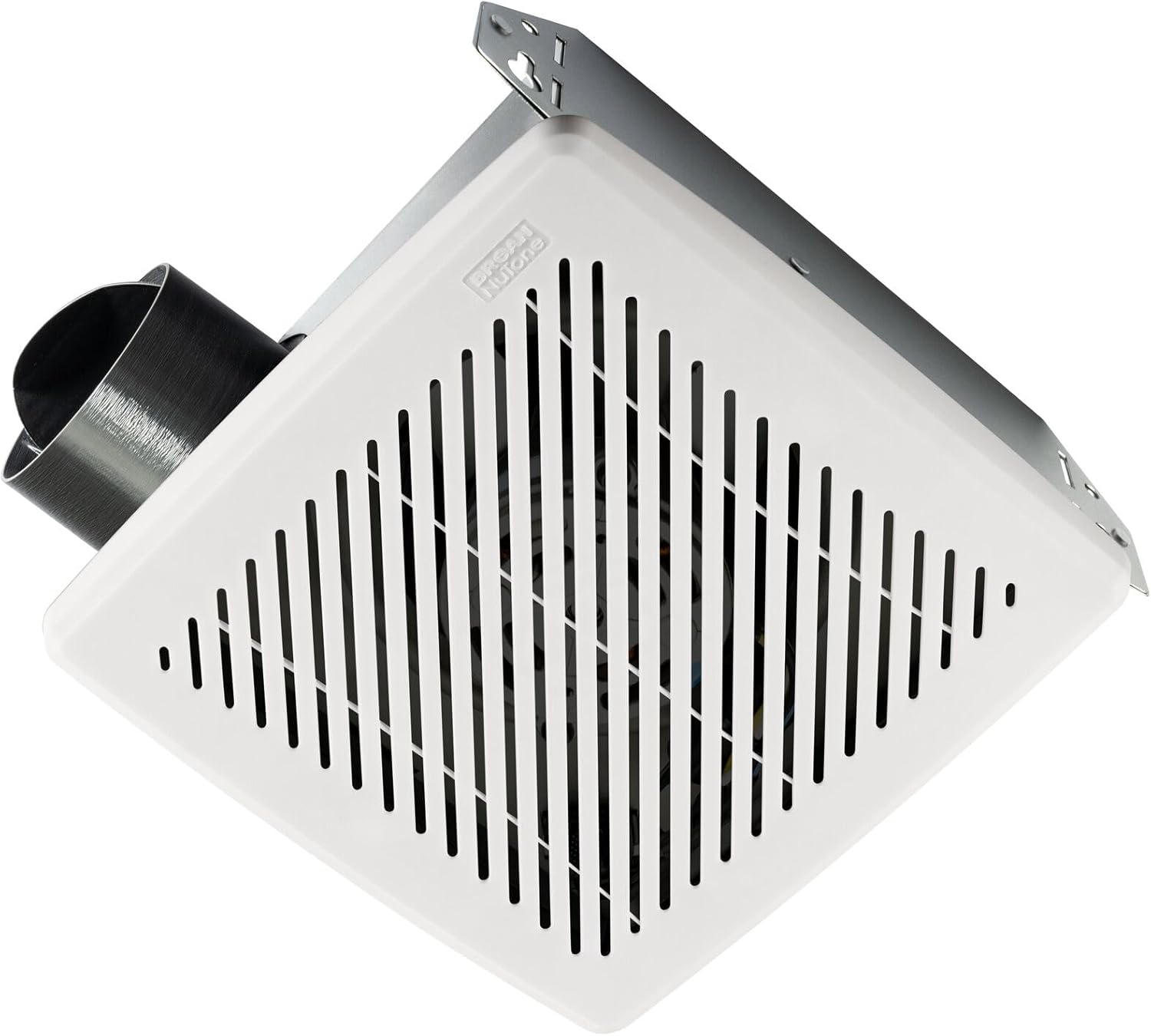
Broan-NuTone 50 CFM Exhaust Fan 688ES
| Air Flow Capacity | 50 cfm |
|---|---|
| Noise Level | 2 sones |
| Wattage | 55 watts |
| Installation Type | No-Cut Ceiling Mount |
| Control Method | Touch |
The Broan-NuTone 688ES is a straightforward, budget-friendly bathroom exhaust fan designed for small rooms up to about 45 sq ft. It provides 50 CFM of ventilation to remove moisture and odors while running at a relatively quiet 2.0 sones, and its Energy Star certification keeps standby power use low. The compact galvanized housing and foldable mounting flanges make no-cut ceiling installation possible and speed up replacement jobs where attic access is limited. The louvered grille is low-profile and easy to remove for cleaning, and the motor is a plug-in, permanently lubricated unit that simplifies servicing. Expect basic, single-speed performance with an AC motor and a 3 inch duct connection, so it is best where simple continuous or switched ventilation is sufficient rather than variable-speed or high-capacity needs. The fan is plastic-finished and does not include lighting or heating extras, but for the price it covers the essentials reliably and is easy for a DIY swap-in.
Best for: Buyers who prioritize an affordable, no-frills replacement fan for a small bathroom and want a simple, energy-efficient unit that is quick to install and maintain.
Less Ideal for: Homes needing higher airflow, selectable speeds, or combined light/heater features should consider more capable or multifunction models instead.
- Energy Star certified for lower standby and operating power
- Compact, no-cut ceiling mount housing with foldable mounting flanges for easier installation
- Removable grille and plug-in permanently lubricated motor for easier cleaning and service
- Quiet enough for small bathrooms at 2.0 sones
- Single-speed AC motor limits control and may be underpowered for larger bathrooms
- No integrated light or heater options included
Verdict: A budget-oriented, Energy Star rated 50 CFM fan that delivers straightforward, easy-to-install ventilation for small bathrooms.
iLIVING 12-Inch Shutter Exhaust Fan

| Air Flow Capacity | 960 cfm |
|---|---|
| Speed | 1650 rpm |
| Wattage | 65 watts |
| Noise Level | 65 db |
| Power Source | Corded Electric |
The iLIVING 12-Inch Shutter Exhaust Fan is built to move a lot of air while offering temperature-based automation and manual speed control. It mounts to a wall and uses three deep-pitched aluminum blades driven by a permanently lubricated, enclosed motor to deliver up to 960 CFM at 1650 RPM, and the included Thermospeed controller lets you set a temperature to cycle the fan on and off or pick from three speed levels. The unit's galvanized steel frame, corrosion-resistant shutters, and OSHA-compliant wire guards make it suitable for garages, workshops, greenhouses, and commercial spaces where continuous operation is expected. Installation requires hardwiring and the fan ships assembled, but it plugs into standard electrical systems and meets UL/cUL safety specs. At its top speed the manufacturer lists noise around 65 dB, so it is powerful but not silent, and the 12-inch size is better for spot or zone ventilation than whole-house replacement. For buyers prioritizing a robust, thermostat-driven exhaust solution, this fan is purpose-built and straightforward to operate.
Best for: Buyers who need a dependable, heavy-duty exhaust fan that will run regularly in workshops, garages, or small commercial spaces and who value automated temperature control to protect equipment or regulate heat.
Less Ideal for: People seeking a near-silent fan for living areas or those who need whole-house ventilation rather than targeted wall-mounted extraction.
- High airflow capacity at 960 CFM suitable for ventilating garages, workshops, and greenhouses
- Thermospeed controller provides temperature-triggered auto on/off plus three manual speed settings
- Durable construction with galvanized steel frame, aluminum blades, corrosion-resistant shutters, and enclosed permanently lubricated motor
- UL/cUL listed and includes OSHA-compliant wire guards for safer commercial or heavy-duty use
- Rated noise near 65 dB at higher speeds which may be loud for quiet indoor settings
- Requires hardwiring for installation which may need an electrician for some buyers
Verdict: Choose this fan when you want a rugged, thermostat-driven wall exhaust that reliably moves large volumes of air for workshops or commercial spaces.
Lasko Pivoting Pro 12" Fan U12104

| Power Source | Corded Electric |
|---|---|
| Number of Speeds | 3 |
| Air Flow Capacity | 289 cfm |
| Wattage | 100 watts |
| Motor Type | Brushless |
The Lasko Pivoting Pro 12" U12104 is a small but powerful utility blower that pushes up to 289 CFM through a pivoting head to target airflow where you need it most. It is typically used in garages, basements, workshops, and job sites to cool people, speed-dry floors or paint, and ventilate stagnant air. The fan offers three rotary-controlled speeds and a 270-degree pivot so you can aim air up, down, or at an angle, and a built-in carry handle and 10-foot cord make it easy to move and position. Practical extras include two grounded outlets on the housing to power nearby tools and a resettable circuit breaker for motor protection. The fan is ETL listed and uses a brushless motor rated at 100 watts, but it is a basic, single-purpose blower without timers, remote control, or noise-dampening features, and it can be noticeably loud on higher speeds. For straightforward extraction, drying, or spot cooling tasks this unit is effective; for quieter or more feature-rich installations you may want a different style of extractor fan.
Best for: Buyers who prioritize reliable, proven performance and want a simple, high-volume blower for drying, ventilating, or spot cooling in garages, basements, or job sites and who value products with a solid track record.
Less Ideal for: People who need a quiet, feature-rich extractor for living spaces or an inline duct fan for whole-room ventilation should consider other options.
- High airflow capacity up to 289 CFM for effective spot cooling and drying
- 270-degree pivoting head for precise directional airflow
- Two built-in grounded outlets to power tools or devices at the fan
- Long 10-foot power cord and integrated carry handle for easy placement and transport
- ETL listed with a resettable circuit breaker for added electrical safety
- Noisy at higher speeds compared with quieter extractor or duct fans
- Limited to three manual speed settings and lacks remote or timer controls
- Made of plastic and built as a basic portable blower rather than a sealed inline extractor
Verdict: If you need a compact, no-nonsense high-velocity blower for fast drying and directional ventilation, this Lasko model delivers dependable, high-volume airflow.
Comfort Zone 9" Twin Window Fan

| Number of Speeds | 3 |
|---|---|
| Air Flow Capacity | 272 cfm |
| Wattage | 45.9 watts |
| Noise Level | 53.3 db |
| Power Source | Corded Electric |
This Comfort Zone 9-inch twin window fan is built to move air into or out of a room using two side-by-side blades and a simple dial control with three speeds. Install it in a double-hung window using the accordion expanders that lock between roughly 22 and 33 inches, or pop on the removable feet to use it as a freestanding desk fan. The reversible design lets you draw fresh outside air in or manually reverse the unit to exhaust warm, stale air, and the included bug screen helps keep insects and debris out when running. At 272 cfm and about 46 watts it delivers noticeable airflow for bedrooms, home offices, and living areas while ETL certification provides a basic safety assurance. Expect straightforward operation and light weight for seasonal use, but know this is a plastic-bodied unit with moderate noise (about 53 dB) and no automatic reversal, timer, or smart controls. It is best when you want an affordable, easy-to-install window fan to boost ventilation rather than a feature-rich or ultra-quiet extractor solution.
Best for: Someone who wants a low-risk, easy-to-install window fan to improve room ventilation with simple manual controls and basic safety certification.
Less Ideal for: People seeking a dedicated, high-performance extractor for continuous kitchen or workshop use or who need app, timer, or ultra-quiet operation.
- Reversible twin-blade design supports intake or exhaust use for basic extraction or fresh-air circulation
- Accordion expanders lock to fit a wide range of double-hung windows without additional hardware
- Includes removable bug screen and tabletop feet for added versatility and protection
- ETL certification indicates it meets accepted safety standards
- Plastic construction and a 53.3 dB noise level make it less suitable where very quiet operation is required
- Manual reversal and simple dial control lack automatic or smart extraction features
Verdict: A straightforward, ETL-certified window fan that reliably boosts ventilation with reversible airflow and a simple manual control, ideal for risk-averse buyers who value ease of use.
Choosing the Right Extractor Fan: Key Factors to Consider
Airflow Capacity
Airflow capacity determines how quickly an extractor fan can clear moisture, odors, and airborne particles from a room. Measured in cubic feet per minute (CFM) or cubic meters per hour, higher numbers move more air but also need compatible ducting and an appropriately sized opening.
Selecting a fan with adequate airflow for the room size prevents persistent humidity and reduces the risk of mold. For bathrooms, consider short bursts at higher flow; for kitchens, sustained higher flow is often needed during cooking. Match the fan's rated airflow to the room volume and the expected ventilation demand to avoid underperforming installations.
Noise Output
Noise output affects whether you will use the fan regularly and how intrusive it will be. Decibel ratings measured at standard distances give a baseline, but perceived loudness depends on frequency and mounting as well.
Lower-noise fans are typically more comfortable in shared living spaces and bathrooms. Look for published sound power levels and, when possible, performance curves that show noise at different speeds. Consider timer or delayed-off controls that let the fan run briefly after use so it can operate at lower, quieter speeds while still achieving required ventilation.
Installation Requirements
Installation requirements determine whether a fan can be retrofitted or will need significant modification. Key details include mounting type (wall, ceiling, or inline), duct diameter compatibility, and whether the unit requires a cutout or existing vent.
A unit with flexible mounting options and common duct sizes reduces complexity and cost of installation. Also check electrical requirements, whether a dedicated circuit is recommended, and if the fan includes a backdraft damper. Ease of access for servicing and cleaning should be considered during installation planning.
Motor Type and Durability
Motor construction and bearing type strongly influence service life and reliable performance. Quality motors with sealed bearings or brushless designs tend to last longer and maintain airflow as they age.
Durability affects maintenance frequency and long-term cost. Look for corrosion-resistant housings and components if the fan will operate in humid environments. Accessibility for cleaning or replacing the motor assembly can extend usable life and keep performance steady.
Controls and Smart Features
Control options shape how the fan is used and how effectively it responds to changing conditions. Basic options include simple on/off switches and timers. More advanced features are humidity sensors, motion or occupancy sensors, and variable-speed control.
Smart or automatic controls can reduce unnecessary runtime and energy use by running the fan only when needed. Timers and delayed-off functions are useful to ensure adequate ventilation after activity has ceased. Confirm compatibility with wall controllers or smart home systems if automated integration is desired.
Maintenance and Cleanability
Routine maintenance keeps airflow and efficiency high while preventing noise increases from debris buildup. Removable covers, washable grilles, and easy access to the impeller make cleaning simple and fast.
Consider how often filters need attention, if any, and whether replacement parts are standard sizes. Fans designed with straightforward disassembly reduce service time and minimize the chance of damage during cleaning.
Choosing the Right Airflow for Room Size
Estimate the room volume and then pick an airflow target based on intended use. For bathrooms, aim for faster exchanges during showers; for kitchens, expect higher continuous demand while cooking. Use manufacturer CFM or m3/h ratings to compare how quickly a unit will process the whole room volume.
Pay attention to duct losses. Long runs, bends, and undersized ducts reduce effective airflow. If the duct path is restrictive, choose a unit with a higher rated airflow to compensate.
- Calculate room volume as length × width × height.
- For bathrooms, target a higher short-term CFM to remove steam quickly.
- For kitchens, favor sustained higher airflow and grease-resistant housings.
Mounting Types and When to Use Them
Ceiling-mounted fans are common for bathrooms because they exhaust directly into attic or roof ducts. Wall-mounted fans work well where ceiling access is limited or when venting directly outside is simpler. Inline fans sit in the duct run and are useful when you need reduced in-room noise or when multiple fixtures share one fan.
Consider the practical tradeoffs: ceiling units simplify aesthetics but may be noisier in the room, while inline units can provide quieter in-room performance but require more ductwork and space.
- Ceiling: easy aesthetics, direct attic venting.
- Wall: useful for retrofits with exterior wall access.
- Inline: quieter in-room operation, flexible placement.
Sound Management Strategies
To minimize perceived noise, look beyond published decibel numbers and consider how the unit is mounted and isolated. Vibration dampening mounts and flexible duct connectors reduce transmitted noise. Selecting a unit with a broad low-frequency profile can be less fatiguing than a higher-frequency, sharper sound at the same dB level.
Behavioral strategies such as using a timer to run the fan at lower speeds after peak activity can also reduce annoyance while maintaining ventilation effectiveness.
- Use vibration isolators and flexible ducts to cut structure-borne noise.
- Choose units with lower rated sones or dB at typical operating speeds.
Controls, Automation, and Energy Use
Built-in timers, humidity sensors, and occupancy sensors reduce unnecessary runtime and improve convenience. Variable-speed fans allow you to tune ventilation to current needs and save energy compared with single-speed units running at high capacity constantly.
Integration with existing wall switches or smart-home controllers can streamline operation. When energy consumption matters, check the wattage at typical operating speeds and look for motors optimized for continuous duty.
- Timers and humidity controls prevent over-venting and wasted energy.
- Variable-speed control offers flexibility for different activities.
- Check power draw at common speeds to estimate running costs.
Installation Checklist and Common Pitfalls
Before installing, confirm duct size, vent termination location, electrical supply, and required cutout dimensions. Verify whether a backdraft damper is built-in or must be added. Measure the clearance needed for the motor and housing in attics or wall cavities.
Common mistakes include undersized ducts, insufficient access for maintenance, and ignoring local building codes. Taking these checks early prevents rework and ensures the fan performs as specified.
- Verify duct diameter and length limits before choosing a unit.
- Ensure electrical wiring matches the fan requirements.
- Plan for service access and clearance around the motor housing.
How We Chose the Best Extractor Fan
We focused on features and performance characteristics that directly affect real-world ventilation outcomes. Selection prioritized measurable airflow capacity, sound output at typical operating speeds, and adaptability to common ducting and mounting scenarios. Long-term reliability indicators such as motor type, bearing style, and maintenance access were considered to estimate durability. Energy efficiency and control options were part of the filter because fans that consume less power and offer speed or timer control reduce operating cost and improve user convenience. We excluded specialty commercial-grade units and bespoke ventilation systems that require custom installation. Also filtered out products without clear airflow or noise specifications. The shortlist reflects units with clear technical data, reasonable installation versatility, and strong user-facing features that simplify upkeep and control. The main dimensions that decided inclusion were airflow (CFM or m3/h), noise (dB), installation flexibility, motor and bearing construction, and control or automation features.
Our full evaluation process is outlined in our review methodology.
FAQ
How loud should an extractor fan be in a bathroom?
Most bathroom extractor fans operate between 20 and 50 dB depending on size and speed. Quieter units are typically in the low 20s to mid 30s dB range. Mounting, ducting, and vibration isolation also significantly affect perceived loudness.
What airflow rating do I need for a small bathroom?
A common recommendation is to size airflow to achieve several air exchanges per hour based on room volume. For small bathrooms, many installations perform well with a fan rated for moderate CFM that can quickly clear steam during showers. Always match rated airflow to your room volume and duct layout.
Can I install an extractor fan myself?
Many extractor fans are suitable for DIY installation if you have basic electrical and carpentry skills. Ceiling or wall cutouts, duct routing, and wiring must be done safely and to code. When in doubt, consult a qualified installer, especially for roof or external wall penetrations.
Do extractor fans need regular maintenance?
Yes. Routine cleaning of grille covers and impellers prevents buildup that reduces airflow and increases noise. Check for lint, dust, or grease depending on location, and inspect seals and dampers periodically. Easy-access designs make maintenance quicker and more likely to be performed.
Are inline extractor fans quieter than ceiling fans?
Inline fans typically produce less in-room noise because the motor is located away from the room and ducting can attenuate sound. However, installation complexity and correct ducting are important to realize the quieter performance.
Final Verdict
Prioritize airflow capacity, noise, and installation fit when choosing an extractor fan. Tradeoffs are common: higher airflow often comes with more noise or larger ducts, while quieter options may require inline placement or increased cost in installation. Consider motor durability and control features to reduce maintenance and operating time. Focus on matching the fan to the room volume and ducting constraints, and plan for access for cleaning and servicing. With those priorities in mind, you can pick an extractor fan that delivers reliable ventilation without unnecessary noise or upkeep.