
Note: This article contains affiliate links. If you click on these links and make a purchase, we may earn a small commission at no extra cost to you. This helps support our research and content. Read our full affiliate disclosure here.
Picking the right fan for a dorm room changes how comfortable you are while studying, sleeping, and spending long days in a small space. A good dorm fan needs to balance airflow, noise, and footprint so it cools effectively without blocking your desk or keeping a roommate awake. This guide shortlists the top options across those tradeoffs and explains the practical strengths and limitations buyers should know. Below you will find our picks for the best fans for dorm rooms along with clear evaluation criteria and buying factors so you can match a model to your room layout and lifestyle.
Top Picks at a Glance
| Best Overall The best all-around choice for most situations | Honeywell QuietSet HYF260 |  |
| Best Quality Built to a higher standard if you want something more solid | Vornado 630 Air Circulator |  |
| Best Value The sweet spot between price and what you get | Amazon Basics Air Circulator FT26-16A |  |
| Best Budget The cheapest option that still gets the job done reliably | VOXON VX-DF001 Desk Fan |  |
| Top Rated A top-rated pick with lots of positive feedback | Honeywell TurboForce HT-900 |  |
| Most Popular A crowd favorite that many people choose with confidence | DREO Tower Fan 307 |  |
| Best Seller A high-volume bestseller chosen again and again | Lasko Pivoting Pro 12" Fan |  |
Honeywell QuietSet HYF260

| Number of Speeds | 5 |
|---|---|
| Noise Level | 46 db |
| Wattage | 1500 watts |
| Air Flow Capacity | 253 cubic meter per hour |
| Control Method | Remote, Touch |
The Honeywell QuietSet HYF260 is a freestanding oscillating tower fan built for steady whole-room cooling and flexible control. It offers five distinct speed settings accessed via touch panel or the included remote, plus oscillation to move air across a room and auto-dim panel lights for nighttime use. The unit is lightweight plastic and designed for indoor use in bedrooms and living rooms; its motorized airflow rating and 1500-watt electrical spec deliver noticeable circulation while the QuietSet tuning keeps sound low enough for sleeping. Typical use is as a supplement to A/C or as a primary circulation fan in spaces where focused, adjustable airflow is needed. Practical benefits include easy placement, simple controls, and an effective blend of power and quiet for overnight use. Important limitations are the plastic construction which is basic compared with higher-end metal or aero-designed towers and the fan relies on a conventional corded power connection rather than battery or smart home integration.
Best for: Buyers who prioritize strong, quiet airflow and straightforward controls for regular room cooling and improved air circulation will appreciate this fan.
Less Ideal for: If you need smart home integration, battery portability, or a premium metal build, this model is not the best choice.
- Five speed settings and oscillation provide flexible whole-room airflow.
- Remote and touch controls make adjustments convenient from across the room.
- Auto-dim panel lights reduce nighttime disturbance.
- Designed for bedrooms and living rooms with straightforward freestanding setup.
- Plastic construction feels basic compared with premium tower fans.
- No smart home connectivity or battery operation for portable use.
Verdict: Choose the QuietSet HYF260 when you want a dependable, quiet tower fan that delivers strong adjustable whole-room airflow with easy remote control.
Vornado 630 Air Circulator

| Number of Speeds | 3 |
|---|---|
| Air Flow Capacity | 1120 cfm |
| Wattage | 50 watts |
| Noise Level | 52 db |
| Power Source | Electric |
The Vornado 630 is a compact whole-room air circulator built to push consistent, high-velocity airflow rather than just a narrow breeze. It uses Vornado's vortex action with deep-pitched blades and a spiral grill to generate up to 1120 cfm and three manual speeds controlled by a dial, so you can switch between gentle circulation and strong cooling quickly. The adjustable tilt head and removable grill make it easy to aim airflow and clean the unit, and the 50 watt motor keeps power use moderate for continuous operation. At the mid-size footprint it is quiet enough for a dorm or bedroom while still moving air to reduce hot spots and improve overall circulation. Limitations include only three fixed speeds and no oscillation or timer features, so it lacks the finer control and automation of some modern fans, and the all-plastic construction feels utilitarian compared with higher-end metal options. For someone who prioritizes steady, room-filling airflow in a small living space, this model delivers reliable performance.
Best for: Students or residents who need a small, reliable fan that prioritizes strong, steady room circulation over smart features and want straightforward manual controls.
Less Ideal for: Those seeking app control, quiet variable-speed DC motors, built-in timers, or oscillation for automated coverage should look at more feature-rich models.
- Vortex design generates strong, whole-room airflow up to 1120 cfm
- Three-speed dial for quick, tactile control
- Adjustable tilt head lets you direct air where needed
- Removable grill simplifies cleaning and maintenance
- Moderate 50 watt power draw suitable for extended use
- Only three fixed speeds with no timer or oscillation
- Plastic construction is utilitarian compared with metal fans
Verdict: If you want dependable, powerful whole-room airflow in a compact dorm or bedroom fan, the Vornado 630 delivers consistent performance with simple manual controls.
Amazon Basics Air Circulator FT26-16A

| Power Source | Corded Electric |
|---|---|
| Number of Speeds | 3 |
| Wattage | 70 watts |
| Noise Level | 30 db |
| Indoor Outdoor Usage | Indoor |
This Amazon Basics air circulator is a simple, no-frills fan designed to boost airflow in small spaces like dorm rooms and home offices. It uses three 11-inch plastic blades driven by a 70-watt motor and offers three speed settings controlled by a rotary knob on the back, so you can switch between gentle breeze and more powerful circulation. The head tilts up to 90 degrees to direct airflow where you need it and the tabletop mount keeps it stable on desks or nightstands. At about 4.2 pounds it is easy to move between rooms and the corded design means continuous cooling without batteries. Noise is modest at the listed 30 db on lower settings, though on high it will be noticeably louder. Construction is plastic throughout, which keeps weight and cost down but limits durability compared with heavier metal fans. For a dorm room this fan delivers straightforward performance, adjustable direction, and portability without complicated controls.
Best for: Students or small-space dwellers who prioritize simple, portable cooling and easy, no-fuss controls for a desk, bed area, or small common room.
Less Ideal for: People who need whisper-quiet operation at high speeds, heavy-duty durability, or battery-operated portability should consider different fan types.
- Compact tabletop design fits on desks and nightstands
- Adjustable 90-degree tilt for targeted airflow
- Three speed settings with simple rotary control
- Lightweight and easy to move between rooms
- Plastic construction may feel less durable than metal alternatives
- Corded power limits placement without a nearby outlet
Verdict: A lightweight, affordable tabletop circulator that gives dorm rooms targeted, adjustable airflow with straightforward controls.
VOXON VX-DF001 Desk Fan
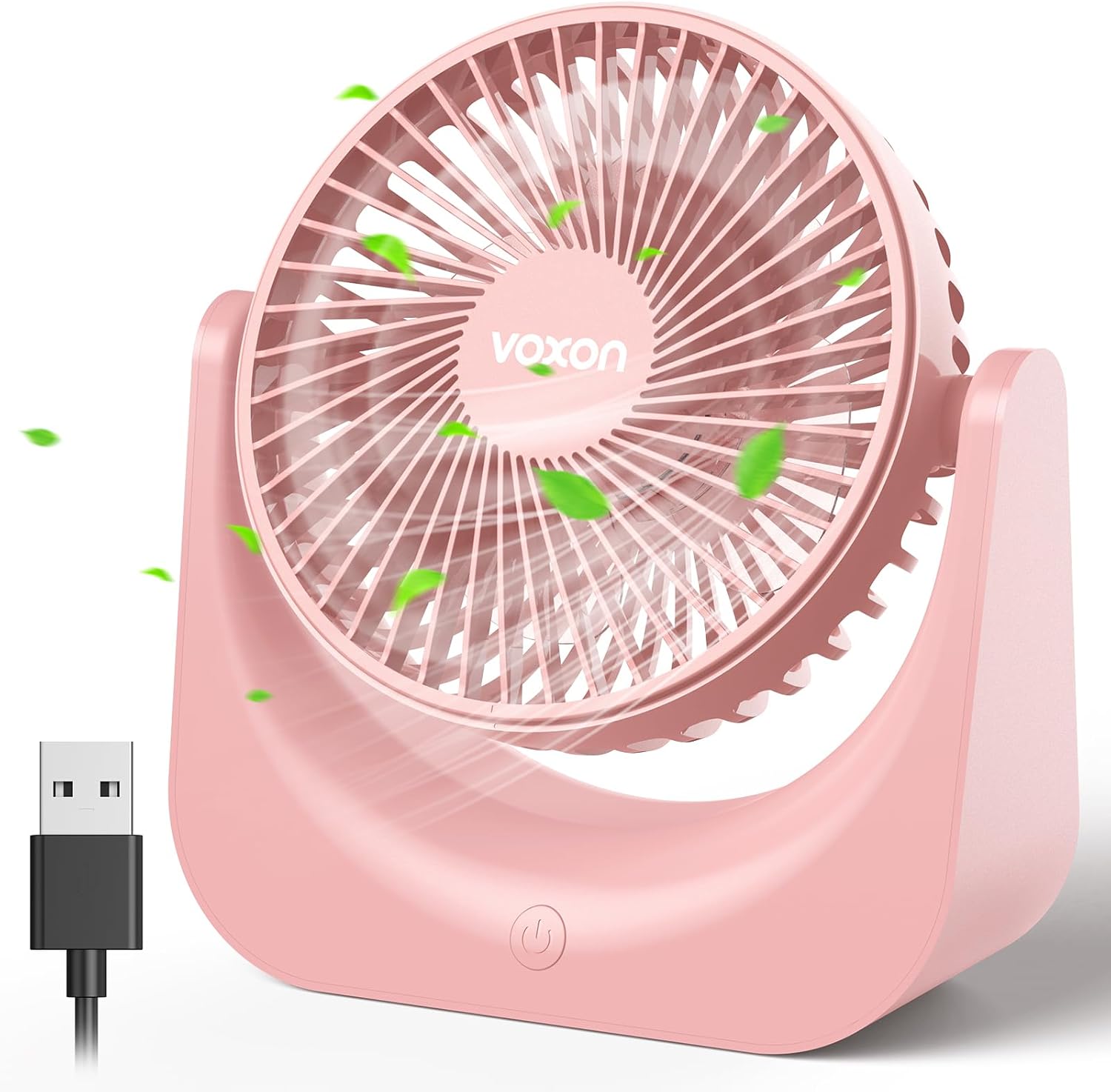
| Power Source | Powered by USB |
|---|---|
| Number of Speeds | 5 |
| Noise Level | 25 db |
| Wattage | 3.3 watts |
| Main Power Connector Type | USB-C |
The VOXON VX-DF001 is a compact USB desk fan designed for personal cooling in small spaces like dorm rooms and home offices. It runs off USB-C power and offers five speed settings that range from a quiet low (around 25 dB) to a high-speed 3200 rpm for stronger airflow. The head tilts 90 degrees for directional cooling and the front cover twists off for simple cleaning. A lightweight plastic build and non-slip rubber pads keep it stable on a desk, and the included 1.5 m USB cable makes it easy to power from laptops, power banks, or wall adapters. Practical for study desks and bedside tables, it balances portability with useful airflow control, though its small size limits the area it can cool compared with larger fans and the plastic construction is not as durable as heavier units. The long manufacturer warranty is a helpful reassurance for budget buyers who want a basic, no-frills personal fan that is easy to move and maintain.
Best for: Students and anyone furnishing a dorm or small bedroom who need an inexpensive, portable personal fan for study desks or bedside use and prioritize quiet operation and easy cleaning.
Less Ideal for: People who need to cool multiple occupants or larger rooms, or those seeking a heavy-duty, longer-lasting build for high-use environments.
- Five distinct speed settings from quiet low to a high 3200 rpm for selectable airflow
- USB-C power compatibility works with laptops, power banks, and common adapters
- Removable front cover allows easy cleaning to keep blades dust-free
- Compact, lightweight design with non-slip pads makes it easy to place on a desk or bedside table
- Small fan head and low wattage limit effective cooling to a single person or very small area
- Plastic construction is lightweight but less robust than metal-bodied fans
Verdict: A compact, budget-friendly USB desk fan that delivers quiet, adjustable personal cooling ideal for dorm-room desks and bedside use.
Honeywell TurboForce HT-900
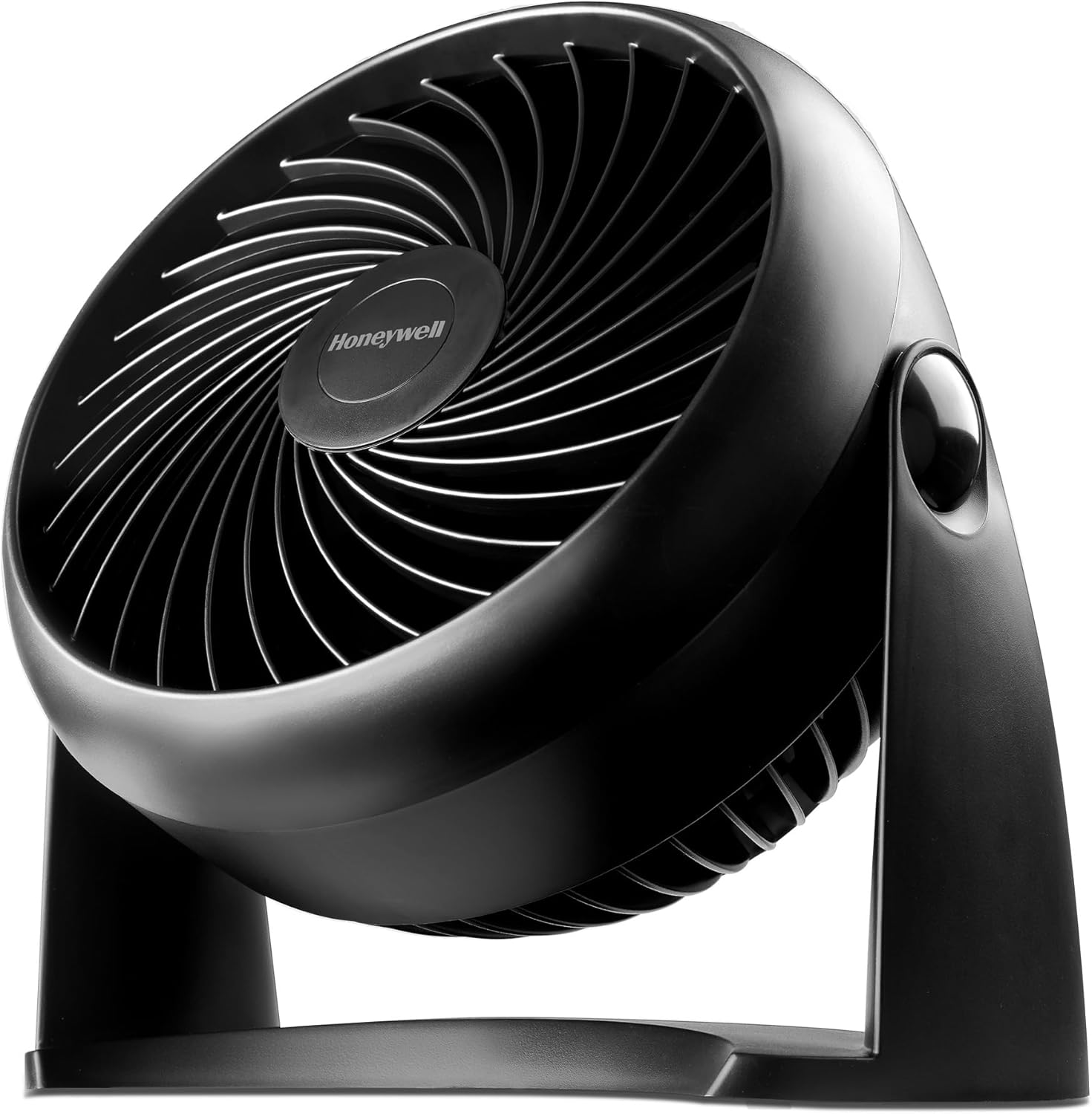
| Power Source | Corded Electric |
|---|---|
| Number of Speeds | 3 |
| Air Flow Capacity | 185 cfm |
| Motor Type | brushless |
| Installation Type | Tabletop or Wall Mount |
The Honeywell TurboForce HT-900 is a compact tabletop fan built to move a surprising amount of air for its size. It runs from a standard 110V plug, offers three speed settings, and a 90-degree pivoting head so you can direct airflow toward a desk, bed, or shared dorm space. The aerodynamic turbo design and brushless motor produce up to 185 cfm, which the manufacturer says can be felt from a distance, while a low-noise design aims to keep the unit unobtrusive during study or sleep. It is lightweight and can also be wall-mounted or carried between rooms, making it versatile for small living spaces. Practical limits are the small footprint and plastic construction, so it is not intended as a whole-room replacement for larger fans, and it lacks remote control or timer features. For straightforward, reliable spot cooling in a dorm room or personal workspace, the HT-900 is hard to beat for consistent performance and simple controls.
Best for: Students or anyone needing a dependable, no-frills personal fan for a dorm room or small study who values steady performance and simple controls.
Less Ideal for: Those looking to cool larger rooms, users who want smart features or timers, or buyers seeking a heavy-duty, metal construction fan.
- Compact and portable for easy placement on desks or shelves
- Three speeds with a 90-degree pivoting head for directed airflow
- Aerodynamic turbo design and brushless motor deliver strong airflow (185 cfm)
- Quieter operation suitable for bedrooms or study areas
- Plastic build is lightweight but less durable than metal alternatives
- No remote, timer, or advanced controls for scheduled use
Verdict: A reliable, compact personal fan that delivers strong, quiet airflow for dorm rooms and small study spaces.
DREO Tower Fan 307

| Number of Speeds | 8 |
|---|---|
| Modes | Normal, Natural, Sleep, Auto |
| Oscillation | 90° |
| Wattage | 36 watts |
| Motor Type | brushless DC motor |
The DREO Tower Fan 307 is a compact 36-inch oscillating floor fan built around an upgraded brushless DC motor that pushes strong airflow while keeping noise low. It offers eight speed settings and four modes including Normal, Natural, Sleep, and Auto, so you can dial in anything from a gentle bedroom breeze to a higher-velocity boost; the unit supports remote and touchpad control for easy adjustments. With 90 degree oscillation and a claimed airflow capacity for broad room coverage, it pairs well with an air conditioner to circulate cool air more effectively. Practical touches include a timer, removable rear grille and impeller for easier cleaning, and ETL safety certification. On the downside the fan runs on standard corded power and lists voltage at 240 volts which may matter for some regions, and the plastic construction means it is lightweight but less premium-feeling than metal alternatives. For buyers focused on quiet, adjustable oscillating cooling in bedrooms or living rooms, this model balances airflow and low noise in a small footprint.
Best for: Buyers who want a quiet, adjustable tower fan that delivers wide oscillating coverage and easy remote control for bedrooms and living spaces backed by strong customer feedback.
Less Ideal for: People seeking a heavy-duty, industrial-strength fan or a premium metal build should consider sturdier floor or bladeless alternatives.
- Brushless DC motor for efficient, high-velocity airflow with lower noise
- Eight speed levels and four modes for flexible comfort settings
- 90° oscillation spreads air across a wide area for better room coverage
- Includes remote and touch controls plus a timer for convenient operation
- Removable rear grille and impeller simplify cleaning and maintenance
- Plastic construction feels less durable compared with metal fans
- Corded operation and listed voltage may limit regional compatibility
Verdict: A feature-rich, quiet oscillating tower fan that gives flexible speeds and modes for effective bedroom and living-room cooling.
Lasko Pivoting Pro 12" Fan

| Power Source | Corded Electric |
|---|---|
| Number of Speeds | 3 |
| Air Flow Capacity | 289 cfm |
| Wattage | 100 watts |
| Motor Type | Brushless |
The Lasko Pivoting Pro 12" is a compact utility blower that moves a surprising amount of air for its size, making it useful in small dorm rooms that need directed cooling or quick drying. It has a 270 degree pivoting head so you can aim airflow at a bed, desk, or doorway, and three rotary speeds to balance comfort and noise. The fan lists up to 289 CFM and runs on a brushless motor with a 10‑foot cord and three‑prong grounded plug for dependable operation. Two grounded outlets on the housing let you power a lamp or laptop nearby without extra extension cords, which is handy in tight dorm setups. The plastic construction keeps the unit lightweight and easy to carry, but it also means the feel is utilitarian rather than premium. Noise at higher speeds is noticeable, so use lower settings for overnight use. The fan is ETL listed and includes a circuit breaker reset for basic motor protection, which fits a buyer who prefers safe, reliable gear.
Best for: A cautious buyer who values a simple, well‑built fan that reliably moves strong, directed airflow in a small room and adds electrical convenience without extra accessories.
Less Ideal for: Those seeking whisper‑quiet bedroom operation or a premium metal finish should consider quieter or more upscale room fans instead.
- High airflow for its size (up to 289 CFM) for fast, directed cooling
- Pivoting head with wide angle to aim air where needed
- Two built‑in grounded outlets reduce need for extra cords
- Long 10‑foot power cord and three‑prong plug for flexible placement
- ETL listed with circuit breaker/reset for added electrical safety
- Plastic construction feels basic compared with higher-end dorm room fans
- Higher speed setting is relatively loud for close‑quarters sleeping
Verdict: Choose this compact pivoting blower if you want a risk‑averse, dependable fan that delivers strong, aimable airflow and built‑in grounded outlets for cramped dorm rooms.
Choosing the Right Fan for Dorm Rooms: Key Factors to Consider
Noise Level
Dorm rooms are shared and often small, so the noise a fan makes directly affects study and sleep quality. Look for measured or manufacturer-stated decibel ratings where available, and pay attention to reviews mentioning a low, steady hum rather than high-pitched whine.
Fans with brushless motors or well-balanced blades tend to be quieter at similar airflow levels. Multiple speed settings and a low-quiet mode let you run the fan at night without disturbing roommates or blocking out ambient sounds needed for concentration.
Airflow Coverage
Airflow matters more than raw power in tight dorm spaces because you want targeted circulation rather than trying to cool a large area. Consider airflow pattern and whether the fan oscillates or has directional tilt, which helps circulate air across a desk, bed, or seating area.
A fan that produces steady, directed airflow at each speed is preferable to one that only feels strong at its highest setting. Look for specifications like cubic feet per minute (CFM) if provided, and think about how the airflow aligns with your intended placement.
Size and Placement Options
Dorm rooms have limited floor and desk space, so a fan's footprint and mounting options are key. Smaller desk fans fit on a nightstand or study desk, while clip-on or wall-mountable fans save surface space and can direct air from higher positions.
Portability is also important if you expect to move between rooms or store the fan during break periods. Consider weight, handle design, and whether the unit disassembles easily for packing.
Power Source and Controls
Dorm power outlets are often shared and sometimes limited. USB- or battery-powered fans provide flexible placement and let you run them from a laptop or power bank, but may trade off top-end airflow for convenience. Mains-powered fans typically deliver stronger airflow but require nearby outlets.
Controls should be simple and accessible. Look for clearly labeled speed settings, an easy oscillation toggle, and ideally a timer or sleep mode. Remote controls or integrated timers add convenience for nighttime adjustments without getting up.
Energy Use and Runtime
Energy efficiency matters if you want to run a fan for long study sessions or overnight. Lower wattage and efficient motor designs reduce electricity draw and are kinder to shared dorm budgets.
For battery models, check expected runtime at different speeds. For mains or USB models, consider whether the fan can run at an efficient low speed that still provides comfort.
Maintenance and Cleanability
Dust build-up reduces airflow and can increase noise, so fans that are easy to disassemble for cleaning are advantageous. Look for quick-release grilles, tool-free blade removal, or simple exterior wipes for routine upkeep.
Ease of cleaning also affects longevity. A design that allows occasional deep cleaning will maintain performance and keep the unit hygienic in a small living space.
Choosing the Right Size for Small Rooms
Measure available space before picking a fan. A compact desk fan sits well on a small nightstand or study table, while a clip-on unit can free up surfaces by attaching to a shelf or headboard. For rooms with limited floor space, consider a wall-mountable or tower-style fan that has a narrow footprint.
Placement determines how effective the fan will feel. Positioning the fan to establish a cross-breeze or to direct airflow along the bed and desk will achieve better perceived cooling than simply choosing the most powerful unit.
- Desk fans: good for direct, focused airflow near study areas.
- Clip-on fans: save surface space and work well on bunk beds or lofted setups.
- Tower or pedestal fans: offer broader coverage with a small floor footprint.
Best Power Options for Dorm Use
USB-powered fans are convenient and portable, letting you run them from a laptop, power bank, or USB wall adapter. They are typically lower wattage and best for near-desktop cooling. Battery-operated fans add mobility and can be used during power outages or in outdoor dorm events, but expect shorter runtimes at higher speeds.
Mains-powered fans provide the strongest continuous airflow and are ideal if you have reliable access to an outlet near your bed or desk. Consider a unit with a low-power mode to reduce energy use overnight.
- USB: portable and flexible; check cable length and connector type.
- Battery: portable with variable runtimes; consider rechargeable options.
- Mains: best for continuous higher airflow; choose efficient motors.
Placement Tips to Maximize Comfort
Target airflow toward the areas you occupy most. For studying, place the fan so it circulates air across your desk. For sleeping, direct airflow along the length of the bed without blowing directly in your face all night. Slight oscillation can keep air moving without creating a draft.
If you share a small room, aim the fan to balance comfort between occupants. Using lower speeds and oscillation often cools the space more pleasantly than blasting a single strong stream of air.
- Avoid obstructing airflow with curtains or clutter.
- Use elevated positions or clip mounts to circulate air above furniture.
- Combine low-speed running with periodic higher bursts for quick cooling.
Maintaining Quiet Operation
To keep a fan from becoming a distraction, choose models with stable blades and quality bearings that reduce vibration. Placement on a solid, even surface also minimizes rattling. Clean blades and grills regularly to prevent noise from dust accumulation.
If sleep quality is a priority, test the fan at its lowest speed to ensure the background noise is not disruptive. Fans with variable speeds and a true low-power silent mode make it easier to find a comfortable overnight setting.
- Check for vibration-reducing feet or padding.
- Balance blade condition and keep screws tight to prevent rattles.
- Use lower speeds overnight to maintain a steady, unobtrusive sound.
Safety and Dorm Regulations
Many residences have rules about certain heating devices, but fans are usually allowed. Still, follow basic safety guidance: keep the fan away from drapes and bedding, ensure vents are not blocked, and avoid running battery chargers unattended for long periods.
If your dorm has fire safety requirements for appliance plugs or surge protection, use approved power strips and avoid daisy-chaining multiple devices on a single outlet.
- Place fans on stable, flat surfaces away from loose fabrics.
- Use manufacturer-recommended power adapters and cords.
- Turn off and unplug when cleaning or when leaving for extended periods.
How We Chose the Best Fan for Dorm Rooms
We prioritized attributes that matter most in compact, shared living situations. The editorial filters focused on noise performance, cooling effectiveness relative to size, ease of placement and mounting, energy efficiency, and user-friendly controls. We also considered durability for frequent moves and how simple it is to clean or maintain the unit. Products were excluded if they required complex installation, had large footprints unsuitable for small rooms, or lacked clear noise or airflow specifications. We favored designs that offered multiple speeds and oscillation or directional control so users can tune airflow for study desks, beds, or bunks. Battery- or USB-powered units were evaluated for portability and dorm-appropriate power options. Final selections reflect models that best met the combined criteria above across different budgets and space constraints.
Our full evaluation process is outlined in our review methodology.
FAQ
What size fan is best for a small dorm room?
A compact desk or clip-on fan is usually sufficient for directed cooling in a small dorm room. If you want broader circulation, a slim tower or small pedestal fan offers more coverage without taking much floor space.
Are USB fans powerful enough for overnight use?
USB fans can provide steady low-to-moderate airflow that is often comfortable for sleeping, especially close to the bed. They usually do not match the sustained power of mains fans but are quieter and more portable.
How can I reduce fan noise at night?
Run the fan at a lower speed or use a model with a designated quiet or sleep mode. Ensure the fan is clean, placed on a stable surface, and free of loose parts that can vibrate.
Is a clip-on fan safe for a bunk bed setup?
Clip-on fans can be safe when securely attached to a stable frame and positioned so the blades are unobstructed. Choose a model with a strong clip and check it regularly for secure mounting to avoid slips.
How often should I clean a dorm fan?
Light cleaning every couple of weeks helps maintain airflow and reduces noise. Deep cleaning, including removing grills and wiping blades, is useful every few months or more often in dusty environments.
Final Verdict
Prioritize noise performance, size, and placement when choosing a fan for a dorm room. Quiet operation and targeted airflow will usually matter more than raw power in a shared small space. Consider the power source and how you plan to use the fan throughout the day to balance portability, runtime, and sustained cooling. Focus on a compact, easy-to-clean design with adjustable speeds and placement options. Those tradeoffs will help you pick a dorm fan that keeps you comfortable without disrupting study or sleep routines.