
Note: This article contains affiliate links. If you click on these links and make a purchase, we may earn a small commission at no extra cost to you. This helps support our research and content. Read our full affiliate disclosure here.
Choosing the right fan for cooling an apartment matters because your living space has limited airflow, variable layouts, and noise sensitivity. The right fan can reduce reliance on air conditioning, improve comfort in specific rooms, and move air efficiently without drowning out conversation or sleep. This guide shortlists seven top fans for cooling an apartment and evaluates them on practical criteria like airflow, noise, and energy use. Read on for quick buying guidance and detailed considerations to match a fan to your room size, placement options, and daily routines.
Top Picks at a Glance
| Best Overall The best all-around choice for most situations | Vornado Model 80 Box Fan |  |
| Best Quality Built to a higher standard if you want something more solid | DREO TurboPoly Pedestal Fan DR-HPF013 |  |
| Best Value The sweet spot between price and what you get | Amazon Basics 16-Inch Pedestal Fan FS40-10BR |  |
| Best Budget The cheapest option that still gets the job done reliably | KopBeau DFT04-1 Tower Fan |  |
| Top Rated A top-rated pick with lots of positive feedback | Honeywell TurboForce HT-900 |  |
| Most Popular A crowd favorite that many people choose with confidence | Levoit Classic 36-inch Tower Fan |  |
| Best Seller A high-volume bestseller chosen again and again | DREO Tower Fan 307S |  |
Vornado Model 80 Box Fan

| Number of Speeds | 5 |
|---|---|
| Wattage | 120 watts |
| Motor Type | Brushless |
| Speed | 1400 rpm |
| Special Features | Removable Grille, Whole Room Air Circulation |
The Vornado Model 80 is a sturdy 20-inch box fan built to move a lot of air for whole-room circulation. It offers five speeds controlled by simple buttons, a brushless motor rated at 120 watts and 1400 rpm, and a removable grille that makes cleaning straightforward. Practical touches include an integrated handle and cord storage for easy placement and transport around an apartment. The fan's alloy-steel construction and ETL certification give a sense of durability and safety, and the vortex-style airflow is aimed at pushing air across larger spaces rather than just a localized breeze. Expect noticeable cooling and faster drying in rooms where you need steady circulation. Trade-offs are typical for high-velocity box fans: it is louder at top speeds and, while the unit is heavy-duty, its size and metal build make it less discreet than slim pedestal or tower fans. For apartment use it works best positioned to create cross-breezes or combined with an air conditioner to distribute cooled air evenly.
Best for: Someone who wants reliable, high-output air circulation to cool or ventilate an apartment and values durability and easy maintenance over a minimal aesthetic.
Less Ideal for: Buyers seeking an ultra-quiet or very compact fan for small bedrooms or tight spaces should consider slimmer or low-noise models instead.
- Powerful whole-room airflow suitable for circulating air in larger apartments
- Five distinct speed settings for flexible control from gentle to high output
- Removable grille simplifies cleaning and maintenance
- Brushless motor for reliable, long-lasting operation
- Built-in handle and cord storage improve portability and tidy storage
- Higher noise levels at top speed compared with quieter pedestal or tower fans
- Bulkier, heavier metal design is less space-saving and more visible than slim models
Verdict: Choose the Vornado Model 80 when you need strong, durable whole-room airflow to cool an apartment and move conditioned air efficiently.
DREO TurboPoly Pedestal Fan DR-HPF013

| Number of Speeds | 8 |
|---|---|
| Noise Level | 28.2 db |
| Wattage | 36 |
| Air Flow Capacity | 1000 cfm |
| Control Method | Remote, Touch |
The DREO TurboPoly DR-HPF013 is a performance-focused pedestal air circulator built to move a lot of air quietly. Its brushless DC motor and three-blade TurboPoly design claim up to 1000 CFM and a 90 ft throw, which makes it useful for cooling an apartment by circulating air across rooms rather than just creating a local breeze. You get eight speeds, an auto mode that adjusts output with temperature changes, 90° horizontal oscillation and a 105° vertical pivot to direct airflow where needed, plus an adjustable height range for targeted delivery. Controls are convenient with a top touch panel and included remote, and the fan disassembles for easier cleaning; there is even an aroma pad for light scenting. On the downside, the unit is plastic-bodied so it does not feel as heavy-duty as metal fans, and some buyers may prefer more advanced app or voice controls found on other models. For apartment cooling the DR-HPF013 combines long-reaching airflow and quiet operation to move room air effectively.
Best for: Buyers who prioritize strong, far-reaching airflow and quiet continuous operation to cool multiple rooms in an apartment and who want simple remote and touch controls for everyday use.
Less Ideal for: People who want a premium metal build or integrated smart-home app and voice features should look at other models with those capabilities.
- High claimed airflow (1000 CFM) and long throw for whole-room circulation
- Brushless DC motor for quieter operation
- Eight speeds plus auto mode for responsive output
- Adjustable height, wide vertical pivot and 90° oscillation for directional control
- Detachable grille and blade for easier cleaning and included remote for convenient control
- Plastic construction feels less heavy-duty than metal alternatives
- No listed app or voice control integration for smart-home setups
Verdict: If you need a quiet, high-airflow pedestal fan to move cool air across an apartment, this DREO model delivers strong reach and directional control with simple remote operation.
Amazon Basics 16-Inch Pedestal Fan FS40-10BR

| Power Source | Corded Electric |
|---|---|
| Number of Speeds | 3 |
| Wattage | 60 watts |
| Motor Type | AC |
| Included Components | Remote |
This Amazon Basics 16-inch pedestal fan is a straightforward room circulator built for everyday cooling in medium to large rooms. It uses a 60W AC motor and dual-layered blades to move air efficiently while remaining relatively quiet, and the oscillation plus adjustable tilt and height help direct airflow where you need it. Controls are simple: three speeds, three preset breeze modes (normal, nature, sleep), and a timer, all accessible from the included remote so you can change settings without getting up. The metal and plastic construction feels utilitarian rather than premium, but assembly is typical for a stand fan and the powder-coated finish resists scuffs. Practical buyers will appreciate the low power draw for continuous use and the fan's effectiveness at boosting cross-ventilation in apartments. Limitations include a basic three-speed control rather than stepless or app control, and the plastic blades are less durable than higher-end models with metal blades. For those who want reliable airflow without frills, this fan covers the essentials well.
Best for: Buyers who prioritize straightforward, energy-conscious cooling and want a reliable pedestal fan to improve apartment airflow without extra smart features.
Less Ideal for: Those seeking app control, stepless speed adjustment, ultra-quiet premium motors, or a high-end aesthetic should consider higher-tier models instead.
- Adjustable height and tilt for directing airflow
- Included remote lets you change speed, mode, and timer from across the room
- Oscillating function evenly circulates air in medium to large rooms
- Energy-efficient 60W AC motor provides good airflow with relatively low power draw
- Only three discrete speed levels so fine-tuning is limited
- Construction is mostly plastic which feels utilitarian compared with premium fans
Verdict: A no-nonsense, energy-efficient pedestal fan that improves apartment air circulation with simple controls and remote convenience.
KopBeau DFT04-1 Tower Fan
| Power Source | Corded Electric |
|---|---|
| Number of Speeds | 3 |
| Noise Level | 25 db |
| Wattage | 40 watts |
| Special Features | 12H Timer ON/OFF, 60° & 110° oscillating |
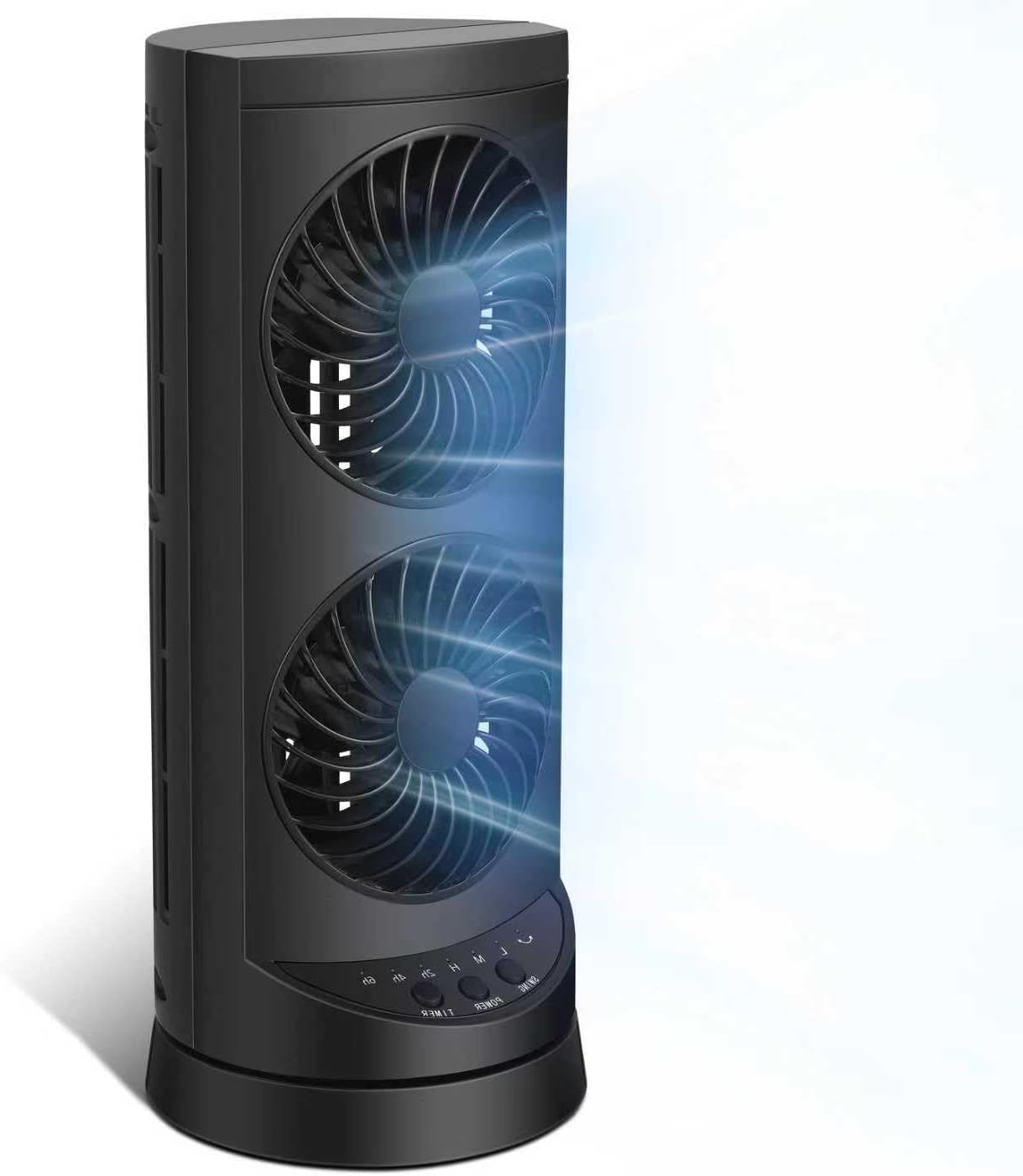
The KopBeau DFT04-1 is a small standing tower fan designed for personal and apartment use, delivering quick airflow (up to 24 ft/s) with three selectable speeds and two oscillation ranges for either focused or room-wide circulation. It is typically used on the floor, a table, or a desk to cool a bedroom, office, or dorm room; the built-in 60° and 110° sweep settings make it easy to direct airflow where you need it. Practical features include a 12-hour on/off timer, simple button controls, a lightweight plastic build with a carry handle, and energy-efficient 40-watt operation. Noise levels are advertised around 25 dB on lower settings, which supports sleep and work without distraction. Trade-offs are its small physical size and plastic construction, which limit maximum airflow compared with larger tower models, and the basic button control scheme lacks remote or smart connectivity. For a budget-focused apartment, it provides effective, quiet personal cooling with modest power use.
Best for: Apartment dwellers wanting an affordable, quiet fan for bedrooms or small living spaces who prioritize portability, low power use, and simple controls over high-end features.
Less Ideal for: Large-room users seeking maximum airflow or buyers who want smart home integration and remote control functionality.
- Dual oscillation angles (60° and 110°) let you choose focused or room-wide airflow
- Three speed settings plus a 12-hour timer for flexible, energy-conscious use
- Low-noise operation around 25 dB on lower settings, suitable for sleep
- Lightweight, compact design with a built-in handle for easy portability
- Small plastic build limits peak airflow compared with larger tower fans
- No remote control or Wi-Fi/smart features for convenient off-distance control
Verdict: A budget-friendly, quiet tower fan that delivers portable, energy-efficient cooling for small apartments and bedrooms.
Honeywell TurboForce HT-900
| Power Source | Corded Electric |
|---|---|
| Number of Speeds | 3 |
| Air Flow Capacity | 185 cfm |
| Wattage | 35 watts |
| Installation Type | Tabletop or Wall Mount |
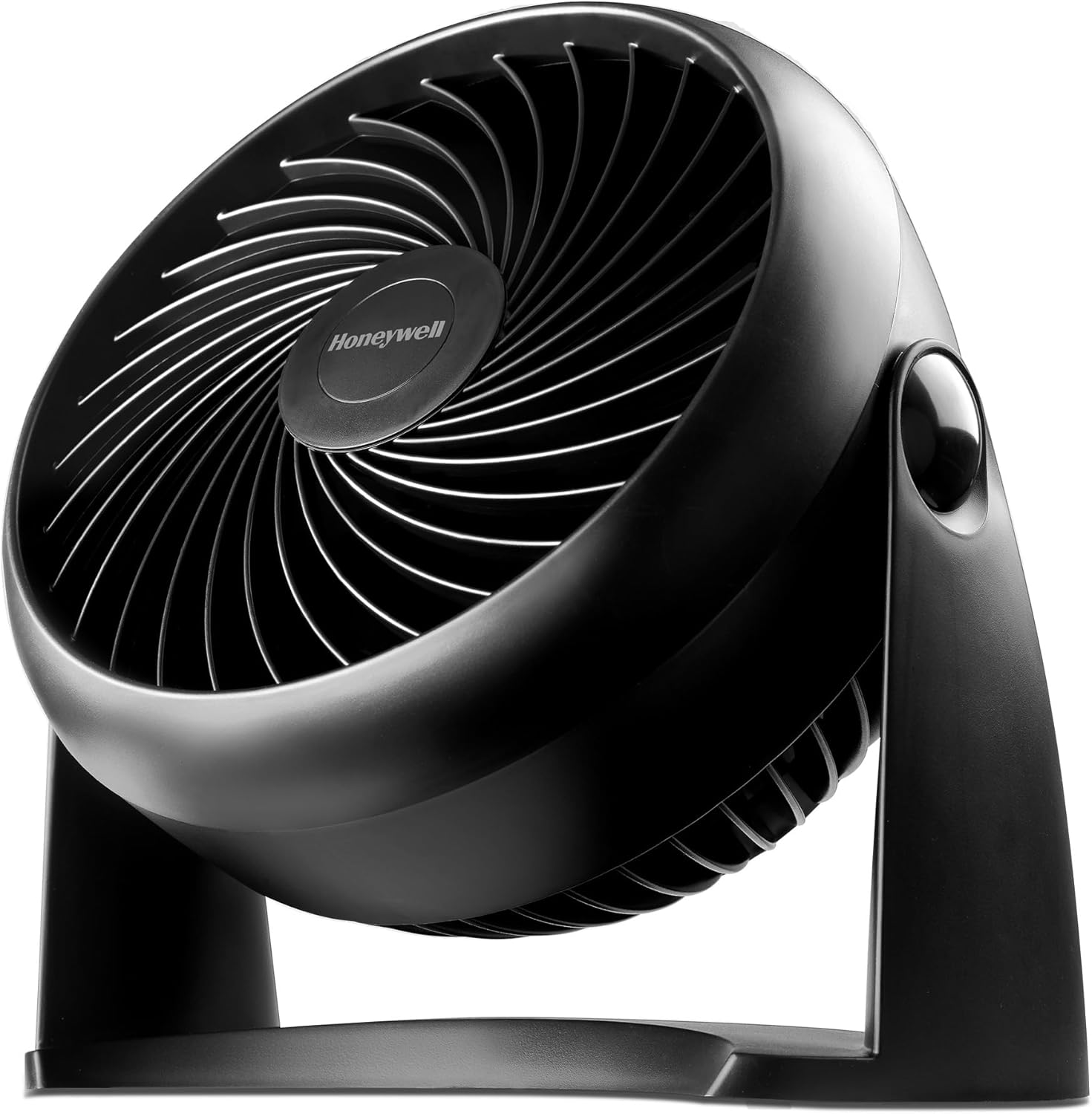
The Honeywell TurboForce HT-900 is a compact tabletop fan built to move a surprising amount of air for its size. It delivers up to 185 cfm from an aerodynamic turbo design and offers three push-button speeds plus a 90-degree pivoting head so you can aim airflow where you need it. Typical uses are desk cooling, bedroom bedside circulation, or mounting on a wall to improve room circulation and help an air conditioner work more efficiently. The unit is plastic-bodied with three blades and a brushless motor, which helps keep operation quiet and energy efficient at 35 watts. Setup is simple: plug into a standard outlet and use the carrying handle and small footprint to shift it between rooms. The trade-offs are obvious: it is meant for small to medium rooms and lacks oscillation or advanced controls such as a timer or remote, so you must reposition it for wider coverage. For buyers prioritizing steady, no-nonsense airflow in an apartment, it excels as a reliable, low-maintenance option.
Best for: Buyers who want a dependable, low-maintenance fan to provide consistent targeted airflow in an apartment or small room and who value quiet, durable operation over extra features.
Less Ideal for: Those who need whole-room oscillation, programmable schedules, or smart controls for larger open-plan spaces should consider a larger or feature-rich fan instead.
- High airflow for size with 185 cfm output.
- Three straightforward speed settings and a 90-degree pivoting head for targeted cooling.
- Brushless motor for quieter, more durable operation and lower power draw.
- Small footprint and built-in handle make it easy to move or wall-mount.
- No oscillation feature so it does not cover wide areas without manual repositioning.
- Basic controls only—no timer, remote, or smart functions.
Verdict: A compact, reliable tabletop circulator that delivers strong, quiet airflow for focused apartment cooling.
Levoit Classic 36-inch Tower Fan

| Number of Speeds | 5 |
|---|---|
| Noise Level | 28 db |
| Wattage | 39 watts |
| Air Flow Capacity | 1044 cfm |
| Control Method | Remote |
The Levoit Classic 36-inch tower fan is a floor-standing bladeless unit intended to move air across a room quietly and efficiently. It offers five speeds and four modes (Normal, Turbo, Sleep, and Auto) so you can choose anything from a gentle night breeze to a strong blast for quick cooling, and the built-in temperature sensor adjusts fan speed in Auto mode to respond to room temperature. The slim, glossy plastic housing includes a 90 degree oscillation for wide coverage and a detachable rear grille for easier cleaning, and the included remote and touch controls make adjustments convenient from a couch or bed. On low settings the fan is nearly silent, making it suitable for bedrooms, while Turbo delivers the listed high airflow for faster circulation. Limitations to note are its plastic construction and corded design, and while the unit lists a high airflow number it is still a fan rather than an air conditioner so it circulates rather than cools the air. For apartment use it balances quiet operation and coverage without complicated setup.
Best for: Buyers who want a quiet, easy-to-use tower fan that adapts to room temperature and provides wide coverage for apartment living and bedrooms.
Less Ideal for: People seeking active cooling or dehumidification or those who need a battery-powered or portable fan for outdoor use should consider other options.
- Multiple modes including Auto with temperature sensor for hands-off adjustments
- Five speeds and 90° oscillation for broad room coverage
- Near-silent operation on low settings suitable for bedrooms
- Remote and touch controls for convenient operation from a distance
- Plastic build may feel less premium than metal alternatives
- Corded design requires a nearby outlet and limits placement
Verdict: A quiet, feature-rich tower fan with auto temperature sensing and wide oscillation that is a strong choice for cooling and air circulation in apartments.
DREO Tower Fan 307S

| Power Source | Corded Electric |
|---|---|
| Special Features | App Operable, Bladeless, Oscillating, Remote Controlled, Timer |
| Wattage | 42 watts |
| Air Flow Capacity | 978 cfm |
| Noise Level | 25 db |
This DREO tower fan is designed as a smart, space-saving floor fan for apartment rooms and bedrooms. It provides four operating modes (Normal, Natural, Sleep, Auto), app and voice control plus a remote and touch buttons for direct adjustments, and a 90° oscillation to move air across a room. The unit lists a 978 cfm airflow and 42 watt power draw, and DREO emphasizes quiet operation with a low noise figure around 25 dB and an 8-hour timer and sleep mode for overnight use. The fan is easy to maintain thanks to a removable rear grille and impeller wheel, and the included remote and LED controls make daily use simple. Practical limits include a modest number of discrete speeds and the use of an AC motor rather than a more efficient DC motor on some competing models, which may affect fine-grain speed control and power efficiency. The fan is ETL listed and includes basic safety features like a fused plug and circuit protection, but buyers seeking maximum customization or the absolute quietest DC-driven operation may want to compare other models.
Best for: Buyers who prioritize a reliable, easy-to-use tower fan with smart controls and quiet overnight operation for apartment rooms.
Less Ideal for: If you need the utmost in energy-efficient, ultra-quiet performance or many fine-grained speed settings, this model is not the best choice.
- Multiple control methods: app, voice, remote, touch for flexible operation.
- 90° oscillation and high listed airflow for good room coverage.
- Low reported noise level and sleep mode suitable for bedrooms.
- Removable rear grille and impeller wheel for easier cleaning.
- Only four discrete speed/power levels despite marketing of more granular settings.
- Uses an AC motor which can limit finer speed control and potential energy savings compared with DC models.
Verdict: A dependable, smart-controlled tower fan that delivers strong room coverage and quiet overnight performance for apartment cooling.
Choosing the Right Fan for Cooling an Apartment: Key Factors to Consider
Room Size and Airflow Needs
Match fan capacity to the size of the room rather than assuming a single model fits every space. A small bedroom needs less airflow than an open-plan living area, while a larger living room benefits from a higher-output fan or multiple units positioned to create cross-breezes.
Consider where the fan will sit and how air will circulate around furniture and doorways. A higher-rated airflow helps when you want to move air between rooms or push warm ceiling air down, but in tightly packed spaces you may prefer directional control over raw power to avoid cold spots or drafts.
Noise Tolerance and Sleep
Noise is often the deciding factor in apartments where walls are thin and neighbors are nearby. Evaluate the fan's sound at the speeds you intend to use most often. A quiet low-to-medium speed for evening and sleep matters more than a loud high-speed rating you rarely use.
Some fans produce steady white-noise that helps sleep, while others have higher-frequency tones that can be distracting. If you plan to use a fan overnight in a bedroom, prioritize documented low-decibel operation and variable speed steps to fine-tune comfort.
Placement and Footprint
Apartment floor area and storage options affect which fan style works best. Tower or pedestal fans have a small floor footprint and are easier to tuck into corners, while box or window-focused fans can occupy more horizontal space. Wall-mount or clip-on fans save floorspace but need suitable mounting points.
Also consider how often you will move the fan. Lightweight, compact designs with convenient handles are better for repositioning to chase shade or create cross-ventilation. A bulky unit may be powerful but impractical if you cannot easily store it between seasons.
Energy Use and Runtime
Fans are typically much cheaper to run than air conditioning, but energy use still matters for long daily operation. Look at power draw at typical speeds rather than peak wattage alone. Energy-efficient fans with optimized blades or brushless motors can run longer for the same cost, which is important if you plan to leave a fan on for hours while you work or sleep.
Also think about how often you will need to run the fan. If you expect continuous overnight use, a model designed for long runtimes with reliable motor cooling is preferable to a high-wattage fan intended for short bursts of cooling.
Control Options and Convenience
Convenient controls improve everyday usability in an apartment where you may not want to get up to change settings. Multiple speed steps, timers, remote control, and programmable modes let you tailor airflow to different times of day. Oscillation and directional tilt help spread airflow more evenly across a room without repositioning the unit.
Smart or app-enabled fans can integrate with schedules or voice assistants, which is handy if you already use smart home automation. However, consider whether complexity is worth it versus simple, reliable manual controls based on your habits.
Safety and Build Quality
In close quarters safety features are important to prevent accidents. Sturdy bases or wall mounts reduce tipping risk in apartments with pets or children. Grills and blade design should protect fingers and loose items while still allowing effective airflow. Durable materials and stable electrical components reduce the likelihood of failures during extended use.
Assess whether the fan offers certifications or features like automatic shutoff on tip-over, overheat protection, or washable grills for cleaning. These traits extend the usable life of the fan and reduce maintenance hassles in a small living space.
Best Fan Styles for Apartment Layouts
Different fan architectures suit different apartment constraints. Pedestal fans are adjustable in height and direction, making them good for directing air across a room or toward seating areas. Tower fans save floor space and often include built-in filters or air-fluttering modes that circulate gently without a large profile.
Box and window fans are best when you want to pull cooler outside air into the apartment or exhaust hot indoor air, but they need appropriate window fit and can be less attractive. Clip-on or wall-mounted fans are the go-to when floor space is scarce and you need targeted airflow near a bed or desk.
- Pedestal: directional control and higher airflow
- Tower: small footprint and lower noise at medium speeds
- Box/window: strong for intake/exhaust ventilation
- Clip/wall: space-saving, targeted circulation
Where to Place Fans for Maximum Effect
Placement is as important as fan choice. To cool an entire apartment, create cross-ventilation by placing one fan near a window to draw in cool air and another to push warm air out. For single-room comfort, position the unit to direct air toward the most-used seating or sleeping area and avoid blocking the intake with furniture.
Ceiling-level heat can be moved down by angling pedestal fans upward to break stratified layers of warm air. In bedrooms, place fans where they will not blow directly onto your head at night if that tends to cause discomfort.
- Use window intake plus interior exhaust for whole-apartment flow
- Position to avoid furniture blockage
- Angle fans to redistribute ceiling heat
Managing Noise Without Sacrificing Airflow
To balance noise and airflow, use multiple lower-speed fans placed strategically instead of running a single fan at maximum. Lower speeds often provide adequate comfort with much less sound. Look for fans with variable speed steps that let you find a quiet sweet spot.
If sleep quality is a priority, test models for tonal characteristics because some fans produce distracting frequencies even at low decibel levels. White-noise-friendly fans that produce a smooth, steady sound are easier to live with in an apartment environment.
- Multiple low-speed units can outperform one loud fan
- Check for smooth tone as well as low dB ratings
- Use timers to reduce overnight runtime
Maintenance and Seasonal Storage
Regular cleaning of grills and blades maintains airflow and reduces motor strain. Opt for models with tool-free grill removal or washable filters to simplify maintenance in a small living space. Dust buildup reduces efficiency and increases noise over time.
Consider how you will store the fan off-season. Compact, lightweight units are easier to stow in closets or under beds. If you have limited storage, choose a model with a small footprint or foldable components.
- Clean grills and blades regularly to retain airflow
- Prefer washable filters and tool-free access
- Choose compact designs for easier storage
Using Fans with Air Conditioning
Fans complement air conditioning by distributing cooled air more evenly and allowing you to set the thermostat a few degrees higher while maintaining comfort. Ceiling and pedestal fans are especially effective at moving conditioned air into occupied zones.
When pairing with AC, run fans on low-to-medium speeds to spread cool air without creating large temperature swings and to maximize energy savings. Fans cool people by increasing evaporation from skin rather than lowering room temperature, so they are most effective when used in occupied spaces.
- Set AC a bit higher and use fans to maintain comfort
- Run fans in occupied rooms rather than whole-house modes
- Use oscillation to distribute cooled air without drafts
How We Chose the Best Fan for Cooling an Apartment
We focused on factors that consistently affect how well a fan cools an apartment in real-world use. Primary evaluation criteria included measurable airflow capacity to gauge how much air the fan can move in a typical room, noise output at normal operating speeds because apartment dwellers often need quiet overnight performance, and energy efficiency to limit electricity draw for long runtime. Portability and footprint were assessed to ensure a fan can be repositioned or stored easily in compact apartments. Control convenience and feature set were included to evaluate whether speed settings, timers, oscillation, or remote operation improve day-to-day usability. Build quality and safety features were considered to ensure durable operation and safe placement around pets or children. We excluded specialty commercial or industrial fans that are noisy or oversized for residential apartments. Units lacking basic safety certifications or with consistently poor user-serviceability were not considered. The final picks balance airflow, sound, and practicality for typical apartment layouts rather than raw power alone.
Our full evaluation process is outlined in our review methodology.
FAQ
Can a fan alone cool an entire apartment?
A fan does not lower air temperature but can make a space feel cooler by increasing airflow across skin and improving ventilation. For whole-apartment cooling, use multiple fans to create cross-breezes and position them to exchange indoor and outdoor air when conditions permit.
How loud is too loud for bedroom use?
Bedroom-appropriate fans usually operate under conversational volumes at typical sleep speeds, which is often below about 40 dB. Personal tolerance varies, so choose a unit with multiple speeds and test the low and medium settings for tonal comfort.
Are tower fans better than pedestal fans for small apartments?
Tower fans typically have a smaller footprint and blend into tight spaces, making them a good fit for small apartments. Pedestal fans offer more directional control and higher elevation, which helps move air over obstacles. The best choice depends on your need for floor space versus directional airflow.
Do fans reduce energy costs compared with using only air conditioning?
Yes, fans generally use far less electricity than air conditioners, so using fans to supplement or reduce AC runtime can lower energy bills. The exact savings depend on runtime, fan energy draw, and how much you raise the thermostat when using fans.
How often should I clean my apartment fan?
Clean visible dust from grills and blades every few weeks during heavy use. Deep cleaning, including removing grills or washing filters if present, is typically needed every few months. Regular maintenance preserves airflow and reduces noise.
Is it worth getting a smart fan for an apartment?
Smart features like scheduling and remote control can add convenience, especially if you automate cooling around your daily routine. However, if you prefer simplicity or have privacy concerns, manual controls and timers often provide the essential functionality without extra complexity.
Final Verdict
When choosing a fan for cooling an apartment, prioritize the combination of airflow and low noise that matches your daily habits and sleeping needs. Pay attention to placement and footprint so the unit fits your layout, and consider energy efficiency if you expect long runtimes. Balance directional control, portability, and safety features to get the most practical performance for your living space. Focus on the tradeoffs that matter most to you: a compact tower for small rooms and quiet operation, or a higher-output pedestal or window-style solution when you need stronger circulation. Use the evaluation criteria to narrow options and pick the fan that best matches your apartment layout and noise tolerance.