
Note: This article contains affiliate links. If you click on these links and make a purchase, we may earn a small commission at no extra cost to you. This helps support our research and content. Read our full affiliate disclosure here.
Picking the right fan for kitchen use matters because kitchens generate heat, steam, and odors that can linger and degrade indoor air quality. The right fan moves enough air to clear steam and smells without adding excessive noise or interfering with conversation. In this guide we shortlist the top-performing options built for kitchen environments and evaluate them on airflow, noise, and maintenance demands. Read on to find a kitchen fan that suits your cooking habits, installation constraints, and noise tolerance.
Top Picks at a Glance
| Best Overall The best all-around choice for most situations | Vornado 630 Air Circulator |  |
| Best Quality Built to a higher standard if you want something more solid | DREO TurboPoly Pedestal Fan DR-HPF008S |  |
| Best Value The sweet spot between price and what you get | DREO Tower Fan 307 |  |
| Best Budget The cheapest option that still gets the job done reliably | Amazon Basics Air Circulator Fan FT19-16AB |  |
| Top Rated A top-rated pick with lots of positive feedback | Vornado 660 Air Circulator |  |
| Most Popular A crowd favorite that many people choose with confidence | Honeywell TurboForce HT-900 |  |
| Best Seller A high-volume bestseller chosen again and again | Lasko Pivoting Pro 12" Fan U12104 |  |
Vornado 630 Air Circulator

| Number of Speeds | 3 |
|---|---|
| Noise Level | 52 db |
| Wattage | 50 watts |
| Air Flow Capacity | 1120 cfm |
| Voltage | 120 volts |
The Vornado 630 is a compact whole-room air circulator built to push continuous, directional airflow rather than just a local breeze. It uses Vornados vortex design, deep-pitched blades and a spiral grill to generate high-velocity output rated at 1120 CFM, and three manual speed settings let you dial from gentle circulation to strong cooling. The pivoting head and adjustable tilt make it easy to target airflow toward a cooktop, island, or a doorway to move hot air out of the kitchen. At about 50 watts and a reported noise level near 52 dB on high, it balances power and reasonable sound for most home kitchens. The plastic construction keeps weight down and the removable grill helps with cleaning, but the fan is not weatherproof and is intended for indoor use only. Its simple dial control and 6-foot cord are straightforward, but there is no remote or timer, so placement and manual adjustments are required during use.
Best for: Someone who wants a reliable, straightforward fan that moves air effectively around a kitchen to improve ventilation and cooling without complicated features.
Less Ideal for: People who need quiet, feature-rich fans with remotes, timers, or a metal construction for outdoor or heavy-duty commercial use.
- Vortex air design delivers strong, whole-room circulation rather than a narrow breeze
- Three-speed manual control for quick adjustments
- Adjustable tilt and multi-directional airflow to direct air where needed
- Removable grill for easier cleaning
- No remote, timer, or advanced controls for hands-free operation
- Plastic build may feel less premium than metal fans
Verdict: Buy this if you want a simple, powerful indoor fan that moves kitchen air effectively with durable vortex airflow technology.
DREO TurboPoly Pedestal Fan DR-HPF008S

| Power Source | dc |
|---|---|
| Number of Speeds | 9 |
| Air Flow Capacity | 1000 cfm |
| Noise Level | 28.2 db |
| Motor Type | DC |
This DREO TurboPoly pedestal fan is built for strong, controllable airflow across a kitchen or open living space. It uses a DC motor to deliver up to 1000 CFM and nine speed settings plus a Turbo mode, so you can push a lot of air when you need rapid cooling or use lower speeds for quieter background circulation. The fan supports app, remote, touch and voice control for easy operation, and 3D oscillation combines horizontal and vertical sweep to move air more evenly across counters, dining areas, or islands. Extras include an RGB LED light, multiple preset modes, an 8 hour timer and an adjustable height/tile pedestal for directional control. Practical benefits are powerful whole-room circulation and a flexible control suite that works hands-free while cooking. Expect some assembly and a plastic construction that keeps weight down but reduces the premium feel; noise is very low on lower speeds but will rise noticeably at high Turbo settings. The RGB light is decorative rather than a serious task light and the glossy finish shows smudges in kitchen traffic.
Best for: Buyers who prioritize strong, adjustable airflow and smart controls to move air quickly through a kitchen or adjacent living spaces will appreciate this fan.
Less Ideal for: If you need a heavy-duty industrial fan, metal construction, or a bright task light for food prep, choose a purpose-built alternative instead.
- High airflow up to 1000 CFM for fast room circulation
- Wide 3D oscillation (horizontal and vertical) spreads air evenly
- Multiple control methods including app, remote, touch and voice
- Nine speeds plus Turbo and preset modes for precise airflow management
- Low-power DC motor that runs efficiently and quietly at low settings
- Plastic construction feels less premium than metal alternatives
- RGB light is mainly decorative and not bright enough as a kitchen task light
Verdict: Choose this fan when you want powerful, smart-controlled airflow and wide 3D oscillation to quickly cool and circulate air in a kitchen-focused space.
DREO Tower Fan 307

| Number of Speeds | 8 |
|---|---|
| Modes | Normal, Natural, Sleep, Auto |
| Oscillation | 90° |
| Wattage | 36 watts |
| Motor Type | brushless DC motor |
The DREO Tower Fan 307 is a compact 36-inch oscillating floor fan built around an upgraded brushless DC motor that pushes strong airflow while keeping noise low. It offers eight speed settings and four modes including Normal, Natural, Sleep, and Auto, so you can dial in anything from a gentle bedroom breeze to a higher-velocity boost; the unit supports remote and touchpad control for easy adjustments. With 90 degree oscillation and a claimed airflow capacity for broad room coverage, it pairs well with an air conditioner to circulate cool air more effectively. Practical touches include a timer, removable rear grille and impeller for easier cleaning, and ETL safety certification. On the downside the fan runs on standard corded power and lists voltage at 240 volts which may matter for some regions, and the plastic construction means it is lightweight but less premium-feeling than metal alternatives. For buyers focused on quiet, adjustable oscillating cooling in bedrooms or living rooms, this model balances airflow and low noise in a small footprint.
Best for: Buyers who want a quiet, adjustable tower fan that delivers wide oscillating coverage and easy remote control for bedrooms and living spaces backed by strong customer feedback.
Less Ideal for: People seeking a heavy-duty, industrial-strength fan or a premium metal build should consider sturdier floor or bladeless alternatives.
- Brushless DC motor for efficient, high-velocity airflow with lower noise
- Eight speed levels and four modes for flexible comfort settings
- 90° oscillation spreads air across a wide area for better room coverage
- Includes remote and touch controls plus a timer for convenient operation
- Removable rear grille and impeller simplify cleaning and maintenance
- Plastic construction feels less durable compared with metal fans
- Corded operation and listed voltage may limit regional compatibility
Verdict: A feature-rich, quiet oscillating tower fan that gives flexible speeds and modes for effective bedroom and living-room cooling.
Amazon Basics Air Circulator Fan FT19-16AB

| Power Source | Corded Electric |
|---|---|
| Number of Speeds | 3 |
| Wattage | 35 watts |
| Noise Level | 60 db |
| Indoor Outdoor Usage | Indoor |
This Amazon Basics air circulator is a straightforward, no-frills table fan that moves air efficiently in small kitchen spaces. It plugs into standard 120V outlets, runs on 35 watts, and offers three speed settings controlled by a rear rotary knob, so you can dial in low to high airflow for spot cooling while cooking. The 90-degree adjustable tilt and lightweight, free-standing design make it easy to aim across countertops or on a dining nook to clear steam and odors. Its plastic construction keeps weight and cost down but also means it is best for intermittent use rather than heavy-duty continuous operation. Noise is modest for its class but can be noticeable at the highest setting. Maintenance is simple since the blades and housing are basic plastic, though there is no remote control or timer. For a budget kitchen fan that provides purposeful airflow and portability without extras, this does the job well.
Best for: Buyers who need an inexpensive, portable fan to add direct airflow in a small kitchen or cooking area and value simple, reliable operation over extra features.
Less Ideal for: Those looking for a silent, heavy-duty fan for large open kitchens or wanting smart controls and oscillation should consider higher-end alternatives.
- Compact footprint fits on counters or small kitchen shelves
- Three speed settings with simple rotary control for quick adjustments
- 90-degree tilt lets you direct airflow to specific areas
- Low power draw at 35 watts for energy-efficient operation
- All-plastic construction is lightweight but less durable than metal alternatives
- Can be noticeably loud on the highest speed
- No advanced features like remote, timer, or oscillation
Verdict: A practical, low-cost countertop fan that delivers targeted airflow for small kitchens without frills.
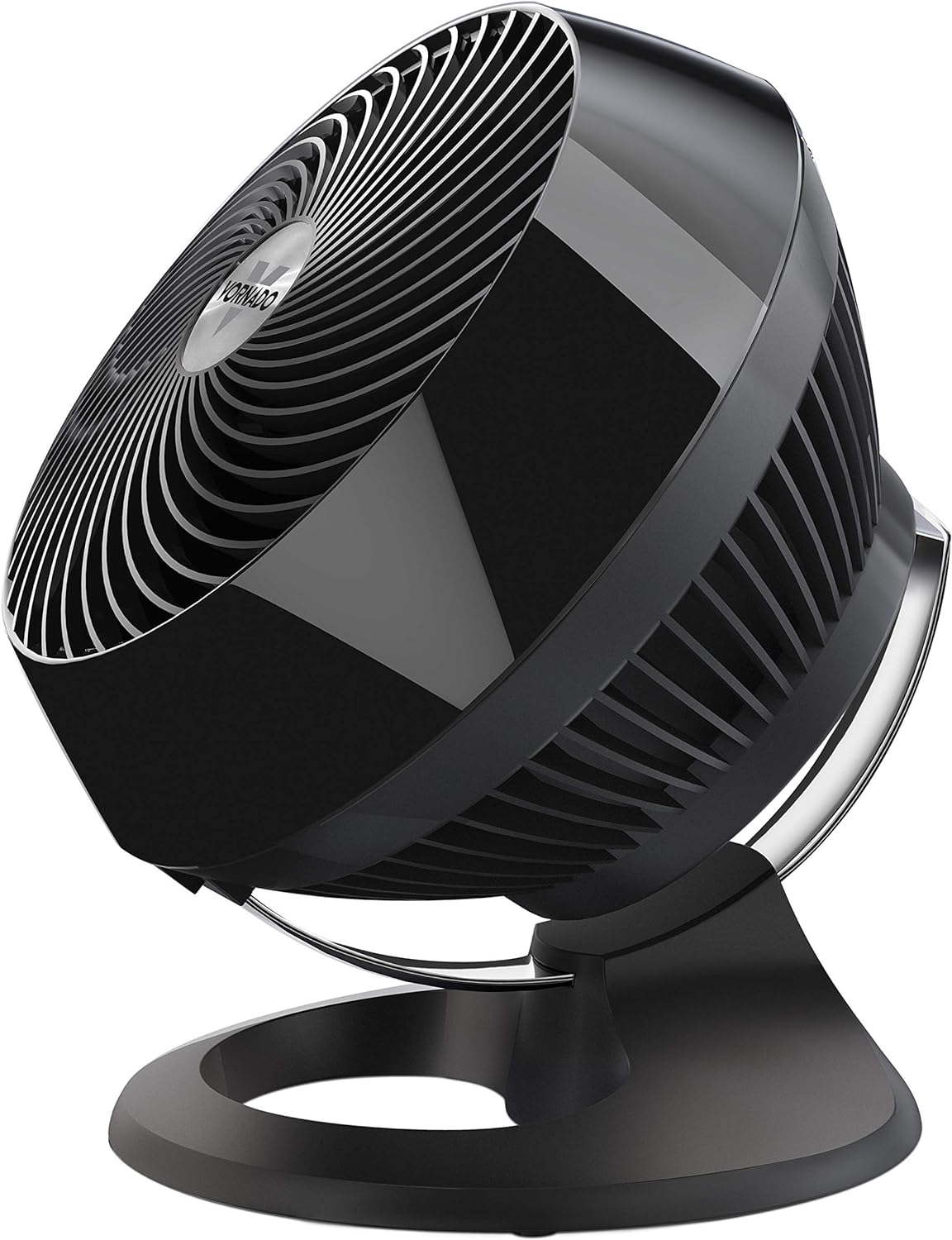
Vornado 660 Air Circulator
| Number of Speeds | 4 |
|---|---|
| Wattage | 45 watts |
| Air Flow Capacity | 584 cfm |
| Motor Type | Brushless |
| Noise Level | 54 db |
The Vornado 660 is a floor/table air circulator built to push steady airflow through an entire room rather than just creating a local breeze. It uses Vortex circulation with deep-pitched blades and a spiral grill to move air up to about 100 feet, and four push-button speed settings let you go from quiet background operation to stronger circulation when you need it. The chrome glide bar provides a 90-degree tilt so you can aim airflow across a kitchen or toward a seating area, and the front grill is removable for easier cleaning. At 45 watts with a brushless motor it is relatively efficient and the design emphasizes durability and simple controls rather than extra features. Noise is listed around 54 dB on higher settings, so expect noticeable sound when running at top speed. This model is sturdy and straightforward, offering reliable whole-room circulation for kitchens that need consistent airflow without complex setup or maintenance.
Best for: Home cooks and householders who prioritize dependable, long-lasting circulation to reduce cooking heat and odors and want a no-fuss, built-to-last fan.
Less Ideal for: People who want a near-silent fan for late-night kitchen use or those seeking smart features like automatic or app-controlled speed adjustment.
- Vortex technology designed to circulate air through an entire room rather than only locally cooling one spot
- Four push-button speeds for simple, predictable control
- 90-degree tilt via chrome glide bar to direct airflow where needed
- Brushless motor and removable grill support long-term reliable operation and easier cleaning
- No thermostat or automatic speed control for demand-based operation
- Higher-speed operation can be audible in quiet kitchen environments
Verdict: Choose the Vornado 660 when you need a reliably built, powerful circulator to move air through a kitchen without fuss or complicated features.
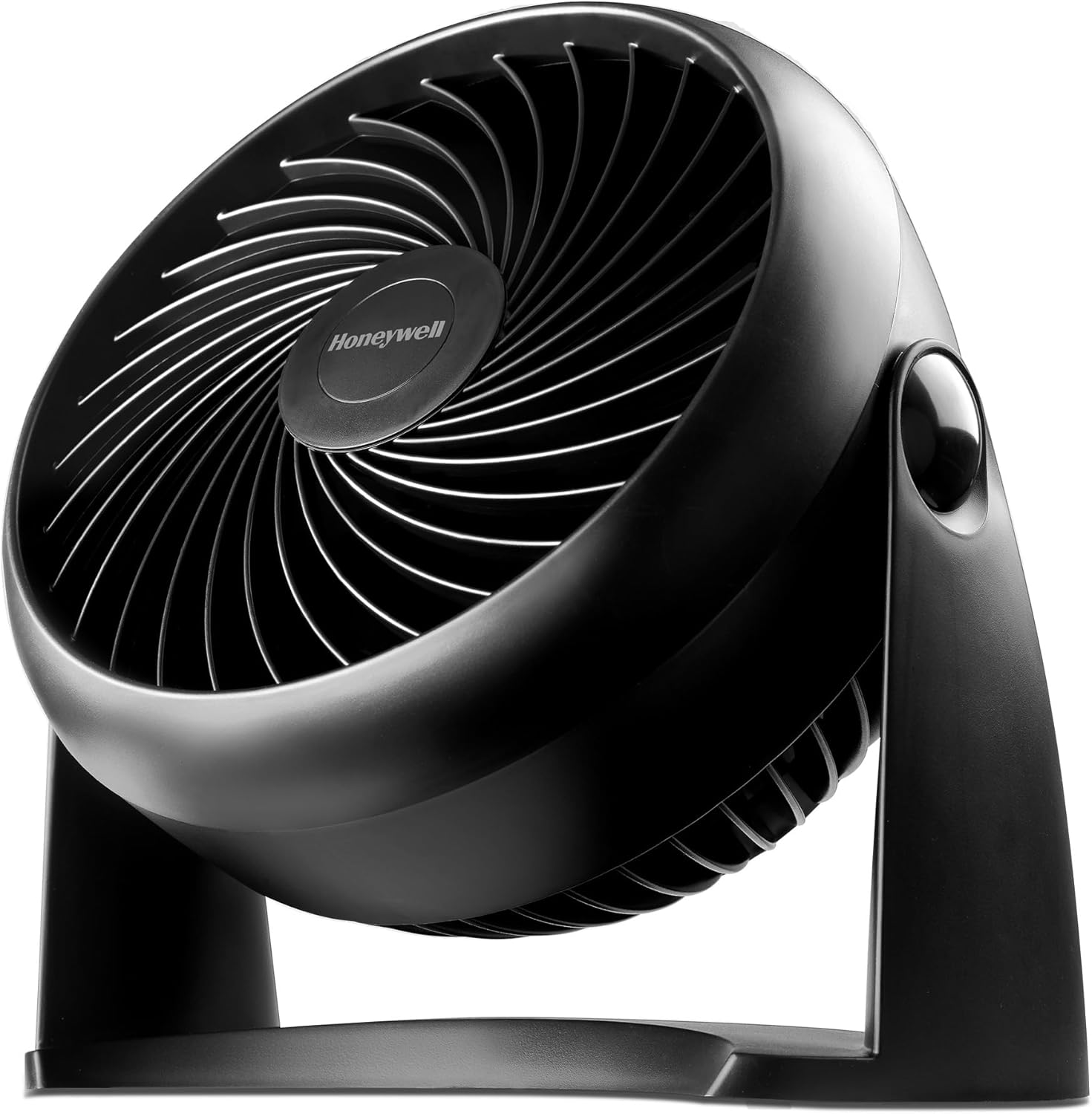
Honeywell TurboForce HT-900
| Number of Speeds | 3 |
|---|---|
| Air Flow Capacity | 185 cfm |
| Wattage | 35 watts |
| Motor Type | brushless |
| Power Source | Corded Electric |
The Honeywell TurboForce HT-900 is a small, durable tabletop fan designed to boost air circulation in kitchens, bedrooms, or home offices. It uses an aerodynamic turbo blade and brushless motor to deliver strong airflow (listed at about 185 cfm) from a compact housing, and the head pivots 90 degrees so you can direct the breeze where you need it. Control is simple: three push-button speeds let you choose quiet low settings for background airflow or higher power when you want faster cooling. The fan is lightweight and can be used on a counter or wall-mounted where space is tight, and its plastic build makes it easy to clean. Practical limits include modest size and single-function controls, so it will not replace larger box or tower fans for cooling large spaces, and there is no timer or remote. For kitchen use it excels at targeted circulation near cooking areas or to help move heat away from a specific spot, but expect a basic, utilitarian feature set rather than smart or multi-function convenience.
Best for: Buyers who prioritize a proven, widely recommended small fan to add targeted airflow in a kitchen or nearby prep area and who value straightforward, reliable performance over extra features.
Less Ideal for: People who need whole-room cooling, programmable schedules, or smart controls should consider larger or feature-rich fans instead.
- Aerodynamic TurboForce blade and brushless motor deliver strong airflow for its size
- Three simple speed settings for quick adjustment
- 90-degree pivoting head lets you aim airflow precisely
- Compact and mountable for countertops or wall use
- No timer, remote, or advanced controls; single-purpose operation
- Plastic construction limits premium feel compared with metal fans
Verdict: A compact, dependable tabletop air circulator that delivers strong directed airflow for kitchen counters or small zones when you want simple, reliable cooling.
Lasko Pivoting Pro 12" Fan U12104

| Power Source | Corded Electric |
|---|---|
| Number of Speeds | 3 |
| Air Flow Capacity | 289 cfm |
| Wattage | 100 watts |
| Motor Type | Brushless |
The Lasko Pivoting Pro 12" utility fan is a small, powerful air mover designed to direct concentrated airflow where you need it most. It delivers up to 289 CFM with three rotary-controlled speeds and a 270-degree pivoting head so you can aim air at a hotspot, dry floors or speed cooling in tight kitchen corners. The fan is corded with a 10-foot grounded plug and two built-in grounded outlets that let you power nearby tools or devices without adding extra extension cords. The plastic housing and 12" blade keep the unit lightweight and easy to carry by the integrated handle, and ETL listing with a circuit breaker/reset button adds basic electrical protection. Expect a noticeably loud output at higher speeds due to its high-velocity blower design, and the unit lacks timers, remote control, or adjustable height that some kitchen-oriented fans offer. For everyday spot cooling, drying spills, or boosting ventilation on demand, this fan is straightforward, durable, and simple to use.
Best for: Buyers who prioritize a reliable, easy-to-use fan for targeted cooling or drying in the kitchen and want straightforward safety features and portability.
Less Ideal for: If you need whisper-quiet operation, remote control, or a fan designed to circulate an entire large kitchen, choose a larger or quieter appliance instead.
- High airflow up to 289 CFM for strong spot cooling and drying
- Pivoting head with 270-degree range to aim air precisely
- Two built-in grounded outlets reduce need for extra extension cords
- Lightweight carry handle and compact footprint for easy repositioning
- ETL listed with circuit breaker and reset for basic electrical safety
- Relatively loud at higher speeds compared with quieter household fans
- No timer, remote, or speed memory features
- All-plastic construction is durable but lacks premium finish
Verdict: A rugged, no-frills portable blower that delivers focused high-velocity airflow and built-in electrical safety for dependable spot cooling and drying in kitchens.
Choosing the Right Fan for Kitchen: Key Factors to Consider
Airflow Capacity
Airflow capacity determines how quickly a fan can clear steam, smoke, and cooking odors from a kitchen. Higher airflow is useful for larger kitchens or for frequent high-heat cooking, while lower airflow can be acceptable in small kitchens or for light cooking.
When evaluating airflow, think about peak cooking moments such as frying or boiling. A fan that moves more air reduces lingering smells and helps prevent condensation on cabinets and surfaces.
Noise Level
Noise level affects comfort, conversation, and the perceived quality of a fan. Kitchens are social spaces, so a loud fan can be intrusive. Look for rated sound levels at typical speeds and consider models with multiple speed steps so you can run quietly most of the time and boost airflow only when needed.
Also note that perceived noise depends on placement and background home noise. Fans with smoother motor operation and well-balanced blades usually sound less harsh at the same decibel rating.
Ease of Cleaning and Maintenance
Kitchen fans collect grease, which reduces efficiency and can create hygiene issues. Choose fans with accessible grills, removable blades, or wipe-clean surfaces to make routine cleaning straightforward. Filtered units should use easily removable and washable filters to avoid frequent replacements.
Maintenance also includes motor sealing and bearing design. Sealed or self-lubricating bearings and corrosion-resistant finishes extend service life in humid, greasy environments.
Installation Flexibility
Kitchens vary in layout and mounting options. Some fans mount on walls, some in windows, and others are designed for countertop or shelf placement. Consider the fan's size, mounting hardware, and whether it needs a dedicated outlet or hardwiring. Easy installation reduces the need for professional help and lets you position the fan for optimal air exchange.
Pay attention to cord length, included mounting brackets, and whether the unit can be secured safely near heat sources.
Energy Use and Control Options
Energy use affects ongoing operating cost and heat output. Fans with efficient motors deliver the same airflow while drawing less power. Look for multi-speed controls, timers, or thermostat-linked operation to avoid running at full power unnecessarily.
Variable speed control also improves comfort by letting you dial in the right balance of airflow and noise for different cooking tasks.
Durability and Materials
Materials and construction determine how well a fan withstands kitchen conditions like humidity, heat, and airborne grease. Metal housings and corrosion-resistant coatings last longer than untreated plastics in some environments. Motors designed for continuous operation and protected from grease ingress will require fewer repairs.
Check for robust mounting hardware and easy-to-replace parts to extend the useful life of the fan.
Where to Place a Kitchen Fan for Best Results
Placement has a big impact on a fan's effectiveness. Position the fan so it either exhausts directly outside or circulates air toward an open window or range hood. For counter or clip-on fans, aim airflow across the cooktop or toward areas where steam accumulates.
Avoid placing fans where they will blow directly on delicate food or create drafts that scatter lightweight items. If the fan will be used near grease-producing cooking, allow easy access for cleaning.
- High near the cooktop for direct extraction
- Window-facing for cross-ventilation
- Corner placement for general air circulation
Types of Kitchen Fans and Typical Uses
Standalone countertop or clip-on fans are portable and useful for directing airflow during cooking or moving air between rooms. They are best for renters or situations where permanent installation is not possible.
Wall-mounted or window fans offer stronger airflow and are more effective for exhausting air out of the kitchen. These options usually require more planning for installation but deliver consistent results for larger spaces.
- Portable fans: flexible, easy install, lower airflow
- Window/wall fans: higher airflow, better for exhaust
- Circulation fans: improve whole-room air mixing
Managing Grease and Moisture
Kitchens produce grease and moisture that can foul fan blades and housing. Regular cleaning schedules prevent buildup and keep performance high. For greasy environments, favor models with removable grills or washable filters.
Use a mild degreasing cleaner and soft cloth to avoid damaging finishes. Inspect motors and vents periodically to confirm there is no grease accumulation that could impair cooling or cause odor.
- Clean grills and blades weekly if you cook frequently
- Wash or replace filters according to manufacturer guidance
- Wipe external surfaces after heavy frying or grilling
Noise Tips and Control Strategies
If noise is a concern, run the fan at lower speeds for longer durations rather than cycling full power. Positioning the fan to avoid resonant contact with cabinets or thin walls can reduce rattles and amplified tones.
Fans with adjustable mounts or rubber isolation pads reduce vibration transfer. Also inspect blade balance and tighten any loose hardware to prevent adding mechanical noise over time.
- Use lower speeds for background ventilation
- Isolate mounting points with rubber pads
- Balance blades and tighten hardware regularly
Energy Use and Running Costs
Energy-efficient motors and variable-speed controls lower ongoing electricity use. For frequent cooks, choosing a fan with a low-wattage but high-efficiency motor will reduce running costs while keeping air moving.
Consider using timers or intermittent ventilation to limit continuous operation. Matching runtime to cooking intensity keeps energy use proportional to need.
- Prefer efficient motors and multi-speed controls
- Use timers or intermittent runs for simmering vs. frying sessions
- Turn off when not needed to save energy
How We Chose the Best Fan for Kitchen
We focused on practical performance and long-term usability when selecting the finalists. Key evaluation criteria included airflow capacity measured in CFM or equivalent, noise output at typical speeds, ease of installation for common kitchen mounting locations, and how simple routine cleaning and maintenance are. We also considered durability factors such as motor type and materials that resist grease and humidity over time. Safety features like thermal protection and sealed bearings were important for kitchen environments. We excluded specialty industrial blowers, decorative desktop fans, and units designed only for outdoor use because they do not match typical kitchen needs. We prioritized units that balance strong airflow with low noise and that use accessible filters or wipe-clean surfaces, since grease and moisture are common in kitchens. The result is a list that emphasizes real-world usability rather than lab-only specs.
Our full evaluation process is outlined in our review methodology.
FAQ
How often should I clean a kitchen fan?
Often depends on cooking frequency, but a good rule is weekly wipe-downs for frequent frying and a deeper cleaning or filter wash every one to three months. Greasy buildup reduces airflow and can shorten motor life.
Can a small fan really improve ventilation in a kitchen?
Yes. A correctly placed small fan can direct steam and odors toward an open window or exhaust point, improving perceived ventilation. For heavy-duty smoke or steam, higher-capacity exhaust options work better.
Are quieter fans less effective?
Not necessarily. Advances in motor design and blade aerodynamics allow some fans to move good volumes of air while remaining quiet. Check the rated airflow and noise levels rather than assuming low noise means low performance.
Should a kitchen fan be vented outside?
Venting outside is typically more effective at removing heat, moisture, and odors permanently. If external venting is not possible, circulating the air toward a window or using filtered units helps but may not remove humidity as effectively.
What safety features are important for kitchen fans?
Look for thermal overload protection, sealed motors or bearings to keep grease out, and sturdily mounted hardware. These features reduce fire risk and improve longevity in hot, greasy environments.
Final Verdict
Choosing a fan for kitchen use means balancing airflow needs, noise tolerance, and how much cleaning you will do. Prioritize sufficient airflow for the size of your kitchen and select models that are easy to clean and resistant to grease and humidity. Also consider installation practicality and energy efficiency. Ultimately, pick the option that best fits your cooking intensity and space constraints: a quieter, lower-airflow model works for light use in small kitchens, while higher-capacity units are appropriate for larger kitchens or frequent high-heat cooking.