
Note: This article contains affiliate links. If you click on these links and make a purchase, we may earn a small commission at no extra cost to you. This helps support our research and content. Read our full affiliate disclosure here.
Choosing the right fan for a warehouse matters more than it might in a home or office. Warehouses have high ceilings, open floor plans, and variable occupancy, which means airflow needs and durability are different than for smaller spaces. The right warehouse fan improves ventilation, reduces hot spots, and lowers strain on HVAC systems while standing up to continuous operation and dusty conditions. This guide shortlists the seven top fans for warehouse use and evaluates them against practical criteria you can measure, such as airflow capacity, mounting flexibility, energy use, and long-term reliability. Read on to see which features matter most for keeping a large work area comfortable and safe, followed by decision-making guidance for your facility.
Top Picks at a Glance
| Best Overall The best all-around choice for most situations | HiCFM 30 inch Drum Floor Fan |  |
| Best Quality Built to a higher standard if you want something more solid | DEWALT 20" Drum Fan DXF2042 |  |
| Best Value The sweet spot between price and what you get | VEVOR 24-Inch Drum Fan |  |
| Best Budget The cheapest option that still gets the job done reliably | Lasko Pivoting Pro U12104 |  |
| Top Rated A top-rated pick with lots of positive feedback | Amazon Basics 16-Inch Pedestal Fan FS40-10BR |  |
| Most Popular A crowd favorite that many people choose with confidence | Amazon Basics 20" Industrial Floor Fan |  |
| Best Seller A high-volume bestseller chosen again and again | Honeywell TurboForce HT-900 |  |
HiCFM 30 inch Drum Floor Fan

| Power Source | Corded Electric |
|---|---|
| Air Flow Capacity | 13000 cfm |
| Number of Speeds | 3 |
| Wattage | 235 watts |
| Noise Level | 75 db |
The HiCFM 30-inch drum floor fan is a purpose-built industrial floor fan that pushes high volumes of air using a 1/3 HP brushed motor and three aluminum blades. It is typically used in warehouses, workshops, garages, and covered patios to drive airflow across large open areas or to provide spot cooling for workstations. The fan offers three speeds and reports up to 13,000 CFM on high, with a 9-foot power cord, solid 5-inch wheels and two carry handles that make it simple to move and position. Construction is steel with a powder coat finish and aluminum blades, and the motor is thermally protected with shielded bearings for longer life; the unit is UL listed. Noise is notable at working distances but the manufacturer calls out reduced noise compared with older models and provides measured dB at several distances. The main trade-offs are the industrial noise level when used at close range and the absence of a variable speed control beyond the three fixed settings, so fine-tuning airflow requires distance or speed selection.
Best for: Buyers who need a rugged, high-airflow fan to cool or ventilate large workspaces and prioritize raw performance and durability over quiet operation.
Less Ideal for: People who need near-silent cooling for offices, living spaces, or small rooms, or who require precise variable-speed control for localized airflow management.
- Very high airflow capacity up to 13,000 CFM for quickly moving air in large spaces
- Durable metal construction with powder coat finish and thermally protected motor for industrial use
- Three-speed control and long 9 ft cord for flexible placement and basic control
- Wheels and carry handles make it easy to reposition around large work areas
- UL safety listing and shielded bearings for improved longevity and safety
- Brushed motor and high-speed operation produce noticeable noise at close range
- Only three fixed speeds, no variable speed dial for finer airflow adjustments
Verdict: A robust, high-CFM industrial drum fan built to move large volumes of air across warehouses and workshops when durable, dependable airflow is the priority.
DEWALT 20" Drum Fan DXF2042

| Air Flow Capacity | 5000 cfm |
|---|---|
| Number of Speeds | 3 |
| Noise Level | 60 db |
| Wattage | 120 watts |
| Motor Type | Brushless |
The DEWALT 20" Drum Fan DXF2042 is a metal, freestanding high-velocity floor fan built to move large volumes of air in demanding spaces. It delivers up to 5000 CFM at a three-speed brushless motor and 1400 RPM, and the trumpet-shaped drum and 180-degree tilt let you target airflow across a warehouse floor, garage, or gym. Controls are simple push/button and pull-chain operated, and a six-foot power cord plus a sturdy carry handle make it portable across jobsite areas. The fan is intentionally loud at higher settings but rated around 60 dB at typical use, and its durable metal construction, rubber feet, and aluminum blades are made for continuous use; the motor also includes overheating protection. Because it is a single-purpose industrial fan with corded power and no oscillation or remote features, it is best for open workspaces that need concentrated, directional airflow rather than quiet or decorative cooling. The DEWALT offers a practical, rugged option when robust circulation and reliability are the priority.
Best for: Buyers who need a rugged, high-output fan to move large volumes of air across warehouses, workshops, or gyms and prioritize reliable, directional cooling over quiet operation.
Less Ideal for: Those seeking a quiet, decorative, or remote-controlled room fan for small residential spaces should look at lighter-duty or feature-rich consumer models instead.
- High airflow capacity (5000 CFM) for rapid circulation in large spaces
- Three-speed brushless motor for adjustable power and durability
- 180-degree adjustable head and trumpet-shaped drum for directed airflow
- Sturdy metal construction with rubber feet and a carry handle for jobsite use
- No oscillation or remote control options for broader area coverage
- Corded-only operation limits placement to reachable outlets
Verdict: A heavy-duty, high-CFM drum fan built to deliver focused, reliable airflow across large warehouse and workshop spaces.
VEVOR 24-Inch Drum Fan

| Diameter | 24 Inch |
|---|---|
| Maximum Airflow | 8700 CFM |
| Speeds | 3-Speed |
| Rotation | 360° Adjustable Tilting |
This VEVOR 24-inch drum fan delivers strong air movement for warehouses, workshops, and other large spaces where ventilation and circulation matter. The fan's high-power motor and wheeled blades produce up to 8700 CFM, and a simple knob controls three speed settings so you can dial airflow to the task. A 360-degree tilt and wide handle plus rolling casters make it easy to aim the stream and move the unit between work areas. In practical use it excels at air exchange, drying, and dust clearance in industrial environments, and the design reduces vibration and noise compared with cheaper shop fans. Expect a sturdy, no-frills utility product built for frequent repositioning rather than aesthetic fit in finished spaces. The main limitations are its size and focus on raw airflow, so it is bulky and tuned for open-area ventilation rather than quiet operation in small offices.
Best for: Buyers seeking a practical, work-ready fan to move large volumes of air in warehouses, shops, and industrial spaces where durability and mobility matter more than style.
Less Ideal for: People who need a low-profile, ultra-quiet fan for small offices, retail spaces, or residential rooms should consider quieter, smaller alternatives.
- High maximum airflow rated at 8700 CFM for rapid air exchange
- Three-speed knob provides simple, reliable control
- 360-degree tilt to precisely direct airflow
- Built-in handle and casters for easy mobility around large spaces
- Bulky footprint limits placement in tight or finished indoor areas
- Engineered for raw airflow rather than whisper-quiet operation
Verdict: Choose this fan when you need a durable, high-CFM, easy-to-move solution for ventilating large warehouse or industrial spaces.
Lasko Pivoting Pro U12104

| Power Source | Corded Electric |
|---|---|
| Number of Speeds | 3 |
| Air Flow Capacity | 289 cfm |
| Wattage | 100 watts |
| Motor Type | Brushless |
The Lasko Pivoting Pro U12104 is a small, purpose-built high-velocity blower that moves a lot of air from a compact footprint. It is typically used in garages, workshops, basements, and light warehouse spots to cool people, speed drying of floors or paint, and ventilate stagnant corners. The fan offers three speeds, a 270-degree pivoting head to aim airflow where you need it, and a built-in carry handle for easy repositioning. Practical extras include two grounded outlets on the unit and a 10-foot cord so you can power nearby tools without extra extension cords, and ETL listing plus a circuit breaker for basic electrical safety. Because it is plastic-bodied with a brushless motor and a simple rotary control, the design is straightforward and durable for general job-site use, though it lacks features like variable-speed digital control, oscillation, or weatherproofing for heavy industrial environments. Noise on higher settings is noticeable but expected for a high-velocity blower of this size.
Best for: Practical buyers seeking an affordable, portable blower to cool work areas, speed drying tasks, or ventilate tight spots in a warehouse or workshop without extra bells and whistles.
Less Ideal for: Large warehouses needing whole-space circulation, outdoor or harsh industrial environments, or buyers who require quiet, variable-speed digital control and oscillation features.
- High airflow up to 289 CFM for effective spot cooling and drying
- 270-degree pivoting head to precisely direct airflow
- Two built-in grounded outlets to power tools nearby
- Portable, lightweight design with carry handle and 10-foot cord
- ETL listed with circuit breaker for basic safety
- Limited to three fixed speeds without precise digital control
- Plastic construction and indoor-only rating limit heavy outdoor or harsh industrial use
Verdict: A budget-friendly, portable high-velocity blower that delivers strong directional airflow for spot cooling and drying in small warehouse or workshop areas.
Amazon Basics 16-Inch Pedestal Fan FS40-10BR

| Wattage | 60 watts |
|---|---|
| Number of Speeds | 3 |
| Number of Blades | 6 |
| Power Source | Corded Electric |
| Motor Type | AC |
This Amazon Basics 16-inch pedestal fan is a straightforward indoor air circulator built for regular duty use in medium to large rooms. It uses a 60W AC motor and dual-layered plastic blades to move air efficiently while remaining reasonably quiet, and the oscillation plus adjustable tilt and height make it easy to direct airflow where needed. Controls are simple: three speeds, three breeze modes (normal, nature, sleep), and a timer, all operable from the included remote for convenience. Practical features such as a powder-coated metal stand and remote control help with day-to-day reliability and ease of use. On the other hand, its three-speed, AC-motor design is basic compared with variable-speed or DC-fan models and it is intended for indoor household or office settings rather than heavy industrial environments. Assembly and placement are typical for pedestal fans, and maintenance is limited to occasional dusting of the blades and grille. For buyers who want a dependable, no-frills circulating fan, this model delivers consistent performance at modest energy use.
Best for: Buyers who prioritize a reliable, easy-to-use fan for continuous indoor air circulation in medium to large spaces and value simple controls and durable basic construction.
Less Ideal for: Those needing heavy-duty warehouse-grade airflow, variable-speed precision, or fans rated for dusty or damp industrial settings should look at commercial-grade units instead.
- Powerful yet quiet AC motor for steady airflow without excessive noise
- Adjustable height and tilt plus oscillation for flexible room coverage
- Remote control and timer for convenient, hands-off operation
- Durable metal and plastic construction with powder-coated finish
- Only three fixed speed settings rather than fully variable speed control
- Designed for indoor household use and not rated for industrial or wet environments
Verdict: A dependable, low-maintenance pedestal fan that provides steady indoor airflow and simple remote control for reliable everyday use.
Amazon Basics 20" Industrial Floor Fan

| Wattage | 125 watts |
|---|---|
| Number of Speeds | 3 |
| Air Flow Capacity | 3542 cfm |
| Power Source | Corded Electric |
| Blade Material | Aluminium |
This Amazon Basics 20" industrial floor fan is built for heavy-duty circulation in garages, warehouses, gyms, and workshops. Its three aluminum blades and metal housing produce a rated 3,542 CFM at high speed, which moves large volumes of air for rapid cooling or ventilation. The fan offers three speed settings and a tilt head so you can direct airflow where it is needed most, and the free-standing design lets you reposition it quickly. Assembly is tool-free and the unit is ETL listed for electrical safety, making it practical for busy commercial environments. At 125 watts it balances power and energy use reasonably well for its class, but the three-speed control is basic compared with variable-speed drives and it lacks integrated wheels or handles for long-distance transport. The all-metal construction is durable but heavier than plastic alternatives, and the rotary knob control is simple rather than precise. For warehouse airflow and spot cooling this fan provides strong, no-nonsense performance with industrial-grade materials.
Best for: Buyers who prioritize proven, high-volume airflow and durable metal construction for cooling or ventilating large indoor commercial spaces and who value straightforward, safety-certified equipment.
Less Ideal for: People who need quiet, fine-grained speed control or lightweight, highly portable fans for frequent relocation should consider other options.
- Very high airflow rating at 3,542 CFM suitable for large spaces
- Durable metal housing and aluminum blades built for commercial use
- Three speed settings plus adjustable tilt head for targeted airflow
- ETL safety listing provides assurance for industrial environments
- Tool-free assembly for quick setup
- Only three fixed speeds rather than a variable-speed control
- No built-in wheels or carrying handle for easy relocation
Verdict: A rugged, ETL-listed high-velocity floor fan that delivers very large airflow for warehouses and other commercial spaces.
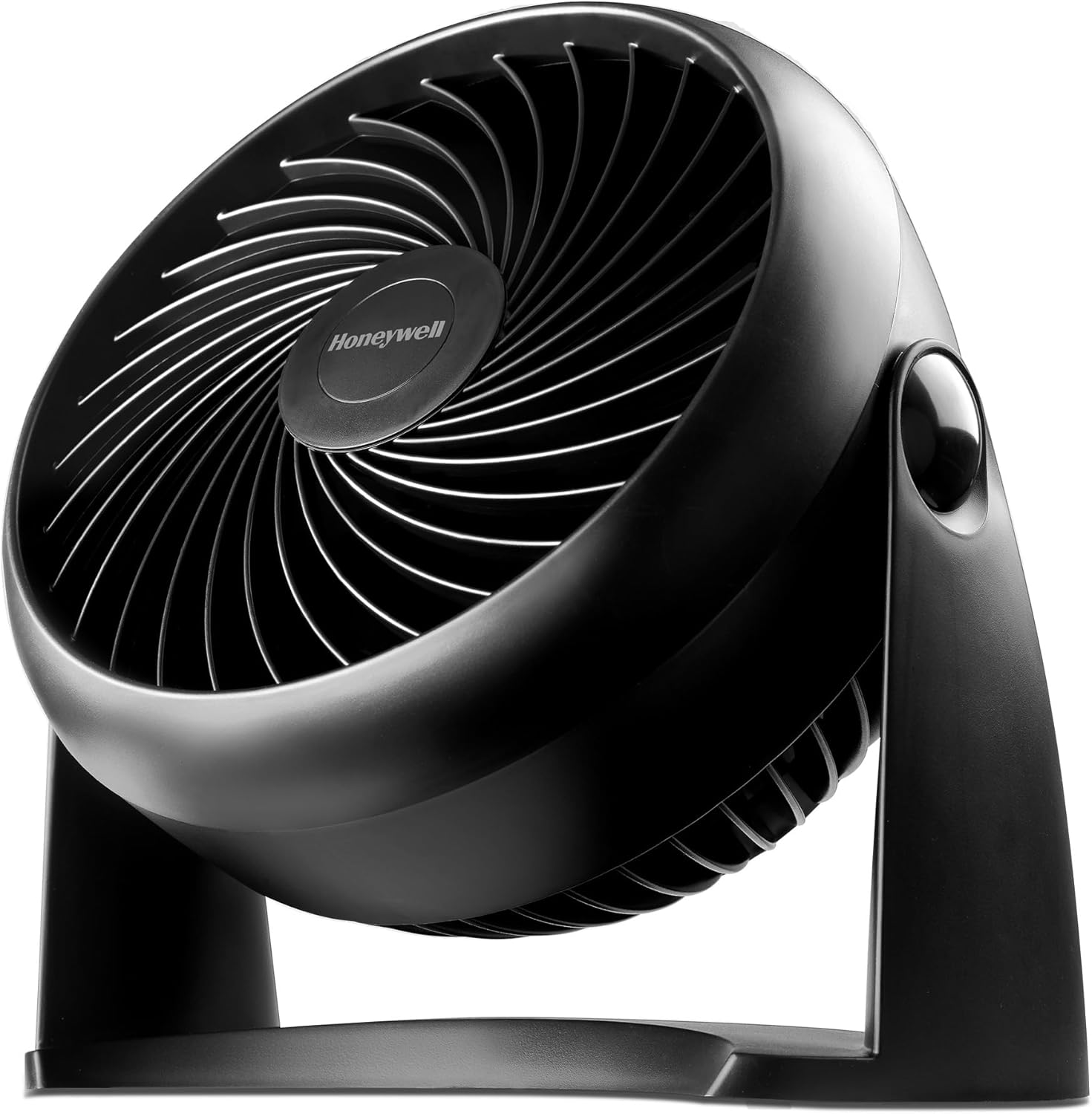
Honeywell TurboForce HT-900
| Power Source | Corded Electric |
|---|---|
| Number of Speeds | 3 |
| Air Flow Capacity | 185 cfm |
| Motor Type | brushless |
| Installation Type | Tabletop or Wall Mount |
The Honeywell TurboForce HT-900 is a small, corded tabletop fan built to deliver strong directed airflow in close quarters. It uses an aerodynamic turbo design and a brushless motor to push up to 185 cfm while remaining relatively quiet, and the head pivots 90 degrees so you can aim the breeze where you need it. Three push-button speeds make it simple to find a comfortable setting and the unit can be mounted on a wall or placed on a desk or shelf. Because it is compact and lightweight, it is easy to move between workstations and fits on crowded surfaces, but its power and coverage are intended for small to medium areas rather than large open spaces. Practical benefits include energy-efficient operation compared with larger fans and a durable plastic build that is easy to clean. Important limitations are its small size and single-direction output, which mean multiple units would be required to cool large warehouse aisles or open-floor work areas.
Best for: Buyers looking for a reliable, low-maintenance personal or small-area fan that is simple to operate and easy to move between workstations.
Less Ideal for: Facilities needing high-volume industrial airflow for large warehouse aisles or open production floors should choose purpose-built industrial or high-velocity fans instead.
- Compact and portable for easy placement on desks or shelves
- Brushless motor and aerodynamic design deliver up to 185 cfm of airflow
- Three simple speed settings with a 90-degree pivoting head for targeted cooling
- Can be used tabletop or wall-mounted to save floor space
- Designed for small to medium spaces and not powerful enough for large warehouse areas
- Plastic construction feels basic compared with heavy-duty industrial fans
Verdict: A dependable, easy-to-use personal air circulator that delivers focused airflow for small workstations and short-range cooling.
Choosing the Right Fan for Warehouse: Key Factors to Consider
Airflow Capacity and Coverage
Airflow capacity is the single most important factor for a warehouse fan because it determines how much air the unit can move and how effectively it can break up stagnant zones. Look for clear CFM ratings and guidance on coverage area. Higher CFM ratings translate to larger effective zones, but the distribution pattern matters too; a focused airstream will travel farther, while broader, lower-velocity flow distributes air across more floor area.
Consider the ceiling height and obstructions like racking and mezzanines. A fan that provides adequate airflow at 20 feet may be insufficient at 40 feet. Matching the fan's throw distance to your facility layout prevents hot spots and ensures consistent temperature and air quality across the workspace.
Duty Cycle and Motor Construction
Warehouse fans often run for long stretches, sometimes continuously during warm months. Choose fans specified for continuous or heavy-duty duty cycles and motors designed for industrial use. Key features to look for include industrial-grade bearings, thermal protection, and sealed motor housings to reduce maintenance and extend lifespan.
A fan built for intermittent residential use will overheat and fail quickly in a warehouse setting. Durable motor construction reduces total cost of ownership by minimizing downtime and repair frequency.
Mounting Options and Installation
Warehouses demand flexible mounting choices to adapt to different ceiling types, clearances, and workflows. Options include ceiling-mounted paddle fans for broad circulation, high-velocity wall fans for aisle-specific airflow, and portable floor units for temporary or localized cooling. Check the mounting hardware, vibration isolation features, and whether the fan supports angled or suspended installations.
Installation complexity affects labor and safety. Fans that include clear mounting templates, adjustable suspension kits, and integrated safety cables make long-term maintenance and repositioning simpler and safer.
Energy Use and Controls
Energy consumption is a major operational cost in large facilities. Evaluate the fan's input power relative to delivered airflow and look for efficient motor types and multiple speed settings. Variable-speed controls and compatibility with building management systems allow precise matching of airflow to occupancy, which reduces wasted energy.
Timer functions, thermostatic controls, and occupancy sensors can further optimize runtime. Prioritizing energy-efficient models with good control options lowers operating expenses without sacrificing comfort.
Noise and Worker Comfort
Noise becomes more noticeable in enclosed areas and can affect communication, concentration, and safety. Check manufacturer noise ratings or independent tests where available, and consider the tradeoff between high-velocity airflow and acceptable sound levels. For work areas that require verbal coordination or long exposure, choose fans with smoother, low-frequency output rather than harsh, high-pitched tones.
Placement and mounting can influence perceived noise; isolating mounts and larger blade diameters often produce quieter operation for the same airflow level.
Maintenance Accessibility and Serviceability
Routine maintenance is inevitable in heavy-use environments, so choose fans that simplify cleaning, lubrication, and part replacement. Accessible motor housings, removable grills, and available replacement parts reduce downtime. Consider whether the unit supports on-site bearing replacement and whether the manufacturer provides clear service documentation.
A design that minimizes tool requirements and allows safe access for maintenance will lower long-term labor costs and keep fans performing at rated capacity.
Types of Warehouse Fans and When to Use Them
Warehouse fans come in several practical forms, each suited to a different task. Large ceiling paddle fans are effective for general air circulation and destratification, pushing warm air down in winter and creating gentle crossflow in summer. High-velocity wall or oscillating fans target aisles and workstations where focused airflow is needed.
Portable industrial fans are useful for temporary cooling, spot ventilation during cleaning or painting, and supplemental airflow in staging areas. Choosing the right type depends on the space layout, ceiling height, and whether you need fixed or flexible airflow solutions.
- Ceiling paddle fans: broad coverage, good for destratification.
- Wall/high-velocity fans: aisle-focused airflow, longer throw.
- Portable fans: flexible placement, temporary or spot use.
Optimizing Placement and Airflow Patterns
Placement determines how effectively a fan moves air through the facility. For destratification, center-mounted ceiling fans with sufficient diameter can create a gentle downward flow that mixes temperature layers. In racked aisles, mount wall fans to push air along the length of the shelving to prevent heat pockets.
Measure throw distance and account for obstructions. Use a mix of fixed and oscillating units where one fan type cannot reach all areas. Avoid aiming high-velocity jets directly at workstations where they could create drafts that impact tasks or inventory handling.
- Match fan throw to aisle length and ceiling height.
- Use oscillation to broaden coverage where needed.
- Avoid direct blasts on sensitive work zones.
Control Strategies to Save Energy
Smart control strategies reduce runtime and energy use without compromising comfort. Use zoning so fans operate only where people are present or where temperature differentials occur. Integrate thermostats, timers, or occupancy sensors to automatically adjust speed and schedules.
Variable-speed fans let you dial in the minimum airflow needed for conditions. During cooler nights or low-occupancy shifts, lower speeds maintain air movement with substantially less power draw.
- Zone fans by occupancy or process area.
- Pair fans with thermostats or timers for automated control.
- Use variable-speed drives to match output to need.
Installation Safety and Compliance
Proper installation protects staff and equipment. Ensure suspension points and mounts meet the building's structural ratings and use safety cables on ceiling installations. Follow local electrical codes and provide lockout/tagout procedures for maintenance.
Consider blade guards and minimum clearance distances to prevent accidental contact near work areas or moving equipment. Document installation locations and maintenance schedules for regulatory compliance and safety audits.
- Verify ceiling or wall structural capacity before mounting.
- Install safety cables and vibration isolation.
- Follow electrical codes and establish maintenance lockout procedures.
Common Mistakes to Avoid
A common error is choosing fans based only on blade size or appearance rather than rated airflow and duty cycle. Large blades do not guarantee useful air movement at warehouse ceiling heights. Another mistake is neglecting the maintenance plan; fans that cannot be serviced easily will underperform over time.
Also avoid over-focusing on highest possible airflow without considering noise and comfort. Excessively powerful fans can create disruptive drafts, making their performance counterproductive for certain tasks.
- Do not rely solely on blade diameter when evaluating capacity.
- Plan for regular maintenance access and parts availability.
- Balance airflow needs with acceptable noise and draft levels.
How We Chose the Best Fan for Warehouse
We selected warehouse fans using criteria that reflect real operational needs in industrial and large commercial spaces. Primary filters included measured airflow and coverage area, because a fan that cannot move sufficient cubic feet per minute (CFM) will not improve ventilation in high-ceiling environments. Durability under continuous operation was another essential filter, emphasizing industrial-grade motors, sealed bearings, and metal housings built to resist dust and vibration. Energy efficiency and motor controls were assessed to determine operating cost and flexibility during varying occupancy. Mounting options and installation complexity were considered so the fans can be adapted to ceiling, wall, or floor setups common in warehouses. Noise level and airflow pattern were evaluated to balance worker comfort with performance. We excluded consumer-only designs intended for occasional residential use and products lacking clear specification data on airflow or duty cycle. The resulting picks prioritize measurable airflow, robust construction, adaptable mounting, and efficient long-term operation.
Our full evaluation process is outlined in our review methodology.
FAQ
How do I calculate the number of fans needed for my warehouse?
Start by mapping the facility and noting ceiling height, aisle lengths, and high-occupancy zones. Use each fan's rated coverage or CFM to estimate how many units are required to achieve desired air changes or consistent airflow. Account for obstructions and overlap coverage for even distribution.
Can warehouse fans reduce heating costs in winter?
Yes. Properly placed ceiling fans can destratify the space by pushing warm air from the ceiling down to floor level, reducing the workload on heating systems. Use low-speed, wide-coverage settings to mix air gently without creating cold drafts.
Are portable fans suitable for permanent warehouse ventilation?
Portable fans are best for temporary or supplemental tasks, such as spot cooling or process ventilation. For continuous whole-facility ventilation, fixed ceiling or wall-mounted fans designed for heavy-duty use are a more reliable long-term solution.
What maintenance do warehouse fans typically require?
Regular maintenance usually includes cleaning blades and grills to prevent dust build-up, inspecting and lubricating bearings if serviceable, checking mounting hardware and safety cables, and testing electrical connections. The exact schedule depends on duty cycle and dust conditions.
How important is noise when choosing a warehouse fan?
Noise is important if staff need to communicate or focus in the area where the fan operates. Assess noise ratings and prefer lower-frequency, smoother airflow for occupied workspaces. In noisy production areas, higher output with more noise may be acceptable if communication is already managed by other means.
Final Verdict
For warehouse ventilation, prioritize measurable airflow, continuous-duty motor construction, and flexible mounting to match your facility layout. Balance energy efficiency and controls with the noise profile appropriate for occupied areas. Investing in fans with accessible maintenance features and proven durability reduces downtime and operating costs. Focus first on covering the space with adequate CFM and then refine your choice by considering installation constraints, control options, and long-term serviceability. That approach will help you pick a fan solution that keeps your warehouse comfortable, safe, and efficient.