
Note: This article contains affiliate links. If you click on these links and make a purchase, we may earn a small commission at no extra cost to you. This helps support our research and content. Read our full affiliate disclosure here.
If you need reliable cooling without a big upfront cost, choosing the right budget fan makes a noticeable difference in home comfort. A well-matched inexpensive fan can improve airflow, reduce perceived temperature, and cost less to run than more powerful climate systems. This guide shortlists the top budget fans and evaluates each option against the core needs of price-sensitive buyers: cooling effectiveness, noise, and running cost. Below you will find compact summaries of seven top picks tuned for different small-room and desktop uses, along with the criteria we used and practical advice to help you pick the best fan for your space.
Top Picks at a Glance
| Best Overall The best all-around choice for most situations | Amazon Basics 16" Pedestal Fan |  |
| Best Quality Built to a higher standard if you want something more solid | Simple Deluxe 12-Inch Floor Fan |  |
| Best Value The sweet spot between price and what you get | Lasko Wind Machine 3300 |  |
| Best Budget The cheapest option that still gets the job done reliably | TriPole KW37 USB Mini Fan |  |
| Top Rated A top-rated pick with lots of positive feedback | Honeywell TurboForce HT-900 |  |
| Most Popular A crowd favorite that many people choose with confidence | Amazon Basics Air Circulator Fan |  |
| Best Seller A high-volume bestseller chosen again and again | Lasko Pivoting Pro 12" Fan U12104 |  |
Amazon Basics 16" Pedestal Fan

| Wattage | 60 watts |
|---|---|
| Number of Speeds | 3 |
| Motor Type | AC |
| Blade Material | Plastic |
| Control Method | Remote |
This Amazon Basics 16" pedestal fan is a straightforward floor fan for cooling and circulating air in medium to large rooms. It uses an AC motor rated at 60 watts and offers three speeds plus three breeze modes (normal, nature, sleep) to vary airflow. The fan oscillates and has adjustable height and tilt so you can direct air where needed, and the included remote and timer make it easy to change settings from across the room. Dual-layered blades and a six-blade assembly aim to move a solid volume of air while keeping noise low for bedroom or living-room use. Assembly and controls are simple, and the metal/plastic construction feels utilitarian rather than premium. There is no advanced smart connectivity or fan-speed granularity beyond three settings, and the design prioritizes value over high-end features. For buyers who want an effective, no-frills standing fan with remote convenience and adjustable airflow, it covers the essentials reliably.
Best for: Buyers who want an affordable, dependable pedestal fan that delivers adjustable airflow and remote convenience for bedrooms, living rooms, or home offices without frills.
Less Ideal for: If you need app control, many speed settings, or a designer finish, choose a higher-end or smart-enabled fan instead.
- Three speed settings and three breeze modes for simple, usable control
- Adjustable height, tilt, and oscillation to direct airflow around a room
- Included remote and timer for convenient operation from a distance
- Energy-efficient AC motor using 60 watts while maintaining quiet operation
- Only three discrete speed levels so fine-tuned airflow control is limited
- No smart home connectivity or app control
- Build is utilitarian metal and plastic rather than premium materials
Verdict: A budget-friendly pedestal fan that gives reliable, quiet airflow control and remote convenience for everyday home cooling.
Simple Deluxe 12-Inch Floor Fan

| Power Source | Corded Electric |
|---|---|
| Number of Speeds | 3 |
| Air Flow Capacity | 1800 cfm |
| Wattage | 44 watts |
| Motor Type | brushed |
This Simple Deluxe 12-inch floor fan is a compact high-velocity unit built for strong, focused airflow in rooms, garages, and workshops. It uses a brushed, ball-bearing motor and three rotary speed settings to push up to 1800 CFM through three aluminum blades, and the 230-degree adjustable tilt lets you aim flow where you need it most. The all-metal body and reinforced wire grill give the fan a durable, industrial feel while the rear carry handle and rubber feet make it easy to move and stable on hard floors. Setup is plug-and-play with a standard corded plug and simple button/rotary controls. Expect louder operation at the highest setting because the design prioritizes airflow over whisper-quiet performance, and there are no advanced features like timers, remotes, or oscillation modes. For buyers who want straightforward, powerful circulation on a budget, this fan delivers reliable performance in a small footprint.
Best for: Buyers who prioritize raw air movement and durable construction over bells and whistles and need affordable, directional cooling for workshops, garages, or tight indoor spaces.
Less Ideal for: Anyone seeking near-silent operation, remote control, or multiple automated modes should consider a quieter, feature-rich tower or pedestal fan instead.
- High airflow capacity up to 1800 CFM for strong room circulation
- Durable all-metal construction with aluminum blades and reinforced grill
- Adjustable tilt head and carry handle for directional use and portability
- Simple three-speed rotary controls that are easy to operate
- No oscillation, remote, or timer features for hands-free or scheduled use
- Brushed motor and high-velocity design can be noticeably loud at top speed
Verdict: A budget-friendly, heavy-duty small floor fan that delivers strong, targeted airflow for performance-focused cooling needs.
Lasko Wind Machine 3300

| Power Source | Corded Electric |
|---|---|
| Number of Speeds | 3 |
| Air Flow Capacity | 1985 cfm |
| Wattage | 107 watts |
| Motor Type | brushless |
The Lasko Wind Machine 3300 is a no-nonsense high-velocity floor fan built to move a lot of air in a compact package. It delivers up to 1,985 CFM across three manual speeds and a pivoting head so you can aim concentrated airflow for spot cooling, drying paint or carpets, or circulating air in larger rooms or garages. The plastic and metal construction is rugged and easy to carry using the integrated handle, and the unit ships fully assembled so setup is just plug-and-play. Controls are simple rotary knobs rather than digital presets, which keeps the price and complexity down but means fewer fine adjustments. The motor produces noticeable white noise that many buyers find helpful for masking background sounds but could be loud in quiet bedrooms at high speed. Safety features include ETL listing and Lasko's fused two-prong plug. For budget-focused shoppers who prioritize raw airflow and portability over silky-quiet operation or smart features, this fan is a practical choice.
Best for: Buyers who need maximum airflow on a budget and want a rugged, easy-to-move fan for workshops, large rooms, or drying tasks rather than a quiet decorative unit.
Less Ideal for: Those seeking near-silent operation, precise speed control, or smart/programmable features should consider other, quieter models with finer controls.
- Very high airflow capacity (up to 1,985 CFM) for fast cooling and drying
- Simple three-speed rotary controls are intuitive and durable
- Pivoting head lets you direct air where needed
- Built-in carry handle and portable design make it easy to move between rooms
- ETL listed with fused plug for added electrical safety
- Only three speed settings limits fine-tuning of airflow
- Plastic-heavy construction is durable but not premium-feeling
- Not designed for whisper-quiet operation at high speed
Verdict: If you want the most cooling power for your money in a portable, hard-working package, the Lasko Wind Machine 3300 is the practical budget pick.
TriPole KW37 USB Mini Fan

| Power Source | USB Powered |
|---|---|
| Number of Speeds | 3 |
| Noise Level | 25 db |
| Motor Type | Brushless Motor |
| Main Power Connector Type | USB Type A |
The TriPole KW37 is a small, plug-in USB desk fan designed for personal cooling at a desk, bedside, or travel setup. It runs from a USB-A power source and offers three speed settings controlled by a push button, but the highest speed requires a USB port or charger that supplies at least 0.8A. The fan uses a brushless motor and five plastic blades to deliver a focused airflow from its 4.5-inch head while remaining quiet at about 25 dB, and a wide base with silicone pads helps keep it stable and low in vibration. The head tilts through 360 degrees so you can direct airflow where you need it, and the cord is non-removable but long enough to reach distant outlets or power banks. Practical limitations include the lack of power-memory after outages and dependence on a USB power source for full performance, but for anyone needing a compact, low-noise personal fan that is easy to move and simple to operate, it is an effective budget pick.
Best for: Buyers who want an inexpensive, portable personal fan for a desk, nightstand, or travel and prioritize quiet, simple plug-and-play cooling.
Less Ideal for: People who need a cordless or battery-powered fan, whole-room airflow, or advanced features like speed memory or timers should look elsewhere.
- Three adjustable speeds for tailored personal airflow
- Quiet operation around 25 dB thanks to brushless motor
- 360° tilt head for precise directional cooling
- Compact, lightweight design with a stable base and silicone pads
- Highest speed may not work on low-current USB ports (needs ~0.8A)
- USB cord is non-removable which limits replacement or shorter-cord use
Verdict: A quiet, no-frills USB mini fan that delivers targeted personal cooling at a very budget-friendly price.
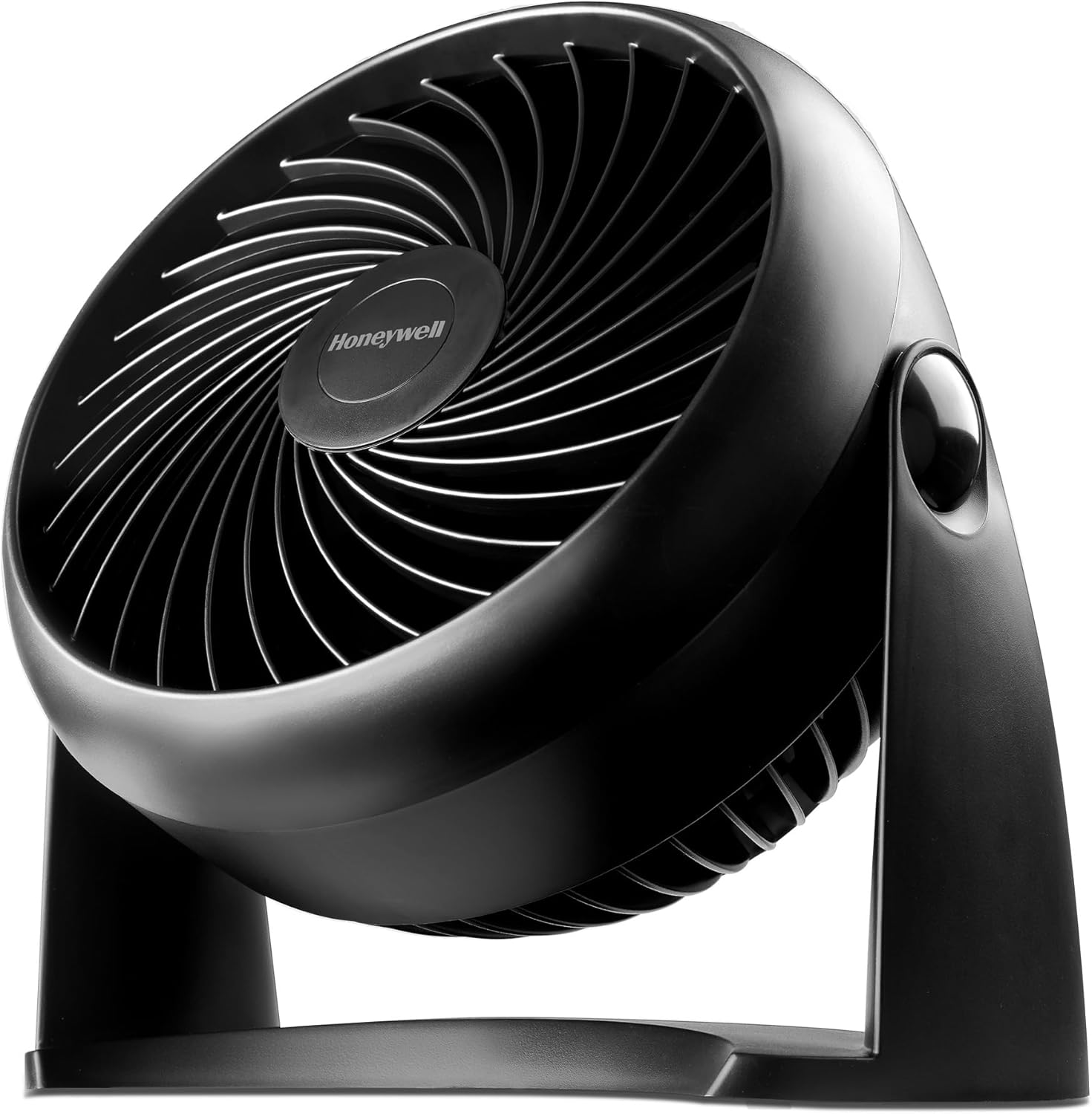
Honeywell TurboForce HT-900
| Power Source | Corded Electric |
|---|---|
| Number of Speeds | 3 |
| Air Flow Capacity | 185 cfm |
| Motor Type | brushless |
| Installation Type | Tabletop or Wall Mount |
The Honeywell TurboForce HT-900 is a small, durable air circulator meant for desks, nightstands, or wall mounting to boost airflow in small to medium rooms. It offers an aerodynamic turbo design and a brushless motor that deliver strong airflow up to 185 cfm while running quieter than comparable compact fans. Three push-button speeds and a 90-degree pivoting head make it easy to aim a focused breeze where you need it, and the lightweight plastic housing and built-in carry handle keep it portable. It plugs into standard 110V outlets and uses a simple push-button controller with no complicated setup. Expect practical, no-frills cooling and steady performance for everyday use, though its small size limits coverage compared with larger floor or tower fans and the plastic construction is basic rather than premium. For buyers who value a reliable, longstanding model, the HT-900 provides consistent, energy-efficient circulation without extra features to fail over time.
Best for: Buyers who prioritize a dependable, easy-to-use personal fan to provide steady targeted airflow in bedrooms, offices, or dorms and who prefer simple controls over smart features.
Less Ideal for: Those who need to cool large open areas or want premium materials and advanced controls like timers or remote operation should look at larger or feature-rich models instead.
- Powerful airflow for its size (185 cfm) suitable for directed cooling
- Three straightforward speed settings with push-button control
- 90-degree pivoting head for precise airflow direction
- Brushless motor for longer lifespan and efficient operation
- Small footprint limits room-wide circulation compared with larger fans
- Basic plastic build with minimal aesthetic or premium materials
Verdict: A compact, no-frills personal fan that reliably delivers strong directed airflow for everyday cooling on a budget.
Amazon Basics Air Circulator Fan

| Power Source | Corded Electric |
|---|---|
| Number of Speeds | 3 |
| Wattage | 35 watts |
| Noise Level | 60 db |
| Indoor Outdoor Usage | Indoor |
This Amazon Basics air circulator is a small, no-frills table fan built to move air in bedrooms, home offices, and living spaces. It uses a 35-watt motor and three 7-inch plastic blades to deliver three speed settings controlled by a rotary knob on the back, and the head tilts up to 90 degrees so you can aim airflow where you need it. At about 3 pounds it is easy to pick up and reposition, and the simple free-standing design means setup is plug-and-play. Practical benefits include low power draw for continuous use and a compact footprint that fits on desks or nightstands. Expect straightforward operation and inexpensive replacement value rather than premium materials or whisper-quiet operation, since the listed noise level is 60 dB and the body is all plastic. The fan also lacks advanced controls, timers, or oscillation, so if you want programmable settings or very low noise you will need a different model. For budget shoppers who want reliable spot cooling, this delivers predictable airflow without complexity.
Best for: Buyers who prioritize a low-cost, easy-to-use fan for spot cooling and want a straightforward product backed by many customer reviews and real-world use.
Less Ideal for: If you need ultra-quiet operation, programmable controls, or premium materials, choose a higher-end fan with those specific features instead.
- Compact footprint fits on desks and small tables
- Adjustable 90-degree tilt lets you direct airflow precisely
- Three speed settings via simple rotary control
- Low power consumption at 35 watts
- Reported noise level of about 60 dB makes it louder than quiet fans
- Basic plastic construction lacks premium build and extra features
Verdict: A compact, energy-efficient table circulator that gives reliable spot cooling for budget-focused buyers who value simple dependable performance.
Lasko Pivoting Pro 12" Fan U12104

| Number of Speeds | 3 |
|---|---|
| Air Flow Capacity | 289 cfm |
| Wattage | 100 watts |
| Motor Type | Brushless |
| Noise Level | 59.3 db |
The Lasko Pivoting Pro 12" utility fan is a small but powerful air mover built for garages, workshops, basements, and job sites. It delivers up to 289 CFM from a 12-inch blower wheel with three rotary speeds and a 270-degree pivoting head so you can aim airflow precisely where it is needed for spot cooling or fast drying of floors and paint. Practical features include a carry handle, a 10-foot grounded power cord, two built-in grounded outlets to power nearby tools, and an ETL listing with a circuit breaker and reset button for added electrical protection. The fan is lightweight and fully assembled out of the box, making it easy to move between projects, but its noise level is noticeable at higher speeds and the plastic construction means it is not as rugged as heavy-duty metal job-site blowers. For everyday home and DIY tasks it balances strong airflow and safety features at a modest price point.
Best for: Buyers who want a reliable, easy-to-use portable blower for home projects, garages, or basements and who prioritize safety and straightforward performance over industrial durability.
Less Ideal for: Those needing a near-silent fan for bedrooms or a heavy-duty metal job-site blower for continuous commercial use should consider other options.
- High airflow up to 289 CFM for fast cooling and drying
- 270-degree pivoting head lets you direct air precisely
- Two built-in grounded outlets eliminate extra extension cords
- ETL listing and built-in circuit breaker add electrical safety
- Plastic construction is less durable than metal job-site fans
- Relatively loud at higher speeds
Verdict: A budget-friendly, safety-minded portable blower that delivers strong directed airflow for home projects and fast drying jobs.
Choosing the Right Fan on a Budget: Key Factors to Consider
Airflow Vs. Room Size
Matching a fan's airflow to the size of the room is the most important factor for effective cooling. Airflow ratings, usually expressed in cubic feet per minute, give a rough idea of how quickly a fan can move air; higher CFM is better for larger rooms, while smaller rooms can be served well by lower-CFM units.
If you pick a fan that is too weak, it will run constantly without producing meaningful comfort improvement. Conversely, an oversized unit can be noisier and use more power than necessary. Consider where the fan will be placed and whether you need focused directional airflow or general circulation to create a breeze.
Noise and Night Use
Noise levels matter when you use a fan in bedrooms, dorm rooms, or workspaces. Fans with lower decibel ratings or smoother motor designs produce a steady white-noise that many people find acceptable for sleeping. High-speed settings usually increase noise significantly, so look for machines with multiple speeds and a genuinely quiet low or medium setting.
Noise also affects perceived quality. A cheap fan that hums, rattles, or produces high-pitched tones will be more annoying over time than one with slightly lower airflow but quieter operation. If you plan to run the fan overnight, prioritize measured or user-reported quietness along with airflow.
Energy Consumption and Running Cost
Because budget buyers often consider long-term expenses, pay attention to wattage and realistic running costs. Lower-wattage fans are cheaper to run but usually provide less airflow. Look for models that give good airflow per watt so you get cooling without excessive electricity use.
Estimating daily running hours and checking the wattage lets you compare approximate monthly energy impact. A slightly higher upfront cost for a more efficient motor can save money over time if you run the fan many hours each day.
Build Quality and Safety
Durability matters for inexpensive appliances because repair or replacement costs erode savings. Check for a stable base or mounting options, solid housing, and a grille that resists bending. A wobbling stand or loose grille can be a nuisance and a safety issue, especially in homes with children or pets.
Safety features such as tip-over protection, thermal cutoff for the motor, and secure blade guards reduce risk and make the fan usable in more locations. Even on a budget, models that feel well-assembled are likely to last longer and perform more reliably.
Controls and Usability
Simple, intuitive controls increase the usefulness of a budget fan. Look for models with distinct speed settings, clearly labeled buttons or knobs, and a stable on-off mechanism. Additional features such as timers, oscillation, or an adjustable tilt can make a low-cost unit much more versatile.
Portability and mounting options also affect usability. Lightweight, compact fans are easy to move between rooms, while fans with handles or hang points offer more placement flexibility. Controls that are easy to reach and operate in the dark are a practical plus.
Maintenance and Cleaning
Budget fans can accumulate dust quickly, which reduces airflow and increases noise. Choose designs that make routine cleaning straightforward: removable grilles, easily accessed blades, and smooth surfaces that wipe clean. Some models allow tool-free disassembly for deeper cleaning, which extends life and preserves performance.
Maintenance considerations include the availability of replacement parts and how often filters or components need attention. A fan that is easy to keep clean will stay efficient and quieter longer than one that traps dust behind fixed grilles.
Where to Place a Budget Fan for Best Results
Placement has a bigger impact on perceived cooling than raw airflow. For single-person cooling, place the fan so it exchanges air across your seating area or desk rather than directly at a wall. Elevating a fan a few feet can increase circulation and reduce obstruction by furniture.
In multi-room or whole-room circulation scenarios, aim the fan toward an open doorway or window to promote cross-ventilation. In bedrooms, a fan positioned near a gap in curtains or a partially open window helps move cooler night air inward.
- Desktop use: position 1 to 3 feet away at seated height.
- Bedroom use: place near foot of bed or on bedside table angled toward sleeper.
- Living room: elevate and angle toward the center of the room for even circulation.
Maximizing Efficiency Without Spending More
Small behavior changes let you extract more cooling from a budget fan. Combine the fan with natural ventilation by running it near a window in morning or evening to pull cooler outside air inside. Use fans to complement, not replace, other steps like shading windows and improving airflow paths.
Running a fan on a lower speed for longer periods often uses less energy than short bursts at high speed and can be quieter while maintaining comfort. Consider setting up a schedule or timer to avoid unnecessary running during cooler parts of the day.
- Use fans with ceiling or box fans to help distribute conditioned air.
- Pair with window shading to reduce heat gain and lessen demand on the fan.
Common Safety Tips for Budget Fans
Even basic fans can pose hazards if misused. Keep fingers and small objects away from the grille, and avoid placing the unit where cords create tripping hazards. Choose fans with stable bases or wall-mount options if you have pets or children who might knock them over.
Check the cord and plug periodically for wear, and unplug the fan before cleaning. Avoid using extension cords that are not rated for the fan's power draw, and follow manufacturer guidance about continuous run limits to prevent motor overheating.
- Unplug before disassembly or cleaning.
- Keep the fan on a level, stable surface to prevent tipping.
- Do not block intake or outlet vents while operating.
When to Replace a Budget Fan
Budget fans are meant to be affordable, but long-term savings depend on replacing them before they become inefficient or unsafe. Signs that replacement is advisable include persistent increases in noise, wobbling despite tightening, a burning smell, or noticeably reduced airflow even after cleaning.
If the motor cycles on and off frequently or the fan fails to reach prior speeds, electrical wear may be present. Replacing a marginal unit can be more cost-effective and safer than continued use.
- Increased noise or wobble after normal maintenance.
- Visible damage to blades or grille.
- Unusual odors or intermittent power.
How We Chose the Best Fan on a Budget
We focused on criteria that matter for inexpensive cooling devices and weeded out models that do not meet basic performance or safety expectations. Primary filters included steady airflow at declared speeds, measured or reported noise levels, and energy consumption to ensure each candidate is genuinely economical to operate. We also prioritized physical durability and ease of maintenance so a low sticker price does not lead to frequent replacements. Concrete evaluation metrics included airflow output across speed settings, decibel levels when running, wattage and estimated running cost, build quality and stability, and the simplicity of controls and cleaning. We excluded models with inconsistent speed control, poor safety features, or common reliability complaints. The shortlisted items balance measurable cooling capability with long-term operating cost and user convenience, so a low price still delivers consistent day-to-day performance.
Our full evaluation process is outlined in our review methodology.
FAQ
Can a budget fan cool a whole room?
A budget fan can improve comfort in a small to medium room by enhancing air circulation, but it does not lower room temperature like an air conditioner. Proper placement and multiple fans for cross-ventilation help maximize the effect.
How loud is too loud for sleeping?
Comfort with fan noise varies, but many sleepers prefer levels under about 40 decibels for background sound. Look for models described as 'quiet' or with measured low-speed noise ratings if overnight use is important.
Do budget fans use a lot of electricity?
Most budget fans draw relatively low wattage, often under 100 watts, and are inexpensive to run compared with cooling appliances. Energy use depends on speed setting and daily run time, so choosing an efficient model can reduce costs.
Are bladeless fans worth the extra cost?
Bladeless designs can offer smoother airflow and easier cleaning but often cost more. For buyers on a tight budget, a well-built bladed fan with a secure grille can deliver comparable cooling performance at lower cost.
How often should I clean a budget fan?
Light dusting weekly and a deeper cleaning every few months is a good rule of thumb. Frequent cleaning preserves airflow and quiet operation, and it helps prevent motor strain from debris buildup.
Final Verdict
When shopping for a fan on a budget, balance airflow needs against noise and energy use. Prioritize a model that delivers sufficient CFM for your room size, runs quietly at sleep-friendly speeds, and uses modest wattage so running costs stay low. Accept some tradeoffs in features to stay within budget, but do not skip basic safety and build-quality checks. Choosing a practical, maintainable fan based on the criteria above will give you reliable cooling and the best value over time.