
Note: This article contains affiliate links. If you click on these links and make a purchase, we may earn a small commission at no extra cost to you. This helps support our research and content. Read our full affiliate disclosure here.
Installing a fan with humidistat changes how you manage indoor comfort by combining air movement with automatic humidity control. If you struggle with sticky air, condensation, or uneven moisture in living spaces, a fan that senses and responds to humidity can reduce mold risk and improve perceived comfort without constant manual adjustments. This guide shortlists the top picks in the fan-with-humidistat category and explains the practical strengths buyers should weigh. We evaluate each option on airflow performance, humidity sensing accuracy, noise, and energy use so you can pick the best fit for the room and installation type.
Top Picks at a Glance
| Best Overall The best all-around choice for most situations | CADPXS Pro Crawlspace Vent Fan |  |
| Best Quality Built to a higher standard if you want something more solid | Panasonic WhisperFit DC FV-0511VFC1 |  |
| Best Value The sweet spot between price and what you get | ALORAIR VentirMax 300SD |  |
| Best Budget The cheapest option that still gets the job done reliably | ALORAIR VentirPro 260S |  |
| Top Rated A top-rated pick with lots of positive feedback | QuietCool AFG SMT PRO-2.0 |  |
| Most Popular A crowd favorite that many people choose with confidence | AC Infinity AIRTITAN T8 |  |
| Best Seller A high-volume bestseller chosen again and again | QuietCool AFG SMT ES-3.0 Attic Fan |  |
CADPXS Pro Crawlspace Vent Fan

| Air Flow Capacity | 220 cfm |
|---|---|
| Noise Level | 48 db |
| Wattage | 45 watts |
| Special Features | Humidistat and freeze-protection thermostat |
The CADPXS Pro Crawlspace Vent Fan is a wall-mounted exhaust fan designed to move moist, stale air out of crawl spaces, basements, attics, garages, and grow tents. It uses dual fans behind a metal faceplate to deliver roughly 220 CFM and runs from a grounded three-prong cord for straightforward plug-in installation. Controls include a knob-style humidistat that activates the fan across a 20 to 80 percent RH range and a freeze-protection thermostat that prevents operation below about 35°F. At 45 watts and roughly 48 dB reported noise, it provides steady ventilation without high energy use or excessive sound. The aluminum housing and plastic blades resist corrosion for damp locations, and the unit is intended for continuous or automatic humidity-driven operation. Limitations are its single fixed speed with no variable airflow options and modest control granularity from the knob controller, so fine-tuning airflow for unusual duct runs may require supplemental equipment. For typical moisture-control jobs the fan is an easy-to-install, automatic ventilation solution.
Best for: Buyers looking for an automated, plug-in ventilation solution to lower humidity and exchange air in crawlspaces or similar small, semi-enclosed spaces who prefer set-and-forget controls.
Less Ideal for: Users needing precise multi-speed airflow control, advanced scheduling, or integration with smart-home systems should consider other options.
- Built-in humidistat for automatic humidity-controlled operation
- Freeze-protection thermostat prevents outdoor cycling at low temperatures
- Reasonable 220 CFM airflow for typical crawlspace ventilation
- Aluminum body and powder-coated finish for durability in damp environments
- Single fixed speed only, no variable fan speeds
- Control is a basic knob with limited precision
Verdict: Choose this fan when you want a simple, automatic humidistat-controlled exhaust fan that reliably lowers crawlspace humidity with minimal setup.
Panasonic WhisperFit DC FV-0511VFC1

| Air Flow Capacity | 110 cfm |
|---|---|
| Number of Speeds | 3 |
| Noise Level | 0.8 sones |
| Motor Type | DC |
| Wattage | 17.9 watts |
The WhisperFit DC FV-0511VFC1 is a ceiling-mounted exhaust fan designed to control bathroom humidity without a separate controller. It uses an ECM DC motor and Pick-A-Flow selector so you can flip between 50, 80, and 110 CFM to match room size or ventilation needs, and an onboard condensation/humidity sensor automatically runs the fan when moisture is detected. The unit is compact with a Flex-Z Fast bracket for simpler retrofit installs and includes a 20-minute delay timer for extended ventilation after use. At 0.8 sones it runs quietly for overnight or frequent use and the Energy Star certification means it uses less power than comparable AC models. Limitations are that it is a hardwired, ceiling-only unit without integrated lighting and the pull-chain/push-button control style may require additional wiring for advanced control features. For buyers prioritizing quiet high-performance humidity control, this fan delivers reliable, adjustable ventilation in a compact package.
Best for: Buyers who want a high-performance, quiet bathroom fan that actively manages humidity with adjustable airflow and straightforward retrofit installation.
Less Ideal for: People seeking a fan with built-in lighting, wireless/remote controls, or a wall-mounted solution should consider other options.
- Selectable airflow (50/80/110 CFM) adapts ventilation to room size and use
- Built-in humidity/condensation sensor for automatic operation when moisture rises
- Quiet DC ECM motor operation at about 0.8 sones for low-noise running
- Slim housing and Flex-Z Fast bracket simplify retrofit ceiling installations
- Energy Star certified for lower standby and operating power
- Hardwired ceiling installation only, no integrated light option included
- Control is basic (pull chain/push button) and may need extra wiring for smart controls
Verdict: A quiet, energy-efficient ceiling exhaust fan with automatic humidity sensing and selectable CFM for performance-driven bathroom ventilation.
ALORAIR VentirMax 300SD
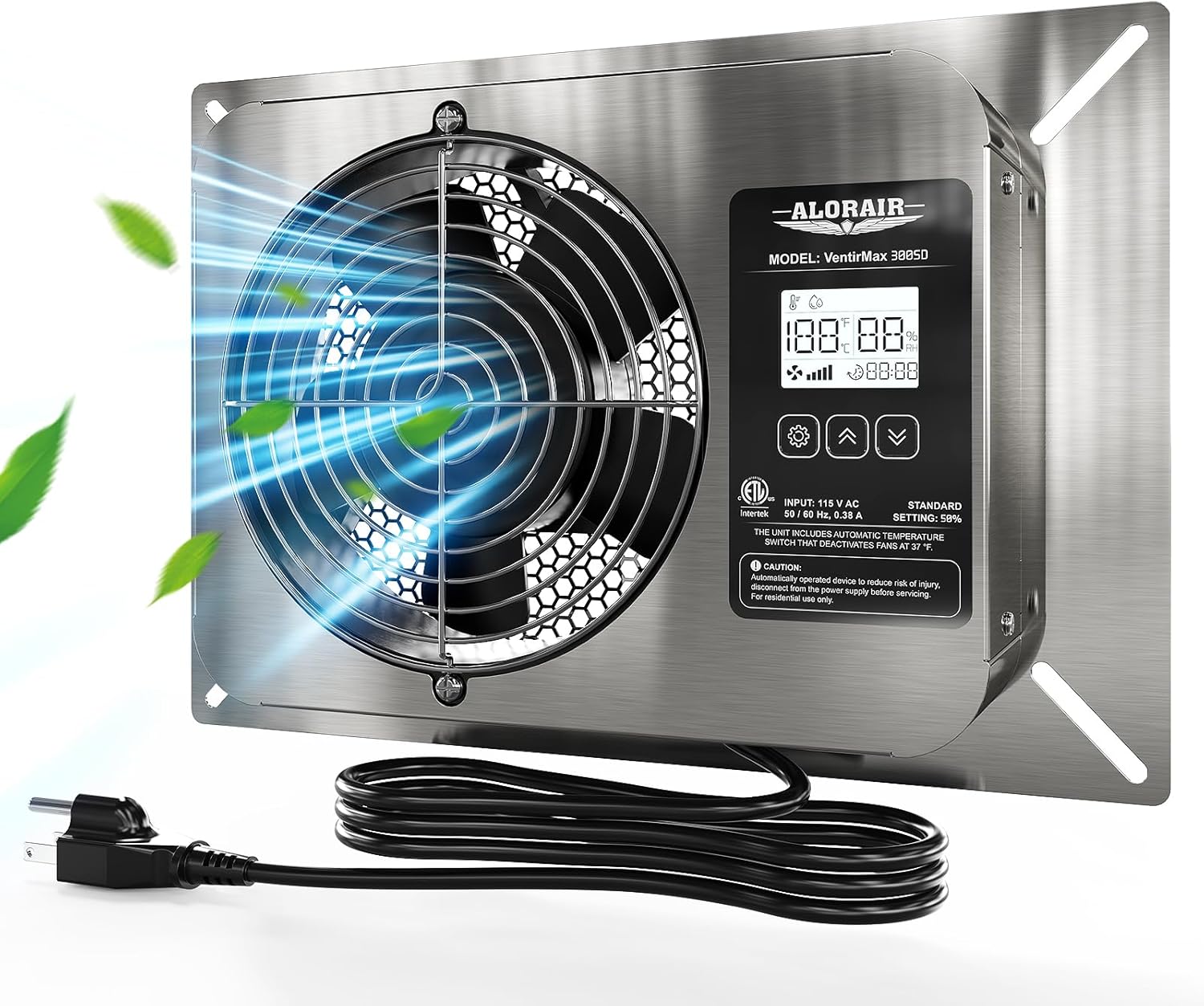
| Air Flow Capacity | 300 cfm |
|---|---|
| Noise Level | 40 db |
| Power Source | AC |
| Motor Type | brushless |
| Control Method | Remote |
The VentirMax 300SD is a compact wall-mounted exhaust fan designed to improve air circulation in crawl spaces, basements, attics, garages and similar confined indoor areas. It delivers 300 CFM through a five-blade assembly driven by a brushless motor, and the stainless-steel housing with IP55-rated blades and isolation mesh resists dust and moisture. The unit includes a digital LCD controller with humidity and temperature sensing, freeze-protection cutoff at 37°F, programmable timing, memory restart after power loss, plus remote control capability for hands-off operation. In practice the fan is useful for lowering humidity and reducing stale air in spaces up to about 550 sq ft while running at a quoted noise level near 40 dB. Expect straightforward wall-mount installation and a durable feel, though the compact footprint means it is best for small to medium areas rather than whole-house ventilation. The unit runs on standard 115V power and uses a NEMA 5-15 connector, so it integrates with typical household circuits.
Best for: Buyers who want a durable, programmable ventilator to control humidity and improve air exchange in crawl spaces, basements, attics or garages and who prioritize automatic sensor control and reliability.
Less Ideal for: Not a good fit for homeowners needing high-volume whole-house ventilation or fans for large open workshops and commercial spaces.
- 300 CFM airflow suitable for improving circulation in small to medium confined spaces
- Integrated humidistat and digital controller allow automatic humidity- or temperature-triggered operation
- Stainless-steel housing with IP55-rated blades and isolation mesh improves durability in dusty or damp environments
- Brushless motor and memory restart provide reliable operation and automatic recovery after power loss
- Quoted noise level around 40 dB may be noticeable in very quiet areas
- Compact size limits effectiveness for large open spaces beyond roughly 550 sq ft
Verdict: A durable, sensor-driven wall ventilator that automatically manages humidity and temperature for small to mid-size confined spaces.
ALORAIR VentirPro 260S

| Air Flow Capacity | 260 cfm |
|---|---|
| Noise Level | 40 db |
| Number of Speeds | 3 |
| Wattage | 30 watts |
| Motor Type | AC |
The VentirPro 260S is a compact wall-mounted exhaust fan designed to improve air circulation and humidity control in crawlspaces, basements, garages, and similar enclosed areas. It delivers up to 260 CFM through a five-blade AC axial motor and offers three speed settings plus a built-in humidistat that lets the fan run automatically when humidity rises. The unit includes a freeze-protection thermostat so it will not operate below roughly 35°F and an isolation mesh to keep particulates out of the crawlspace. Constructed from stainless steel with an IP55 rating, it resists dust and moisture for longer outdoor-adjacent service life. Typical use is simple: install into a foundation or wall vent opening, plug in the grounded cord, set humidity threshold and speed, and let it manage moisture without constant attention. Trade-offs are its modest 260 CFM output, which suits small to medium crawlspaces but is underpowered for large areas, and the fan is basic electrically with no advanced smart controls beyond the humidistat and included remote-style controller.
Best for: Buyers who want an affordable, set-and-forget crawlspace or basement ventilator that actively manages humidity without complex installation or cloud-connected controls.
Less Ideal for: Do not choose this fan if you need high-capacity ventilation for large foundations or want integrated smart-home control and scheduling features.
- Built from stainless steel with IP55 rating for resistance to moisture and dust
- Integrated humidistat automates ventilation when humidity rises
- Freeze-protection thermostat prevents operation at low temperatures
- Three-speed AC motor with 260 CFM suited to small-to-medium crawlspaces
- Includes isolation mesh to reduce particulate entry into the space
- 260 CFM capacity may be insufficient for larger crawlspaces or whole-basement ventilation
- No advanced smart connectivity or app control beyond basic remote/controls
Verdict: A budget-friendly, weather-resistant crawlspace vent fan with a built-in humidistat that automates moisture control for small to medium spaces.
QuietCool AFG SMT PRO-2.0
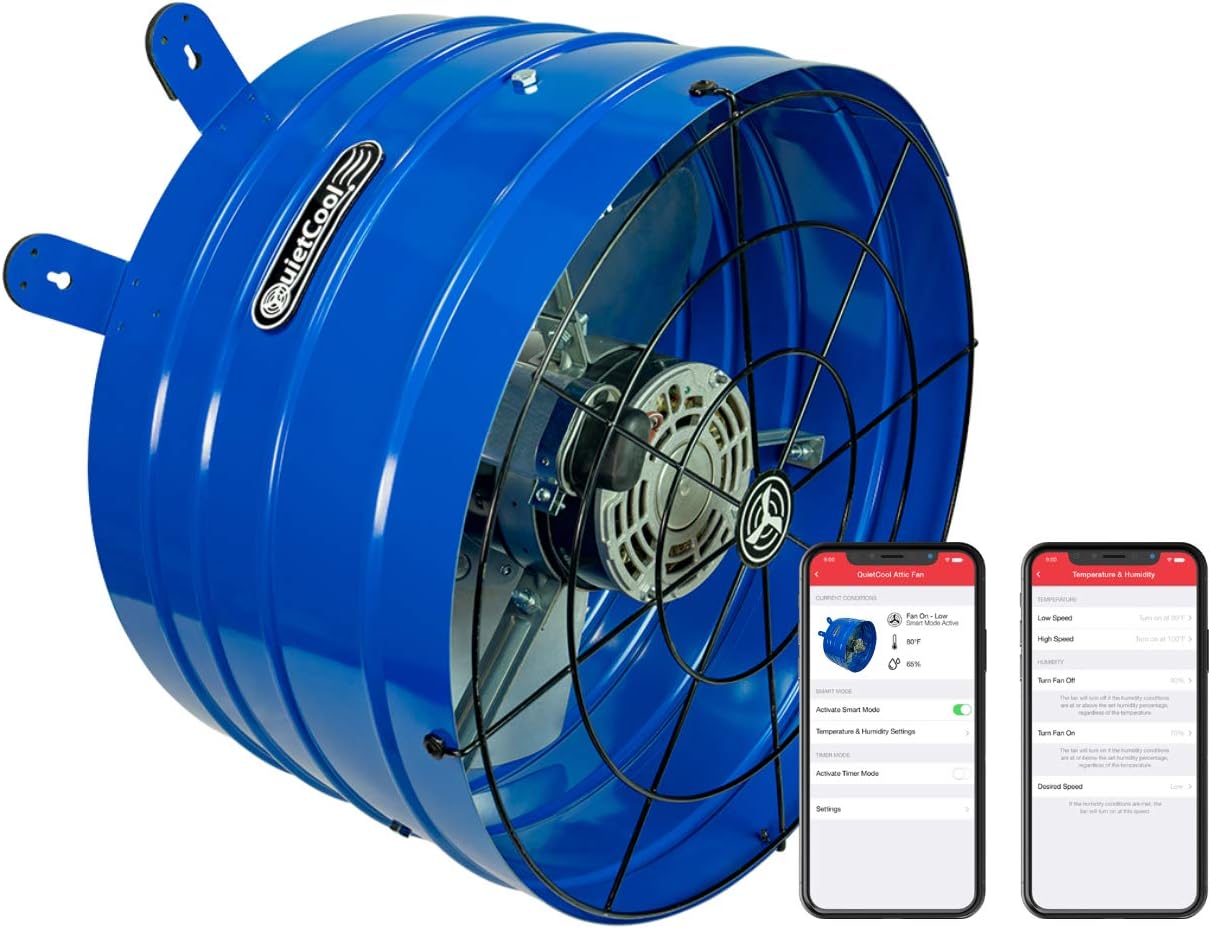
| Air Flow Capacity | 1945 cfm |
|---|---|
| Number of Speeds | 2 |
| Wattage | 120 watts |
| Motor Type | PSC |
| Control Method | App |
The QuietCool AFG SMT PRO-2.0 is a plug-and-play gable attic fan aimed at reducing attic temperature and humidity using a two-speed PSC motor and smart control. It is typically mounted in a gable vent and paired with the included smart hub so you can monitor attic temperature and humidity and set seasonal presets from the app. The fan moves up to 1,945 CFM on high while drawing about 120 watts, and the built-in thermostat and humidistat allow automatic operation to protect against heat buildup and moisture. Practical benefits include lower attic temperatures, reduced roof thermal stress, and remotely adjustable presets for summer and winter, plus a fire safety shutoff. Trade-offs are that it is a two-speed PSC unit rather than a variable-speed ECM or DC motor, and effective performance depends on correct attic sizing and sufficient intake vents, so planning and proper installation matter.
Best for: Buyers who prioritize dependable, automated humidity and temperature control in an attic and want a straightforward smart-enabled solution that runs reliably with minimal user intervention.
Less Ideal for: People seeking fully variable-speed motors or models specifically sized for roof-mount installations should consider other options.
- Smart app control with thermostat and humidistat for automated humidity-based operation
- High airflow up to 1,945 CFM for rapid attic ventilation
- Plug-and-play installation with included smart control hub and vent covers
- Energy-efficient operation relative to airflow, running at about 120 watts on high
- Two-speed PSC motor limits fine-grained speed control compared with variable-speed motors
- Designed for gable mounting only, so roof-mount installs require a different model
Verdict: Choose this smart gable attic fan if you want reliable, humidity-aware attic ventilation that you can monitor and preset from your phone.
AC Infinity AIRTITAN T8

| Air Flow Capacity | 240 cfm |
|---|---|
| Noise Level | 32 db |
| Motor Type | Brushless DC motor |
| Control Method | App |
| Power Source | Corded Electric |
The AC Infinity AIRTITAN T8 is an inline-style exhaust fan system built to move moisture-laden air out of crawlspaces and basements while offering programmable climate control. It is typically mounted permanently and wired to a standard IEC connector, then paired with the WiFi/Bluetooth controller to set humidity, temperature, VPD thresholds, timers, and minimum speeds. The unit uses an efficient brushless DC motor and a 14-blade plastic impeller to deliver up to 240 CFM while running quietly at about 32 dB. IP55-rated construction and a stainless-steel backplate make it suitable for damp environments, and the included remote and app support make scheduling and alerts convenient. Practical limitations include its fixed installation requirement and a 12 V/10 W power profile that means it is meant for ventilation rather than heavy-duty industrial extraction. The controller's automation and multiple speed settings are strong for preventing mold and stale air, but buyers should plan wiring and mounting before purchase since it is not a simple plug-and-play portable fan.
Best for: Buyers who prioritize automated humidity control and want a quiet, durable exhaust solution for crawlspaces or basements backed by real-user feedback and configurable alerts.
Less Ideal for: People needing a portable or temporary ventilation solution or those who require very high extraction power for industrial applications.
- App-compatible temperature and humidity controller for automated climate-based operation
- Brushless DC motor for efficient, low-noise operation
- 240 CFM airflow suitable for moving moist air out of crawlspaces and basements
- IP55-rated and stainless-steel backplate for damp-area durability
- Multiple speeds and timers for tailored ventilation schedules
- Permanent mount installation requires planning and wiring
- Not intended as a high-power industrial extractor due to 10 W motor
Verdict: Choose the AIRTITAN T8 when you want a quiet, app-controlled exhaust fan that actively manages humidity in crawlspaces or basements.
QuietCool AFG SMT ES-3.0 Attic Fan

| Air Flow Capacity | 2801 cfm |
|---|---|
| Number of Speeds | 3 |
| Motor Type | brushless ECM |
| Control Method | App |
| Wattage | 148 watts |
The QuietCool AFG SMT ES-3.0 is a gable-mounted attic exhaust fan designed to reduce attic temperature and humidity using a three-speed brushless ECM motor and smart app control. Installers mount it in a gable vent, plug it into power, then set temperature and humidity presets in the QuietCool app or rely on the built-in thermostat and humidistat to run automatically. It moves up to 2,801 CFM on high while drawing relatively low power thanks to the ECM motor, and the app gives remote status, manual control, and seasonal presets for daytime cooling or winter ice-prevention. Built-in mounting tabs and anti-vibration pads simplify installation and reduce noise transfer. Important limitations are that it requires a compatible gable opening and electrical access for plug-and-play use, and the unit produces noise around the listed 45 dB at typical settings which may be noticeable in nearby living spaces. The fan is best used as part of a whole-attic ventilation strategy to lower attic temps, reduce moisture, and ease HVAC load rather than as a standalone solution for whole-house cooling.
Best for: Buyers who prioritize reliable, automated attic climate control and want a low-maintenance, app-enabled fan to reduce attic heat and moisture without complex wiring.
Less Ideal for: Homes without a gable vent or without easy access to a nearby outlet should consider other mounting or wired solutions, and those seeking near-silent operation for directly adjacent living spaces may want quieter alternatives.
- Smart app control with thermostat and humidistat for automated and remote operation
- High airflow up to 2,801 CFM for substantial attic ventilation
- Brushless ECM motor for efficient power use across three speeds
- Plug-and-play installation with mounting tabs and anti-vibration pads
- Requires an appropriate gable vent opening and nearby electrical outlet for plug-in operation
- Noise level around 45 dB may be noticeable in adjacent living areas
Verdict: Choose this fan when you want a high‑flow, app‑controlled attic fan with built‑in humidistat and thermostat for dependable automatic humidity and temperature management.
Choosing the Right Fan with Humidistat: Key Factors to Consider
Humidity Sensing Accuracy
A fan with a humidistat only helps if the sensor reads reliably. Look for units that specify sensor accuracy or describe how the humidistat responds to changes. Better sensors reduce cycling and avoid oscillation between on and off states, which improves comfort and energy use.
Sensor placement relative to moisture sources matters. If the sensor is housed in the fan body, ensure the unit will be installed where it sees representative room air rather than directly above a shower or open window. Some humidistats offer adjustable setpoints and hysteresis settings to tune responsiveness; these features help match control behavior to the room.
Airflow and Room Coverage
Airflow determines whether the fan can effectively mix air and lower localized humidity. Check rated airflow for a unit and compare it to the room size you intend to serve. Undersized fans may leave damp corners and leave surfaces susceptible to condensation and mold growth.
Consider the fan's mounting and orientation. Ceiling-mounted fans typically provide more even distribution, while wall or inline units may require higher flow ratings to achieve the same effect. Purpose-built residential fans balance cubic feet per minute with acceptable noise levels.
Noise and Continuous Operation
Humidistat-controlled fans often run automatically and may operate for extended periods, so noise characteristics are important. Look for decibel ratings at typical speeds, and seek designs that minimize vibration and motor whine. Fans with variable speed controls can reduce noise by running at lower RPM when only modest dehumidification is needed.
Also consider operational behavior during cycles. Units with rapid on/off cycling are louder in aggregate than those that run steadily at a low speed. Sound damping features and quality bearings also extend the quiet operating life of a fan.
Energy Consumption and Control Options
Because humidistat fans may run frequently, motor efficiency and control strategy affect long-term energy use. Brushless motors or electronically commutated motors typically draw less power for the same airflow compared with older shaded-pole designs. Variable speed capability or multi-speed settings help match output to need and reduce wasted energy.
Integration with timers, switches, or home controllers can also save energy by restricting operation to the necessary periods. Evaluate whether the fan allows direct setpoint adjustment or remote control to avoid unnecessary runtime.
Installation and Fit
Installation ease and physical fit influence the cost and feasibility of adding a fan with humidistat. Check clearance requirements, whether the unit fits common ceiling or wall openings, and whether it can be mounted in tight joist spaces. Some fans require additional housing, ducting, or joist brackets.
Also consider electrical wiring needs. Units with built-in humidistats may require line-voltage wiring and a dedicated circuit in some installations. Verify whether retrofit wiring will be simple or if professional installation is likely required for safe, code-compliant setup.
Durability and Maintenance
Fans exposed to moist air need corrosion-resistant components and accessible filters or grilles for routine cleaning. Look for housings and fasteners rated for damp locations as well as motors with sealed bearings or washable grills.
Regular cleaning of the intake and sensor area preserves humidistat accuracy over time. Units designed for easy disassembly reduce the risk of neglect and maintain consistent performance across seasons.
Choosing the Right Setpoint and Hysteresis
Selecting an appropriate humidity setpoint determines how aggressively the fan will run. Typical comfortable indoor ranges fall between 40 and 60 percent relative humidity. For rooms prone to condensation, setpoints in the lower part of that range help prevent surface moisture without over-drying the air.
Hysteresis is the difference between the turn-on and turn-off thresholds. A small hysteresis leads to frequent cycling, while a larger hysteresis lets the fan run longer but less often. Match hysteresis to the room dynamics: small bathrooms with sudden moisture spikes may need tighter control, while living rooms benefit from wider hysteresis.
- Use 45% RH as a common starting setpoint for moisture-prone rooms.
- Increase hysteresis if you notice rapid cycling or noise complaints.
- Lower the setpoint briefly after showers or cooking to speed drying.
Placement and Sensor Location Best Practices
Where you mount the fan affects both sensing and effectiveness. A sensor placed directly in a steam plume will trigger excessive runtime, while a sensor tucked away in a stagnant corner may never see elevated moisture. Aim to place the sensor where it samples typical room air movement, not directly next to a source.
For ceiling fans, center placement provides even circulation. For wall-mounted units, position the sensor away from external doors and vents that could give false readings.
- Avoid mounting the sensor directly over showers or cooktops.
- Place wall units 6 to 8 feet above floor level where possible for representative readings.
- Ensure ducted installations draw representative air through the sensor housing.
Maintaining Sensor Accuracy Over Time
Humidity sensors can drift or become coated with dust and grime, degrading accuracy. Establish a simple maintenance schedule: inspect and gently clean the sensor area and grill every few months, and check for obvious corrosion or moisture intrusion in the housing.
If a unit offers recalibration or an accessible sensor, use those features to restore reading accuracy rather than adjusting setpoints to compensate for a faulty sensor.
- Clean accessible grills and sensor ports with a soft brush or cloth.
- Replace or service units showing persistent offset from a trusted hygrometer.
- Document any long-term changes in operation to detect sensor drift early.
Using Fans with Humidistat in Different Rooms
Different room types impose different demands. Bathrooms and laundry rooms benefit from responsive sensing and moderate airflow to clear moisture quickly after use. Basements and utility rooms may require higher continuous airflow to combat persistent dampness. Living areas and bedrooms prioritize low noise and inconspicuous operation.
Match the fan's airflow and noise profile to the room function: choose higher CFM for basements, and prioritize quiet, low-RPM operation for bedrooms.
- Bathrooms: prioritize quick response and moderate CFM.
- Basements: choose higher CFM and durable, damp-rated construction.
- Bedrooms and living rooms: prefer low noise and subtle operation.
Integration with Home Controls and Timers
Many fans with humidistats include basic timers or remote control options. These features let you limit total runtime or combine humidity control with manual overrides. If you plan to centralize control, select units that support external switching or compatibility with common home automation inputs.
When integrating with a timer or central controller, set the humidistat as the primary control and use the external control to limit runtime windows or enable manual boost modes only when needed.
- Use timers to restrict overnight operation in low-risk periods.
- Prefer units with manual override for intermittent high-moisture events.
- Verify compatibility before trying to tie into existing home automation.
How We Chose the Best Fan with Humidistat
We focused on features that matter for selecting a fan with humidistat rather than brand recognition. Core evaluation criteria included humidity sensing accuracy and control logic, because reliable setpoints and minimal hysteresis determine whether a fan actually stabilizes indoor moisture. Airflow performance and distribution were assessed to ensure the fan can move enough air for the intended room size and mounting position. Noise output across typical operating speeds was considered so that continuous or automatic duty does not become intrusive. Energy efficiency and control options were weighed to estimate running cost and integration with home controls. Build quality and installation flexibility were included to judge long-term durability and fitment in different ceiling or wall configurations. We excluded units without an integrated humidity sensor or with only basic on/off timers, since they do not deliver true humidistat control. We also filtered out specialty industrial blowers that exceed normal residential airflow ranges. The final shortlist favors products that balance accurate humidity regulation, appropriate airflow for common rooms, quiet operation, and reasonable installation options.
Our full evaluation process is outlined in our review methodology.
FAQ
How does a humidistat differ from a simple timer fan?
A humidistat measures relative humidity and turns the fan on or off based on set thresholds, while a timer only runs the fan for a preset period regardless of moisture levels. Humidistats respond to actual humidity changes, reducing unnecessary runtime and better preventing condensation.
Can I install a humidistat fan myself?
Many residential units are designed for DIY installation, but requirements vary. Simple replacements that use existing wiring are often manageable for competent homeowners. Complex installations that require new wiring, ducting, or code compliance should be handled by a qualified electrician or installer.
Will a fan with humidistat prevent mold entirely?
A humidistat fan helps reduce conditions that support mold by controlling moisture, but it is not a cure-all. Proper ventilation, addressing leaks, and managing sources of moisture are also necessary. For persistent mold issues, broader remediation steps are usually required.
What humidity level should I set the humidistat to?
Comfort and mold prevention typically occur between 40 and 60 percent relative humidity. Setting the humidistat near 45% is a common compromise for moisture-prone rooms, but you can adjust based on occupant comfort and seasonal differences.
Do humidistat fans use a lot of electricity?
Energy use depends on motor type and how often the fan runs. Fans with efficient motors and variable speeds use less power than older designs. Because humidistats target runtime to actual humidity events, they can be more energy-efficient than fans that run continuously.
Final Verdict
When choosing a fan with humidistat, prioritize accurate sensing, appropriate airflow for the room, and quiet operation for spaces where the unit may run frequently. Balance setpoint and hysteresis to avoid rapid cycling, and check that installation and wiring needs match your situation. Durable, damp-rated construction and easy access for cleaning will preserve performance over time. Decide which tradeoffs matter most—maximum airflow versus low noise, or tight humidity control versus simpler installation—and pick the option that aligns with your room size and use patterns. With the right priorities, a humidistat-equipped fan can provide reliable moisture control and more consistent indoor comfort.