
Note: This article contains affiliate links. If you click on these links and make a purchase, we may earn a small commission at no extra cost to you. This helps support our research and content. Read our full affiliate disclosure here.
Picking the right faucet water filter for home use makes a real difference in daily drinking, cooking, and general household tasks. The right filter reduces common contaminants, improves taste and odor, and fits your faucet and routine without constant fuss. This guide covers our five top shortlisted options for home tap filtration. We evaluate effectiveness at removing common contaminants, installation and compatibility, ongoing cartridge costs, and user convenience so you can pick a solution that suits your water concerns and lifestyle.
Top Picks at a Glance
| Best Quality Built to a higher standard if you want something more solid | Kraus Purita FF-100SFS Faucet |  |
| Best Value The sweet spot between price and what you get | Waterdrop FC-06 Faucet Water Filter |  |
| Best Budget The cheapest option that still gets the job done reliably | Vortopt T1 Faucet Filter |  |
| Most Popular A crowd favorite that many people choose with confidence | Brita On Tap Faucet Filter |  |
| Best Seller A high-volume bestseller chosen again and again | PUR Plus Faucet Replacement Filter |  |
Kraus Purita FF-100SFS Faucet

| Other Special Features of the Product | Lead Free |
|---|---|
| Installation Type | Single Hole |
| Maximum Flow Rate | 1 gpm |
| Material Type | Brass |
The Kraus Purita FF-100SFS is a dedicated filtered water tap that delivers cold drinking water from an under‑sink filter without the bulk of an external dispenser. It installs as a single‑hole beverage faucet and is used alongside a range of concealed filtration systems including reverse osmosis and carbon block filters. The high-arc gooseneck rotates 360 degrees for easy filling of glasses, bottles, and pots, and the single-handle control plus premium ceramic cartridge are meant to keep flow smooth and drip-free. Solid lead-free brass construction and a spot-free stainless finish improve corrosion resistance and help avoid water spots or fingerprints. Flow is limited to 1.0 gpm, so it favors filtration efficiency and steady dispensing over fast fill rates, and it only provides cold water which is appropriate for drinking but not for general kitchen tasks. If you want a compact, factory-quality filtered water point that pairs cleanly with under‑sink systems, this faucet is a sensible, durable choice.
Best for: Buyers who prioritize clean, contaminant-free drinking water delivered from a compact, dedicated faucet and want a durable, factory-quality finish that pairs with an under-sink filter.
Less Ideal for: Anyone needing a high-flow or hot-and-cold kitchen faucet for general sink tasks should choose a standard kitchen faucet instead.
- 100% lead-free brass waterways and body for durable, corrosion-resistant construction
- Designed for direct connection to under-sink filtration systems including RO and carbon block units
- 360-degree swivel high-arc spout for easy filling of bottles and pots
- Premium ceramic cartridge and single-handle control for smooth, drip-free operation
- Maximum flow rate is 1.0 gpm which fills slowly compared with standard kitchen faucets
- Provides cold filtered water only, not suitable as a main hot/cold kitchen faucet
Verdict: A durable, lead-free stand-alone filtered faucet that gives reliable, on-demand cold drinking water when paired with an under-sink filtration system.
Waterdrop FC-06 Faucet Water Filter
| Model Number | WD-FC-06 |
|---|---|
| Unit Count | 4 Count |
| Filtration Lifespan | ≈320 gallons / 3 months per filter |
| Flow Rate | 0.5 GPM |
| Certifications | NSF/ANSI 42 & 372 |
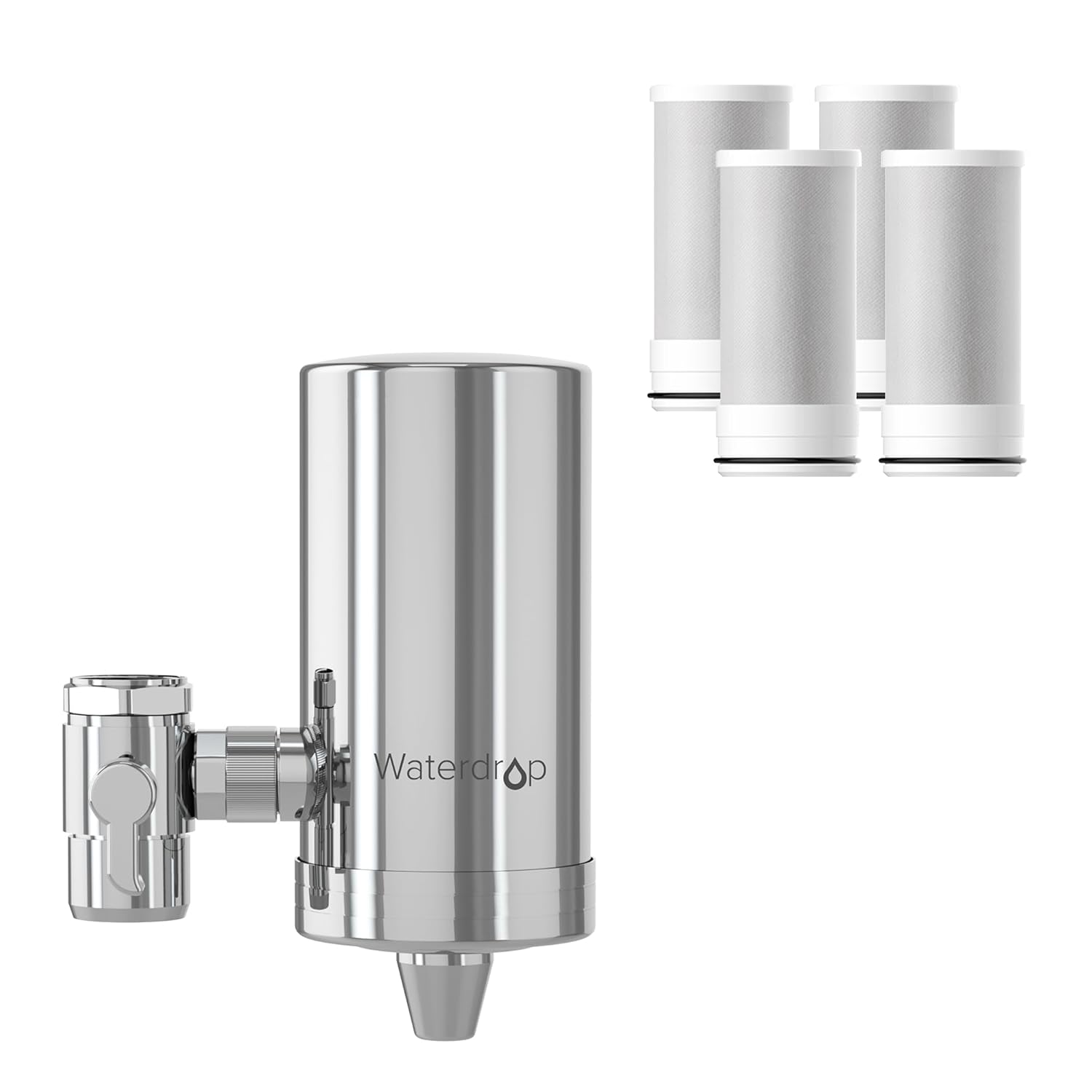
The Waterdrop FC-06 is a faucet-mounted filtration kit that attaches to standard kitchen faucets to deliver filtered tap water without under-sink plumbing. It uses replaceable carbon-block style filters (each rated for roughly 320 gallons or about three months) and is NSF/ANSI 42 and 372 tested for chlorine, taste and odor reduction and lead-free materials. The unit's food-grade 304 stainless-steel housing rotates 360 degrees for flexible use and is designed for tool-free, plug-in installation on compatible faucets. In practical use it produces noticeably better tasting water at a reported 0.5 GPM flow so you can fill a cup quickly, and replacement filters are sold separately for ongoing maintenance. Limitations include compatibility only with standard fixed faucets (it will not fit pull-out, spray-style, or sensor faucets) and the relatively short life per filter compared with larger under-sink systems, so frequent cartridge changes are required for continuous use.
Best for: Buyers who want an easy, countertop-free way to improve tap taste and reduce chlorine or lead on a standard fixed faucet and who prefer a durable stainless-steel unit they can install without tools.
Less Ideal for: Homes with pull-out, handheld, spray or sensor faucets or users who prefer longer-life under-sink or reverse-osmosis systems for much lower TDS levels.
- NSF/ANSI 42 and 372 tested for chlorine reduction and lead-free materials
- Food-grade 304 stainless-steel, joint-free housing with 360° rotation for durable, flexible use
- Quick flow rate around 0.5 GPM for fast filling
- Includes four replacement filters to cover initial year of typical use (kit contains 4)
- Not compatible with pull-out, spray, or sensor-style faucets
- Each filter has a limited life (about 320 gallons or 3 months) requiring periodic replacement
Verdict: A tool-free, stainless-steel faucet filter kit that reliably improves taste and reduces chlorine and lead on standard fixed faucets for buyers who value easy installation and flexible faucet access.
Vortopt T1 Faucet Filter

| Installation Type | Faucet Mount |
|---|---|
| Purification Method | Activated Carbon |
| Maximum Flow Rate | 1.78 gpm |
| Capacity | 400 gallons |
| Filter Life Cycle | 3 months |
The Vortopt T1 is a budget-friendly faucet mount filter that installs to most standard faucets and switches between filtered and raw water with a button. It filters tap water through a five-stage system led by activated carbon fiber to reduce chlorine, bad tastes and odors while maintaining a fairly high flow rate of up to 1.78 gpm so everyday tasks like filling bottles, rinsing produce and washing dishes remain quick. The unit is lightweight plastic and ships with multiple adapters to fit common faucet threads, and its NSF/ANSI 42 certification confirms basic reduction of chlorine and taste/odor contaminants. Expect the cartridge to last about 400 gallons or roughly 3 to 6 months depending on use, and note it will not lower TDS or remove dissolved minerals since it is not a reverse osmosis system. For the money you get easy installation, good flow, and a certified carbon-based filter, but those wanting deeper contaminant removal will need a different solution.
Best for: Shoppers looking for an inexpensive, easy-to-install faucet filter that improves taste and odor and keeps decent flow for everyday kitchen use.
Less Ideal for: Households that need removal of dissolved minerals, heavy metals, or very low TDS water should choose a reverse osmosis or under-sink system instead.
- NSF/ANSI 42 certified to reduce chlorine, taste and odor
- Relatively high flow rate (up to 1.78 gpm) keeps water delivery fast
- Includes multiple adapters for broad compatibility with standard faucets
- Five-stage filtration with activated carbon fiber improves flavor and clarity
- Plastic body may be less durable than metal-bodied faucet filters
- Does not reduce TDS or remove dissolved ions like an RO system
Verdict: A cost-conscious pick that delivers certified chlorine and taste reduction with strong flow and simple installation for everyday kitchen use.
Brita On Tap Faucet Filter

| Capacity | 100 gallons |
|---|---|
| Filter Life Cycle | 4 months |
| Maximum Flow Rate | 0.5 gpm |
| Purification Method | Sedimentation |
The Brita On Tap Faucet Filter mounts directly to a standard kitchen faucet to deliver filtered water without pitcher refills or bottled water waste. Installation is tool-free using the included adapters and the unit offers three spray settings so you can choose filtered flow or unfiltered for tasks like filling pots. It uses Brita carbon-block filtration to cut chlorine taste and odor, reduce sediment and remove many contaminants including lead, and a built-in indicator helps track the roughly 100-gallon / four-month filter life. Typical use is daily drinking and cooking water with quick switching between filtered and unfiltered water. Practical benefits include compact, space-saving mounting and eliminating frequent pitcher maintenance, while limitations are that it does not fit pull-out or spray-style faucets and the flow rate is modest at about 0.5 gpm, which can feel slow for large fills.
Best for: Buyers who want a proven, easy-to-install faucet filtration system that delivers better-tasting, lower-contaminant tap water with visible user feedback and broad real-world use cases.
Less Ideal for: Homes with pull-out or spray-style faucets or users who need high-flow output for frequent large-volume fills should consider other filter formats.
- Tool-free installation with included adapters for most standard faucets
- Reduces chlorine taste and odor and removes a wide range of contaminants including lead
- Compact faucet-mounted design saves counter space and replaces many single-use bottles
- Three spray settings let you choose filtered flow or unfiltered stream for different tasks
- Filter indicator reminds you when the cartridge approaches its 100-gallon life
- Does not fit pull-out or spray-style faucets
- Maximum flow rate of about 0.5 gallons per minute can be slow for filling large containers
Verdict: Choose this Brita faucet filter if you want a compact, easy-to-install system that reliably improves tap water taste and reduces common contaminants.
PUR Plus Faucet Replacement Filter

| Set | 2 Count |
|---|---|
| Certified by | NSF, WQA |
| Rated life | Up to 100 gallons / ~3 months per filter |
| Compatible models | PUR and Beautiful by PUR faucet systems |
These PUR Plus faucet replacement filters are sold as a two-pack of genuine PUR cartridges designed for direct faucet-mount filtration. Each cartridge uses a 14-layer, 3-in-1 filtration system and a mineral core to improve taste while targeting contaminants such as lead, PFAS, VOCs, chlorine, mercury, and microplastics; PUR cites NSF and WQA testing and IAPMO certification for reduction claims. Installation is straightforward with a pull-tab design and they fit a wide list of PUR and Beautiful by PUR faucet systems, making them convenient for routine kitchen use like drinking and cooking water. Expect about 100 gallons or roughly three months of use per filter under typical conditions, after which replacement is recommended. Limitations: they do not filter microbes and off-brand cartridges may not match certified performance, so replacement with genuine PUR is advised for consistent results. For buyers focused on reliable, certified contaminant reduction and simple maintenance, these filters deliver predictable tap-water improvement.
Best for: Home cooks and families who prioritize certified contaminant reduction and predictable, low-effort maintenance for everyday drinking and cooking water.
Less Ideal for: People needing microbiological disinfection or whole-house treatment should choose a different technology or professional system.
- Certified contaminant reduction backed by NSF, WQA, and IAPMO claims
- 14-layer, 3-in-1 filter design for improved taste and broader capture of particulates and chemicals
- Easy pull-tab installation for quick swaps without tools
- Two-pack provides a six-month supply under typical replacement intervals
- Does not remove microbes so not suitable for microbiologically unsafe water
- Performance depends on using genuine PUR cartridges rather than off-brand replacements
Verdict: Choose these genuine PUR Plus faucet filters when you want a simple, certified, and reliable faucet-mounted solution for better-tasting, broadly purified tap water.
Choosing the Right Faucet Water Filter for Home Use: Key Factors to Consider
Filtration Performance and Contaminant Reduction
The primary purpose of a faucet water filter is to reduce specific contaminants in your tap water. Look for filters that target the impurities you care about, such as chlorine, sediment, lead, or volatile organic compounds. Product literature and third-party certifications indicate typical reduction percentages and which substances the media removes.
Higher-rated filtration media often mean better taste and safer water, but more aggressive filtration can also reduce flow. Balance the contaminant reduction you need with the everyday usability you expect at the kitchen sink.
Faucet Compatibility and Installation
Faucet-mounted filters must physically connect to your existing spout. Measure your faucet and check whether the filter includes adapters for common aerator sizes or lever-style faucets. Some units require removing the aerator while others use a diverter valve that attaches over the end of the spout.
Ease of installation matters because many homeowners prefer a no-tools or minimal-tools setup. If you rent or prefer nonpermanent solutions, confirm the product does not require modifications to pipes or permanent fittings.
Flow Rate and Daily Usability
A filter that severely restricts flow will frustrate kitchen tasks. Consider the rated flow rate and whether the unit has a bypass or separate filtered/unfiltered setting for filling pots. Some filters slow flow noticeably when the cartridge is new or near end of life.
Also evaluate how the control interface works. Simple lever switches are easier to use when your hands are full, while more complex knobs can be less convenient during frequent use.
Cartridge Life and Ongoing Costs
Replacement cartridges determine the true cost of ownership. Check the rated capacity in gallons or months, and whether cartridges are easy to replace without tools. Longer-life cartridges cost more up front but lower the long-term expense and maintenance frequency.
Be realistic about your household water use when estimating replacement intervals. Also check whether replacement filters are readily available and whether the manufacturer publishes clear guidance on change intervals based on usage or water quality.
Build Quality and Leak Resistance
A faucet-mounted filter sits under constant mechanical stress from water pressure and handling. Inspect construction materials and connection points for robustness. Units with solid machined fittings or reinforced adapters tend to resist leaks and last longer.
Leak prevention is critical. Look for models with reliable sealing interfaces and clear installation instructions. A slight misalignment can cause drips, so products designed to accommodate minor variations in faucet geometry reduce the risk of leaks.
Taste, Odor, and Maintenance Convenience
Beyond technical contaminant removal, the practical outcome is improved taste and odor. Activated carbon and similar media are effective for chlorine and organic tastes. Consider whether the filter also addresses aesthetic factors like cloudiness or metallic taste.
Maintenance convenience includes how easy it is to replace cartridges, whether the unit requires periodic flushing, and whether there are indicators for end-of-life. Filters that make maintenance obvious or simple help ensure continued performance over time.
Common Faucet Types and Fit Issues
Not all faucet-mounted filters fit every spout style. Standard threaded aerator faucets are the easiest fit, but pull-down, pull-out, and uniquely shaped spouts can present challenges. Before buying, identify your faucet type and check for included adapters.
When compatibility is uncertain, look for filters that provide a broad adapter kit or explicit compatibility lists. If your faucet lacks a standard aerator thread, a short visit to your faucet documentation or a quick measurement can save returns and frustration.
- Threaded aerators: easiest and most common to adapt
- Pull-down sprayers: may require temporary reattachment or different mounting
- High-arc or wide spouts: check clearance for filter housing
How Filter Media Types Affect Results
Filter cartridges combine media like activated carbon, ion exchange resin, and mechanical screens. Activated carbon excels at removing chlorine and improving taste while ion exchange targets certain heavy metals. Mechanical filtration removes sediment and particulates.
Understanding media types helps match a filter to your local water issues. For example, if cloudiness is the main concern, a unit with a fine mechanical screen is valuable. If taste and odor dominate, look for higher carbon content and flow designs that maximize contact time.
- Activated carbon for taste and chlorine reduction
- Ion exchange for specific metal reduction
- Mechanical screens for sediment and particulates
Installation Tips to Avoid Leaks
Clean the faucet aerator threads before fitting an adapter to remove mineral deposits that prevent a tight seal. Use only the included washers and adapters; mixing parts from other kits can cause misalignment.
When connecting the diverter or housing, hand-tighten and then test at low flow to confirm the seal. Check for slow drips over the first 24 hours and re-seat the adapter if necessary. Keep the installation area clear so you can access the connection if a replacement is required.
- Remove mineral deposits from faucet threads
- Use supplied washers and adapters only
- Start with low flow and inspect for drips
When to Choose a Filter for High Frequency Use
If you use filtered water for cooking and daily drinking, choose units with higher flow rates and longer cartridge life. Frequent replacements are inconvenient and increase costs, so prioritize capacity and simple swap procedures for busy households.
Conversely, if you only need filtered water for occasional drinking glasses, a compact unit with shorter cartridge life but lower initial cost may be acceptable. Match throughput and maintenance intervals to your household's routine.
- High-use homes: prioritize flow rate and cartridge capacity
- Low-use settings: compact, lower-capacity units can suffice
Environmental Considerations
Consider the waste generated by replacement cartridges. Some manufacturers offer recycling programs or refillable cartridge options that reduce landfill impact. Longer-lasting cartridges lower the total number of disposables used over time.
Also factor in water wasted during cartridge changes or flushing cycles. Units that require minimal flushing and have clearly documented end-of-life steps are better for households aiming to minimize waste.
- Look for recycle-friendly cartridges
- Factor in water used for flushing during changes
- Longer-life cartridges reduce disposable waste
How We Chose the Best Faucet Water Filter for Home Use
Our selection focused on practical, measurable attributes that matter for in-kitchen faucet filtration. We prioritized proven filtration performance against contaminants commonly found in municipal and well water, including chlorine, particulates, lead, and other typical impurities. Lab-verified reduction rates or third-party certifications were a key filter for inclusion when available. Ease of installation and faucet compatibility were treated as essential criteria because many buyers want a tool-free or low-skill setup. We also assessed cartridge life and replacement cost to reflect real ownership expense, and evaluated flow rate and user experience to avoid solutions that unduly restrict water output. Durability and build quality were considered to limit early failures and leaks. We excluded products that require major plumbing changes or permanent modifications since the list targets straightforward home use. Ultimately, only faucets-attachable filters that balance contaminant reduction, convenient installation, and reasonable operating cost made the final list.
Our full evaluation process is outlined in our review methodology.
FAQ
How often should I replace a faucet filter cartridge?
Replacement intervals vary by rated capacity and household use. Typical recommendations range from two to six months depending on gallons used and water quality. If flow noticeably drops or taste worsens, replace the cartridge sooner.
Will a faucet-mounted filter reduce my water pressure?
Some reduction in flow is normal because the water must pass through filter media. Higher-quality designs minimize this effect, and filters with larger surface area or bypass settings maintain better pressure. Severe drops often indicate a clogged cartridge.
Can I install a faucet filter myself?
Yes. Most faucet-mounted filters are designed for tool-free or minimal-tool installation and include multiple adapters. Confirm your faucet type first and follow the manufacturer instructions to ensure a leak-free seal.
Do faucet filters remove lead and heavy metals?
Certain media, such as specific ion exchange resins and certified carbon blocks, can reduce lead and some metals. Check product specifications and third-party test results to confirm whether a particular filter targets the contaminants you are concerned about.
Are faucet filters safe for well water?
Faucet-mounted filters can address taste, chlorine, and particulates but may not be sufficient for complex well water issues like bacteria or high mineral content. For well water, consider testing first and matching treatment to the test results.
Final Verdict
When choosing a faucet water filter for home use, prioritize the contaminant reductions that match your water test results and daily usage patterns. Balance filtration effectiveness with flow rate, cartridge life, and ease of installation so the unit fits seamlessly into everyday kitchen tasks. Accept tradeoffs between maximum contaminant removal and convenience: more aggressive filtration can mean slower flow and higher replacement frequency. Pick a solution that matches how often you use filtered water and how much maintenance you are willing to do for consistently better-tasting, safer tap water.