
Note: This article contains affiliate links. If you click on these links and make a purchase, we may earn a small commission at no extra cost to you. This helps support our research and content. Read our full affiliate disclosure here.
A Floor Robot Mop can save you time and cut down on routine floor maintenance by handling wet mopping and light pickup without daily effort. Whether you have grout-lined tile, sealed hardwood, or mixed floors, picking the right robot mop affects how clean your floors actually get, how much upkeep the device needs, and how often you have to intervene. This guide presents seven shortlisted options that represent the best balance of cleaning performance, runtime, and ease of use. Read on to see which attributes matter most and which tradeoffs to expect as you compare models.
Top Picks at a Glance
| Best Overall The best all-around choice for most situations | roborock Q10 S5+ |  |
| Best Quality Built to a higher standard if you want something more solid | roborock Saros 20 |  |
| Best Value The sweet spot between price and what you get | iRobot Roomba 105 Combo |  |
| Best Budget The cheapest option that still gets the job done reliably | ILIFE V5s Plus Robot Vacuum |  |
| Top Rated A top-rated pick with lots of positive feedback | TRDIOL RV251 Robot Vacuum & Mop |  |
| Most Popular A crowd favorite that many people choose with confidence | eufy C28 Robot Vacuum |  |
| Best Seller A high-volume bestseller chosen again and again | Shark Matrix Clean AV2511AE |  |
roborock Q10 S5+

| Maximum Suction | 10,000 Pa |
|---|---|
| Capacity | 2.7 liters |
| Battery Life | 150 minutes |
| Filter Type | Washable |
| Noise Level | 65 db |
The roborock Q10 S5+ is a robot vacuum and mop combo built for low-touch, regular maintenance of mixed flooring. It navigates with 360° LiDAR mapping and ReactiveTech obstacle avoidance, so it plans efficient routes and avoids common household objects while supporting multi-level maps and no-go zones via the app. The unit pairs a 10,000 Pa suction system and smart carpet detection to boost suction on rugs and a dual anti-tangle brush setup to reduce hair clogs, which is helpful for pet homes. Its VibraRise 2.0 sonic mopping lifts and scrubs floors and can auto-lift the mop when carpet is detected. The included auto-empty dock holds a 2.7 L dust bag for extended hands-free operation, advertised up to about 70 days between bag changes. Battery runtime and app controls allow scheduled and voice-operated cleaning. Expect roughly moderate noise and a relatively large robot footprint that may limit access under very low furniture, and advanced features depend on using the app and 2.4 GHz Wi-Fi.
Best for: Buyers who prioritize low-maintenance, reliable cleaning backed by broad user adoption and want a robot that cleans floors and mops with strong suction and advanced navigation.
Less Ideal for: If you need an ultra-compact robot for very low-clearance furniture or want a model that runs without any networked app features, this is not the best fit.
- Strong 10,000 Pa suction for deep pickup on carpets and floors
- LiDAR mapping with multi-level maps and no-go zones for predictable navigation
- VibraRise sonic mopping that auto-lifts on carpet to protect rugs
- Large 2.7 L auto-empty dock reduces how often you need to empty the bin
- Dual anti-tangle brush design reduces hair snags and maintenance
- Relies on 2.4 GHz Wi‑Fi and the app for full feature set
- Noise level is moderate and may be noticeable during runs
Verdict: Choose the Q10 S5+ when you want a mostly hands-free robot that combines strong suction, LiDAR mapping, and auto-emptying for dependable weekly cleaning under $1,000.
roborock Saros 20

| Suction | 36,000 Pa |
|---|---|
| Battery Life | 180 minutes |
| Filter Type | Washable Filter |
| Noise Level | 55 db |
| Power Source | Battery Powered |
The roborock Saros 20 is built for heavy cleaning jobs: a 36,000 Pa digital motor, dual anti‑tangle system, and adaptive lift chassis let it pull deep debris from rugs and cross thresholds without getting stuck. It combines precise StarSight 3D navigation and an RGB camera to map rooms, avoid more than 300 obstacles, and plan efficient routes that reduce missed spots. The slim profile reaches under low furniture while FlexiArm extends brushes and the mop to cover edges and corners. The RockDock adds hands‑free maintenance with hot‑water mop washing, hot‑air drying, and long auto dust‑emptying intervals for less upkeep. For dark hardwood specifically, its mapping and edge cleaning help avoid repeated passes that can highlight streaks, though aggressive suction and mop use mean you should choose gentle water settings and test on finish‑sensitive areas first. Expect solid pet hair pickup and long runtimes, but factor in the dock footprint and occasional app setup tuning to get optimal schedules and mop pressure for delicate floors.
Best for: Buyers prioritizing raw cleaning performance and minimal intervention who want a robot that handles pet hair, deep dirt, and complex floor plans with powerful suction and advanced navigation.
Less Ideal for: Those who need an ultra-compact or budget robot, or users who prefer a barebones device without a large automated dock system taking permanent floor space.
- Very high suction (36,000 Pa) for deep dirt and pet hair removal
- Advanced 3D navigation and RGB camera reduce collisions and missed areas
- AdaptiLift chassis crosses high thresholds and cleans under low furniture
- RockDock offers hot‑water wash, hot‑air dry, and extended auto emptying for hands‑free maintenance
- FlexiArm side brush and mop reach edges and behind curtains for edge‑to‑edge cleaning
- Powerful suction and automated mopping may require conservative settings on finished hardwood to avoid excess moisture or visible streaking
- Large multifunction dock requires dedicated floor space for the full hands‑free benefits
Verdict: If top-tier suction, obstacle-aware navigation, and a hands‑free self‑cleaning dock are your priority for deep clean performance on hardwood, the Saros 20 delivers.
iRobot Roomba 105 Combo
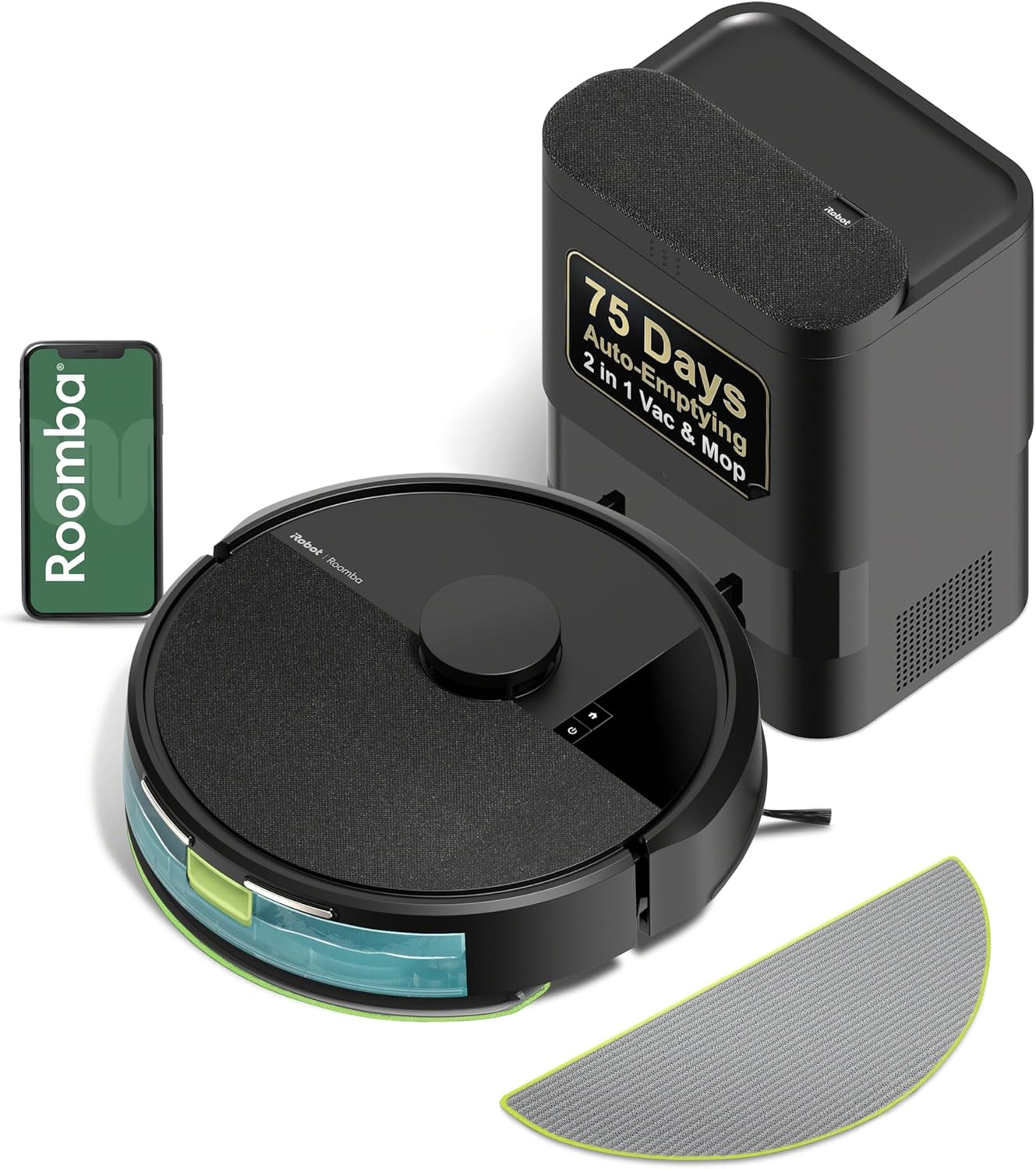
| Surface Recommendation | Carpet & Hard Floor |
|---|---|
| Battery Life | 100 minutes |
| Controller Type | App Control, Button Control, Voice Control |
| Filter Type | Cartridge |
The Roomba 105 Combo is a vacuum-and-mop robot built for regular home cleaning on carpets and hard floors, with ClearView LiDAR mapping, 3 cleaning modes, and a self-emptying AutoEmpty dock. In typical use you pick mop only, vacuum only, or vacuum-and-mop, schedule runs in the iRobot Home app or start with voice commands, and the robot maps rooms to avoid obstacles and stairs. Notable features include a 4-stage cleaning system with power-lifting suction and an edge-sweeping brush for better corner cleaning, a washable microfiber mop pad and a micro-pump that meters cleaning solution for controlled mopping, plus a dock that holds up to 75 days of debris in a disposable bag. Practical benefits for LVP floors are targeted wet cleaning with carpet detection so rugs stay dry, and LiDAR navigation for consistent coverage. Limitations to expect are routine maintenance like filter and brush cleaning, a 100-minute battery life that may need recharges for larger homes, and dependency on the companion app for advanced settings and map customization.
Best for: Buyers who want a mostly hands-off vacuum-and-mop robot that reliably cleans LVP and other hard floors and values documented performance and peer reviews when choosing a dependable, low-maintenance option.
Less Ideal for: People who need the longest possible run time for very large homes, want a mop dock that washes and dries pads, or who prefer fully bagless base stations.
- Self-emptying AutoEmpty dock holds up to 75 days of debris for low-touch maintenance.
- ClearView LiDAR mapping gives reliable room coverage and obstacle avoidance.
- Combined vacuum-and-mop modes with a micro-pump and washable microfiber pad let you control how much liquid is applied to hard floors.
- 70x power-lifting suction and an edge-sweeping brush improve pickup, including pet hair and edge debris.
- App and voice control with scheduling and keep-out zones simplify routine cleaning.
- Battery runtime is 100 minutes which may require mid-run recharges in larger homes.
- AutoEmpty uses disposable bags, adding ongoing consumable cost.
- Does not include heated pad washing or advanced self-washing dock features found on higher-end models.
Verdict: Choose the Roomba 105 Combo if you want a trustworthy LiDAR-mapped vacuum-and-mop with a hands-free AutoEmpty dock that keeps LVP clean with minimal daily effort.
ILIFE V5s Plus Robot Vacuum

| Battery Life | 110 minutes |
|---|---|
| Capacity | 300 ml |
| Controller Type | App Control, Voice Control, Remote Control |
| Compatible Devices | Amazon Echo, Google Home |
The ILIFE V5s Plus is a slim 2-in-1 robot that vacuums and mops while offering app, remote and voice control for scheduled cleaning. It runs up to 110 minutes per charge and automatically returns to its charging dock when the battery is low, making it suitable for daily maintenance across small to medium rooms. The unit provides five cleaning modes including auto, spot, edge and max for adjustable suction and targeted passes, and its 300 ml tanks handle both dust and water for light mopping tasks. Practical benefits include a low profile that reaches under furniture, compatibility with Alexa and Google Assistant, and sensor suites that reduce falls and collisions. Limitations are a modest suction level compared with higher-end models, a relatively small water/dust capacity that requires frequent emptying for larger homes, and simpler navigation that may miss complex path optimization on cluttered carpets. For its price point the V5s Plus delivers consistent, hands-off upkeep rather than deep clean performance on thick carpeted surfaces.
Best for: Buyers looking for an affordable, no-frills robot that keeps hard floors and low-pile carpet tidy with minimal setup and smart-home control.
Less Ideal for: Homes that need powerful deep-cleaning on thick or high-pile carpets or large houses where longer runtimes and larger dust/water capacity are required.
- 2-in-1 vacuum and mop combination for quick maintenance of floors and light spills
- 110-minute runtime with automatic self-charging for largely unsupervised cleaning cycles
- Multiple cleaning modes and scheduling via app, remote or voice for flexible operation
- Slim profile and sensors help the robot reach under furniture and avoid drops or collisions
- Smaller 300 ml tanks and dustbin need more frequent emptying during larger jobs
- Navigation is basic compared with lidar or advanced mapping systems, so pathing can be inefficient on cluttered layouts
Verdict: A budget-friendly robot that combines vacuuming and light mopping with smart controls to keep small-to-medium homes tidy without breaking the bank.
TRDIOL RV251 Robot Vacuum & Mop

| Suction | 6000Pa |
|---|---|
| Battery Life | 180 minutes |
| Dust Bag Capacity | 4L |
| Navigation | LiDAR, multi-floor mapping |
The TRDIOL RV251 is a robot vacuum and mop combo built for hands‑off floor care. It uses 360° LiDAR to map up to four floors and supports no‑go zones and virtual walls, so you can schedule room‑by‑room cleaning and protect pet areas. The docked self‑emptying station holds a 4L dust bag that the brand says can last up to 120 days, which cuts down on bin maintenance. Suction goes up to 6000Pa with automatic carpet boost and a tangle‑resistant roller plus side brush for edge and corner pickup. The electrically controlled water tank offers three mop flow levels and the app, voice, or remote control lets you set schedules and recall saved maps. Battery runtime is listed at 180 minutes, which should cover most single‑level cleaning sessions. Expect solid performance on hard floors and routine carpet maintenance, but like many combos it will not replace deep carpet cleaning and wet mopping of heavy stains. The RV251 focuses on reliable navigation and low‑maintenance operation for everyday floor upkeep.
Best for: Buyers who want a low‑maintenance, reliable robot that handles everyday vacuuming and light mopping across multiple floors with strong navigation and long interval dust disposal.
Less Ideal for: Homes that need professional‑level deep carpet cleaning or heavy-duty wet mopping should look at dedicated carpet cleaners or standalone mops instead.
- LiDAR-based mapping with multi-floor map saving and no-go zones for precise room management
- Self-emptying dock with 4L dust bag rated up to 120 days reduces frequent manual emptying
- Powerful 6000Pa suction with automatic carpet boost for better pickup on rugs and high-traffic areas
- Vacuum and mop combo with adjustable water flow and three suction levels controlled via app or voice
- Tangle-resistant roller and edge brush design aimed at pet hair and corner cleaning
- Mopping function is designed for light stains and maintenance rather than deep wet cleaning
- Not intended to fully replace manual deep-cleaning on heavily soiled carpets
Verdict: If you want a dependable, low‑touch floor robot that pairs LiDAR precision with a long‑interval self‑emptying system, the RV251 is a strong choice.
eufy C28 Robot Vacuum

| Suction | 15,000 Pa |
|---|---|
| Battery Life | 140 minutes |
| Capacity | 3 liters |
| Filter Type | Washable |
The eufy C28 is a full-featured robot vacuum and mop designed to reduce hands-on maintenance. It uses LiDAR navigation to map rooms and avoid obstacles without cameras while its HydroJet roller mop spins and self-cleans into a separate dirty-water tank, and the included Omni station automatically empties dust into a 3 L container, refills and washes the mop, and dries it with hot air. In daily use it handles hard floors and short-pile carpet, boosts suction on carpets, and its zero-tangle DuoSpiral brush is built to manage pet hair without frequent brush cleaning. The unit reports long runtimes for multi-room jobs and can lift the mop on rugs to protect carpets. Practical limitations include the robot's overall size and weight for homes with very low clearances and the dependence on the docking station for the hands-free features to work as advertised. For buyers who prioritize low-maintenance cleaning and reliable navigation, the C28 delivers measurable time savings but it is best suited to households that can accommodate the Omni station footprint.
Best for: A cautious buyer who wants dependable mapping, strong suction, and near hands-off vacuuming and mopping with minimal daily maintenance.
Less Ideal for: Homes with very limited floor space for the docking station or users who need a compact robot that performs primarily without a large base station.
- 15,000 Pa suction with automatic carpet boost for stronger pickup on rugs
- All-in-one Omni station auto-empties dust, washes and hot-dries the mop, and collects wastewater for up to 75 days
- LiDAR navigation avoids obstacles using laser mapping without cameras to protect privacy
- Zero-tangle DuoSpiral roller reduces hair wrap and simplifies pet-hair maintenance
- Large station and robot size may be difficult to place in tight or low-clearance homes
- Hands-free features require the Omni station, so benefits are reduced if you only use the robot standalone
Verdict: Buy this if you want a privacy-safe LiDAR robot that combines strong suction with a station that largely automates emptying, mop washing, and drying for low-maintenance floor care.
Shark Matrix Clean AV2511AE

| Battery Life | 120 minutes |
|---|---|
| Capacity | 0.27 gallons |
| Control Method | Voice |
| Compatible Devices | Amazon Alexa, Google Assistant |
The Shark Matrix Clean AV2511AE is a robot vacuum and mop built to handle pet hair and everyday debris with minimal intervention. It uses 360° LiDAR mapping and a Matrix Clean grid pattern to methodically cover rooms, while a self-cleaning brushroll helps prevent hair wrap. The XL bagless base captures up to 60 days of dirt so you do not need to empty it often, and app and voice control let you schedule targeted cleanings or select modes for carpets and hard floors. Battery life supports long runs and the unit can return to recharge and resume where it left off. Practical benefits include strong suction across surfaces, corner-focused airflow for edge pickup, and smart mapping for room-specific tasks. Important limitations are that the base is bagless rather than using disposable bags, which means occasional dust-bin maintenance for the base filter, and the robot's effectiveness can vary on very high-pile rugs or extremely tangled hair. The unit is a solid, hands-off option for homes that need frequent hair and debris cleanup but expect to perform periodic base and filter care.
Best for: Buyers who want a largely hands-off robot that reliably removes pet hair and everyday dirt and who value systematic mapping and long intervals between emptying.
Less Ideal for: People who need peak performance on very high-pile rugs, or those who prefer base units that use disposable bags for cleaner, lower-dust service.
- Self-emptying bagless base holds up to 60 days of debris for reduced hands-on maintenance
- Matrix Clean grid pattern plus LiDAR mapping provides systematic whole-room coverage
- Self-cleaning brushroll and strong suction designed to clear pet hair from carpets and hard floors
- App and voice control with scheduling and room targeting for convenient automated cleaning
- Bagless base still requires periodic filter and dust compartment cleaning
- Performance can be limited on very high-pile carpets or with heavily matted hair
Verdict: Choose this Shark if you want a pet-hair-focused robot with systematic LiDAR mapping and a 60-day self-emptying base to minimize daily upkeep.
Choosing the Right Floor Robot Mop: Key Factors to Consider
Mopping System Design
How the robot applies moisture and scrubs the floor determines cleaning results. Robots with oscillating or rotating pads will typically remove stuck-on residues better than simple damp cloth systems. The pad material and whether the device uses replaceable or reusable pads also matters for long-term cost and hygiene.
Also consider whether the robot offers selectable cleaning modes so you can choose a gentler damp wipe for delicate flooring or a heavier scrubbing mode for high-traffic areas. The presence of separate vacuuming and mopping actions can be beneficial if you want to avoid spreading loose debris with wet pads.
Water Tank and Flow Control
Tank capacity and the ability to adjust water flow both influence how long the robot can mop and how wet your floors will be. Larger tanks reduce the need for mid-job refills but increase weight, which can affect agility. Adjustable flow settings let you match dampness to floor type so sealed wood is not over-wetted while tile receives enough moisture for effective cleaning.
Also evaluate how the robot isolates the water system to prevent leaks, how easy the tank is to remove and clean, and whether the design minimizes mineral buildup when you use hard water. Simple but robust valves and filters help reduce maintenance headaches.
Navigation, Mapping, and Obstacle Avoidance
Accurate mapping and confident obstacle avoidance reduce missed spots and minimize collisions with furniture. Robots with structured mapping let you create no-go zones or schedule room-specific cleaning, which is especially useful in homes with mixed floor surfaces or areas you do not want mopped.
Consider how the robot handles thresholds and rugs. If your layout includes many transitions, look for a unit that reliably detects and avoids carpets while following a systematic cleaning path to improve efficiency and coverage.
Battery Life and Run Strategy
Battery capacity determines whether a single charge will cover your floor plan. Robots with longer runtimes or automatic recharge-and-resume behavior can finish larger homes without user intervention. Keep in mind that heavy mopping modes drain battery faster than gentle wiping, so runtime figures reported for vacuum-only runs are not fully indicative of mop performance.
Also consider charging time and whether the robot is energy-efficient when idle. A machine that frequently aborts mid-cycle for recharge can leave streaks and incomplete coverage.
Maintenance and Consumables
Owning a robot mop involves recurring upkeep such as washing or replacing pads, cleaning the water tank, and occasional brush or sensor maintenance. Easy access to removable components reduces the time you spend on upkeep. Machines that use widely available, reusable pads can lower recurring costs.
Check how the design minimizes trapped debris in crevices and whether consumables are simple to swap. Clear maintenance workflows reduce downtime and help the device retain consistent cleaning performance over time.
Matching a Robot Mop to Your Flooring
Different floor materials respond to different mopping approaches. Sealed hardwood and laminate do best with a lightly damp pad and low water flow, while glazed tile and vinyl can tolerate heavier moisture and benefit from more aggressive scrubbing. Before choosing, inventory your main floor types and note how much dried soil each area typically accumulates.
If your home has area rugs or thick thresholds, prioritize models with reliable rug detection and the option to exclude carpeted zones from mopping sessions. For multi-surface homes, look for machines that remember room boundaries so they use customized cleaning modes per area.
- Hardwood and laminate: low flow, soft pads
- Tile and vinyl: higher flow, scrubbing pads
- Mixed floors: mapping and room-based modes
Daily Use and Scheduling Best Practices
Regular, short runs usually outperform infrequent long mopping sessions because dirt does not have time to dry into sticky spots. Use scheduling features to run the robot during low-traffic times and in targeted rooms rather than attempting whole-house wet mopping in a single long job.
Pair scheduled robotic mopping with spot treatments for heavy soiling. Pre-sweeping or a quick vacuum pass before a wet cycle reduces the risk of spreading loose grit that can abrade floor finishes.
- Schedule short, frequent runs for maintenance
- Pre-clean high-debris zones before mopping
- Use room schedules to avoid over-wetting sensitive areas
Care and Upkeep Tips to Maintain Performance
Keep the water tank and fill lines clean to avoid odors and mineral buildup. Rinse reusable pads after each run and allow them to dry fully to reduce mildew risk. Inspect brushes and sensors weekly for hair and dust accumulation to preserve navigation accuracy.
Store spare pads and a soft scrub brush for periodic deeper cleaning. Replace consumables on a schedule driven by visible wear rather than arbitrary timelines to keep cleaning consistent.
- Rinse and air-dry pads after each use
- Clean tanks and valves monthly
- Check brushes and sensors for debris weekly
When to Use Mop Mode Vs. Damp Wipe
Use an active mop or scrubbing mode for sticky spills, dried-on residues, or bathrooms where soap scum builds up. Damp wipe modes are better for general maintenance on delicate surfaces and for homes with frequent light soil.
If a model allows you to set flow and pad aggressiveness per room, adopt a conservative default and increase intensity only where needed to avoid over-wetting finishes.
- Mop/scrub for heavy soils and bathrooms
- Damp wipe for daily maintenance on wood
- Adjust per-room settings when available
Integration With Home Automation
Many robots support basic scheduling and mapping through companion apps. Consider whether you want voice or smart-home integration to trigger cleaning automatically or to pause sessions remotely. Integration can enhance convenience but should not replace core features like reliable navigation and water control.
Evaluate how the app presents mapping, zone controls, and maintenance alerts. Simple, clear interfaces make it easier to manage cleaning patterns and to diagnose issues when the robot stops or reports low water.
- Look for useful map editing and no-go zoning
- Prefer apps with clear maintenance notifications
- Voice control is convenient but optional
How We Chose the Best Floor Robot Mop
We evaluated candidates for this roundup by focusing on the features that most directly affect real-world cleaning results and ownership experience. Key evaluation criteria included: cleaning system effectiveness, measured by how well the unit agitates and dissolves dried spots and removes thin residues from tile and sealed wood; water delivery and mopping control, including adjustable flow, pad technology, and coverage consistency; navigation and mapping accuracy for minimizing missed zones and efficient runs; battery life and recharge behavior to ensure sufficient runtime for typical home layouts; and maintenance needs such as pad replacement, tank cleaning, and filter access. We filtered out units that lack both wet-mop capability and a proper water-management system, as well as devices intended only for spot cleaning. We excluded robots without basic mapping or obstacle-avoidance features because they lead to frequent jams or missed areas. The final shortlist balances measured wet-cleaning potential with practical concerns like reliability and upkeep rather than relying on single standout specs alone.
Our full evaluation process is outlined in our review methodology.
FAQ
Can a floor robot mop safely clean hardwood floors?
Usually yes if the robot has adjustable water flow and a gentle pad mode. Avoid models that soak the surface and use a low-moisture setting on sealed wood to prevent warping or finish damage.
How often should I replace the mopping pads?
It depends on pad type and usage. Reusable microfiber pads can last months with regular washing, while disposable pads should be replaced after heavy soiling. Inspect pads for thinning or persistent staining to decide replacement timing.
Will a robot mop remove sticky spills and dried-on food?
Robots with oscillating or rotating scrub heads and higher flow modes handle sticky residues better. For very dried or thick messes, a quick pre-treatment or spot mop may be necessary before the robot run.
Do robot mops work on area rugs and carpets?
Most robot mops are designed to avoid carpets when in mop mode. Look for reliable carpet detection and the ability to set no-mop zones to prevent accidental wetting of textiles.
How long does the water tank usually last during a cleaning cycle?
Tank life varies widely by capacity and flow setting. Smaller tanks may cover a single room on high flow, while larger tanks or conservative flow settings can last through multiple rooms. Check runtime expectations relative to your home size.
Final Verdict
Choose a Floor Robot Mop by prioritizing the features that match your floors and daily habits. Focus on mopping effectiveness and water control if you need genuine wet cleaning, and emphasize navigation and battery endurance for larger or multi-room homes. Balance performance against maintenance demands to avoid a device that requires frequent intervention. A confident pick comes from matching the robot's mopping method and runtime to your layout and finishing preferences. Prefer models with adjustable flow, reliable mapping, and accessible maintenance workflows to keep floors consistently clean with minimal effort.