
Note: This article contains affiliate links. If you click on these links and make a purchase, we may earn a small commission at no extra cost to you. This helps support our research and content. Read our full affiliate disclosure here.
If you grow, forage, or buy mushrooms in bulk, a dedicated food dehydrator for mushrooms helps you preserve flavor, extend shelf life, and reduce waste. Correct drying ensures mushrooms rehydrate well and resist mold during storage, so the right dehydrator matters more than raw capacity alone. This guide covers the top shortlisted units for mushroom drying and explains the features that make them suitable for delicate fungi, including temperature stability, airflow patterns, and tray designs. Read on for clear, practical criteria to match a dehydrator to your typical batch sizes and handling habits before the product list.
Top Picks at a Glance
| Best Overall The best all-around choice for most situations | Cosori Stainless Steel Dehydrator P501 |  |
| Best Quality Built to a higher standard if you want something more solid | Magic Mill Pro Dehydrator MFD-7700 |  |
| Best Value The sweet spot between price and what you get | NutriChef Food Dehydrator PKFD14BK |  |
| Best Budget The cheapest option that still gets the job done reliably | Rosewill RHFD-15001 Food Dehydrator |  |
| Top Rated A top-rated pick with lots of positive feedback | PSIIDAN Food Dehydrator FD-1033 |  |
| Most Popular A crowd favorite that many people choose with confidence | Presto Dehydro 06300 Dehydrator |  |
| Best Seller A high-volume bestseller chosen again and again | Cosori Food Dehydrator CP267-FD |  |
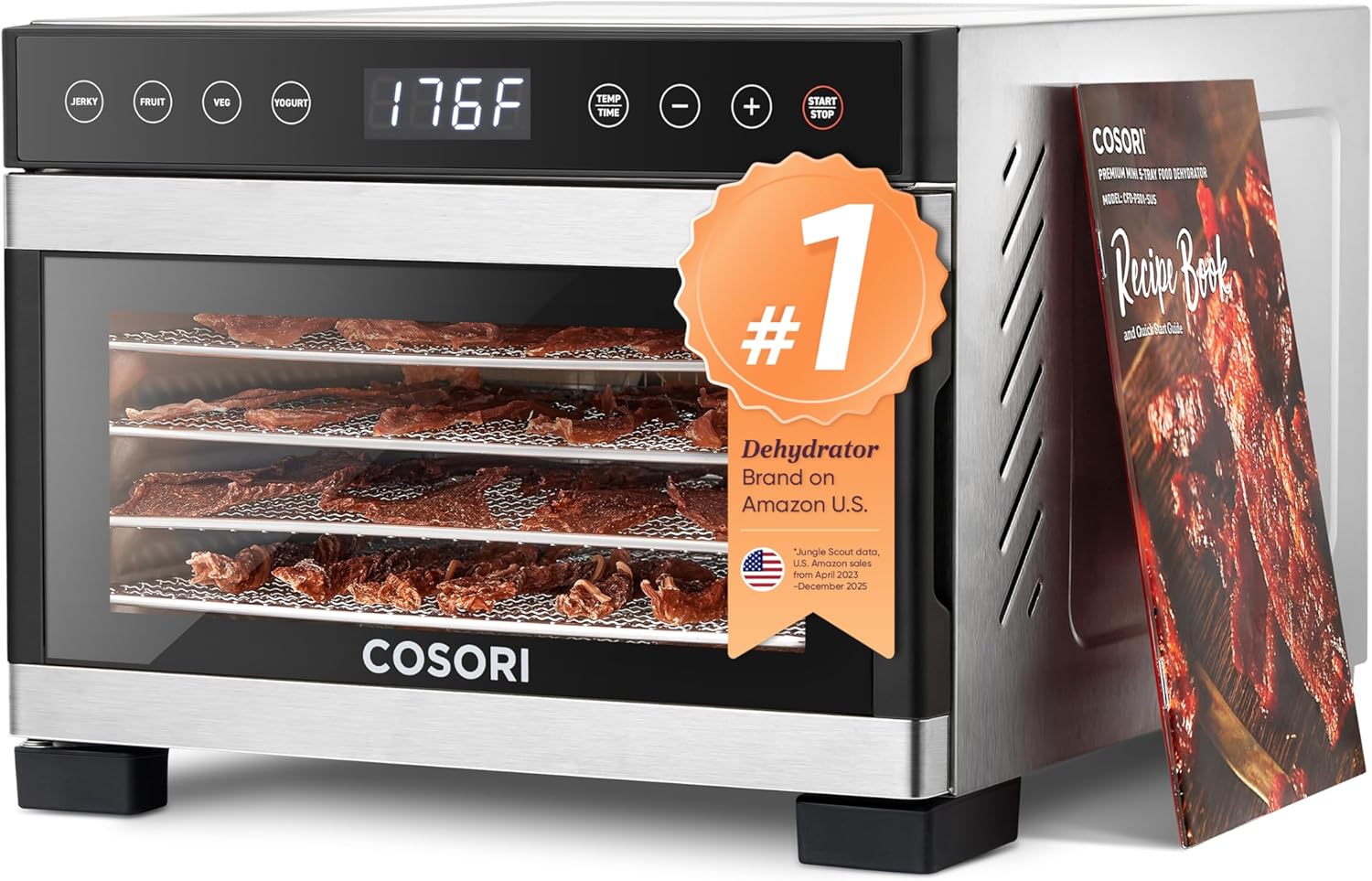
Cosori Stainless Steel Dehydrator P501
| Wattage | 480 watts |
|---|---|
| Voltage | 110 volts |
| Number of Trays | 5 |
| Temperature Range | 95-176 F |
The Cosori P501 is a compact stainless steel dehydrator built for everyday home use and small-batch drying. It uses a rear-mounted fan and horizontal airflow to circulate heat across five stainless steel trays, giving about 3.1 sq ft of drying area that is convenient for mushrooms, fruits, jerky, and herbs. Temperature can be set between 95 and 176°F in 1°F increments and a 48-hour timer plus four presets (jerky, fruit, vegetables, yogurt) simplify routine jobs. The all-stainless interior and included mesh screen and fruit roll sheet avoid plastic contact with food and make cleaning straightforward. At 480 watts it reaches recommended temps for safe jerky and handles low-temp mushroom drying without forced overcooking. The unit is fairly compact for countertop use, but its drying area limits large batches, and the single-zone design means you may need to rotate trays for the most uniform results with mixed-thickness loads. For hobbyist foragers and home cooks who want reliable, easy-to-use drying of mushrooms and other produce, it offers strong performance in a compact package.
Best for: Home cooks and hobbyist foragers who want a reliable, easy-to-use countertop dehydrator for modest batches of mushrooms and other produce and who value stainless-steel food contact surfaces.
Less Ideal for: People who need to dry large volumes at once or who require multi-zone drying control for simultaneous different-temperature jobs.
- Stainless steel construction and trays prevent food contact with plastic and are easy to clean
- Precise temperature control from 95 to 176°F in 1°F increments for low-temp mushroom drying
- Rear fan horizontal airflow promotes even dehydration across trays
- Includes five trays plus mesh screen and fruit roll sheet so you can start drying right away
- Single-zone heating means very thick or mixed loads may require tray rotation for best uniformity
- Limited drying capacity compared with larger commercial dehydrators
Verdict: A compact stainless-steel dehydrator with fine temperature control and solid airflow that is well suited for home drying of mushrooms and other small-batch produce.
Magic Mill Pro Dehydrator MFD-7700

| Wattage | 600 |
|---|---|
| Voltage | 120 |
| Number of Trays | 7 |
| Material | Stainless Steel |
The Magic Mill Pro is a heavy-duty countertop dehydrator built around a powerful 600W rear fan that pushes heat evenly through seven full-size stainless steel trays, which helps produce consistent results without rotating trays. Temperature control is precise in 1°F increments from 95 to 176°F, making it easy to dial in the low, slow settings mushrooms need as well as higher temps for jerky. The digital 48-hour timer with auto shutoff and a keep-warm mode adds convenience for long drying cycles and overnight batches. All-stainless construction and included mesh and fruit-roll trays reduce plastic contact and simplify cleanup, while ETL listing and overheat protection add peace of mind. At roughly the size and weight of a full-capacity machine, it takes up counter space and is heavier than slim stackable units, and its higher power means it will run hotter than lower-watt models during long runs. For serious home dehydrating where even airflow, repeatable temperature control, and durable parts matter, this model delivers professional-feeling performance.
Best for: Mushroom foragers and home cooks who prioritize consistent, repeatable dehydration and want a durable, high-capacity machine for batch drying and long low-temperature runs.
Less Ideal for: Casual users who only dry occasional small amounts or need a compact, lightweight unit for limited counter space should consider smaller stackable models instead.
- Rear-mounted 600W fan and heater for consistent, even drying across all trays
- Precise digital temperature control in 1°F increments from 95–176°F for repeatable results
- All-stainless steel interior, exterior, and trays reduce plastic contact and improve durability
- Includes seven full-size trays plus mesh screens and a fruit roll tray for versatile drying tasks
- 48-hour timer with auto shutoff and a 24-hour keep-warm mode for unattended long cycles
- Larger, heavier footprint compared with stackable or compact dehydrators
- Higher wattage can mean increased energy use during multi-day drying sessions
Verdict: Choose this Magic Mill model if you want professional-feeling, even drying and precise temperature control for reliably dehydrating mushrooms and other large batch projects.
NutriChef Food Dehydrator PKFD14BK

| Wattage | 300 watts |
|---|---|
| Voltage | 220 volts |
| Number of Trays | 5 |
| Temperature Range | 180 °F |
The NutriChef countertop dehydrator is a straightforward 5-tray unit that uses 300 watts and up to 180°F to remove moisture from foods for longer storage and snacking. Setup is simple: stack the trays, load sliced produce or mushrooms in a single layer, and start the one-button operation while the unit circulates warm air through each tier. The device is designed for everyday home use — it is stainless steel, easy to wipe down, and the removable trays make cleaning and loading easier than fixed racks. At 5 tiers it gives decent capacity for small to medium batches, and the consistent airflow helps produce evenly dried mushrooms and fruit snacks. Limitations include a single fixed maximum temperature (no precise low-temperature control shown) and a compact footprint that may require multiple cycles for larger harvests. Noise and exact drying times vary by food thickness, so expect to experiment with slice thickness and rack spacing for best results.
Best for: Buyers who want a no-fuss countertop dehydrator to turn homegrown or store-bought mushrooms into shelf-stable snacks and ingredients without complicated controls.
Less Ideal for: People who need large commercial-scale drying capacity or precise low-temperature settings for delicate, long-duration dehydration.
- Five removable, stackable trays increase usable drying surface and are easy to clean
- Stainless steel construction and food-safe materials suitable for regular food use
- Simple one-button operation makes it easy to start drying without a learning curve
- Max temperature of 180°F and high heat circulation for consistent dehydration
- No detailed variable temperature control or timer for precise low-temperature drying
- Compact capacity may require multiple batches for large mushroom harvests
Verdict: A simple, five-tray countertop dehydrator that delivers reliable, even drying for home mushroom batches without a steep learning curve.
Rosewill RHFD-15001 Food Dehydrator

| Wattage | 350 watts |
|---|---|
| Voltage | 120 |
| Number of Trays | 5 |
| Temperature Range | 95 – 158 °F |
| Material Features | BPA Free |
The Rosewill RHFD-15001 is an affordable, countertop food dehydrator built around a bottom-mounted fan and five stackable BPA-free trays. It heats from 95 to 158°F using a 350W motor, which makes it suitable for slow, low-temperature drying such as herbs and mushrooms as well as fruit leather or jerky. The round housing and horizontal airflow aim to distribute heat evenly across trays, and the large clear lid makes it easy to monitor progress without opening the unit. Trays and included herb/roll inserts are dishwasher-safe for straightforward cleanup. Because it is compact and energy efficient it fits well in small kitchens and for occasional batch drying. Limitations include a lack of a digital timer or preset programs, and at this price point temperature control is manual rather than precision digital, so users who require strict humidity or timed cycles may need to monitor runs more closely.
Best for: Buyers on a tight budget who want a practical, no-frills dehydrator for occasional home use and small batches of mushrooms, herbs, and fruit.
Less Ideal for: Not a good fit for commercial users or hobbyists who need large-capacity racks, precise digital controls, or programmable timed cycles.
- Adjustable 95–158°F range suitable for low-temperature drying like mushrooms and herbs
- Five stackable BPA-free trays plus herb and roll trays increase drying capacity and versatility
- Bottom-mounted fan with horizontal airflow for more even drying across trays
- 350W power draw keeps energy use low for home kitchen use
- Clear lid lets you monitor progress without interrupting drying cycles
- No digital timer or automatic shutoff requires manual monitoring for long drying cycles
- Round, compact footprint limits batch size compared with larger shelf-style dehydrators
Verdict: A low-cost, energy-efficient 5-tray dehydrator that handles small batches of mushrooms and herbs effectively for budget-minded home users.
PSIIDAN Food Dehydrator FD-1033

| Wattage | 650 watts |
|---|---|
| Number of Trays | 8 |
| Temperature Range | 167 °F |
This PSIIDAN FD-1033 dehydrator is built for steady, hands-off drying thanks to its 650W motor, 8 stainless steel trays, and adjustable temperature control up to 167°F. Typical use is loading sliced produce or mushrooms across the racks, setting a precise temperature and timer (up to 48 hours), and letting the unit run until the desired dryness is reached; the interior viewing light and quiet motor make it easy to monitor progress without interrupting airflow. Notable features include dual-layer insulation that keeps the exterior cool during long cycles, a mesh tray for small items like spores or thin mushroom slices, and a drip tray for wetter foods. The large tray count and strong airflow support even drying across multiple layers, which is useful when batch-processing mushrooms for jerky-style snacks or long-term storage. Trade-offs are the maximum temp limit of 167°F, which is fine for mushrooms but may be low for some specialty jerky processes, and the unit's compact footprint means very large batches may require multiple cycles.
Best for: Home cooks who value dependable, consistent drying for small to medium mushroom harvests and want a unit that can run long cycles quietly and safely.
Less Ideal for: People who need industrial-scale capacity or regularly require temperatures above 167°F for specialty meat drying should look at larger commercial units.
- Eight stainless steel trays allow large, even batches without cross-flavor transfer
- 650W motor and 360° airflow promote consistent drying across racks
- Adjustable temperature up to 167°F and a 48-hour timer for precise, long runs
- Dual-layer insulation keeps the exterior cool for safer extended operation
- Includes mesh and drip trays plus a recipe guide to get started quickly
- Maximum temperature of 167°F may be lower than some users want for certain jerky techniques
- Compact interior may need multiple batches for very large harvests
Verdict: A reliable countertop dehydrator that delivers even, quiet, and safe long-cycle drying ideal for preserving mushrooms at home.
Presto Dehydro 06300 Dehydrator

| Wattage | 600 watts |
|---|---|
| Voltage | 120 volts |
| Number of Trays | 8 |
| Temperature Range | 165 °F |
The Presto Dehydro 06300 is a straightforward countertop dehydrator that uses a top-mounted fan and heating element to deliver steady airflow across stacked trays without any rotation. It ships with four nesting trays and can expand to eight trays if you need more capacity, and the preset temperature around 165°F is geared toward jerky but also works well for fruits, vegetables, and mushrooms. Trays and the drip tray are fully immersible for easy cleaning, and the unit stores neatly because trays nest and the cord wraps around the cover. Its plastic construction keeps weight low and makes handling simple, though it is not a heavy-duty commercial machine. The lack of a variable temperature dial means finer control requires monitoring or separate timing adjustments, so delicate items may need closer attention. For home cooks who want a reliable, easy-to-clean dehydrator that handles regular batches of produce or jerky, this model covers the basics efficiently.
Best for: Home cooks focused on dependable, no-fuss dehydration for fruits, vegetables, mushrooms, and jerky who value easy cleaning and compact storage backed by many user reviews.
Less Ideal for: Users who need precise temperature control for lab-grade drying, high-volume commercial production, or heavier-duty metal construction should consider more advanced models.
- Top-mounted fan and heating element for consistent airflow and no tray rotation.
- Expandable from four to eight trays for larger batches.
- Trays and drip tray are fully immersible for straightforward cleaning.
- Nesting trays and cord wrap design reduce storage footprint.
- Fixed preset temperature limits precise control for very delicate drying tasks.
- Plastic housing is lightweight but less rugged than metal alternatives.
Verdict: A simple, reliable countertop dehydrator that delivers consistent airflow and easy cleanup, making it a practical choice for home mushroom and produce drying.
Cosori Food Dehydrator CP267-FD

| Wattage | 600 watts |
|---|---|
| Voltage | 120 volts |
| Number of Trays | 6 |
| Temperature Range | 95-165 F |
| Operating Frequency | 60 hertz |
The Cosori CP267-FD is a countertop food dehydrator built for batch drying and precise temperature control. It uses a rear-mounted 600W fan and horizontal airflow to circulate heat across six stainless steel trays, which lets you dehydrate larger quantities without rotating trays. The digital touch panel provides degree-by-degree temperature selection from 95 to 165°F and a timer up to 48 hours, useful for low-and-slow drying of delicate items like mushrooms. Included accessories such as a mesh screen and fruit roll sheet expand what you can dry and protect small pieces from falling through. The stainless housing and dishwasher-safe trays simplify cleanup and avoid plastic contact with food. Noise is low thanks to the brushless motor, so overnight runs are practical. The unit is fairly large and weighs more than compact models, so it needs a permanent spot on a counter or in a garage when in frequent use, and its single-appliance design means it is dedicated to dehydrating rather than multi-function cooking.
Best for: Buyers who want a reliable, factory-quality dehydrator to dry consistent, large batches of mushrooms and other produce with precise temperature control and quiet operation.
Less Ideal for: Someone who needs a compact, lightweight unit for occasional travel or those who prefer multi-function countertop appliances that combine dehydrating with other cooking modes.
- Six stainless steel trays provide large drying capacity for batch jobs
- Precise digital temperature control from 95–165°F for low-temperature drying
- Rear-mounted fan with horizontal airflow for even drying across trays
- Quiet brushless motor suitable for overnight cycles
- Includes mesh screen, fruit roll sheet, and cookbook for immediate use
- Relatively heavy and bulky compared with compact dehydrators
- Single-purpose appliance without additional cooking functions
Verdict: A quiet, high-capacity stainless-steel dehydrator with precise low-temperature control that makes it a safe, dependable choice for drying mushrooms at home.
Choosing the Right Food Dehydrator for Mushrooms: Key Factors to Consider
Temperature Range And Stability
Mushrooms dry best at low, steady temperatures to avoid cooking the tissue and to preserve flavor. Look for a unit with a minimum setting around 95 to 110°F and the ability to hold a chosen temperature precisely for many hours. Frequent temperature swings lengthen drying time and increase the chance of uneven moisture.
Stability matters because mushrooms contain a lot of water and dense pieces can trap moisture. A dehydrator that maintains its set point within a few degrees reduces the risk of partially dried pockets that later develop mold during storage. When assessing a dehydrator, prioritize consistent control over a wide but usable range rather than overly high maximum temperatures.
Airflow Pattern And Distribution
Even circulation prevents wet spots and ensures all slices dry at a similar rate. Units with horizontal airflow or well-designed rear-mounted fans with baffles tend to produce more uniform results than models that simply vent from the bottom with no distribution system. Consider how the fan pushes air across each tray and whether there is a tendency for the center or edges to dry faster.
For mushroom drying, you want steady, low-velocity air that carries moisture away without blasting fragile pieces. Adjustable fans or models that balance convection and gentle airflow give you better control, especially when drying whole caps versus thin slices.
Tray Material, Size, And Spacing
Tray construction affects airflow, hygiene, and how easily you can load mushrooms. Mesh or perforated trays allow air to reach both sides of slices and are easier to clean. Slightly raised edges keep irregular pieces in place and prevent overlap. Tray spacing should accommodate both thin slices and thicker whole pieces; insufficient spacing leads to crowding and uneven drying.
If you regularly dry large batches, consider trays with consistent dimensions for stacking and expandability. Removable, dishwasher-safe trays save time and minimize handling, which is useful when processing perishable harvests quickly.
Capacity Relative To Typical Harvest
Match dehydrator capacity to the quantity you process in a single session to avoid excessive batch stacking or repeated runs. Larger capacities reduce total processing time but increase footprint and energy use. Expandable systems that let you add trays later are helpful if your harvests vary seasonally.
Think beyond the listed tray count and consider usable volume. How many pounds or liters of sliced mushrooms fit per tray and whether trays can be arranged for different load sizes will determine whether a model meets your workflow.
Cleaning, Maintenance, And Food Safety
Mushrooms can leave residues that encourage microbial growth if not cleaned thoroughly. Trays and interior surfaces that are easy to remove and wash reduce maintenance time and improve long-term hygiene. Nonreactive materials such as food-grade plastic or stainless-style finishes are preferred.
Consider how often you will need to deep-clean and whether parts are dishwasher-safe. Regular cleaning prevents off-odors and cross-contamination when switching between different foraged or cultivated varieties.
Noise And Practical Usability
Drying mushrooms is a long process, so fan noise and interaction design affect how comfortable it is to run a dehydrator in a kitchen or utility room. Quieter circulation systems make it feasible to run overnight or while you are at home. Controls that are intuitive, with clear timers and temperature settings, reduce user error and remove guesswork.
Also evaluate cord length, footprint, and storage. A compact unit with reliable controls is often more useful than a larger but clumsy machine if your workspace is limited.
Slice Thickness And Preparation Tips
How you prepare mushrooms affects drying time and final texture. Uniform slices dry more evenly, so aim for consistent thickness across the batch. Thinner slices dry faster and are useful for crisps, while slightly thicker pieces retain more structure for rehydration in recipes.
Blot mushrooms to remove surface moisture before loading to reduce drying time. For thicker caps or whole pieces, consider a brief blanch or steam step only when appropriate for the species; however, most culinary varieties dry well without precooking.
- Aim for 1/8 to 1/4 inch slices for consistent drying.
- Spread pieces in a single layer with small gaps to allow airflow.
- Rotate or rearrange trays halfway through long cycles if your dehydrator shows uneven drying.
Storing Dried Mushrooms Safely
Proper storage extends shelf life and preserves aroma. Fully dried mushrooms should snap or have no perceptible soft spots before storage. Use airtight containers and store in a cool, dark place to minimize moisture uptake and flavor degradation.
To guard against residual moisture, consider using small desiccant packets or oxygen absorbers when packing long-term. Label containers with the drying date and variety to track freshness over time.
- Test dryness by breaking a thicker piece; it should not bend.
- Use glass jars or high-barrier bags for long-term storage.
- Check containers after a week for any moisture accumulation and re-dry if necessary.
Drying Different Mushroom Types
Different species vary in water content and tissue density, which changes recommended drying times. Thin-fleshed varieties will dry faster, while dense or large caps need lower temperatures and more time. Adjust slice thickness and airflow accordingly.
If you frequently work with multiple species, plan a conservative drying schedule and monitor the first batch to dial in times and settings. Keep notes on ideal temperatures and durations for each type you process.
- Adjust temperature downward for delicate or aromatic varieties.
- Use thinner slices for dense specimens to speed drying.
- Document best settings for each species to replicate results reliably.
Using Timers And Automation
Built-in timers and programmable controls reduce guesswork for long cycles. Timers let you run a full drying session without constant monitoring, which is helpful for overnight runs. Look for models that allow you to set both time and temperature independently.
If the dehydrator lacks advanced programming, consider pairing it with an external timer or thermometer to monitor conditions. Some users also employ small digital probes to verify interior tray temperatures during longer cycles.
- Set realistic drying windows and check periodically rather than relying solely on the timer.
- Use a thermometer to confirm that the actual temperature matches settings, especially during the first runs.
- Program lower temperatures for mushrooms than you would for herbs or fruit leathers.
Energy Use And Practical Costs
Long drying cycles mean energy consumption matters over time. Higher-wattage units will dry faster but may use more electricity. Consider efficiency in the context of how often you dehydrate and the typical batch size.
Look for models with good insulation and efficient airflow that reduce run time without sacrificing uniformity. If you process mushrooms seasonally, balance the cost of a larger unit against the convenience of fewer runs.
- Estimate monthly energy use based on run hours and wattage.
- Smaller, efficient units can be better for occasional use.
- Expandability can be more energy-efficient than running multiple full cycles.
How We Chose the Best Food Dehydrator for Mushrooms
We shortlisted units that meet the specific needs of mushroom drying rather than general snack dehydration. Our evaluation prioritized temperature accuracy and range, since mushrooms require lower, steady heat to dry without cooking. We also focused on airflow design and tray arrangement because even drying across all trays prevents pockets of moisture that cause spoilage. Build and tray materials were considered for food safety and ease of cleaning, with nonreactive surfaces preferred. Capacity and expandable tray options mattered for buyers who process larger harvests, while footprint and storage were important for home kitchens. Noise level and ease of use rounded out our criteria because long drying cycles make those factors meaningful. We excluded units that cannot hold stable low temperatures or that lack adjustable airflow. We also filtered out products with tray spacing incompatible with sliced or whole mushrooms. The shortlist reflects practical tradeoffs between usable capacity, consistent drying performance, and everyday convenience.
Our full evaluation process is outlined in our review methodology.
FAQ
What temperature is best for drying mushrooms?
Most culinary mushrooms dry well between 95 and 135°F. Lower temperatures preserve aroma and texture, so start near the lower end and increase only if drying is excessively slow.
How do I know when mushrooms are fully dry?
Fully dry mushrooms snap or break cleanly with no soft, flexible areas. Thick pieces should not bend. If any dampness is felt, return them to the dehydrator for further time.
Can I dry whole mushrooms or should I slice them?
You can dry whole small mushrooms, but slices dry more evenly and predictably. Slicing increases surface area and reduces total drying time, especially for dense species.
How should dried mushrooms be stored?
Store in airtight containers in a cool, dark place. For long-term storage, use moisture absorbers or oxygen scavengers to minimize rehydration and preserve flavor.
Is a fan-on-top or fan-on-back design better for mushrooms?
A back-mounted fan with well-distributed airflow often yields more uniform drying for stacked trays. Top-mounted fans can work but may require more tray rotation to avoid uneven spots.
Final Verdict
When choosing a food dehydrator for mushrooms, prioritize steady low-temperature control, uniform airflow, and tray designs that support single-layer drying. Capacity and expandability matter if you process large harvests, while easy-to-clean trays and quiet operation improve day-to-day usability. Balance these tradeoffs based on how often you dry and the mushroom varieties you handle. With those priorities in mind, you can select a dehydrator that reliably produces shelf-stable, flavorful dried mushrooms.