
Note: This article contains affiliate links. If you click on these links and make a purchase, we may earn a small commission at no extra cost to you. This helps support our research and content. Read our full affiliate disclosure here.
A dependable Food Dehydrator makes it simple to turn fruit, vegetables, herbs, and jerky into shelf-stable snacks with better flavor and less waste. Choosing the right dehydrator matters because drying time, evenness, and safe storage all depend on airflow, temperature accuracy, and usable capacity. This guide presents seven carefully shortlisted options that suit home kitchens, occasional batch drying, and small-scale preserving. We evaluated practical factors that affect daily use and long-term results so you can pick a unit that matches the foods you plan to dry and the space you have available. Read on for the criteria we used and concise buying guidance before the product list.
Top Picks at a Glance
| Best Overall The best all-around choice for most situations | Excalibur 8-Tray Dehydrator |  |
| Best Quality Built to a higher standard if you want something more solid | Magic Mill Pro Food Dehydrator MFD-7700 |  |
| Best Value The sweet spot between price and what you get | NESCO Snackmaster FD-75A |  |
| Best Budget The cheapest option that still gets the job done reliably | Elite Gourmet EFD770WD Dehydrator |  |
| Top Rated A top-rated pick with lots of positive feedback | Cosori Stainless Steel Dehydrator CP267-FD |  |
| Most Popular A crowd favorite that many people choose with confidence | Magic Mill Food Dehydrator MFD-5000 |  |
| Best Seller A high-volume bestseller chosen again and again | Cosori Stainless Steel Dehydrator P501 |  |
Excalibur 8-Tray Dehydrator

| Wattage | 700 watts |
|---|---|
| Voltage | 120 |
| Number of Trays | 8 |
| Temperature Range | 85°F to 165°F |
| Timer | Up to 80 hours |
The Excalibur 8-Tray Dehydrator is a countertop machine built for serious home dehydration work like jerky, fruit leather, herbs and pet treats. It offers 7.2 square feet of drying space across eight chrome trays plus a mesh and crumb tray, and uses Excalibur's Hyperwave Pulse and Horizontal Parallex airflow to promote even drying without rotating trays. The LED control panel lets you set temperatures from 85°F to 165°F and a digital timer up to 80 hours with automatic shutoff, and the glass French door makes it easy to watch progress. Its stainless-steel shell and glass door give a more finished look than plastic box dehydrators and the compact footprint is designed to fit under most cabinets. Expect steady, reliable performance for batch drying, though the unit is relatively heavy and uses a conventional fan-heater setup rather than a convection blower for faster cycles. Included trays and a recipe book help get you started quickly.
Best for: Home cooks who want a reliable, high-capacity dehydrator for regular batch drying and preserving seasonal produce while valuing even results and a durable, finished design.
Less Ideal for: Users who need an ultra-lightweight, ultra-compact travel unit or who prioritize the absolute fastest drying cycles should consider simpler or blower-driven alternatives.
- Large drying capacity with eight chrome trays plus mesh and crumb tray
- Even heat distribution using Hyperwave Pulse and Horizontal Parallex Air Flow so trays do not need rotation
- Wide temperature range (85°F–165°F) and an 80-hour digital timer with automatic shutoff for precise control
- Stainless steel construction and clear glass door let you monitor drying and offer a durable countertop presence
- Heavier and bulkier than basic plastic models, which can make moving or storing it less convenient
- Does not advertise a high-speed convection blower, so drying cycles can be longer than some faster designs
Verdict: Buy this if you want a durable, large-capacity countertop dehydrator that delivers even, reliable drying for regular home preserving.
Magic Mill Pro Food Dehydrator MFD-7700

| Wattage | 600 |
|---|---|
| Voltage | 120 |
| Number of Trays | 7 |
| Material | Stainless Steel |
The Magic Mill Pro is a performance-focused dehydrator built around a 600W rear fan and all-stainless construction to deliver even drying across seven full-size trays. You use it like a typical countertop dehydrator: load sliced fruit, jerky, or herbs onto the trays, set the temperature in 1°F increments between 95°F and 176°F, program the timer up to 48 hours, and let the rear-fan circulation do the work without rotating trays. The solid stainless interior and trays resist warping and avoid plastic contact with food, and included mesh screens and a fruit roll tray extend use to herbs and leather. Practical features such as Keep Warm (holds 95°F for up to 24 hours), auto shutoff, and overheat protection add safety for long runs. The digital control and 1-degree resolution make it easy to reproduce recipes, while the 600W motor provides consistent airflow for larger batches. The unit is a bit heavy and bulky compared with plastic models, so it takes more counter or storage space and is less portable, but that rigidity supports durability and repeatable results for serious users.
Best for: Buyers who prioritize consistent, repeatable drying and want a durable, high-capacity machine for frequent batch dehydrating and jerky-making.
Less Ideal for: Casual users who need a lightweight, ultra-compact unit for occasional small batches or who must store the appliance in tight spaces.
- Rear-mounted 600W fan provides consistent, even airflow across all trays
- All-stainless interior and 100% stainless trays reduce warping and avoid plastic contact with food
- Precision digital temperature control in 1°F increments (95–176°F) for repeatable results
- 48-hour programmable timer with auto shutoff plus Keep Warm mode for long recipes
- Larger, heavier stainless build requires more counter or storage space than compact plastic models
- No tray rotation feature so very uneven loads may still need manual rearranging
Verdict: Choose this dehydrator if you want a durable, high-capacity stainless unit with precise temperature control and a powerful rear-fan system for consistent, professional-style drying.
NESCO Snackmaster FD-75A

| Wattage | 600 watts |
|---|---|
| Voltage | 120 volts |
| Number of Trays | 5 |
| Temperature Range | 95–160 °F |
The NESCO FD-75A Snackmaster is a small, practical food dehydrator aimed at home users who want to dry fruit, herbs, vegetables, and jerky without fuss. It uses a top-mounted fan and the brand's Converga-Flow system to push air across each tray for even drying so you do not need to rotate trays during a cycle. The unit ships with five BPA-free trays plus fruit roll sheets, clean-a-screen inserts, and jerky seasoning so you can start with small batches right away, and the tray system expands up to 12 trays when you need larger capacity. An adjustable thermostat ranges from 95 to 160 degrees F, which covers the temperatures needed for herbs, fruit leathers, and safe jerky drying. At 600 watts the machine gets to drying speeds typical for countertop dehydrators, and the top-mounted design keeps drips away from the heater. Limitations are its compact footprint if you regularly need very large batches and its plastic exterior, which some buyers may prefer replaced by metal for heavier duty use.
Best for: Buyers who want a reliable, no-fuss countertop dehydrator for home kitchen projects, recipe experimentation, and occasional larger batches with the option to expand trays.
Less Ideal for: Not the best choice for commercial users or anyone who needs high-volume continuous drying for large-scale food production.
- Converga-Flow top-mounted airflow delivers even drying without rotating trays
- Expandable tray system from 5 up to 12 trays for scaling batch size
- Adjustable thermostat (95–160°F) for precise drying of different foods
- Includes fruit roll sheets, clean-a-screen inserts, and jerky seasoning to get started
- Plastic exterior rather than metal may feel less robust for heavy frequent use
- Compact base capacity means longer total runtime for very large batches
Verdict: A versatile, expandable home dehydrator that delivers even, hands-off drying and the accessories needed to start making jerky and fruit leather quickly.
Elite Gourmet EFD770WD Dehydrator

| Wattage | 350 watts |
|---|---|
| Voltage | 230 volts |
| Number of Trays | 5 |
| Temperature Range | 95-158 °F |
The Elite Gourmet EFD770WD is a compact 5-tier digital dehydrator meant for everyday home use. It uses a base-mounted fan and 350-watt heater to circulate warm air upward through five BPA-free trays, giving roughly 610 square inches of total drying area for small batches of fruits, vegetables, herbs or jerky. The unit offers an adjustable temperature range from 95 to 158 F and an electronic timer up to 48 hours, which makes it simple to set-and-forget longer drying cycles. Trays are dishwasher-safe for easy cleanup and the stainless steel exterior keeps a tidy look on the counter. Practical limits include its modest wattage and countertop footprint, so it works best for household portions rather than large-scale preserving. Also the 230V voltage listing may require attention in regions with different mains standards. For home cooks who want a straightforward, budget-friendly dehydrator, this model covers the essentials without complicated controls.
Best for: Buyers looking for an affordable, no-frills countertop dehydrator to make snacks, herbs, and small-batch jerky at home who prioritize simple controls and easy cleanup.
Less Ideal for: People needing commercial-scale drying capacity or very large batch preservation should choose a larger or higher-power unit instead.
- Five BPA-free trays provide about 610 sq in total drying area for multiple small batches
- Adjustable temperature (95–158 F) and up to 48-hour timer for flexible drying profiles
- Base-mounted fan and heater promote even airflow for consistent drying
- Dishwasher-safe trays and stainless steel exterior make cleaning straightforward
- 350-watt power is modest and may lengthen drying times compared with higher-power units
- Specified voltage is 230 volts which may not match all household circuits without an adapter
Verdict: A budget-friendly, user-friendly 5-tray dehydrator that delivers reliable home drying with simple digital controls and easy cleanup.
Cosori Stainless Steel Dehydrator CP267-FD

| Wattage | 600 watts |
|---|---|
| Number of Trays | 6 |
| Temperature Range | 95-165 F °F |
| Voltage | 120 volts |
The Cosori CP267-FD is a countertop food dehydrator built for regular home use and larger batch drying. It uses a rear-mounted fan and horizontal airflow with a 600 W motor to circulate heat evenly across six stainless steel trays, and the digital control panel lets you set temperatures from 95 to 165 F and a timer up to 48 hours. Included accessories such as a fruit roll sheet, mesh screen, and a 50-recipe booklet make it easy to start drying fruit, jerky, herbs, and snacks without hunting for extras. Practical benefits are consistent drying across trays, dishwasher-safe metal trays for easier cleanup, and a brushless motor rated for quiet operation under 48 dB so it can run overnight. The unit is fairly large and heavier than small plastic models, which helps durability but reduces portability and takes more counter space. If you need ultra-fast commercial throughput or a compact travel-friendly option, this home model may be more than required.
Best for: Home cooks who value a reliable, durable dehydrator that handles regular medium-to-large batches with consistent, programmable results and quiet operation.
Less Ideal for: People who need a very compact, lightweight unit for occasional travel or those seeking a commercial-scale dehydrator for continuous high-volume production.
- Six stainless steel trays provide large 6.5 ft² drying area for batch dehydrating
- Digital temperature control from 95–165°F and a 48-hour timer for precise recipes
- Rear-mounted fan and upgraded airflow deliver more even drying without rotating trays
- Stainless steel construction and dishwasher-safe trays improve durability and cleanup
- Brushless motor runs quietly under 48 dB for overnight operation
- Bulky and comparatively heavy, so it occupies significant counter or storage space
- Not designed for commercial throughput where continuous high-volume drying is needed
Verdict: Buy this if you want a sturdy, quiet, six-tray home dehydrator that delivers consistent, programmable drying for medium-to-large batches.
Magic Mill Food Dehydrator MFD-5000

| Wattage | 240 watts |
|---|---|
| Voltage | 110 volts |
| Number of Trays | 5 |
| Temperature Range | 95-167 °F |
The Magic Mill MFD-5000 is a countertop dehydrator designed for making fruit leather, jerky, dried herbs, and pet treats at home. It uses a 240W heating system and a top temperature of 167°F with a digital timer that runs up to 48 hours, so you can low‑and‑slow dry meats or speed through thin fruit slices. Five food‑safe stainless steel trays are adjustable to accommodate thicker cuts, and the trays are removable for handwashing or dishwasher cleaning. The unit combines a stainless steel base with a BPA‑free plastic body for a balance of durability and lighter weight. In practice it handles multiple small batches simultaneously and preserves flavor and nutrients during dehydration, while the simple control panel keeps settings straightforward. Limitations include a relatively small footprint and tray spacing compared with larger models, so very large batches or bulky items may require multiple cycles, and the maximum listed temperature is adequate for most uses but not for extremely fast high‑heat drying.
Best for: Buyers who want a reliable, easy‑to‑use countertop dehydrator for occasional to regular home use and who value stainless steel trays and simple digital controls backed by solid user reviews.
Less Ideal for: Those who plan to dehydrate very large quantities at once or need industrial‑scale capacity should consider larger stackable or commercial dehydrators instead.
- Five stainless steel, food‑safe trays with adjustable spacing for varied ingredients
- Digital timer up to 48 hours and temperature control to 167°F for precise dehydration
- Dishwasher‑safe removable trays for easier cleanup
- Compact footprint suitable for countertop storage or small kitchens
- Tray area and spacing limit large batch capacity compared with full‑size dehydrators
- Construction mixes stainless steel and plastic rather than full all‑metal housing
Verdict: A compact, user‑friendly dehydrator with stainless steel trays and long timer control that reliably handles small to medium home batches.
Cosori Stainless Steel Dehydrator P501
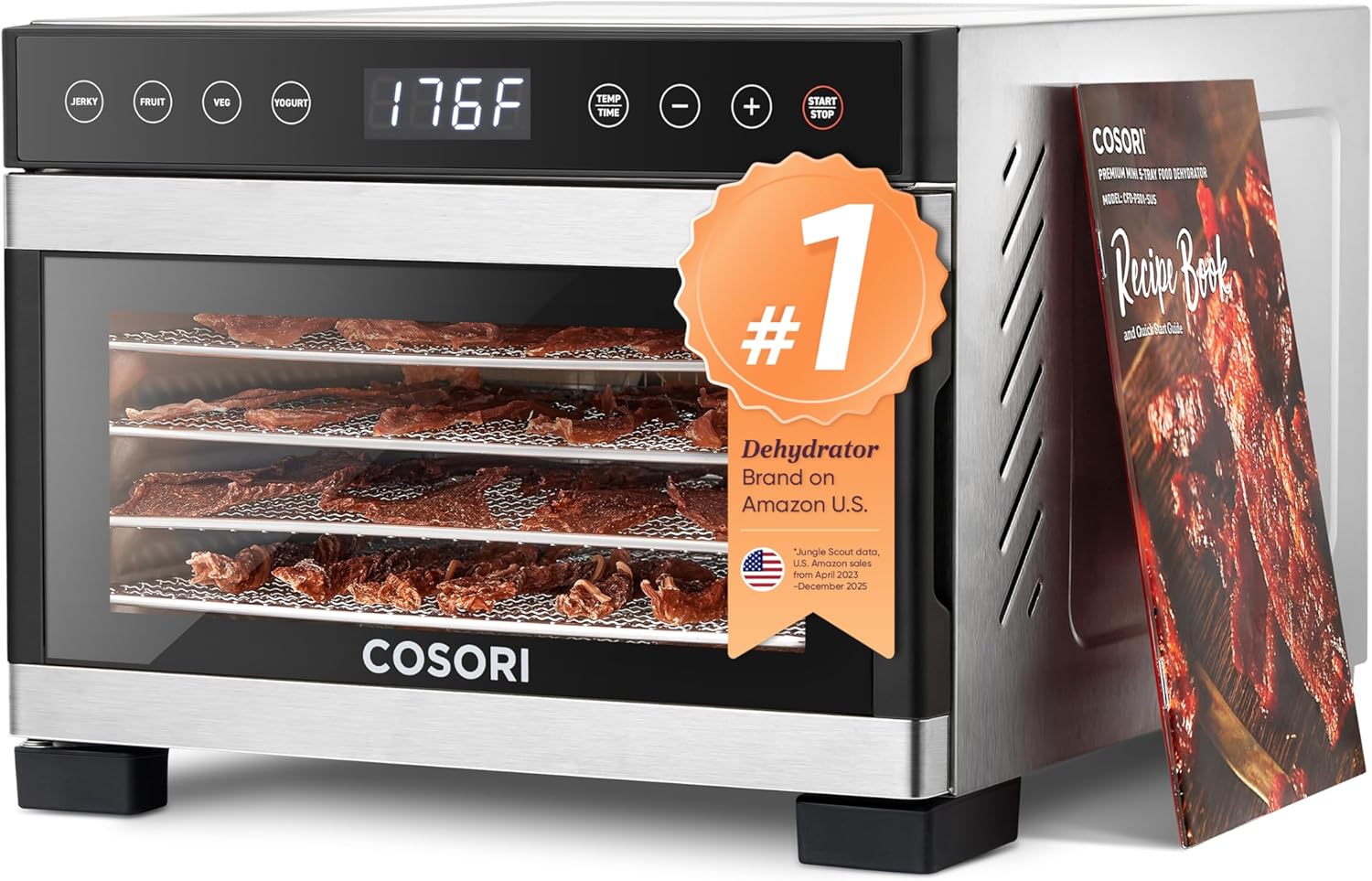
| Wattage | 480 watts |
|---|---|
| Voltage | 110 volts |
| Number of Trays | 5 |
| Temperature Range | 95-176 F |
The Cosori P501 is a compact countertop dehydrator built around five stainless steel trays and a rear fan that promotes even horizontal airflow across the racks. You set temperature in 1°F increments from 95 to 176°F and choose one of four presets for jerky, fruit, vegetables, or yogurt, or use manual time and temperature control for customized batches. The included mesh screen and fruit roll sheet expand usable foods, and the stainless-steel interior keeps food away from plastic surfaces. In practice the unit dries evenly across trays and the 48-hour timer handles long runs for jerky or fruit leather without constant monitoring. Noise is moderate from the rear fan and the compact footprint fits most counters, though the 3.1 ft² drying area is best for small to medium batches rather than large-scale preserving. If you want a straightforward, durable dehydrator with precise temperature control and stainless-steel food contact, the P501 delivers reliable, predictable results for home use.
Best for: Buyers who want a reliable, easy-to-use countertop dehydrator that prioritizes food-safe materials and precise temperature control for occasional to regular home dehydration projects.
Less Ideal for: People who need industrial capacity or very large batch throughput for commercial use or frequent high-volume preserving should look at larger units.
- Stainless-steel construction and trays keep food from contacting plastic
- Precise temperature control from 95 to 176°F in 1°F increments
- Five trays provide about 3.1 ft² drying area for small to medium batches
- Rear fan and horizontal airflow promote even dehydration across trays
- Compact drying area limits throughput for large or continuous batches
- Fan produces moderate operational noise during long runs
Verdict: A compact, food-safe stainless-steel dehydrator with precise temperature control that reliably handles home jerky, fruit, and vegetable drying.
Choosing the Right Food Dehydrator: Key Factors to Consider
Temperature Range and Stability
Accurate and stable temperature control matters because different foods require different drying temperatures. Fruits and herbs typically dry well at lower temperatures, while jerky and other meats need higher, steady heat to reach safe internal moisture levels.
A dehydrator with a broad, reliable temperature range and minimal fluctuation reduces the risk of spoilage and helps preserve color and nutrients. Look for units with either digital thermostats or well-calibrated analog dials and clear manufacturer guidance on recommended settings for common foods.
Airflow Pattern and Tray Layout
How air moves through the drying chamber determines how evenly foods dehydrate. Vertical airflow units push air straight up or down through stacked trays, which can be efficient for small batches. Horizontal or rear-blown designs tend to produce more uniform results across every tray for larger loads.
Tray spacing and the ability to rearrange or remove trays also affect airflow. Choose a layout that minimizes hot spots and allows air to reach all pieces without excessive overlap or crowding, especially when drying thicker slices or mixed trays.
Capacity Versus Counter Space
Capacity matters depending on whether you plan to dry small snacks occasionally or larger quantities for canning and storage. Larger multi-tray units handle big batches but also take up more counter or cabinet space and may be heavier to move.
Consider the typical batch size you expect to dry and match it to a unit with enough tray area. Also think about where you will store the dehydrator when not in use and whether you need stackable trays or a compact footprint to fit your kitchen.
Materials and Food Safety
Materials that contact food should be nonreactive and easy to clean. Trays made from BPA-free plastics or stainless steel are typical; stainless steel offers durability and easier long-term sanitation while high-quality food-safe plastics can be lighter and more affordable.
Check that tray surfaces do not retain odors or stains and that the construction resists warping under extended heat. Removable trays that tolerate hot water and scrubbing make routine cleaning safer and more effective.
Ease of Cleaning and Maintenance
Dehydrators need regular cleaning to prevent sticky residue and bacterial growth. Units with removable, dishwasher-safe trays and wide access to the interior simplify maintenance and reduce downtime between batches.
Also consider whether the fan and heating elements are accessible for occasional cleaning or if filters are replaceable. Simple designs with fewer crevices cut the time it takes to keep the machine sanitary and functioning well.
Noise, Power Draw, and Runtime
Drying cycles often run for several hours, sometimes overnight, so noise level matters for home use. Quieter fans are more comfortable in open kitchens or apartments. Energy efficiency influences operating cost when running long cycles; lower wattage and efficient airflow can reduce runtime and power consumption.
Look for units that balance sufficient airflow with efficient heaters and fans to minimize both noise and electricity use without compromising drying speed or evenness.
Best Foods To Dehydrate At Home
Many home cooks dehydrate fruits, vegetables, herbs, and lean meats. Fruit slices and purees make excellent snacks and baking ingredients, while herbs concentrate flavor and store for months when dried correctly. Vegetables can be dried for soups and stews, and jerky requires careful temperature control to be safe.
Thickness and pre-treatment matter. Uniform slices dry faster and more evenly. Blanching some vegetables or applying a light sugar or salt cure to fruit can improve texture and color. For meat, follow safe curing guidelines and recommended temperatures to reduce bacterial risk.
- Apples, pears, and bananas: slice thinly and dry at low to moderate heat
- Tomatoes and mushrooms: dry longer at moderate heat to remove moisture
- Herbs: use low heat and quick cycles to preserve volatile oils
- Jerky: use higher, steady temperatures and monitor internal moisture
How Tray Type Affects Results
Solid trays, mesh inserts, and perforated options each change airflow and finish. Mesh or perforated trays let air reach the underside of items and shorten drying time compared with solid platforms. Nonstick-coated trays make cleanup easier but can wear over time.
Consider using sheet liners or drying screens for small pieces that might fall through mesh. Removable tray options let you expand or collapse capacity depending on the batch size.
- Mesh/perforated trays: best for thin slices and small pieces
- Solid trays: easier for purees or delicate items
- Nonstick coatings: convenient but check for durability
Managing Drying Time And Preventing Overdrying
Drying time depends on humidity, slice thickness, and temperature. Thinner slices and lower humidity shorten drying time. Expect citrus and apple chips to finish in a few hours, while thicker vegetables and meats can take much longer. Check items periodically rather than relying solely on a timer.
Rotate trays or rearrange positions during long cycles if your unit has uneven heat zones. Testing a few pieces to determine the ideal crispness or pliability helps you dial in settings for repeatable results.
- Make uniform slices for consistent drying
- Check doneness by texture rather than time alone
- Rotate trays if you notice uneven drying
Storage And Rehydration Tips
Properly dried foods store better when cooled and sealed in airtight containers with a desiccant or oxygen absorber for long-term storage. Store in a cool, dark place to extend shelf life and check periodically for any signs of moisture or condensation.
Rehydration is simple: soak dried fruits or vegetables in warm water until they regain pliability. For soups and stews, add dried vegetables directly during cooking. Dried herbs typically are added late in cooking to preserve aroma.
- Cool items completely before sealing
- Use airtight jars or vacuum-sealed bags for long storage
- Label containers with date and contents
Common Mistakes To Avoid
Crowding trays and using inconsistent slice sizes are frequent errors that lead to uneven drying and longer cycles. Overloading a dehydrator reduces airflow and can trap moisture, which invites spoilage. Avoid mixing very different foods on the same tray unless you monitor closely.
Skipping pre-treatments when needed can affect color and flavor. For example, some fruits benefit from a brief dip in lemon juice or an ascorbic acid solution to prevent darkening. Always follow safe handling practices when drying meats to ensure proper internal temperatures are reached.
- Do not overcrowd trays
- Keep slice thickness uniform
- Use recommended pre-treatments when appropriate
How We Chose the Best Food Dehydrator
We prioritized features that directly influence drying performance, food safety, and everyday usability. Key evaluation criteria included temperature control accuracy because precise thermostats prevent under- or over-drying; airflow design since consistent circulation yields even results across trays; usable drying capacity to match batch sizes without crowding; ease of cleaning and tray access for regular maintenance; noise level and energy efficiency for comfortable home use; and construction quality for long-term reliability. We excluded units that lacked reliable temperature settings or provided only vague heater controls. We also filtered out dehydrators with trays that do not remove or clean easily, and those using questionable materials for food contact. Our selection favors devices with clear, adjustable temperature ranges suitable for fruit, vegetable, and meat drying and models with design choices that reduce hot spots and speed drying when appropriate. The final list balances practical home-use concerns with measurable performance dimensions buyers can check in spec sheets or manuals.
Our full evaluation process is outlined in our review methodology.
FAQ
What temperature should I use to dry fruit?
Fruit typically dries well between low to moderate heat settings. A range around 125 to 135 degrees Fahrenheit is common, though exact recommendations vary by fruit and slice thickness. Lower temperatures preserve flavor but will take longer.
Can I put a dehydrator in a garage or unheated space?
You can run a dehydrator in a garage if the ambient temperature stays within the unit's recommended range, but extreme cold or humidity will slow drying and may affect performance. Ensure adequate ventilation and avoid areas with dust or pests.
How do I know when jerky is fully dehydrated and safe?
Jerky should be firm and pliable with no moist spots. Use the recommended higher temperature range for meat drying and follow safe curing procedures. When in doubt, use a meat thermometer and follow food-safety guidance for internal temperature targets before and after drying steps.
Are plastic trays safe for long-term food storage?
Food-safe, BPA-free plastics used in dehydrator trays are generally safe for drying, but they may retain odors or discolor over time. Stainless steel trays offer more durable and inert contact surfaces if you are concerned about long-term wear.
How often should I clean my dehydrator?
Clean trays after each use to remove sugars, oils, and food particles that can harbor bacteria. Wipe the interior and fan housing periodically according to the manufacturer's guidance. Regular cleaning prevents odors and maintains drying efficiency.
Final Verdict
When choosing a Food Dehydrator, prioritize temperature control, airflow design, and a tray layout that matches the batch sizes you plan to run. Expect tradeoffs between capacity and countertop footprint, and weigh materials and ease of cleaning against long-term durability. Focus on units with reliable thermostats and accessible trays to reduce maintenance and achieve consistent results. With those priorities in mind, you can select a dehydrator that delivers predictable drying performance and long-term convenience for homemade snacks and preserved ingredients.