
Note: This article contains affiliate links. If you click on these links and make a purchase, we may earn a small commission at no extra cost to you. This helps support our research and content. Read our full affiliate disclosure here.
If you bake bread at home, the right food processor can turn a tedious kneading session into a quick, consistent step in your workflow. A food processor used for making bread dough speeds mixing and kneading while reducing strain on your hands, and it can help you produce more even gluten development and better crumb structure. This guide highlights seven shortlisted food processors chosen for dough work. We focus on motor strength, dough-capable accessories, bowl size, and durability so you can pick a processor that fits your typical batch size and baking routine. Read on for the criteria we used and practical notes to help you match a model to your baking needs.
Top Picks at a Glance
| Best Overall The best all-around choice for most situations | Cuisinart Pro Custom 11 |  |
| Best Quality Built to a higher standard if you want something more solid | Cuisinart 14-Cup Food Processor DFP-14BCNY |  |
| Best Value The sweet spot between price and what you get | FOHERE Food Processor FP9042 |  |
| Best Budget The cheapest option that still gets the job done reliably | Hamilton Beach 8-Cup Food Processor 70740 |  |
| Top Rated A top-rated pick with lots of positive feedback | Ninja PrecisionPro 9-Cup Food Processor |  |
| Most Popular A crowd favorite that many people choose with confidence | Ninja Mega Kitchen System BL770 |  |
| Best Seller A high-volume bestseller chosen again and again | Ganiza Food Processor GC10 |  |
Cuisinart Pro Custom 11

| Wattage | 625 watts |
|---|---|
| Bowl Capacity | 11 cups |
| Power Source | Corded Electric |
| Blade Material | Stainless Steel |
| Product Care Instructions | Dishwasher Safe |
The Cuisinart Pro Custom 11 is a versatile 11-cup food processor built for everyday and entertaining prep, driven by a 625-watt motor and a set of slicing, shredding, and chopping blades. It handles vegetables, sauces, and mixing tasks easily and the large feed tube and two pushers speed up repetitive jobs. The bowl and removable parts are dishwasher-safe, which keeps cleanup simple after heavier use. For bread dough, the powerful motor and roomy bowl let you mix and knead small-to-medium batches though it lacks a dedicated dough hook and has a single speed, so heavier or very large doughs require short pulses and monitoring. The stainless steel blade and sturdy construction feel durable in repeated use, and the included spatula helps get sticky mixtures out of the bowl. Expect reliable multi-purpose performance for most home baking and prep tasks, with the caveat that intensive, frequent large-batch dough kneading is better suited to a stand mixer designed for dough.
Best for: Home bakers who want a single, multi-use kitchen machine that can handle most mixing, slicing, and small-to-medium dough jobs while saving counter space and cleanup time.
Less Ideal for: Those who regularly knead large or very heavy bread doughs and prefer hands-off, low-speed kneading should consider a stand mixer built specifically for dough.
- 625W motor provides strong, consistent power for chopping, mixing, and light kneading
- 11-cup bowl offers enough capacity for small-to-medium dough batches and general prep
- Includes multiple slicing and shredding discs plus a chopping blade for versatile tasks
- Dishwasher-safe removable parts simplify cleanup after sticky or heavy use
- Single speed control means dough mixing relies on pulse technique rather than variable low-speed kneading
- Not supplied with a dedicated dough hook, so very heavy or large doughs can strain the motor
Verdict: A versatile, well-powered 11-cup processor that can handle most home bread doughs and general prep, making it a smart all-around choice for bakers who value flexibility.
Cuisinart 14-Cup Food Processor DFP-14BCNY

| Wattage | 720 watts |
|---|---|
| Bowl Capacity | 14 cups |
| Number of Speeds | 1 |
| Power Source | Corded Electric |
The Cuisinart 14-Cup food processor pairs a 720-watt motor with a large stainless steel work bowl and basic controls to handle heavy-duty prep tasks including kneading dough. It arrives with a stainless steel chopping blade plus medium shredding and 4mm slicing discs, and features an extra-large feed tube and on/off-pulse controls that make processing whole fruits and vegetables straightforward. In real kitchens the unit excels at shredding cheese, pureeing sauces, and mixing or kneading small to medium batches of dough thanks to the powerful motor and roomy bowl. Dishwasher-safe removable parts simplify cleanup, but the processor has only a single speed with pulse rather than variable speed settings, so fine control relies on pulsing technique. The metal construction feels durable and the included recipe book helps get started, but users who need adjustable slice thickness or multiple speed settings may find the controls limiting for delicate dough handling. For bakers who want a reliable, motor-forward machine for frequent dough and prep work, this is a practical, workhorse choice.
Best for: Bakers and home cooks who prioritize a strong motor and roomy bowl for frequent dough mixing and heavy prep and want a durable, straightforward machine to speed batch baking.
Less Ideal for: Users who need precise variable-speed control, adjustable slicing thickness, or who routinely mix very large commercial dough batches should consider other machines.
- Powerful 720-watt motor suited for heavy tasks like kneading dough
- Large 14-cup stainless steel bowl accommodates medium batch doughs and big prep
- Includes stainless steel chopping blade plus slicing and shredding discs for versatile prep
- Extra-large feed tube speeds slicing and shredding of whole fruits and vegetables
- Dishwasher-safe removable parts for easier cleanup
- Single speed with only on/off and pulse limits fine speed control
- Shredding and slicing discs are not adjustable for different thicknesses
Verdict: Choose this Cuisinart if you want a durable, motor-forward food processor that reliably handles kneading and heavy prep for home baking.
FOHERE Food Processor FP9042

| Bowl Capacity | 12 cups |
|---|---|
| Wattage | 500 watts |
| Number of Speeds | 3 |
| Power Source | AC adapter |
| Blade Material | Stainless Steel |
The FOHERE FP9042 is a mid-size food processor built to handle a variety of kitchen tasks, including mixing and kneading dough for small to medium batches of bread. It pairs a 12-cup bowl with a 500W motor and three speed settings plus pulse, and includes an S-blade, dough blade, and a reversible slicing/shredding disc so you can chop, grate, puree and knead without swapping machines. Practical touches like an extra-wide feed chute, dishwasher-safe parts and a dual-lock safety interlock make it straightforward to use and clean. For dough work the dedicated dough blade and the roomy bowl let you mix and knead batters and doughs for quick loaves, rolls, or pizza bases, though very heavy or very large bread doughs may push the motor harder than a dedicated stand mixer. Voltage is listed at 220V, and the unit uses an AC adapter, so check compatibility with your household supply. Overall it is a capable, budget-friendly all-in-one for cooks who want a single machine for prep work and occasional bread making.
Best for: Buyers who prioritize a single, space-saving appliance that handles prep work and occasional kneading will appreciate this model for everyday cooking and small-batch bread projects.
Less Ideal for: Those who regularly make large loaves, high-hydration artisan doughs, or do frequent heavy baking should choose a heavy-duty stand mixer designed specifically for prolonged kneading.
- 12-cup bowl suitable for batch cooking and family-sized prep
- Includes dough blade plus S-blade and reversible slicing/shredding disc for diverse tasks
- Dishwasher-safe parts simplify cleanup
- Built-in safety locks and anti-slip feet improve safe operation
- 500W motor may struggle with very heavy or large bread doughs
- Voltage listed at 220 volts which may not match all household outlets
Verdict: A versatile 12-cup processor that doubles as a capable small-batch dough mixer for home bakers looking to optimize counter space and tool count.
Hamilton Beach 8-Cup Food Processor 70740

| Bowl Capacity | 8 cups |
|---|---|
| Wattage | 450 watt-hours |
| Number of Speeds | 2 |
| Power Source | AC |
The Hamilton Beach 8-Cup Food Processor is a small, no-frills unit designed for everyday kitchen prep like chopping, shredding, slicing and pureeing. It uses a stainless steel S-blade plus a reversible slice/shred disc and offers two speeds plus pulse, giving basic control for different textures. The large feed chute accepts blocks of cheese or halved vegetables so you spend less time pre-cutting, and most food-contact parts are dishwasher safe for easy cleanup. With a 450-watt motor it handles standard chopping and shredding chores well, but it is a compact processor rather than a heavy-duty mixer. That means it is not ideal as a primary dough-kneading machine for larger or very stiff bread doughs, though it can manage small batches or wet doughs for quick mixing. Storage is simplified by the flip-over lid that nests in the bowl. For buyers on a budget who need a solid all-purpose prep tool and occasional small-batch dough mixing, this is a sensible choice; those baking large loaves frequently should consider a dedicated stand mixer instead.
Best for: Buyers prioritizing an affordable, space-saving food processor for everyday chopping, shredding and occasional small-batch dough mixing who want a reliable basic tool without the cost of a stand mixer.
Less Ideal for: Frequent bakers who make large loaves or dense, high-hydration doughs should avoid this and opt for a higher-torque stand mixer designed for kneading.
- Compact 8-cup bowl fits most counter spaces and stores easily
- Large feed chute reduces pre-cutting for common ingredients
- Stainless steel S-blade plus reversible slice/shred disc provide versatility
- Dishwasher-safe bowl, lid and blades simplify cleanup
- Two speeds plus pulse give straightforward control over texture
- 450-watt motor is underpowered for heavy or large dough batches
- No dedicated dough hook or high-torque setting for thorough kneading
Verdict: A budget-friendly, compact food processor that handles everyday prep and small‑batch dough mixing but is not a replacement for a dedicated stand mixer.
Ninja PrecisionPro 9-Cup Food Processor

| Wattage | 1000 watts |
|---|---|
| Bowl Capacity | 9 cups |
| Number of Speeds | 3 |
| Power Source | ac_dc |
The Ninja PrecisionPro is a compact, versatile food processor built around a 1000-peak-watt motor and a 9-cup work bowl that handles everything from quick chopping to dough mixing. It includes a chopping blade, dough blade, and reversible slicing/shredding disc plus a large feed chute and Auto-iQ preset programs that automate common tasks so you get consistent results without guessing speed or timing. The stainless-steel blades and dishwasher-safe BPA-free parts make cleanup straightforward, and the 3 manual speeds let you take control for delicate jobs. For dough, the dedicated dough blade and the strong motor can mix pizza and bread dough for small to medium batches, though the capacity limits very large loaves. The unit is thoughtfully designed for regular kitchen use, offering reliable performance and easy maintenance, but users making frequent very large dough batches should consider larger-capacity mixers.
Best for: Buyers who prioritize dependable, all-purpose kitchen tools that handle occasional to moderate dough mixing and want automated presets to reduce guesswork.
Less Ideal for: Bakers who routinely make large batches or heavy artisan breads should choose a full-size stand mixer with greater capacity and torque.
- Powerful 1000-peak-watt motor suitable for kneading and mixing dough
- Includes dough blade plus chopping blade and reversible slicing/shredding disc for multiple tasks
- Auto-iQ presets simplify common programs for consistent results
- Dishwasher-safe, BPA-free removable parts for easy cleaning
- 9-cup bowl limits capacity for large or multiple loaves
- Only three manual speeds may restrict fine control for some specialized doughs
Verdict: Choose this Ninja if you want a reliable, compact processor that can confidently mix dough for small to medium homemade loaves while also handling everyday chopping and slicing.
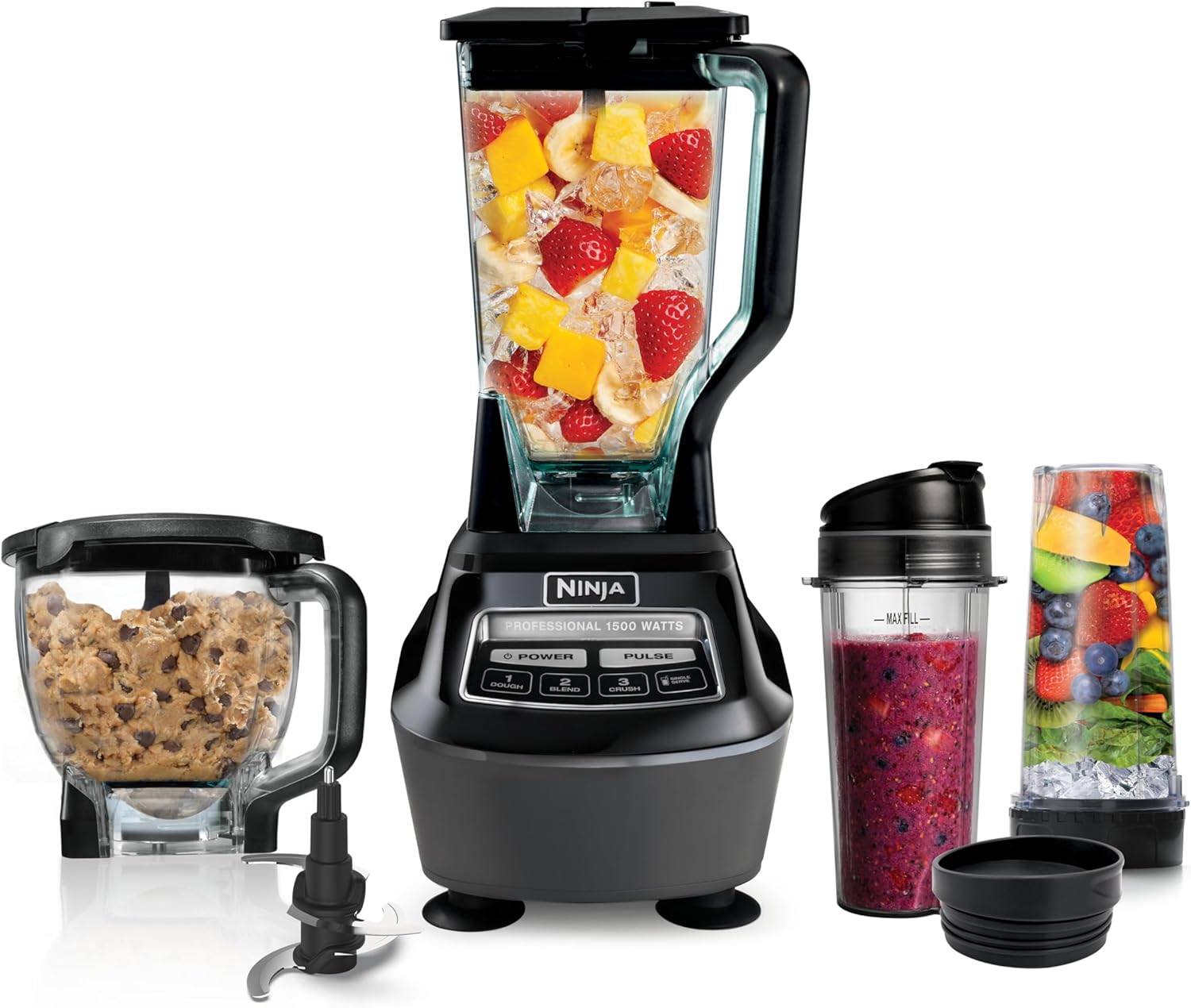
Ninja Mega Kitchen System BL770
| Wattage | 1500 watts |
|---|---|
| Number of Speeds | 5 |
| Capacity | 16 fluid ounces |
| Power Source | ac_dc |
The Ninja Mega Kitchen System BL770 combines a powerful 1500W motor with multiple containers and blade sets to handle most home kitchen tasks. You get an XL 72-oz pitcher with Total Crushing Blades for smoothies and ice crushing, an 8-cup food processor bowl with chopping and dough blades for vegetables and quick dough mixing, plus two 16-oz Nutri Ninja to-go cups for single-serve drinks. Controls are manual with five speeds and four main function modes that make it simple to switch between blending, mixing, crushing, and single-serve work. Most removable parts are dishwasher safe, and the stainless steel blades are effective on frozen fruit and ice. The unit is versatile for batch smoothies, meal prep, and small baking projects, but the motor base is fairly large and the system takes some counter space and storage room. Also, the manual controls lack presets, so you need to watch run times for delicate tasks like purees. For buyers wanting a single machine that covers blending and food processing jobs, it delivers strong performance and a useful accessory set.
Best for: Buyers who want one versatile countertop appliance that handles large-batch smoothies, food prep, and occasional dough mixing without buying separate machines.
Less Ideal for: People with very limited counter or storage space or those who prefer compact single-function appliances with automatic preset programs.
- 1500-watt motor provides strong ice crushing and blending power
- Includes XL 72-oz pitcher plus 8-cup processor and two 16-oz to-go cups for multiple uses
- Multiple specialized blades (total crushing, pro extractor, chopping, dough) cover blending and processing tasks
- Most removable parts are dishwasher-safe for easier cleanup
- Large footprint that requires significant counter or cabinet space
- Manual controls with no preset programs require more user attention for consistent results
Verdict: A powerful, multi-function blender and food processor combo that covers large-batch blending, chopping, and dough mixing for buyers seeking one versatile countertop machine.
Ganiza Food Processor GC10

| Wattage | 450 watts |
|---|---|
| Bowl Capacity | 0.95 gallons |
| Number of Speeds | 2 |
| Power Source | AC |
| Blade Material | Stainless Steel |
The Ganiza GC10 is a small countertop food processor built around a 450W copper motor and two 8-cup bowls (one glass, one stainless steel) so you can keep separate bowls for different ingredients. It runs on two speeds and ships with two sets of S-shaped stainless steel blades aimed at vegetables, meat, and harder items like nuts or frozen fruit. Typical use is quick prep jobs — chopping onions, grinding small amounts of meat for burgers, or making sauces and dips — and the paired bowls and removable blades make switching tasks straightforward. Safety features include a locking lid, spring-loaded blades that stop when the motor head is lifted, and an overheating protection cutoff that pauses the unit until it cools. Practical limits for bread bakers are its capacity and motor class: the 8-cup bowls and 450W motor handle small dough batches and light mixing but are not sized for heavy kneading or large loaves. Cleaning is easier thanks to removable parts and glass bowl durability, though frequent heavy use will push the thermal protection to engage more often.
Best for: Buyers who prioritize safety and predictable, low-risk performance for small-batch prep and occasional dough mixing will appreciate this unit as a compact, easy-to-use kitchen helper.
Less Ideal for: Anyone who needs to knead large quantities of bread dough or wants a processor capable of prolonged heavy-duty mixing should choose a larger, higher-powered machine designed for dough work.
- Includes two 8-cup bowls (glass and stainless steel) to separate tasks and avoid cross-contamination
- 450W copper motor with overheating protection for safer, longer run times in short bursts
- Two speed settings plus two blade sets let you control texture from coarse chops to finer grinds
- Removable blades and dishwasher-safe bowls simplify cleanup
- Built-in safety lock and blade stop feature when motor head is lifted
- 450W motor and 8-cup capacity are insufficient for heavy kneading or large bread dough batches
- Thermal protection can interrupt long or continuous processing until the unit cools
Verdict: A safe, compact food processor for small-batch prep and light dough mixing when you want predictable, low-risk performance.
Choosing the Right Food Processor for Making Bread Dough: Key Factors to Consider
Motor Torque and Power Delivery
Strong, sustained torque is the single most important factor when using a food processor for bread dough. Dough requires continuous resistance as gluten develops, and a weak motor will stall, overheat, or strain the drive train. Look for processors designed to run at lower speeds with stable torque rather than short high-wattage bursts.
Reliable power delivery reduces the chance of the blade stalling mid-knead, which can lead to inconsistent dough development. Consider how often you plan to knead and whether the machine has thermal protection or active cooling to handle repeated dough batches without loss of performance.
Bowl Capacity and Shape
Bowl size determines the maximum dough batch you can handle and how much headroom there is for mixing. For single loaves you can usually manage with a medium bowl, but if you bake multiple loaves or larger recipes you need a larger volume to prevent overflow and ensure ingredients incorporate evenly.
The internal shape matters too. Taller bowls help contain flour dust and splatter, while wider shallow bowls may mix unevenly with heavy dough. Match bowl capacity to your typical recipe size and allow extra volume for hydrated doughs.
Dough Blade Design and Durability
A dedicated dough blade or attachment designed for low-speed kneading protects both the dough and the machine. Metal, commercially tempered blades resist bending and wear, while poorly made plastic blades can snap or deform under the torque of heavy dough.
Durability also affects long-term value. Check for secure blade mounting and a drive interface built to handle torsional stress. Durable blades reduce the risk of introducing plastic shavings into dough and extend the functional life of the processor for baking tasks.
Heat Management and Thermal Protection
Kneading generates heat from the motor, which can warm the dough and shorten workable time or damage motor windings. Good heat management includes vents, heat sinks, or automatic shutoff/thermal cutouts that let the machine rest before damage occurs.
A processor that runs cool or has thermal protection lets you perform longer kneading cycles or back-to-back batches without risking motor failure. For home bakers who run multiple recipes in one session, this factor is especially important.
Stability and Base Design
A stable base prevents movement during high-torque kneading, which keeps the work area safer and the dough mixing consistent. Non-slip feet, low center of gravity, and well-distributed weight help the processor remain stationary even with sticky, resistant dough.
A machine that rocks or shifts can cause uneven kneading and increase wear on the drive mechanism. Consider where you will operate the processor and whether your countertop provides a solid, level surface for heavier units.
Ease of Cleaning and Maintenance
Bread dough can be sticky and cling to bowls, blades, and seals. Removable parts that are dishwasher-safe or have smooth surfaces make cleanup faster and reduce the chance of dough buildup that can harbor bacteria or affect future batches.
Also consider how easy it is to disassemble and reassemble blades and seals. Components that snap together awkwardly or hide residues in crevices add time and increase the risk of damage during cleaning. Durable, serviceable parts reduce long-term ownership hassle.
How A Food Processor Changes Your Dough Workflow
Using a food processor for dough shortens the time needed for initial mixing and short kneads. Rather than hand-kneading for 10 to 15 minutes, a processor can combine ingredients and perform a short knead cycle in under five minutes, which is especially helpful for enriched breads or recipes that require quick gluten development.
That said, processors are best for initial mixing and short kneads rather than extended kneading sessions. Many bakers use the processor to bring the dough together and then finish by hand or with a stand mixer for longer development and folding.
- Speeds up mixing and initial kneading
- Reduces manual effort and arm fatigue
- Best for short kneads and small to medium batches
Practical Batch Sizing and Recipe Scaling
Match your processor's usable bowl volume to the recipes you bake most often. A bowl listed as large may not be practical if its usable volume for dough is limited by the blade or lid design. When scaling recipes up, allow at least 25 percent extra space for hydration and expansion.
If you plan to double recipes occasionally, choose a model whose capacity comfortably accommodates the larger mass. For frequent large batches, opt for processors designed with commercial-style bowls or higher-capacity housings.
- Allow extra headroom for hydrated dough
- Check usable volume versus listed capacity
- Avoid constant overfilling to protect motor and seals
Attachment Choices and How They Affect Dough
Some processors include a dedicated dough blade, while others rely on a multipurpose S-blade. A purpose-built dough blade kneads at lower speeds and distributes force more evenly, reducing heat and preventing overworking the dough. Multipurpose blades can work in a pinch but may not deliver the same texture consistency.
Also consider whether the processor offers multiple speed settings and pulse control. Low, steady speeds are essential when handling wet, sticky doughs to avoid splatter and to let gluten form without shredding.
- Prefer low-speed dough attachments for kneading
- Multiple speeds and pulse help control mixing
- Accessories that are easy to remove simplify cleanup
Common Mistakes When Using a Processor for Dough
Overfilling the bowl is a frequent error that leads to poor mixing and added strain on the motor. Start with smaller batches if you are unsure about capacity and increase only after monitoring how the processor handles the dough.
Another common issue is running extended continuous kneading cycles. Processors are optimized for short, efficient work intervals. If a recipe calls for long kneading, break cycles into shorter intervals with rest periods to avoid overheating.
- Do not overfill beyond recommended capacity
- Avoid very long continuous kneading runs
- Use low speeds for initial mixing of hydrated doughs
Maintaining Seals and Drive Components
Inspect seals and gaskets regularly; dough and flour can work into crevices and accelerate wear. Clean around the drive coupling after each use and check that the blade hub engages smoothly without wobble.
For long-term reliability, follow a simple maintenance routine: clean parts promptly after use, allow components to dry fully before storage, and replace worn seals to prevent leaks and gear damage.
- Clean seals and coupling areas after each use
- Replace worn gaskets to avoid leaks and contamination
- Store components dry to prevent mold or corrosion
How We Chose the Best Food Processor for Making Bread Dough
We selected models based on concrete, dough-specific performance factors and real-world usability. Primary filters included sustained motor torque under load, presence and durability of dough or kneading blades, and bowl capacity suitable for common home-baking batch sizes. We also prioritized machines with stable drive systems and cooling features that prevent overheating during multi-minute kneading cycles. Secondary considerations included ease of assembly and cleaning, secure lid and feed-chute design for adding ingredients safely during mixing, and the availability of robust warranties or service options. We excluded compact choppers and mini processors that lack the motor torque or bowl volume needed for typical bread dough, as well as units with plastic gear drives prone to stripping under dough loads. In practice, our shortlist favors food processors that combine sustained torque, appropriate bowl volume, and durable dough-handling accessories. These criteria align closely with how home bakers use a processor for mixing, short kneading, and handling heavy, sticky doughs.
Our full evaluation process is outlined in our review methodology.
FAQ
Can I use a standard S-blade to knead bread dough?
A standard S-blade can bring ingredients together but is not ideal for extended kneading. It tends to cut and tear gluten rather than stretch it, so a dedicated low-speed dough blade or attachment produces better texture and less heat buildup.
How much dough can a typical home food processor handle?
Capacity varies by model, but practical dough limits are often lower than listed bowl volume because dough requires headroom. For most home processors, small to medium single-loaf batches work best, while larger batches may overload the motor.
Will kneading in a processor warm the dough too much?
Short kneading cycles in a processor usually do not overheat dough, but long continuous runs can raise dough temperature. Use short intervals and allow the motor to rest between cycles to keep dough cool and maintain yeast performance.
How do I know if my processor is struggling with the dough?
Signs of strain include frequent stalling, excessive noise, burning smells, or the motor running unusually hot. If you notice these, stop, let the unit cool, reduce batch size, or switch to manual kneading to avoid damaging the machine.
Are metal dough blades worth it over plastic ones?
Metal dough blades are generally more durable and resist deformation under torque, which makes them preferable for regular bread-making. Plastic blades may be lighter and cheaper but can wear or crack with heavy doughs.
Final Verdict
When choosing a food processor for making bread dough, prioritize sustained motor torque, an appropriately sized bowl, and a durable dough blade. Those elements determine whether a unit can handle typical home-baking batches without stalling or overheating. Also weigh heat management and ease of cleaning, since those affect performance and maintenance over time. Balance capacity against how often you bake and the size of your recipes. For occasional small loaves, a medium-capacity unit with a solid dough blade will be sufficient. If you bake larger or more frequent batches, choose a processor designed to handle heavier loads and better thermal stress to ensure consistent, reliable results.