
Note: This article contains affiliate links. If you click on these links and make a purchase, we may earn a small commission at no extra cost to you. This helps support our research and content. Read our full affiliate disclosure here.
If you bake bread at home, the right food processor can turn dough prep from a chore into a fast, reliable step in your routine. A processor built to handle bread dough saves time on mixing and kneading, reduces physical effort, and helps you get a more consistent crumb and rise. This guide shortlists the top food processors suited to bread making and explains the practical tradeoffs that matter when you convert a general kitchen machine into a dough-working tool. Below you will find our top picks for kneading and mixing dough, with evaluation focused on motor capacity, usable bowl size, and ease of cleanup. Read on to match a model to your weekly baking volume and preferred dough types.
Top Picks at a Glance
| Best Overall The best all-around choice for most situations | Cuisinart 14-Cup Food Processor DFP-14BCNY |  |
| Best Value The sweet spot between price and what you get | Hamilton Beach 10-Cup Food Processor 70730 |  |
| Best Budget The cheapest option that still gets the job done reliably | Hamilton Beach 8-Cup Food Processor |  |
| Top Rated A top-rated pick with lots of positive feedback | Ninja PrecisionPro BZ601 |  |
| Most Popular A crowd favorite that many people choose with confidence | Ninja Mega Kitchen System BL770 |  |
| Best Seller A high-volume bestseller chosen again and again | Ganiza Food Processor GC10 |  |
Cuisinart 14-Cup Food Processor DFP-14BCNY

| Wattage | 720 watts |
|---|---|
| Bowl Capacity | 14 cups |
| Number of Speeds | 1 |
| Power Source | Corded Electric |
| Blade Material | Stainless Steel |
The Cuisinart 14-cup food processor is a heavy-duty kitchen workhorse built around a 720-watt motor and a large stainless steel bowl that handles batch prep and light dough tasks. It ships with a stainless steel chopping blade, a 4mm slicing disc and a medium shredding disc, and its simple on/off and pulse controls make it easy to use for shredding cheese, slicing vegetables, making purees and mixing or kneading small amounts of dough. Dishwasher-safe parts and a detachable disc stem simplify cleanup. Because it has a single speed with pulse rather than multiple speed settings, you control texture by pulsing and timing rather than dialed speeds, which works well for most prep but can require more attention for delicate doughs. The unit is sizable and fairly heavy, so it suits a countertop with enough clearance and stable placement. For home bakers who make bread occasionally and need a reliable unit for prep plus dough mixing, this model balances power and capacity with straightforward controls.
Best for: Home bakers who want a capable, no-nonsense processor for frequent batch prep and occasional bread dough mixing, prioritizing power and capacity over multiple speed controls.
Less Ideal for: If you bake large loaves regularly and need precise low-speed kneading or a dedicated stand mixer for long dough cycles, choose a specialized mixer instead.
- Powerful 720-watt motor that can handle heavy chopping and small dough mixing
- Large 14-cup bowl good for batch prep and mixing larger quantities
- Stainless steel blades and discs for consistent slicing and shredding
- Dishwasher-safe removable parts and detachable disc stem for easier cleanup
- Simple controls (on/off and pulse) make operation intuitive
- Single-speed design means no dedicated low-speed kneading setting for more delicate dough control
- Relatively large and heavy footprint requires stable counter space
Verdict: A powerful 14-cup processor that delivers solid mixing and dough-kneading performance for home bakers who want capacity and simplicity.
Hamilton Beach 10-Cup Food Processor 70730

| Wattage | 450 watts |
|---|---|
| Bowl Capacity | 10 cups |
| Number of Speeds | 2 |
| Power Source | Wall outlet |
This Hamilton Beach 10-cup food processor is a straightforward countertop unit designed for everyday prep tasks. It pairs a 450-watt motor with an S-blade and a reversible slicing/shredding disc to handle chopping, grating, slicing and pureeing, while the large feed chute reduces prep time. The standout practical feature is the integrated bowl scraper that keeps ingredients near the blade so you rarely need to stop and scrape by hand. Two speed settings plus pulse give reliable control for delicate mixing or more aggressive processing. Removable parts are dishwasher safe and BPA-free, which makes cleanup simple after kneading or mixing dough-adjacent batters and for shredding cheese or vegetables for bread toppings. Limits to note: the 450-watt motor and 10-cup bowl are fine for small-to-medium doughs or mixing wet batters but are not built for heavy or high-volume bread dough kneading that demands higher torque or a dedicated stand mixer with a dough hook. For routine kitchen prep and occasional light bread mixing, it is efficient and easy to maintain.
Best for: Buyers who want a practical, easy-to-clean food processor for routine prep, occasional dough mixing, and multi-task kitchen use without needing a heavy-duty stand mixer.
Less Ideal for: Home bakers who regularly knead large or dense bread doughs and need high torque and larger-capacity mixing should choose a dedicated stand mixer instead.
- Built-in bowl scraper keeps ingredients against the blade to reduce manual scraping
- 450-watt motor handles chopping, shredding, slicing, and pureeing efficiently
- Large feed chute reduces prep time by accepting bigger pieces
- Dishwasher-safe, BPA-free removable parts simplify cleanup
- Motor and bowl size are limited for heavy or large-quantity bread dough kneading
- Two speeds may lack fine control for very delicate mixing tasks
Verdict: A practical, easy-to-clean 10-cup processor with a bowl scraper that speeds routine prep and handles light bread mixing tasks well.
Hamilton Beach 8-Cup Food Processor

| Bowl Capacity | 8 cups |
|---|---|
| Wattage | 450 watt-hours |
| Number of Speeds | 2 |
| Power Source | AC |
The Hamilton Beach 8-Cup Food Processor is a straightforward countertop unit that speeds up common prep jobs like chopping, shredding and pureeing. It includes a stainless steel S-blade for chopping and mixing plus a reversible slicing/shredding disc, and a large feed chute that accepts bigger items to reduce pre-cutting. Two speeds plus pulse and a 450-watt motor give usable control for vegetables, cheese and wet mixtures, and the bowl, lid and blades are dishwasher safe for easy cleanup. For bread making this model can handle mixing small doughs and combining wet ingredients but its capacity and motor are modest compared with dedicated heavy-duty dough-capable machines, so expect to work in smaller batches and avoid very stiff or high-volume doughs. The lid nests into the bowl for compact storage and the parts are plastic with stainless blades, keeping the unit lightweight and easy to store. Overall it is a capable, budget-friendly choice for everyday prep and occasional small-batch dough mixing, but not a replacement for a full-size stand mixer for regular bread baking.
Best for: Buyers on a tight budget who want a reliable, no-frills food processor for daily chopping, slicing and small-batch mixing and who only occasionally mix bread dough.
Less Ideal for: People who bake large loaves frequently or need heavy-duty dough kneading should choose a stand mixer or a higher-capacity, commercial-grade processor instead.
- 450-watt motor provides enough power for chopping, shredding and light mixing
- Includes stainless steel S-blade and reversible slice/shred disc for versatile prep
- Large feed chute reduces pre-cutting and speeds up processing
- Dishwasher-safe bowl, lid and blades for easy cleanup
- Compact storage with lid that nests into the bowl
- 8-cup capacity limits batch size for dough or large recipes
- Motor and plastic gearing are not designed for heavy, frequent dough kneading
Verdict: A budget-friendly, compact food processor that handles everyday chopping, shredding and light dough mixing for occasional bread makers.
Ninja PrecisionPro BZ601

| Wattage | 1000 watts |
|---|---|
| Bowl Capacity | 9 cups |
| Number of Speeds | 3 |
| Power Source | ac_dc |
The Ninja PrecisionPro BZ601 is a mid‑size food processor built around a powerful 1000‑peak‑watt motor and a 9‑cup processing bowl, designed to handle everything from quick chops to dough mixing. It comes with a chopping blade, dough blade, and a reversible slicing/shredding disc plus an XL feed chute, and four Auto‑IQ preset programs that automate common tasks for consistent results. In practice the motor gives enough torque to mix pizza or bread dough for small batches and the dough blade simplifies hands‑on kneading, while the stainless steel blades and disc deliver even slicing and shredding for sandwich prep and add‑ins. Parts are BPA‑free and dishwasher safe which keeps cleanup simple after heavy use. Limitations are the 9‑cup capacity for larger loaves or big batches and only three manual speeds if you want fine speed control; heavy, very stiff doughs may still need short manual kneading. For home bakers making weekly loaves or multiple small doughs, this unit balances power and convenience in a compact footprint.
Best for: Home bakers who prioritize reliable, repeatable performance for weekly bread and dough prep and want a compact processor that handles chopping, shredding, and dough mixing without a steep learning curve.
Less Ideal for: Bakers who routinely make very large loaves, commercial quantities, or need precise multi‑speed control for specialty doughs should consider a larger or dedicated stand mixer.
- 1000‑peak‑watt motor provides strong, consistent power for mixing and dough tasks
- Includes dough blade plus chopping blade and reversible slicing/shredding disc for versatile prep
- Auto‑IQ presets automate common jobs for consistent results with one touch
- 9‑cup bowl and XL feed chute handle family‑size prep without frequent refills
- BPA‑free, dishwasher‑safe parts simplify cleanup after heavy use
- 9‑cup capacity may be limiting for very large loaves or bulk batches
- Only three manual speeds offer limited fine control for specialty doughs
Verdict: A dependable, compact food processor with a strong motor and a dough blade that makes weekly bread and small‑batch dough work fast and simple.
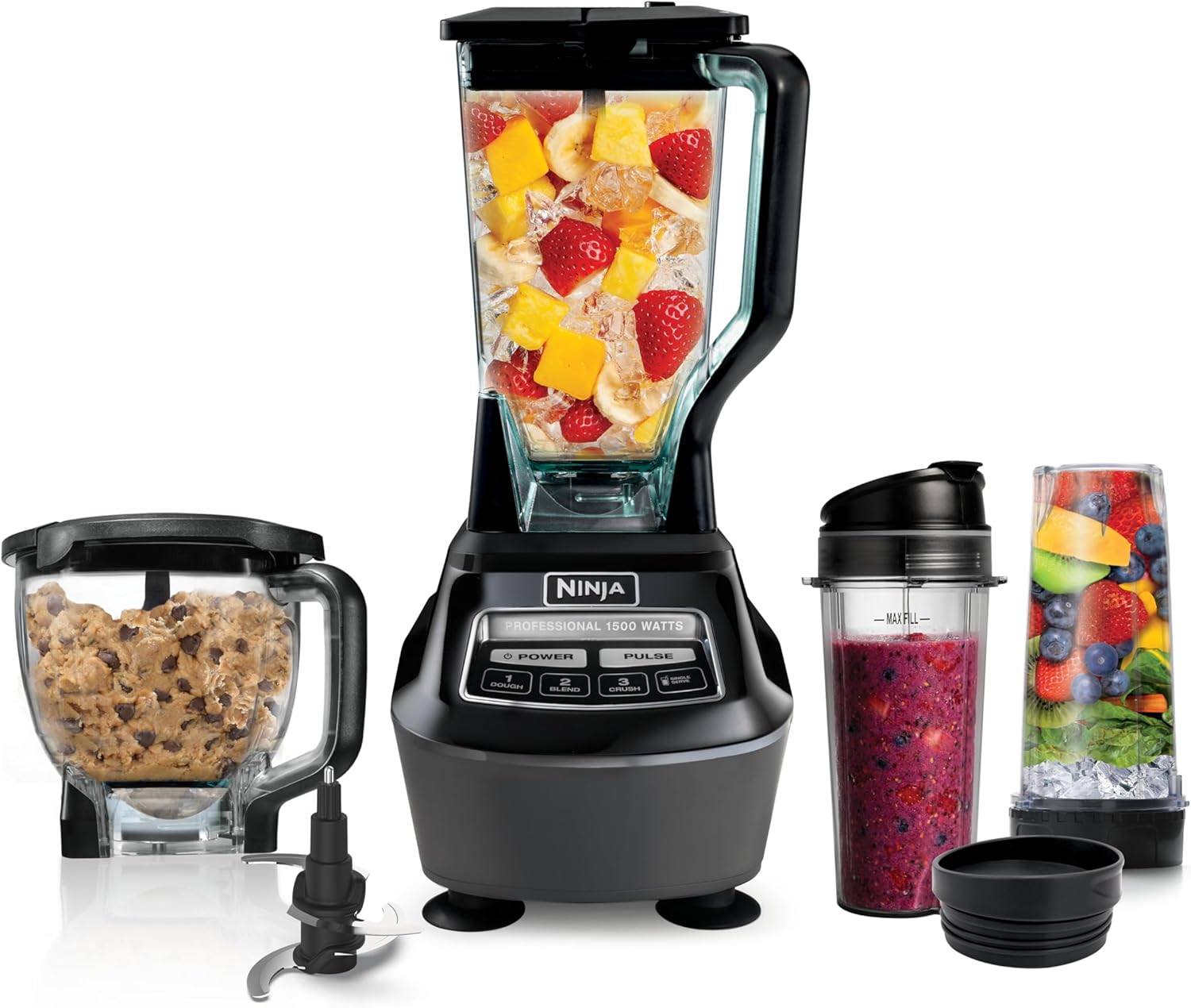
Ninja Mega Kitchen System BL770
| Wattage | 1500 watts |
|---|---|
| Number of Speeds | 5 |
| Capacity | 16 fluid ounces |
| Power Source | ac_dc |
The Ninja Mega Kitchen System BL770 combines a powerful 1500W motor with multiple containers and blade sets to handle most home kitchen tasks. You get an XL 72-oz pitcher with Total Crushing Blades for smoothies and ice crushing, an 8-cup food processor bowl with chopping and dough blades for vegetables and quick dough mixing, plus two 16-oz Nutri Ninja to-go cups for single-serve drinks. Controls are manual with five speeds and four main function modes that make it simple to switch between blending, mixing, crushing, and single-serve work. Most removable parts are dishwasher safe, and the stainless steel blades are effective on frozen fruit and ice. The unit is versatile for batch smoothies, meal prep, and small baking projects, but the motor base is fairly large and the system takes some counter space and storage room. Also, the manual controls lack presets, so you need to watch run times for delicate tasks like purees. For buyers wanting a single machine that covers blending and food processing jobs, it delivers strong performance and a useful accessory set.
Best for: Buyers who want one versatile countertop appliance that handles large-batch smoothies, food prep, and occasional dough mixing without buying separate machines.
Less Ideal for: People with very limited counter or storage space or those who prefer compact single-function appliances with automatic preset programs.
- 1500-watt motor provides strong ice crushing and blending power
- Includes XL 72-oz pitcher plus 8-cup processor and two 16-oz to-go cups for multiple uses
- Multiple specialized blades (total crushing, pro extractor, chopping, dough) cover blending and processing tasks
- Most removable parts are dishwasher-safe for easier cleanup
- Large footprint that requires significant counter or cabinet space
- Manual controls with no preset programs require more user attention for consistent results
Verdict: A powerful, multi-function blender and food processor combo that covers large-batch blending, chopping, and dough mixing for buyers seeking one versatile countertop machine.
Ganiza Food Processor GC10

| Wattage | 450 watts |
|---|---|
| Capacity | 0.95 gallons |
| Voltage | 120 volts |
| Material Type | Stainless Steel, Glass |
The Ganiza GC10 is a compact 450W food processor built for everyday chopping, grinding, and light meat processing. It ships with two 8-cup bowls — one glass and one stainless steel — plus two sets of S-shaped stainless blades and two speed settings, so you can switch between coarse and finer chops without swapping tools. The full-copper motor and an overheating protection system are intended to extend motor life and stop operation if it gets too hot, while a spring-loaded safety design stops the blades when the motor head is removed. In practice the machine handles vegetables, nuts, and small batches of dough ingredients quickly and is easy to clean thanks to removable blades and simple bowls. Limitations include a modest 450W motor and a sub-gallon combined capacity, so heavy dough mixing for large loaves or frequent intense kneading sessions will push the unit and may trigger the thermal cutout. For routine home baking tasks — chopping add-ins, mixing small doughs, and preparing fillings — it is convenient and safe for cautious buyers.
Best for: Buyers who prioritize safety and reliability and need a compact processor for everyday baking prep like chopping add-ins, mixing small dough batches, and preparing fillings.
Less Ideal for: Bakers who routinely make large loaves or rely on intensive, continuous kneading should choose a heavier-duty stand mixer or higher-powered processor instead.
- Two 8-cup bowls (glass and stainless steel) let you separate ingredients and avoid cross-contamination
- Two speed settings with S-shaped stainless blades for quick coarse or finer chopping
- Full-copper motor with built-in overheating protection to improve durability and safety
- Removable blades and simple bowl design make cleanup straightforward
- 450W motor and under-1-gallon capacity limit heavy dough kneading or large batch processing
- Not intended for continuous heavy-duty use; thermal protection can require cooldown periods
Verdict: A safe, user-friendly compact food processor that handles small baking prep tasks and mix-ins reliably for cautious home bakers.
Choosing the Right Food Processor for Making Bread: Key Factors to Consider
Motor Power and Torque
Bread dough is dense and can stall weak motors. Higher continuous torque matters more than peak wattage because kneading requires sustained force to develop gluten. Look for motors and gear designs rated for prolonged low-speed work rather than machines optimized solely for high-speed slicing or pureeing.
A motor with good torque reduces strain and the risk of overheating when the processor works through heavy dough. It also shortens kneading time and improves texture consistency across batches.
Bowl Capacity and Shape
The usable bowl volume determines the maximum batch you can mix in one go. If you bake multiple loaves or larger artisan recipes, a larger bowl avoids multiple mixes that change dough hydration and development. Consider the effective working capacity, which is often less than the total labeled volume once ingredients and kneading motion are accounted for.
Bowl shape matters too. A wider, shallow bowl gives the dough room to move and encourages even kneading, while a very tall, narrow bowl can limit movement and stress the motor.
Dough Blade and Drive Interface
Not all processing blades are equally effective at kneading. Dedicated dough blades or attachments with a gentle folding action mimic hand kneading better than sharp chopping blades. The drive interface should hold the blade securely with minimal wobble to avoid uneven gluten development and wear on the coupling.
A removable, sturdy dough blade also makes cleanup easier and reduces the chance of dough getting trapped in hard-to-reach crevices.
Heat Management and Continuous Use
Kneading sessions often run longer than quick chop cycles. Good heat dissipation and thermal protection let a processor run multiple kneading cycles without performance loss. Machines designed with cooling vents, thermal cutoffs, or heavier-duty components will maintain torque and avoid shutdowns during typical bread-baking workflows.
Check duty-cycle recommendations and look for features that indicate sustained-use capability rather than appliances meant for intermittent, short tasks.
Stability and Safety Features
Dough can pull and shift unpredictably. A stable base with strong suction or non-slip feet prevents movement that can stress the motor or cause spillage. Safety interlocks that prevent operation when the lid is loose are important for working with sticky, elastic dough.
Consider latch quality and lid sealing because a tight, reliable fit prevents accidents and keeps flour dust contained during mixing.
Cleaning and Maintenance
Bread dough sticks and cures into nooks quickly. Machines with simple disassembly, dishwasher-safe parts, and smooth internal surfaces cut down cleanup time. Fewer seams and accessible seals reduce the risk of trapped flour that can harbor moisture and odors over time.
Also factor in how easy it is to remove dried dough from blades and seals and whether replacement parts like gaskets or couplings are straightforward to service.
How a Food Processor Handles Dough Compared with a Mixer
Food processors use a high-torque blade rotating in a bowl to work dough differently than a stand mixer with a hooked paddle. Processors can be faster for initial mixing and are excellent at cutting in fats or quickly incorporating liquids, while mixers excel at long, low-speed kneading.
For bread bakers, that means processors are best viewed as a time-saving tool for initial development and short kneading bursts. Understanding that difference helps you pick a processor that complements, not replaces, traditional kneading when needed.
- Processors excel at fast hydration and initial dough formation.
- Mixers provide gentler, prolonged kneading for high-hydration or long-fermentation doughs.
- Choose a processor with appropriate torque to avoid overheating during kneading bursts.
Batch Sizing and Practical Baking Workflows
Match bowl capacity to your typical batch size. If you bake once a week for a family, a medium-large bowl will likely suffice. If you routinely make multiple loaves or larger artisan recipes, prioritize larger usable capacity to avoid double-mixing.
Plan workflows around processor strengths. Use the processor for mixing and short kneads, then complete gluten development by hand or with resting and folding if necessary. This hybrid approach saves time and still produces good dough structure.
- Test a new recipe with half a batch to observe how the machine handles the dough before scaling up.
- Allow rest times between short kneading cycles to reduce motor strain on long batches.
Managing High-Hydration and Sticky Doughs
High-hydration doughs can be challenging because they cling to surfaces and require more tolerant blade action. Look for processors with dough blades that allow folding and pulling rather than slicing. Adding water gradually and using brief pulse-like kneading cycles helps the dough come together without overworking the motor.
If you bake a lot of wet, open-crumb loaves, consider workflow adjustments like using a bench scraper during processing pauses to prevent clumping around the blade and to keep the motor load steady.
- Add liquid slowly and monitor gluten development to avoid overhydrating in the bowl.
- Use interval kneading with rest periods for especially sticky or slack doughs.
Maintaining Your Processor for Heavy Dough Use
Regular maintenance preserves performance. Clean all parts thoroughly after each dough session to remove sticky residues that can harden. Periodically inspect seals, couplings, and the blade mounting for wear to avoid failure during a kneading cycle.
If your machine has recommended duty cycles or thermal protection, follow those to prevent premature motor wear. Proper storage of blades and gaskets away from moisture extends component life.
- Hand-wash removable components when possible and dry thoroughly before reassembly.
- Keep a spare set of common wear items like gaskets if you knead dough frequently.
Recipes and Techniques Optimized for Processors
Adjust traditional recipes to processor-friendly methods: reduce kneading time, allow longer autolyse periods, and use brief rest-and-knead intervals. Many bakers find that slightly shorter mixing yields better crumb structure because processors mix more aggressively than hands or mixers.
For enriched doughs with butter, add fats gradually once the dough has formed to prevent separation and to allow the blade to incorporate ingredients without overloading.
- Use autolyse to hydrate flour before vigorous mixing.
- Introduce butter in small pieces after initial gluten formation.
How We Chose the Best Food Processor for Making Bread
We evaluated candidates based on the demands of bread dough rather than general food prep. Key selection filters included motor power and torque, continuous-duty performance under dough load, and bowl capacity that allows for typical batch sizes from rolls to large loaves. We also prioritized robust dough blade design and secure lid/locking systems to handle stiff, hydrated dough without slippage. Ease of cleaning and durable materials were included because sticky dough and flour dust require accessible parts and surfaces that stand up to frequent use. We excluded compact processors designed exclusively for light chopping or pureeing and any units with known overheating issues under sustained load. Models with flimsy drive couplings or small bowls that force users to mix in multiple batches were filtered out. What remained are processors that balance power, capacity, and maintenance needs for reliable bread dough mixing and kneading.
Our full evaluation process is outlined in our review methodology.
FAQ
Can a food processor actually knead bread dough?
Yes, many food processors can knead bread dough effectively for short cycles. They excel at initial mixing and short bursts of kneading, though very long, gentle kneads may still be better done with a stand mixer or by hand.
What bowl size is ideal for a home baker making 2 loaves?
For two standard loaves, aim for a bowl with enough usable volume to hold the combined ingredients plus room to move, often in the medium-large range. Exact needs depend on your recipes, but avoid bowls that leave little headspace once ingredients are added.
How can I prevent my processor from overheating when making dough?
Use short kneading intervals with rest pauses between cycles, avoid overfilling the bowl, and follow any duty-cycle guidance from the manufacturer. Allow the motor to cool between long sessions and avoid forcing very large batches in one go.
Are dough blades necessary or can I use the standard chopping blade?
Dedicated dough blades tend to mimic folding actions and minimize cutting the dough, which improves gluten development. A standard chopping blade can work for initial mixing but may be less effective for final kneading and can tax the motor more.
How do I clean sticky dough from hard-to-reach parts?
Soak removable components briefly in warm water to loosen residue, then use a soft brush to clear seams and blade mounts. Dry parts thoroughly before reassembly to prevent trapped moisture and odors.
Final Verdict
Choosing the right food processor for making bread comes down to matching motor torque, usable bowl capacity, and durable dough-focused attachments to your baking habits. Expect processors to speed initial mixing and perform short, intensive kneading well, while very long, gentle kneads may still call for a different tool. Prioritize machines with solid thermal management, secure drive couplings, and easy-to-clean parts if you bake frequently. With those tradeoffs in mind, you can select a processor that reduces hands-on time and reliably produces consistent dough for your home-baked loaves.