
Note: This article contains affiliate links. If you click on these links and make a purchase, we may earn a small commission at no extra cost to you. This helps support our research and content. Read our full affiliate disclosure here.
If you bake often, the right food processor can turn a fiddly, hands-on chore into a quick, repeatable step in your workflow. A food processor for making pastry dough should combine enough torque to cut butter into flour, a bowl size that fits your batch, and controls that make short pulses reliable. In this guide we shortlisted the top options that excel at dough tasks and evaluated them for what home bakers actually need. Below you will find practical guidance and the top picks for different needs, plus the evaluation criteria we used to select them.
Top Picks at a Glance
| Best Overall The best all-around choice for most situations | Ninja Professional Plus BN601 |  |
| Best Quality Built to a higher standard if you want something more solid | Breville Sous Chef 9 Cup |  |
| Best Value The sweet spot between price and what you get | KOIOS Food Processor AMJ-301 |  |
| Best Budget The cheapest option that still gets the job done reliably | Hamilton Beach 8-Cup Food Processor 70740 |  |
| Top Rated A top-rated pick with lots of positive feedback | Cuisinart 14-Cup Food Processor DFP-14BCNY |  |
| Most Popular A crowd favorite that many people choose with confidence | Hamilton Beach Stack & Snap 12-Cup Food Processor |  |
| Best Seller A high-volume bestseller chosen again and again | Ganiza Food Processor GC10 |  |
Ninja Professional Plus BN601

| Wattage | 1000 watts |
|---|---|
| Bowl Capacity | 4.5 pounds |
| Number of Speeds | 3 |
| Power Source | AC adapter |
The Ninja Professional Plus BN601 is a versatile countertop food processor powered by a 1000-peak-watt motor and Auto-iQ preset programs that simplify common tasks like chopping, slicing, pureeing and mixing dough. It ships with a 9-cup precision bowl, a chopping blade, dough blade and a reversible slicing and shredding disc, so you can handle large batches and switch between tasks without swapping appliances. Auto-iQ offers one-touch cycles that deliver consistent results for sauces and purees, while the dedicated dough blade mixes and kneads heavier batters and doughs better than a standard multipurpose blade. Removable parts are dishwasher safe and blades are stainless steel for easy cleanup and reliable cutting performance. The unit is mostly plastic, so it is lighter than pro-grade metal machines and may not match heavy-duty commercial mixers for very stiff or large-volume doughs, but for home bakers making bread, pizza or pastry in small to medium batches it provides solid power and convenience. Safety interlocks and straightforward controls keep operation simple for everyday baking prep.
Best for: Home bakers who want a single countertop machine that handles chopping, slicing and reasonable dough mixing for pastries and small-to-medium bread batches with convenient presets.
Less Ideal for: Users who routinely make very large batches of dense dough or need a commercial-grade mixer for professional baking should consider a heavy-duty stand mixer instead.
- 1000-peak-watt motor provides strong power for chopping, pureeing and dough mixing
- Includes dough blade plus chopping blade and reversible slicing/shredding disc for versatile prep
- 9-cup bowl handles larger batches useful for family meals or multiple pastry portions
- Auto-iQ preset programs offer one-touch, consistent results for common tasks
- Removable parts are dishwasher safe and blades are stainless steel for easier cleanup
- Plastic construction is less heavy-duty than professional metal machines
- May struggle with very large volumes or extremely stiff dough compared with stand mixers
Verdict: A powerful, versatile home food processor that simplifies pastry dough mixing and general prep with Auto-iQ presets and a dedicated dough blade.
Breville Sous Chef 9 Cup
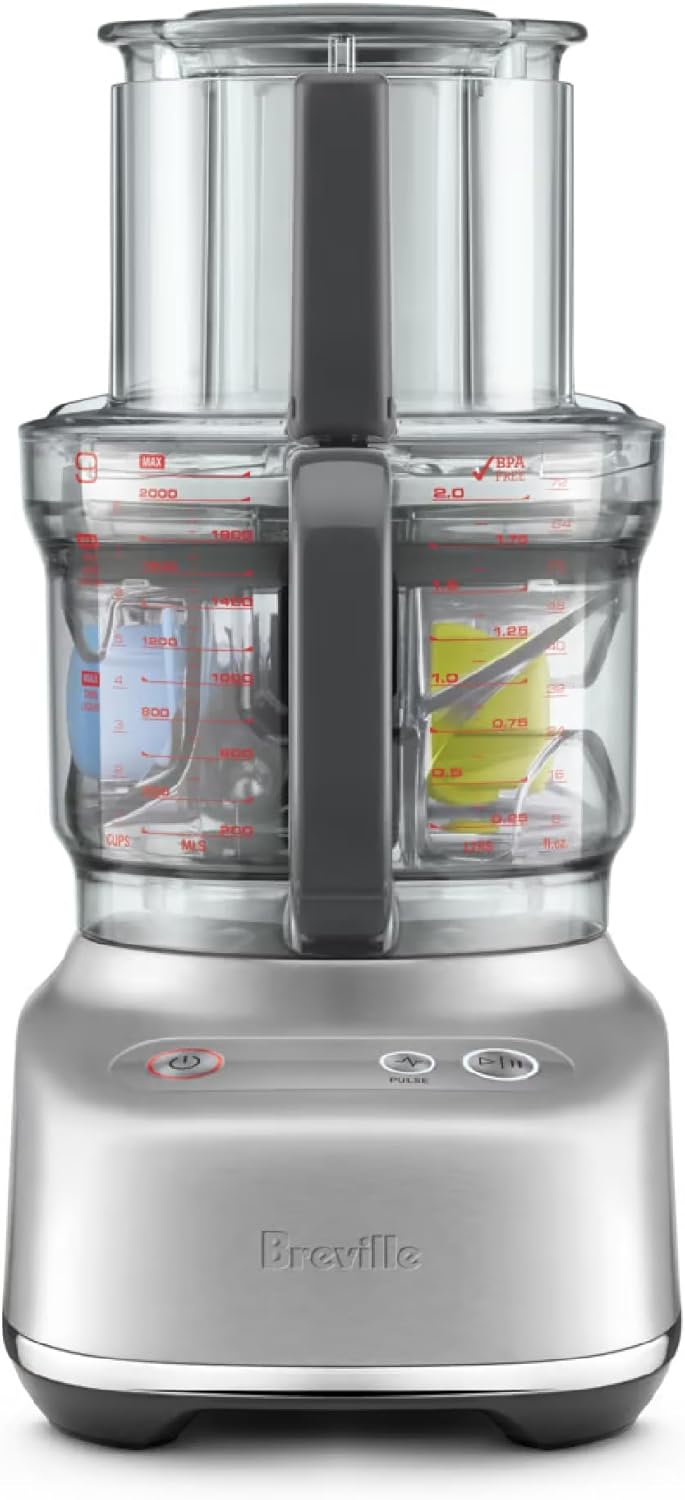
| Wattage | 625 watts |
|---|---|
| Bowl Capacity | 9 cups |
| Number of Speeds | 1 |
| Voltage | 120 volts |
The Breville Sous Chef 9 Cup is a performance-minded compact food processor built to handle frequent home use. It pairs a heavy-duty induction motor with a 9-cup bowl and a set of premium attachments including an S-blade, dough blade, reversible shredder, and adjustable slicer, so it covers chopping, shredding, slicing, and mixing tasks. The onboard storage caddy and color-coded accessories make switching tools and storing them neat and convenient. For pastry work the dough blade and sturdy motor translate to reliable kneading of small- to medium-batch doughs without overheating, and the wide feed chute helps incorporate add-ins quickly. Parts that contact food are dishwasher safe and made from BPA-free materials, which eases cleanup. Trade-offs are the single speed plus pulse control rather than multiple continuous speeds, and the 9-cup capacity limits very large batches, so it is best suited to serious home bakers who work mostly in small to medium quantities.
Best for: Home bakers who prioritize motor power and build quality for reliable kneading and frequent prep but typically work in small to medium batch sizes.
Less Ideal for: Bakers who regularly make very large batches of dough or need fine-grained continuous speed control for specialized recipes.
- Heavy-duty induction motor designed to handle tough tasks without bogging down
- Includes dough blade and S-blade for effective kneading and chopping
- Onboard storage caddy keeps attachments organized and accessible
- Adjustable reversible slicer and shredding disc add versatility for prep
- Dishwasher-safe, BPA-free bowl and parts for easier cleanup
- Only a single speed with pulse control instead of multiple continuous speed settings
- 9-cup capacity restricts very large dough batches
Verdict: Choose this compact processor if you want a durable, motor-forward machine that reliably kneads small to medium pastry doughs and stores neatly between uses.
KOIOS Food Processor AMJ-301

| Wattage | 500 watts |
|---|---|
| Bowl Capacity | 2 liters |
| Number of Speeds | 2 |
| Power Source | ac |
| Blade Material | Stainless Steel |
The KOIOS AMJ-301 is a small, practical food processor aimed at everyday prep tasks. It pairs a 500W pure copper motor with reversible bi-level stainless steel blades and two 8-cup (2 L) bowls so you can process two batches without flavor carryover or swap bowls for storage. Controls are simple with two speed modes plus a pulse function, and safety features include a hidden interlock and overheating auto shutoff. Detachable bowls and blades are dishwasher safe for easy cleanup, and rubber base rings help reduce vibration during use. For pastry work you can mix small quantities of dough or cut butter into flour, but the unit is limited to short run times (recommendations to not exceed 30 seconds per processing with rests) so heavy, continuous kneading is not its strength. Overall this is a space-saving, easy-to-clean processor that handles chopping, pureeing, and light dough tasks well but is not a substitute for larger, high-torque mixers for large or dense pastry doughs.
Best for: Buyers who want a compact, easy-to-clean processor for routine kitchen prep and occasional small-batch pastry tasks where convenience and storage matter most.
Less Ideal for: People who regularly make large or dense pastry doughs or who need continuous high-torque mixing should choose a larger, more powerful stand mixer or full-size food processor instead.
- Two 8-cup bowls let you process separate ingredients and stack for compact storage
- 500W pure copper motor with reversible bi-level blades for even chopping and pureeing
- Safety interlock and overheating auto shutoff protect the motor during heavy use
- Dishwasher-safe removable parts make cleanup fast
- Short recommended continuous run time and required cool-downs limit heavy kneading for large pastry batches
- Smaller capacity and lower torque mean dense or large doughs may require multiple batches or a stand mixer
Verdict: A compact, easy-to-clean processor that handles chopping and light pastry mixing for small batches, ideal when counter space and quick cleanup are top priorities.
Hamilton Beach 8-Cup Food Processor 70740

| Bowl Capacity | 8 cups |
|---|---|
| Wattage | 450 watt-hours |
| Number of Speeds | 2 |
| Power Source | AC |
The Hamilton Beach 8-Cup Food Processor is a small, practical unit for everyday kitchen prep like chopping, shredding, slicing and pureeing. It pairs a 450-watt motor with an S-blade and a reversible slice/shred disc, plus two speeds and pulse control, so it handles tasks from shredding cheese to making pesto with minimal fuss. The large feed chute accepts bigger pieces, cutting down on pre-chopping when you are working with blocks of butter or chilled ingredients used in pastry work. Parts that contact food are dishwasher safe for quick cleanup and the lid nests into the bowl for compact storage. For pastry dough specifically, the processor can quickly cut cold butter into flour for shortcrusts and pie crusts, though its 8-cup capacity limits batch size and the motor is designed for light- to medium-duty use rather than heavy kneading. Expect good results for small batches and for speeding the initial dough-mixing steps, but larger or very heavy doughs will require hand mixing or a stronger stand mixer.
Best for: A buyer who wants an affordable, space-saving processor to speed up pastry prep steps like cutting cold butter into flour and making small batches of dough.
Less Ideal for: Bakers who need to mix or knead large volumes of heavy dough regularly should choose a larger-capacity processor or a dedicated stand mixer instead.
- Compact 8-cup bowl fits most small-batch prep and stores easily.
- 450-watt motor with two speeds plus pulse gives usable control for chopping and cutting in butter.
- Stainless steel S-blade and reversible disc add versatility for slicing, shredding and pureeing.
- Large feed chute reduces pre-chopping of ingredients like blocks of butter or apples.
- Dishwasher-safe bowl, lid and blades simplify cleanup.
- 8-cup capacity restricts you to small dough batches.
- Motor and controls are not suited for heavy kneading or large-volume doughs.
Verdict: A budget-friendly compact processor that reliably speeds the initial pastry dough steps for small batches like pie crusts and shortcrusts.
Cuisinart 14-Cup Food Processor DFP-14BCNY

| Wattage | 720 watts |
|---|---|
| Bowl Capacity | 14 cups |
| Number of Speeds | 1 |
| Power Source | Corded Electric |
The Cuisinart 14-cup food processor is a heavy-duty kitchen workhorse built around a 720-watt motor and a large stainless steel bowl that handles batch prep and dough tasks with ease. Typical uses include chopping vegetables, shredding cheese, slicing whole produce through the wide feed tube, making purees and using the chopping blade to knead small to medium pastry doughs. It ships with a stainless steel slicing disc, shredding disc and chopping/mixing blade, and most removable parts are dishwasher-safe for easier cleanup. The single-speed plus pulse control keeps operation simple while the powerful motor and roomy bowl give the machine the torque and capacity needed for denser mixes like cookie or tart dough. Limitations include only one speed setting so fine speed control is manual and the shredding/slicing discs are not adjustable for thickness variety, and the unit is fairly heavy and sizable on the counter. For bakers who need a reliable, motor-forward processor for routine dough and prep, this model delivers consistent performance.
Best for: Bakers who prioritize a durable, powerful machine that reliably handles frequent dough mixing and large-batch prep and who value straightforward controls over fine electronic speed tuning.
Less Ideal for: Users seeking precise multi-speed control for delicate doughs or those with very limited counter space should consider a different compact or variable-speed appliance.
- 720-watt motor provides strong torque for kneading and dense mixtures
- Large 14-cup stainless steel bowl handles larger dough batches and big prep tasks
- Includes stainless steel slicing and shredding discs plus a chopping/mixing blade
- Dishwasher-safe removable parts make cleanup straightforward
- Only one speed plus pulse limits precise speed control for delicate doughs
- Shredding and slicing discs are fixed thicknesses and not adjustable
Verdict: Choose this Cuisinart if you want a sturdy, motor-forward food processor that reliably kneads and handles large pastry dough batches.
Hamilton Beach Stack & Snap 12-Cup Food Processor

| Wattage | 450 watts |
|---|---|
| Bowl Capacity | 12 cups |
| Number of Speeds | 2 |
| Blade Material | Stainless Steel |
| Power Source | ac_dc |
The Hamilton Beach Stack & Snap 12-Cup Food Processor is built for straightforward everyday prep and larger batches, using its 12-cup sealed bowl and 450-watt motor to chop, shred, slice and puree. The Stack & Snap design makes assembly and disassembly quick and avoids fiddly twist locks, while the big-mouth chute accepts whole potatoes or tomatoes to reduce pre-cutting. It ships with an S-blade for chopping and pureeing plus a reversible stainless steel slicing/shredding disc, and removable parts are dishwasher safe for easy cleanup. Suction-cup feet add countertop stability during use. For dough work, the 450-watt motor handles small pastry doughs and shortcrust tasks but it is not a heavy-duty dough mixer and will struggle with very stiff or high-hydration bread doughs. The sealed bowl and pour spout help contain mess when processing wet ingredients, and the two-speed control keeps operation simple. If you want a reliable, easy-to-use processor for pie dough, pastry batches, and general prep, this model covers those needs affordably; for frequent large or heavy kneading you should consider a dedicated stand mixer instead.
Best for: Buyers who value easy assembly, simple controls, and the ability to make medium-sized batches of pastry doughs and typical kitchen prep without investing in a stand mixer.
Less Ideal for: Bakers who regularly make large volumes of heavy, high-hydration, or long-kneaded doughs should choose a dedicated stand mixer with a stronger motor and dough hook instead.
- Large 12-cup sealed bowl for processing bigger batches without leaks
- Stack & Snap assembly reduces time and frustration when putting the unit together
- Includes S-blade plus reversible slicing/shredding disc for common prep tasks
- Dishwasher-safe removable parts and sealed bowl simplify cleanup
- Suction-cup feet improve stability during processing
- 450-watt motor is modest and can struggle with very stiff or heavy doughs
- Two-speed control limits fine-tuned speed selection for delicate textures
Verdict: A simple, easy-to-assemble 12-cup processor that is a sensible, space-saving choice for making pie and pastry doughs in small to medium batches.
Ganiza Food Processor GC10

| Wattage | 450 watts |
|---|---|
| Capacity | 0.95 gallons |
| Voltage | 120 volts |
The Ganiza GC10 pairs a 450W copper motor with two interchangeable 8-cup bowls—one glass and one stainless steel—and two speeds to handle chopping, grinding, and basic mixing tasks. It is marketed as a compact food processor and meat grinder that quickly breaks down vegetables, nuts, meat, and frozen fruit using S-shaped stainless blades and an included lid and blade set. The dual-bowl design helps keep ingredients separate for different tasks, and removable blades make cleanup straightforward. Safety features include an automatic stop design and an overheating protection system that requires short cool-down pauses during heavy use. For pastry dough the GC10 can handle light mixing and cutting-in cold butter or shortening, but its 450W motor and compact bowls limit capacity and heavy kneading; expect better results for small batches or preliminary dough work rather than sustained heavy-duty kneading.
Best for: Home cooks who prioritize safety and reliability and want a compact machine for small-batch prep, quick chopping, and light dough mixing for pastries.
Less Ideal for: Bakers who regularly make large or heavy bread and pastry doughs or need prolonged high-torque kneading should choose a larger, more powerful stand mixer or commercial-grade processor.
- Two 8-cup bowls (glass and stainless steel) let you separate tasks and avoid cross-contamination
- 450W full-copper motor designed for longer life than standard motors
- Two-speed controls for coarse or fine chopping
- Safety features include automatic blade stop and overheating protection
- Removable blades and simple parts make cleaning easier
- Motor and bowl size limit ability to knead heavy or large pastry dough batches
- Not intended for continuous heavy-duty use without cooling pauses
Verdict: Choose the Ganiza GC10 if you want a safe, compact processor for reliable small-batch prep and light pastry dough work.
Choosing the Right Food Processor for Making Pastry Dough: Key Factors to Consider
Motor Torque and Power
A food processor that handles pastry dough needs enough torque to chop cold butter into flour without stalling. Higher wattage and good torque at low speeds help the blade cut cleanly instead of smearing fat into the flour. Consistent torque also reduces the number of pulse cycles required, which helps prevent overworking gluten and keeps the dough flaky.
For home baking, look for motors designed to maintain speed under load rather than only peak watt ratings. Thermal protection is important too because dough work can involve repeated short runs that heat the motor if it is not well-managed.
Bowl Capacity and Shape
Bowl size determines the batch you can make in one run. If you commonly prepare single-pie or double-pie batches, choose a capacity that accommodates the recipe without crowding. Too small a bowl forces multiple mini-batches and uneven results.
The bowl's shape matters as well. A wider, flatter bowl helps dry ingredients spread so the blade can reach butter pieces; a tall narrow bowl can leave material under the blade or make distribution uneven. Consider your typical recipe sizes and the counter space needed for the unit.
Blade Geometry and Control
The metal S-blade is standard for cutting fat into flour, but differences in blade height, edge profile, and how the processor pulses affect results. Blades that sit too high may not reach the center of the bowl and leave lumps; blades with a steeper angle can shear fat more cleanly.
Pulse control precision is critical for dough work. Short, controlled pulses give you the texture you want without turning the mixture into a paste. Simple, responsive pulse buttons or intuitive speed settings are preferable to multi-stage, complex control schemes.
Ease of Cleaning and Maintenance
Pastry dough work leaves sticky residue and small flour particles that can hide in crevices. Models with removable components that are dishwasher-safe streamline cleanup and reduce time spent scrubbing. Smooth bowl interiors and easily removable seals prevent trapped dough from harboring bacteria or causing odors.
Also consider how easy it is to detach and reattach the blade safely. A design that lets you remove the blade without awkward maneuvers reduces the risk of cuts and makes thorough cleaning more likely.
Durability and Build Quality
A durable machine handles frequent dough-making without wobble or loosened fittings. Metal fittings where the bowl mounts to the base, robust locking mechanisms, and corrosion-resistant blades all extend service life. Durability matters if you bake often or make large batches.
Inspect materials and how parts interface. Plastic that feels thin or locking tabs that flex easily can be signs of faster wear. Reliability reduces long-term ownership costs and prevents mid-session failures.
Noise and Thermal Performance
Quiet operation makes repeated short runs more pleasant in a home kitchen. Units that run loud can be fatiguing, especially when pulsing for texture. Equally important is how the unit handles heat: motors designed with adequate ventilation and heat protection avoid overheating during consecutive short uses.
If you make multiple batches in a session, look for processors rated for continuous or frequent intermittent use, or those with thermal cutoffs that cool quickly rather than shutting down unpredictably.
Why a Food Processor Beats Hand Cutting for Pastry
For many bakers, cutting cold butter by hand is time-consuming and inconsistent. A food processor speeds that step by delivering uniform fat distribution in seconds while reducing the physical effort. The result is more consistent texture across batches and less time spent on prep.
Using a food processor also reduces the time ingredients spend at room temperature. Short pulse bursts limit warmth transferred from hands, helping maintain flakiness in pastry. For busy home bakers, that reliability and speed are the main reasons to invest in a processor suitable for dough work.
- Faster, more uniform fat distribution
- Less handling keeps ingredients cold
- Short pulses prevent overworked gluten
Batch Size and How It Affects Results
Choosing the right bowl size helps you match the processor to common recipes. Smaller bowls are fine for single small pies or tart shells, while medium to large bowls let you process double batches or tart crusts for multiple pans. Overfilling any bowl reduces blade effectiveness and can lead to uneven mixing.
If you plan to scale up recipes, consider whether the motor and bowl geometry will still allow efficient cutting. Running two smaller batches can work, but it increases active time and exposes dough to more handling.
- Small bowl: efficient for single small recipes
- Medium bowl: best for most home bakers
- Large bowl: convenient for larger or multiple batches
Pulse Technique and Common Mistakes
Mastering pulse technique is the key to flaky pastry. Use short bursts rather than continuous running to break down butter into pea-sized pieces. Check the bowl frequently and stop as soon as the mixture looks evenly coated with tiny fat flecks.
A common mistake is over-pulsing, which results in a mealy or greasy dough that lacks lift. Another is trying to process an over-wet mixture; add liquid sparingly and pulse between additions to avoid a sticky, uniform paste.
- Use short, controlled pulses
- Aim for pea-sized butter pieces
- Add liquid gradually and pulse between additions
Maintenance Tips to Keep Performance Consistent
Regular cleaning and checking seals keeps a processor working well. Remove the blade carefully and wash all removable parts after dough tasks to prevent buildup. Wipe the base with a damp cloth and avoid submerging motor housings.
Periodically inspect mounting tabs, seals, and blade edges. Replace worn seals and sharpen or replace blades if they become dull. Good maintenance preserves motor health and ensures consistent dough results over time.
- Clean blades and bowls promptly after use
- Check seals and mounting tabs for wear
- Avoid soaking the motor base; wipe clean instead
Accessories That Make Dough Work Easier
Some processors include additional disks and dough blades that expand functionality. A dedicated dough blade can be helpful for finishing mixing, though for pastry dough many bakers prefer to finish by hand to avoid over-developing gluten. Removable splash guards and wide-mouth feed chutes make adding small ingredients simpler.
Storage solutions for blades and small parts keep your workspace safe and reduce the chance of damage. Consider whether the unit includes a secure blade storage system or extra attachments that you will actually use.
- Look for a secure blade storage option
- Dough blade can help with light mixing
- Splash guards reduce mess when pulsing
How We Chose the Best Food Processor for Making Pastry Dough
We focused on features that directly affect how well a food processor handles pastry dough. Primary evaluation criteria included motor torque and wattage for consistent cutting power, bowl capacity and shape to accommodate typical dough batches, and blade design plus speed control for even distribution without overworking the gluten. We also measured noise and thermal management to ensure motors can handle repeated short-duty duty cycles, and examined ease of cleaning and dishwasher compatibility since dough work can be sticky. Safety features and robust construction were included to assess long-term reliability in a kitchen setting. Products were excluded if they lacked sufficient motor power for small blocks of cold butter, had undersized bowls that force multiple batches for standard recipes, or used overly complex controls that make pulse work imprecise. We prioritized units with straightforward pulse functions, durable metal blades, and bowl geometries suited to combining dry and cold fat without leaving large unincorporated chunks. Each shortlisted model met multiple criteria across power, capacity, control, cleanup, and build quality.
Our full evaluation process is outlined in our review methodology.
FAQ
Can I use a food processor for all types of pastry dough?
A food processor is excellent for shortcrust and pie dough where cold fat needs to be cut in. For very delicate laminated pastries you may prefer manual techniques, but for most home pastry doughs a processor is appropriate.
How long should I pulse when cutting butter into flour?
Pulse in short bursts of one to two seconds, checking the texture between pulses. Total processing time varies but aim for pieces about the size of peas rather than a uniform paste.
Will a powerful motor ruin delicate dough?
A strong motor does not ruin dough if you use short, controlled pulses. The danger comes from over-processing rather than power level. Good controls and attention are what prevent overworked gluten.
Is a dough blade necessary for making pastry dough?
A dough blade can help with light mixing, but many bakers prefer finishing by hand to avoid overworking the dough. For cutting fat into flour, a standard S-blade is usually sufficient.
How should I clean the processor after making dough?
Disassemble removable parts and wash them promptly. Use warm water and mild detergent to remove sticky dough, and dry pieces thoroughly. Wipe the base with a damp cloth and ensure all seals are free of trapped flour before reassembling.
Final Verdict
Prioritize motor torque, bowl capacity, and precise pulse control when choosing a food processor for making pastry dough. Those dimensions most directly affect texture and efficiency in pastry prep, while ease of cleaning and durable construction determine how pleasant the unit is to own long term. Balance batch size needs against countertop space and maintenance preferences to pick a model that fits how often you bake and the sizes you make most. With the right priorities you can pick a processor that reliably produces flaky, consistent pastry dough.