
Note: This article contains affiliate links. If you click on these links and make a purchase, we may earn a small commission at no extra cost to you. This helps support our research and content. Read our full affiliate disclosure here.
When you want tender pastry without laborious hand mixing, the right food processor makes the job faster and more consistent. A purpose-suited machine reduces overworking, blends fats into flour evenly, and brings dough to the right texture quickly. This guide focuses on the top shortlisted food processors for making pastry, chosen for their ability to handle delicate dough tasks. We evaluated each option for motor strength and dough-handling features, capacity and bowl shape, and how simple the unit is to clean and maintain. Use the concise picks below to find a tool that fits your usual batch size and countertop habits.
Top Picks at a Glance
| Best Overall The best all-around choice for most situations | Breville Sous Chef 16 Cup |  |
| Best Quality Built to a higher standard if you want something more solid | Cuisinart 14-Cup Food Processor DFP-14BCNY |  |
| Best Value The sweet spot between price and what you get | Cuisinart Pro Classic 7-Cup Food Processor |  |
| Best Budget The cheapest option that still gets the job done reliably | Hamilton Beach 8-Cup Food Processor |  |
| Top Rated A top-rated pick with lots of positive feedback | Breville Sous Chef 9 Cup |  |
| Most Popular A crowd favorite that many people choose with confidence | Ninja Professional Plus BN601 |  |
| Best Seller A high-volume bestseller chosen again and again | Ninja PrecisionPro BZ601 |  |
Breville Sous Chef 16 Cup

| Wattage | 1450 watts |
|---|---|
| Bowl Capacity | 16 cups |
| Number of Speeds | 1 |
| Voltage | 120 volts |
| Power Source | electric |
The Breville Sous Chef 16 is a large-capacity food processor built for serious home cooks who need consistent, precise results for tasks from slicing and shredding to kneading dough. It pairs a high-torque 1450W induction motor with a 16-cup BPA-free bowl and a wide set of attachments including an adjustable 24-position slicer, reversible shredding disk, French fry disk, S-blade, dough blade and mini bowl accessories. The extra-large 3-in-1 feed chute reduces pre-cutting and speeds batch work, while storage boxes keep blades and tools organized. For pastry work the dough blade and powerful motor make mixing and kneading heavier doughs easier than with smaller processors, and the adjustable slicer gives uniform pieces for tarts and garnishes. Trade-offs are its substantial footprint and weight which require permanent counter or cabinet space, and the unit has a single speed plus pulse rather than multiple variable speeds for delicate control. Dishwashable parts help cleanup, and Breville supports the motor with a long warranty that underscores its durability.
Best for: Home cooks who want a durable, high-capacity processor that can handle frequent batch cooking and pastry mixing while prioritizing consistent, professional-style results.
Less Ideal for: People with very small kitchens or those who need a lightweight, highly portable unit for occasional use should consider smaller or more compact models.
- Powerful 1450W induction motor handles heavy-duty tasks like kneading and shredding
- Large 16-cup BPA-free bowl suitable for big batches and pastry dough
- Comprehensive accessory set including adjustable 24-position slicer and dough blade
- Extra-large 3-in-1 feed chute reduces pre-cutting and speeds prep
- Storage containers for organized accessory storage
- Large footprint and heavy weight make it less portable and require dedicated storage space
- Limited speed control with only one main speed plus pulse for delicate mixing
Verdict: Choose this for heavy-duty pastry and batch prep when you want a powerful, well-equipped processor that delivers consistent, professional results.
Cuisinart 14-Cup Food Processor DFP-14BCNY

| Wattage | 720 watts |
|---|---|
| Bowl Capacity | 14 cups |
| Number of Speeds | 1 |
| Power Source | Corded Electric |
The Cuisinart 14-Cup Food Processor is built around a 720-watt motor and a large stainless steel work bowl that handles batch prep and light dough work well. It includes a stainless steel chopping/mixing blade, a medium shredding disc and a 4mm slicing disc, and uses on and pulse controls for straightforward operation. The extra-large feed tube speeds processing of whole fruits and vegetables, while dishwasher-safe removable parts simplify cleanup after making batters, shredding cheese or preparing pastry dough. For pastry specifically, the motor and bowl size are capable of cutting in butter and handling small-to-moderate doughs, though the unit has a single speed plus pulse rather than multiple variable speeds for fine control. The detachable disc stem and included recipe book add convenience, but note the slicing and shredding discs are not adjustable so slice thickness is fixed. This model is a durable, no-frills workhorse that favors reliability and capacity over fine speed control or advanced digital features.
Best for: Buyers who prioritize motor power and bowl capacity for frequent baking and batch prep and want a dependable machine that can cut butter into flour and handle medium doughs without fuss.
Less Ideal for: Bakers who need precise variable-speed control for delicate laminated doughs or who require adjustable slice thickness for specialized pastry techniques should consider other models.
- Powerful 720-watt motor suited to heavy chopping and small dough tasks
- Large 14-cup bowl for batch prep and larger pastry projects
- Stainless steel blades and discs for durable, consistent cutting
- Dishwasher-safe removable parts for easier cleanup
- Extra-large feed tube reduces pre-cutting time for whole produce
- Only one speed plus pulse limits fine control for delicate dough handling
- Slicing and shredding discs have fixed thickness settings
Verdict: A robust, high-capacity processor that delivers the motor power and bowl space pastry bakers need for cutting in fats and handling medium doughs.
Cuisinart Pro Classic 7-Cup Food Processor

| Wattage | 600 watts |
|---|---|
| Bowl Capacity | 7 cups |
| Number of Speeds | 1 |
| Power Source | AC adapter |
The Cuisinart Pro Classic 7-Cup is a compact, all-purpose food processor powered by a 600-watt motor that handles chopping, slicing, shredding, pureeing and kneading small batches of dough. It includes a stainless steel chopping/dough blade, medium slicing and shredding discs, a detachable disc stem and pushers to feed whole fruits and vegetables through the extra-large tube. In practice it makes quick work of prep tasks like making pastry dough, purees, and shredded vegetables; the single-speed plus pulse control keeps operation simple and lets you avoid overworking dough when combining butter and flour. The 7-cup bowl is sized for most home baking batches but is not suited to very large quantities. Materials are primarily plastic with stainless blades and the removable parts are hand-wash recommended. If you need straightforward performance for pastry and everyday prep without complicated controls, this model delivers reliable, relatively quiet power, though its single speed limits fine-grained speed control compared with multi-speed units.
Best for: Home bakers and cooks who want a reliable, no-frills food processor that handles pastry dough and everyday prep efficiently without complicated controls.
Less Ideal for: Those who regularly make very large batches of dough or need multiple precise speed settings for delicate tasks should consider larger or multi-speed machines.
- 600-watt motor provides strong, consistent power for mixing and kneading small dough batches
- Includes stainless steel chopping/dough blade plus slicing and shredding discs for versatile prep
- Extra-large feed tube accepts whole fruits and vegetables to speed processing
- Compact 7-cup bowl fits typical home baking batch sizes and stores more easily than larger units
- Single-speed control with pulse only limits precise speed adjustments
- Primary construction is plastic which may be less durable than heavier metal-bodied units
Verdict: A compact, powerful 7-cup processor that reliably mixes and kneads small pastry batches for practical home bakers.
Hamilton Beach 8-Cup Food Processor

| Bowl Capacity | 8 cups |
|---|---|
| Wattage | 450 watt-hours |
| Number of Speeds | 2 |
| Power Source | AC |
The Hamilton Beach 8-Cup Food Processor is a straightforward countertop unit for everyday prep like chopping, shredding, slicing and pureeing. It pairs a 450-watt motor with two speeds plus pulse and includes a stainless steel S-blade for chopping and a reversible disc for slicing and shredding, so it handles tasks from cheese shredding to vegetable slicing quickly. The large feed chute accepts bigger pieces, reducing pre-cutting time, and the bowl, lid and blades are dishwasher safe for easy cleanup. Its compact footprint and the flip-over lid that nests into the bowl make storage in a small kitchen simple. For pastry work it can mix shortcrust and work-in butter for dough in small batches, though the 8-cup capacity limits large-volume mixing and there is no dedicated dough blade or heavy-duty motor for dense, high-hydration doughs. The controls are basic but intuitive, and build materials are a mix of plastic and stainless steel that balance cost and function. This model is a good no-frills choice when you need reliable prep power without extra attachments.
Best for: Buyers who want a budget-friendly, compact food processor to handle routine prep and occasional small-batch pastry mixing without unnecessary extras.
Less Ideal for: Bakers who regularly make large batches of pastry dough or need heavy-duty kneading performance should choose a larger-capacity processor with a dough blade and stronger motor.
- 450-watt motor provides solid power for everyday chopping, slicing and pureeing
- Includes stainless steel S-blade plus reversible slice/shred disc for multiple prep tasks
- Large feed chute reduces need to pre-cut large items like blocks of cheese
- Dishwasher-safe bowl, lid and blades speed cleanup and are BPA-free in food zones
- Compact design with nesting lid for easier storage in small kitchens
- 8-cup capacity is small for larger batches or heavy pastry doughs
- No dedicated dough blade or specialized attachment for heavy kneading
Verdict: A budget-minded, compact processor that handles common prep and small-batch pastry tasks reliably without costly extras.
Breville Sous Chef 9 Cup
| Wattage | 625 watts |
|---|---|
| Bowl Capacity | 9 cups |
| Voltage | 120 volts |
| Special Features | Removable Parts |
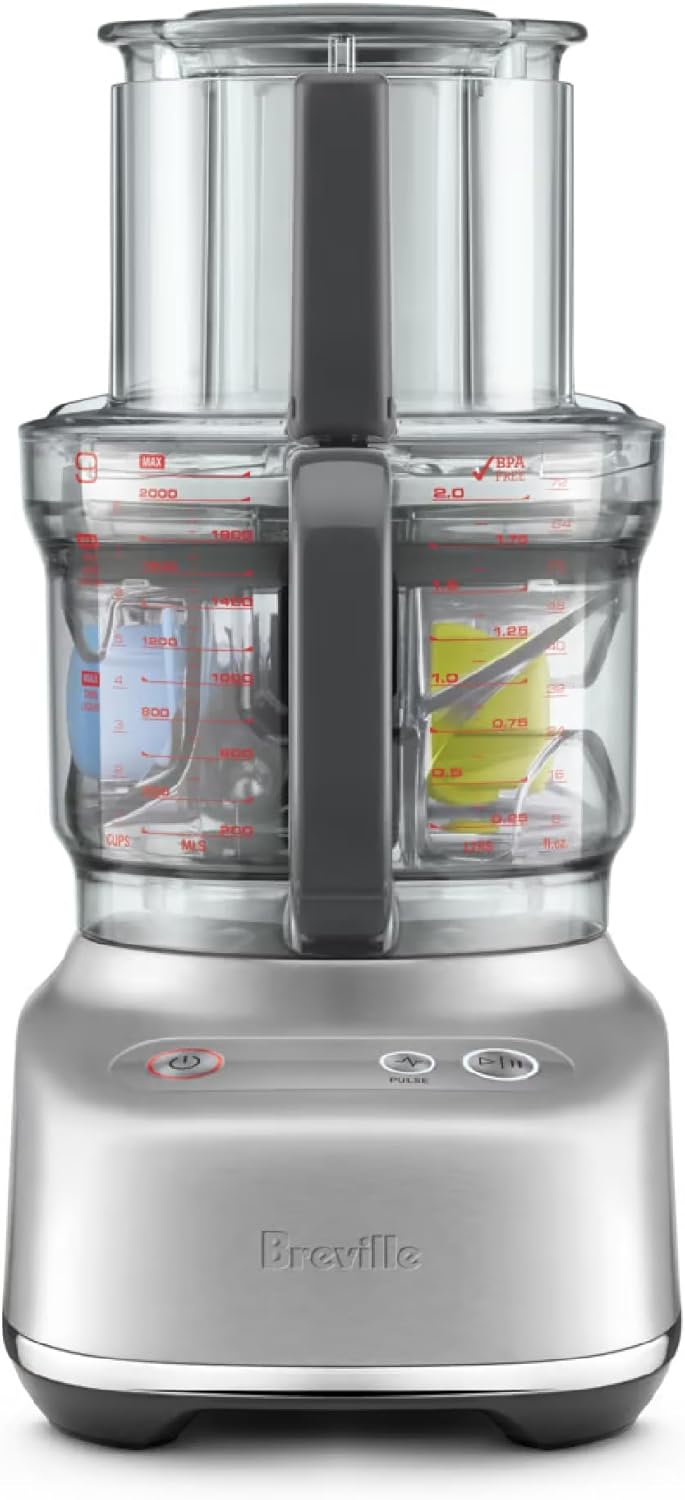
The Breville Sous Chef 9 Cup is a compact, well-built food processor aimed at home cooks who want consistent results without occupying much counter space. It handles chopping, slicing, shredding, and dough work using an S-blade, dough blade, reversible shredder, and adjustable slicer with multiple settings, and the wide feed chute accommodates larger items. The unit emphasizes durability with stainless steel construction, dishwasher-safe removable parts, and a heavy-duty induction motor designed for demanding tasks. Onboard storage keeps accessories tidy inside the bowl and color-coded components simplify setup. For pastry work the dough blade and strong motor make quick work of mixing doughs and cutting cold butter into flour, and the precise slicing and shredding options help with garnish and prep. Limitations are its single speed with pulse control rather than multiple continuous speeds and the 9-cup bowl size may require batching for very large doughs or pastry projects.
Best for: Buyers who prioritize a durable, precision-focused processor for regular pastry and baking prep and value tidy storage and long-term reliability.
Less Ideal for: Those who need variable continuous speed control for delicate emulsions or who routinely mix very large batches should consider larger or multi-speed alternatives.
- Heavy-duty induction motor built for sustained tasks
- Comprehensive accessory set including dough blade and adjustable slicer
- Onboard storage caddy keeps attachments neatly stored inside the bowl
- Dishwasher-safe, removable parts simplify cleanup
- Single continuous speed with pulse control limits fine speed adjustments
- 9-cup bowl can require multiple batches for larger pastry quantities
Verdict: Choose the Breville Sous Chef 9 Cup when you want a compact, durable processor with a strong motor and dedicated dough tools for reliable pastry and baking prep.
Ninja Professional Plus BN601

| Wattage | 1000 watts |
|---|---|
| Bowl Capacity | 4.5 pounds |
| Number of Speeds | 3 |
| Power Source | AC adapter |
The Ninja Professional Plus BN601 is a versatile 9-cup food processor built around a 1000-peak-watt motor and Auto-iQ preset programs that simplify common tasks like chopping, slicing, pureeing, and making dough. In everyday use it handles vegetables, cheeses, sauces, and batch prep quickly, and the included dough blade is capable of mixing and kneading small-to-medium amounts of dough for cookies, pizza, or quick bread. The reversible slicing and shredding disc plus stainless steel blades give even results for prep work, while the feed chute and pusher speed up continuous slicing. Removable parts are dishwasher-safe which makes cleanup straightforward after baking sessions. Limitations to note are the bowl size and dough capacity—while good for family-sized batches, very large or high-hydration doughs may require mixing in stages or finishing by hand, and the plastic construction could feel less heavy-duty than pro-grade metal units. For cooks who rely on preset programs and want a fast, easy-to-clean processor that can also mix dough, this model strikes a strong balance of power and convenience.
Best for: Home bakers who value reliable, one-touch performance and easy cleanup for regular pastry and dough prep and who prefer products backed by strong user feedback.
Less Ideal for: Professional bakers or those who routinely mix very large or high-hydration doughs should consider a heavier-duty commercial stand mixer or larger-capacity processor instead.
- Powerful 1000-peak-watt motor handles tough ingredients reliably
- Auto-iQ preset programs simplify chopping, slicing, pureeing, and dough
- 9-cup bowl suitable for family-size batches and meal prep
- Includes dough blade and reversible slicing/shredding disc for pastry prep
- Dishwasher-safe removable parts speed cleanup
- Plastic construction is less heavy-duty than metal commercial models
- Bowl capacity can limit very large or high-hydration dough batches
Verdict: A powerful, easy-to-use food processor with Auto-iQ presets and a dough blade that makes pastry and small-to-medium dough batches much faster for home bakers.
Ninja PrecisionPro BZ601

| Wattage | 1000 watts |
|---|---|
| Bowl Capacity | 9 cups |
| Number of Speeds | 3 |
| Power Source | ac_dc |
The Ninja PrecisionPro BZ601 is a versatile 9-cup food processor built around a 1000‑peak‑watt motor and Auto‑iQ preset programs that simplify common tasks like chopping, slicing, shredding, pureeing, and mixing dough. It comes with a chopping blade, dough blade, and a reversible slicing/shredding disc plus a large feed chute, so you can handle batch prep, vegetables, cheese, and basic pastry doughs without switching appliances. Controls are straightforward with three manual speeds plus the presets for repeatable results, and most removable parts are BPA‑free and dishwasher safe which eases cleanup after baking prep. Because it is compact for a 9‑cup machine it fits comfortably on a countertop yet still holds enough mixture for family recipes. The main limitation is that it is a generalist rather than a dedicated heavy‑duty dough mixer, so very stiff doughs or very large pastry batches may require more kneading by hand or a stand mixer; also the plastic bowl and lid mean buyers should follow capacity and ingredient limits for best durability.
Best for: Home bakers who prioritize reliable, easy-to-use equipment for everyday pastry prep and want a single compact machine that handles chopping, slicing, and light-to-moderate dough mixing with minimal fuss.
Less Ideal for: Professional bakers or anyone who needs to knead very stiff doughs or process very large pastry batches regularly should choose a dedicated heavy‑duty mixer instead.
- Powerful 1000‑peak‑watt motor for consistent processing
- Includes chopping blade, dough blade, and reversible slicing/shredding disc for multiple pastry and prep tasks
- 9‑cup bowl with large feed chute handles family‑sized batches
- Auto‑iQ presets and manual speeds make repeatable results and simple controls
- Dishwasher‑safe, BPA‑free removable parts for easy cleanup
- Plastic bowl and lid may limit heavy continuous use compared with metal‑bodied machines
- Not designed as a heavy‑duty stand mixer replacement for very stiff or high‑volume doughs
Verdict: Choose the Ninja PrecisionPro BZ601 if you want a compact, reliable food processor that simplifies pastry prep and handles everyday doughs and prep tasks with minimal learning curve.
Choosing the Right Food Processor for Making Pastry: Key Factors to Consider
Motor Power and Torque
Pastry dough needs short, forceful pulses to cut cold fat into flour without generating heat. Higher wattage alone is not the only indicator; the motor's torque at low speed matters more because pastry work is done in quick bursts rather than continuous blending.
A motor with steady low-speed torque reduces the risk of the blade stalling when a dense patch of dough forms. Look for pulse or variable-speed controls that let you manage short bursts. Strong torque also shortens processing time, which helps keep butter or shortening from warming and changing dough texture.
Control Options and Pulse Functionality
Precise control is essential for pastry because overmixing turns flaky pastry gummy. A responsive pulse switch or a low-speed setting gives you repeatable short bursts so you can stop as soon as pieces of fat reach the desired size.
Simple, tactile controls are preferable to complex digital menus for this task; they make it easier to judge processing time by feel. Reversible blades or dedicated dough tools can expand capability, but pulse control is the core feature to prevent overworked dough.
Bowl Capacity and Shape
The right bowl size depends on batch volume. Small bowls concentrate ingredients for single pies or small tart doughs and let you process quickly with less risk of overmixing. Larger bowls are useful for multiple pies or pastry-heavy batches but can allow ingredients to spread too thinly, requiring longer processing.
Bowl shape matters too. A wide, shallow bowl promotes even distribution and easier cutting of butter into flour, while very tall narrow bowls can make it hard to achieve consistent particle size. Consider typical batch size and storage space when choosing capacity.
Blade Design and Material
Food-processor blades should hold a sharp edge and resist bending when cutting cold fat and dry flour. A well-designed S-blade or dedicated pastry blade helps produce uniform breadcrumb-sized pieces of fat, which is key to flaky layers.
Stainless steel blades are standard because they combine durability and ease of cleaning. Some units offer specialized inserts that gently distribute ingredients; those can help, but robust basic blades are sufficient if other controls and bowl geometry are right.
Ease of Cleaning
Pastry work leaves sticky residues of fat and flour that can cling to bowls and blades. Dishwasher-safe parts save time and reduce frustration. Look for bowls with smooth joints and removable seals that do not trap flour.
Simple assembly and fewer nooks make it easier to clean by hand when needed. Quick-release blades and lids that disassemble easily reduce time between bakes and help maintain hygiene.
Stability and Safety Features
Short, firm pulses can generate sudden torque, so a stable base and secure lid locking are important to prevent the processor from walking or the lid from unseating. Non-slip feet and robust lid latches keep processing safe and predictable.
Built-in interlocks that prevent the unit from starting unless properly assembled provide peace of mind. Also consider ease of removing blades safely when cleaning to avoid accidental cuts.
Why a Food Processor Beats Hand Cutting for Pastry
Hand cutting fat into flour works but is laborious and inconsistent. A food processor replicates the same short, precise motion much faster and with less effort. That speed helps keep the fat cold and the dough flaky.
Using a processor also reduces handling time and lets you achieve repeatable results. For home bakers who make pastry occasionally or in larger batches, this consistency can noticeably improve end texture and reduce waste.
- Faster blending preserves fat temperature
- Short bursts reduce overworking the dough
- Even particle size improves final flakiness
Batch Size Tips: Matching Processor Capacity to Your Baking
Think about typical recipes. If you usually make a single 9-inch pie, a smaller bowl is faster and more efficient. If you bake multiple pies or larger tarts on a regular basis, choose a larger-capacity bowl so you can process full batches without repeating steps.
Also consider storage. Larger bowls take more counter and cabinet space and can be heavier to handle. Choose the smallest size that fits your common batch needs to maximize control and minimize cleanup.
- Small bowl: best for single pies and small pastries
- Medium bowl: versatile for most home bakers
- Large bowl: for multiple pies or larger pastry projects
Technique: How to Use Pulse Mode for Perfect Pastry
Start with cold butter or shortening and chilled dry ingredients. Cut the fat into small cubes before adding. Use short, 1-2 second pulses and check after every few pulses until the mixture resembles coarse crumbs with pea-sized bits of fat.
Stop immediately when the desired texture appears. Over-processing will warm the fat and lead to a tougher crust. Transfer the crumbly mixture to a bowl for final liquid addition rather than continuing to process in the bowl.
- Pre-chill bowl and blade if possible
- Use very short pulses, checking often
- Avoid continuous run times to prevent warming
Maintenance and Long-Term Care
Rinse components soon after use to prevent fat from setting on surfaces. For dried-on residue, soak with warm soapy water before scrubbing. Dry blades thoroughly to prevent staining or corrosion.
Inspect seals and interlocks periodically for wear. Replacing worn gaskets keeps the unit operating safely and prevents leaks that can trap dough fragments. Regular maintenance extends the machine's useful life and keeps pastry results consistent.
- Soak and rinse parts promptly after use
- Hand-dry blades to avoid water spots
- Check seals and replace worn parts as needed
Common Mistakes to Avoid With Pastry in a Processor
One frequent error is overfilling the bowl, which leads to uneven cutting and requires longer processing times. Process in smaller batches when necessary to maintain control. Another mistake is running the motor continuously instead of pulsing, which warms the fat and ruins flakiness.
Forgetting to chill ingredients or processing with wet hands can lead to clumping. Follow a controlled, cold-ingredient workflow for the best results.
- Do not overfill the bowl
- Avoid continuous runs; use pulse
- Keep ingredients cold and dry during prep
How We Chose the Best Food Processor for Making Pastry
We prioritized characteristics that directly affect pastry dough quality and user experience. First, motor power and torque were critical because pastry dough requires short bursts of force to cut fat into flour without overmixing. We also looked for reversible or pulse controls that give fine control during short processing bursts. Second, we evaluated bowl capacity and design to ensure even mixing without compacting the dough. Blade shape and materials were assessed for their ability to produce flaky breadcrumbs and to withstand repeated use. Third, ease of cleaning and dishwasher-safe components were factored in because flour and fat residue can be sticky and time-consuming to remove. We included safety and stability features such as secure locking lids and non-slip bases to prevent messy failures during short, vigorous pulses. Noise and heat management were considered when relevant to repeated pastry tasks. We excluded specialty or industrial units that are oversized for home baking, and units lacking pulse control or a suitable bowl shape for dough. The final list emphasizes machines that balance control, capacity, and cleanup for reliable pastry results.
Our full evaluation process is outlined in our review methodology.
FAQ
Can I use a food processor to make both pie crust and puff pastry?
Often yes. A food processor handles initial cutting of fat into flour for both types. Puff pastry requires many lamination steps that are usually done by hand or with a rolling technique after the initial mix, but the processor helps with consistent fat distribution.
How cold should the butter or shortening be before processing?
Usually as cold as possible without being frozen solid. Cold, firm cubes produce the desired pea-sized bits during short pulses. If the fat is too soft, the processor will blend it into the flour and reduce flakiness.
Is pulse mode really necessary for pastry dough?
Yes. Pulse mode gives short, controlled bursts that prevent overmixing and help maintain cold fat particles. Continuous operation tends to warm ingredients and can make pastry dense.
Will processing dough in a food processor make cleanup harder?
It can if you leave residue to dry. Rinsing parts promptly and choosing dishwasher-safe components simplifies cleanup. Blades can be handled carefully during washing to avoid nicks.
What bowl size is best for a home baker making occasional pies?
A medium bowl is usually the most versatile for occasional pie baking. It allows comfortable batch sizes without spreading ingredients too thin, giving good control during pulsing.
Final Verdict
Choosing a food processor for making pastry means prioritizing control over raw power. Focus on machines with reliable low-speed torque, a responsive pulse function, and a bowl size that suits your typical batches. Pay attention to blade quality and cleanup ease because those practical factors determine whether you use the tool routinely. Accept tradeoffs between capacity and control: a smaller bowl often gives better consistency for single pies, while larger bowls save time for high-volume baking. Use short pulses, keep ingredients cold, and maintain the unit to get the flaky pastry texture you want.