
Note: This article contains affiliate links. If you click on these links and make a purchase, we may earn a small commission at no extra cost to you. This helps support our research and content. Read our full affiliate disclosure here.
Picking the right freezer for camping changes how you plan meals, extend trips, and protect perishable food outdoors. The wrong cooler can mean wasted food and limited menu options, while the right portable freezer keeps meat, dairy, and prepared meals safely frozen for days. This guide covers seven shortlisted freezers for camping that excel at cold retention, portability, and power flexibility. We focus on features that matter on the trail or at a campsite, including temperature control, battery and vehicle power options, and usability in uneven conditions. Read on to see the top options and the criteria we used to evaluate them.
Top Picks at a Glance
| Best Overall The best all-around choice for most situations | EUHOMY 53QT Portable Freezer |  |
| Best Quality Built to a higher standard if you want something more solid | Dometic CFX5 75L Dual Zone |  |
| Best Value The sweet spot between price and what you get | Setpower RF20 21QT Car Refrigerator |  |
| Best Budget The cheapest option that still gets the job done reliably | Stopsad HA801B 22QT Portable Refrigerator |  |
| Top Rated A top-rated pick with lots of positive feedback | Feelfunn 61QT Dual-Zone Refrigerator |  |
| Most Popular A crowd favorite that many people choose with confidence | BougeRV CR22 23-Quart Portable Refrigerator |  |
| Best Seller A high-volume bestseller chosen again and again | BougeRV CR28 30-Quart Portable Refrigerator |  |
EUHOMY 53QT Portable Freezer

| Capacity | 53 quarts |
|---|---|
| Temperature Range | -4°F to 68°F |
| Voltage | 12 volts (supports 12/24V DC and 110–240V AC) |
| Cooling Method | Compressor |
| Additional Features | Battery protection, Wheels, Touch Control |
The EUHOMY 53QT portable freezer is a compressor-powered fridge built for road trips, camping, and household backup storage. It offers a broad temperature range from -4°F to 68°F and selectable ECO and MAX cooling modes so you can prioritize energy use or fast chilling. Two internal baskets and a removable divider create separate zones for frozen and chilled items, while the reversible lid, LCD touch controls, and low-noise design make everyday operation straightforward. Mobility is practical: dual handles and off-road wheels ease transport and the unit claims anti-shake performance on mild slopes. For off-grid use it supports both 12/24V DC and 110–240V AC power and includes three-level battery protection to reduce the risk of draining a vehicle battery. Expect a sturdy, well-insulated cabinet and quiet running around 40 dB, but note its weight and physical size mean it is best moved on wheels rather than carried long distances. The freezer is a versatile choice for campers who want near-full-size refrigeration with vehicle compatibility and sensible battery safeguards.
Best for: Buyers who want a near-full‑size portable fridge for camping or long road trips and prioritize reliable compressor cooling, vehicle compatibility, and easy organization over ultralight portability.
Less Ideal for: People seeking a lightweight backpackable cooler or a minimal single-day beverage cooler should consider smaller, lighter alternatives.
- Large 53‑quart capacity with removable divider and baskets for organized storage
- Compressor cooling with -4°F to 68°F range for both freezing and chilling
- Works on 12/24V DC and 110–240V AC with three-level battery protection for vehicle use
- Wheels, dual handles, and anti-shake design make transporting on rough terrain easier
- Low noise operation and simple LCD touch controls for convenient campsite use
- Relatively heavy for a portable unit, so wheeled movement is preferred over carrying
- No app control on this model, so remote monitoring or adjustments are not available
Verdict: A capacious, compressor-driven portable freezer that delivers campsite-worthy freezing and vehicle-safe power management for multi-day trips.
Dometic CFX5 75L Dual Zone
| Capacity | 75 liters |
|---|---|
| Temperature range | -7°F to 68°F (approx.) |
| Power connections | 12/24V and 120V cables included |
| Control | TFT LCD and smartphone app |
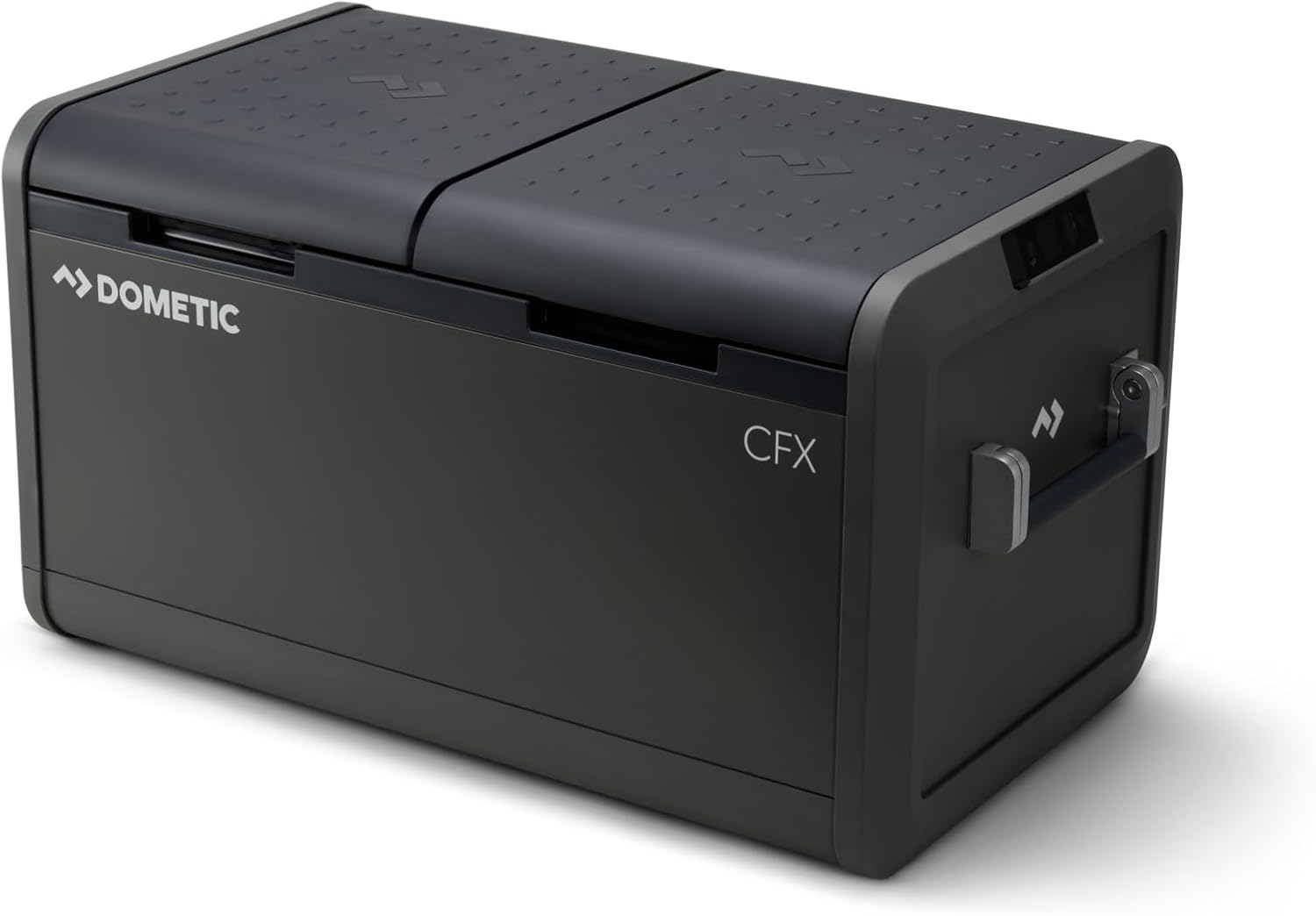
The Dometic CFX5 75L Dual Zone is a portable compressor freezer that delivers fridge and freezer temperatures in one unit, making it useful for multi-day camping, fishing trips, or RV kitchens. It uses a compressor to reach as low as -7°F and vacuum insulated panels to keep temperatures stable while drawing less power, and a high-gloss TFT LCD plus smartphone app let you monitor and change settings remotely. The dual-zone layout lets you store frozen and refrigerated items separately without sacrificing usable space, and included 12/24V and 120V cables mean you can run it from vehicle, solar setups, or shore power. At roughly 75 liters it fits a large load—baskets and interior lighting help with organization—but the unit is heavy compared with soft coolers and requires a suitable mounting or storage spot in a vehicle. Expect typical compressor noise and the need for adequate ventilation when running for long periods in enclosed spaces.
Best for: Buyers who prioritize reliable, performance-oriented temperature control for extended camping or RV trips and need the flexibility to keep both frozen and refrigerated goods on hand.
Less Ideal for: If you need an ultra-light, grab-and-go cooler for short day trips or you lack space to secure a heavy unit in your vehicle, a lighter portable cooler is a better choice.
- Dual-zone compressor design supports simultaneous fridge and freezer storage.
- Vacuum insulated panels improve efficiency and usable interior space.
- App and TFT LCD control make temperature monitoring and adjustments convenient.
- Includes 12/24V and 120V connection cables for vehicle and shore power use.
- Relatively heavy compared with portable soft coolers, making transport and installation more demanding.
- Compressor operation produces audible noise and requires ventilation during extended use.
Verdict: Choose the Dometic CFX5 75L Dual Zone when you need rugged, camper-ready freezer performance with separate fridge and freezer zones for multi-day outdoor trips.
Setpower RF20 21QT Car Refrigerator

| Capacity | 20 liters |
|---|---|
| Cooling method | Compressor |
| Voltage | 12 volts |
| Temperature range | -4℉ to 68℉ |
| Power consumption | 28W (ECO) / 40W (MAX) |
The Setpower RF20 is a compact 21‑quart 12V compressor refrigerator built for on‑the‑road cooling in trucks, vans, and RVs. It operates as either a fridge or freezer with a temperature range from about 68°F down to -4°F and offers a fast‑cooling mode that can drop interior temperature quickly (15 minutes to near‑fridge temps). The unit runs off AC or DC power and includes a built‑in ice pack that extends cooling for up to 50 hours during power interruptions, useful for long hauls or temporary disconnections. Controls are available on the panel or via a phone app for remote monitoring and mode switching, and the compressor is tuned for relatively low draw (advertised 28W in ECO mode). Practical benefits for drivers include a reversible lid for flexible placement, frost‑free operation, and low noise during operation. Important limitations are the modest 21QT capacity—adequate for personal or two‑person use but tight for larger food loads—and its reported weight and footprint that require solid mounting in a cab. The RF20 suits mobile use where fast cooling, battery protection, and app control matter most, but it is not a substitute for larger onboard fridges when hauling significant supplies.
Best for: Drivers who prioritize reliable, fast compressor cooling and low power draw for short to medium length trips and who want remote monitoring via an app.
Less Ideal for: Groups needing large-capacity refrigeration for extended multi‑person trips or users who require an ultra‑lightweight countertop cooler for occasional home use.
- Compressor cooling with wide temperature range from about 68°F to -4°F for fridge or freezer use
- Fast‑cooling mode that reaches near‑fridge temps quickly
- 50‑hour backup cooling using included ice pack for power interruptions
- App control plus onboard panel for remote monitoring and setting changes
- Low power draw in ECO mode (advertised 28W) suitable for long vehicle runs
- Limited 21QT capacity not ideal for larger crews or extended trips
- Unit weight and footprint require secure mounting or stable placement in a cab
Verdict: A compact, vehicle‑focused compressor fridge that delivers fast, low‑power cooling and remote control for drivers who need reliable on‑road refrigeration.
Stopsad HA801B 22QT Portable Refrigerator

| Capacity | 0.7 cubic feet |
|---|---|
| Cooling method | Compressor |
| Temperature range | -4°F to 68°F |
| Power source | 12/24V DC and 110/240V AC |
| Defrost system type | Frost Free |
This compact compressor fridge is built for on-the-road use in trucks, RVs, and boats while still working at home on AC power. It offers a 22‑quart (0.7 cu ft) compartment with a removable divider to create two zones, and the variable-frequency compressor can run from a freezer-cold -4°F up to 68°F so you can store frozen items or keep drinks chilled. Controls are on a simple LCD panel with ECO and MAX modes for energy-saving or fast cooling, and built-in three-stage battery protection helps avoid draining a vehicle battery. The unit is designed to be quiet (around 40 dB) and shock resistant for use on bumpy roads, and its frost-free compressor eliminates manual defrosting. The trade-offs are its modest internal volume—suitable for a few days of supplies for one or two people—and a roughly 23-inch footprint that requires a stable flat surface in a cab or sleeper. For a semi truck where space, battery safety, and reliable compressor cooling matter, this model covers the basics without frills.
Best for: Drivers who need a reliable, energy-conscious fridge that runs from truck power or household outlets and keeps food cold or frozen on multi-day trips.
Less Ideal for: Those who need large-capacity refrigeration for extended group travel or for carrying bulky frozen goods should look at larger or full-size truck fridges.
- Compressor cooling with wide temperature range from -4°F to 68°F for freezing or chilling
- Dual power support (12/24V DC and 110/240V AC) for use in trucks and at home
- Removable divider creating two storage zones to separate food and beverages
- Quiet operation (~40 dB) and shock-resistant design for vehicle use
- Frost-free operation and ECO/MAX modes for energy management
- Internal capacity is limited to about 22 quarts, so it holds only a few days of food for one or two people
- Relatively heavy and requires a stable flat installation in a cab or sleeper
Verdict: A compact, truck-ready compressor fridge that balances battery protection, quiet operation, and freezer-capable cooling for solo or two-person road trips.
Feelfunn 61QT Dual-Zone Refrigerator

| Capacity | 58 liters |
|---|---|
| Temperature range | -4°F to 68°F |
| Cooling method | Compressor |
| Configuration | Dual Zone |
| Noise level | <45dB |
The Feelfunn 61QT Dual-Zone Refrigerator is a portable compressor fridge designed for camping, RVing, and long drives where you need separate fridge and freezer zones. It offers two independently controlled compartments with a wide -4°F to 68°F range so you can freeze ice on one side while keeping drinks chilled on the other, and Bluetooth app control lets you adjust temps without opening the lid. The compressor boasts a 15‑minute turbo mode that can drop interior temperature quickly and an intelligent cycling system to limit power use, while built-in battery protection prevents vehicle drain. Practical touches include LED interior lighting, a wheeled chassis and handle for easier transport, reversible doors, and relatively quiet operation under 45 dB. Expect a solid, heavier unit that prioritizes performance over ultraportability, and plan for vehicle or campsite power since it is a powered compressor refrigerator rather than an insulated passive cooler.
Best for: Buyers who want a true powered portable fridge that delivers fast cooling and separate fridge/freezer control for family trips, RVs, or extended camping where performance and convenience matter.
Less Ideal for: People looking for a lightweight, passive cooler for short outings or those who need a completely off-grid solution without access to vehicle or campsite power.
- Dual‑zone independent temperature control lets you run fridge and freezer simultaneously
- Fast 15‑minute turbo cooling to quickly lower interior temperature
- Bluetooth app control for remote adjustments and status checks
- Built‑in battery protection with three levels to avoid vehicle power drain
- Wheeled design and handle make moving the 61QT unit easier on trips
- Heavier, larger footprint compared with smaller portable coolers
- Requires DC/AC power to run since it is a compressor refrigerator
Verdict: Choose this Feelfunn 61QT if you need a powerful, dual‑zone portable refrigerator that cools fast and offers app control and battery protection for dependable use on trips.
BougeRV CR22 23-Quart Portable Refrigerator

| Capacity | 23 quarts |
|---|---|
| Temp range | -8℉ to 50℉ (-22℃ to 10℃) |
| Power source | 12/24V DC, 100–240V AC |
| Cooling method | Compressor |
| Noise level | 45 dB |
The BougeRV CR22 is a compact 23‑quart compressor fridge meant for road trips, camping, and grocery runs where you need reliable cold storage without ice. It uses compressor cooling to reach as low as -8°F and can cool from room temperature to about 32°F in roughly 15 minutes, so it will rapidly chill drinks and perishables. You get both 12/24V DC and 100–240V AC adapters in the box and a 3‑level battery protection system that stops the unit before a vehicle battery is drained. The top‑load chest layout and manual defrost keep design simple and durable, and the unit is built to run quietly around 45 dB and tolerate tilts up to 30° for off‑road use. Important compromises are its modest 23‑quart capacity, which limits long trips for larger groups, and the unit is heavier than some alternatives. It also lacks app control and a dual‑zone option, so you cannot set separate fridge/freezer temperatures in the same box.
Best for: Buyers who want a dependable, no-frills portable fridge for regular car camping, road trips, or grocery runs and who prioritize reliable compressor cooling and battery protection over smart features.
Less Ideal for: Those needing larger capacity for long group trips or users who want app control, dual‑zone storage, or a lighter ultra‑portable cooler should look elsewhere.
- Compressor cooling that reaches freezer temperatures for true refrigeration without ice
- Fast initial cool-down (about 15 minutes to 32°F) for quick chilling
- Runs on 12/24V DC and 100–240V AC with included cords for versatile powering
- Built-in 3-level battery protection to avoid draining vehicle batteries
- Relatively quiet operation (~45 dB) and can operate on a 30° tilt for off‑road use
- Only 23 quarts net capacity, limiting how much you can store for groups
- No app control or dual‑zone capability for separate fridge/freezer use
- Requires manual defrosting
Verdict: A rugged, vehicle‑friendly 23‑quart compressor fridge that reliably chills fast and protects your car battery, ideal for cautious buyers who value proven performance.
BougeRV CR28 30-Quart Portable Refrigerator

| Capacity | 30 quarts |
|---|---|
| Temp Range | -8℉ to 50℉ (-22℃ to 10℃) |
| Power Source | 12/24V DC, 100–240V AC adapter |
| Cooling Method | Compressor |
| Noise Level | 45 dB (typical) |
The BougeRV CR28 is a chest-style 30-quart portable refrigerator built for road trips, camping and in-vehicle grocery runs. It uses a rotary-scroll compressor to cool quickly — the manufacturer specifies about 15 minutes from 77°F to 32°F and deeper freeze capability — and can be powered by 12/24V DC or a 100–240V AC adapter, so it works in cars, trucks, RVs and at a campsite. Practical features include a removable partition, a top-opening chest design that helps hold temperature when opened, an electronic lock, and a three-level battery protection system to avoid draining vehicle batteries. The unit is Energy Star rated and claims low-noise operation around 45 dB and a low power ECO mode that runs roughly 45W normally. Trade-offs are its chest form factor, which takes more horizontal space and requires lifting items in and out, and its 30-quart capacity may be small for larger families or extended trips; it is also relatively heavy to move on foot. For buyers who want a durable, plug-and-play car fridge with efficient compressor cooling and built-in battery safeguards, the CR28 is a sensible choice.
Best for: Buyers who prioritize reliable compressor cooling, quiet operation and built-in battery safeguards for car, RV or camping use and want a ready-to-run, low-maintenance portable fridge.
Less Ideal for: People who need upright access, very large chilled capacity, or an ultralight cooler for frequent hand-carry trips should consider other formats.
- True compressor cooling for fast, reliable temperature drop
- Works from 12/24V DC or 100–240V AC for vehicle and household use
- Built-in 3-level battery protection to prevent vehicle battery drain
- Low-noise operation and ECO mode for energy-efficient running
- Includes removable partition and electronic lock for organization and security
- Chest-style lid makes loading and accessing tall items less convenient
- 30-quart capacity can be limiting for larger groups or long trips
- Relatively heavy to carry for frequent portable use
Verdict: A dependable vehicle-ready compressor fridge that delivers fast cooling, battery protection and quiet, energy-efficient operation for risk-averse buyers.
Choosing the Right Freezer for Camping: Key Factors to Consider
Temperature Control and Stability
How well a freezer maintains a steady set temperature affects food safety and how long items stay frozen. On a camping trip you will encounter variable ambient temperatures and frequent door openings, so a unit with accurate temperature control and good insulation reduces the risk of partial thawing and freezer burn.
Look for freezers with digital thermostats or precise thermostatic control and a reliable compressor or thermoelectric system rated for outdoor use. Rapid recovery after opening is especially important for multi-day trips where you access supplies often.
Power Source Compatibility and Efficiency
Camping freezers are only useful if you can power them where you camp. Consider compatibility with 12V vehicle outlets, solar-charged battery packs, or integrated battery options. Equally important is how efficiently the unit uses power at steady state and during startup; high surge draws can trip vehicle fuses or overwhelm small inverters.
Evaluate idle wattage, compressor cycle efficiency, and whether the freezer supports low-voltage cutoff settings to protect your vehicle battery. Efficient insulation reduces energy needs and lengthens runtime on limited power supplies.
Portability and Weight
Portability is a mix of weight, footprint, and carry features. A freezer that is too heavy or awkward to lift can be impractical for car-camping where you must load gear, or for short portages between campsite and parking. Handles, recessed grips, tie-down points, and a compact footprint help with transport and secure mounting in a vehicle.
Also consider how the freezer balances when partially packed and whether the lid stays closed under movement. A design that can be secured or bundled with straps simplifies stowage and reduces the risk of damage during transit.
Durability and Weather Resistance
Camping environments expose gear to bumps, dust, moisture, and temperature swings. A freezer built with impact-resistant housing, reinforced corners, and weather seals will hold up longer and protect internal components. Corrosion-resistant hardware and a design that tolerates vibration matter if you plan off-road travel.
Consider whether the unit has drain plugs, serviceable filters, or protective covers for electrical ports. These small features extend usability and simplify maintenance after muddy or wet trips.
Storage Layout and Capacity
Usable capacity is more important than gross liters. Look for flat interiors, removable baskets, and dividers that let you organize meal kits, ice packs, and irregular packages common to camping. A freezer with modular storage saves time at the campsite and prevents small items from getting lost at the bottom.
Also evaluate how full the unit needs to be for efficient operation. Some portable freezers perform better when partially loaded with frozen bottles or blocks that help stabilize temperature.
Ease of Use and Controls
Simple, readable controls and a clear temperature display are essential when you need to check or change settings outdoors. Controls that are responsive across expected temperature ranges and that include useful modes such as quick-freeze or economy help tailor operation to different trip phases.
Consider audible or visual alarms for high temperature or low input voltage. A freezer with accessible service menus or a straightforward reset procedure reduces hassle when troubleshooting in the field.
Powering a Camping Freezer: Batteries, Vehicles, and Solar
Choosing how you will power a camping freezer determines how long it will run and how much you can rely on frozen food. Most campers use a 12V vehicle connection for day trips and a deep-cycle battery or portable power station for extended stays. Understand the unit's steady-state draw and compressor startup current so you can size batteries and inverters appropriately.
Solar charging is practical for longer backcountry stays but requires a sufficiently large panel array and charge controller to match the freezer's daily energy needs. When pairing a freezer with solar, plan for worst-case cloudy conditions and include battery storage sized to supply several nights of operation.
- Check continuous amp draw and peak startup current before pairing with batteries
- Low-voltage cutoff protects your vehicle battery; ensure it is configurable
- Combine insulation strategies, like frozen bottles, to reduce runtime demands
Packing and Organizing Inside a Portable Freezer
Efficient packing extends usable freezer space and speeds meal prep at camp. Use rigid containers or vacuum-sealed bags to stack items and avoid wasted voids. Place frequently used items near the top and group similar foods together for quick access.
Consider pre-freezing meal kits to a solid block so they stack well and act as thermal mass. Removable baskets are particularly helpful for small items so you do not have to dig through the entire compartment.
- Use flat, stackable containers for better volume utilization
- Label bags with dates and contents for streamlined meal planning
- Keep a dedicated basket for thawing items you plan to consume soon
Field Maintenance and Troubleshooting
Basic maintenance keeps a camping freezer reliable. Clean the seals and drains after wet trips, inspect power cords and terminals for corrosion, and keep vents clear of debris. If the unit fails to reach set temperature, check the power source voltage and the seal integrity before concluding there is a mechanical fault.
For minor issues, a power cycle and verifying voltage at the input often resolves compressor startup problems. Carry spare fuses and basic tools if you expect remote operation, and know the reset procedure for the unit's controller.
- Keep a small kit with spare fuses, terminal cleaner, and dielectric grease
- Dry and ventilate the unit after storage to prevent mold or mildew
- Document serial numbers and controller settings before trips for quick reference
Safety and Food Handling at Camp
Safe food handling remains critical even with a freezer. Keep raw proteins separated and store thawing items in sealed containers to avoid cross-contamination. Monitor temperatures periodically to ensure perishable goods stay well below safe thresholds.
Plan meals so high-risk items are consumed earlier in the trip if power is limited. Use an inexpensive independent thermometer as a backup to the freezer's internal readout to verify actual conditions.
- Store raw meat on the bottom to prevent drips onto other foods
- Use thermometer logs to track temperature during transport and storage
- Thaw items safely by moving them to a cooler or chilled area rather than leaving at ambient temperatures
Transport and Securing Tips
Securing your freezer during transport prevents damage and maintains seal integrity. Use tie-down straps at designated points and position the unit on a flat surface where it will not shift. For rooftop or trailer-mounted setups, check the manufacturer's mount points and avoid placing heavy items on top of the lid.
Consider where the unit will live at camp to minimize exposure to direct sun and reduce cooling load. Shaded, ventilated placement improves efficiency and reduces runtime on limited power supplies.
- Use soft pads under the freezer to reduce vibration and abrasion
- Avoid placing the unit directly on bare ground in wet conditions
- Plan load order so the freezer is accessible without unpacking all gear
How We Chose the Best Freezer for Camping
We prioritized features that matter most when using a freezer for camping: temperature stability, power options and efficiency, portability and durability, and usable storage layout. Temperature stability was assessed as the freezer's ability to hold consistent sub-freezing temps under realistic ambient heat and repeated opening. Power options included compatibility with 12V vehicle systems, portable battery packs, and low idle draw to extend runtime. Portability and durability covered weight, carry design, impact resistance, and how well units lock or seal during transport. Storage layout examined usable internal volume, trays or dividers for organization, and whether the interior shape makes packing common camping items easy. Units were excluded if they lacked explicit portable power compatibility, had unprotected cooling components that are fragile in transit, or if their control interface did not offer clear temperature setpoints for camping use. Our shortlist favors models that balance real-world campsite demands rather than laboratory peak performance, and the evaluation criteria align with the concrete buyer needs described above.
Our full evaluation process is outlined in our review methodology.
FAQ
How long will a portable freezer run on a vehicle battery?
Runtime depends on the freezer's continuous amp draw and the battery capacity. A deep-cycle battery sized for camping will run a low-draw freezer longer than a standard starter battery, and using a low-voltage cutoff helps prevent dead batteries.
Can I use a freezer for camping with solar panels alone?
Yes, but you need enough panel capacity and battery storage to cover daily energy use, plus a charge controller sized for your system. Solar is most practical when paired with adequate battery storage to handle cloudy periods.
Should I choose a compressor or thermoelectric freezer for camping?
Compressor-based units usually cool faster and maintain lower temperatures, which is better for frozen food, while thermoelectric units are lighter and simpler but struggle in hot ambient conditions. Choice depends on whether you prioritize freezing performance or lower weight and simplicity.
How do I prevent food from thawing during transport?
Pre-freeze items solid, use additional frozen bottles or blocks for thermal mass, minimize lid openings, and secure the freezer so it does not shift. A well-sealed unit with good insulation and organized packing reduces warm spots.
What maintenance should I do after a muddy or wet trip?
Clean and dry seals and the interior, flush drain plugs, inspect electrical connections for corrosion, and ventilate the unit before storage. Addressing moisture promptly prevents mold and component damage.
Final Verdict
When choosing a freezer for camping, prioritize temperature stability, compatible power options, and a balance between capacity and portability. Expect tradeoffs between weight and cooling performance, and size your power system to match the freezer's steady and startup draws. Focus on units with usable interior layouts and robust seals to simplify packing and protect food in the field. With the right priorities, you can pick a portable freezer that extends trip length, broadens meal choices, and reduces food waste.