
Note: This article contains affiliate links. If you click on these links and make a purchase, we may earn a small commission at no extra cost to you. This helps support our research and content. Read our full affiliate disclosure here.
If you store extra food or bulk purchases in an unheated garage, choosing the right freezer matters for safety and efficiency. A freezer designed for cold-garage conditions keeps stable internal temperatures and protects compressors and thermostats from extreme ambient chill. This guide shortlists the top freezers suited for cold garages and explains the features that matter for dependable long-term storage. Below we summarize our top picks and the evaluation criteria we used, so you can match capacity and durability to your space and storage habits.
Top Picks at a Glance
| Best Overall The best all-around choice for most situations | BLACK+DECKER 2.0 Cu. Ft. Chest Freezer BCFK206 |  |
| Best Quality Built to a higher standard if you want something more solid | Hamilton Beach 14 cu ft Chest Freezer |  |
| Best Value The sweet spot between price and what you get | Kismile Chest Freezer BD-80 |  |
| Best Budget The cheapest option that still gets the job done reliably | Climate Choice 4.0 Cu.Ft Chest Freezer |  |
| Top Rated A top-rated pick with lots of positive feedback | Whynter CUF-301SS 3.0 cu ft Upright Freezer |  |
| Most Popular A crowd favorite that many people choose with confidence | Frigidaire Upright Freezer 6.5 cu ft |  |
| Best Seller A high-volume bestseller chosen again and again | BODACIOUS 5.0 Cu Ft Chest Freezer |  |
BLACK+DECKER 2.0 Cu. Ft. Chest Freezer BCFK206

| Capacity | 2 cubic feet |
|---|---|
| Voltage | 115 volts |
| Door Orientation | Top |
| Number Of Shelves | 1 |
This BLACK+DECKER 2.0 cu. ft. chest freezer is designed to add extra cold storage in tight spaces such as a garage, basement, or small kitchen. It holds roughly 70 pounds of frozen food and includes a removable storage basket for organizing frequently used items. Temperature is adjusted with an external mechanical dial that offers seven settings and an indicator light so you do not need to open the lid to check the control. Maintenance is manual defrost with an easy-access drain which simplifies thawing but requires occasional intervention to clear ice buildup. The unit is freestanding and compact, making it simple to place where space is limited, and it uses R600a refrigerant. Expect basic, reliable freezing performance and straightforward controls rather than smart features or automatic defrost functionality.
Best for: Buyers who want a straightforward, space-saving secondary freezer to store extra frozen groceries in a garage or small utility area and prioritize simple mechanical controls over smart features.
Less Ideal for: People who need large capacity, automated defrosting, or smart monitoring should choose a larger upright or feature-rich freezer instead.
- Compact footprint fits small garages, basements, or tight kitchen corners
- Holds up to about 70 lbs. of frozen food for overflow storage
- Removable storage basket keeps frequently used items accessible
- External mechanical dial with 7 settings and indicator light for simple temperature control
- Manual defrost with drain makes cleaning straightforward
- Manual defrost requires regular maintenance and thawing
- No advanced features like auto-defrost, Wi-Fi, or temperature alarms
Verdict: A compact, no-frills chest freezer that delivers reliable extra frozen storage and simple mechanical controls for garages and small spaces.
Hamilton Beach 14 cu ft Chest Freezer

| Capacity | 14 cubic feet |
|---|---|
| Wattage | 500 watts |
| Voltage | 110 volts |
| Number Of Shelves | 1 |
| Installation Type | Freestanding |
This Hamilton Beach 14 cu ft chest freezer delivers large, no-fuss cold storage for families or seasonal stockpiles and is built to sit in a garage or basement. It uses a top-opening design with a removable vinyl-coated wire basket to keep frequently used items accessible while the main cavity stores bulkier cuts and frozen meals. Temperature is controlled with an adjustable seven-position thermostat and a power-on indicator lets you verify operation at a glance. Practical features include an external front-access defrost drain for easier manual defrosting and an external handle with a keyed lock for security. The aluminum interior liner and simple mechanical controls make this unit reliable and straightforward to service, but it is a manual-defrost model so it will require occasional defrosting and some temperature recovery time after the lid is opened. For buyers wanting straightforward capacity and durability for a cold garage, this freezer focuses on dependable storage rather than advanced automation or frost-free convenience.
Best for: Buyers who prioritize raw cold-storage capacity and durable, simple operation for garages or basements and who are comfortable with occasional manual maintenance.
Less Ideal for: Shoppers who want a frost-free, low-maintenance freezer with automatic defrosting or who need advanced digital controls and connectivity should look elsewhere.
- Spacious 14 cu ft capacity suitable for large families or bulk storage
- Adjustable seven-setting thermostat for straightforward temperature control
- Front-access defrost drain simplifies manual defrosting and cleaning
- Removable vinyl-coated wire basket helps organize small or frequently used items
- Aluminum interior liner and simple mechanical construction promote durability
- Manual defrost design requires periodic defrosting and more maintenance
- Not frost-free, so temperature recovery after opening is slower compared with automatic defrost units
Verdict: Choose this chest freezer if you need big, reliable cold storage in a garage or basement and prefer simple, serviceable mechanical controls over high-tech features.
Kismile Chest Freezer BD-80

| Capacity | 3.2 cubic feet |
|---|---|
| Door Orientation | Top |
| Number Of Shelves | 1 |
| Installation Type | Freestanding |
The Kismile 3.2 cu ft chest freezer is a space-saving deep freezer aimed at small households, dorms, or garages that need extra frozen storage. It cools with an adjustable 7‑level thermostat that ranges from about 6.8 F down to -7.6 F, letting you pick normal or deeper freezing, and status lights show power and run state. Two removable wire baskets keep smaller items accessible while the larger cavity handles bulky packages like meat or frozen meals, and a drain makes defrost cleanup easier. The balanced hinge keeps the lid open at several angles for loading and unloading without slamming. The unit is designed for low noise and modest energy use, with the listing citing about 0.68 kWh per day. Downsides to expect are limited capacity compared with upright garage freezers and a temperature range that is adequate for everyday freezing but not for ultra-low commercial requirements. If you need a compact, affordable extra freezer for occasional bulk storage, this model covers the basics reliably.
Best for: Buyers who want a compact, no-frills secondary freezer to store bulk groceries, meat, or extras in a garage or small space and who prioritize efficient use of floor area and straightforward controls.
Less Ideal for: People who need large-capacity or commercial-grade ultra-low freezing for long-term storage or heavy throughput should consider a bigger chest or upright garage freezer instead.
- Compact 3.2 cu ft footprint fits tight spaces like garages, dorms, or small kitchens
- Adjustable 7‑grade thermostat for choosing normal or deeper freezing
- Two removable baskets for organized storage of small items
- Balanced hinge door that holds open at multiple angles for easier loading
- Built-in drain simplifies defrost and cleaning
- Smaller overall capacity than full-size garage freezers
- Temperature range bottoms out around -7.6 F, which may not suit ultra-low freezing needs
Verdict: A compact, energy-conscious chest freezer that provides dependable extra frozen storage for garages and small spaces.
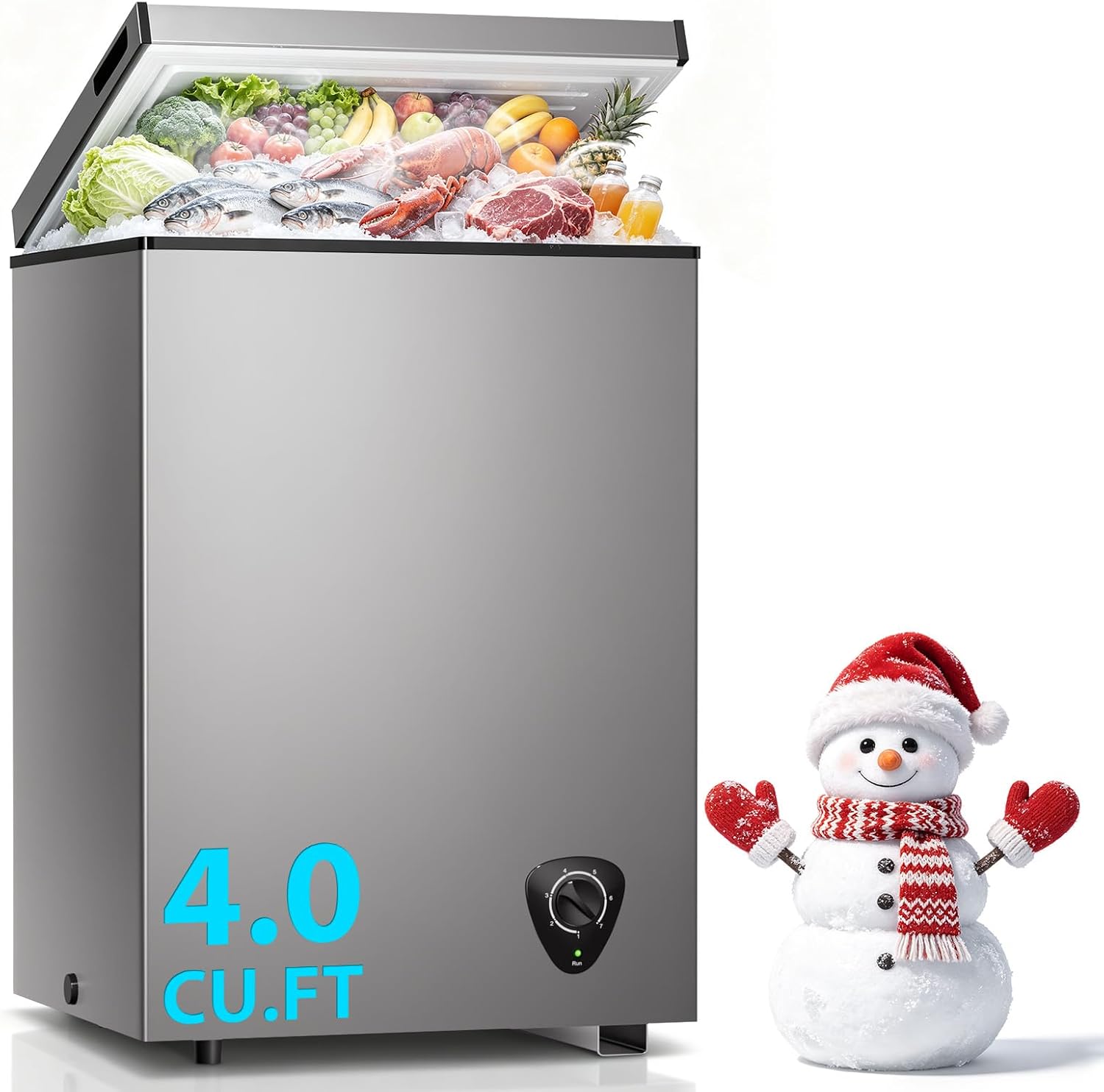
Climate Choice 4.0 Cu.Ft Chest Freezer
| Capacity | 4 cubic feet |
|---|---|
| Wattage | 85 watts |
| Voltage | 120 volts |
| Installation Type | Freestanding |
This small chest freezer provides practical extra frozen storage for tight spaces such as a garage, apartment, or office. It offers seven temperature settings that let you dial in conditions from mild chill to deep freeze, and a removable wire basket helps keep frequently used items accessible. The built-in drain and simple top-open layout make defrosting and cleaning straightforward, and the unit is designed to run quietly while using relatively little power. Construction appears basic but functional, with a stainless-steel door and a tight seal intended to retain cold. Expect straightforward, budget-oriented performance rather than premium insulation or advanced controls. It should work well as supplemental freezer capacity or for long-term pet food and bulk storage in an unheated garage if the ambient temperature stays within the unit's operating range, but buyers seeking fast recovery after a warm-door opening or high-end frost management may prefer larger, more expensive models.
Best for: Buyers who need affordable, extra frozen storage in limited spaces and prioritise low running cost and simple, reliable operation.
Less Ideal for: Those who need large-capacity, commercial-grade freezing, precise digital control, or guaranteed performance in extremely cold or unheated garage environments should look elsewhere.
- Compact footprint fits tight spaces like garages or apartments
- Seven adjustable temperature settings for flexible freezing needs
- Removable storage basket simplifies organization and access
- Built-in drain and top-open design make defrosting and cleaning easy
- Quiet, energy-efficient operation suitable for continuous use
- Basic, budget construction with limited advanced insulation features
- Not intended for heavy-duty commercial use or very low ambient garage temperatures
Verdict: A budget-friendly, space-saving chest freezer that adds reliable extra cold storage for garages or small homes without high energy use.
Whynter CUF-301SS 3.0 cu ft Upright Freezer

| Capacity | 3 cubic feet |
|---|---|
| Temperature range | -14° to 50° F |
| Wattage | 100 |
| Door orientation | Reversible |
| Number of shelves | 3 |
The Whynter CUF-301SS is a small upright freezer designed for tight spaces such as garages, offices, dorms, or kitchens and can be switched to refrigerator mode when you need chilled storage. It uses a compressor-based cooling system with a mechanical dial that sets refrigerator temperatures from 32 to 50°F or freezer temperatures from -14 to -11°F, and includes two wire shelves plus a removable slide-out basket for basic organization. The reversible-swing stainless steel door and recessed handle make placement flexible while the included cylinder lock and keys let you secure contents in shared spaces. Rated to use relatively little energy, this unit is quiet enough for nearby rooms and runs on standard 115V household power. Limitations for garage use include modest capacity—only 3 cubic feet—and basic mechanical controls rather than precise digital settings, so it is best for regular food and beverage storage rather than long-term bulk freezing or temperature-critical items.
Best for: Practical buyers who need a compact, energy-conscious cold storage unit for a garage, office, or small household space and value flexibility between fridge and freezer modes.
Less Ideal for: Users who need large capacity or precise temperature control for long-term freezing, or those who store large frozen loads regularly.
- Convertible freezer/refrigerator mode for flexible cold storage needs
- Reversible stainless steel door and recessed handle for flexible placement
- Integrated lock with two keys for secure shared-space storage
- Quiet compressor operation suitable for near-room placement
- Includes removable shelf and slide-out basket for basic organization
- Only 3.0 cu ft capacity, limiting bulk storage
- Mechanical thermostat lacks precise digital control
- Not designed for heavy-duty or large-volume freezing tasks
Verdict: A compact, energy-conscious convertible freezer that fits garages and small spaces when you need a reliable, secure solution for everyday frozen or chilled storage.
Frigidaire Upright Freezer 6.5 cu ft

| Capacity | 6.5 cubic feet |
|---|---|
| Wattage | 760 watts |
| Door Orientation | Reversible |
| Number Of Shelves | 6 |
| Voltage | 120 volts |
This Frigidaire upright freezer is a compact, freestanding unit built to add dedicated frozen storage where space is limited. It provides six wire shelves that make organization straightforward and accessible, and the recessed handle plus flush-back design help fit the cabinet into tight corners, garages, or utility rooms. Temperature is manually adjustable so you can tune performance for long-term storage or quick freezing, and the reversible door adds installation flexibility. The vinyl-coated metal exterior and stainless-style door are easy to wipe clean and stand up to ordinary garage dust and dirt. Expect simple maintenance: it requires manual defrosting and includes a drain hole to speed the process. Practical downsides are the manual defrost and the lack of advanced features like frost-free operation or digital temperature controls, which means occasional defrost time and more hands-on temperature monitoring. For buyers who want straightforward, roomy frozen storage without smart features, this model covers the essentials reliably.
Best for: Buyers who prioritize reliable, high-capacity frozen storage in a garage or small utility space and who value straightforward operation over smart features.
Less Ideal for: People who want a low-maintenance frost-free freezer or precise digital temperature monitoring should consider other models with automatic defrost and electronic controls.
- Compact 6.5 cu ft capacity that maximizes storage in small footprints
- Six adjustable wire shelves for organized, visible storage
- Reversible door and recessed handle for flexible placement in tight spaces
- Vinyl-coated metal exterior that is easy to clean and durable for non-climate-controlled areas
- Manual temperature control lets you set colder or milder freezer conditions as needed
- Manual defrost requires periodic thawing and draining
- No digital controls or frost-free technology for hands-off operation
Verdict: A practical, space-saving upright freezer that delivers roomy, organized cold storage for garages when you want simple reliable performance.
BODACIOUS 5.0 Cu Ft Chest Freezer

| Capacity | 5 cubic feet |
|---|---|
| Wattage | 58 watts |
| Voltage | 110 volts |
| Number Of Shelves | 1 |
| Specification Met | ETL |
This BODACIOUS 5.0 cu ft chest freezer is a compact, top-opening unit intended for homes, small restaurants, or garage use where space and noise matter. It delivers basic chest-freezer performance: a fast-freeze function for preserving meat and produce, one removable basket for organizing small items, and a built-in drain that makes defrosting easier. The unit emphasizes low power use, with listed daily and annual energy figures that should keep operating costs modest, and it claims ultra-quiet operation under 40 dB so it can sit in or near living areas without drawing attention. Construction appears simple but practical, with a stainless-steel door and ETL safety listing. Important limitations are its small capacity and single-shelf configuration, which means bulky items need arranging and long-term heavy storage is limited; also buyer documentation recommends waiting 24 hours after delivery before powering on. For someone who wants a straightforward, efficient freezer for a garage or compact space, this covers core needs without frills.
Best for: Buyers who prioritize a quiet, energy-conscious freezer for a garage, apartment, or small household and want a low-risk basic chest freezer that is easy to place and run.
Less Ideal for: Those who need large-capacity or heavily compartmentalized freezing for bulk shopping, extended meal prep, or large families should consider bigger or differently configured freezers.
- Compact 5.0 cu ft capacity fits tight spaces like garages or small kitchens
- Energy-efficient operation with low daily and annual consumption estimates
- Ultra-quiet design rated under 40 dB suitable for locations near living areas
- Fast-freeze function helps preserve freshness of meats and produce
- Built-in drain and removable basket make defrosting and organization easier
- Limited internal shelving and single basket reduce flexibility for large or irregular items
- Smaller capacity may not suit households needing bulk long-term storage
Verdict: A compact, quiet, and energy-efficient chest freezer well suited for a garage or small-space buyer who wants a reliable, no-frills freezer.
Choosing the Right Freezer for Cold Garage: Key Factors to Consider
Ambient-Temperature Rating
Not all freezers are built to operate correctly in cold, unheated garages. The ambient-temperature rating shows the lowest external temperature at which the unit can maintain safe internal temperatures and run its compressor reliably. Units with appropriate low-ambient ratings include thermostats and control logic that prevent the compressor from short cycling or failing when the outside air is near freezing.
Choosing a unit with a low-ambient rating reduces the risk of warm pockets forming inside the cavity during very cold spells. For buyers who experience extended subfreezing conditions, confirm the specification and prefer models tested for garage or outdoor-ish installation to avoid unexpected trips and spoilage.
Compressor and Control Robustness
Compressors and start components are vulnerable to low temperatures if they were designed only for indoor climates. Look for compressors with cold-start capability or built-in cranking aids and thermostats that sense internal cabinet conditions independently of external temperatures. Reliable start relays and protection against frequent on/off cycles matter because cold ambient air can cause long off periods followed by heavy duty cycles when the compressor restarts.
Durable controls reduce wear and the likelihood of premature failure. For garages that see wide temperature swings, simpler mechanical controls can sometimes be more reliable than complex electronic boards that are sensitive to cold and condensation.
Insulation and Lid/Seal Quality
Thicker, high-quality insulation slows heat transfer and helps the interior stay uniformly cold, which matters more when the outside air is cold and variable. A well-sealed lid or door prevents moist garage air from entering and forming frost, which can lead to extra defrost cycles and poorer efficiency.
Pay attention to gasket design and the hinge mechanism so the cabinet closes tightly even if the floor is slightly uneven. Good insulation reduces compressor runtime and helps maintain safe food temperatures during brief power interruptions.
Frost Management and Defrost System
Cold garages can cause different frost patterns than indoor installations because of humidity shifts and temperature stratification. A freezer with an effective frost-management strategy—whether manual-defrost that is easy to service or an automatic system that performs well at low ambient temperatures—will reduce maintenance burden and preserve usable storage volume.
Consider how easy it is to defrost, how often you will need to do it in your environment, and whether removable baskets or drain systems simplify the process. In some cold settings, manual defrost systems still outperform poor automatic systems that do not adapt to low ambient conditions.
Energy Efficiency in Low Temperatures
Garages often have poorer thermal buffering than conditioned rooms, so compressors may cycle differently. Energy-efficient insulation and compressors designed for low-ambient operation will consume less electricity over time and handle cold starts more gracefully.
Look for models with efficient heat-exchanger layouts and well-sealed cabinets to reduce unnecessary runtime. While efficiency ratings are usually given for standard indoor conditions, focusing on design features that lower heat gain—such as thicker walls and tight seals—helps in a garage setting even if published numbers do not reflect that exact environment.
Capacity and Layout for Your Storage Needs
Choose a capacity that matches how you plan to use the freezer. Larger chests or upright units may be more efficient because they run less frequently relative to stored volume, but they also require more garage floor space. Interior layout, baskets, and shelf positioning affect how easy it is to organize items and retrieve frequently used goods without letting too much exterior air in.
Consider whether you need divided compartments, removable baskets, or a top-opening lid versus a front door based on your typical access patterns. Ergonomic features matter for practical daily use and reduce the time the cabinet is open, which helps maintain temperature stability.
Chest Versus Upright Configurations
Chest and upright freezers each have tradeoffs for garage use. Chest freezers generally trap cold air more effectively when opened, which helps in very cold ambient conditions and reduces compressor cycles during frequent access. Upright freezers offer better organization and easier access to items on shelves but can lose more cold air with each door opening.
When placement space is limited, think about how you access items and whether you will be frequently opening the unit. If you store bulk items and open the freezer rarely, a chest configuration often provides better long-term temperature stability in a cold garage.
- Chest: better cold retention, typically simpler mechanics
- Upright: improved organization, less bending to reach items
- Consider door clearance and how the unit will sit on an uneven garage floor
Placement and Ventilation in a Garage
Freezers need sufficient ventilation around the compressor and condenser to shed heat. In a garage, allow clearance behind and above the unit as specified by the manufacturer, and avoid tight alcoves that trap cold or moisture. Proper airflow helps the compressor operate efficiently even when ambient temperatures are low.
Keep the unit off bare concrete if possible by using a small platform or feet to prevent dampness and to improve air circulation under the cabinet. Position the freezer away from direct drafts or sources of moisture such as open windows or doorways that open to outside air frequently.
- Maintain recommended clearance around the unit for ventilation
- Use a raised platform to reduce exposure to damp concrete
- Avoid placing under car exhaust paths or direct sun exposure
Thermostat Settings and Monitoring
Set thermostat points to protect food without overworking the compressor in cold conditions. In very low ambient temperatures, some thermostats may read colder than the interior actually is, so using an independent freezer thermometer helps verify internal temperatures and avoid overcooling or freezer burn.
Consider adding a temperature monitor with an alarm if you need to ensure stable storage for long-term goods. Monitoring helps detect control failures or unusual cycling behavior early, which is especially useful when the unit is in a remote garage.
- Use an independent thermometer to confirm internal temperatures
- Avoid extreme thermostat drops that cause unnecessary compressor strain
- Temperature alarms add protection for long-term storage
Maintenance Tips for Cold-Garage Operation
Regular maintenance prevents small issues from becoming major failures in challenging environments. Keep gaskets clean and pliable by wiping them periodically and checking for gaps. Remove accumulated frost according to the manufacturer's guidance to maintain usable space and efficient operation.
Inspect the compressor area and condenser coils periodically to clear dust and debris. Even in a garage, dust buildup can reduce heat rejection efficiency and increase wear on the compressor. Simple preventative maintenance extends service life and improves reliability in cold-weather conditions.
- Check and clean door gaskets every few months
- Defrost and clear drain lines as needed
- Clean condenser coils annually or as recommended
Power Considerations and Surge Protection
Garages sometimes have older wiring or shared circuits that are prone to voltage fluctuations. Protect the freezer with appropriate surge protection and confirm the circuit can handle the starting current of the compressor. A weak circuit can cause repeated tripping and potentially damage the unit.
If your garage experiences frequent outages, consider how long the freezer contents can remain safe and whether a backup plan such as a generator or temporary relocation is necessary. Proper electrical setup is a simple step that reduces service issues and keeps stored goods safe.
- Use a dedicated circuit if possible to avoid nuisance tripping
- Install compatible surge protection rated for motor loads
- Check breaker sizing against the unit's documented starting current
How We Chose the Best Freezer for Cold Garage
We focused on attributes that directly affect a freezer's ability to operate reliably in low-ambient, unheated garage environments. Key evaluation criteria included ambient-temperature rating and insulation performance, compressor and thermostat design for cold starts, build durability against condensation and frost, energy efficiency at low temperatures, and useful storage features such as basket layout and defrost system. We prioritized models with documented cold-environment tolerance and mechanical protections that prevent short cycling or compressor damage in chilly conditions. We excluded freezers explicitly rated only for indoor climate-controlled spaces or those that rely on electronics known to fail at low temperatures. We also filtered out units with inadequate insulation R-factor or with thin-walled construction that increases frost buildup. The final shortlist favors practical reliability over transient features, selecting freezers that balance robust cold-start design, steady temperature control, and sensible storage ergonomics.
Our full evaluation process is outlined in our review methodology.
FAQ
Can I use any freezer in an unheated garage?
Not all freezers are designed for unheated garages. Many models are rated only for indoor, climate-controlled spaces. Using a unit without a suitable low-ambient rating can lead to compressor cycling problems, poor internal temperatures, or control failures.
How cold is too cold for a garage freezer?
It depends on the freezer's specified ambient-temperature rating. Some units are tested to operate down to near-freezing ambient temps, while others require warmer conditions. Check the manufacturer's ambient rating and avoid environments that fall below that limit for extended periods.
Will a chest freezer be better than an upright in a cold garage?
Chest freezers often retain cold air better when opened and can be simpler mechanically, which helps in cold garages. Uprights provide easier organization. The best choice depends on your access patterns and how often you open the unit.
How often should I defrost a garage freezer?
Defrosting frequency depends on humidity and usage, but in garages you may need to defrost more often if frost accumulates from moisture. Monitor frost build-up and plan manual defrosting before layers significantly reduce usable space or impede airflow.
Do I need special installation for a garage freezer?
Installation is similar to indoor units but pay extra attention to ventilation clearance, elevation from damp floors, and reliable electrical supply. Ensuring the freezer sits level and has adequate airflow is particularly important for efficient operation in a garage.
Final Verdict
Prioritize a freezer that is explicitly rated for low-ambient or garage installation, with a compressor and control system designed for cold starts. Balance insulation performance, frost-management design, and the storage layout that fits your usage patterns. Consider placement, electrical capacity, and ongoing maintenance when choosing a unit. Focus on durability and proven cold-environment features rather than extra bells and whistles. Choosing a freezer suited to your garage conditions reduces the risk of failures and keeps long-term food storage safe and dependable.