
Note: This article contains affiliate links. If you click on these links and make a purchase, we may earn a small commission at no extra cost to you. This helps support our research and content. Read our full affiliate disclosure here.
When you spend nights on the road, a reliable heater for campervan living changes comfort and safety. The right unit keeps the cabin warm, prevents condensation and frozen plumbing, and uses fuel or power efficiently so you do not run down batteries or waste propane. This guide presents seven carefully shortlisted heaters for campervan use, selected for their installation suitability, consistent heat output, and everyday reliability in small mobile spaces. We evaluate units on measurable factors like heat delivery, energy or fuel efficiency, installation footprint, and noise so you can find a solution that fits your van layout and travel habits.
Top Picks at a Glance
| Best Overall The best all-around choice for most situations | GEARLASSO Diesel Heater 8KW |  |
| Best Quality Built to a higher standard if you want something more solid | ROKKIT 8KW Diesel Heater |  |
| Best Value The sweet spot between price and what you get | Triclicks Diesel Air Heater 12V 5KW |  |
| Best Budget The cheapest option that still gets the job done reliably | R.W.FLAME Ceramic Space Heater |  |
| Top Rated A top-rated pick with lots of positive feedback | Mr. Heater Portable Buddy F232000 |  |
| Most Popular A crowd favorite that many people choose with confidence | Amazon Basics Ceramic Mini Heater DQ1722C |  |
| Best Seller A high-volume bestseller chosen again and again | DREO Portable Space Heater HSH006 |  |
GEARLASSO Diesel Heater 8KW
| Heat Output | 17000 BTU |
|---|---|
| Power | 8 KW |
| Voltage | 12V/24V/110V |
| Fuel Type | diesel |
| Fuel Tank Capacity | 5 L |
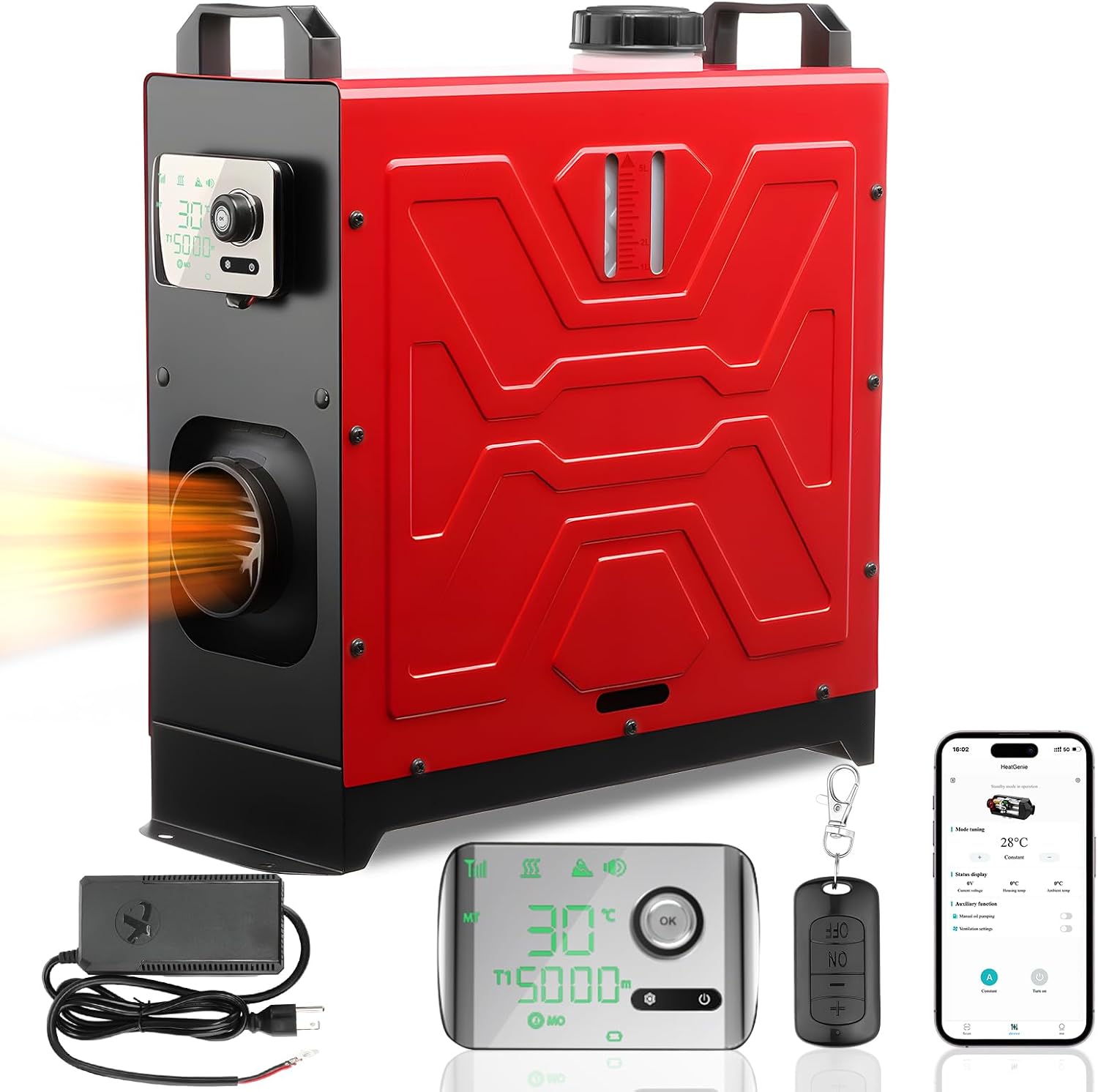
This GEARLASSO 8KW diesel heater is a compact, fuel-powered unit designed to deliver fast radiant heat to campervans, RVs, trucks and small indoor spaces. It runs on 12V/24V/110V power, draws diesel from its 5 L tank and claims rapid warm-up in roughly 5 to 10 minutes while producing up to 17,000 BTU and covering roughly 215 to 269 ft². Controls are flexible: an LCD panel, a long-range remote and a Bluetooth app let you set temperatures between about 46.4 and 104 °F and preheat from a distance. The unit includes safety features such as thermostatic control, automatic shutdowns and external exhaust routing for safer overnight use. Fuel efficiency is emphasized via a precision pump and ceramic ignition with consumption listed at 0.15–0.45 L/h, so it can run many hours on the internal tank. Expect routine installation work, venting and occasional maintenance typical for diesel heaters, and plan for some operating noise despite the muffler silencer. For a campervan this provides strong, reliable heat and remote convenience when properly installed.
Best for: Campers and vanlifers who want strong, fast heat and remote control in a compact diesel unit and are comfortable arranging proper installation and venting.
Less Ideal for: People who prefer purely electric heaters, need fully silent operation, or want a plug-and-play portable heater with no fuel plumbing.
- High heat output up to 17,000 BTU suitable for quickly warming a campervan
- Three control methods: Bluetooth app, long-range remote and LCD panel for flexible operation
- Built-in 5 L fuel tank and efficient fuel consumption (0.15–0.45 L/h) for extended run time
- Safety features including thermostatic control, automatic shutdown and externally vented exhaust
- Requires professional-style installation with venting and fuel plumbing
- Can produce noticeable operational noise even with a muffler silencer
Verdict: If you need powerful, fast heating for a campervan and are willing to install a fuel-fed system, this 8KW diesel heater delivers reliable heat plus app and remote control.
ROKKIT 8KW Diesel Heater

| Power | 8 kW |
|---|---|
| Fuel tank capacity | 5 L |
| Voltage | 12V and 110V (transformer included) |
| Temperature range | 15 °C–40 °C |
The ROKKIT 8KW diesel heater is a compact all-in-one unit designed to deliver fast, high-output heat in vehicles and small living spaces. It features an integrated 5 L fuel tank and claims to heat up in about five minutes while consuming roughly 0.14 to 0.4 L/h, which makes it suitable for long overnight runs without refueling. Controls include an LCD panel plus a long-range remote for temperature adjustment between 15 and 40 C, a timer, and pump frequency settings so you can tune comfort and fuel use. The unit emphasizes safety with temperature regulation and overheating protection and uses a muffler, low-frequency pump, and silent fan to reduce noise. Practical limitations include weight and bulk for very tight installations and the need to follow safe venting and installation practices for combustion heaters; it also requires diesel fuel storage and periodic maintenance. For campervan use it provides rapid, powerful heat and long runtime but needs careful mounting and proper exhaust routing.
Best for: Campers and van converters who prioritize fast, high-output heating and long unattended runtime for cold-weather trips and need a heater that can be tuned for fuel efficiency.
Less Ideal for: People seeking the smallest, lightest heater for very tight van builds or those unwilling to install and maintain a combustion exhaust and fuel system should consider electric or smaller diesel options instead.
- High heat output (8 kW) for quick warm-up in cold conditions
- Integrated 5 L fuel tank for extended 24–36 hour runtime
- Works on 12V and includes a 110V transformer for flexible power options
- LCD plus long-range remote lets you set temperature and schedule runs
- Built-in muffler, low-frequency pump, and fan design reduce operating noise
- Relatively heavy and bulky compared with compact campervan heaters
- Requires safe exhaust routing and regular maintenance typical of combustion heaters
Verdict: A performance-focused diesel heater that delivers fast, high-output heat and long runtime for campervans that need powerful cold-weather heating.
Triclicks Diesel Air Heater 12V 5KW

| Power | 5KW |
|---|---|
| Voltage | 12V |
| Item Weight | 19.14 pounds |
| Exterior | Metallic Finish |
This Triclicks 12V diesel air heater is an all-in-one unit intended to warm campervans, trucks, boats, and small indoor areas when shore power is unavailable. It runs from a vehicle 12V system and burns diesel to produce hot air, with adjustable temperature, fan speed, and preheat via the included remote or LCD controller; some listings also show Bluetooth app control on select variants. The compact metal-bodied unit includes an accessory kit for installation and a fuel pump designed for continuous use, and it claims low emissions and modest fuel consumption compared with space heaters that rely on vehicle idling. Practical benefits include fast localized heating, the ability to clear window frost, and a small footprint that fits tight mounting locations. Important limitations are the need for a diesel fuel source and installation that requires cutting vents and routing exhaust, and it may be louder than purpose-built RV furnace systems despite a listed silencer. Expect routine maintenance for combustion parts and careful mounting to meet safety and ventilation needs in a campervan.
Best for: Buyers who want a practical, fuel-powered heater for a campervan or mobile rig that delivers fast, vehicle-independent heat and can be installed in limited space.
Less Ideal for: If you need a plug-and-play electric solution or cannot accommodate fuel, exhaust, or maintenance requirements, choose an electric or propane alternative instead.
- All-in-one compact design suitable for tight mounting locations
- Remote control and LCD switch for preheating and adjusting temperature and fan speed
- Works from a 12V vehicle electrical system so it heats without running the engine
- Accessory kit and fuel pump included to support installation
- Designed for low fuel consumption and reduced emissions compared with engine idling
- Requires fuel plumbing, exhaust routing, and a proper installation which is more complex than plug-in heaters
- Combustion heater needs periodic maintenance and careful ventilation for safe operation
- May produce more noise than factory RV furnaces despite having a silencer
Verdict: A compact 12V diesel air heater that gives campervan owners dependable, vehicle-independent heat and frost clearing in a small, installable package.
R.W.FLAME Ceramic Space Heater

| Heating Coverage | 200 Sq.ft |
|---|---|
| Heat Output | 1500 watts |
| Heating Element | Ceramic |
| Number of Speeds | 4 |
| Max Temperature Setting | 104 °F |
This small R.W.FLAME ceramic heater delivers fast, focused warmth using a 1500W PTC element and convection airflow, making it useful for warming a single zone quickly. It is typically used on a tabletop or floor in small spaces up to about 200 sq ft and includes a built-in thermostat with ±1°F precision so it can cycle to maintain a steady temperature rather than running full blast. The unit supports four modes (Low, High, Eco, Fan), a 24-hour timer and an ECO setting to reduce energy use, and comes with a remote and touch controls for convenient operation. Safety features include a flame-retardant case, overheat protection, tip-over shutoff, ETL certification and a child lock, which matter in compact mobile living spaces. Limitations are inherent to a 1500W plug-in heater: it needs shore power or an inverter sized to handle the load and will only heat a small area rather than an entire van on its own. It is lightweight and portable but not intended as a primary heating system for very cold nights without supplemental insulation or power capacity.
Best for: Buyers who need an inexpensive, portable electric heater to warm a single area in a campervan or mobile space and who prioritize simplicity, safety, and low upfront cost.
Less Ideal for: People seeking a whole-van heating solution for extended cold-weather camping or those without reliable shore power or an inverter capable of 1500W continuous draw.
- Rapid PTC ceramic heating that begins warming within seconds
- 1500W output with built-in thermostat for steady temperature control
- Remote and touch controls plus a 24-hour timer for easy, hands-off operation
- Multiple safety measures including tip-over shutoff, overheat protection, flame-retardant case and child lock
- Requires 1500W mains or a suitably sized inverter so it can strain limited van power systems
- Designed for spot heating only and will not heat a poorly insulated van evenly
Verdict: A compact, budget-friendly plug-in heater that provides quick, safe spot heating for a campervan when you have sufficient electrical capacity.
Mr. Heater Portable Buddy F232000

| Heat Output | 9000 british thermal units |
|---|---|
| Fuel Type | Propane |
| Heating Coverage | 225 |
| Number of Speeds | 2 |
The Mr. Heater Portable Buddy is a compact propane radiant heater built for quick, dependable heat in small spaces. It offers two output settings (about 4,000 and 9,000 BTU) and runs on a 1 lb propane cylinder with the option to connect a larger tank via accessories, making it easy to use at rest stops or in a well-ventilated campervan. Key safety features include an oxygen depletion sensor, thermal shutoff, and a tip-over switch, which are important when using an open-flame heater in mobile living spaces. The unit is lightweight with an easy-grip handle and piezo igniter for simple startup, and a 1 lb cylinder lasts roughly three hours on high. Practical limits are its need for ventilation and propane fuel, the short runtime on small cylinders, and the radiant-only heat pattern which favors directional warming over whole-van air circulation. For users who prioritize a reliable, no-frills heat source that works off-grid, the Buddy is straightforward and proven; it requires safe placement and fresh-air management when used inside a campervan.
Best for: Campervan owners who need a compact, dependable off-grid heater that runs on propane and prioritizes straightforward performance and built-in safety.
Less Ideal for: People who want quiet, continuous whole-van heating without managing ventilation or fuel swaps should consider integrated diesel or electric heating systems instead.
- Portable, lightweight design with easy-grip handle for carry and placement
- Two heat settings (approx. 4,000 and 9,000 BTU) for flexible output
- Built-in safety systems: oxygen depletion sensor, thermal shutoff, and tip-over switch
- Runs on a standard 1 lb propane cylinder and can hook to larger tanks with accessories
- Requires ventilation and propane refills, so continuous indoor use needs planning
- Radiant-only heating warms people and objects directly rather than circulating air
Verdict: A compact, safety-minded propane radiant heater that reliably delivers directional warmth for campervans when ventilation and fuel planning are handled.
Amazon Basics Ceramic Mini Heater DQ1722C
| Heat Output | 500 watts |
|---|---|
| Heating Method | Convection |
| Power Source | Corded Electric |
| Room Type | Home Office |
| Special Features | Tip-Over Protection |
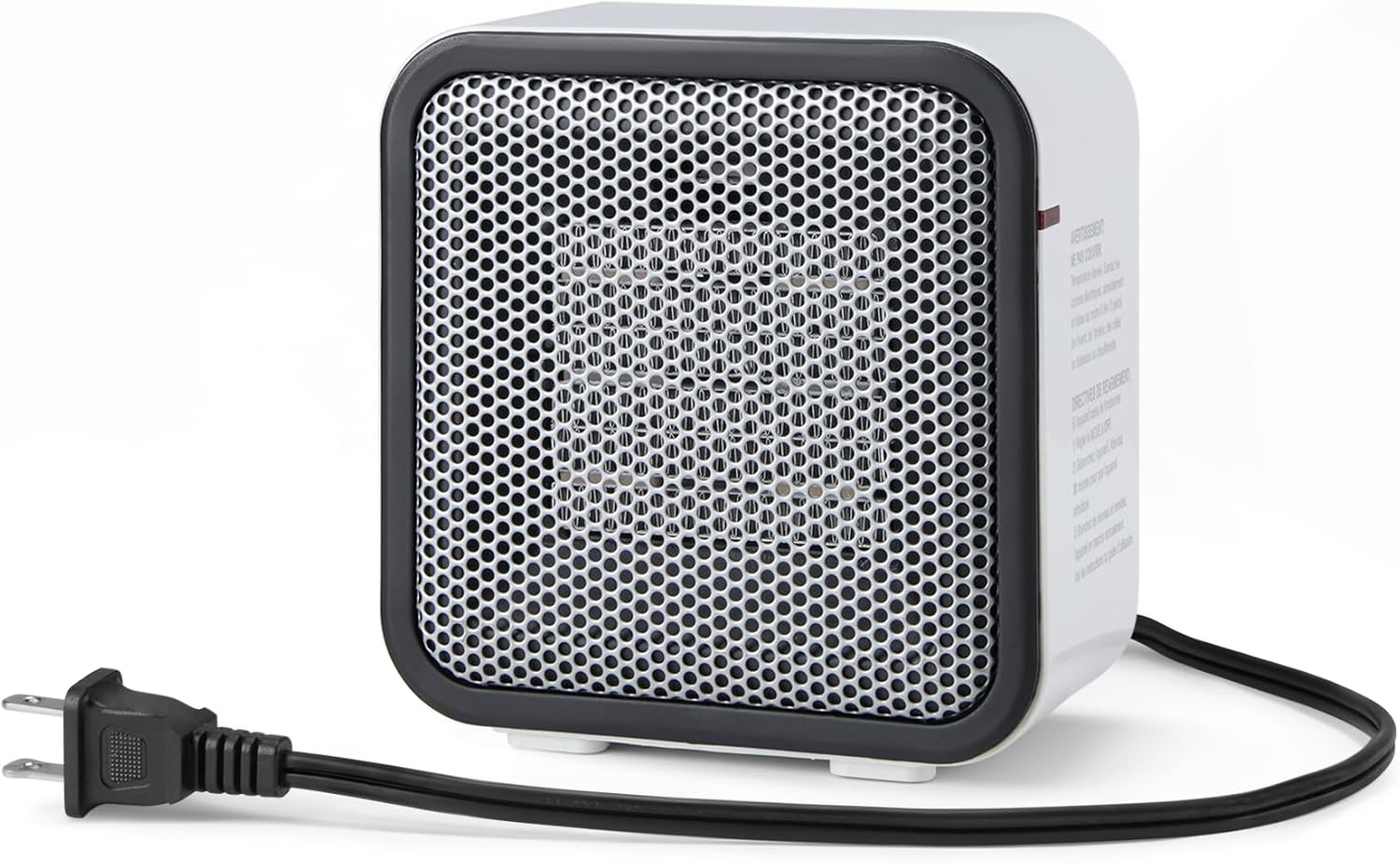
This little ceramic heater provides targeted, fast heat from a very small footprint, making it useful for warming a single seat or a small area in a campervan. It runs on 500 watts and uses ceramic coils to produce convective heat quietly, so you get noticeable warmth in seconds without a loud fan. The heater is portable and light, so it can be moved between countertop, dinette, or sleeping areas, and the built-in tip-over protection automatically cuts power if it is knocked over. Its single-speed output and fixed wattage mean it is simple to operate but not adjustable for fine temperature control or large spaces, and the 120V corded power requirement limits use to shore power or an inverter capable of handling the draw. For short bursts of personal heat while parked and connected to power, it is an efficient, low-profile option; it is not intended to heat an entire van or run from small battery setups for long periods.
Best for: Campers who prioritize a small, quiet heater for short, personal heating sessions while plugged into shore power or an inverter and who want a simple, low-profile device.
Less Ideal for: People needing to heat a whole campervan, rely on long off-grid battery operation, or who want precise temperature control and multiple heat settings.
- Compact, lightweight design for easy placement and portability
- 500W ceramic heater delivers quick, quiet convective heat
- Built-in tip-over safety shuts the unit off if knocked over
- Low noise operation suitable for sleeping areas
- Single fixed heat output without adjustable settings
- Requires 120V corded power so not ideal for off-grid battery-only use
Verdict: A tiny, quiet 500W ceramic heater that gives fast personal warmth in a campervan when you have shore power or a capable inverter.
DREO Portable Space Heater HSH006

| Heat Output | 1500 watts |
|---|---|
| Heating Element | PTC Ceramic |
| Heating Coverage | 200 sq.ft |
| Sound Level | 34 dB |
| Voltage | 120 volts |
The DREO HSH006 is a small tower-style space heater that delivers up to 1500 watts of forced-air warmth using a PTC ceramic element and an adjustable thermostat. It is designed for close-range heating in personal spaces and includes multiple heat modes, a 12-hour timer, and a remote for hands-off control. The brushless DC motor and winglet fan design are tuned to run quietly at about 34 dB, which helps keep noise low in confined living areas, and safety features include tip-over detection, overheat protection, child lock, and V0 flame-retardant materials. Practical benefits for a campervan include rapid warm-up, precise temperature control in 1 F increments from 41 to 95 F, and a small footprint with a carry handle for repositioning. The unit is corded and rated for 120 V, so it requires access to shore power, an inverter sized for continuous 1500 W output, or careful power management. It does not list DC or battery operation, so off-grid campers should plan power accordingly.
Best for: Campers who prioritize a safe, quiet, plug-in heater for short-range warmth and who have reliable shore power or an inverter capable of handling a 1500W load.
Less Ideal for: People relying solely on vehicle batteries or tiny portable power stations without a high-capacity inverter should choose a heater designed for low-voltage DC or propane alternatives instead.
- 1500W PTC ceramic element provides fast, consistent heat
- Precise thermostat with 1°F increments from 41°F to 95°F
- Quiet brushless DC motor reduces noise to about 34 dB
- Multiple modes, 12-hour timer, and included remote for convenience
- Built-in safety: tip-over sensor, overheat protection, child lock, and flame-retardant materials
- Requires 120V AC and up to 1500W continuous power, so it is not natively suited to battery-only setups
- No listed oscillation feature to spread heat across a larger area
Verdict: A compact, safety-focused 1500W plug-in heater that is ideal for campers with reliable 120V power and who want quiet, controllable warmth.
Choosing the Right Heater for Campervan: Key Factors to Consider
Heat Output and Coverage
Heat output determines how quickly and uniformly a heater can raise and maintain comfortable temperatures in a campervan. Small vans need units rated to heat the specific cubic footage of the cabin, and you should check rated kilowatts or BTUs against your van's volume. A unit that can briefly run at a higher output is useful for rapid warm-up, but sustained low-power capability matters for overnight comfort and conserving fuel.
Overpowering a tiny space wastes fuel and may cycle on and off frequently, reducing efficiency and increasing wear. Conversely, undersized heaters struggle in very cold conditions and force continuous high output, which drains power supplies faster. Choose a heater sized to your typical climate and the van's insulation level.
Fuel Type and Energy Availability
The type of fuel or energy the heater uses affects installation complexity, runtime, and where you can operate it. Common options include diesel, propane, and electric resistive or hydronic systems. Diesel and propane offer long runtimes off-grid from onboard tanks, while electric options are cleaner and simpler but depend on battery and inverter capacity. Hydronic heaters integrate with vehicle fuel or a separate tank and can be efficient for steady, low-noise heat.
Consider how you camp: frequent boondocking favors fuel-based heaters with long runtimes. If you regularly have shore power or a large battery bank and inverter, electric options may be viable. Also account for safe fuel storage, refilling logistics, and any ventilation that certain fuels require.
Installation Footprint and Mounting
Space is at a premium in campervans, so the heater's physical footprint and mounting options are crucial. Look for compact units with multiple mounting orientations and slim exhaust arrangements. Under-bed, wall, or floor-mount options affect interior layout and usable storage space. Some systems require routing exhaust and air intake through the van wall, which needs planning for cutting, sealing, and weatherproofing.
Also plan for clearances around the unit for service access and for safe heat dispersion. If you rent or modify a van you want to return to stock, choose solutions with minimal permanent alterations or that can be relocated.
Noise and Comfort
Noise matters in a small living space because even moderate fan or burner sounds can disrupt sleep. Check manufacturer sound ratings and seek units designed for low-speed, continuous operation rather than noisy high-power bursts. Hydronic or hot-water-based systems are often quieter during steady-state heating because they rely on thermal mass rather than high airflow.
Also consider where air outlets are placed relative to sleeping areas. Ducting can help move warm air without placing the blower near the bed. Smaller fans running longer at low speed often feel more comfortable than occasional high-speed blasts.
Safety and Ventilation
Operating a heater inside a sealed metal box introduces risks that must be managed. Proper exhaust routing, carbon monoxide management, flame-failure protection, overheat shutdown, and secure fuel lines are key safety features. Approved combustion units should have adequate combustion air intake and sealed exhaust to prevent fumes from entering the cabin.
For electric heaters, ensure wiring and inverter sizing match the heater's draw, and include appropriate circuit protection. Install carbon monoxide and combustible-gas detectors in the living area and place them according to safety guidelines. Regular inspection and maintenance reduce the chance of leaks or blocked vents.
Maintenance and Serviceability
Routine maintenance affects long-term reliability and ownership cost. Components like glow plugs, filters, pumps, fuel lines, and burners need inspection and occasional replacement. Choose units with accessible service points and clear maintenance schedules so you can perform routine checks yourself or with minimal shop time.
Consider the availability of replacement parts and whether basic servicing can be done with common tools. Simpler systems with fewer moving parts are easier to maintain on the road, while more complex hydronic or forced-air systems may offer benefits at the cost of greater upkeep.
Types of Heaters Suitable for Campervans
Several heater types are commonly used in campervans, and each has advantages depending on how you travel. Combustion air heaters burn diesel or propane and provide substantial heat with long runtimes from compact fuel tanks. Electric space heaters are simple and quiet but need significant battery and inverter capacity for extended use. Hydronic or hot-water heaters heat coolant that circulates through a small radiator, offering quiet, even warmth and the ability to heat other systems, like onboard plumbing.
Assess which category aligns with your power setup, camping style, and tolerance for installation complexity. The rest of the guide focuses on practical tradeoffs and installation considerations to help you match a heater type to your van life habits.
- Combustion air heaters: high output, off-grid friendly, requires exhaust and fuel line.
- Electric resistive heaters: simple, quiet, limited by battery/inverter capacity.
- Hydronic systems: quiet, even heat, greater installation complexity and parts.
Sizing a Heater for Your Van
To estimate needed heat output, calculate the van's insulated volume rather than just floor area. Use typical heat loss guidance for small insulated boxes and factor in expected low temperatures. A common approach uses a watts-per-cubic-meter or BTU-per-cubic-foot rule adjusted for insulation quality. Poorly insulated vans need proportionally more output than well-insulated ones.
Plan for both peak warm-up needs and overnight hold. It is often better to choose a unit with variable output or one that can run low-power continuously than a single high-output model that cycles frequently.
- Measure interior volume and factor in insulation quality.
- Prioritize variable output or multi-stage settings for versatility.
Installation Basics and Venting
Safe installation usually involves routing exhaust and intake through the van wall, securing the unit to a sturdy surface, and sealing any penetrations against weather and fumes. Placement should keep hot surfaces away from storage, bedding, and fuel lines while allowing access for maintenance. Some heaters can be mounted under seats or inside cabinets with ducting to deliver heat where needed.
Venting options vary by unit type. Sealed combustion units need precise intake and exhaust clearances; improper routing can reduce efficiency or create safety hazards. If you are uncomfortable cutting the van skin or routing fuel lines, plan for professional help and ensure all joints are sealed and insulated.
- Follow clearance and ventilation specifications closely.
- Seal and insulate wall penetrations to prevent drafts and moisture.
Power Management and Runtime Planning
Fuel-based heaters provide predictable runtimes tied to tank capacity and consumption rates, while electric heaters draw directly from the battery/inverter system. Understand the power draw at various settings and how that impacts SOC, solar recharge, and generator use. Conservative runtime planning prevents dead batteries or running out of fuel in remote locations.
Consider integrating the heater into a broader energy system with a battery monitor, adequate inverter capacity, and solar charging if you rely on electric heating. For combustion heaters, size the fuel tank and plan refills based on typical trip length and consumption.
- Model expected runtime at common settings before heading off-grid.
- Match inverter and battery capacity to electric heater draw if using electric options.
Ducting and Interior Flow
How warm air is delivered inside the van affects comfort more than raw output. Strategically placed vents and simple ducting move heat to sleeping and living areas while avoiding hot spots. Short duct runs with smooth bends preserve airflow and reduce blower strain. Some setups include adjustable vents so you can direct heat where you need it most.
Think about integrating under-bed ducts, toe-kick vents, or small outlets at head height for even distribution. Insulated ducts reduce heat loss on the way to outlets and keep surfaces safer to touch.
- Use short, insulated ducting to preserve delivered heat.
- Place vents to balance sleeping and living area temperatures.
Seasonal Use and Condensation Control
Heating a campervan in cold, damp climates often increases condensation risk. Adequate ventilation, moisture control, and managing surface temperatures can reduce dripping and mold. Running a low continuous heat can keep interior surfaces above the dew point, while extraction vents or small fans help remove humid air during cooking or drying wet gear.
Combine heating strategy with insulation upgrades and vapor barriers where practical. Addressing condensation proactively preserves finishes and reduces long-term maintenance headaches.
- Run low continuous heat in very cold, humid conditions to prevent condensation.
- Use vents or extract fans during activities that add humidity.
How We Chose the Best Heater for Campervan
We evaluated heaters for campervan use with measurable, practical standards that reflect real vanlife conditions. Our selection focused on sustained heat output for small cabins, fuel and electrical efficiency for off-grid use, compactness and mounting options to fit tight van interiors, and safety features that matter in enclosed spaces. We prioritized systems with clear installation paths and accessible maintenance so owners can fit and service the unit without complex shop work. Noise levels under load were considered to avoid units that disrupt sleep or conversation. We excluded devices intended only for tents, large RVs, or industrial spaces because their installation, ventilation, and power demands differ from campervan needs. The final list includes heaters that strike a balance between heat performance, installation practicality, efficiency, and safety for typical campervan layouts.
Our full evaluation process is outlined in our review methodology.
FAQ
Can I run a heater while sleeping in a campervan?
Often you can, but it depends on the heater type and proper installation. Combustion heaters must have sealed combustion and correct exhaust routing, and you should install carbon monoxide and gas detectors. Electric and hydronic systems can be safer for overnight use but still require correct wiring and fusing.
How much fuel or power will a campervan heater use overnight?
Usage depends on heater size, output setting, insulation, and outside temperature. Fuel-based units usually consume modest fuel amounts over many hours, while electric heaters can draw substantial battery power. Estimate consumption from manufacturer output and efficiency ratings and plan tank or battery capacity accordingly.
Do I need a professional to install a campervan heater?
It depends on your skills and the chosen heater. Simple electric units may be DIY-friendly if you have electrical know-how. Combustion and hydronic systems require careful fuel and exhaust routing and are often best installed or at least inspected by a professional to ensure safety.
How noisy are campervan heaters?
Noise varies by type and model. Combustion blowers can be noticeable at high output, while hydronic and some electric options are quieter during steady operation. Consider blower speed, placement, and ducting to minimize perceived noise near sleeping areas.
What maintenance do campervan heaters need?
Regular tasks include checking and cleaning air filters, inspecting fuel lines and fittings, replacing glow plugs or igniters as recommended, and keeping exhaust and intake vents clear. Following a maintenance schedule reduces the risk of failures while traveling.
Final Verdict
Prioritize a heater that matches your van's insulation, power or fuel availability, and how you camp. Size the unit for both warm-up and overnight hold, and favor systems with adjustable output and clear installation guidance. Balance tradeoffs between runtime, noise, and maintenance needs so you get reliable comfort without unexpected energy shortfalls. With attention to installation and safety, you can choose a campervan heater that keeps you warm and protects your vehicle and gear during colder trips.