
Note: This article contains affiliate links. If you click on these links and make a purchase, we may earn a small commission at no extra cost to you. This helps support our research and content. Read our full affiliate disclosure here.
A properly sized heater makes a big difference in a large basement. Basements are often the coldest rooms in a house due to below-grade walls, limited sunlight, and larger open areas. Picking the right heater ensures faster warm-up, more even temperatures, and safer operation in a space that may have different clearance and ventilation constraints than upstairs rooms. This guide covers the top shortlisted heaters suitable for large basements and explains the practical tradeoffs you should weigh, including heat output, energy use, and installation or placement requirements. Read on to see the evaluation criteria we used and which features matter most for basement heating.
Top Picks at a Glance
| Best Overall The best all-around choice for most situations | Mr. Heater Big Maxx 125K BTU |  |
| Best Quality Built to a higher standard if you want something more solid | DEWALT Forced Air Propane Heater DXH70CFAV |  |
| Best Value The sweet spot between price and what you get | DREO Solaris Max 25" Space Heater | 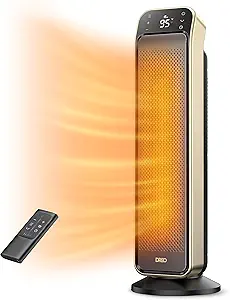 |
| Best Budget The cheapest option that still gets the job done reliably | AUBKN PTC-SL2403 Tower Heater |  |
| Top Rated A top-rated pick with lots of positive feedback | DREO Tower Space Heater HSH006 |  |
| Most Popular A crowd favorite that many people choose with confidence | Dr. Infrared Heater DR-968 |  |
| Best Seller A high-volume bestseller chosen again and again | Mr. Heater 30,000 BTU Blue Flame Heater |  |
Mr. Heater Big Maxx 125K BTU

| Heat Output | 125000 british thermal units |
|---|---|
| Heating Coverage | 2000 square feet |
| Power Source | Natural Gas (includes LP conversion kit) |
| Mounting Type | Ceiling Mount |
The Mr. Heater Big Maxx is a 125,000 BTU ceiling‑mount forced‑air unit that uses a high‑velocity fan and heat exchanger to push warm air into large indoor spaces. It ships set for natural gas and includes a propane conversion kit, an electric spark ignition, and powered exhaust that allows vertical or horizontal venting. Typical use is overhead installation in a garage or basement where it runs off household 120‑volt power for ignition control and the fan; the built‑in thermostat access and three locking louvers help direct and regulate airflow. Safety features include a high‑temperature shutoff, gas safety shutoff flame sensor, and a self‑diagnostic control module. Tradeoffs are its size and installation needs: it requires ceiling mounting, proper venting, fuel hookup and electrical hookup, and is best for truly large spaces rather than small rooms. For buyers who need a durable, high‑output heater for a workshop, large basement, or barn, this unit delivers robust, direct heat with built‑in safety controls.
Best for: Buyers who need a permanent, high‑capacity heater for a large basement, workshop, or garage and prioritize strong, fast heating and factory safety features.
Less Ideal for: People looking for a portable or temporary space heater, or those unable to accommodate ceiling mounting, venting, and gas connections.
- Very high heat output suitable for large spaces
- Includes propane conversion kit for fuel flexibility
- Powered exhaust allows vertical or horizontal venting
- Multiple safety systems including high‑temperature shutoff and flame sensor
- Requires permanent ceiling mounting and professional fuel hookup
- Large physical footprint and installation clearance needed
Verdict: Choose this unit when you need a permanent, high‑output ceiling heater to reliably warm a large basement or workshop.
DEWALT Forced Air Propane Heater DXH70CFAV

| Heat Output | 68,000 BTU/hr |
|---|---|
| Heating Coverage | 1,7000 square feet |
| Power Source | Propane |
| Voltage | 120 volts |
| Cable Length | 10 feet |
This DEWALT forced-air propane heater is built to push a lot of heat into large, poorly insulated spaces where quick, powerful warmth is needed. It runs on propane and produces up to 68,000 BTU per hour, using a forced-air fan to move heat rapidly across a workspace or basement; it is freestanding and includes a hose and regulator for straightforward hookup. The unit is designed for heavy-duty use and hybrid power between electric or propane allows ignition and fan operation on 120V while fuel comes from a propane cylinder, which makes starting and control reliable. Practical benefits include rapid temperature response and portability so you can move it around a workshop or basement, plus a 10-foot power cable and a compact footprint for placement. Limitations are typical of high-output propane heaters: it needs adequate ventilation for indoor use and continuous fuel supply, and it is louder and less refined than residential electric heaters. For large basements needing fast, robust heating, this is a strong performance-focused option.
Best for: Buyers who prioritize raw heating power to warm large basements or workspaces quickly and value a portable, job-site durable unit.
Less Ideal for: People seeking whisper-quiet, low-maintenance home heating or those unable to provide ventilation and propane storage should consider electric alternatives.
- High heat output at 68,000 BTU/hr suitable for large spaces
- Forced-air design moves heat quickly for fast warm-up
- Freestanding and portable with included hose and regulator
- Hybrid operation uses propane fuel with 120V electrical components for reliable ignition and fan power
- Requires adequate ventilation for safe indoor use
- Dependence on propane supply means ongoing fuel management
- Can be loud compared with residential electric heaters
Verdict: Choose this DEWALT if you need a powerful, portable heater that quickly warms large basements and heavy-duty spaces.
DREO Solaris Max 25" Space Heater

| Heating Element | PTC Ceramic |
|---|---|
| Heat Output | 1500 watts |
| Heating Coverage | 100-270 sq.ft. |
| Oscillation | 70° |
| Temperature Range | 41-95 °F |
This DREO tower heater blends forced-air PTC ceramic heat with a digital thermostat and wide 70° oscillation to warm medium to large rooms. In use you select one of the heat modes or ECO, set the temperature to the 41–95°F range in 1°F increments and let the unit maintain comfort automatically; the extended impeller and higher airflow design are intended to push warm air farther than a typical tower heater. The included remote and timer make placement flexible for basements or open living spaces, and noise is kept low around 25 dB on low which helps for overnight use. Safety features include ETL-listed overheat and tip-over protection, reinforced plug, and a child lock. The heater is corded and runs up to 1500 watts, so it delivers strong output but requires attention to energy use and circuit capacity in larger unfinished basements.
Best for: Someone who wants an efficient, quietly running tower heater that pushes warm air farther than basic models and gives precise thermostat control for heating larger basement rooms.
Less Ideal for: Those who need a permanently installed or hardwired heat source or who cannot accommodate a 1500 W plug-in heater due to circuit or energy constraints.
- PTC ceramic heating with up to 1500 W output for quick warm-up
- 70° oscillation and extended impeller to distribute heat across larger areas
- Digital thermostat with 1°F increments and ECO mode for precise temperature control
- Low noise operation (around 25 dB) suitable for quiet rooms or overnight use
- Multiple safety features including overheat and tip-over protection plus child lock
- 1500 W power draw can strain circuits or increase energy costs in large continuous use
- Corded design limits placement unless you have accessible grounded outlets
Verdict: A quiet, safety-focused tower heater that delivers strong, far-reaching ceramic heat and precise thermostat control for heating larger basement spaces.
AUBKN PTC-SL2403 Tower Heater

| Heat Output | 1500 watts |
|---|---|
| Heating Coverage | 200 sq.ft |
| Number of Speeds | 3 |
| Special Features | Oscillating, Timer, Tip-Over Protection |
This tower heater uses a 1500W PTC ceramic element to deliver fast, even warmth for indoor rooms up to about 200 sq ft, and it starts producing heat within seconds. It is typically placed on the floor in bedrooms, home offices, or basements where you want a portable supplemental heat source; the tower form factor and 70 degree oscillation help spread heat across a wider area than a fixed-direction heater. Controls include a 1–12 hour programmable timer, three-speed fan settings, ECO modes, and a handheld remote so you can change settings from a couch or bed. Safety features include tip-over protection, overheat shutoff, flame-retardant housing, and a long flat power cord. Practical benefits are quick warm-up, simple timed operation for nighttime use, and the convenience of remote control. Important limitations are the 1500W output, which is standard but may be marginal for very large or poorly insulated basements, and the unit is designed for indoor floor use only so it should not be used in damp or unfinished spaces.
Best for: Buyers who need an affordable, portable heater to quickly warm a finished basement or similar medium-to-large room and value simple timed operation and remote convenience.
Less Ideal for: Do not choose this if you need to heat a very large, open, or poorly insulated basement, or if you require a heater rated for damp or outdoor use.
- 1500W PTC ceramic element for rapid heat-up
- 70° oscillation spreads warmth across a wider area
- 1–12 hour programmable timer for scheduled use
- Remote control lets you adjust settings without getting up
- Multiple built-in safety protections including tip-over and overheat shutoff
- Rated for about 200 sq ft so it may struggle to heat very large or poorly insulated basements
- Intended for indoor, dry locations only so not suitable for damp unfinished basement areas
Verdict: AUBKN PTC-SL2403 is a budget-friendly 1500W tower heater that delivers fast, portable warmth with timer, remote, and safety features ideal for finished basements up to about 200 sq ft.
DREO Tower Space Heater HSH006

| Heat Output | 1500 watts |
|---|---|
| Heating Coverage | 200 sq.ft |
| Heating Element | PTC Ceramic |
| Number of Speeds | 4 |
| Min/Max Temp | 41F to 95F |
This DREO tower heater is a compact, safety-minded electric heater built around a 1500W PTC ceramic element and forced-air output to warm rooms up to roughly 200 sq ft. It is typically used as a spot or supplemental heater: pick a mode (Power heat, ECO, Fan Only), set the precise thermostat between 41 and 95 F in 1 F steps, or use the 12-hour timer and remote for hands-off control. Notable features include ETL-listed safety protections (overheat, tip-over detection, flame retardant materials), a brushless DC motor that keeps noise down to about 34 dB, and a memory/child-lock function for steadier operation. Practical benefits are fast warm-up from the PTC element, accurate temperature control for energy-minded use, and quiet operation that suits occupied spaces. Important limitations are its stated 200 sq ft coverage and 1500W maximum output, which means it may struggle to efficiently heat a large basement alone without supplemental insulation or multiple units.
Best for: Buyers who prioritize a reliable, safety-forward supplemental heater for conditioned areas and want precise thermostat control and quiet operation for regular use.
Less Ideal for: People needing to warm a large, uninsulated basement as a primary heat source should consider higher-output heaters or multiple units instead.
- 1500W PTC ceramic element provides quick, consistent warm-up
- Precise adjustable thermostat from 41 to 95 F with 1 F increments
- Multiple convenience controls: remote, 12-hour timer, and memory function
- ETL-listed safety features including tip-over and overheat protection and child lock
- Brushless DC motor and winglet fan reduce operating noise to about 34 dB
- Rated coverage (200 sq ft) and 1500W output limit usefulness as a single heater for large basements
- Tower form factor offers no directional oscillation which can reduce even heat spread in very wide spaces
Verdict: A dependable, quiet 1500W tower heater with precise thermostat control and strong safety features for supplemental heating in conditioned basement zones.
Dr. Infrared Heater DR-968

| Wattage | 1500 Watts |
|---|---|
| Heating Coverage | 576 square feet |
| Number of Speeds | 3 |
| Voltage | 120 |
| Amperage | 12.5 A |
The Dr. Infrared Heater DR-968 combines a quartz infrared tube and a PTC element with a high-velocity low-noise blower to heat rooms quickly and more evenly than simple fan heaters. It is used freestanding on caster wheels and offers three power modes including an Auto energy-saving setting that cycles between high and low to hold a set temperature on the electronic thermostat. Practical features include a remote, 12-hour timer, tip-over and overheat protection, and a long 72-inch cord for flexible placement. The unit is UL certified and engineered to feel warm to the touch rather than exposing hot elements, which helps around children and pets. Trade-offs are its 1500W limit and 12.5A draw, which is typical for portable space heaters but means it is best for supplementing a primary system rather than powering whole-house heating; it also weighs about 19 pounds, so while mobile on wheels it is not as lightweight as smaller ceramic heaters.
Best for: Buyers who prioritize proven safety and reliable customer feedback and want a portable heater that heats a large room quickly while offering convenience features like a remote and timer.
Less Ideal for: Those seeking a lightweight, ultra-compact heater or a single unit to heat an entire very large basement without supplemental heat sources should consider higher-capacity or fixed heaters instead.
- Dual heating system (quartz infrared + PTC) for faster, more even heat delivery
- Auto energy-saving mode that cycles between high and low to maintain set temperature
- Built-in safety features including tip-over and overheat protection and UL certification
- Remote control, timer, and caster wheels for convenient placement and operation
- 1500W maximum limits how quickly it can heat very large, open basements on its own
- Heavier than many portable heaters, making manual lifting less convenient
Verdict: A safety-focused, feature-rich 1500W infrared heater that reliably warms large rooms and gives risk-conscious buyers confident, fast supplemental heat.
Mr. Heater 30,000 BTU Blue Flame Heater

| Heat Output | 30,000 BTU/hr |
|---|---|
| Heating Coverage | 1,000 sq ft |
| Fuel Type | Natural Gas |
| Ignition | Battery operated electronic ignition |
| Special Features | Adjustable Temperature; Low oxygen safety shut-off |
The Mr. Heater 30,000 BTU Blue Flame is a vent-free natural gas space heater designed to warm large, open areas up to about 1,000 square feet. It runs without electricity using a battery-operated ignition and spreads heat by convection from a clean-burning blue flame tube; a built-in adjustable thermostat and oxygen depletion sensor add basic safety and user control. Installation options include wall mounting or freestanding placement with included wall hardware, and a separate blower kit is available if you want more active air circulation. In practice this heater is straightforward to operate and keeps a basement or large room steadily warm without relying on house electric service. Expect typical vent-free characteristics: efficient, immediate heat but no outside venting and modest radiant warmth compared with direct-vent units. The unit is simple mechanically, so upkeep is minimal, but proper installation and adequate fresh-air ventilation are important for safe indoor use.
Best for: Buyers who prioritize reliable, non-electric heating for large, open basements and want a straightforward, safety-minded unit that delivers steady convection heat.
Less Ideal for: People who need portable plug-and-play electric heaters, rooms with poor ventilation or where vent-free gas appliances are restricted by code, or those who want built-in forced-air circulation without buying a separate blower.
- High heat output rated at 30,000 BTU for large rooms up to 1,000 sq ft
- Works without household electricity thanks to battery ignition
- Adjustable thermostat and oxygen depletion sensor improve safety and comfort control
- Can be wall mounted or freestanding and includes mounting hardware
- Vent-free design requires careful attention to room ventilation and local code compliance
- No blower included—fan sold separately if you want faster heat distribution
Verdict: A high-output, non-electric natural gas heater that reliably heats large basements while prioritizing basic safety controls and simple installation.
Choosing the Right Heater for Large Basement: Key Factors to Consider
Heat Output and Room Coverage
Basement volume and ceiling height determine the required heat output. A heater rated for the correct square footage and British thermal units or watts will reach set temperatures without running constantly. Underpowered units struggle to keep larger basements warm and increase wear through continuous cycles.
Also consider how heat distributes in the space. Open plans and exposed concrete floors absorb more heat, so a unit with higher output or supplemental fans for circulation will give more even warmth across the room.
Energy Efficiency and Operating Cost
Basements can require extended heating during cold months, so efficiency directly affects monthly costs. Look for units with better conversion efficiency, low standby draw, or programmable settings that reduce run time. A more efficient heater may cost more up front but typically lowers long-term operating expense.
Factor in thermostat precision and adaptive control features. Accurate regulation prevents overheating and wasted cycles, which matters when heating large volumes over long periods.
Safety Features and Certifications
Basements often have limited ventilation and different space constraints, so safety is paramount. Choose heaters with tip-over protection, overheat shutoff, and appropriate certifications from safety bodies. Sealed combustion or electric units avoid combustion byproducts in poorly ventilated areas.
Check placement requirements and clearances in the manual. Units with cool-touch exteriors or guarded elements reduce risk in family or multipurpose basements.
Placement and Installation Flexibility
Basement layouts vary from finished living areas to workshop-style spaces. Consider whether you need wall-mounted, ceiling-ducted, or freestanding heaters. Wall-mounted units save floor area and reduce obstruction, while freestanding models are easier to reposition. Installation complexity and the need for wiring or venting affects both cost and suitability.
Also evaluate noise from fans or blowers. A quieter unit is better for media or living spaces, while louder forced-air models might be acceptable in utility areas.
Controls, Thermostat Accuracy, and Zoning
Good control features let you maintain consistent basement temperatures without manual adjustments. Built-in thermostats with tight differential control keep swings small. Programmable schedules and remote control or smart-home compatibility let you reduce runtime when the space is unused.
If you heat multiple zones, consider models that integrate with zone controls or allow setpoint staging so the basement can be maintained at a different temperature than the rest of the house.
Durability and Maintenance
Basements can be damp or dusty environments depending on finishing and use. Durable construction and corrosion-resistant materials increase service life. Consider ease of cleaning and availability of replaceable parts like filters or elements.
Regular maintenance needs, such as filter changes or annual inspections for vented systems, affect long-term ownership costs and reliability, so choose a heater with manageable upkeep for the expected use pattern.
Sizing Your Heater for a Large Basement
Calculate required heat output by estimating the cubic footage of the basement and accounting for insulation, exposed concrete, and typical ceiling height. A general starting point is to multiply square footage by a watts-per-square-foot guideline adjusted for basement conditions. Insulation upgrades and area rugs can reduce required output.
When in doubt, choose a unit with slightly higher capacity rather than undersizing. You can use built-in controls to dial down output, but an underpowered heater may run continuously and never reach a comfortable temperature.
- Measure square footage and ceiling height to estimate volume
- Adjust for poor insulation, slab floors, or large exterior-facing walls
- Plan for additional heat if the basement will be used as a living space
Electric Vs Combustion Options for Basements
Electric heaters are common in finished basements because they avoid combustion fumes and complex venting. They are typically simpler to install and require fewer clearances. Combustion heaters can offer strong output but often need venting and more careful placement, which can limit options in some basements.
Consider the ventilation and code requirements for any combustion unit. In spaces where ventilation is limited or where occupants spend a lot of time, electric models or sealed-combustion designs reduce indoor air quality concerns.
- Electric: easier installation, no combustion byproducts
- Combustion: high output but requires venting and clearance
- Sealed-combustion options combine power with safer indoor air
Managing Airflow and Temperature Layers
Basements often exhibit temperature stratification with cold floors and warmer air above. To counter this, choose heaters with built-in fans or plan supplemental circulation. Ceiling fans set on low reverse can also move warmer air downward in certain layouts.
Placement matters. Position heating sources to promote cross-room circulation rather than concentrating heat in one corner. If the basement has multiple rooms, smaller distributed units or ducting can reduce cold spots more effectively than a single centralized unit.
- Use fans or blower-equipped heaters to improve distribution
- Avoid placing heaters directly against cold exterior walls
- Consider multiple smaller units for compartmentalized basements
Noise Considerations for Living-Style Basements
Noise from blowers or fans can be disruptive in media rooms or beds-in-basement setups. Look for units that specify dB levels or advertise quiet operation for living spaces. Radiant and convection heaters are often quieter than forced-air models.
If noise is a primary concern, prioritize units with variable fan speeds and lower-speed operation modes, which maintain heat while reducing audible output.
- Check stated noise levels if available
- Choose convection or radiant designs for quieter operation
- Use placement and vibration isolation pads to minimize transmission
Maintenance Tips for Basement Heaters
Regular maintenance keeps systems running efficiently and extends service life. Clean or replace filters per manufacturer intervals, inspect electrical connections, and remove dust from vents and elements. In damp basements, check for corrosion and ensure mounting hardware remains secure.
Schedule professional inspections for vented combustion units to confirm safe exhaust and combustion performance. Keep combustible materials at the recommended clearances regardless of heater type.
- Replace filters and clean vents regularly
- Inspect for corrosion or moisture damage in damp basements
- Follow service intervals for vented systems to ensure safe operation
How We Chose the Best Heater for Large Basement
We focused on practical, measurable attributes that matter when heating a large basement. Key evaluation criteria included continuous heat output and coverage to ensure a unit can maintain comfortable temperatures across an open or partially divided lower level. Energy efficiency and running cost were weighed to reflect seasonal operation and the high heat demand of below-grade spaces. Safety features and certified protections were required because basements often have limited ventilation and unique placement considerations. Thermostat accuracy and control options were assessed for maintaining steady temperatures without large swings. Installation or placement flexibility, including wall-mount, freestanding, or venting options, was considered for varying basement layouts. Excluded from consideration were units designed only for very small rooms, portable devices with insufficient continuous output, or products lacking basic safety certifications. We also filtered out heaters that cannot be used in typical finished basement environments due to excessive clearance or ventilation requirements. The final picks balance measured heat capacity, operational efficiency, user control, safety, and installation practicality for large basement spaces.
Our full evaluation process is outlined in our review methodology.
FAQ
How do I figure out what size heater I need for a large basement?
Estimate the basement volume by multiplying square footage by ceiling height, then use a watts- or BTU-per-cubic-foot guideline adjusted for insulation and exterior wall area. When unsure, pick a slightly larger capacity to account for slab and concrete heat loss.
Are electric heaters safe to use in basements?
Yes, electric heaters are generally safe for basements because they do not produce combustion byproducts. Choose units with overheat protection and certified safety approvals, and follow clearance and placement instructions in the manual.
Can a single heater warm an open-plan large basement effectively?
It depends on the heater capacity and room layout. A high-output unit with good airflow can work, but in very large or partitioned basements multiple units or supplemental circulation may provide more even temperatures and reduce cold spots.
Do I need professional installation for basement heaters?
Professional installation is recommended for vented or hardwired units to ensure safe exhaust, electrical connections, and code compliance. Plug-in electric units usually do not require professional installation but must be used on appropriate circuits.
How does insulation affect heater choice for a basement?
Better insulation lowers heat loss and reduces the required output, allowing a smaller or more efficient heater to maintain comfort. Improving insulation is often a cost-effective way to reduce the long-term expense of heating a basement.
Final Verdict
Prioritize heat output, safety, and control precision when selecting a heater for a large basement. Correct sizing and thoughtful placement reduce runtime and improve comfort, while efficiency and thermostat accuracy lower operating costs. Balance installation complexity against the expected use of the space to choose a solution that provides steady warmth with manageable maintenance.