
Note: This article contains affiliate links. If you click on these links and make a purchase, we may earn a small commission at no extra cost to you. This helps support our research and content. Read our full affiliate disclosure here.
When temperatures drop, a proper heater for your garage in winter makes the space usable, protects stored items, and keeps projects on schedule. You need a unit that delivers enough heat to raise ambient temperature, runs safely in a dusty, partially insulated space, and fits your power and ventilation constraints. This guide covers seven shortlisted heaters that meet those needs and explains the technical and practical factors behind each selection. We evaluate heating output, safety systems, installation and portability, and operating costs so you can pick the right solution for your garage and typical winter conditions.
Top Picks at a Glance
| Best Overall The best all-around choice for most situations | VEVOR 5000W Garage Heater |  |
| Best Quality Built to a higher standard if you want something more solid | Mr. Heater Unit Heater F260560 |  |
| Best Value The sweet spot between price and what you get | Comfort Zone Ceiling Garage Heater CZ220 |  |
| Best Budget The cheapest option that still gets the job done reliably | Dura Heat EUH1465 1500W Heater |  |
| Top Rated A top-rated pick with lots of positive feedback | DREO Atom One Tower Heater |  |
| Most Popular A crowd favorite that many people choose with confidence | Lasko Ceramic Tower Heater 751320 |  |
| Best Seller A high-volume bestseller chosen again and again | Amazon Basics 46,000 BTU Patio Heater |  |
VEVOR 5000W Garage Heater

| Power | 5000 Watt |
|---|---|
| Heating Coverage | 50 sq.m. |
| Voltage | 240 |
| Number of Speeds | 2 |
| Timer Function | 1-9H |
The VEVOR 5000W garage heater is a hardwired, wall- or ceiling-mounted electric unit that uses a fan-forced heating element to quickly warm workshop and garage spaces. It offers two power settings and an LCD panel plus remote control for simple temperature and timer adjustments, and adjustable louvers help direct airflow where you need it. Practical features include a 1–9 hour timer, overheat automatic shutoff, and what the brand calls precise temperature control to hold stable temps in the space. The metal housing and ETL listing add some confidence for indoor use. Expect robust, even heat for medium-sized garages but plan for professional or competent electrical installation since it runs on 240V and about 20.8A. Noise is typical for fan-forced units and heat coverage will depend on insulation and ceiling height, so this unit is best where fast, direct warm air is preferred over silent radiant-only heat.
Best for: Buyers who want a powerful, controllable garage heater that delivers quick, directional warm air and are comfortable arranging a 240V hardwired installation.
Less Ideal for: Those needing ultra-quiet background heat, very large uninsulated workshops, or users who cannot install a dedicated high-voltage circuit should look elsewhere.
- High 5000W output for rapid warming of medium garages
- Wall or ceiling mount increases placement flexibility and floor space use
- LCD controls plus remote and a 1–9 hour timer make operation convenient
- Built-in overheat protection and ETL listing for safer indoor use
- Adjustable louvers and two speed settings to direct airflow and control output
- Requires hardwiring to 240V circuit and likely professional installation
- Fan-forced operation produces noticeable noise compared with radiant-only heaters
- Max temperature listed may be limited for very cold climates
Verdict: If you need fast, controllable heat for a medium garage and can provide a 240V hardwired connection, this 5000W VEVOR heater delivers reliable, directional warmth with convenient remote control.
Mr. Heater Unit Heater F260560

| Heat Output | 80,000 BTU |
|---|---|
| Heating Coverage | 2667 |
| Fuel Type | Natural Gas |
| Mounting Type | Ceiling Mount |
| Power Source | gas_powered |
This Mr. Heater F260560 is a ceiling-mounted forced-air unit heater that uses natural gas and an electric high-velocity fan to move air across a coil heat exchanger, delivering up to 80,000 BTU to heat large spaces. It is typically mounted in garages, barns, or workshops and vents either vertically or horizontally; installation includes ceiling brackets and external access to thermostat and power connections for straightforward wiring. Notable features include an electronic thermostat interface, durable spark ignition, a factory self-diagnostic control module, and compatibility with standard 24-volt or Wi-Fi thermostats. In practical use the high fan power and 80,000 BTU output make it fast at raising temperatures in open, high-ceiling spaces up to the rated coverage, and the low mounting clearance and included conversion kit simplify setup. Important limitations are that it requires a natural gas hookup (includes LP conversion kit), 115 V power for the fan and controls, and an appropriate ceiling height and ventilation per local codes, so it is not a simple plug-and-play portable heater for living areas.
Best for: Buyers who need a high-performance, permanently installed heater to quickly warm large garages, barns, or workshop spaces and value rapid heat delivery and thermostat compatibility.
Less Ideal for: People looking for a portable, plug-in heater for small rooms or those without access to natural gas or propane hookups should consider other options.
- High 80,000 BTU output suitable for heating large garages or workshops
- Ceiling-mounted forced-air design moves heat quickly across wide areas
- Includes ceiling mounting brackets and NG-to-LP conversion kit for flexible fuel setup
- Compatible with standard 24-volt or Wi-Fi thermostats for temperature control
- Factory self-diagnostic control and durable spark ignition improve reliability
- Requires natural gas or propane hookup and 115 V power, so installation is more involved than portable heaters
- Not suitable for low-ceiling or small indoor living spaces due to mounting and clearance requirements
Verdict: A high-output, ceiling-mounted natural gas unit heater built to rapidly heat large garages and workshops while integrating with thermostats for precise control.
Comfort Zone Ceiling Garage Heater CZ220

| Heating Coverage | 1000 sq. ft. |
|---|---|
| Voltage | 240 |
| Number of Speeds | 3 |
| Heat Output | 17065 british thermal units |
| Power Source | Hard-Wired Electric |
This Comfort Zone ceiling heater is a hard-wired, fan-forced unit intended to heat garages or workshops while leaving floor space clear. It mounts to the ceiling and delivers variable output across three settings (3,000, 4,000, 5,000W) to suit different cold-weather needs, and louvers plus an adjustable mounting angle let you aim airflow toward a workstation or a drafty corner. Controls are simple: a dual knob for thermostat adjustments and on/off operation, and a power indicator shows when the unit is running. The heavy-gauge steel body feels durable for a work environment and the built-in overheat sensor adds a layer of safety for unattended operation. Because it is 240V hard-wired, installation requires electrical work and the unit is fixed in place, but that also gives it steady, high-output performance compared with portable shop heaters. It is best for garages where permanent, ceiling-mounted heat and focused airflow matter more than portability or plug-and-play convenience.
Best for: Buyers who want a permanent, high-output solution to heat a garage or workshop and prioritize floor-space savings and targeted airflow over portability.
Less Ideal for: People who need a portable or plug-in heater, who cannot accommodate hard-wired 240V installation, or who frequently move heating between spaces.
- High maximum output with three heat settings for flexible heating power
- Ceiling mount saves floor space and directs heat where needed
- Heavy-gauge steel construction suited to garage and workshop environments
- Built-in overheat protection and power indicator for safer operation
- Requires 240V hard-wired installation and likely professional electrician
- Fixed ceiling mounting prevents repositioning or portable use
Verdict: A durable, ceiling-mounted 240V heater that delivers strong, targeted heat for garages and workshops where a permanent, floor-saving solution is the priority.
Dura Heat EUH1465 1500W Heater

| Heat output | 5,120 BTU |
|---|---|
| Power | 1500 Watts |
| Coverage | Up to 250 sq ft |
| Voltage | 120 volts |
| Cord length | 6 ft |
The Dura Heat EUH1465 is a portable 1500W forced-air heater built for garages, workshops, and similar small spaces. It pairs a high-velocity fan with a PTC ceramic heating element to deliver 5,120 BTU and warm areas up to roughly 250 square feet, and includes a built-in thermostat plus a fan-only mode for year-round use. The steel cabinet and carry handle make it reasonably durable and easy to move, while the 6 ft polarized cord and stable base let you place it where you need heat without additional installation. Safety features include overheat shut-off, and the single-speed fan keeps controls simple. For budget-minded buyers the unit offers straightforward, effective spot heating without extras, but it is noisy compared with oil-filled or infrared models and provides only one power/speed setting and a modest maximum temperature, so it is best for supplemental heat rather than whole-garage central heating.
Best for: Someone who wants an affordable, portable heater to quickly warm a single bay, workbench area, or small garage during winter and values simple, durable equipment.
Less Ideal for: People looking to heat large, uninsulated garages, or those who need a very quiet heater for noise-sensitive spaces should consider higher-capacity or alternative heating types.
- 1500W PTC ceramic element provides quick, efficient heat for small workspaces
- Rugged steel cabinet and carry handle make it easy to move and durable for garage use
- Built-in thermostat and fan-only mode offer simple temperature control and year-round utility
- Overheat shut-off adds a helpful safety safeguard during extended operation
- Single fan speed limits fine control of airflow and sound levels
- Not powerful enough to heat large or poorly insulated whole garages effectively
Verdict: A rugged, no-frills 1500W forced-air heater that gives budget-conscious garage users fast, portable warmth for single bays and work areas.
DREO Atom One Tower Heater
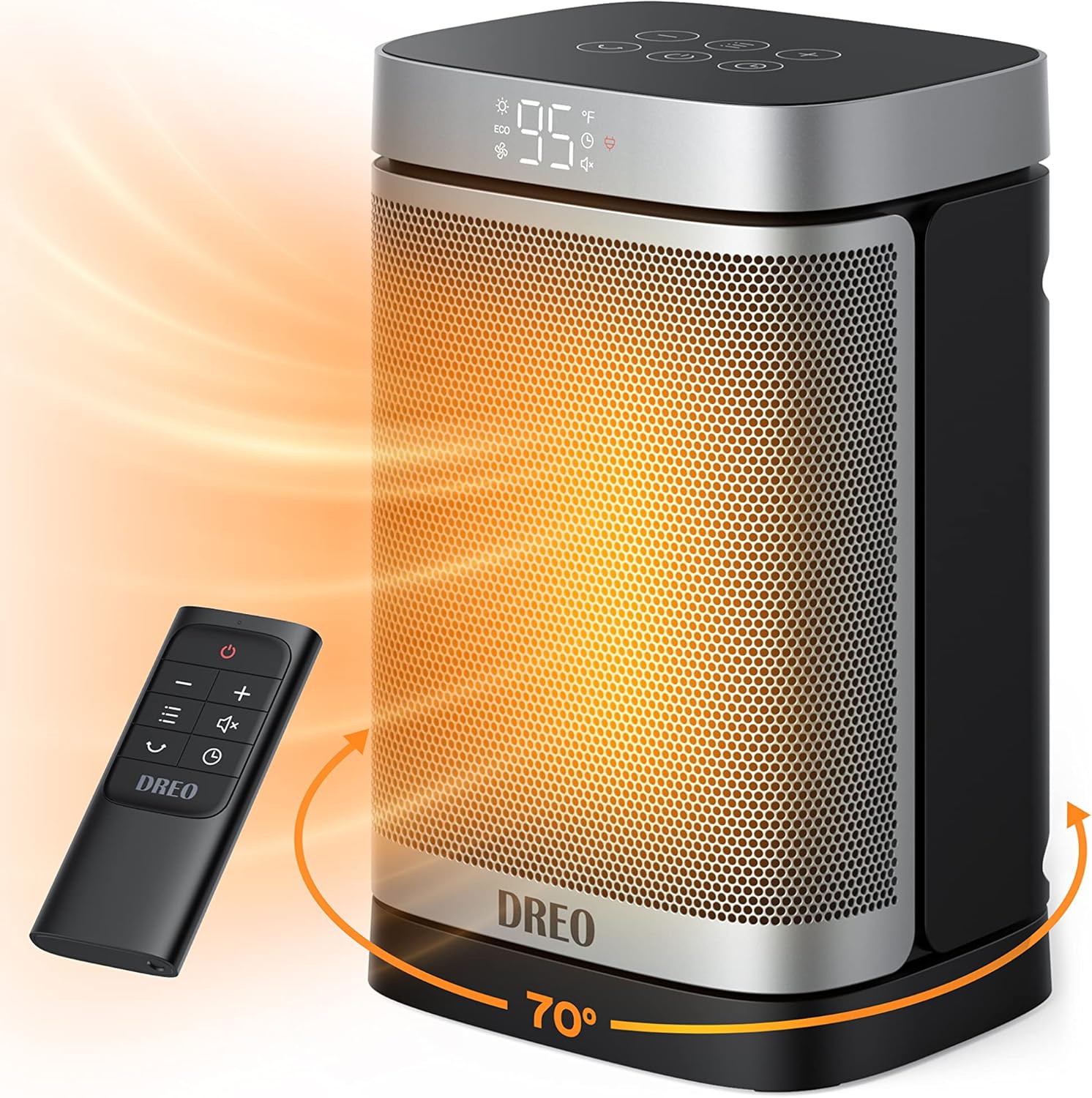
| Heat Output | 1500 watts |
|---|---|
| Heating Coverage | 200 sq.ft |
| Thermostat Range | 41–95 °F |
| Oscillation | 70° |
| Number of Speeds | 5 |
The DREO Atom One is a portable tower heater aimed at quickly warming small to medium indoor spaces using a PTC ceramic element and up to 1500 watts of power. It offers a programmable digital thermostat (41 to 95°F in 1°F increments), ECO mode to moderate power use, 70° oscillation to spread heat across a work area, and a detachable filter for basic maintenance. The included remote and 1–12 hour timer make it convenient to manage from a distance while the Brushless DC motor and multi-blade design keep operating noise low for use in a garage workshop or home office. Safety features include ETL listing, tip-over and overheat protections, an enhanced safety plug, and flame-retardant materials. Because it is a compact tower-style unit rated to cover about 200 sq ft, it works best as a zone heater for a garage workspace rather than for heating an entire detached or very large garage; it also relies on standard 120V household power so it will not deliver industrial-scale output. For buyers who want a reliable, feature-rich electric garage heater for temperate winters and targeted warming, this model balances heat, convenience, and safety well.
Best for: A buyer who needs a dependable, safety-focused electric heater to warm a garage workspace or single-zone area during milder winter conditions and values precise thermostat control and quiet operation.
Less Ideal for: People who need to heat a large, uninsulated garage or require heavy-duty, hardwired heating for very cold climates should consider higher-capacity or fuel-based garage heaters instead.
- 1500W PTC ceramic heating for fast, even heat delivery
- Programmable digital thermostat with 1°F increments for precise temperature control
- 70° oscillation spreads heat over a work area rather than a narrow beam
- ETL-listed safety package with tip-over and overheat protection and enhanced plug
- Quiet operation thanks to a brushless DC motor and aerodynamic fan design
- Designed for up to about 200 sq ft so not suitable as the sole heater for very large or uninsulated garages
- Runs on 120V household power so it cannot match output of hardwired or propane garage heaters
Verdict: A reliable, safety-minded 1500W tower heater that provides precise, quiet zone heating for garage workspaces and small shops.
Lasko Ceramic Tower Heater 751320

| Heat Output | 1500 watts |
|---|---|
| Heating Element | Ceramic |
| Heating Coverage | 150 |
| Power Source | Corded Electric |
| Timer | 7-hour auto-off |
The Lasko Ceramic Tower Heater is a slim, portable 1500-watt electric heater that delivers targeted warmth for small to medium indoor spaces. It uses a ceramic heating element and a forced-air fan to move heat, with widespread oscillation to distribute warmth more evenly across a room. Controls include two heat settings plus an electronic thermostat, a seven-hour auto-off timer and a multi-function remote that stores on-board, which makes it easy to change settings from across the room. Practical safety features include overheat protection and cool-touch housing, and the built-in handle keeps it easy to carry between rooms. The unit is best used on the floor in bedrooms, home offices or garages where plug-in electric heat is acceptable; it gives quick local warmth but will not replace a hardwired garage heater for very large or poorly insulated spaces. Expect steady, quiet operation but limited coverage beyond a medium-sized room and typical 1500W running costs when used frequently.
Best for: Buyers who want a portable, plug-in heater that delivers quick, controllable warmth for a single garage zone or smaller workshop and who value safety features and easy remote control.
Less Ideal for: Those needing to heat large, uninsulated garages or continuous all-day workspace heating should choose a higher-capacity hardwired or propane-style garage heater instead.
- 1500W ceramic element provides fast, effective localized heating
- Widespread oscillation helps distribute warmth across a room
- Electronic thermostat and timer allow simple temperature control and scheduling
- Remote control with on-board storage adds convenient, at-a-distance operation
- Built-in safety features including overheat protection and cool-touch housing
- Two heat settings limit fine-grained power control compared with multi-stage models
- Not intended to heat large or poorly insulated garages for extended periods
Verdict: A compact 1500W ceramic tower that gives quick, controllable spot heating for a single garage zone or small workshop where portable electric heat is suitable.
Amazon Basics 46,000 BTU Patio Heater

| Heat Output | 46,000 british thermal units |
|---|---|
| Heating Coverage | 9 feet |
| Power Source | Gas Powered |
| Fuel Type | Propane |
This freestanding Amazon Basics patio heater is a high-output propane tower designed to warm outdoor areas with a 9-foot effective radius. It uses a 46,000 BTU burner with an adjustable control knob and one-touch ignition, and the weighted water tank plus wheels make it easy to move and stabilize. The heater includes a tilt-safety auto-shutoff valve and a chain to secure the tank, which helps reduce common safety concerns with portable gas heaters. Typical use is spot-heating a patio, seating area, or a small outdoor workspace where electric options are impractical; it lights quickly and delivers strong radiant heat. Expect a tall footprint that needs clearances and a 20-pound propane cylinder to operate, and because it is an outdoor-rated gas appliance it is not intended for enclosed indoor use without proper ventilation. For someone prioritizing straightforward setup, strong heat output, and basic safety features, this is a practical choice, though buyers should follow clearance and ventilation guidance carefully.
Best for: Buyers who want a simple, high-output gas heater for occasional outdoor spot heating and who prioritize easy setup and built-in safety features.
Less Ideal for: People seeking a heater for enclosed garages, basements, or continuous indoor use should choose a properly vented indoor-rated heater instead.
- High heat output (46,000 BTU) suitable for quickly warming outdoor seating areas
- One-touch ignition and adjustable control knob for easy startup and heat control
- Wheels and a water-weighted base make positioning and stabilization straightforward
- Built-in safety features including tilt shutoff valve and tank securing chain
- Designed for outdoor use only and not safe for unventilated indoor garages
- Requires a 20 lb propane tank which adds ongoing fuel handling and storage
Verdict: Choose this propane patio heater if you need quick, powerful outdoor spot heating with easy ignition and basic safety features.
Choosing the Right Heater for Garage in Winter: Key Factors to Consider
Heating Capacity Relative to Garage Volume
Heating capacity determines how quickly and effectively a heater raises the temperature in a garage. Garages vary widely in cubic feet, so match a heater's BTU or watt rating to your space. A small wall-mounted unit may be enough for a single-car, well-insulated garage, while a larger, higher-BTU or multi-kilowatt unit is necessary for tall ceilings, two-car bays, or poorly insulated structures.
Underestimating capacity leads to continuous runtime, higher operating costs, and inadequate comfort. Consider peak winter conditions rather than mild days when choosing capacity, and account for doors opening frequently, which increases heat loss. If the garage houses projects or temperature-sensitive items, aim for a heater that can reach and maintain your target temperature with reasonable cycle times.
Safety Features for Workshop Environments
Safety systems are crucial because garages often contain flammable materials, solvents, and vehicle fluids. Look for tip-over shutoff, overheat protection, sealed combustion chambers for fuel-burning units, and thermal cutoffs on electric elements. For kerosene or gas heaters, verify that the unit includes proper ventilation requirements and carbon monoxide safeguards when used in semi-enclosed spaces.
Dust and debris in garages increase fire risk and can clog intakes or fans. Models with accessible filters and protection screens reduce maintenance frequency and lower hazard potential. Electrical cord routing and grounded plugs are also important to prevent accidental damage from tools or doors.
Power Source and Installation Constraints
The available power in your garage limits heater choices. Many portable electric heaters run on standard 120V outlets but have limited output; higher-capacity electric garage heaters often require a 240V circuit or hardwired installation. Fuel-burning heaters offer high output without heavy electrical demands but require safe fuel storage and, depending on design, fresh-air intake or exhaust pathways.
Installation complexity affects cost and flexibility. Wall or ceiling-mounted units free floor space but need competent mounting and sometimes hardwiring. Portable units allow repositioning but may produce uneven heating in larger spaces. Factor in typical usage patterns when deciding between fixed and mobile solutions.
Operating Cost and Energy Efficiency
Running a garage heater through an extended cold season can add meaningful energy costs. Compare wattage or BTU ratings to estimate daily energy use based on expected run hours. Electric heaters convert nearly all input energy to heat but can be expensive at high outputs; fuel-burning heaters may have lower per-hour fuel costs in some areas but add fuel handling and potential ventilation needs.
Look for efficiency features such as thermostatic control, multiple heat settings, or programmable timers to limit run time. Insulation and weatherproofing the garage door and walls reduce demand and lower operating cost regardless of heater type.
Durability and Maintenance in Dusty Conditions
Garages typically expose appliances to dust, oil, and temperature swings, so robust construction and easy maintenance matter. Durable housings, accessible fan assemblies, and washable filters extend service life and reduce downtime. Corrosion-resistant materials and sealed components are valuable if the garage sees moisture or occasional vehicle exhaust.
Consider how often filters need cleaning, whether fans are user-serviceable, and how easy it is to access electrical components for inspection. Choosing a heater with straightforward maintenance routines reduces long-term ownership headaches.
Sizing Your Garage and Estimating Heat Needs
Calculate your garage volume by multiplying floor area by ceiling height to estimate how much heat you need. Use a rule-of-thumb wattage or BTU per cubic foot guideline appropriate for your climate severity to narrow choices quickly.
Account for factors that increase load such as frequent door openings, attached house walls that leak cold, or poor insulation. When in doubt, choose a slightly higher capacity unit to avoid running continuously during cold snaps.
- Measure floor area and ceiling height for an accurate volume.
- Increase capacity estimate for single-pane windows and uninsulated doors.
- Factor in desired temperature rise versus outdoor lows.
Fixed-Mount Vs Portable Heaters: Pros and Cons
Fixed-mount heaters, whether wall or ceiling installed, deliver consistent coverage and keep floors clear for tools and vehicles. They often require hardwiring or a dedicated circuit but provide a tidy, permanent heating solution when you use the garage frequently.
Portable heaters are flexible and useful if you only heat zones or specific work areas. They require no permanent installation and allow you to concentrate heat where it is needed, but they may be less effective at maintaining an even ambient temperature in larger garages.
- Fixed: cleaner installation, consistent coverage, higher installation complexity.
- Portable: flexible placement, easy removal, potential for uneven heating.
Ventilation and Fuel Considerations
If considering fuel-burning heaters, plan for ventilation and combustion air. Indoor-safe models have sealed combustion or dedicated exhaust; others need outdoor ventilation and should be used with caution in attached garages. Carbon monoxide and combustion byproduct management are important for safety.
Electric heaters avoid combustion concerns but need sufficient electrical supply. Verify breaker capacity and wire gauge before installing high-wattage units to prevent nuisance tripping or unsafe wiring conditions.
- Do not use exhaust-reliant heaters in closed garages without proper venting.
- Confirm electrical panel capacity before adding 240V heaters.
Noise, Controls, and Convenience Features
Noise levels matter if you spend long hours in the garage. Fans and high-speed blowers increase perceived noise. Look for units with quiet blower options or variable-speed fans when noise is a concern.
Thermostats, programmable timers, multiple heat settings, and remote controls improve usability and can reduce runtime. Easy-to-read controls and clear indicator lights are practical features that make daily operation simpler.
- Variable fan speeds reduce noise and improve comfort.
- Built-in thermostats and timers save energy and maintain steady temperatures.
Placement and Clearance Best Practices
Place heaters to promote even airflow and prevent hot or cold spots. Wall or ceiling installations should follow manufacturer clearance guidelines to avoid heat buildup near combustible materials. For portable units, position them on stable, level surfaces away from doors and flammable supplies.
Maintain clear space around intakes and outlets to ensure efficient operation and to avoid tripping safety cutoffs. Secure cords and fuel lines to prevent accidental damage from tools or garage doors.
- Follow clearance distances from walls and stored items.
- Avoid placing portable units where they can be knocked over.
How We Chose the Best Heater for Garage in Winter
We prioritized heaters that address the specific challenges of garages in cold months: ability to produce sustained heat in semi-insulated areas, built-in safety to handle dust and vehicle fumes, and practical installation or portability for varied garage layouts. Selection criteria included measured heating output relative to typical garage volumes, certified safety features such as tip-over and overheat shutoffs, and compatibility with common garage power options including 120V, 240V, and hardwired models. We also evaluated ease of installation or repositioning, noise during operation, and expected daily operating cost based on typical winter use. Units were excluded if they lacked documented safety certifications, were designed strictly for indoor living rooms rather than workshop or garage environments, or required unusual fuel or ventilation setups unsuitable for typical attached or detached garages. We favored durable construction and straightforward maintenance because garages accumulate dust and occasional vehicle residues that affect long-term reliability. The scoring dimensions reflect heat capacity, safety, installation/portability, runtime cost, and durability.
Our full evaluation process is outlined in our review methodology.
FAQ
Can I safely use a fuel-burning heater in an attached garage?
It depends. Some fuel-burning models are designed for indoor use with sealed combustion and proper venting. If a unit requires open combustion, it needs adequate ventilation and carbon monoxide monitoring. For attached garages, choose designs with explicit indoor-use ratings and follow ventilation guidance closely.
Is an electric heater better than a gas or kerosene option for a garage?
Electric heaters avoid combustion and ventilation concerns and are simple to operate, but high-output electric models may require a 240V circuit. Fuel-based heaters can offer higher BTUs without heavy electrical demand, but they add fuel handling and ventilation tradeoffs. The right choice depends on your power availability and willingness to manage fuel and exhaust.
How do I estimate running costs for winter use?
Estimate running cost by multiplying the heater's wattage or BTU equivalent by typical daily run hours and your local energy or fuel rates. Thermostatic control and good insulation reduce run time. Expect costs to vary with outdoor temperatures and how frequently garage doors open.
What maintenance should I plan for garage heaters?
Regular tasks include cleaning or replacing filters, removing dust from fan assemblies, inspecting electrical cords or fuel lines, and checking safety switches. For fuel-burning units, inspect combustion components and vents. Frequent maintenance extends lifespan, especially in dusty garage environments.
Do I need a dedicated circuit for a high-capacity electric garage heater?
Often yes. Many high-output electric heaters require a 240V dedicated circuit to operate safely without tripping breakers. Check your electrical panel capacity and consult a licensed electrician if installation requires new wiring or hardwiring.
Final Verdict
Prioritize capacity, safety, and installation practicality when choosing a heater for a garage in winter. Match heating output to your garage volume and season severity, select units with robust safety protections for workshop conditions, and factor in power or ventilation constraints early. Balance upfront installation complexity against long-term operating cost and durability to pick the best fit for how and how often you use the space. With the right priorities, you can keep your garage functional and comfortable throughout the cold months.