
Note: This article contains affiliate links. If you click on these links and make a purchase, we may earn a small commission at no extra cost to you. This helps support our research and content. Read our full affiliate disclosure here.
Picking the right energy-efficient electric space heater matters if you want dependable warmth without a surprise spike in your utility bill. The right heater delivers steady, comfortable heat in the rooms you use most while minimizing wasted energy and handling safety and control features that affect daily use. This guide shortlist presents the top picks in energy-efficient electric space heaters, each chosen for practical home performance and efficiency traits. Below we outline what we tested for efficiency, safety, and usability so you can pick a heater that fits your routine and keeps running costs low.
Top Picks at a Glance
| Best Overall The best all-around choice for most situations | DR. Infrared Heater DR-968 |  |
| Best Quality Built to a higher standard if you want something more solid | De'Longhi Comfort Temp Radiant Heater EW7707CM |  |
| Best Value The sweet spot between price and what you get | WINHL PTC-150A Tower Heater |  |
| Top Rated A top-rated pick with lots of positive feedback | DREO Space Heater HSH006 |  |
| Most Popular A crowd favorite that many people choose with confidence | Lasko Ceramic Tower Heater 751320 |  |
| Best Seller A high-volume bestseller chosen again and again | DREO Space Heater DR-HSH004 |  |
DR. Infrared Heater DR-968

| Wattage | 1500 Watts |
|---|---|
| Heating Coverage | 576 square feet |
| Number of Speeds | 3 |
| Voltage | 120 |
The DR. Infrared Heater DR-968 combines a quartz infrared tube with a PTC element and a high-velocity low-noise blower to deliver fast, even warmth across medium to large rooms. It is typically used as a primary supplemental heater in living rooms, bedrooms, home offices, or studies where you want quick radiant warmth without blasting dry air. Notable features include Auto energy-saving mode that switches between high and low output to maintain a set temperature, a 12-hour timer, electronic thermostat (50 to 85°F), caster wheels for easy repositioning, and a remote for convenient control. Practical benefits include strong heat transfer for its 1500-watt rating, quieter operation around 39 dB, and multiple safety protections such as tip-over and overheat shutoff which make it suitable around pets and children. Important limitations are that it is corded and intended for indoor freestanding use only, and like all electric space heaters it relies on sufficient circuit capacity (12.5 A) so prolonged whole-house heating may be costly compared with central systems. Overall, it is a capable, safety-minded heater that prioritizes efficient radiant heating and user convenience.
Best for: Buyers who want an efficient supplemental heater that delivers fast radiant warmth across living rooms or bedrooms while emphasizing quiet operation and built-in safety.
Less Ideal for: People seeking a hardwired or whole-house heating solution or a portable heater for outdoor use should look elsewhere.
- Dual heating system (PTC plus quartz infrared) for stronger heat output at 1500W
- Auto energy-saving mode that cycles between high and low to maintain set temperature
- Quiet high-pressure blower for widespread, low-noise heat distribution
- Built-in safety features including tip-over and overheat protection plus a timer and remote
- Caster wheels and electronic thermostat for easy placement and control
- Corded indoor-only design requires appropriate circuit capacity
- Heats objects and nearby space efficiently but is not a substitute for whole-house heating
Verdict: Choose the DR-968 if you want a quiet, safety-focused 1500W infrared heater that heats rooms quickly while conserving energy with an auto mode.
De'Longhi Comfort Temp Radiant Heater EW7707CM

| Heat Output | 1500 watts |
|---|---|
| Heating Method | Radiant |
| Number of Speeds | 3 |
| Voltage | 120 volts |
| Min Temperature Setting | 44 °F |
The De'Longhi EW7707CM is an oil-filled radiator that delivers quiet, gentle radiant heat for bedrooms, home offices, and similar small to medium spaces. It offers three heat settings, an adjustable thermostat, and an anti-freeze mode that automatically engages below 44°F, while the ComfortTemp function actively manages power to maintain the target temperature and improve efficiency. Its thermal slot design aims to spread heat evenly without a fan, which reduces air movement and helps keep dust and allergens undisturbed. The unit is portable thanks to a handle and snap wheels, and construction uses a permanently sealed oil reservoir so there is no refilling. Safety features include fully enclosed heating elements and a thermal cut-off, and the low surface temperature design makes it family- and pet-friendly. Expect steady, long-lasting warmth and modest energy savings versus running a heater at full blast, but note it warms by radiation and convection rather than fast forced-air blasts, so it is better for sustained room comfort than quick spot heating.
Best for: Buyers focused on efficient, steady whole-room comfort who prioritize quiet operation and an automatic thermostat to lower energy use in living rooms, bedrooms, or home offices.
Less Ideal for: People who need rapid spot heating or very quick temperature changes should consider a fan-forced or ceramic heater instead.
- ComfortTemp automatic control reduces power use by maintaining optimal temperature
- Oil-filled design provides quiet, steady heat with no fan to stir dust
- Portable with integrated handle and snap wheels for easy room-to-room movement
- Built-in safety features including thermal cut-off and enclosed heating elements
- Slower to change room temperature compared with fan-forced heaters
- Heavy for its size, which can make lifting awkward despite wheels
Verdict: Choose this oil-filled radiator if you want quiet, efficient whole-room heating with an automatic thermostat that reduces energy use while maintaining steady comfort.
WINHL PTC-150A Tower Heater

| Heat Output | 1500 watts |
|---|---|
| Number of Speeds | 5 |
| Max Temperature Setting | 95 °F |
| Special Features | Oscillating, Timer, Overheat Protection |
The WINHL PTC-150A is a compact tabletop tower heater that uses PTC ceramic elements to deliver quick heat to small rooms like bedrooms and home offices. It offers five fan speeds, a thermostat with a 95°F max setting, wide-angle auto oscillation for more even coverage, and a 12-hour timer so you can schedule runtime without manual monitoring. The included remote makes it easy to change modes and fan speeds from across the room, and built-in safety features such as overheat protection and tip-over shutoff reduce risk during unattended use. At 1500 watts it produces strong output for short-term spot heating but will draw its full rated power whenever heating, so it is best when used to warm occupied spaces rather than maintain whole-house temperatures. The unit is lightweight and portable for moving between rooms, though it is designed for indoor tabletop placement and should be plugged directly into a wall outlet per the manufacturer guidance.
Best for: Buyers who want a practical, quick-to-heat portable heater for bedrooms or home offices and prioritize easy controls, safety, and even room coverage.
Less Ideal for: People seeking a low-wattage or whole-room central heating solution or those who need an outdoor or permanently mounted heater should look elsewhere.
- Fast PTC ceramic heating provides rapid warm-up for small rooms
- Auto oscillation spreads heat more evenly across a room
- Remote control and 12-hour timer add convenient hands-free operation
- Multiple safety protections including overheat and tip-over shutoff
- 1500W continuous power means higher energy use if run for long periods
Verdict: A compact, safety-minded tower heater that delivers fast, even heat and convenient remote and timer controls for efficiently warming small indoor spaces.
DREO Space Heater HSH006

| Heat Output | 1500 watts |
|---|---|
| Heating Element | PTC Ceramic |
| Heating Coverage | 200 sq.ft |
| Noise Level | 34 dB |
| Timer | 1-12 H |
The DREO HSH006 tower heater uses a 1500W PTC ceramic element and a brushless DC motor to deliver quick forced-air warmth for rooms up to about 200 sq ft. It offers an adjustable thermostat with a wide 41 to 95°F range in 1°F increments, four speed/heat settings including ECO and fan-only modes, plus a 12-hour timer and remote for hands-off control. Safety features include tip-over detection, overheat protection, flame-retardant materials, and an ETL listing, making it suitable for bedroom or office use. The unit is compact and easy to move with an integrated handle and runs relatively quietly at about 34 dB on low settings, so it will not disturb sleep or work. Expect steady, targeted heat for small to medium rooms but not enough to replace whole-house heating; at 1500W it will increase comfort quickly but uses full-power electricity on higher settings. The interface and remote simplify daily adjustments, though those who need larger coverage or lower long-term energy draw should consider alternative heating strategies.
Best for: Buyers who prioritize dependable, safety-focused room heating in bedrooms or home offices and want precise temperature control with quiet operation.
Less Ideal for: People needing to heat large open areas or looking for ultra-low running costs for continuous whole-home heating should choose a larger system or supplemental insulation and thermostatic controls instead.
- Fast PTC ceramic heating element for quick warm-up
- Precise thermostat control with 1°F increments between 41–95°F
- Multiple modes and 12-hour timer with remote for convenient operation
- Built-in safety features including tip-over and overheat protection and ETL listing
- Quiet brushless DC motor suitable for bedrooms and offices
- 1500W output limits effective coverage to small or medium rooms
- Higher heat settings can draw significant power for extended use
Verdict: A safety-minded, quiet 1500W tower heater that delivers fast, precise warmth for small rooms with convenient remote and timer control.
Lasko Ceramic Tower Heater 751320

| Heat Output | 1500 watts |
|---|---|
| Heating Method | Forced Air |
| Heating Element | Ceramic |
| Indoor Outdoor Usage | Indoor |
| Power Source | Corded Electric |
The Lasko Ceramic Tower Heater (model 751320) is a slim, portable electric heater built to deliver fast, targeted warmth for small to medium rooms. It uses a 1500-watt ceramic element and widespread oscillation to circulate warm air, and offers two heat settings plus an adjustable electronic thermostat and auto-off timer for basic temperature control and scheduled use. The unit includes a multi-function remote with onboard storage and a built-in carry handle for moving between bedroom, office, or living spaces. Safety features include overheat protection and cool-touch housing, and the tower design keeps the footprint small. On the downside, controls are fairly simple compared with higher-end digital models and there is no child lock or tip-over switch on this variant, so placement and supervision matter in households with kids or pets. Expect efficient, straightforward supplemental heat for everyday rooms rather than advanced smart features or whole-house heating.
Best for: Buyers who prioritize proven performance and widespread customer feedback and want a simple, reliable heater for bedrooms or medium rooms without needing app connectivity or advanced automation.
Less Ideal for: People seeking smart-home integration, multi-room heating, or models with built-in child locks and tip-over protection should consider other options.
- 1500W ceramic element provides fast, effective heat
- Widespread oscillation helps distribute warmth across a room
- Electronic thermostat and 7-hour timer allow simple temperature control and scheduling
- Includes remote control with onboard storage for convenient adjustments
- Slim, portable tower with built-in handle is easy to move and stores compactly
- Lacks advanced safety features such as a tip-over switch or child lock on this model
- Controls and features are basic compared with smart or premium heaters
Verdict: A straightforward, well-reviewed 1500W ceramic tower heater that delivers reliable room-facing warmth with easy controls and remote convenience.
DREO Space Heater DR-HSH004
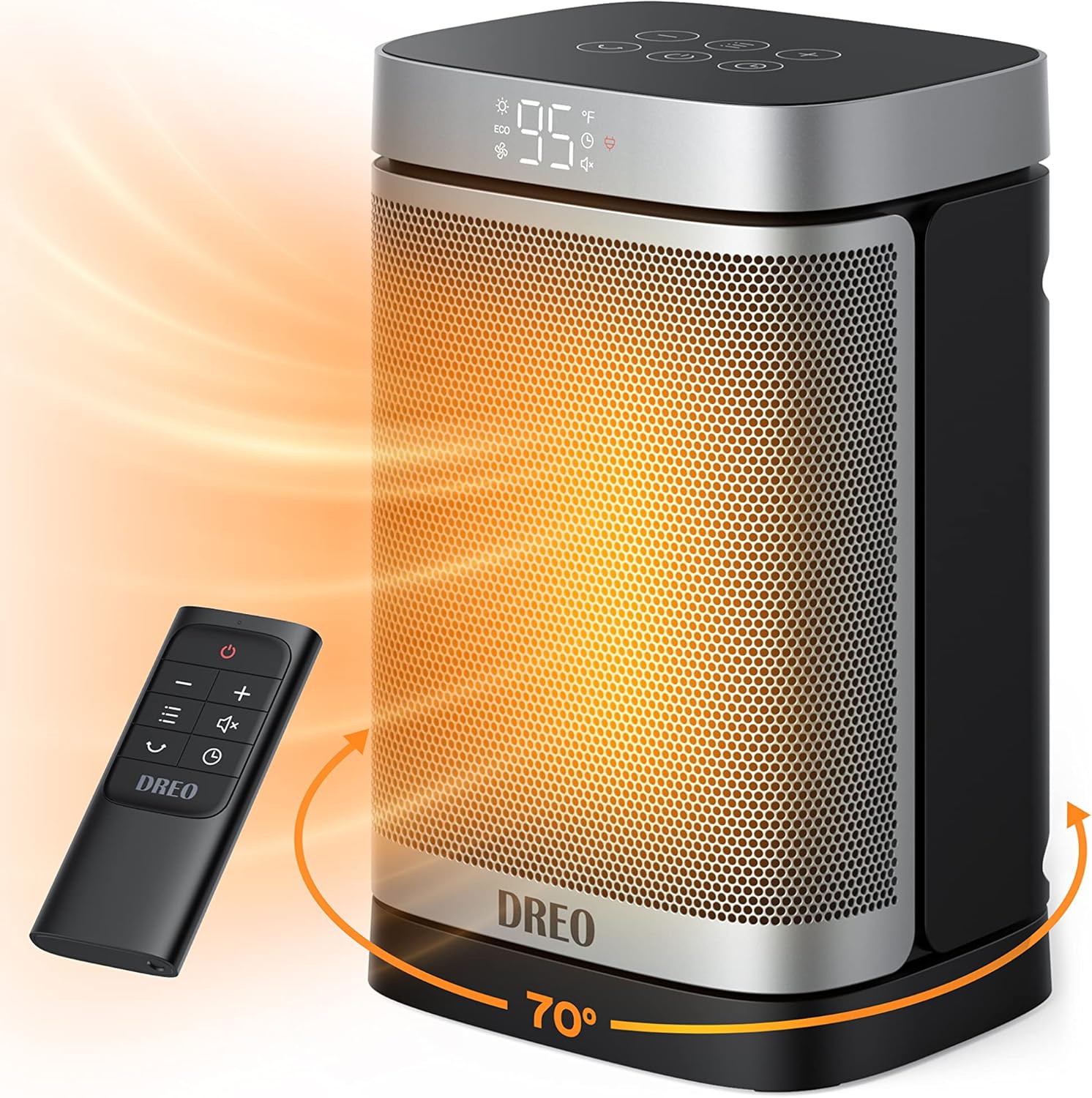
| Heat Output | 1500 watts |
|---|---|
| Heating Coverage | 200 sq.ft |
| Heating Element | PTC Ceramic |
| Number of Speeds | 5 |
| Programmable Thermostat | 41-95 °F |
The DREO DR-HSH004 is a compact tower PTC ceramic heater designed to warm small to medium rooms quickly with up to 1500 watts of output. It uses a programmable digital thermostat (41 to 95°F in 1°F steps), a 1–12 hour timer, and a 70° oscillation to spread heat across a 200 sq. ft. area, and ECO mode helps reduce runtime by adjusting output to maintain the set temperature. Practical touches include a detachable filter, LED control panel, and a remote for changing modes from across the room. Safety is emphasized with ETL-listed Shield360 protection offering tip-over and overheat cutouts and flame-retardant materials. The heater runs quietly thanks to a brushless motor and aerodynamic blades, making it suitable for bedrooms or home offices. Downsides are the inherent limits of a 1500W unit—it is not suited for very large, poorly insulated spaces—and being electric means continuous power draw at higher settings. For buyers who want a safe, programmable, and relatively quiet heater for everyday indoor use, this model balances performance and convenience well.
Best for: Practical buyers who prioritize safety, quiet operation, and precise temperature control for everyday indoor heating in bedrooms, home offices, or similar spaces.
Less Ideal for: People needing to heat very large, open, or poorly insulated areas or those seeking a non-electric heating solution.
- Precise digital thermostat with 1°F increments for accurate temperature control
- ECO mode and programmable timer help reduce energy use during steady-state operation
- 70° oscillation and 1500W output spread heat across rooms up to about 200 sq ft
- Built-in safety features including tip-over and overheat protection and ETL listing
- Quiet operation via brushless DC motor and aerodynamic blades suitable for bedrooms or offices
- 1500W limit means it cannot rapidly heat very large or poorly insulated rooms
- Electric operation requires continuous power at higher settings which increases energy draw
Verdict: A safe, quiet, and programmable 1500W tower heater that gives precise temperature control and energy-conscious ECO operation for small to medium indoor rooms.
Choosing the Right Energy-Efficient Electric Space Heater: Key Factors to Consider
Heat Output and Coverage
Heat output determines how quickly and evenly a heater warms a room. Look for explicit wattage or BTU-equivalent information so you can match a heater to the square footage you plan to heat. A heater that is undersized will run continuously and waste energy trying to reach a set temperature, while an oversized unit can short-cycle and reduce efficiency.
Consider the heater's delivery method as well. Convection units are good for steady whole-room warmth, while radiant or fan-assisted units heat occupants and objects more directly. Factor in ceiling height and insulation: poorly insulated rooms require more output to maintain the same comfort level, so efficiency in a drafty room depends partly on improving the room envelope as well as picking the right unit.
Energy Consumption Controls
Controls that let you limit power draw or adjust setpoints directly reduce operating costs. Thermostatic controls that cycle the heater to maintain a precise temperature prevent unnecessary full-power operation. Multiple heat settings allow lower-power runs for background warmth instead of constant maximum output.
Timers and programmable schedules can cut hours of runtime by matching heat only to when the room is occupied. Some units include eco or economy modes that optimize fan speed or cycle patterns for lower consumption. When assessing efficiency, check for clearly stated power draw at each setting and whether the control options match how you plan to use the heater.
Safety Features
Built-in safety features protect people and property and also support efficient operation by avoiding unintended shutdowns or hazards. Tip-over shutoff and overheat protection are essential for safe continuous use, especially in households with pets or children. Cool-touch exteriors reduce the need to constantly monitor the unit and allow placement nearer to living areas without increasing risk.
Automatic shutoff timers and locked controls prevent accidental long run times. Durable electrical components and proper insulation reduce the risk of failure that could lead to inefficient performance or unsafe conditions. Verify certifications from recognized safety organizations as part of making a confident selection.
Noise and Comfort Controls
Noise level influences where you can practically place and run a heater for extended periods. Fan-assisted units often deliver faster perceived warmth but can produce audible noise, which may be disruptive in bedrooms or home offices. Quieter convection or infrared units are better suited for low-noise environments where you want background warmth without distraction.
Comfort controls such as adjustable fan speed, oscillation, or directional louvers let you tailor how heat is felt in a room. Being able to direct heat toward occupied zones reduces wasted energy heating empty space. Consider the tradeoff between speed of comfort and noise when choosing a unit for bedrooms versus living rooms or garages.
Portability and Placement Options
How easily you move a heater affects its utility and overall efficiency. A lightweight unit with a handle or casters lets you move heat to the rooms you use most, reducing the need to heat the entire house. Placement also influences performance: a heater placed near drafts or obstructed by furniture will run longer to reach setpoints.
Consider mounting or wall-mount options if you want a permanent installation that frees floor space. Compact units can fit small rooms, but check that vents and intakes have sufficient clearance to prevent reduced airflow and efficiency losses. The better a heater fits your intended locations, the less energy you will waste heating unoccupied areas.
Durability and Maintenance
Durable components and accessible maintenance points reduce the chance of efficiency loss over time. Units with washable filters, serviceable fans, or easy-to-clean exteriors maintain performance longer and avoid clogged airflow that forces higher power draw. A robust build lowers the risk of electrical or mechanical failures that can create unsafe conditions or reduce efficiency.
Consider warranty length and the availability of replacement parts when evaluating long-term ownership cost. Even small maintenance tasks, like keeping vents clear and dust-free, preserve airflow and heat transfer efficiency, making a well-maintained heater more cost-effective over its lifetime.
How Energy Efficiency Is Measured
Energy efficiency for space heaters is about how effectively electrical input becomes usable heat in the room and how long the heater needs to run to maintain comfort. Because nearly all electric heaters convert electricity to heat at similar theoretical efficiency, practical efficiency comes from controls, insulation of the space, and heat distribution.
Key metrics include wattage at different settings, thermostat accuracy, and effective heated area. Real-world efficiency is often reflected in shorter runtime to reach and hold temperature, not just peak wattage. Look for units that provide clear data on power draw across modes and that include a thermostat or programable schedule to reduce run time.
- Wattage defines maximum heat potential but not runtime efficiency
- Thermostatic control reduces unnecessary full-power cycles
- Directed heat and oscillation can heat occupants more effectively than empty space
- Timers and programable modes cut total hours of operation
Placement Tips to Maximize Efficiency
Placement has a major impact on how efficiently a heater warms a room. Position the unit near where people gather rather than in a corner behind furniture. Keep a clear space around the intake and outlet to preserve airflow and avoid thermal short-cycling caused by recirculating warm air back into the intake.
Avoid placing a heater near drafts, open windows, or doors that lead to colder spaces. In multi-room homes, use portable heaters strategically to heat occupied zones only and reduce central-system heating demand.
- Place near occupancy zones to reduce wasted heat
- Maintain clearance around vents and intakes
- Avoid draft-prone locations and direct airflow away from open doors
- Use doorways or fans to share heat between small adjacent rooms if needed
Using Thermostats and Timers Effectively
A thermostat that maintains a set temperature is one of the most effective efficiency features. Setbacks of a few degrees during sleeping hours or when a room is unoccupied can yield significant energy savings. Combine thermostatic control with timers so the heater runs only when needed.
Avoid using maximum settings as a default. Start at lower settings and incrementally increase until comfortable. Program schedules for predictable daily routines to avoid leaving the heater running unnecessarily.
- Use programmable schedules to match occupancy
- Lower setpoints gradually to find the most comfortable energy-saving level
- Pair thermostats with timers for automatic shutoff
- Check thermostat accuracy periodically with a room thermometer
Safety Best Practices
Even energy-efficient heaters must be used safely to avoid hazards that can force shutdowns or damage. Keep flammable materials away from the heater and do not block airflow. Never use extension cords that are under-rated for the heater's current draw.
For households with children or pets, opt for units with tip-over protection and cool-touch exteriors. Regularly inspect cords and plugs for wear and replace damaged components promptly to maintain safe, efficient operation.
- Keep a minimum clearance from fabrics and combustible materials
- Avoid running through undersized extension cords
- Place on a stable, level surface to prevent tip-overs
- Inspect power cords and plug connections regularly
Long-Term Cost Considerations
Upfront efficiency features affect ongoing costs. Units with more control options and better heat distribution may cost more initially but reduce operating hours and energy consumption. Factor in warranty length and expected service life when considering lifetime cost.
Additionally, plan for maintenance tasks such as cleaning filters or keeping vents clear. Those simple tasks preserve airflow and performance, preventing a gradual increase in run time that raises energy usage over months and years.
- Consider lifecycle and warranty, not just initial purchase
- Account for minor maintenance to preserve efficiency
- Better controls often reduce runtime and save money over time
- Match heater capacity to actual room use to avoid wasted operation
How We Chose the Best Energy-Efficient Electric Space Heater
We focused on measures that directly affect household energy use and real-world comfort. Each heater on our list met minimum standards for regulated heat output and included at least one adjustable control for temperature or power level. We prioritized models with clear energy-consumption data, efficient heat-delivery methods, and features that reduce run time such as programmable thermostats or adaptive controls. Safety features were a must, including reliable tip-over and overheat protection, because safe continuous operation reduces the need for manual intervention and prevents wasteful short cycles. We excluded products that lacked measurable efficiency features or had ambiguous power ratings. We also filtered out devices without user-accessible controls or that relied solely on constant high-power output. Our evaluation emphasized four to six concrete dimensions: heat output effectiveness, energy consumption and efficiency controls, safety features, ease of use and controls, and build quality and durability. These dimensions reflect what matters most to homeowners who want lower operating costs and dependable room heating.
Our full evaluation process is outlined in our review methodology.
FAQ
Can an energy-efficient electric space heater actually lower my heating bill?
It can, depending on how you use it. Using a heater to warm only occupied rooms and lowering the main thermostat can reduce total energy use. Efficiency depends on correct sizing, controls like thermostats and timers, and avoiding overuse.
Are convection heaters more efficient than radiant heaters?
Not inherently. Both convert electricity to heat with similar theoretical efficiency. Practical differences come from how heat is distributed and how quickly occupants feel warm. Radiant heaters warm people and objects directly, while convection units heat the air for whole-room comfort.
What features should I prioritize for safety in a portable heater?
Prioritize tip-over shutoff, overheat protection, and cool-touch surfaces. Sturdy construction and well-insulated wiring reduce risk of electrical failures. These features keep the unit safe during longer run times and in households with children or pets.
How do I size a heater for my room?
Match the heater's recommended coverage or wattage to the square footage and room conditions. Higher ceilings, poor insulation, or exterior-facing walls increase required output. When in doubt, choose a unit with adjustable settings so you can scale output to real-world conditions.
Do timers and programmable thermostats make a big difference?
Yes. Timers and programmable thermostats reduce total runtime by aligning heat with occupancy patterns. Even small setpoint setbacks during unoccupied hours add up to noticeable savings over a season.
Final Verdict
When choosing an energy-efficient electric space heater, prioritize controls that limit runtime and deliver heat where you need it. Thermostats, timers, and adjustable output let you balance comfort with operating costs, while safety features and proper placement preserve efficient long-term use. Consider how you will actually use the heater day to day and pick a unit that matches those patterns for the best combination of warmth and efficiency.