
Note: This article contains affiliate links. If you click on these links and make a purchase, we may earn a small commission at no extra cost to you. This helps support our research and content. Read our full affiliate disclosure here.
If you run an indoor garden, keeping temperatures steady in a grow tent matters for germination, vegetative growth, and flowering. A dedicated heater for grow tent helps you avoid cold stress, protect humidity levels, and maintain consistent night and day differentials. This guide shortlists the top heater options suited to enclosed grow spaces and explains the practical tradeoffs you should expect. We evaluated units for heating capacity, temperature control, and safety features so you can pick the right heater for your tent size and ventilation setup. Below are the best picks for a range of tent sizes and setups, followed by clear buying factors and practical advice.
Top Picks at a Glance
| Best Overall The best all-around choice for most situations | AC Infinity THERMOFORGE T3 |  |
| Best Quality Built to a higher standard if you want something more solid | Bio Green Palma Greenhouse Heater |  |
| Best Value The sweet spot between price and what you get | VEVOR Greenhouse Heater BGP1506-150 |  |
| Best Budget The cheapest option that still gets the job done reliably | Amazon Basics Ceramic Mini Heater |  |
| Top Rated A top-rated pick with lots of positive feedback | AC Infinity THERMOFORGE T7 |  |
| Most Popular A crowd favorite that many people choose with confidence | Aikoper NT15-20A Space Heater |  |
| Best Seller A high-volume bestseller chosen again and again | DREO Tower Space Heater HSH006 |  |
AC Infinity THERMOFORGE T3

| Heating Method | PTC Heating |
|---|---|
| Number of Speeds | 10 |
| Power Source | Electric |
| Min Temperature Setting | 15 °C |
| Max Temperature Setting | 140 °F |
The THERMOFORGE T3 is a purpose-built grow tent heater that combines precise PTC plate heating with an onboard controller and a sensor probe for VPD and temperature-based automation. It is typically used inside tents, small rooms, or greenhouses where maintaining narrow temperature and vapor pressure deficit ranges matters for plant health. Notable features include ten discrete heat levels driven by PWM control, a detachable extension hose to direct warm air, and integrated timers and triggers for scheduling or linking to a UIS controller for finer output control. In practice the unit delivers steady, radiant warmth without the cycling loudness of simple on/off heaters, and the digital controls make it straightforward to set target conditions and get alerts when readings drift. The main limitations are that it is designed for indoor grow environments rather than general household heating and it occupies floor space as a tower unit, so placement and duct routing need planning in smaller tents. For growers who need automated, fine-grained temperature and VPD management, the T3 provides a compact, feature-rich solution.
Best for: Growers who want tighter environmental control and automation in a tent or small grow room and value VPD-aware temperature management over a basic on/off heater.
Less Ideal for: People who need a general-purpose space heater for living areas or very large grow rooms where a single compact unit cannot deliver enough distributed heat.
- Ten PWM-controlled heat levels let you dial warmth precisely for VPD and temperature targets
- Onboard VPD and temperature controls with sensor probe enable automated triggers and scheduling
- Detachable extension hose focuses airflow to specific zones inside a tent
- Compact tower form factor fits typical grow tents and integrates with UIS controllers for advanced automation
- Designed specifically for grow spaces, not intended as a general room heater
- Requires floor space and hose routing which may be awkward in very small tents
Verdict: Choose the THERMOFORGE T3 if you need a compact, automation-ready heater that delivers precise, VPD-aware temperature control for a grow tent.
Bio Green Palma Greenhouse Heater
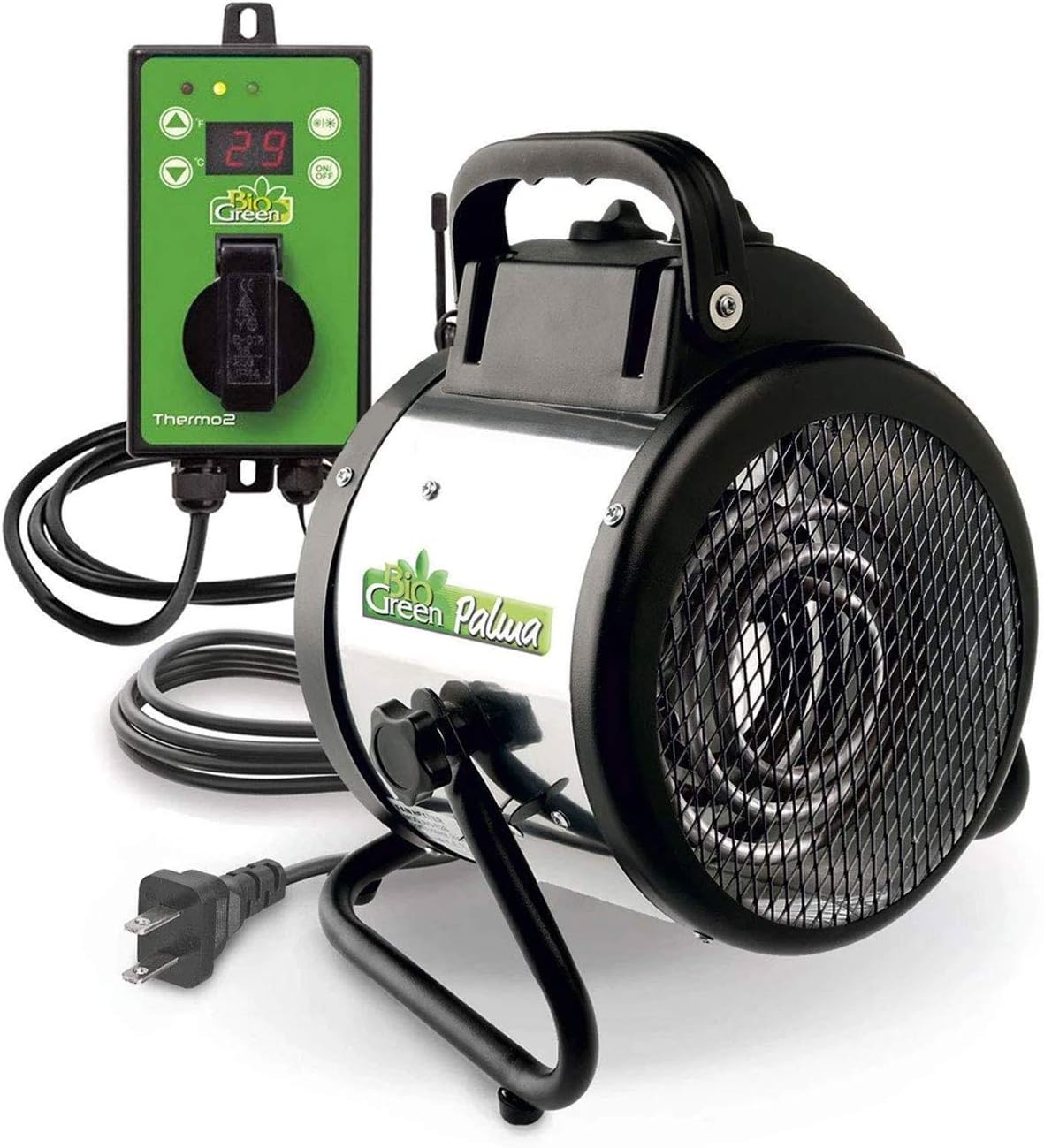
| Power settings | 750 W / 1500 W |
|---|---|
| Temperature range | 32°F to 185°F |
| Air circulation | Up to 5800 ft3/h |
| IP rating | IPX4 splash-proof |
| Voltage | 120 V |
The Bio Green Palma is a compact electric heater designed to keep a small greenhouse or grow tent above frost temperatures while also doubling as a circulation fan. It uses two selectable heating elements (750W or 1500W) controlled by a digital thermostat that cycles the unit to hold a set temperature between 32°F and 185°F, which helps reduce energy wasted by large temperature swings. A dedicated air circulation mode runs the fan alone to move up to 5800 ft3/h of air, improving distribution of warm air and aiding plant pollination or cooling when needed. The stainless steel housing and IPX4 splash protection make it suitable for damp environments, and a carry handle plus compact footprint make placement easy in tight tents. Limitations include a single-zone output suitable for roughly 120 ft2 and no integrated humidity control, so users must manage moisture and ventilation separately; also the unit is tabletop/floor mount only and requires standard 120V power. For growers focused on consistent temperature control and efficient air circulation, this unit is a practical, purpose-built choice.
Best for: Growers who prioritize stable, precise temperature control and active air circulation in a small tent or compact greenhouse and want a robust, splash-resistant heater that is easy to position.
Less Ideal for: Those with large grow rooms or who need integrated humidity or environmental control systems should look for higher-capacity or multi-function climate units instead.
- Two heat settings (750W/1500W) for adaptable power and lower running cost when full output is not needed
- Digital thermostat for precise set-and-hold temperature control
- High air circulation (up to 5800 ft3/h) to evenly distribute heat through a tent or small greenhouse
- Splash-proof IPX4 rating and stainless steel housing for reliable use in damp grow environments
- Rated to heat roughly 120 sq ft so it is not intended for larger grow rooms
- No built-in humidity or CO2 control so environmental management requires separate equipment
Verdict: Choose the Bio Green Palma when you need a compact, splash-resistant heater with precise thermostat control and strong air circulation for a small grow tent.
VEVOR Greenhouse Heater BGP1506-150

| Power | 1500W |
|---|---|
| Heating coverage | 150-200 square feet |
| Heat output | 5100 BTU |
| Number of speeds | 3 |
| Temperature range | 40 °F to 75 °F |
This compact VEVOR greenhouse heater is a portable PTC unit designed to warm small grow tents and greenhouses quickly while also offering a fan mode for ventilation. It produces up to 5100 BTU from a 1500W element and uses a three-speed fan and adjustable tilt to direct airflow; a 25 degree outlet angle is recommended for best circulation. Practical touches include a carry handle, anti-slip base, an IP20 dust-resistant housing, and built-in overheat protection for safer continuous use. The unit is lightweight and easy to move between tents or workspaces, and fan mode can help with dehumidifying and air exchange during warmer periods. Limitations are its coverage: the heater is intended for small to medium enclosures and its temperature range tops out at 75 F, so larger or poorly insulated spaces will need a more powerful solution. Also the IP20 rating means it is not waterproof, so it should be kept away from direct moisture.
Best for: Growers who prioritize a compact, moveable heater to stabilize temperatures and improve air circulation in small tents or greenhouse compartments.
Less Ideal for: People needing to heat large, uninsulated rooms or outdoor areas where higher output and weatherproofing are required.
- Fast PTC heating that delivers 5100 BTU from a 1500W element for quick warm-up
- Three-speed fan plus a reversible hot/cold function gives year-round ventilation or heating
- Lightweight, portable design with carry handle and anti-slip base for easy repositioning
- Built-in overheat protection and ETL certification for safer continuous operation
- Rated coverage (150–200 sq ft) and 75 F max limit its usefulness in larger or poorly insulated grow spaces
- IP20 protection is dust-resistant but not waterproof, so it must be kept away from wet conditions
Verdict: A lightweight, safety-certified 1500W PTC heater that is a practical, movable option to keep small grow tents warm and improve airflow year-round.
Amazon Basics Ceramic Mini Heater

| Heat Output | 500 watts |
|---|---|
| Power Source | Corded Electric |
| Heating Element | Ceramic |
| Voltage | 120 volts |
This Amazon Basics ceramic mini heater is a small, lightweight tabletop unit that uses a 500-watt ceramic element to produce quick, localized heat for desks, small rooms, or other tight spaces. It plugs into a standard 120V outlet and warms the immediate area by convection, so it is best used close to the person or object you want to heat rather than trying to warm a whole room. The unit's compact size and low weight make it easy to move between a home office, study, or grow tent where gentle supplemental warmth is needed. Built-in tip-over protection automatically cuts power if the heater is knocked over, and the straightforward design keeps operation simple. Expect moderate noise around 48 dB during use and limited reach because of the 500W output, so it is not suitable for large spaces or heavy-duty heating needs. For buyers wanting an inexpensive, portable source of quick spot heat, this delivers predictable performance with basic safety features.
Best for: Buyers on a tight budget who need a cheap, portable way to add gentle, localized heat to a small indoor space like a desk area or a grow tent that requires modest temperature boost.
Less Ideal for: People who need to heat larger rooms, maintain precise climate control, or require higher wattage continuous heating should choose a more powerful or dedicated climate control solution.
- Compact and lightweight for easy placement and transport
- Quick warm-up from a 500W ceramic heating element
- Tip-over safety cut-off for safer tabletop use
- Simple plug-and-play design with no complicated controls
- Low 500W output limits effective coverage to very small areas
- Designed for indoor, localized heating rather than whole-room temperature control
Verdict: A very affordable, portable mini heater that provides quick, small-area warmth when you need a simple supplemental heat source.
AC Infinity THERMOFORGE T7

| Power | 1000W |
|---|---|
| Heat levels | 10 |
| Built-in media | Detachable extended hosing, sensor probe, VPD and temperature controls |
| Connectivity | UIS controller compatibility (Wi‑Fi) |
The THERMOFORGE T7 is a 1000W plant heater built to keep small grow tents and controlled spaces at target temperatures and vapor pressure deficit (VPD) profiles. It uses PTC heating plates with PWM control to offer 10 discrete heat levels and can intake fresh air or duct warm air directly into a grow space using its dual ports. Adaptive AI programming and VPD/temperature presets help the unit adjust output automatically through growth stages, and an external sensor probe improves detection accuracy. It pairs with AC Infinity UIS controllers for Wi‑Fi monitoring, remote adjustments, and data logging when you want stronger automation. Practical benefits include flexible ducting options for closed-loop or direct-vent setups and finer control than a simple on/off heater. Important limitations are that ducting is not included and the 1000W output is aimed at tents and small rooms rather than large spaces, so sizing the heater to your tent is still necessary.
Best for: Growers who prioritize dependable, automated climate control in tents and small controlled rooms and want a heater that maintains stable temperature and VPD profiles with minimal manual tuning.
Less Ideal for: Those needing high heat for large rooms, outdoor patios, or users who prefer a bare-bones, no-network simple heater should consider other options.
- Adaptive AI with VPD and temperature programming for automated environment control
- Ten-level PTC heating with PWM for finer temperature steps than basic heaters
- Dual duct ports support direct or closed-loop configurations for flexible setups
- External sensor probe improves measurement accuracy and responsiveness
- UIS controller compatibility enables remote monitoring and automation
- Ducting and installation accessories are not included
- 1000W output is tailored to tents and small rooms and may be insufficient for larger spaces
Verdict: Choose the THERMOFORGE T7 when you need a reliable, AI-driven 1000W heater that keeps grow tents at precise temperature and VPD settings with remote monitoring.
Aikoper NT15-20A Space Heater

| Heat Output | 1500 watts |
|---|---|
| Heating Coverage | 150sq.ft |
| Power Source | Corded Electric |
| Number of Speeds | 3 |
The Aikoper NT15-20A is a small, plug-in ceramic PTC space heater designed to warm single rooms quickly. It offers three heat settings plus a fan-only mode, and an adjustable thermostat dial to hold a comfortable temperature without constant babysitting. The heater uses a PTC ceramic element and an internal fan to move warmed air into the room, making it useful on a desk, bedside table, or small grow tent where steady localized heat is needed. Practical benefits include a fast warm-up time, an ergonomic handle for moving the unit, and safety protections such as tip-over and overheat shutoff backed by ETL certification. Expect modest noise from the fan but generally quiet operation under 45 dB. Important limitations are its small coverage area—rated for about 150 sq ft—and reliance on a manual thermostat and basic controls rather than precise digital temperature management, so it is best for simple, short-run heating rather than tightly controlled environmental setups.
Best for: Buyers who want a compact, low‑maintenance heater to provide quick, localized warmth with basic safety features and straightforward controls.
Less Ideal for: Users who need precise, programmable temperature control or to heat larger grow areas should consider more advanced, climate-focused heating equipment.
- Fast heating from PTC ceramic element and built-in fan
- Three heat settings plus fan-only mode for simple control
- Compact, portable design with built-in handle for easy placement
- ETL-listed safety features including tip-over and overheat protection
- No digital thermostat or precise temperature control
- Designed for small spaces only, not for larger grow rooms
Verdict: Choose this compact 1500W heater when you need quick, portable warmth with simple controls and built‑in safety for small enclosed spaces.
DREO Tower Space Heater HSH006

| Heat Output | 1500 watts |
|---|---|
| Heating Element | PTC Ceramic |
| Heating Coverage | 200 sq.ft |
| Min Temperature Setting | 41 °F |
| Max Temperature Setting | 95 °F |
The DREO tower heater delivers quick, forced-air warmth using a 1500W PTC ceramic element and a focused funnel design that pushes heat farther than many compact heaters. It is typically used to heat small to medium indoor spaces and in a grow tent context it can raise air temperature rapidly while the built-in thermostat allows fine control from 41 to 95°F in 1°F steps. Notable features include a brushless DC motor and winglet fan that keep noise down to about 34 dB, a 12-hour timer and remote for hands-off adjustments, and a range of safety protections including tip-over detection, overheat cutoff, child lock, and flame retardant materials. The unit offers multiple heat modes plus an ECO setting to balance comfort and energy use, and its handle and compact tower form make placement and repositioning simple. Important limitations are its 1500W maximum output which is suited to tents under roughly 200 sq ft and may not sustain larger or heavily insulated setups, and forced-air operation can create slight airflow that may affect very delicate plants or microclimates.
Best for: Growers who prioritize safe, dependable temperature control in small tents and want a quiet, easy-to-use heater with precise thermostat settings and remote operation.
Less Ideal for: Large grow tents, multi-zone rigs, or setups that need silent radiant heat with zero air movement should consider higher-capacity or alternative heater types.
- 1500W PTC ceramic element provides fast, stable heat output
- Adjustable thermostat with 1°F increments for precise temperature control
- Brushless DC motor and winglet fan keep noise low (~34 dB)
- Multiple safety protections including tip-over detection and overheat cutoff
- Remote control and 12-hour timer allow easy hands-off operation
- 1500W output limits use to smaller tents or single-zone setups
- Forced-air fan creates airflow that can disturb very sensitive plants
Verdict: A compact, safety-focused 1500W tower heater that gives precise, quiet temperature control for small grow tents and single-zone setups.
Choosing the Right Heater for Grow Tent: Key Factors to Consider
Heating Capacity Vs Tent Volume
Match the heater output to the cubic volume of your grow tent. A unit that is too small will struggle to reach setpoints, leading to long run times and uneven temperatures.
Estimate tent volume by multiplying internal length, width, and height. Use that volume to choose a heater with steady output and some headroom for heat loss through ducts, venting, and seams. Remember that internal equipment, lights, and plant transpiration also affect the net heat requirement.
Temperature Control and Thermostat Precision
Precise temperature control keeps growth stages on schedule and prevents stress from swings. Built-in thermostats with fine setpoint resolution or compatibility with external controllers lets you maintain narrow temperature bands.
Look for units with user-adjustable differentials, clear readouts, and the ability to integrate with external thermostats or environmental controllers. Overly coarse control can lead to short-cycling, higher energy use, and wider microclimate variability inside the tent.
Safety Features for Enclosed Fabric Spaces
Because grow tents are enclosed fabric environments, safety features matter more than in open rooms. Tip-over protection, overheat cutoffs, and cool-touch housings reduce fire risk and accidental damage.
Also consider automatic shutoff on blocked airflow, thermal fuses, and low-surface-temperature designs if the heater will be mounted near walls or support poles. Proper clearances and secure mounting reduce the chance of contact burns or localized overheating that can harm plants or tent material.
Compatibility With Ventilation and Airflow
Heaters change the internal airflow pattern and can interact with exhaust fans and intake openings. Choose a unit that works well with your tent's existing fan layout and does not disrupt desired air exchange rates.
Consider how the heater will be positioned relative to intake and exhaust, whether it needs ducting, and whether fan speed or placement needs adjustment to even out temperatures without drying plants. Some heaters use internal fans, which can aid circulation but also shift humidity patterns.
Mounting, Placement, and Space Constraints
Grow tents have limited floor and vertical space. Think about whether the heater will sit on the floor, attach to a shelf, or hang from support rails. Mounting options affect safety and heat distribution.
Choose compact designs or ones with mounting brackets if you have limited floor area. Ensure the chosen placement keeps the unit stable, maintains required clearances from tent fabric, and directs heat where it is most effective for canopy or root-zone warming.
Noise, Maintenance, and Long-Term Reliability
Continuous operation makes noise and maintenance important. Heaters with noisy fans can stress sensitive seedlings or be disruptive during long dark periods. Maintenance needs, such as cleaning dust from intake grilles, should fit your routine.
Favor units with accessible filters or grills and replaceable components. Durable materials and straightforward user-serviceable parts will reduce downtime across repeated grow cycles.
Sizing a Heater for Different Tent Sizes
Determine your tent volume first and use a heating capacity estimate to choose an appropriately sized unit. Small propagation tents need much less steady output than full-height tents used for flowering.
For marginal cases, prefer a slightly higher capacity heater that can run at a lower percentage of maximum output rather than one that has to run flat out. That reduces cycling and can extend the unit's lifespan.
- Propagation tents: low heat, precise control recommended
- Vegetative tents: moderate output with good airflow
- Flowering tents: higher capacity to offset lights-off temperature drops
Mounting and Placement Best Practices
Place the heater to promote even distribution of warm air across the canopy and away from direct contact with tent walls. Elevated placement can warm canopy height more directly while floor placement aids root-zone temperature.
Secure mounting reduces tip-over risks and keeps the unit stable during routine work inside the tent. If hanging, ensure cables and brackets are rated for continuous load and keep electrical connections outside the tent when possible.
- Avoid directing heat at a single point on the fabric
- Keep clearances per manufacturer guidance and add a safety margin
- Route power cords to prevent tripping or accidental disconnection
Integrating Heaters With Automation
Heaters often work best when connected to a separate thermostat or environmental controller so you can automate day/night profiles and prevent wide swings. External controllers can also log temperature trends and trigger alarms.
When automating, use a controller with proper relay or switching capacity for the heater's load. Solid-state relays or purpose-built heater outputs offer cleaner control than simple on/off timers for temperature-sensitive stages.
- Use temperature probes placed at canopy level for accurate feedback
- Stagger heater and fan cycles if needed to reduce short-cycling
- Ensure controllers are rated for continuous duty with your heater
Humidity and Heat: Managing Combined Effects
Heating a confined tent affects relative humidity. Warm air holds more moisture and can lower relative humidity if additional moisture sources are not present. Conversely, some heaters with internal fans can accelerate evaporation and reduce RH.
Monitor humidity alongside temperature and be prepared to add humidification or adjust ventilation to keep RH in the target range for your plants. Stable humidity helps prevent stress, mold, and pest problems.
- Track both RH and temperature simultaneously
- Place hygrometers at canopy level for representative readings
- Adjust vents and humidifiers gradually to avoid sudden swings
Safety Checklist Before Running a Heater
Before using a heater in a tent, confirm that it has tip-over protection, overheat shutoff, and a cool-touch exterior if it will be near fabric. Inspect tent seams and flammable materials and maintain recommended clearances.
Test shutoff features and verify wiring is properly rated for continuous load. Keep a fire extinguisher nearby and ensure electrical outlets are on a dedicated circuit if possible.
- Verify automatic shutoff functionality
- Keep combustible materials away from heating element
- Do not run extension cords unless they are rated for continuous high-current loads
How We Chose the Best Heater for Grow Tent
We prioritized features that matter most to indoor growers who need controlled, reliable warmth inside a grow tent. Primary evaluation criteria included heating capacity relative to tent volume, accuracy and range of temperature control, integrated safety systems for enclosed spaces, and compatibility with common tent ventilation and mounting arrangements. We also looked at energy efficiency and how simply the unit can be monitored or automated with external thermostats or timers. Units that failed to provide reliable thermostat control or that lacked basic safety protections were excluded. We discounted heaters designed only for open rooms or outdoor use when they could not be secured or vented appropriately in a tent. Practical build quality, serviceability, and straightforward user interfaces were required for inclusion, since growers often need to adjust settings frequently. The final list represents devices that balance steady heat output, safe operation inside confined fabric spaces, and ease of integration with typical tent environmental controls.
Our full evaluation process is outlined in our review methodology.
FAQ
Can I use a space heater inside a grow tent?
You can use a heater designed for enclosed spaces if it has appropriate safety features and is sized correctly. Avoid general room heaters that lack overheat cutoffs or tip-over protection intended for confined fabric tents.
How do I size a heater for my grow tent?
Calculate tent volume and consider expected heat loss from venting and lights. Choose a heater rated to maintain your target temperature with some headroom instead of running at maximum output constantly.
Will a heater affect humidity in the tent?
Yes. Heating changes air temperature and can lower relative humidity unless you add moisture. Monitor RH and use humidification or adjust ventilation to keep levels within the desired range.
Is it safe to hang a heater in a grow tent?
Hanging is safe if the heater is designed or bracketed for that mounting and if cables and clearances meet the safety specs. Ensure the heater cannot contact fabric and that hang points are secure.
Do I need an external thermostat with a heater?
An external thermostat or environmental controller gives finer control and logging capability, which is especially helpful for sensitive growth stages. Built-in thermostats may be sufficient for simpler setups.
Final Verdict
Prioritize steady, controlled heat and robust safety features when choosing a heater for a grow tent. Match capacity to tent volume, ensure accurate temperature control, and confirm the unit integrates cleanly with your ventilation and automation setup. Balance energy use against the need for narrow temperature bands during sensitive growth stages. Focus on safety and control first, then pick a size and mounting approach that fit your tent. With the right heater, you can maintain stable environmental conditions that support healthy plant development and predictable growth cycles.