
Note: This article contains affiliate links. If you click on these links and make a purchase, we may earn a small commission at no extra cost to you. This helps support our research and content. Read our full affiliate disclosure here.
If you use an uninsulated garage as a workshop, storage area, or occasional workspace, the right heater makes the space usable through cold months. A heater for uninsulated garages must deliver strong, sustained heat, resist drafts, and offer sensible installation and safety features to avoid wasted energy or fire risk. This guide covers seven shortlisted heaters that suit uninsulated garages and explains the evaluation criteria you should care about, including heat output, mounting options, efficiency controls, and safety. Read on to compare the top picks and find the style and features that match how you use the space.
Top Picks at a Glance
| Best Overall The best all-around choice for most situations | Comfort Zone Ceiling Garage Heater CZ220 |  |
| Best Quality Built to a higher standard if you want something more solid | DEWALT DXH150FAV 150,000 BTU Propane Heater |  |
| Best Value The sweet spot between price and what you get | DREO Solaris Slim H3 Space Heater |  |
| Best Budget The cheapest option that still gets the job done reliably | Comfort Zone CZ35E Space Heater |  |
| Top Rated A top-rated pick with lots of positive feedback | DREO Atom One Space Heater |  |
| Most Popular A crowd favorite that many people choose with confidence | Heat Storm Phoenix HS-1500 |  |
| Best Seller A high-volume bestseller chosen again and again | Mr. Heater 30,000 BTU Vent Free Heater |  |
Comfort Zone Ceiling Garage Heater CZ220

| Form Factor | Ceiling Mount |
|---|---|
| Power Source | Hard-Wired Electric |
| Number of Speeds | 3 |
| Voltage | 240 |
| Heating Coverage | 1000 sq. ft. |
The Comfort Zone CZ220 is a ceiling-mounted, hard-wired electric heater built for garages and workshops where floor space matters. It delivers three selectable power levels (3,000, 4,000, 5,000W) and fan-forced airflow with adjustable louvers and mounting angle to aim heat toward a workstation or drafty area. Controls are simple: a dual knob thermostat and on/off switch let you dial temperature quickly, and a power indicator light shows when the unit is active. The steel cabinet and overheat protection make it durable for poorly insulated spaces and provide a safety stop if temperatures get too high. Because it is 240V hardwired and ceiling-mounted, installation is more permanent and best handled by someone comfortable with electrical work. The unit is intended for indoor use and targets coverage around 1,000 sq. ft., making it practical for single-car garages or medium workshops that need focused, overhead warmth rather than whole-home heating.
Best for: Homeowners or DIYers who need a durable, high-output heater to warm an uninsulated garage or workshop and prefer a permanent, overhead installation that preserves floor space.
Less Ideal for: People who need a portable or temporary heating solution, multi-room coverage, or who cannot install a 240V hardwired unit.
- High power range up to 5,000W for rapid heating of garage spaces
- Ceiling mount design preserves floor space and directs heat where needed
- Durable heavy-gauge steel construction suitable for tough environments
- Built-in overheat protection and power indicator for safer operation
- Requires 240V hardwired installation, which may need a licensed electrician
- Fixed ceiling mount limits portability and repositioning
Verdict: Choose this ceiling-mounted 240V heater when you want a rugged, high-output solution to heat an uninsulated garage while keeping the floor clear.
DEWALT DXH150FAV 150,000 BTU Propane Heater

| Heat Output | 150000 BTU (adjustable down to ~100,000 BTU) |
|---|---|
| Fuel Type | Propane |
| Heating Coverage | Approximately 3,750 square feet (estimate on 100 lb tank) |
| Power Source | Gas powered |
| Included Components | 20 ft hose and regulator |
The DEWALT DXH150FAV is a pedestal-style forced-air propane heater made for heating large, poorly insulated work areas. It produces up to 150,000 BTU and can be throttled down to about 100,000 BTU, so you can run high-output bursts or back it off for longer runtimes. Designed for job sites, the unit includes Quiet Burner Technology to cut combustion noise roughly in half, recessed controls to reduce damage risk, and a split barrel that eases cleaning and maintenance. It uses continuous electronic ignition and ships with a 20 ft hose and regulator for hookup to standard propane tanks. On a 100 lb tank the heater can run roughly 14 hours on high or 22 hours on low, which makes it practical for multi-shift work in uninsulated garages and workshops. Important limitations are that it is gas-powered and intended for outdoor or well-ventilated use only, and its size and required fuel make it less suitable for small enclosed rooms or residential living spaces.
Best for: Buyers who need powerful, reliable temporary heat for uninsulated garages, workshops, or job sites and prioritize high output and quiet operation over portability for home use.
Less Ideal for: People seeking a sealed, indoor-safe heater for living spaces or those wanting a compact electric solution for small garages should look elsewhere.
- Very high heat output up to 150,000 BTU suitable for large uninsulated spaces
- Quiet Burner Technology reduces operational noise compared with similar forced-air units
- Continuous electronic ignition and included 20 ft hose/regulator simplify setup and reuse
- Split barrel and recessed controls improve maintainability and durability on job sites
- Requires propane and well-ventilated or outdoor operation so not safe for enclosed living areas
- Large fuel consumption on high output, so long runtimes need a sizable propane supply
Verdict: A high-output, jobsite-grade propane heater that delivers powerful, quieter forced-air heat for large uninsulated garages and workshops.
DREO Solaris Slim H3 Space Heater

| Heating Coverage | 107.6 – 215.3 sq.ft. |
|---|---|
| Heat Output | 1500 watts |
| Heating Element | PTC |
| Min Temperature Setting | 41 °F |
| Max Temperature Setting | 95 °F |
The DREO Solaris Slim H3 is a tower-style electric space heater that uses a PTC ceramic element and forced-air fan to deliver quick, directional warmth. It is designed for indoor spot heating—bedrooms, living rooms, offices and similar spaces—and offers a 70° oscillation to spread heat across a room. Controls include a digital thermostat adjustable from 41 to 95°F in 1°F increments, three heat speeds plus ECO mode, a 1–12 hour timer and a remote for convenient adjustments. Safety is extensive with tip-over and overheat protection, flame-retardant materials, an auto-off timer and an ETL listing. In practice the 1500W output heats up fast and the oscillation helps cover mid-size spaces, while the quiet brushless DC motor keeps noise low enough for bedrooms. The heater is corded only and relies on 1500W power, so it provides localized heat rather than warming a large, poorly insulated garage evenly; it also needs a nearby 120V circuit and will increase electricity use at high settings. For rooms within its stated coverage it balances speed, safety and precise temperature control well.
Best for: Buyers who prioritize fast, controllable spot heating and safety for indoor rooms and want a compact, programmable heater they can set and forget.
Less Ideal for: Those needing to heat an uninsulated, whole garage or workshop as a primary heat source should consider hardwired or higher-capacity heating solutions instead.
- Rapid heat from 1500W PTC ceramic element for quick comfort
- Adjustable digital thermostat with 1°F increments for precise temperature control
- 70° oscillation and multiple modes spread heat across a room
- Remote control plus 1–12 hour timer for convenient hands-off use
- Comprehensive safety: tip-over and overheat protection, auto-off and ETL listing
- 1500W corded design provides limited ability to heat very large or poorly insulated spaces evenly
- Not intended as a permanent garage heating solution where sustained whole-space heat is required
Verdict: A fast, safe and programmable 1500W tower heater that delivers precise spot warmth for mid-size indoor spaces.
Comfort Zone CZ35E Space Heater

| Heating Coverage | 150 sq. ft. |
|---|---|
| Heat Output | 5120 british thermal units |
| Power | 600/1500W |
| Number of Speeds | 3 |
The Comfort Zone CZ35E is a small fan-forced electric heater designed to warm personal spaces. It offers three heat settings including a fan-only mode and an adjustable rotary thermostat so you can tune output for short sessions at a desk, in a bedroom, or a small workspace. Energy Save Technology claims about 30% improved efficiency versus the older model, which helps reduce run-time cost when used to heat a single zone rather than whole-room HVAC. Safety is addressed with an overheat sensor, tip-over switch, cool-touch housing, and an ETL listing for North America. Practical limits are its compact output and 150 sq. ft. heating coverage rating, so it functions best as a spot heater rather than a primary solution for large or poorly insulated garages; expect slower warm-up and limited effectiveness in very cold, drafty spaces. The lightweight design and molded handle make it easy to move where you need supplemental warmth.
Best for: Buyers who need an inexpensive, portable spot heater to warm a small workspace, bedroom, or occasional task area and who prioritize low up-front cost and simple operation.
Less Ideal for: People who need to heat large, uninsulated garages or maintain consistent temperatures in drafty spaces should choose a higher-output or dedicated garage heating solution instead.
- Three heat settings plus fan-only mode for simple, flexible use
- Energy Save Technology reduces energy use compared with the prior model
- Multiple safety features including overheat sensor, tip-over switch, and cool-touch housing
- Compact, lightweight design with molded handle for easy portability
- Rated for about 150 sq. ft., so it is underpowered for heating large or uninsulated garages
- Basic controls (rotary thermostat) lack precision compared with digital thermostats
Verdict: A cheap, portable spot heater that delivers safe, energy-improved supplemental warmth for small indoor areas but is not intended to heat large uninsulated garages.
DREO Atom One Space Heater
| Heat Output | 1500 watts |
|---|---|
| Heating Method | PTC Ceramic |
| Heating Coverage | 200 sq.ft |
| Oscillation | 70° |
| Timer | 1-12 H |
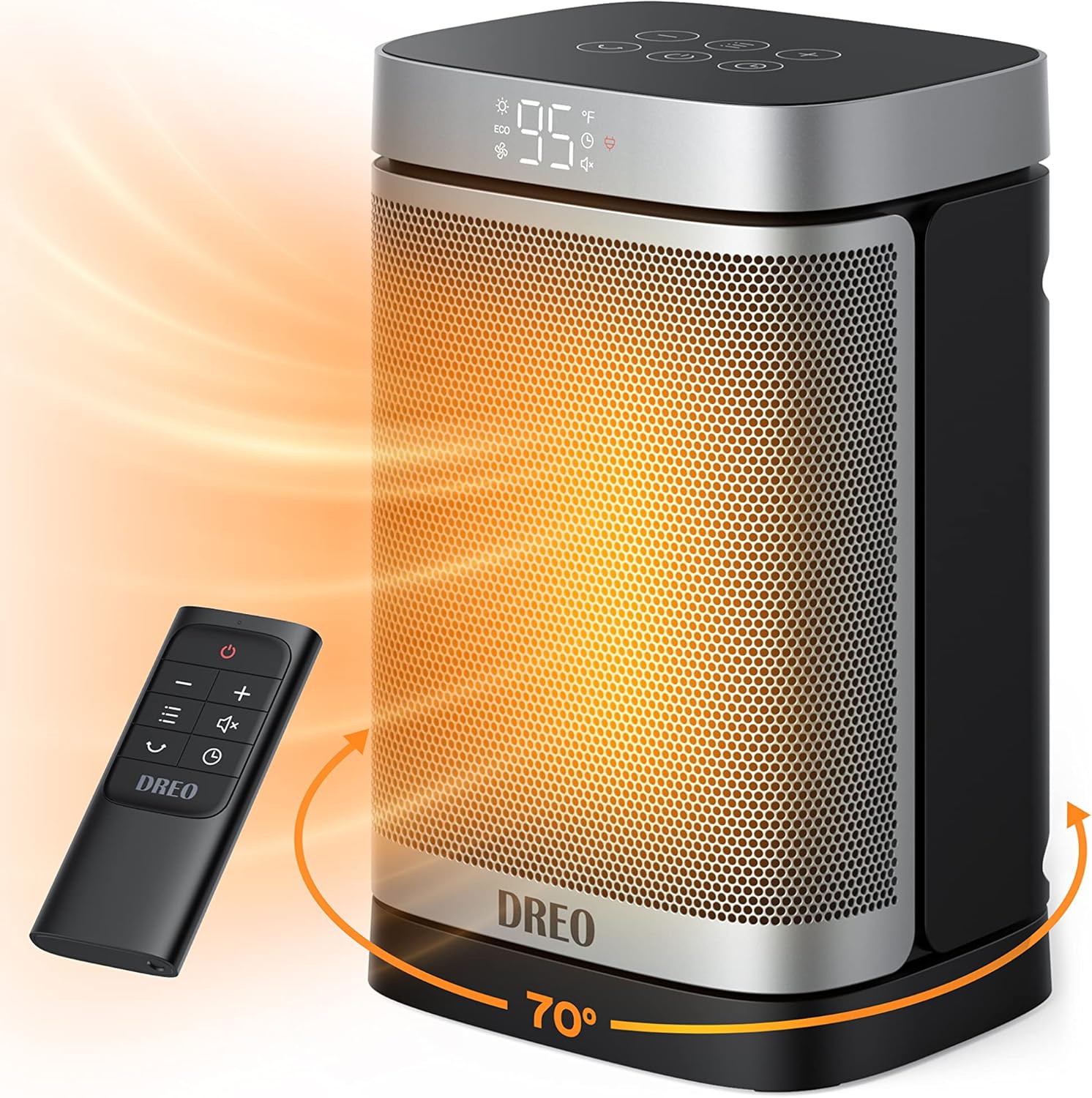
The DREO Atom One is a portable 1500W ceramic tower heater designed to deliver fast, directed heat for small to medium indoor spaces. It uses a PTC ceramic element and a brushless DC fan to push warm air while keeping noise low, and the 70 degree oscillation helps spread heat across a work area. Controls include a programmable digital thermostat (41 to 95°F in 1°F steps), a 1–12 hour timer, five power/speed modes including an ECO mode for automatic energy trimming, and a supplied remote for hands-off adjustments. Safety features are thorough with ETL listing, tip-over and overheat protection, a detachable filter, and flame-retardant materials. For an uninsulated garage this heater works best as a spot heater near your workstation or vehicle because it reaches setpoint quickly and the oscillation widens coverage; however it is still an electric space heater so expect limited whole-garage heating in very large or poorly sealed bays. The unit's compact footprint and quiet operation make it easy to move and run during projects, while the ECO and thermostat features help avoid wasted runtime when you only need localized warmth.
Best for: A buyer who needs a reliable, safe, moveable heater to provide fast, precise spot warmth in a single workspace or small uninsulated garage bay and values predictable performance and safety features.
Less Ideal for: Someone who wants to heat an entire, poorly insulated garage or a large open bay as the heater is best used for targeted, localized heating rather than whole-space tempering.
- 1500W PTC ceramic element provides rapid, consistent spot heat.
- Programmable digital thermostat with 1°F increments for precise temperature control.
- 70° oscillation helps distribute heat across a work area.
- ECO mode and timer reduce unnecessary runtime and energy use.
- ETL-listed safety features include tip-over and overheat protection plus flame-retardant materials.
- Not intended to heat an entire uninsulated garage effectively on its own in very large or open spaces.
- Relatively small form factor means limited airflow volume compared with larger garage heaters.
Verdict: Choose this compact, safety-focused 1500W heater when you need dependable, quick spot heating and precise temperature control in an uninsulated garage workspace.
Heat Storm Phoenix HS-1500
| Power | 1500 W |
|---|---|
| Voltage | 110 volts |
| Heating Method | Infrared / Radiant |
| Mounting Type | Wall Mount |
| Wi-Fi | Yes |
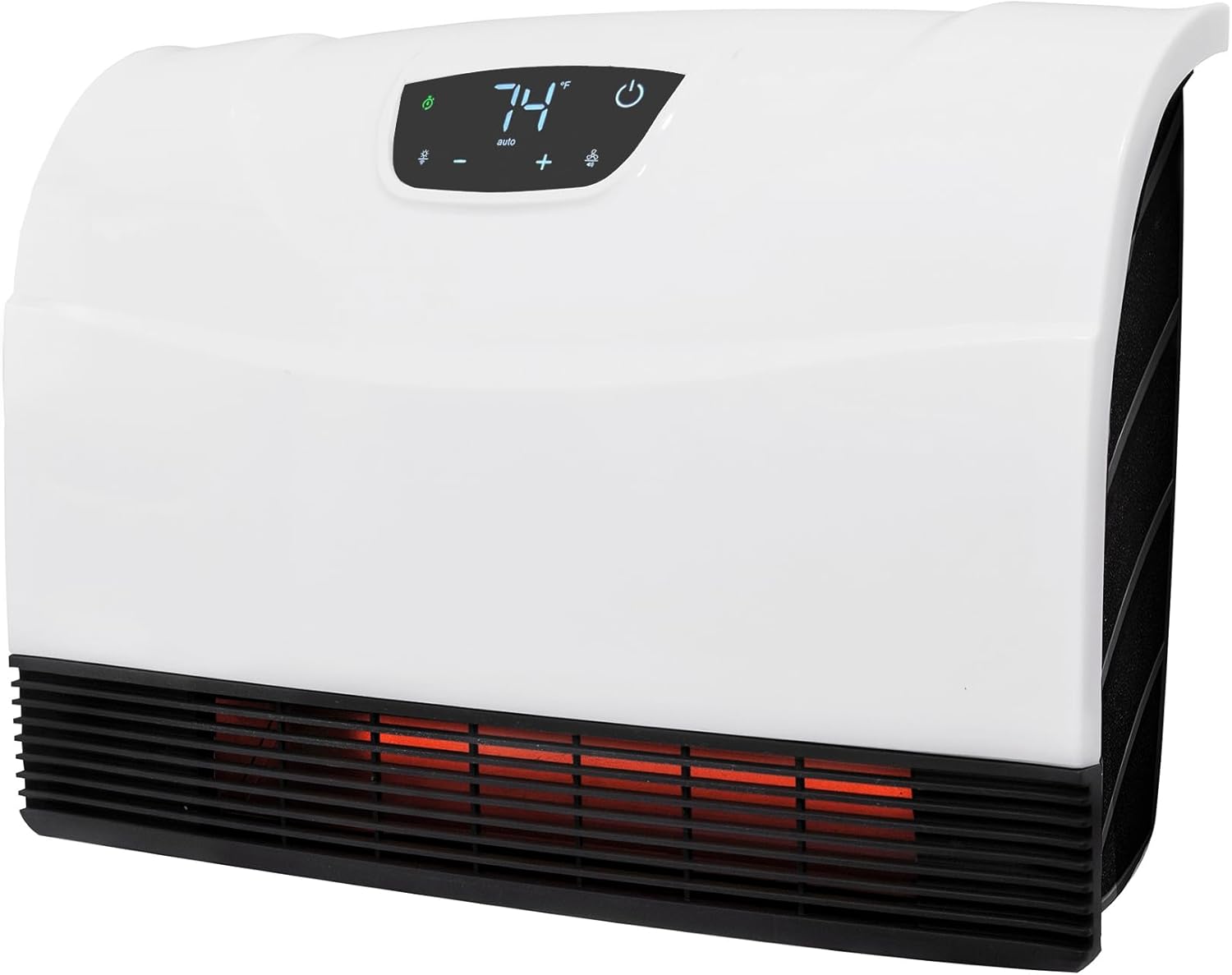
The Heat Storm Phoenix HS-1500 is a 1500 W infrared wall-mounted heater intended to deliver targeted, space-saving heat in bathrooms, bedrooms, offices, and small garages. It mounts to the wall and plugs into a standard 110 V outlet, so installation is simple and it does not take floor space. The built-in Wi-Fi and one-touch Bluetooth setup let you control temperature and schedules from a phone or the included remote, while a touch-screen display provides local adjustment. As an infrared radiant heater it warms objects and people directly, which feels quicker than relying on air temperature alone and can be efficient for zone heating up to roughly 150 sq ft as a primary source. Safety features include tip-over protection for freestanding use and a cool-to-touch grill for wall installation. Trade-offs are that infrared radiant heat is best for targeted zones rather than evenly warming a large, poorly insulated garage, and the unit's 1500 W limit means it will struggle to maintain high temps in very cold, uninsulated spaces without supplemental heating.
Best for: Buyers who want a compact, controllable wall heater to provide fast, targeted warmth in a small garage zone or work area and who value remote scheduling and simple plug-in installation.
Less Ideal for: People needing to heat a large or severely uninsulated garage as a primary heat source should consider higher-capacity or forced-air solutions instead.
- Wall-mount design saves floor space and keeps the unit out of the way in a garage
- Wi‑Fi and remote control allow temperature scheduling and remote adjustments
- Infrared radiant heating warms people and objects directly for fast local comfort
- 1500 W power runs on a standard 110 V outlet without special wiring
- 1500 W output and radiant style are limited for heating large or very cold uninsulated garages
Verdict: If you need a compact, Wi‑Fi controllable wall heater for quick, localized warmth in a small garage zone, this 1500 W infrared unit is a practical choice.
Mr. Heater 30,000 BTU Vent Free Heater

| Heat Output | 30,000 BTU/hr |
|---|---|
| Heating Coverage | 1,000 sq ft |
| Power Source | Natural Gas |
| Ignition | Battery operated electronic ignition |
| Special Features | Adjustable Temperature; Low oxygen safety shut off |
The Mr. Heater 30,000 BTU Vent Free Blue Flame heater is a hard‑working natural gas space heater designed to warm large indoor areas without venting. It can be wall mounted or used freestanding with included feet hardware, and it uses a blue flame tube burner and convection heating to move warmed air through a room. The unit includes a push‑button/battery igniter, a built‑in adjustable thermostat and an oxygen depletion safety shutoff for added protection in enclosed spaces. In practice it delivers quick, steady heat for garages or similar uninsulated spaces where electric heaters struggle, and an optional blower kit is available if you want stronger circulation. Important limitations are that it requires a natural gas hookup and proper installation, it produces combustion byproducts so the space needs adequate ventilation and CO/combustible safety measures, and it does not include a factory blower so warm‑air distribution can be uneven without the separate kit.
Best for: Buyers who prioritize reliable, high‑output heating for large uninsulated garages and want a unit with built‑in safety features rather than relying on electric heat alone.
Less Ideal for: People who cannot provide a natural gas connection, need a purely electric solution, or who cannot ensure proper ventilation and CO monitoring in the heated space.
- High heat output suitable for large, cold spaces with 30,000 BTU output
- Vent‑free design heats without external venting or electricity
- Built‑in adjustable thermostat and oxygen depletion safety shutoff for safer operation
- Can be wall mounted or freestanding and includes mounting hardware
- Requires natural gas hookup and professional or careful installation
- No included blower fan so air circulation may be limited without optional kit
- Produces combustion byproducts so space must meet safety and ventilation requirements
Verdict: A powerful vent‑free natural gas heater that delivers fast, high‑capacity heat with built‑in safety—ideal for warming large uninsulated garages when a gas supply and proper ventilation are available.
Choosing the Right Heater for Uninsulated Garages: Key Factors to Consider
Heat Output and Coverage Area
A heater for an uninsulated garage must provide higher continuous heat output than one designed for insulated rooms. Uninsulated spaces lose heat quickly through walls, ceiling, and doors, so calculate the volume of the garage and allow extra capacity for heat loss. Look for rated BTU or kilowatt figures and documentation showing performance at low ambient temperatures.
Choosing a unit with adjustable output stages helps because you can run higher power briefly to recover temperature after door openings, then back off to maintain comfort. Oversizing slightly is often better than undersizing in uninsulated garages, but extreme oversizing without control options can waste energy and shorten component life.
Installation Type and Placement
Mounting options affect both performance and safety. Ceiling- or wall-mounted units distribute heat across more of the space and stay out of the way of tools and vehicles. Portable heaters are useful for spot heating but may not heat the whole garage evenly and can be a trip hazard.
Consider where you'll install the unit relative to doors, vents, and work areas. High mounts reduce obstruction and minimize dust intake, but require secure anchors and clearances. Hardwired or direct-vent models need professional or experienced installation; plan for that in your decision. Ease of access for maintenance should factor into placement choices.
Fuel Source and Power Requirements
Heaters for uninsulated garages may use electricity, natural gas, propane, or indirect-fired setups. Each fuel type has tradeoffs in running cost, installation complexity, and suitability for unvented environments. Electric units are generally easier to install but require sufficient circuit capacity and can be costly to operate at high outputs. Gas or propane furnaces offer strong heat per fuel unit but often need venting and safe combustion air supply.
Verify that your garage has the necessary hookups and that local codes permit the chosen fuel and venting method. If choosing an electric model, confirm circuit amperage and whether a dedicated line or subpanel work is needed.
Thermostat Control and Efficiency
Accurate control reduces runtime and cost in uninsulated spaces. A responsive thermostat with multi-stage output or modulating control prevents overshoot and reduces short cycling, which can stress components. Programmable or smart controls let you set schedules to warm the garage only when needed, improving efficiency even in a leaky space.
Also consider fan speed settings and circulation options. A heater that can run a low-power fan to distribute warm air without full heat output helps even temperatures and avoids cold pockets near doors and floors.
Safety Features and Certifications
Safety matters more in garages where flammable liquids, dust, and tools are common. Look for heaters with automatic shutoff on overheating, tip-over protection for portable units, sealed combustion for gas models, and clearances documented for nearby combustibles. Models with cool-touch exteriors or guarded elements reduce accidental burn risk.
Check for relevant safety marks and compliance with local codes. Proper installation and adherence to clearance guidelines are as important as the built-in safety features themselves.
Durability and Maintenance Needs
Garages are harsher environments than living spaces, so choose heaters with dust-tolerant designs and sturdy housings. Metal construction, washable filters, and serviceable fans or heat exchangers prolong life. Units that allow easy access to common service points reduce long-term maintenance cost and downtime.
Consider expected maintenance tasks such as filter cleaning, burner inspection, or electrical terminal checks. A unit that makes these tasks straightforward will stay reliable in a garage setting with minimal fuss.
Sizing Your Garage Heater
To size a heater, start with the garage volume in cubic feet and an allowance for the expected heat loss of an uninsulated space. A rule-of-thumb multiplier is higher than for insulated rooms, so plan for extra output or choose a unit with higher maximum settings. Also factor in how often doors will open and whether you will heat only part of the garage.
If you intend to heat a work zone only, portable or directional units can be more efficient than trying to warm the entire volume. For full-space heating, prefer fixed-mounted units with wide-throw fans to reduce cold spots.
- Measure floor area and ceiling height to calculate volume.
- Account for frequent door openings with extra capacity.
- Decide between spot heating and whole-garage heating early.
Ventilation and Combustion Air
Combustion heaters require adequate air supply and proper venting to operate safely. In uninsulated garages, leaks and gaps can affect airflow patterns, so ensure vent paths are unobstructed and routed to the outdoors as specified. Indirect-vent or sealed-combustion designs reduce the risk of exhaust entering the workspace.
Even electric heaters should be installed with attention to ventilation if they have fans that stir dust or if the garage houses chemicals that should not be heated directly.
- Follow manufacturer clearance requirements for vents and exhausts.
- Avoid locating combustion intakes near vehicle exhaust or chemical storage.
Power Supply and Electrical Considerations
Electric heaters may demand high-current circuits. Confirm your garage electrical panel can support continuous loads and that wiring meets local codes. For hardwired heaters, plan for professional installation to ensure safe connections and appropriate disconnects.
Portable electric models should be used with proper cord gauge and plugged into dedicated outlets when possible. Avoid extension cords for continuous high-power loads.
- Verify circuit amperage and breaker sizing before purchase.
- Consider a dedicated circuit or subpanel upgrade for large electric units.
Maintaining Performance in Cold, Drafty Conditions
To keep a heater performing well in an uninsulated garage, perform regular maintenance such as cleaning or replacing filters, clearing dust from vents and fans, and checking seals on ducting or vent connections. Drafts can cause short cycling on some thermostats; locating the thermostat away from doors and direct airflow improves control accuracy.
Periodic inspection of electrical connections and mechanical fasteners ensures the unit remains secure and efficient, especially if the heater is ceiling-mounted where vibration can loosen hardware over time.
- Clean intake filters and fan grills quarterly or more often in dusty garages.
- Inspect vent terminations and seals annually.
Safety Best Practices for Garage Heating
Keep combustibles and flammable liquids well away from any heater. Maintain clearances recommended for the heater type and use guards or barriers if work or storage brings items close to the unit. Install carbon monoxide detection if you use any combustion-heating appliance in a semi-enclosed space.
Use professional installation for gas or hardwired models and follow local codes for venting and fuel connections. For portable electric heaters, never leave them running unattended for extended periods and ensure tip-over protection is functional.
- Maintain manufacturer-recommended clearances at all times.
- Install CO and smoke detection appropriate for the heater type.
How We Chose the Best Heater for Uninsulated Garages
We selected heaters that are appropriate for uninsulated garage environments by focusing on measurable performance and practical installation attributes. Primary evaluation criteria included steady heat output at low ambient temperatures, installation flexibility for wall, ceiling, or portable setups, and fuel or power delivery options that maintain output in drafty spaces. We also weighed energy control features such as thermostatic regulation and multi-stage output for managing runtime and operating cost. Safety and durability were critical filters. We prioritized units with built-in overheat protection, tip-over or flame-shutdown mechanisms where relevant, and robust housings suited to garage dust and occasional bumps. Ease of installation and serviceability were included because many garage heaters are mounted high or hardwired, so clear mounting systems and accessible filters matter. We excluded lightweight room heaters intended only for insulated living spaces and any models lacking appropriate safety certifications or adequate continuous output for larger, cold garages. The final list balances raw heat capacity, installation practicality, and safety to match the demands of uninsulated garage use.
Our full evaluation process is outlined in our review methodology.
FAQ
Can I use a portable space heater to warm an entire uninsulated garage?
Often a portable space heater is best for spot heating rather than warming an entire uninsulated garage. Portables can handle small work zones effectively, but whole-garage heating usually requires higher continuous output from a mounted unit.
How do I calculate how many BTUs I need for an uninsulated garage?
Calculate the garage volume and apply a higher heat loss allowance than for insulated spaces. Use published sizing charts adjusted upward for uninsulated conditions or consult a professional to account for local climate and door usage frequency.
Are electric heaters a good choice for uninsulated garages?
Electric heaters are convenient and avoid combustion venting, but they require sufficient circuit capacity and can be more expensive to operate at very high outputs. They work well for smaller garages or spot heating if your electrical system supports the load.
Do I need special ventilation for gas or propane heaters in a garage?
Yes. Combustion heaters need proper air supply and exhaust venting. Sealed-combustion or direct-vent systems reduce the risk of exhaust entering the space, and professional installation ensures compliance with codes and safe operation.
How can I improve heating efficiency without upgrading the heater?
Reduce heat loss by sealing gaps around doors and windows, adding door sweeps, and insulating overhead doors where possible. Use curtains or temporary barriers to isolate the work area and run the heater only when needed.
Final Verdict
For uninsulated garages, prioritize heaters that deliver robust continuous output, flexible installation options, and trustworthy safety features. Accurate thermostat controls and durable construction matter because the space is subject to drafts, dust, and occasional impacts. Balance the tradeoffs between fuel type, installation complexity, and operating cost to match how you use the garage. Choose a unit with a slight capacity margin, good control options, and clear installation guidance to ensure reliable warmth and safe operation through the colder months.