
Note: This article contains affiliate links. If you click on these links and make a purchase, we may earn a small commission at no extra cost to you. This helps support our research and content. Read our full affiliate disclosure here.
If seasonal sniffles, pet dander, or persistent indoor dust make your home uncomfortable, the right HEPA air purifier can reduce airborne triggers and improve daily comfort. You want an appliance that actually captures tiny particles, covers the rooms you use most, and runs at noise and energy levels that fit your lifestyle. This guide shortlists seven top HEPA air purifiers for allergies, each selected for strong filtration, sensible coverage, and practical features. Below we evaluate models on filtration performance, room coverage, noise, and ongoing costs to help you pick an option that matches your space and symptoms.
Top Picks at a Glance
| Best Overall The best all-around choice for most situations | Coway Mighty AP-1512HH |  |
| Best Quality Built to a higher standard if you want something more solid | Winix 5510 Air Purifier |  |
| Best Value The sweet spot between price and what you get | GermGuardian AC4825E Tower Air Purifier |  |
| Best Budget The cheapest option that still gets the job done reliably | VOOPNU HEPA Air Purifier DH-JH12 |  |
| Top Rated A top-rated pick with lots of positive feedback | Levoit Core 300-P Air Purifier |  |
| Most Popular A crowd favorite that many people choose with confidence | Levoit Core 200S-P |  |
| Best Seller A high-volume bestseller chosen again and again | Honeywell HPA304 HEPA Air Purifier |  |
Coway Mighty AP-1512HH

| Coverage | Up to 1,748 sq. ft. in 60 minutes |
|---|---|
| Filtration stages | Pre-filter, Deodorization, Bipolar Device, HEPA |
| HEPA effectiveness | 99.97% of 0.3μm particles |
| Filter lifespan | Up to 1 Year |
| Model number | AP-1512HH(W) |
The Coway Mighty AP-1512HH is a room air purifier that uses a four-stage system—washable pre-filter, deodorization filter, bipolar ionizer, and a True HEPA filter—to remove particles, odors, and many VOCs from indoor air. It is typically placed in bedrooms, living rooms, or offices and runs in Auto mode to adjust fan speed based on the built-in pollution sensor, with an LED air quality indicator that shows conditions at a glance. Practical benefits include strong HEPA filtration that captures 0.3 micron particles, a washable pre-filter that reduces replacement frequency, and timer and Eco options to limit power use and noise during sleep. The unit is rated to cover large spaces quickly, and filter life notifications help maintain performance. Important limitations are that specialized custom filters are sold separately for intense smoke or pet allergens and the bipolar ionizer adds another mechanism some buyers prefer to disable; replacement filters and occasional maintenance are required to keep peak performance.
Best for: Buyers who want a reliable, easy-to-use purifier that actively manages air quality in medium to large rooms and values strong particle filtration with simple automatic controls.
Less Ideal for: Those seeking a completely passive filtration unit without ionization features or buyers who need a lightweight travel purifier for very small spaces.
- True HEPA filtration capturing 99.97% of 0.3 μm particles
- Auto mode with real-time air quality sensor and visible LED indicator
- Washable pre-filter reduces dust load and extends filter life
- Multiple modes including Eco and timer for quieter, lower-power operation
- Replacement/custom filters for specific problems like intense smoke or pet allergens are additional purchases
- Contains a bipolar ionizer which some users may prefer to turn off
Verdict: A dependable all-round HEPA purifier that automatically monitors and cleans medium to large rooms, making it a strong choice for allergy-focused buyers.
Winix 5510 Air Purifier

| Max room coverage | 1,882 Ft² in 1 Hr |
|---|---|
| Filtration stages | 4-Stage |
| Particle capture | Down to 0.01 microns |
| Noise (low) | 23.5 dB |
| Smart features | WiFi / Alexa / Google Home |
The Winix 5510 is a four-stage air purifier built to clean large rooms quickly while giving you automated, smart control. It combines a washable pre-filter, True HEPA that captures down to 0.01 microns, and an advanced deodorization carbon layer to reduce odors and some VOCs, plus Winix PlasmaWave technology for additional airborne impurity reduction. Built-in air quality sensors drive an Auto Mode that raises or lowers fan speed as needed, and an LED AQI indicator makes room conditions visible at a glance. The unit is app compatible with Wi‑Fi and voice assistants for remote monitoring and control, and it goes into a nearly silent Sleep Mode that lowers noise and energy use when the room is dark. Practical benefits include strong particle removal for allergy triggers, straightforward filter-change alerts, and a washable mesh pre-filter that extends filter life. Important limitations are typical for its class: it requires ongoing replacement filters and power to run continuously for best results, and some users may prefer independent third-party VOC testing rather than relying on the carbon stage and PlasmaWave for gas removal.
Best for: Buyers who prioritize fast, high‑capacity particle removal and automated operation for allergy relief in larger rooms and want smart control and quiet night operation.
Less Ideal for: People who need specialized gas or VOC removal beyond basic carbon adsorption or who want a purely mechanical system without any plasma/ionizing component.
- Four-stage filtration including True HEPA for capturing very fine particles
- Advanced carbon filter to reduce household odors and some VOCs
- Smart sensors with Auto Mode and visual AQI indicator for hands-off operation
- Winix Smart App plus Alexa/Google compatibility for remote control
- Washable pre-filter helps trap large particles and extends filter life
- Requires regular replacement filters to maintain performance
- PlasmaWave is an added technology but not a substitute for ventilation or chemical-specific filtration
Verdict: Choose the Winix 5510 when you want a high-capacity, smart HEPA purifier that quickly reduces airborne allergens and runs quietly at night.
GermGuardian AC4825E Tower Air Purifier

| Coverage guidance | Small room 153 sq. ft. / Large up to 743 sq. ft. |
|---|---|
| Filter type | True HEPA + activated carbon pre-filter |
| Fan speeds | 3 speeds with sleep mode |
| Optional sanitizer | UV-C light available |
The GermGuardian AC4825E is a compact tower air purifier that pulls room air through an activated carbon pre-filter and a True HEPA filter, with an optional UV-C bulb for extra germ reduction. It is typically used in bedrooms, living rooms, offices, or basements to reduce dust, pollen, pet dander, smoke and common odors; manufacturer coverage guidance cites cleaning cycles for small rooms every 12.5 minutes and larger rooms hourly. Controls are simple with three fan speeds including a quiet sleep mode, and the unit accepts several factory replacement Filter B cartridges and UV-C bulbs for straightforward upkeep. Practical benefits include proven HEPA capture down to 0.1 microns, carbon odor reduction, and modest size that fits on floors or small tables. Trade-offs: it is a single-room purifier without advanced sensors or Wi-Fi, and the optional UV-C means replacement bulbs are an additional maintenance item. If you want a no-frills, tested HEPA purifier focused on allergen and odor reduction, this model covers the essentials reliably.
Best for: Buyers who prioritize practical, proven allergen reduction in single rooms and want a straightforward, easy-to-maintain purifier rather than smart features or whole-home coverage.
Less Ideal for: People seeking whole-house purification, connected/smart controls, or automatic air-quality sensing should consider other models with larger coverage or built-in sensors.
- True HEPA filter captures 99.97% of particles down to 0.1 microns
- Activated carbon pre-filter reduces common household odors and cooking smells
- Three fan speeds including a quiet sleep mode for nighttime use
- Compact tower design fits small spaces and is easy to move
- No air-quality sensors or automatic speed adjustment
- Optional UV-C requires separate bulb replacements and increases maintenance
Verdict: A compact, no-frills HEPA tower that reliably reduces allergens and odors in single rooms for buyers focused on practical performance.
VOOPNU HEPA Air Purifier DH-JH12

| Filter type | H13 True HEPA |
|---|---|
| Coverage (claimed) | Up to 1,076 ft² |
| Noise level | 22 dB (quiet) |
| Fan speeds | 3 speeds |
The VOOPNU DH-JH12 is a compact tabletop air purifier built around an H13 true HEPA triple-layer filter and 360° intake to capture airborne particles such as pet hair, pollen, smoke, and most fine dust. It is simple to operate from a minimal control panel, offers three fan speeds plus a timer, and includes a small essential-oil tray for light scenting. Laboratory figures and the listed CADR imply it can refresh a 250 ft² area every 15 minutes, making it suitable for bedrooms, living rooms, or home offices. Noise is low at the quoted 22 dB on its quiet setting, which helps overnight use. The unit is fully certified to common safety and emissions standards. Trade-offs are its very small footprint and lightweight construction, which suit personal and small-room use rather than heavy-duty whole-house cleaning, and replacement filters are recommended every few months for best performance. For buyers focused on straightforward allergy relief on a budget, this unit offers a lot of filtration power for its size but requires continuous or long run times to reach the stated coverage in real rooms.
Best for: Value-minded buyers who need effective particle filtration for bedrooms or small living spaces and prefer a simple, low-noise purifier that is easy to operate and maintain.
Less Ideal for: Homes that need a primary purifier for very large open areas or continuous whole-house coverage should choose a larger, higher-capacity unit instead.
- H13 true HEPA triple-layer filter captures 99.97% of fine particles
- 360° air intake and lab-tested refresh rate suitable for small to medium rooms
- Very quiet operation down to 22 dB for overnight use
- Simple controls and timer make it easy to run continuously
- Includes essential oil tray for light aroma option
- Compact, lightweight design limits airflow for very large or open-plan spaces
- Requires regular filter replacements to maintain effectiveness
Verdict: A budget-friendly, quiet HEPA purifier that delivers strong particle filtration for bedrooms and small to medium rooms.
Levoit Core 300-P Air Purifier

| Floor Area | 1073 square_feet |
|---|---|
| Noise Level | 24 db |
| Particle Retention Size | 0.3 micron |
| Wattage | 56 watts |
| Filter Type | 3 in 1 Filtration |
The Levoit Core 300-P is a small, user-friendly HEPA air purifier built for home use where allergy control and low noise matter. It uses a 3-stage original filter that captures fine particulates down to 0.1–0.3 microns at a stated 99.97% efficiency and a motor delivering a CADR suited to refresh a 222 ft² room nearly five times per hour or provide whole-level dilution in larger spaces. Controls are touch-based and it includes a sleep mode that drops noise to about 24 dB while still operating in HEPA-grade filtration. The unit is AHAM verified and meets CARB and ETL safety standards, and includes a timer and filter check indicator for straightforward maintenance. Practical limits are manual fan-speed control on this model rather than smart Auto Mode, and the manufacturer recommends using genuine replacement filters and changing them roughly every 6 to 8 months to keep performance high. For reliable day-to-day particulate and odor reduction in bedrooms, living rooms, or home offices, the Core 300-P is a sensible, low-noise choice.
Best for: Someone who prioritizes dependable, certified particulate removal and quiet overnight operation and wants a straightforward, low-maintenance purifier for bedrooms or common rooms.
Less Ideal for: Users who require Wi‑Fi, Auto Mode, or app-based control and automation should consider models with smart features instead.
- True HEPA-grade 3-stage filter capturing 99.97% of 0.1–0.3μm particles
- AHAM verified CADR with clear room-refresh guidance
- Very quiet Sleep Mode at about 24 dB for overnight use
- Touch controls, timer, and filter indicator simplify daily operation
- Meets safety certifications (CARB, ETL) for home use
- No smart/auto mode on this specific model so fan speeds are manual
- Recommended use of genuine Levoit filters increases ongoing cost
Verdict: Buy this if you want a compact, certified HEPA purifier that reliably removes fine allergens while staying whisper-quiet at night.
Levoit Core 200S-P
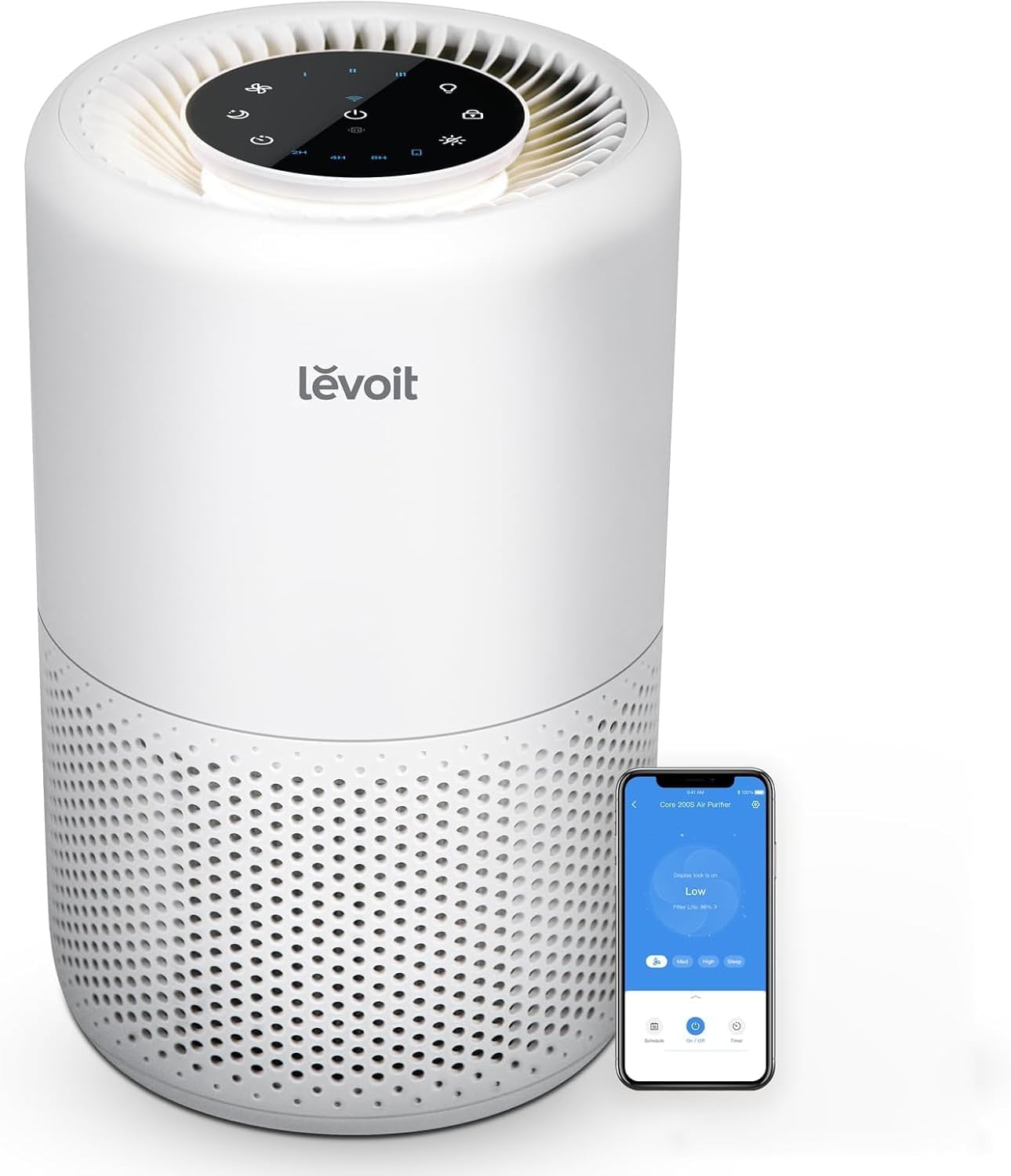
| Model | Core 200S |
|---|---|
| Filtration | 3-stage (pre-filter, activated carbon, HEPA) |
| Room coverage | 140 ft² refreshes 4.8×/hour |
| Noise level | As low as 27 dB |
The Levoit Core 200S-P is a small-room HEPA air purifier built for everyday allergy and pet-odor relief. It pulls air in through 360 degree intake and passes it through a nylon pre-filter, activated carbon layer for odors, and a true HEPA main filter that captures 99.97% of particles down to 0.1–0.3 microns. Levoit rates it to refresh a 140 ft² room nearly five times per hour, making it a practical choice for bedrooms, nurseries, or home offices. Smart features include app and voice control plus a sleep mode and a display-off button for low-noise overnight use; the unit can run quietly to about 27 dB on low. The compact footprint and light weight make placement flexible, and the in-app filter-life monitoring simplifies maintenance. Trade-offs are predictable for a small purifier: it is optimized for single rooms rather than open-plan spaces, and replacement filters are an ongoing cost to maintain peak performance. For buyers who value quiet operation, verified HEPA filtration, and smart controls in a compact package, this model covers the basics very effectively.
Best for: Buyers who want a compact, smart-controlled purifier to reduce common allergens and pet odors in a bedroom, nursery, or small apartment and who prefer units with quiet overnight performance and strong user reviews.
Less Ideal for: Those needing whole-home coverage or a unit to clean large living rooms or open-plan spaces should consider higher-capacity purifiers instead.
- True HEPA main filter removes 99.97% of particles 0.1–0.3 microns in size
- 360° air intake and rated refresh rate suitable for ~140 ft² rooms
- Quiet operation with noise as low as 27 dB for bedroom use
- App and voice control plus filter-life monitoring for convenient operation
- Designed for single rooms and not powerful enough for large open-plan areas
- Requires periodic replacement filters which add ongoing cost
Verdict: A quiet, smart small-room HEPA purifier that reliably reduces common allergy triggers and pet odors in bedrooms and similar spaces.
Honeywell HPA304 HEPA Air Purifier

| Filter Type | HEPA |
|---|---|
| Floor Area | 465 square_feet |
| Particle Retention Size | 0.3 micron |
| Wattage | 80 watts |
| Contaminant Filtration Capability | Dust, Pet Dander, Pollen, dust mite debris, smoke |
The Honeywell HPA304 is a straightforward HEPA air purifier built for extra-large rooms and allergy relief. It uses a true HEPA filter that captures up to 99.97% of particles 0.3 microns and larger, and Honeywell rates it to circulate air roughly 4.8 times per hour in a 465 sq ft space or deliver one air change per hour for up to 2,250 sq ft at a slower rate. Controls are simple touch buttons with multiple fan speeds including a Turbo setting, an adjustable timer and a dimmable control panel. In practice it provides reliable filtration for dust, pollen, pet dander and smoke without complicated setup, and the filter-change indicator helps maintenance. Expect steady performance and relatively quiet operation at low and medium speeds, with higher noise at Turbo. The unit is corded and uses replaceable genuine Honeywell filters for best results, so ongoing filter replacement is an ownership cost. For buyers who value dependable, no-nonsense allergen removal in large rooms, this purifier is a practical choice.
Best for: Buyers who prioritize reliable, proven allergen removal and simple, low-friction operation for large living spaces will appreciate this purifier.
Less Ideal for: If you need ultra-quiet performance at the highest cleaning rates or an integrated smart/Wi-Fi feature set, choose a different model with those capabilities.
- True HEPA filtration capturing up to 99.97% of 0.3 micron particles
- Rated for circulation in extra-large rooms (465 sq ft) with multiple fan speeds
- Simple touch controls with timer and control-panel dimmer
- Filter change indicator simplifies maintenance
- Quiet at low and medium speeds for overnight or home use
- Requires periodic genuine replacement filters which add ongoing cost
- Higher fan speeds produce noticeable noise
Verdict: A dependable, user-friendly HEPA purifier that delivers proven allergen removal for extra-large rooms.
Choosing the Right HEPA Air Purifier for Allergies: Key Factors to Consider
Filtration Efficiency
A purifier's true HEPA filter rating is the most important factor for allergy relief because it determines how effectively the unit captures fine particles like pollen, pet dander, and dust mite debris. Look for explicit claims about capturing 99.97% of particles down to 0.3 microns or better; this gives realistic assurance that the device will remove the kinds of particulates that trigger symptoms.
Higher filtration efficiency matters when occupants have moderate to severe allergies or when the home has indoor sources of allergens. In smaller rooms or for light sensitivities, lower-grade filters may offer partial relief, but true HEPA-level filtration is the reliable choice for consistent symptom reduction.
Room Coverage and CADR
Room coverage, often expressed via a clean air delivery rate or recommended square footage, tells you whether a purifier can cycle and clean the air in your space fast enough to make a difference. A unit that is undersized for the room will struggle to lower allergen concentrations, even if it has an excellent filter.
Match the purifier's rated coverage to the rooms where you spend the most time. For whole-room relief, choose a model rated for the full room area at a reasonable air-change-per-hour rate; for targeted relief while sleeping or working, a smaller unit with strong local circulation may suffice.
Noise Levels During Operation
Allergy sufferers often run purifiers for long stretches, including overnight, so fan noise and tonal character are critical. Excessive noise can disrupt sleep and lead users to reduce run time, which negates filtration benefits. Look for manufacturer noise specs at different fan speeds and seek models that balance quiet performance at lower speeds with the ability to ramp up when needed.
Consider how noise interacts with placement. A quieter unit may be better for bedrooms, while slightly louder units can work in living areas where background noise masks fan sounds.
Filter Life and Ongoing Maintenance
Long-term effectiveness depends on filter replacement frequency and the cost and availability of replacement filters. Short-lived or expensive filters increase ongoing ownership costs and can discourage regular maintenance. Check expected filter life in hours or months, whether pre-filters are washable, and how easy it is to obtain replacements.
Maintenance also includes simple tasks like vacuuming pre-filters and checking indicator lights. Low-effort maintenance helps ensure the purifier stays effective over seasons when allergy exposure is highest.
Operational Cost and Energy Use
Because HEPA purifiers may run for many hours daily during allergy season, energy efficiency impacts utility bills and long-term convenience. Look for models with efficient motors, multiple speed settings, and sleep or eco modes that reduce power draw overnight.
Operational cost also ties into filter replacement expenses. A unit with slightly higher energy use but much longer filter life may be cheaper to operate overall. Evaluate both electricity draw and filter replacement cadence when estimating total cost of ownership.
Sizing Your Purifier For Bedrooms and Living Areas
When choosing a HEPA air purifier for allergies, think about where you spend the most time. Bedrooms need quieter units sized for the square footage of the room so the purifier can run all night without disturbing sleep. Living rooms and open-plan areas require models rated for larger coverage or multiple units placed strategically.
To size correctly, check the clean air delivery rate or the manufacturer's recommended room area and plan for at least two to four air changes per hour in rooms where allergy symptoms are worst. If you have an open floor plan, consider a single higher-capacity unit placed centrally or two smaller units for distributed coverage.
- Measure room square footage and compare to rated coverage.
- Aim for higher air-change rates in bedrooms and rooms with pets.
- Consider placement: central locations and unobstructed airflow improve performance.
Placement Tips to Maximize Allergen Removal
Placement affects performance more than many buyers expect. Keep intakes and outlets unobstructed and avoid tucking a purifier against furniture or behind curtains. Placing the unit near the source of allergens, such as a pet bed or near entryways where outdoor pollen enters, helps lower local concentrations quickly.
Elevating small units a few inches off the floor can improve circulation, especially in rooms with low furniture. Avoid corners and tight enclosures that restrict airflow. For multi-room coverage, prioritize placing higher-capacity units in the area where occupants spend most time rather than distributing power evenly.
- Keep 1 to 2 feet clearance around the unit for best airflow.
- Place near allergy sources or near where you sleep.
- Avoid placing behind curtains or in enclosed shelving.
Maintenance Routines That Keep Performance High
Regular maintenance keeps a purifier operating near peak efficiency. Follow the recommended filter replacement schedule and clean pre-filters as instructed. Many units include accessible pre-filters that can be vacuumed or rinsed to extend the life of the HEPA element and maintain airflow.
Also check intake grills for dust buildup and ensure any sensors are clean if the unit uses automatic fan control. Consistent maintenance prevents reductions in CADR and helps the purifier sustain allergen removal over months of continuous use.
- Vacuum or rinse pre-filters every 1 to 3 months depending on use.
- Replace HEPA filters per manufacturer guidance or sooner if indicated.
- Wipe down intake grills and sensor areas to avoid false readings.
Dealing With Odors and VOCs in Addition to Particles
Allergies are primarily driven by particles, but many households also contend with odors or volatile organic compounds. If odors are a concern, look for purifiers that pair HEPA filtration with an activated carbon stage. Carbon does not remove particles but adsorbs many odors and some common VOCs, making the indoor air feel fresher alongside particle removal.
Understand that carbon filters saturate and have a finite lifespan. For mixed problems of allergens and smells, prioritize units that allow easy carbon filter replacement and that offer clear guidance on combined filter maintenance.
- Choose multi-stage filtration when odors or smoke are also concerns.
- Expect carbon filters to require periodic replacement separate from HEPA elements.
- Check whether carbon is integrated or offered as a separate replaceable module.
Noise Tradeoffs: When Quiet Matters Most
Noise performance is a balance between speed and sound. Running at low speed is quiet but reduces clean-air delivery, while higher speeds increase noise and particulate removal. Determine whether steady low-noise operation or strong intermittent purging works better for your routine.
If you sleep light, prioritize models with low decibel ratings on their quiet settings and consider units with night modes that dim indicators and slow fan speed. For daytime living areas, you can accept higher fan speeds when occupants are active and noise is less disruptive.
- Compare decibel ratings at different speeds instead of a single number.
- Use night modes to reduce fan speed and lights during sleep.
- Place louder units in rooms where background noise masks operation.
How We Chose the Best HEPA Air Purifier for Allergies
We focused on capabilities that matter specifically to allergy sufferers and typical home environments. Primary evaluation criteria included true HEPA filtration effectiveness for particles 0.3 microns and smaller, the clean air delivery rate (CADR) and rated room coverage to ensure practical performance for common room sizes, and multi-stage filtration that combines pre-filters and activated carbon for common irritants like pet dander and odors. Noise output at typical fan speeds and energy consumption were reviewed because continuous operation is common during allergy seasons. We also considered filter replacement frequency and availability to estimate ongoing maintenance effort and cost. Excluded from consideration were units that rely solely on ionizers or ozone-producing technologies, as those do not provide reliable HEPA-level particle capture and can introduce indoor air chemistry concerns. We prioritized products with verifiable HEPA or true HEPA ratings and clear CADR or equivalent room coverage specifications. The result is a shortlist of seven HEPA air purifiers that balance particle removal performance, practical coverage, and reasonable upkeep for allergy-focused households.
Our full evaluation process is outlined in our review methodology.
FAQ
Will a HEPA air purifier eliminate allergy symptoms completely?
A HEPA purifier can significantly reduce airborne allergens but rarely eliminates symptoms entirely. Effectiveness depends on matching purifier capacity to room size, running it consistently, and combining it with other measures like cleaning, vacuuming, and controlling pet access to bedrooms.
How often should I run a HEPA air purifier for allergies?
For best results run a purifier continuously during high-allergy periods, since particle concentrations build up when the unit is off. If continuous operation is not possible, run it several hours before occupying a room and while you sleep or spend long periods there.
Do I need an activated carbon filter if I only have pollen allergies?
Activated carbon targets odors and some gases rather than pollen. If pollen is your only concern, a strong HEPA filter is the priority. Carbon can be helpful in homes with simultaneous odor or VOC issues, but it is not required solely for particle removal.
Can I run a purifier in a closed window room with pets?
Yes. Running a properly sized HEPA purifier in a closed room helps reduce airborne pet dander and hair that has become airborne. For best results, run the unit continuously and place it near where pets spend time, while also using regular grooming and cleaning to reduce sources.
How do I know when to replace the HEPA filter?
Replace filters according to the manufacturer's time or usage guidance and watch for reduced airflow or indicator lights. Visible dust buildup on pre-filters and a drop in cleaning performance are signs replacement may be needed sooner.
Final Verdict
Prioritize true HEPA filtration and proper sizing when choosing an air purifier for allergies. Focus on filtration efficiency, CADR or room coverage, and practical factors like noise and filter maintenance to ensure consistent, long-term allergen reduction. Balance tradeoffs between quiet overnight operation and peak cleaning power for daytime use. When you match a purifier to your space and maintain its filters regularly, you can noticeably reduce airborne triggers and make indoor life more comfortable during allergy seasons.