
Note: This article contains affiliate links. If you click on these links and make a purchase, we may earn a small commission at no extra cost to you. This helps support our research and content. Read our full affiliate disclosure here.
If you or someone in your household has asthma, indoor air quality can have a direct impact on daily symptoms and overall comfort. A HEPA air purifier for asthma is designed to capture fine particles that trigger attacks, including dust, pollen, pet dander, and many irritant aerosols. Choosing the right unit matters because filter efficiency, room coverage, and clean-air delivery affect how well a device reduces airborne triggers in real-world use. This guide shortlists the seven top HEPA air purifiers for asthma and explains the practical differences between them. We evaluated units on filtration effectiveness, airflow and coverage, noise, and usability so you can pick the option that fits your living space and symptom priorities. Read on for the highlights and the factors that should guide your choice.
Top Picks at a Glance
| Best Overall The best all-around choice for most situations | Coway Mighty AP-1512HH |  |
| Best Quality Built to a higher standard if you want something more solid | IQAir HealthPro Plus XE |  |
| Best Value The sweet spot between price and what you get | MOOKA B-D02L Air Purifier |  |
| Best Budget The cheapest option that still gets the job done reliably | FULMINARE H13 HEPA Air Purifier |  |
| Top Rated A top-rated pick with lots of positive feedback | Levoit Core 300-P |  |
| Most Popular A crowd favorite that many people choose with confidence | Levoit Core 200S-P |  |
| Best Seller A high-volume bestseller chosen again and again | VOOPNU HEPA Air Purifier DH-JH12 |  |
Coway Mighty AP-1512HH

| Coverage | Up to 1,748 sq. ft. in 60 minutes |
|---|---|
| HEPA efficiency | 99.97% of 0.3μm particles |
| Filtration stages | Washable pre-filter, deodorization, bipolar device, HEPA |
| Filter lifespan | Up to 1 Year |
The Coway Mighty AP-1512HH is a plug-and-play air purifier built for continuous home use in medium to large spaces. It pulls air through a washable pre-filter, deodorization stage, bipolar ionizer, and a true HEPA filter that captures 99.97% of 0.3 micron particles, which helps reduce pollen, pet dander, smoke and other common asthma triggers. An auto mode and air quality LED let the unit adjust fan speed and show real-time status, while an eco mode and timer make it easy to lower energy use at night. The washable pre-filter and filter indicator simplify maintenance, though replacement HEPA and custom filters are required periodically. The unit is relatively heavy for its class but intended to stay in one room; it is straightforward to operate and reasonably quiet on low speeds. Coverage claims up to about 1,748 sq ft in 60 minutes make it suitable for living rooms or open-plan areas, but expect slower circulation in complex layouts or connected rooms.
Best for: Buyers who want a dependable, low-maintenance purifier that actively manages indoor air quality for allergy and asthma symptom reduction in medium to large living spaces.
Less Ideal for: People looking for a lightweight, highly portable bedroom-only unit or those who need smart home integration and remote app control.
- True HEPA filtration capturing 99.97% of 0.3μm particles for allergens and smoke.
- Multi-stage system with washable pre-filter reduces large particles and extends filter life.
- Auto mode and air quality indicator provide hands-free adjustments and easy monitoring.
- Eco and timer modes help reduce energy use during low-need periods.
- Filter indicator alerts simplify maintenance scheduling.
- Large footprint and weight make it less portable between rooms.
- Replacement HEPA and specialty filters add ongoing cost.
Verdict: A reliable, feature-packed HEPA purifier that actively monitors and reduces common asthma triggers across medium to large rooms.
IQAir HealthPro Plus XE

| Maximum Coverage | Up to 1125 sq. ft. |
|---|---|
| Filtration Rating | Filters 99.5% particles ≥ 0.003 microns |
| Air Delivery (example) | Speed 6: 300 cfm / 510 m³/h |
| App Integration | AirVisual app, WiFi |
The IQAir HealthPro Plus XE is a premium HyperHEPA air purifier built to deliver medical-grade filtration in large spaces up to 1125 sq ft. It uses IQAir's HyperHEPA technology to capture ultrafine particles down to 0.003 microns and pairs that filtration with a redesigned, energy-efficient fan system and multi-speed airflow. The unit includes an advanced particle sensor and three smart modes so it can run sensor-based automatic adjustments or be controlled remotely through the AirVisual app and WiFi integration. In practical use the XE is suited to living rooms, offices, or clinical settings where strong continuous removal of smoke, pollen, pet dander, viruses, and fine particulates matters most; filter life estimates are long on primary filters but replacement modules are part of ongoing ownership. Expect quiet, steady airflow on low speeds and substantial air delivery on higher speeds, but also a larger, heavier footprint than small room purifiers and a correspondingly higher upfront cost. For someone prioritizing top-tier particle removal and reliable automatic sensing in large spaces, the HealthPro Plus XE performs as advertised.
Best for: Buyers who want the strongest particle filtration available for asthma-sensitive households and are focused on long-term air quality performance in large rooms.
Less Ideal for: People looking for a budget compact purifier for small bedrooms or those who need a lightweight, highly portable unit.
- HyperHEPA filtration captures at least 99.5% of particles down to 0.003 microns for ultrafine protection
- Rated for large rooms up to 1125 sq ft with multiple fan speeds and high maximum airflow
- Advanced particle sensor with three smart modes enables automatic, sensor-based adjustments
- WiFi and AirVisual app integration allow remote monitoring and control
- Redesigned fan system improves energy efficiency compared with previous models
- Large and heavy compared with compact purifiers, which reduces portability
- High upfront cost and ongoing expense for replacement filters and modules
Verdict: If you need the highest practical particle removal for asthma-prone households in large rooms, the HealthPro Plus XE is a top-performing, sensor-driven choice.
MOOKA B-D02L Air Purifier
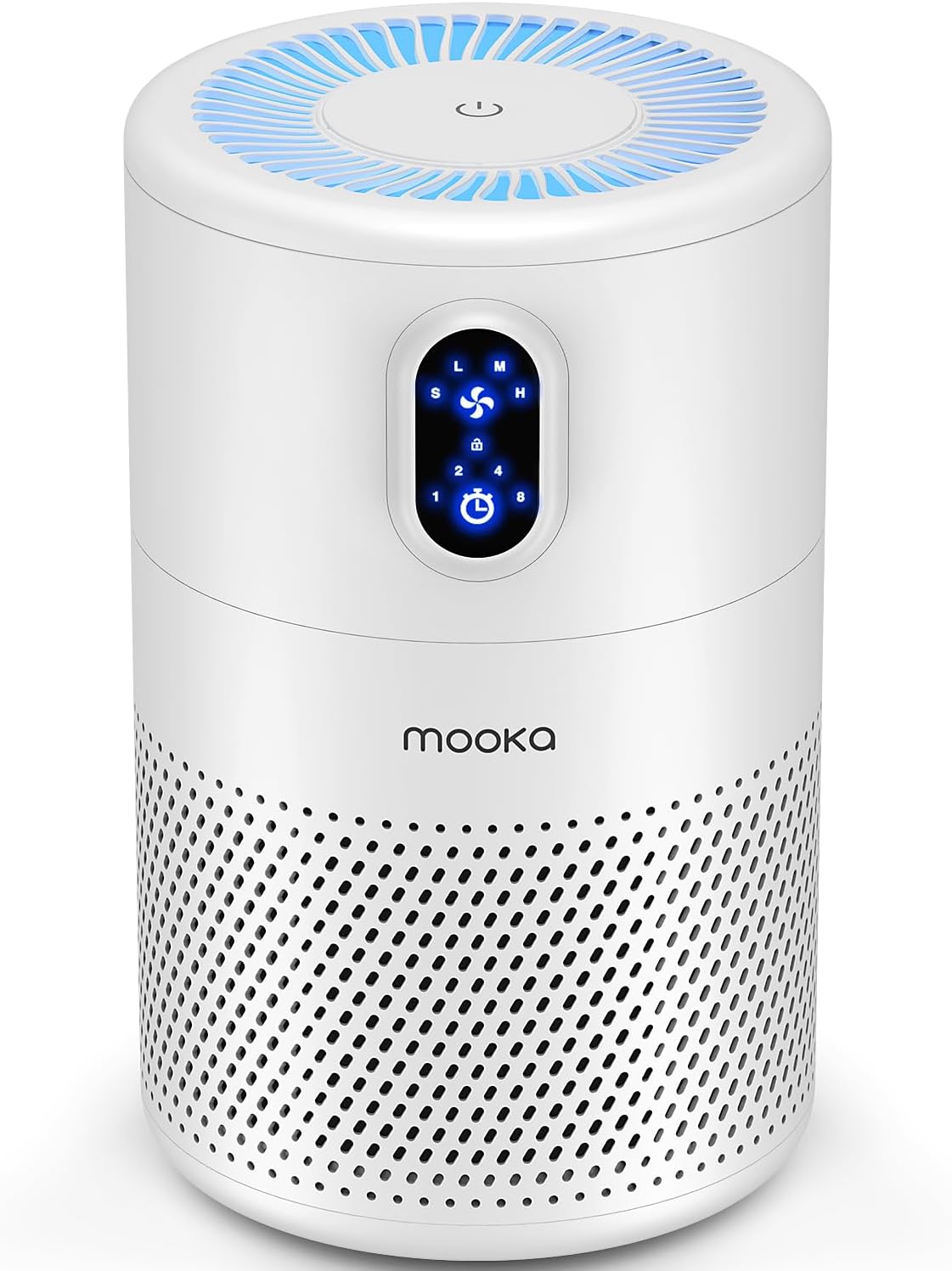
| Effective area | 1076 sq ft |
|---|---|
| Filter type | H13 true HEPA + activated carbon |
| Fan modes | 4 speeds |
| Timer settings | 1/2/4/8 hours |
The MOOKA B-D02L is a tabletop air purifier built around an H13 true HEPA filter plus an activated carbon layer and a washable pre-filter to capture pollen, pet dander, smoke, and particles down to 0.3 microns. It is sized and marketed for large spaces—MOOKA cites coverage up to 1076 sq ft with lower ACH in bigger rooms and faster air changes in smaller areas—so typical use is continuous run in living rooms, bedrooms, or offices to reduce airborne triggers. Controls include four fan speeds, four timer settings, a child lock, and a soft night light you can switch off, while the brushless motor keeps noise very low for sleep or study. Filters are user-replaceable and the company recommends changes every 3 to 6 months depending on conditions. Practical limitations are that effective clean-air delivery falls with room size (air changes per hour vary), replacement filters are required, and the unit is compact so performance will be strongest in medium rooms or when paired with good placement rather than relying on a single unit for very large open plans.
Best for: Buyers who prioritize practical, quiet air cleaning for allergy or asthma triggers and want a straightforward, low-maintenance purifier for bedrooms, living rooms, or offices.
Less Ideal for: Homes needing a single device to fully service very large open-plan spaces or whole-house filtration should consider larger or multiple units and HVAC-integrated solutions instead.
- H13 true HEPA plus activated carbon and pre-filter for particle and odor removal
- Low-noise brushless motor suitable for bedrooms and study
- Multiple fan speeds and timers for flexible scheduling and energy saving
- Child lock and simple top controls make it easy to operate safely
- Coverage and air changes per hour drop in very large open areas so single-unit performance can be limited
- Replacement filter required every 3–6 months depending on environment
Verdict: A quiet, practical H13 HEPA purifier with timers and child lock that is a solid choice for reducing asthma triggers in bedrooms and medium living spaces.
FULMINARE H13 HEPA Air Purifier

| Filter type | H13 HEPA |
|---|---|
| Recommended room size | Up to 215 ft² (20 m²) |
| Noise level (low) | Around 24 dB |
| Timers | 2, 4, 8, 10, 12 hours |
The FULMINARE H13 is a small-room air purifier built around an H13 true HEPA filter and a 360° outlet that the maker says refreshes air up to five times per hour in rooms up to about 215 sq ft. It operates on multiple fan speeds including a near-silent sleep mode that the company rates at roughly 24 dB, which makes it suitable for bedrooms and nurseries. The unit includes an independent night light and five preset timer options for 2 to 12 hours, and the plug-in power design keeps it running without batteries. Practical benefits include straightforward setup, portability for moving between office and bedroom, and a replaceable filter system so you can maintain filtration over time. Limitations are the small-room coverage—it is not intended for whole-house use—and the manufacturer recommends replacing the filter regularly, which adds ongoing cost. The compact design also means fewer advanced features such as app control or air-quality sensing found on higher-end models.
Best for: Buyers looking for an affordable, quiet HEPA purifier for a bedroom, nursery, or small office who prioritize simple, reliable particle filtration and low-noise sleep performance.
Less Ideal for: People needing whole-home air cleaning, advanced connectivity, or built-in air-quality monitoring should consider larger or feature-rich models instead.
- H13 true HEPA filter captures fine particles including smoke, pet dander, and pollen
- Near-silent sleep mode rated around 24 dB for use in bedrooms
- 360° air outlet with dual-channel design for even room circulation
- Independent night light and multiple timer settings for nighttime use
- Plug-in power with no battery required for continuous operation
- Rated coverage limited to about 215 sq ft, not suitable for large open areas
- Requires periodic replacement filters, creating ongoing maintenance cost
- Lacks smart features such as app control or built-in air quality sensors
Verdict: A budget-friendly, quiet H13 HEPA purifier that is a solid choice for cleaning bedroom or small-room air for asthma-sufferers who need reliable particle removal without bells and whistles.
Levoit Core 300-P

| Power Source | Corded Electric |
|---|---|
| Filter Type | 3 in 1 Filtration |
| Floor Area | 1073 square_feet |
| Noise Level | 24 db |
| Wattage | 56 watts |
The Levoit Core 300-P is a compact HEPA air purifier built for everyday home use, especially bedrooms and small to medium living spaces. It uses a three-stage original filter (pre-installed) including a True HEPA-grade element that Levoit reports captures 99.97% of 0.1–0.3 μm particles, and a 56W motor that delivers a measured CADR suitable for circulating air in rooms up to the stated coverage. Controls are touch-based with a sleep mode that lowers noise to about 24 dB and allows the display lights to be turned off for night use. Practical benefits include verified AHAM performance, CARB and ETL listings for safety, and a compact portable design that is easy to move between rooms. Limitations to consider are the lack of Auto Mode or smart connectivity on this specific model, which means fan speeds must be adjusted manually, and Levoit recommends using official replacement filters to maintain stated performance and lifespan. For allergy or asthma-focused users the unit provides effective fine-particle removal, but it requires routine filter changes and manual speed management to sustain peak performance.
Best for: Buyers who prioritize proven, safety-certified particle filtration and quiet night-time operation for allergy or asthma symptom management in home bedrooms or living rooms.
Less Ideal for: People who need automatic sensing and hands-off operation or integrated smart-home control should consider models with Auto Mode and connectivity instead.
- True HEPA-grade three-stage filter that targets 0.1–0.3 μm particulates
- AHAM verified CADR and safety certifications (CARB, ETL) for reliable performance
- Very quiet Sleep Mode (~24 dB) suitable for bedrooms
- Compact, portable design that is easy to relocate between rooms
- No Auto Mode or smart connectivity on this Core 300-P model
- Requires regular replacement with official Levoit filters to maintain performance
Verdict: A dependable, AHAM-verified HEPA purifier that delivers quiet, effective fine-particle removal for home allergy and asthma relief when you want straightforward manual control.
Levoit Core 200S-P
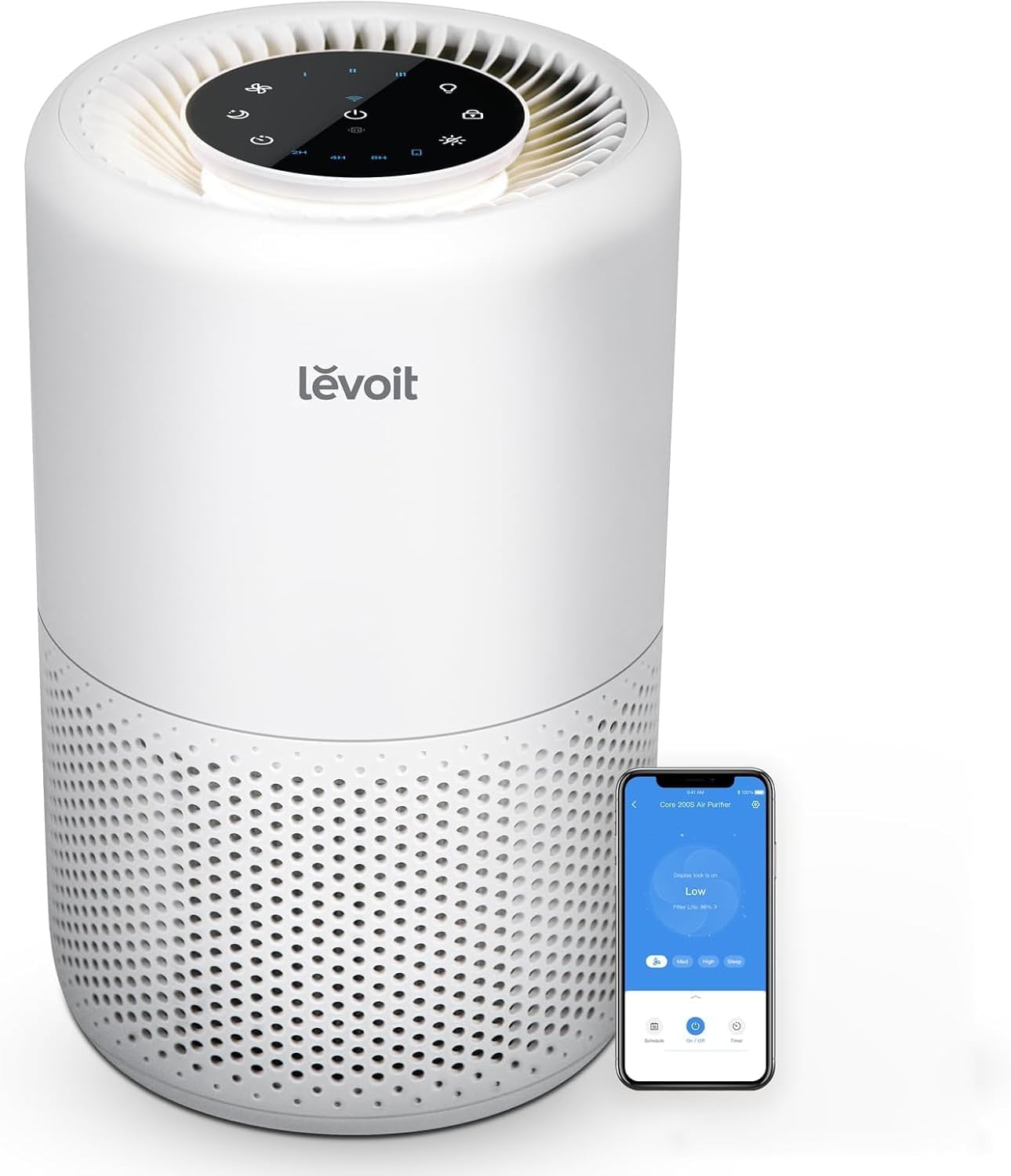
| Model | Core 200S |
|---|---|
| Room coverage | 140 ft² (4.8 air changes/hr) |
| Filtration | 3-stage (pre-filter, activated carbon, HEPA-grade) |
| Noise level | As low as 27 dB |
| AHAM | AHAM VERIFIDE |
The Levoit Core 200S-P is a small, smart HEPA air purifier meant for bedrooms, nurseries, and offices where space is limited but clean air matters. It draws air in 360 degrees through a three-stage system: a nylon pre-filter and activated carbon layer for large particles and odors, plus a main HEPA-grade filter that removes 99.97% of particles down to 0.1–0.3 microns. The unit is AHAM-verified and rated to refresh the air in a 140 ft² room almost five times per hour, so it can noticeably reduce pollen, dust, pet dander, and smoke in a single room. Smart features include app and voice control plus in-app filter-life monitoring, and operation is quiet enough for night use with noise down to about 27 dB and a display-off option. The purifier is lightweight and portable, but it is sized for single rooms rather than whole-home coverage, and replacement filters are a recurring cost. For people needing higher CADR for larger spaces, a bigger model would be required.
Best for: Buyers who prioritize proven, quiet HEPA filtration in a single bedroom or office and who want smart controls and visible social proof from an AHAM-verified, widely reviewed product.
Less Ideal for: Those who need to purify large open-plan living areas or an entire home should consider larger-capacity units instead.
- True HEPA-grade main filter captures 99.97% of 0.1–0.3 micron particles.
- Three-stage filtration including activated carbon reduces odors and fumes.
- AHAM-verified performance for consistent, tested air cleaning.
- Quiet night operation with noise as low as 27 dB and a display-off option.
- Smart and voice controls plus in-app filter life monitoring for convenience.
- Designed for single-room use only, not suitable for whole-house purification.
- Requires periodic replacement filters which add ongoing cost.
Verdict: A compact, AHAM-verified HEPA air purifier with smart controls that reliably cleans a single bedroom or office while running quietly.
VOOPNU HEPA Air Purifier DH-JH12

| Coverage | Up to 1,076 ft² (manufacturer test) |
|---|---|
| Filtration | H13 True HEPA triple-layer filter |
| Noise level | 22 dB (low setting) |
| Speeds | 3 fan speeds |
The VOOPNU DH-JH12 is a small, user-friendly air purifier built around an H13 true HEPA triple-layer filter and a 360° intake that the manufacturer says can clean about 250 ft² every 15 minutes (roughly 1,076 ft² per hour). It offers three fan speeds, a simple control panel and a quiet low setting rated near 22 dB for night use, plus an essential oil tray if you want mild scenting. Practical benefits include strong particulate capture for pet hair, pollen and smoke thanks to the H13 filter and a compact footprint that makes it easy to place in bedrooms or living rooms. The unit is certified to common safety and emissions standards, and replacement cycles are indicated at about 3–6 months depending on use. Limitations to note are the small physical size which implies a modest fan and possibly reduced performance in very large or heavily polluted spaces, and the need to run the purifier continuously for best results; filter replacements are an ongoing cost. For someone seeking straightforward operation and solid HEPA filtration in a small room, this model is a sensible choice.
Best for: Buyers who prioritize reliable, certified HEPA filtration and an easy, low-noise user experience for bedrooms or medium living spaces and want a low-friction, reliable appliance.
Less Ideal for: People needing to continuously purify very large open-plan homes or heavily polluted environments should choose a larger, higher-CADR unit instead.
- H13 true HEPA triple-layer filter captures 99.97% of fine particulates
- 360° surround air intake for more even room circulation
- Very quiet low-speed operation suitable for bedrooms (about 22 dB)
- Compact footprint that fits on desks or corners and is easy to move
- Simple one-touch controls and an essential oil tray for light scenting
- Small unit size may limit clean-air delivery in very large or heavily polluted rooms
- Requires regular filter replacements (manufacturer recommends 3–6 months)
- Best results depend on continuous operation rather than short intermittent use
Verdict: A compact, certified HEPA purifier that gives risk-averse buyers quiet, plug-and-play particulate filtration for bedrooms and medium rooms.
Choosing the Right HEPA Air Purifier for Asthma: Key Factors to Consider
Filter Type and True HEPA Rating
A true HEPA filter is essential for asthma because it reliably captures at least 99.97% of particles 0.3 microns in size. Knowing whether a unit uses a genuine HEPA element versus a HEPA-style or HEPA-type label affects real-world performance. Multi-stage filtration that includes a prefilter for large particles and an activated carbon layer for odors and VOCs adds value for homes where both particles and gaseous irritants contribute to symptoms.
Also check whether the manufacturer provides particle-size capture data or third-party certification. Filters with clear ratings give you confidence that the unit will reduce typical asthma triggers rather than only larger visible dust.
Clean-Air Delivery Rate (CADR) and Air Changes
CADR indicates how quickly a purifier can remove specific pollutants from the air and is directly relevant to how well it reduces triggers in a room. For asthma management, aim for a unit whose CADR and airflow provide multiple air changes per hour in the rooms where you spend the most time. A higher CADR shortens the time airborne particles remain suspended and lowers exposure peaks.
Consider the typical room size and how many hours the purifier will run. For bedrooms, portable living rooms, or nurseries, match the purifier's recommended coverage to your actual square footage rather than relying on vague "suitable for" claims.
Noise and Nighttime Use
Many people need continuous air cleaning, including overnight. Noise levels matter because users are less likely to run a unit on high speed if it disturbs sleep. Look for models with quiet or sleep modes and check decibel ratings when available. A low-noise purifier on a medium setting that still provides decent CADR can be more effective overall than a loud unit that runs rarely.
Also consider fan speed steps and whether the unit offers an automatic mode that balances airflow and sound based on detected particle levels.
Maintenance, Filter Life, and Operating Cost
Filter replacement frequency and ease directly affect long-term effectiveness. A unit that is difficult to open or uses proprietary, expensive filters may reduce the chance of timely maintenance. Check estimated filter life in months or hours of run time and whether filters are readily available. Also factor in energy consumption for continuous use; energy-efficient models can lower operating cost while running 24/7 if needed.
Clear filter-replacement indicators and straightforward filter changes reduce the chance of running a purifier with degraded performance.
Airflow Pattern and Placement Flexibility
How a purifier moves air through a room influences where it should be positioned. Some designs draw air from all sides and exhaust upward, which suits central placement, while others intakes from the front and exhausts back. Consider how furniture layout and room shape will affect circulation. A unit that performs well when placed against a wall or in a corner is useful for small bedrooms.
Also evaluate whether the purifier is portable enough to move between rooms, and whether its airflow pattern minimizes dead zones where particles can linger.
Matching Purifier Size to Your Space
Select a purifier based on the square footage of the room where it will run most of the time. A unit rated for a larger room will perform more effectively in an oversized space than one rated only for small rooms.
When calculating coverage, factor in ceiling height. Rooms with higher ceilings require more airflow to achieve the same air changes per hour. For bedrooms and living rooms, aim for at least 4 to 6 air changes per hour when managing asthma triggers.
- Measure floor area and multiply by ceiling height to estimate volume.
- Use CADR and manufacturer coverage to estimate expected air changes.
- Consider using multiple smaller units if you need coverage in several rooms.
Placement and Operation Tips for Best Results
Place the purifier where airflow is unobstructed and close to the typical breathing zone. Avoid hiding units behind furniture or tucking them into tight corners where intake or exhaust is blocked.
Run purifiers continuously if possible, because intermittent operation allows particle levels to rebound. Use timers or auto modes to conserve energy while maintaining protection during periods of highest exposure.
- Keep several feet of clearance around intake and exhaust vents.
- Run higher fan speeds during peak allergen times, such as when vacuuming.
- Use bedroom-focused operation overnight to reduce night-time symptom triggers.
Managing Odors and Gaseous Irritants
Asthma symptoms are sometimes triggered by airborne gases or strong odors that HEPA alone will not remove. Models that include activated carbon or other adsorbent layers help reduce volatile organic compounds and cooking or pet odors, which can be beneficial in combination with HEPA filtration.
If you live with strong odor sources, consider a purifier with replaceable carbon inserts and check how often those inserts need replacement. Keep in mind that carbon capacity is finite and performance declines as the media becomes saturated.
- Use range hoods and ventilation in combination with purifiers to reduce gaseous load.
- Replace carbon inserts per manufacturer guidance for continued effectiveness.
Using Monitors and Auto Modes Effectively
Air quality sensors and automatic modes can simplify maintaining cleaner air. Reliable particle sensors adjust fan speed based on measured concentrations, which helps balance noise and energy use with effective cleaning.
Not all sensor readings are equivalent. Look for units that respond quickly to spikes in particles and provide an understandable readout or indicator rather than vague color codes.
- Verify sensor responsiveness by observing changes after common activities like cooking.
- Use auto mode for everyday operation and manual boost during high-exposure tasks.
Allergen Management Beyond Purification
Air purifiers are only one part of an asthma management plan. Regular cleaning, minimizing indoor sources of allergens, and controlling humidity all help reduce the airborne load. Vacuuming with a HEPA-filter vacuum and washing bedding in hot water reduce settled dust that becomes airborne.
Maintain indoor humidity between 30 and 50 percent to discourage dust mites and mold growth. In many homes, a combination of humidity control and targeted air purification yields the best symptom reduction.
- Combine vacuuming, washing bedding, and high-efficiency filtration for layered protection.
- Address indoor moisture issues promptly to prevent mold triggers.
How We Chose the Best HEPA Air Purifier for Asthma
We focused on criteria that matter to people managing asthma in daily life. First, filtration efficiency was a priority, favoring true HEPA capture of particles down to 0.3 microns and clear information about filter stages and prefilters. Second, clean-air delivery rate and room coverage were evaluated to ensure the unit can move enough air to reduce pollutant concentrations in realistic room sizes. Third, noise levels were considered because persistent loud operation can discourage continuous use, especially overnight. Fourth, ease of maintenance and filter replacement accessibility were assessed to keep upkeep straightforward for consistent protection. Finally, we considered energy use and runtime features like programmable schedules or auto modes that help maintain indoor air quality without excessive operating cost. We excluded units that only claim HEPA-style or ''HEPA-like'' performance without verifiable particle capture ratings. Cheap one-off filters and single-use consumer gadgets that lack adequate airflow or replaceable HEPA cartridges were not considered. The final shortlist balances certified filtration, adequate airflow for intended room sizes, usable controls, and practical maintenance requirements.
Our full evaluation process is outlined in our review methodology.
FAQ
Will a HEPA air purifier eliminate asthma attacks?
A HEPA air purifier reduces airborne particles that commonly trigger asthma, but it cannot guarantee elimination of attacks. Asthma is influenced by multiple factors including allergens, infections, and individual sensitivity. Use a purifier as part of a larger management plan that includes medication and trigger avoidance.
How often should I run a purifier if someone has asthma?
Continuous operation is recommended for the best reduction in airborne particles, especially in rooms where the person spends many hours. If continuous running is not feasible, run the purifier at higher speeds during peak exposure times and overnight in sleeping areas.
Do HEPA filters remove odors and chemicals?
True HEPA filters capture particles but do not remove most gases or odors. For odors and volatile organic compounds, choose a unit with activated carbon or another adsorbent stage designed for gaseous contaminants.
How loud are HEPA air purifiers when used overnight?
Noise varies by model and fan speed. Many purifiers have a sleep or low-noise setting that is quiet enough for overnight use while still providing moderate filtration. Check decibel ratings and choose a unit with a proven quiet mode if sleep disturbance is a concern.
How do I know when to replace the filter?
Most units include filter-replacement indicators or recommended replacement intervals in months or run-hours. Look for clear guidance on expected filter life and consider your household's pollution level, as heavier use or high particle loads may shorten filter lifespan.
Can I rely on built-in particle sensors to control the unit?
Built-in sensors are useful and often effective at adjusting fan speed for measured particle spikes. However, sensor accuracy varies, so observe real-world responsiveness and use manual boosts when you notice activities that produce particles.
Final Verdict
When choosing a HEPA air purifier for asthma, prioritize true HEPA filtration, adequate CADR for the rooms you use most, and a noise profile you can live with on continuous operation. Consider added activated carbon if odors or gases are a concern, and factor in filter replacement frequency and ease of maintenance. Balance coverage and portability to ensure the purifier is used consistently where it matters most. Focusing on these tradeoffs will help you choose a unit that meaningfully reduces airborne triggers and supports better daily breathing.