
Note: This article contains affiliate links. If you click on these links and make a purchase, we may earn a small commission at no extra cost to you. This helps support our research and content. Read our full affiliate disclosure here.
If wildfire smoke, cooking fumes, or tobacco odor is making your home uncomfortable, choosing the right budget air purifier for smoke can make a noticeable difference. At lower price points you still want a unit that captures fine particles, reduces visible haze, and keeps noise low enough for daily use. This guide shortlists seven top picks that balance filtration performance, quiet operation, and running cost for smoke-focused indoor air improvements. Below you will find concise evaluations, a clear breakdown of the criteria we used, and practical buying guidance to help you select the most suitable budget air purifier for smoke in your space.
Top Picks at a Glance
| Best Overall The best all-around choice for most situations | WINIX 5520 Air Purifier |  |
| Best Quality Built to a higher standard if you want something more solid | GermGuardian AC4825E Tower Air Purifier |  |
| Best Value The sweet spot between price and what you get | VOOPNU HEPA Air Purifier DH-JH12 |  |
| Best Budget The cheapest option that still gets the job done reliably | YLGNKIA Air Ionizer AP-105 |  |
| Top Rated A top-rated pick with lots of positive feedback | ECOSELF HAP609 Air Purifier |  |
| Most Popular A crowd favorite that many people choose with confidence | Levoit Core 300-P |  |
| Best Seller A high-volume bestseller chosen again and again | Levoit Core Mini-P |  |
WINIX 5520 Air Purifier
| Item model number | 5520 |
|---|---|
| AHAM verified coverage | 392 sq ft |
| PlasmaWave technology | Included |
| Wi‑Fi | Winix Smart App compatible |
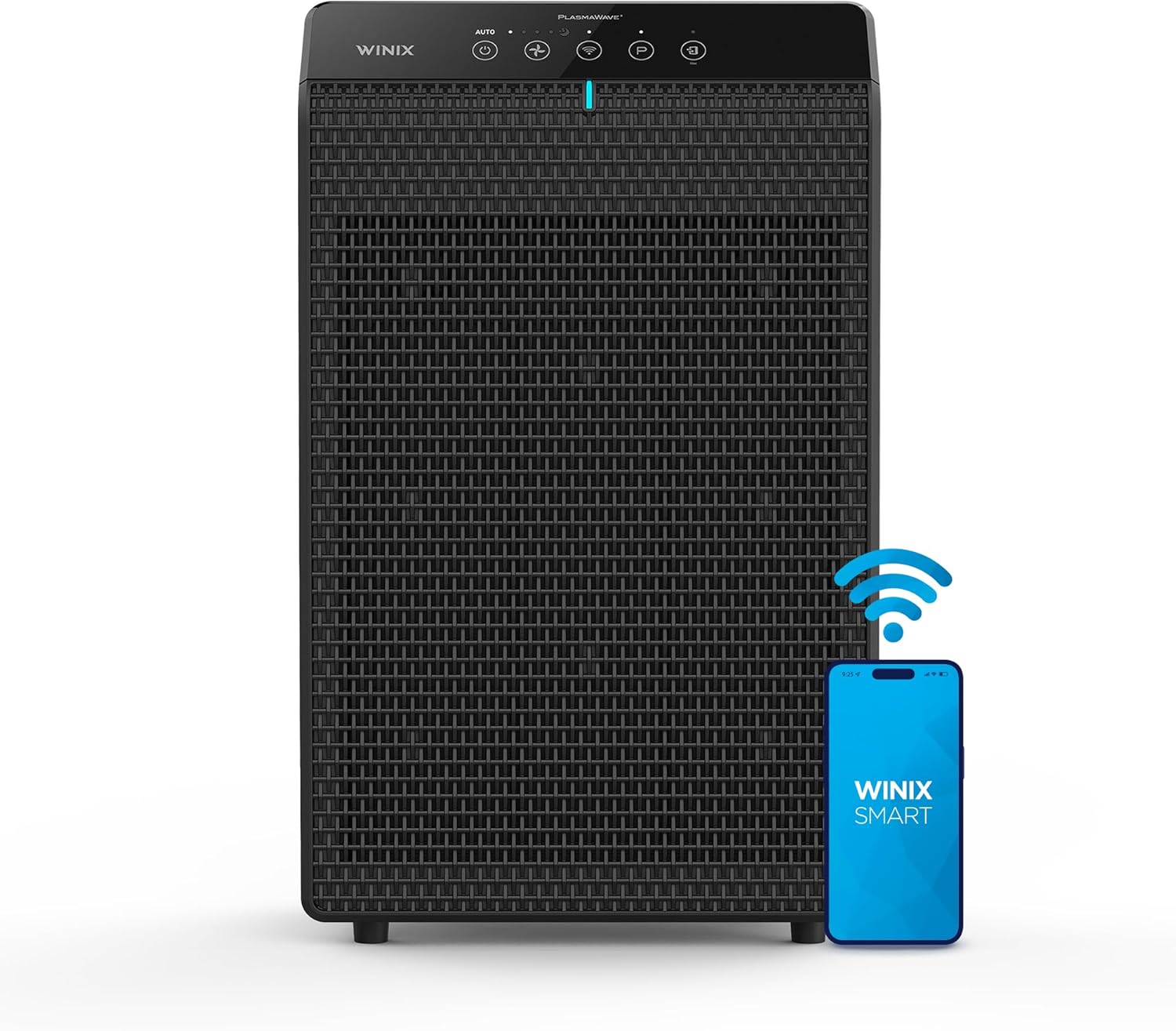
The WINIX 5520 is a four-stage air purifier built to handle smoke, pet dander, dust, and household odors in medium to large rooms. It combines a washable pre-filter, True HEPA filter that captures particles down to 0.01 microns, and an advanced carbon filter for VOCs and smells, with Winix PlasmaWave technology layered in for additional pollutant reduction. Real-time LED air quality feedback and smart sensors let the unit run in Auto Mode, adjusting fan speeds as conditions change, and a light-activated Sleep Mode keeps operation quiet at night. Wi‑Fi and the Winix Smart App provide remote monitoring and control when you want it. The practical benefits are strong cleanup performance for smoke and typical indoor odors, easy maintenance thanks to the washable pre-filter, and quiet low-speed operation suitable for bedrooms. Expect the unit to be larger and heavier than compact purifiers and to require periodic filter replacements to maintain peak performance, so factor ongoing filter costs into ownership.
Best for: Buyers who want a balanced, all-around purifier that handles smoke, odors, and allergens in medium to large rooms while offering smart controls and quiet night operation.
Less Ideal for: People seeking the smallest, most portable bedroom-only unit or those unwilling to budget for recurring filter replacements.
- True HEPA filtration captures very small particles down to 0.01 microns
- Activated carbon filter reduces VOCs, smoke and household odors
- Smart sensors with Auto Mode and LED air quality indicator for hands-off operation
- Washable pre-filter reduces larger debris and extends main filter life
- Wi‑Fi and Winix Smart App support remote monitoring and control
- Larger physical footprint and weight compared with compact bedroom purifiers
- Requires periodic paid filter replacements to sustain rated performance
Verdict: A feature-rich, smart-capable purifier that balances strong smoke and odor removal with quiet, automated operation for medium to large rooms.
GermGuardian AC4825E Tower Air Purifier

| Room coverage claim | 153 sq. ft. every 12.5 minutes; up to 743 sq. ft. hourly |
|---|---|
| Filter type | True HEPA with activated carbon pre-filter |
| Fan speeds | 3 speeds plus sleep mode |
| Optional feature | UV-C light |
| Replacement filters | GermGuardian Filter B (multiple variants) |
The GermGuardian AC4825E is a compact tower purifier that combines a True HEPA filter, activated carbon pre-filter, and optional UV-C sanitizer to reduce dust, pollen, pet dander, odors, and some airborne particles. It is meant to run continuously in bedrooms, living rooms, or basements and is adjustable with three fan speeds including a quiet sleep mode for nighttime use. The unit's HEPA media captures particles down to 0.1 microns at initial efficiency and the carbon layer helps reduce cooking and pet smells and some smoke-related scents. Its claimed circulation rates cover a small bedroom every 12.5 minutes and larger spaces up to about 743 sq ft once per hour, so it can make a noticeable difference in smoke-prone rooms when run on higher speeds. Maintenance is straightforward with replaceable GermGuardian Filter B cartridges and an optional UV-C bulb. Expect typical trade-offs for a budget tower purifier: it is not as powerful or fast at heavy smoke removal as larger, higher-CADR machines and effectiveness depends on continuous operation and timely filter replacement.
Best for: Buyers who want an affordable, space-saving purifier that meaningfully reduces particulate smoke and allergens in bedrooms or living areas and are willing to run it continuously and maintain filter changes.
Less Ideal for: People needing rapid, heavy-duty smoke or VOC removal for large open-plan spaces or those who expect instant clearing from dense wildfire or heavy indoor smoke should consider higher-capacity units instead.
- True HEPA filter captures fine particles down to 0.1 microns
- Activated carbon pre-filter reduces common household odors and some smoke scents
- Three fan speeds including a quiet sleep mode for overnight use
- Compatible with several genuine GermGuardian replacement filters and UV-C bulbs for easy maintenance
- Not as high CADR or smoke-clearing speed as larger, premium purifiers
- Optional UV-C reduces certain microbes but does not replace filtration for gases or VOCs
Verdict: A compact, budget-friendly tower purifier that reliably reduces smoke particles and common odors in bedrooms and small living spaces when run continuously.
VOOPNU HEPA Air Purifier DH-JH12

| Coverage claim | 1,076 ft² (per hour) / 250 ft² per 15 min (laboratory tested) |
|---|---|
| Filter type | H13 triple-layer HEPA with activated carbon options |
| Noise level | 22 dB (lowest) |
This compact VOOPNU purifier uses a 360° intake and an H13 triple-layer filtration system to capture particles and reduce pet odors, pollen, and smoke in everyday spaces. It is designed for simple one‑tap operation and a quiet low‑noise mode down to 22 dB, which makes it suitable for bedrooms or workspaces where minimal disruption matters. The unit includes an essential oil tray for light scenting and offers certified safety compliance with DOE, ETL, FCC, CARB, CE, and ROHS approvals. VOOPNU rates the purifier to clean about 250 ft² every 15 minutes, translating to broader coverage over time in open areas. Practical considerations: the small footprint makes placement flexible but also indicates this is best for single rooms rather than whole-house use, and the manufacturer recommends continuous operation for best results which affects energy use and filter replacement cadence. Replacement filters are proprietary and sold in standard or pet-care editions to optimize performance for different needs.
Best for: Buyers who want a no‑fuss, space-saving purifier for bedrooms or home offices and prioritize low noise and simple controls while still addressing smoke and allergens.
Less Ideal for: People needing whole-house purification or rapid cleaning of large open areas should consider higher-capacity units instead.
- H13 triple-layer HEPA filtration captures 99.97% of fine particles for better indoor air quality
- 360° intake design for even room circulation from a compact package
- Very quiet operation down to 22 dB suitable for night use
- Easy one‑tap controls simplify everyday operation
- Essential oil tray adds optional light fragrance
- Small footprint limits peak effectiveness to single rooms rather than large open plans
- Manufacturer recommends continuous operation which increases filter replacement frequency and energy use
Verdict: A quiet, compact HEPA purifier that delivers practical smoke and particle removal for single rooms at a budget-friendly size.
YLGNKIA Air Ionizer AP-105

| Item model number | AP-105 |
|---|---|
| Product Dimensions | 3.94 x 2.56 x 2.56 inches; 2.88 ounces |
| Date First Available | April 13, 2026 |
This tiny plug-in air ionizer is a low-cost, no-friction option for improving room air by releasing negative ions that help settle smoke, dust, and odor particles. It plugs directly into a standard outlet and runs quietly enough for overnight use, so you can leave one in a bedroom, office, or hotel room without distraction. The filterless design means no replacement filters or recurring maintenance costs, and the unit is light and portable for travel or moving between rooms. Practical limits: because it is a small ionizer it does not provide the room circulation or particulate capture of a HEPA purifier, and best results come from placing a unit in the room where smoke or odors originate rather than trying to clean a whole house. For budget-minded buyers who need a silent, compact way to reduce smoke and odors in single rooms, this is a convenient, low-maintenance choice.
Best for: Buyers looking for an inexpensive, low-maintenance way to reduce smoke and odors in single rooms or small spaces and who prioritize quiet, portable operation over high-efficiency particulate removal.
Less Ideal for: People seeking strong particulate removal for large rooms or those who require certified HEPA filtration for allergies or heavy smoke should consider a true HEPA air purifier instead.
- Plug-and-play design fits standard outlets with no installation
- Filter-free operation eliminates replacement costs and maintenance
- Very quiet operation suitable for overnight use
- Compact, lightweight and easy to move between rooms or travel with
- Does not actively filter particles like HEPA units and has limited coverage per room
- Effectiveness depends on placement and it may take time to reduce heavy smoke
Verdict: A very affordable, ultra-quiet plug-in ionizer that reduces smoke and odors in single rooms without filter costs, ideal for budget-conscious buyers who need a portable, low-maintenance solution.
ECOSELF HAP609 Air Purifier

| Model number | HAP609 |
|---|---|
| PM2.5 display | Yes |
| Noise level (Sleep) | 20 dB |
| Timer | 1–24 hours |
The ECOSELF HAP609 is a compact HEPA air purifier intended to improve indoor air in bedrooms and small to medium living spaces. It draws air from all directions with a 360° intake and uses a three-stage filtration system to reduce dust, smoke, pollen, and pet dander. A built-in PM2.5 sensor continuously monitors air quality and the unit shifts fan speeds automatically in Auto mode, while a color ring and numeric display make air conditions easy to read at a glance. Practical features include a full 1–24 hour timer and a Sleep mode that disables lights and drops sound to about 20 dB for overnight use. The purifier is easy to place thanks to its slim footprint, and its automatic response to pollution spikes is helpful for homes with intermittent smoke or pet activity. Limitations are its focus on single-room performance rather than whole-house coverage and the lack of advanced smart-home integrations, so buyers should match capacity to room size and replace filters on schedule to maintain performance.
Best for: Buyers who prioritize a reliable, no-frills purifier that responds automatically to smoke and airborne particles and who need a quiet nighttime option for bedrooms or small living areas.
Less Ideal for: People looking to purify whole floors or large open-plan areas or those who require app control and remote scheduling features.
- 360° air intake for more even room coverage
- Built-in PM2.5 sensor with numeric readout and color ring for instant air-quality feedback
- Auto mode adjusts fan speed automatically when pollution rises
- Very quiet Sleep mode with lights off and 20 dB operation
- 1–24 hour timer for scheduled use
- Designed for single-room use so it may not be effective in large open-plan spaces
- No listed Wi-Fi or smart-home connectivity for remote control
Verdict: A dependable, quiet HEPA purifier that automatically senses and reacts to smoke and particles, making it a strong budget pick for bedrooms and small rooms.
Levoit Core 300-P

| Power Source | Corded Electric |
|---|---|
| Filter Type | 3 in 1 Filtration |
| Floor Area | 1073 square_feet |
| Noise Level | 24 db |
| Wattage | 56 watts |
The Levoit Core 300-P is a compact, plug‑in air purifier built around a three‑stage HEPA-grade filter and a 56W motor that delivers strong airflow for its size. It is typically used in bedrooms, living rooms, or home offices to reduce smoke, pollen, dust, pet dander, and household odors; the AHAM-verified CADR ratings make it effective at cycling air in typical rooms and it claims near 99.97% capture for 0.1–0.3 μm particles. Controls are touch-based with a sleep mode that drops noise to about 24 dB and an option to turn off display lights for undisturbed nights. The unit is portable and energy efficient and carries safety certifications useful for home use. Limitations include the lack of Auto Mode or smart connectivity on this model, which means fan speeds must be adjusted manually, and it relies on Levoit genuine filters for the stated CADR and performance. For budget-minded buyers focused on smoke removal, it balances proven filtration performance with quiet operation, though users who want app control or automatic sensing should consider a different model.
Best for: Buyers who want a budget-friendly, well-tested purifier that quietly reduces smoke and fine particulates in bedrooms and living spaces and who value independent certifications and broad social proof.
Less Ideal for: Those who need smart features, automatic air-quality sensing, or enterprise-level coverage for very large open areas should choose a higher-end, connected model instead.
- True HEPA-grade three-stage filter with 99.97% efficiency for 0.1–0.3 μm particles
- AHAM-verified CADR and certifications (CARB, ETL) supporting reliable performance and safety
- Very quiet Sleep Mode at about 24 dB suitable for bedrooms
- Portable, compact design that fits small to medium rooms and includes a timer and filter indicator
- No Auto Mode or smart connectivity on this Core 300-P model so fan speed must be changed manually
- Best performance depends on using Levoit original replacement filters
- Coverage claims are based on Levoit testing with original filters and may vary in smoky conditions
Verdict: A quiet, AHAM‑verified HEPA purifier that reliably reduces smoke and fine particles on a budget for bedrooms and living rooms.
Levoit Core Mini-P
| Rated Power | 7W |
|---|---|
| Noise Level | 27-45dB |
| Model | LAP-C161-WUS |
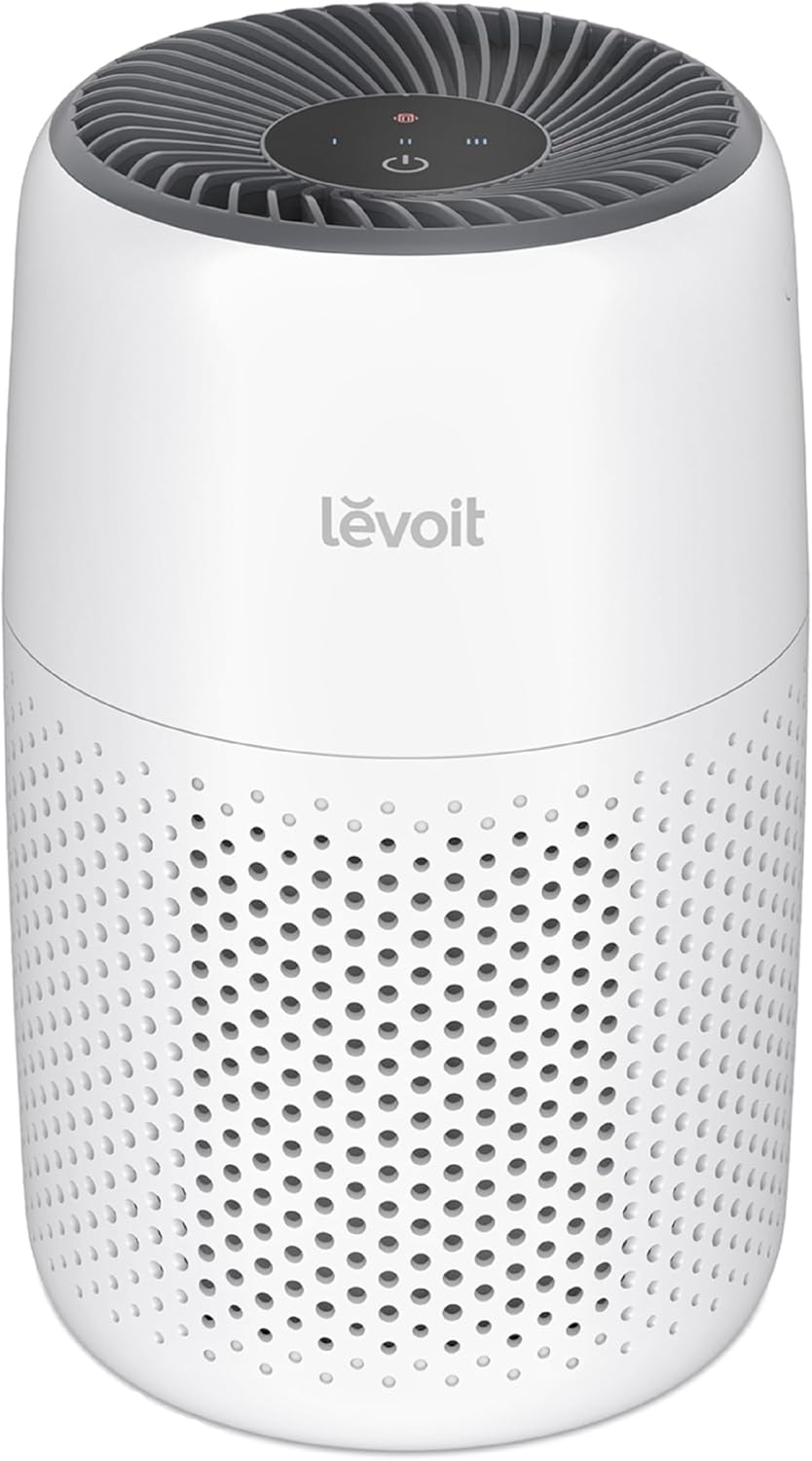
The Levoit Core Mini-P is a small, low-power air purifier intended for bedrooms, dorms, and desktops where space and noise matter. It uses a pre-filter and main HEPA-grade filter to capture lint, pet dander, dust and smoke-sized particles while an included fragrance sponge lets you add a couple of drops of scent for mild aromatherapy. With a rated power of 7W and noise between 27 and 45 dB, it is unobtrusive overnight and has a sleep mode and auto-off display to reduce disturbance. Practical benefits include easy placement on a bedside table, low energy use, and simple filter replacement with Levoit genuine parts. Important limitations are its small coverage: this unit is best for localized use rather than whole rooms or open-plan living areas, and the fragrance feature requires careful dosing to avoid damaging internal parts. For buyers focused on quiet, budget smoke reduction in a small space, it delivers sensible performance for the size.
Best for: Buyers who want a quiet, energy-efficient purifier for a bedroom, dorm, or small office and prioritize reliable basic filtration without expensive features.
Less Ideal for: People needing to remove heavy smoke or cover larger rooms should choose a higher-capacity purifier built for whole-room use.
- Compact footprint suitable for bedside, desk, or small rooms
- Quiet operation with sleep mode and 27–45 dB noise range
- Low power draw (7W) for continuous use
- Pre-filter plus main filter captures pet dander, dust, and smoke-sized particles
- Not designed to purify large rooms or open living areas
- Aromatherapy sponge can damage plastic if overfilled and requires careful use
Verdict: A quiet, energy-efficient small-room purifier that gives reliable basic smoke and allergen filtration at a budget-friendly size.
Choosing the Right Budget Air Purifier for Smoke: Key Factors to Consider
Filtration Efficiency And Filter Type
How effectively a purifier removes fine smoke particles determines how quickly indoor air clears. Smoke contains PM2.5 and smaller particles that drive health and visibility concerns, so look for true HEPA or equivalent filters rated to capture 99.97% of particles down to 0.3 microns, plus a prefilter to trap larger debris.
A dedicated activated carbon layer or granular carbon media helps reduce smoke odor and volatile organic compounds. If a unit lacks sufficient carbon content it may lower particle counts but still leave a smoky smell in the room. Consider filter specifications and whether replacement carbon media is available separately.
Room Size And Clean Air Delivery Rate (CADR)
Match the purifier's recommended room coverage or CADR to the space where you spend the most time. CADR values for smoke or fine particles indicate how many cubic feet per minute of clean air the unit can deliver; higher numbers clear smoke faster in larger rooms.
Undersizing a purifier leads to long runtime and poor results. For open-plan living areas or larger bedrooms, choose a unit whose CADR comfortably exceeds the room's volume to achieve several air changes per hour when smoke is present.
Noise Levels And Usability
Noise matters because people are more likely to run a purifier continuously if it stays quiet during daily activities and sleep. Manufacturers often list decibel levels at different fan speeds; prioritize low-noise performance at the speeds needed to control smoke. A unit with a true low or night mode and simple controls improves adoption.
Also consider the physical footprint and portability. Lightweight units with handles or compact footprints are easier to move between rooms as smoke sources change.
Filter Lifetime And Ongoing Cost
Replacement filters are the main ongoing expense for budget purifiers. Determine expected filter life under smoky conditions and the cost or availability of replacement HEPA and carbon cartridges. Some budget units bundle replaceable prefilters that extend main filter life, reducing total ownership cost.
Energy consumption also affects long-term cost. Look for ENERGY STAR or low-wattage operation, especially if you will run the purifier for many hours during smoke events.
Power And Operating Modes
A purifier's fan power and available operating modes affect how quickly it clears smoke and how efficiently it runs. Units with multiple fan speeds, automatic pollution sensing, or timed scheduling let you balance speed, noise, and energy use.
Automatic modes tied to particle sensors can be helpful during unpredictable smoke events, but confirm the sensor type and responsiveness since some low-cost sensors are less sensitive to fine smoke.
Build Quality And Filter Access
Sturdy construction and easy filter access make routine maintenance simpler. Check how filters are secured and whether the housing seals well so air is forced through the filter media rather than bypassing it.
A clear filter-replacement indicator and straightforward filter change process reduce the chance of user error and ensure the purifier performs as expected over time.
How Smoke Differs From Other Indoor Pollutants
Smoke is a complex mix of fine particulate matter, gases, and odorous compounds that behave differently than common household dust. Particle size distribution in smoke skews much smaller than coarse dust, so particle-capturing filtration is the primary defense. Odors and some volatile compounds require adsorption media such as activated carbon to meaningfully reduce smell. Understanding this distinction helps you pick a unit that addresses both particles and smells rather than relying on a single technology.
- Smoke contains high concentrations of PM2.5 and ultrafine particles.
- Effective smoke control needs both particle filtration and carbon-based adsorption.
- Ionizers or ozone-generating devices do not substitute for HEPA plus carbon in smoke scenarios.
Where To Place Your Purifier For Best Smoke Removal
Placement affects how quickly a purifier reduces visible smoke and odor. Position the unit where smoke frequently enters the home or where you spend the most time—near a window, doorway, or the primary living area. Give the intake and outlet at least a few feet of clearance from walls and furniture so airflow is not blocked. In multi-room smoke events, running one appropriately sized purifier in the main living area plus smaller units in bedrooms yields better perceived results than scattering undersized units.
- Center the unit in the room when possible, or place near the pollution source.
- Keep at least 1 to 2 feet of clearance around intakes and outlets.
- Avoid corners and behind heavy furniture that restricts airflow.
Managing Odor Versus Particulate Removal
Reducing visible smoke and particles is primarily a matter of capturing fine particulate matter. Removing odor and gaseous components requires adsorption materials and sometimes higher carbon volume. For persistent smells, run the purifier on a higher setting for longer periods and prioritize units that include dense carbon media or replaceable carbon inserts. If odor is your primary concern rather than airborne particles, consider filter change frequency and whether supplementary odor absorbers or source control are needed alongside the purifier.
- Prioritize carbon media if odor removal is essential.
- Longer runtime at moderate speeds often helps reduce lingering smells.
- Combine source control—like sealing windows—with filtration for best results.
Using Auto Modes And Sensors During Smoke Events
Auto modes that ramp fan speed in response to rising particle counts can make purifiers easier to live with during unpredictable smoke episodes. However, sensor accuracy varies across entry-level models. If auto mode is important, favor units with reliable particle-sensing technology and a clear display of air-quality readings so you can confirm responsiveness. When sensors are sluggish or insensitive, manually increasing fan speed during visible smoke will deliver better short-term results.
- Look for visible or numeric air-quality feedback when relying on auto modes.
- Confirm that the unit responds quickly to increased smoke or particle spikes.
- Use manual high fan settings when you need rapid clearing.
Maintaining Performance Over Time
Regular cleaning of prefilters and timely replacement of HEPA and carbon modules is essential to sustain smoke-removal performance. In smoky environments filters will load faster, shortening service life. Keep a replacement schedule and check seals to prevent bypassing. Store spare filters if you expect prolonged smoke seasons so you can swap them quickly when performance drops.
- Clean prefilters monthly in smoky conditions.
- Replace main filters according to manufacturer guidance or sooner if clogged.
- Monitor airflow and odor as informal indicators of filter condition.
How We Chose the Best Budget Air Purifier for Smoke
Our selection focused on finding budget air purifiers that deliver measurable reductions in smoke-related particulates and odor without adding significant noise or maintenance cost. We prioritized units with true HEPA or equivalent multi-stage filtration capable of capturing fine particles under 2.5 microns, along with an activated carbon stage or comparable adsorption media to reduce volatile compounds and smoke smell. CADR or stated clean-air delivery performance for smoke or fine particles was used as a proxy for real-world clearing speed. Noise output at typical operating speeds and available low-speed modes were evaluated to ensure practical use in living spaces and bedrooms. Energy use and replacement filter availability were reviewed to estimate ongoing ownership cost. We excluded units that rely solely on electrostatic or ion-only technology without a particle-capturing HEPA stage, since those do not reliably remove fine smoke particles. Very large commercial units and specialty industrial systems were also excluded to keep the list relevant to home budgets and typical room sizes.
Our full evaluation process is outlined in our review methodology.
FAQ
Can a budget air purifier really remove wildfire or cigarette smoke?
Often yes. Budget purifiers with a true HEPA stage and sufficient activated carbon can remove fine smoke particles and reduce odor. Effectiveness depends on unit sizing, amount of carbon media, and runtime.
How large a room can a budget purifier cover for smoke?
It depends on CADR or recommended room size. Budget units vary, so choose a model with a CADR suited to the room volume to achieve multiple air changes per hour during smoke events.
How often will I need to change filters during a smoke season?
Filters typically need replacement more frequently when exposed to heavy smoke. Expect shorter lifetimes than normal use; plan for filter checks every few weeks and replacements based on visible loading or manufacturer intervals.
Are ozone generators or ionizers good for smoke?
No. Ozone generators and ion-only devices do not reliably remove fine smoke particles and can produce harmful ozone. For smoke, particle-capturing filtration plus carbon adsorption is the recommended approach.
Will running a purifier on high remove smell faster?
Yes. Higher fan speeds circulate more air through the carbon and HEPA media, accelerating both particle capture and odor adsorption. Balance noise and energy use when deciding how long to run high mode.
Final Verdict
When shopping for a budget air purifier for smoke, prioritize true HEPA filtration paired with meaningful activated carbon media, and make sure the unit's CADR matches the room you plan to protect. Expect tradeoffs between cost, filter longevity, and noise; a slightly larger unit that runs at lower fan speeds often outperforms smaller, louder models. Choose a purifier you will actually run during smoke events: check filtration specs, confirm filter availability, and consider noise and energy use to ensure sustained performance and fewer surprises during high-smoke periods.