
Note: This article contains affiliate links. If you click on these links and make a purchase, we may earn a small commission at no extra cost to you. This helps support our research and content. Read our full affiliate disclosure here.
If you want cleaner indoor air without spending a fortune, a budget HEPA air purifier can capture dust, pollen, pet dander, and many airborne particles that aggravate allergies. Choosing the right low-cost unit matters because cheap models vary widely in true HEPA filtration, CADR, and ongoing energy and filter expenses. This guide shortlists six well-rounded options that balance real HEPA performance with low operating cost and manageable noise. Below we outline how we evaluated each purifier and what features matter most for affordable whole-room or bedroom use, so you can pick the model that fits your space and lifestyle.
Top Picks at a Glance
| Best Overall The best all-around choice for most situations | GermGuardian AC4825E 22" Tower |  |
| Best Value The sweet spot between price and what you get | MOOKA B-D02L Air Purifier |  |
| Best Budget The cheapest option that still gets the job done reliably | FULMINARE H13 HEPA Air Purifier |  |
| Top Rated A top-rated pick with lots of positive feedback | ECOSELF HAP609 Air Purifier |  |
| Most Popular A crowd favorite that many people choose with confidence | Levoit Core Mini-P |  |
| Best Seller A high-volume bestseller chosen again and again | Levoit Core 300-P |  |
GermGuardian AC4825E 22" Tower

| Model number | AC4825E |
|---|---|
| Room coverage | 153 sq. ft. (air turnover every 12.5 min) |
| Filter type | True HEPA with activated carbon pre-filter |
| Fan speeds | 3 speeds including sleep mode |
The GermGuardian AC4825E is a compact tower air purifier that uses a True HEPA filter, an activated carbon pre-filter, and an optional UV-C bulb to clean household air. It is intended for everyday use in bedrooms, living rooms, basements, or offices and circulates air in a 153 sq ft room roughly every 12.5 minutes while still providing hourly turnover in larger spaces. Controls are simple with three fan speeds including a quiet sleep mode, so it can run continuously without much fuss. The activated carbon layer helps reduce cooking and pet odors, and the HEPA media captures very small particles down to 0.1 microns from air passing through the filter. Maintenance is straightforward because the unit accepts factory replacement Filter B cartridges and UV-C bulbs. Trade-offs are its basic control layout and single-intake tower design, which means it is best for point coverage rather than whole-house air cleaning and may be less powerful than larger or newer models with higher CADR ratings.
Best for: Buyers who want a reliable, easy-to-use purifier that improves indoor air quality in bedrooms or single rooms without complexity or advanced smart features.
Less Ideal for: Those seeking whole-house air cleaning, smart-home integration, or the highest CADR for very large open-plan spaces should consider larger or more powerful units.
- True HEPA filter captures very small particles for allergy relief
- Activated carbon pre-filter reduces common household odors
- Optional UV-C bulb adds a sanitizing function
- Three fan speeds including a quiet sleep mode for nighttime use
- Single tower intake limits airflow pattern compared with 360-degree or larger units
- Basic controls lack advanced features like timers or app connectivity
Verdict: A straightforward, budget-friendly HEPA tower that reliably reduces allergens and household odors in single rooms.
MOOKA B-D02L Air Purifier
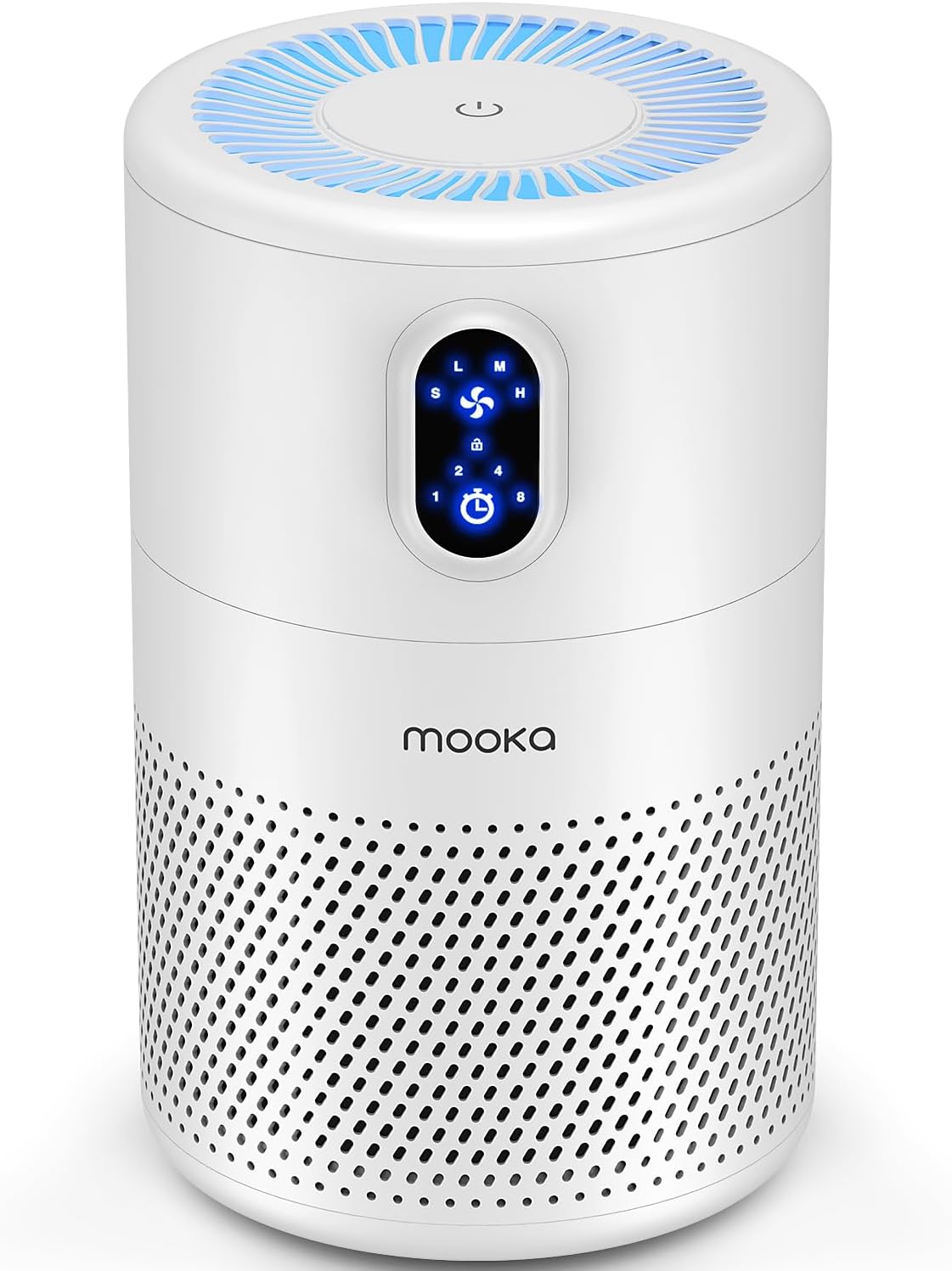
| Effective area | 1076 sq ft |
|---|---|
| Filter type | H13 True HEPA + activated carbon |
| Noise level | 20 dB (low) |
| Fan modes | 4 speeds |
The MOOKA B-D02L is a compact tabletop air purifier aimed at removing common indoor pollutants in larger rooms. It uses a three-stage system — pre-filter, H13 true HEPA, and activated carbon — to capture pet hair, dust, pollen, smoke and odors down to 0.3 microns, and the unit claims coverage up to 1,076 square feet with reduced air changes at maximum area. Controls are straightforward with four fan speeds, a sleep/quiet mode that runs near 20 dB, a child lock, and four timer settings for scheduled run times. Practical touches include a soft night light (user-disableable), an indicator for filter replacement, and a brushless motor for energy savings. Filters are user-replaceable and recommended every 3 to 6 months depending on use. Trade-offs are expected for the size and price class: the high coverage claim corresponds to slower air changes in very large spaces, and filtration performance will be strongest in medium rooms or when used continuously at higher fan speeds. For budget-conscious buyers this unit balances features, low noise and replaceable filters in a small footprint.
Best for: Buyers looking to maximize value on a budget who want a low-noise, easy-to-use purifier for bedrooms, living rooms or offices and prefer simple controls and replaceable filters.
Less Ideal for: People needing rapid, whole-house air turnover or medical-grade ventilation for severe respiratory conditions should choose a higher-capacity or commercial unit.
- H13 true HEPA plus activated carbon for particle and odor removal
- Rated coverage up to 1,076 sq ft for flexible placement
- Very quiet operation (around 20 dB) suitable for bedrooms and offices
- Multiple timers, four fan speeds and child lock for simple everyday control
- Largest-area coverage yields low air-change rates at the maximum square footage
- Replacement filters need periodic purchase every 3–6 months
Verdict: A budget-friendly, low-noise HEPA purifier that delivers solid particle and odor removal for bedrooms and living spaces where quiet, simple operation and replaceable filters matter.
FULMINARE H13 HEPA Air Purifier

| Filter type | H13 HEPA |
|---|---|
| Room coverage | Up to 215 sq ft / 20 m² |
| Noise level | Around 24 dB (low fan) |
The FULMINARE H13 is a small, budget-focused air purifier that uses an H13 true HEPA filter and a 360-degree outlet to circulate room air up to five times per hour in spaces up to about 215 sq ft. It is simple to operate with multiple fan speeds, a near-silent sleep mode (around 24 dB), and a separate night light that doubles as a comforting bedside lamp for children. The unit emphasizes portability and convenience: plug-in power with no internal battery, an accessible bottom-mounted filter compartment, and five preset timers (2, 4, 8, 10, 12 hours) for hands-off use. For the price it delivers effective particle filtration for pet hair, smoke, and odors, but buyers should expect periodic filter replacements roughly every three months under heavier use and that advanced features like app control or air-quality sensors are not present. Placement on a flat surface with clear intake/exhaust is needed to reach the stated coverage. If you want a straightforward, quiet purifier that focuses on core HEPA filtration without extras, this unit is a sensible low-cost pick.
Best for: Buyers seeking an inexpensive, no-frills HEPA purifier for bedrooms or small living areas who prioritize quiet operation and straightforward plug-and-play use.
Less Ideal for: Users who need smart features, integrated air-quality monitoring, or high-capacity whole-house filtration should consider more advanced models.
- H13 true HEPA filter for high-efficiency particle capture
- 360-degree air outlet with dual-channel design for faster room circulation
- Very quiet sleep mode around 24 dB suitable for bedrooms
- Independent night light and five timer settings for convenience
- Portable, plug-in design with easy bottom access to the filter
- No smart controls or air-quality sensing included
- Filter replacement recommended frequently under heavy use (about every three months)
Verdict: A compact, affordable HEPA purifier that delivers quiet, effective particle filtration for small rooms without extra smart features.
ECOSELF HAP609 Air Purifier

| Model number | HAP609 |
|---|---|
| PM2.5 display | Yes |
| Noise level (Sleep Mode) | 20 dB |
| Timer | 1–24 hours |
| Air intake | 360° |
The ECOSELF HAP609 is a compact HEPA air purifier aimed at everyday home use where quiet operation and simple automation matter. It pulls air in from all sides with a 360° intake and uses a built-in PM2.5 sensor to adjust fan speed automatically when particle levels rise, which is useful for cooking smoke, pollen, or pet dander. The front display shows real-time PM2.5 readings and a color ring for quick status checks, and a 1–24 hour timer adds straightforward scheduling. Its sleep mode turns off lights and drops noise to about 20 dB, making it suitable for bedrooms. Because it is small and lightweight, it is easy to move between rooms, but that size also means it is best for single rooms rather than whole-house coverage. The unit focuses on core purification functions without advanced smart-home integrations, so buyers who want app control or multi-room setups should look elsewhere. For a budget-oriented HEPA purifier, the HAP609 balances quiet night operation, automatic sensing, and clear feedback in a simple package.
Best for: Buyers who want a reliable, easy-to-use bedroom or small-room purifier that prioritizes quiet night operation and automatic response to particle spikes.
Less Ideal for: People needing whole-home coverage, integrated smart controls, or high-speed purification for very large rooms should consider larger or more feature-rich models.
- 360° air intake for more even room airflow
- Built-in PM2.5 sensor with auto mode adjusts fan speed to changing air quality
- Very quiet sleep mode with lights off at about 20 dB
- Real-time PM2.5 display and color ring give immediate air quality feedback
- 1–24 hour timer for simple scheduled operation
- Compact size limits effective coverage to single rooms rather than large open areas
- No mention of mobile app or smart-home connectivity in feature set
Verdict: A dependable, budget-friendly HEPA purifier for bedrooms and small rooms that delivers quiet night operation and automatic air-quality response.
Levoit Core Mini-P
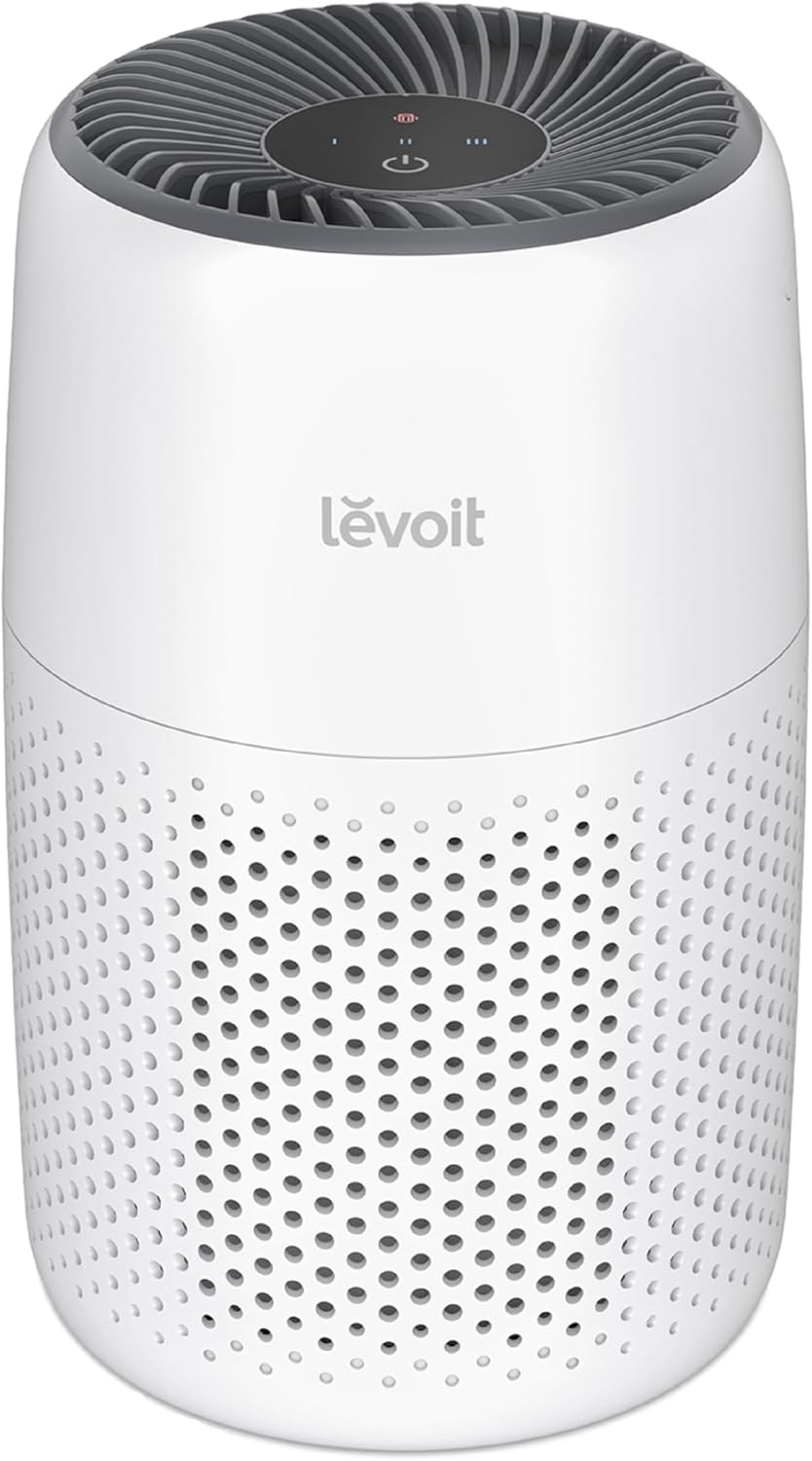
| Rated Power | 7W |
|---|---|
| Noise Level | 27-45dB |
| Particle Retention Size | 0.3 micron |
The Levoit Core Mini-P is a small HEPA-style purifier intended for desktops, bedrooms, and other compact spaces. It uses a pre-filter plus a main filter to capture lint, pet dander, dust, and smoke particles, and includes an aromatherapy sponge for light scenting. Typical use is simple: place it on a bedside table, office desk, or kitchen counter to reduce visible particles and odors while you work or sleep. Notable features include AHAM-verified performance claims, a sleep mode and an auto-off display to reduce disturbance, and a very low-rated power draw around 7W that keeps operating costs minimal. The unit runs quietly, listed at roughly 27–45 dB depending on fan speed, so it is suitable for overnight use. Limitations are its coverage: the Core Mini-P is built for small areas and will not replace larger room purifiers, and the scent pad needs careful dosing to avoid overflow. Replacement filters are required for continued performance and add to long-term cost.
Best for: Buyers who want a compact, proven small-room purifier that runs quietly overnight and prioritizes verified particle removal over extra smart features or large-area coverage.
Less Ideal for: People seeking whole-room or multiroom purification or those who need a purifier with extensive smart controls and app integration should look elsewhere.
- AHAM-verified cleaning performance for reliable small-room air cleaning
- Very quiet operation with a dedicated sleep mode
- Low power consumption (around 7W) for continuous use
- Built-in aromatherapy sponge for light odor masking and relaxation
- Designed for small spaces only and not effective for large rooms
- Aromatherapy pad can overflow if overfilled and may damage plastic parts
Verdict: A reliable, very quiet HEPA-style purifier that's a smart budget pick for bedrooms and desktops where verified small-room performance matters.
Levoit Core 300-P

| Filter Type | 3 in 1 Filtration |
|---|---|
| Floor Area | 1073 square_feet |
| Noise Level | 24 db |
| Particle Retention Size | 0.3 micron |
| Wattage | 56 watts |
The Levoit Core 300-P is a small, user-friendly air purifier built for everyday home use in bedrooms, living rooms, or offices. It uses a 3-in-1 filtration system with a pre-filter, HEPA-grade original filter, and activated carbon to capture dust, pollen, pet dander, smoke, odors, and VOCs, and its tested 99.97% efficiency for 0.1–0.3 μm particles means it tackles fine particulates effectively. A 56W motor delivers measurable CADR performance (reported for smoke, dust, and pollen) so the unit can refresh a typical room several times per hour, while Sleep Mode lowers the fan and drops noise to about 24 dB for nighttime use. Controls are touch-based and there is a timer plus a check-filter indicator for maintenance reminders. The purifier is portable and certified to AHAM, CARB, and ETL safety standards, which supports reliability for cautious buyers. Limitations include manual fan control only on this model (no Auto Mode) and the recommendation to replace filters every 6 to 8 months to maintain performance, which adds ongoing cost.
Best for: Buyers who prioritize reliable, tested filtration and quiet night operation and want a straightforward, safety-certified purifier that performs well in typical rooms without complicated setup.
Less Ideal for: Shoppers who want automatic air-quality-driven control, integrated smart features, or a purifier sized for continuous whole-house coverage should consider other options.
- HEPA-grade 3-in-1 filter captures fine particles and common household pollutants
- AHAM verified CADR ratings provide measurable room-cleaning performance
- Very quiet in Sleep Mode at about 24 dB for undisturbed night use
- Certified to CARB and ETL safety standards and portable for room-to-room use
- No Auto Mode or smart connectivity on this model, requiring manual speed adjustments
- Requires regular filter replacement every 6 to 8 months, adding running cost
Verdict: A compact, safety-certified HEPA purifier that gives dependable measurable cleaning and whisper-quiet sleep operation for cautious buyers on a budget.
Choosing the Right HEPA Air Purifier on a Budget: Key Factors to Consider
Filter Type and True HEPA Media
A genuine HEPA filter captures at least 99.97% of particles down to 0.3 microns, which matters for removing pollen, dust, and many respiratory aerosols. Some budget units advertise HEPA-style or HEPA-type filters that do not meet true HEPA standards, so confirming the filter specification helps avoid overstated performance.
Filter construction and prefilter layers also affect lifespan. Units that include an effective washable or replaceable prefilter trap larger debris and protect the HEPA element, extending time between costly replacements.
Room Coverage and CADR
Clean Air Delivery Rate (CADR) and recommended room size indicate how quickly an air purifier can exchange and clean the air in a given space. For bedroom use you can accept lower CADR, while living rooms and open-plan areas require higher-rated units to achieve multiple air changes per hour.
On budget models, manufacturers sometimes quote ideal conditions. Look for realistic CADR figures or manufacturer-recommended room sizes that match your actual ceiling height and layout to ensure adequate performance.
Energy Use and Ongoing Costs
A low purchase price can be offset by high electrical draw or expensive filter replacements. Check wattage at typical fan speeds and estimate monthly electrical cost for continuous or nightly use. Also research the recommended replacement interval and cost of HEPA and prefilters to estimate annual ownership cost.
Budget-friendly models should balance modest energy consumption with affordable, widely available replacement filters to keep total cost of ownership low over time.
Noise and Daily Comfort
Noise output affects whether you can run a purifier overnight or keep it in a living area without distraction. Look at decibel ratings when available and how loud the purifier is on lower fan settings. Some budget units are surprisingly quiet at sleep settings, while others use high-speed fans that generate intrusive noise.
Consider whether the unit has a sleep mode, dimmed indicators, or fan speed steps that let you trade off speed for quiet operation during sensitive hours.
Ease of Use and Maintenance
Simple controls, straightforward filter replacement, and clear maintenance alerts matter for long-term satisfaction. Budget models that hide filters behind complicated panels or require special tools for replacement create friction and may discourage timely upkeep.
Also check whether filter-change indicators are accurate and whether replacement filters are easy to buy through common retail channels to avoid long delays or aftermarket-only options.
Size, Placement, and Portability
Physical footprint and weight affect where you can place a purifier and how easily you can move it between rooms. Compact units are convenient for bedrooms or apartments but may sacrifice CADR. Taller, tower-style units can offer better airflow in limited floor space, while tabletop models are easiest to relocate.
Consider whether the unit stacks well against walls or fits on bedside furniture, and whether handles or casters are provided for occasional relocation.
Matching Purifier Size to Room Layout
Measure the floor area and note ceiling height to estimate the volume of air the purifier must process. Most manufacturer recommendations assume standard 8-foot ceilings; if your ceilings are higher, choose a unit rated for a larger square footage or higher CADR. For awkward layouts or open-plan rooms, place the purifier where airflow is least obstructed and avoid corners that trap the unit's intake.
For bedrooms, a unit that provides two to four air changes per hour is usually sufficient. For living rooms or open spaces, aim for three to five air changes per hour depending on how much time you and your household spend in that area.
- Confirm the CADR or recommended room size against your actual room volume.
- Place units away from walls and large furniture to avoid restricting airflow.
- Multiple smaller purifiers can outperform one undersized unit for separated rooms.
Understanding True HEPA Versus HEPA-Type Labels
True HEPA filters meet a defined particle-capture standard. Labels like HEPA-type or HEPA-style may indicate lower minimum capture rates. When buying on a budget, check packaging or specifications for the word 'true' or a stated efficiency percentage near 0.3 microns.
If a budget unit pairs a HEPA element with activated carbon or other media, it can offer broader odor and VOC reduction. However, verify the primary particulate filter performance first because odor control alone does not reduce allergy-causing particles.
- Look for stated efficiency (for example, 99.97% at 0.3 microns).
- Activated carbon helps with smells but does not substitute for HEPA.
- Avoid models that rely only on ionizers or ozone generators for cleaning.
Practical Tips for Filter Maintenance and Savings
Treat the prefilter as the first line of defense. Washing or vacuuming a reusable prefilter regularly can significantly extend the life of the HEPA element. Keep a log of filter-change dates and run the unit on a lower setting when full cleaning is not necessary.
Buy replacement filters in advance if you find a reliable, affordable source. Some manufacturers offer multi-packs that reduce per-filter cost; check compatibility and warranty implications before buying aftermarket parts.
- Vacuum prefilters monthly in dusty homes or homes with pets.
- Estimate annual filter cost before committing to a model.
- Follow manufacturer recommendations for replacement intervals to maintain efficiency.
Balancing Noise and Performance for Night Use
Many budget purifiers have a sleep or low mode that reduces fan speed and noise, sometimes at the cost of lower clean-air throughput. If you need overnight coverage, prioritize models with quiet low-speed settings and a high enough CADR at that speed to meaningfully reduce pollutants while you sleep.
Consider placing the purifier a few feet from the bed and selecting a fan speed that keeps noise below typical bedroom conversation levels. Also look for units with dimmable or turn-off-able indicators to avoid light disturbance.
- Check reported decibel levels or user feedback for quiet-mode performance.
- Position units to minimize direct airflow onto a sleeping person.
- Use timers to run higher speeds while you are out, and switch to quiet mode overnight.
Energy Use: Estimating Real-World Running Cost
Calculate expected running cost by multiplying wattage at your commonly used fan setting by your local electricity rate and estimated daily hours. Budget units that draw 20 to 50 watts on medium settings are typically inexpensive to operate, but continuous high-speed use can increase costs.
Some models include eco or auto modes that reduce energy consumption by adjusting speed based on detected particle levels. These features can lower runtime at high power, reducing both electricity use and fan wear.
- Use lower fan speeds for longer periods rather than short bursts at max speed.
- Auto modes can save energy but rely on the accuracy of onboard sensors.
- Factor filter replacement cost into your total annual ownership estimate.
How We Chose the Best HEPA Air Purifier on a Budget
We prioritized true HEPA filtration, measured air-cleaning capacity, and overall ownership cost when selecting budget air purifiers. Specifically, we verified that each product uses a HEPA-grade filter or equivalent fine-particle media and checked Clean Air Delivery Rate (CADR) or stated room coverage to ensure a unit can handle common bedroom or living-room sizes. Energy use and replacement-filter frequency were evaluated because cheap upfront cost can be offset by high running expenses. Noise levels at typical fan settings were considered for overnight and open-plan use. We also looked at control simplicity, available fan speeds, and whether the unit includes useful extras like a timer or air-quality indicator without adding unnecessary complexity. Units were excluded if they relied solely on non-HEPA technologies or lacked clear filtration and airflow specifications. We filtered out models with poor user feedback on filter availability or excessively high replacement costs. The result is a list that balances verified particulate capture, practical room coverage, quiet operation, and low lifetime cost for buyers on a budget.
Our full evaluation process is outlined in our review methodology.
FAQ
How often should I replace HEPA filters in a budget air purifier?
Replacement intervals depend on usage and environment but typically range from 6 to 12 months. Homes with pets or higher particulate loads may need changes more often, while light use in low-dust environments can extend filter life.
Can a small HEPA purifier clean an entire apartment?
A single small unit can effectively clean one room but is unlikely to maintain low particle levels across multiple rooms or an entire apartment. For whole-apartment coverage, use a higher-CADR unit or multiple purifiers placed in the main living areas.
Are carbon filters necessary in a budget HEPA purifier?
Carbon filters help reduce odors and some volatile organic compounds but do not capture fine particulates. They are useful if smells or cooking fumes are a concern, but prioritize HEPA filtration first for allergy and particle removal.
Will a HEPA air purifier remove mold spores?
HEPA filters capture many mold spores found in the air and can reduce airborne concentrations. They will not address mold growth on surfaces or inside walls, so combine purification with moisture control and remediation for persistent mold problems.
Do HEPA purifiers produce ozone or other harmful byproducts?
True HEPA filtration by itself does not produce ozone. Avoid models that advertise ozone generation or heavy ionization, since ozone can be harmful in indoor spaces. Check specifications to ensure the primary cleaning method is mechanical filtration.
Final Verdict
When shopping for a HEPA air purifier on a budget, prioritize true HEPA filtration, realistic CADR or room coverage, and reasonable filter-replacement costs. Expect tradeoffs between price, noise, and clean-air throughput; a quieter, smaller unit may be ideal for a bedroom, while larger spaces require higher CADR ratings. Decide which factors matter most for your routine—overnight quiet, low running cost, or stronger short-term cleaning—and choose a model that balances those priorities. With attention to filter type, maintenance, and placement, you can get meaningful air-quality improvements without overspending.