
Note: This article contains affiliate links. If you click on these links and make a purchase, we may earn a small commission at no extra cost to you. This helps support our research and content. Read our full affiliate disclosure here.
If you want an air cleaner that adds targeted UV germ control to standard filtration, choosing the right model matters for everyday health and indoor comfort. A UV air purifier can reduce airborne microbes while also removing dust, pollen, and pet dander when paired with effective filters. In this guide we shortlisted the top models across typical home use cases and evaluated them for filtration efficiency, room coverage, noise, and ease of upkeep. Read on to see which types of UV-equipped air purifiers suit different rooms and routines, plus the selection criteria we used to build the list.
Top Picks at a Glance
| Best Overall The best all-around choice for most situations | GermGuardian AC5900WCA Air Purifier |  |
| Best Quality Built to a higher standard if you want something more solid | Sans True HEPA Air Purifier |  |
| Best Value The sweet spot between price and what you get | InvisiClean Aura II IC-5018 |  |
| Best Budget The cheapest option that still gets the job done reliably | Homedics TotalClean AP-P20 |  |
| Top Rated A top-rated pick with lots of positive feedback | Hunter HP450UV Air Purifier |  |
| Most Popular A crowd favorite that many people choose with confidence | POMORON MJ002H Air Purifier |  |
| Best Seller A high-volume bestseller chosen again and again | GermGuardian GG1000 Pluggable UV-C Sanitizer |  |
GermGuardian AC5900WCA Air Purifier

| Model | AC5900WCA |
|---|---|
| Coverage | Up to 1760 sq. ft. (1x/hr) / 365 sq. ft. (4.8x/hr) |
| Filter efficiency | Captures 99.97% of particles as small as 0.1 microns |
| Speeds | 3 fan speeds |
| Timer | 8-hour auto-off |
The GermGuardian AC5900WCA is a console-style air purifier built around a True HEPA filter, activated carbon stage, and a UV-C lamp to reduce airborne microbes and VOCs. It is typically placed in living rooms, bedrooms, or open-plan spaces where you want continuous filtration; the unit circulates air roughly once per hour in very large rooms and faster in medium rooms. Controls are simple: three fan speeds, an 8-hour timer, a night light, and a filter-change indicator. The HEPA stage captures fine particles down to 0.1 microns while the carbon layer targets odors from cooking, smoke, and pets, and the UV-C adds another layer aimed at reducing bacteria, viruses, and mold spores. Noise is manageable on low for night use but increases on higher speeds needed for bigger rooms, and the unit is a mid-size, freestanding console rather than a compact tower. Replacement HEPA, carbon filters and a spare UV bulb are available separately, so ongoing maintenance is straightforward but should be budgeted. For buyers focused on home air quality with added UV sanitization, this delivers a practical balance of filtration and features.
Best for: Buyers who want a robust home air purifier that combines HEPA filtration, carbon odor control, and UV-C sanitization for bedrooms and larger living areas and prioritize comprehensive, all-around air-cleaning performance.
Less Ideal for: People who need a very small, ultra-quiet bedside unit or an ultra-portable purifier for travel should consider more compact models instead.
- True HEPA filter captures 99.97% of particles to 0.1 microns
- Activated carbon layer reduces common household odors and some VOCs
- Includes UV-C light to supplement particle filtration with microbial reduction
- Simple electronic controls with 3 speeds, 8-hour timer, and filter-change indicator
- Larger console footprint compared with compact tower purifiers
- UV-C requires bulb replacement over time which adds maintenance cost
Verdict: Choose the AC5900WCA when you want a mid-size home purifier that pairs True HEPA and carbon filtration with UV-C to deliver broad, practical air-cleaning for larger rooms.
Sans True HEPA Air Purifier

| Filtration | Pre-filter, True HEPA, activated carbon |
|---|---|
| Coverage | Up to 1,854 sq ft |
| Noise | As low as 25 dB (sleep mode) |
| Particle capture | Captures particles down to 0.1 microns |
This Sans purifier is built to handle very large spaces, using a three-stage system that pairs a pre-filter, medical-grade True HEPA filter and an activated carbon layer, plus a UV-C light layer for added germ-inactivation. In daily use it runs quietly on low and ramps fan speed automatically when onboard sensors detect poorer air quality, making it suitable for bedrooms or open-plan living areas where you want continuous background cleaning. The activated carbon stage targets odors and smoke while a pet-friendly pre-filter helps capture hair and dander before they reach the HEPA element. The unit claims coverage up to 1,854 square feet and has an indicator to prompt fast filter swaps. Expect solid particulate removal down to 0.1 microns, but note that large-coverage purifiers are larger and louder at high speeds and require periodic filter replacements to maintain peak performance. For buyers focused on performance in big rooms, this model balances powerful filtration with a few user-maintenance obligations.
Best for: Buyers who prioritize measurable air-cleaning performance in very large rooms and want an appliance that actively adjusts to changing air quality while minimizing disruption.
Less Ideal for: People with very tight budgets or those who need a compact, travel-friendly purifier for small rooms should consider smaller, lower-capacity options instead.
- Medical-grade True HEPA filter captures very small particles down to 0.1 microns
- Three-stage system includes pre-filter and activated carbon for hair, dander, odors and smoke
- Covers very large areas, advertised up to 1,854 sq ft
- Smart sensors with auto mode adjust fan speed based on real-time air quality
- Quiet sleep mode with dimmed display suitable for nighttime use
- High-speed operation can be louder and uses more power in large spaces
- Requires periodic filter replacements to sustain advertised performance
Verdict: Choose this purifier if you need a high-performance, sensor-driven unit that cleans very large rooms while controlling odors and particulate pollution.
InvisiClean Aura II IC-5018

| Maximum CADR | 171 CFM / 291 m³/h |
|---|---|
| Coverage | 228 sq ft (4.8 ACH) / 1,094 sq ft (1 ACH) |
| Filter Type | H13 99.985% True HEPA |
| Fan Speeds | Low, Med, High, Turbo |
| Timer | 2, 4, 8 Hours |
The InvisiClean Aura II is a tower-style air purifier built around an H13 True HEPA filter, an activated carbon prefilter, an optional ionizer and a UV-C light to tackle particles, odors and some microbes. It is typically used in bedrooms, living rooms or home offices where quiet operation and energy efficiency matter. The unit offers four fan speeds including a Turbo setting, a sleep mode that turns off lights, and a 2/4/8 hour timer for scheduled runs. Its DC motor delivers a high CADR (171 CFM) while claiming lower power draw across speeds, making it practical for long nightly use. The filter-change indicator and independent controls for UV and ionizer add convenience and allow you to limit extra emissions. Limitations include no auto air-quality sensor so fan speeds must be adjusted manually, and the ionizer/UV features require cautious use around sensitive occupants even though the unit is CARB approved. Noise rises noticeably on the highest speed, which may be disruptive in smaller rooms.
Best for: Buyers who prioritize energy-efficient, high-throughput filtration for bedrooms or living spaces and want straightforward controls with optional UV/ionizer features.
Less Ideal for: Avoid this model if you need an auto-sensing purifier that adjusts itself based on real-time air quality or if you want a completely passive filtration-only unit without ionization or UV options.
- H13 True HEPA filter captures very small particles down to 0.3 microns
- Activated carbon prefilter reduces common household odors and smoke
- High CADR (171 CFM) powered by an efficient DC motor for faster air circulation
- Multiple convenient controls including sleep mode, timer and filter-change indicator
- No automatic air-quality sensor or auto mode to adjust fan speed
- Ionizer and UV functions add complexity and should be used cautiously around sensitive people
- Noise level is noticeably higher on Turbo setting
Verdict: Choose the Aura II if you want a compact, energy-efficient purifier with strong H13 HEPA filtration plus optional UV and ionizer controls for cleaner air in bedrooms and medium rooms.
Homedics TotalClean AP-P20

| Power Source | ac_dc |
|---|---|
| Control Method | Touch |
| Filter Type | UV Light |
| Contaminant Filtration Capability | odors |
The HoMedics TotalClean AP-P20 is a plug-in UV-C personal air sanitizer intended for small rooms like bathrooms, closets, or bedside areas. It uses a photocatalyst ionizer plus UV-C light for two-stage sanitizing that the brand reports reduces 99.9% of certain bacteria and viruses in third-party tests, and it targets odors rather than particulate filtration. The unit draws power from a standard outlet, has an auto-on motion and light sensor for hands-off operation, and includes a three-level night-light that can be turned off. Because it is filterless, there is no ongoing filter maintenance, but it also does not provide HEPA-style particle removal so it will not catch dust or allergens. The compact design is easy to install and suitable for travel or small personal spaces, though its sanitizing approach is best paired with regular cleaning and ventilation for more complete indoor air management.
Best for: Buyers who prioritize a low-cost, low-maintenance sanitizer for bathrooms, travel, or other tight spaces and want simple plug-and-play microbial and odor reduction.
Less Ideal for: People seeking comprehensive particulate filtration, allergy relief, or coverage for medium to large rooms should choose a purifier with HEPA filtration and higher CADR instead.
- Plug-in design for tool-free installation and portable use
- UV-C plus photocatalyst ionizer offers two-stage sanitizing for microbes and odors
- Auto-on motion and light sensors for convenient, hands-free operation
- No filters to buy or replace, reducing ongoing maintenance
- Does not include HEPA or mechanical filtration so it will not remove fine particles or allergens
- Performance is limited to small personal spaces and is not suitable for whole-room purification
Verdict: If you want an inexpensive, maintenance-free plug-in sanitizer to reduce microbes and odors in very small areas, this unit delivers simple, portable UV-C protection.
Hunter HP450UV Air Purifier
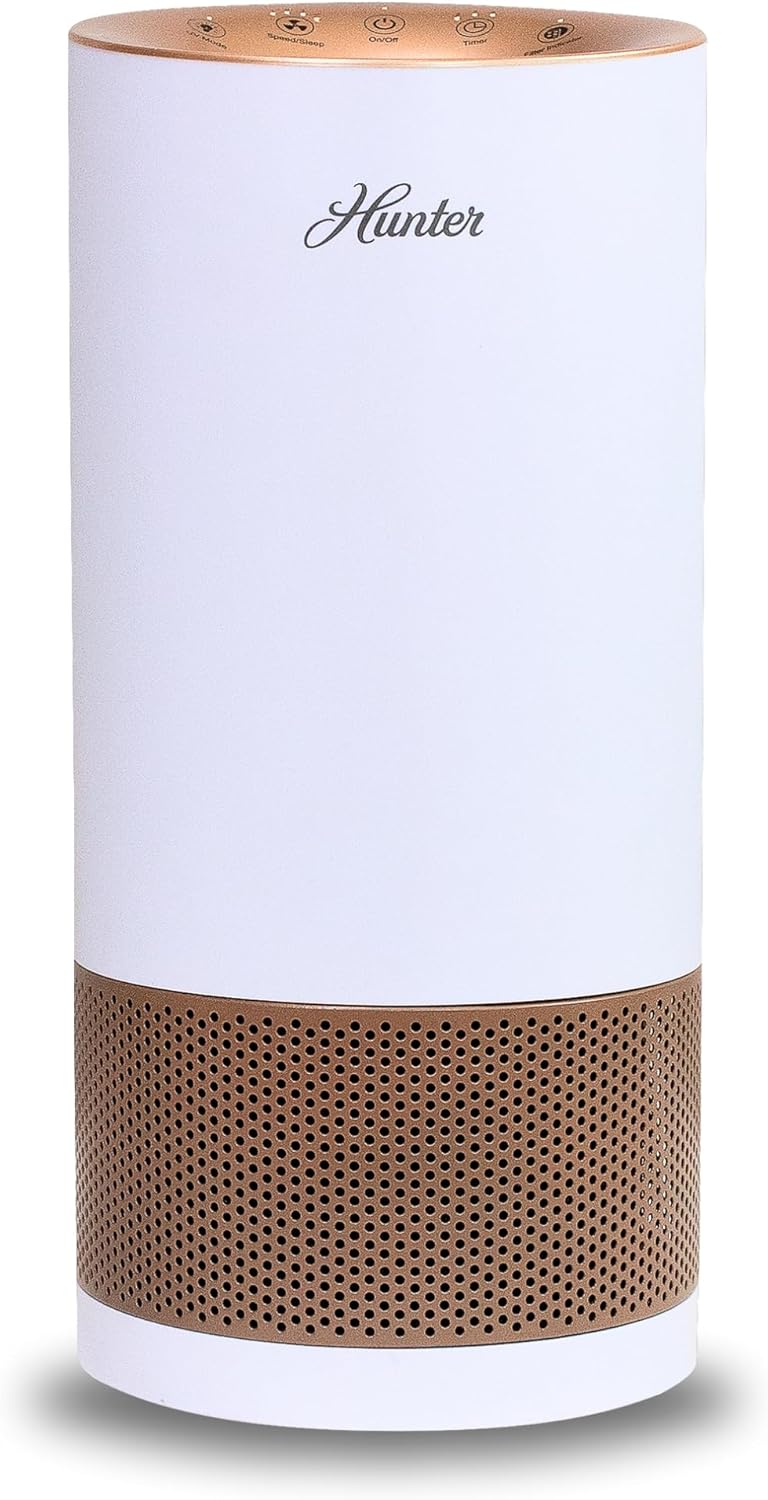
| Filter Type | HEPA |
|---|---|
| Floor Area | 106 square_feet |
| Noise Level | 47 db |
| Particle Retention Size | 0.3 micrometer |
| Power Source | ac |
The Hunter HP450UV is a small cylindrical tower purifier designed for bedrooms and offices where quiet, reliable filtration matters. It uses a True HEPA filter plus an EcoSilver pre-filter and a coconut carbon pre-filter to capture particles, reduce odors and inhibit microbial growth, while an integrated UVC lamp provides an extra sanitizing step for air passing through the unit. Controls are touch-based with three fan speeds, a sleep mode and a timer, and the unit includes a filter-replacement indicator and an optional LED accent nightlight. In real-world use the HP450UV is easy to move between rooms and runs quietly on its low setting, which helps for overnight use; higher speeds are available for faster cleaning in small spaces. Trade-offs are typical for compact purifiers: its coverage is limited to about 106 square feet, and the UVC lamp adds maintenance considerations and should not be relied on as a sole disinfection method. Still, for small rooms this model offers layered filtration and practical features in a compact package.
Best for: Buyers who prioritize dependable, layered filtration and quiet overnight operation in small bedrooms or home offices and want a compact, easy-to-use purifier with added UV capability.
Less Ideal for: People who need to clean large open-plan areas or who want a whole-home solution should choose a higher-capacity purifier instead.
- True HEPA plus EcoSilver pre-filter for particle capture and microbial inhibition
- Coconut carbon pre-filter to reduce VOCs and household odors
- UVC light adds an extra layer of microbial control inside the unit
- Quiet sleep mode suitable for overnight use
- Touch controls, timer and filter-replacement indicator for convenient operation
- Designed for small rooms only with coverage around 106 square feet
- UVC lamp requires careful handling and periodic maintenance
Verdict: For small rooms where reliable, multi-stage filtration and quiet operation matter, the Hunter HP450UV delivers layered cleaning plus UV support in a compact, user-friendly design.
POMORON MJ002H Air Purifier

| Filter Type | Pre-Filter, True H13 HEPA |
|---|---|
| Floor Area | 1250 square_feet |
| Noise Level | 25 db |
| Wattage | 17 watts |
| Contaminant Filtration Capability | 99.97% |
The POMORON MJ002H is a small, feature-packed air purifier intended for bedrooms and other personal spaces. It pulls room air through a 3-layer True H13 HEPA filter and activated carbon to capture 99.97% of particles down to 0.3 microns while an internal UV lamp and a negative ion generator add extra purification and odor reduction. Controls are touch and button based with four fan speeds, selectable 8/12/24 hour timers and a sleep mode rated around 25 dB for quiet overnight use. At 17 watts it is energy efficient and its compact footprint makes it easy to place on a nightstand or desk. The unit includes one factory H13 filter and the manufacturer offers dedicated replacement filters. Limitations are its small physical size and implied coverage—this is built for personal or small-room use rather than large open living spaces, and ionizer/UV features provide supplemental benefits but do not replace routine filter maintenance.
Best for: Buyers who prioritize proven filtration and visible social proof and want a compact, quiet purifier for a bedroom or personal workspace with extra odor-reduction features.
Less Ideal for: People seeking large-room or whole-house purification or those who prefer a unit without ionizer or UV functions should consider larger or differently configured models.
- True H13 HEPA filter captures 99.97% of particles down to 0.3 microns
- Built-in activated carbon layer helps reduce smoke, VOCs and odors
- Multiple fan speeds plus 8/12/24-hour timers and a quiet 25 dB sleep mode
- Includes UV light and negative ion generator for additional air-cleaning effects
- Low power draw (17 watts) and compact, portable design
- Small unit suited to single rooms only, not whole-home coverage
- Ionizer and UV features are supplemental and require continued filter replacement to maintain performance
Verdict: A compact, quiet bedroom purifier that pairs factory H13 HEPA filtration with UV and ionizer extras for buyers who want proven particle removal plus added odor-control features.
GermGuardian GG1000 Pluggable UV-C Sanitizer

| Model number | GG1000 |
|---|---|
| Primary Filter Type | UV-C |
| Bulb wattage | 3.5 Watt |
The GermGuardian GG1000 is a wall‑pluggable UV-C air sanitizer that uses a 3.5 watt UV-C bulb and titanium dioxide coating to reduce airborne bacteria, some viruses, and volatile organic compounds while helping to neutralize odors. You simply plug it into a standard 120V outlet in small spaces such as bathrooms, laundry rooms, pet areas, or a nursery; there is no assembly or filters to replace, only an annual UV-C bulb change. Its compact footprint makes it unobtrusive and convenient for continual use in tight spots, and the device is engineered specifically to run continuously to keep air refreshed. Limitations are that it is not a HEPA filter purifier so it will not remove particulates like dust or pollen, and its sanitizing effect is constrained to the immediate airflow around the unit and small rooms rather than whole-house coverage. It is best treated as a supplemental germ‑reduction and deodorizing device rather than a standalone solution for airborne particles.
Best for: Buyers who want a low‑maintenance, plug-and-play way to reduce germs and odors in small spaces and prefer a simple, continuously running sanitizer over a filter-based purifier.
Less Ideal for: People seeking full particulate removal, whole‑room air cleaning, or medical-grade filtration should consider HEPA-equipped purifiers instead.
- Plugs directly into a 120V outlet for simple, no‑setup operation
- UV-C light plus titanium dioxide targets airborne bacteria, some viruses, and VOCs
- Compact size fits bathrooms, laundry rooms, and other small spaces
- No regular filter replacements required, only an annual bulb replacement
- Does not capture or remove airborne particles like dust, pollen, or pet dander
- Effectiveness is limited to the vicinity of the unit and is not suited for larger rooms
Verdict: Choose the GG1000 if you want an easy, low‑maintenance plug-in UV-C sanitizer to reduce germs and odors in small rooms.
Choosing the Right UV Air Purifier: Key Factors to Consider
Filtration Type and Efficiency
Mechanical filtration quality determines how well an air purifier captures particles like dust, pollen, and respiratory aerosols. A high-efficiency HEPA-level filter will remove fine particulates that carriers of microbes often hitch a ride on, so pairing UV with a capable particle filter increases overall effectiveness.
When evaluating filtration, consider both the filter rating and actual tested particle removal where available. Pre-filters for larger debris extend main filter life and help maintain airflow, which is essential to keep both filtration and UV treatment effective over time.
UV Dose and Placement
UV germicidal activity depends on the dose delivered to microbes passing through the device. Dose is a function of lamp intensity, exposure time, and the geometry of the UV chamber. Systems that expose air to UV for only a fraction of a second may have limited microbial kill rates compared with well-designed chambers that maximize contact time.
Also consider where the UV lamp is positioned. UV placed after the mechanical filter treats air post-filtration, while UV before filters can reduce biological loading on the filters themselves. Confirm that the design shields occupants and prevents direct line-of-sight exposure to UV light.
Room Size and CADR
An air purifier must move enough clean air for the space to make a meaningful difference. Clean Air Delivery Rate, or CADR, expresses how quickly a unit reduces particles in a room. Choose a unit with a CADR appropriate for the room square footage and typical ceiling height to ensure multiple air changes per hour.
Overestimating the purifier's effective coverage is a common mistake. Smaller units in large rooms will run continuously without achieving desired air exchanges, reducing both UV exposure opportunities and filtration effectiveness.
Noise Level and Daily Use
A unit that is too loud will be turned down or off, negating any air quality benefits. Noise varies with fan speed; check decibel ratings or manufacturer figures for low and high settings. Quiet operation at a speed that still provides adequate CADR is the ideal tradeoff for continuous use.
Consider whether the device will run in living spaces, bedrooms, or home offices. Some units offer sleep modes or night settings that prioritize quiet operation while still providing modest air changes.
Maintenance and Consumables
Routine upkeep affects both performance and cost of ownership. Filters require periodic replacement and UV lamps have finite life and reduced output over time. Easy-access filter compartments and clear replacement intervals make maintenance less of a chore.
Check the availability of replacement filters and lamps, estimated service life, and whether the device has indicator lights to signal when components need attention. Units with washable pre-filters can reduce consumable spending and help maintain consistent airflow.
Safety and Ozone Emissions
UV systems should be designed to prevent accidental exposure to UV-C light, which can harm skin and eyes. Properly enclosed UV chambers and interlocks reduce that risk. Some UV technologies or additional ionization methods can produce ozone as a byproduct, which is an indoor pollutant at higher concentrations.
Prioritize products that disclose ozone emissions and comply with safety guidelines. For households with children or respiratory sensitivities, choose designs that isolate UV action internally and have low or negligible ozone output.
How UV Helps — And Where It Matters Most
Ultraviolet germicidal irradiation can inactivate microbes in air streams when the design delivers an adequate dose. In a home setting, UV is most useful as a supplement to particle filtration rather than a standalone solution. It adds a layer of defense against bacteria and some viruses that pass through the device.
The most practical applications are in rooms where airborne biological loads are a concern, such as bedrooms, home offices, or spaces used by people with mild immune vulnerabilities. UV-equipped purifiers are also helpful where filters alone cannot address biological contaminants trapped on filter media.
- UV is complementary to particle filtration, not a replacement
- Best used in occupied spaces when the lamp is safely enclosed
- Effectiveness depends on proper airflow and exposure time
Sizing Your Unit for Real-World Rooms
Start by calculating the square footage and typical ceiling height of the room to estimate volume. Use the CADR and recommended room sizes as a guideline for how many air changes per hour you can expect. A higher target air change rate is advisable in high-occupancy or high-activity rooms.
Placement matters. Put the unit where airflow is unobstructed and away from walls or large furniture that could impede intake or exhaust. Avoid corners and tight shelving, and aim for central or elevated placement if possible to promote circulation.
- Match CADR to room volume for meaningful air exchanges
- Place units away from obstructions for best airflow
- Consider two smaller units for large or oddly shaped areas
Operational Tips to Maximize Performance
Run the purifier at a speed that balances noise with effective CADR. For continuous baseline protection, a moderate speed often provides the best tradeoff. Boost fan speed temporarily during periods of higher activity, such as after cleaning or when many people are present.
Keep pre-filters and particle filters clean. Clogged filters reduce airflow and shorten the effective UV exposure time for passing air. Replace UV lamps according to manufacturer recommendations to maintain germicidal output.
- Use higher speeds for short bursts when needed
- Maintain filters and lamps on schedule
- Avoid placing the purifier near strong airflow sources like open windows
Common Myths and Misconceptions
UV is sometimes marketed as a cure-all for airborne germs. In practice, UV effectiveness is constrained by dose and contact time; tiny or fast-moving air streams may not receive enough exposure. Combining UV with proper filtration and sufficient airflow yields the best results.
Another misconception is that any UV lamp automatically purifies the air. Lamp placement, shielding, and the overall airflow path determine actual performance. Focus on systems with documented engineering that show how air is routed through the UV exposure zone.
- UV alone rarely provides complete protection
- Lamp placement and air path are critical
- Documented engineering and safety features matter
Installation, Placement, and Room Layout Considerations
Most plug-in and freestanding units require little installation beyond selecting a suitable spot. For larger duct-mounted or integrated systems, plan placement to ensure they serve the intended rooms. Consider electrical outlet access and keep cords tidy to avoid tripping hazards.
In rooms with high ceilings or open plans, verify that the unit's CADR accounts for the actual volume. In some layouts, multiple strategically placed smaller units outperform a single large unit by reducing dead zones and improving circulation.
- Ensure outlet access and safe cord routing
- Use multiple units for complex room layouts
- Check that advertised coverage matches your room volume
How We Chose the Best UV Air Purifier
We focused on characteristics that directly affect how well a UV air purifier performs in real homes and how easy it is to live with day to day. Primary evaluation criteria included capture efficiency of mechanical filters, verified UV germicidal design and dose, clean air delivery rate relative to room size, and operational noise and energy demand. We also looked at maintenance needs such as filter replacement frequency and accessibility, plus safety features that isolate UV light from occupants. Devices that relied solely on unverified UV claims, lacked adequate mechanical filtration for particles, or offered insufficient airflow for common room sizes were excluded. The result is a shortlist of units that balance particle removal, UV microbial control, practical coverage, and low-friction ownership.
Our full evaluation process is outlined in our review methodology.
FAQ
Does a UV air purifier replace the need for a HEPA filter?
No. UV inactivates some microbes but does not remove particles from the air. A HEPA-level mechanical filter captures dust and aerosols that can carry microbes, so combining both technologies is more effective than relying on UV alone.
Is UV light inside the purifier safe for people and pets?
When properly enclosed and designed with interlocks, UV-C chambers prevent exposure to occupants. Avoid units that expose occupants to direct UV light. Verify product safety features and manufacturer guidance to ensure the lamp is contained.
How often do UV lamps and filters need replacement?
Replacement intervals vary by design and usage. Filters typically need replacement every few months to a year depending on type and pollution levels. UV lamps have a rated life and gradually lose efficacy, so follow the recommended lamp change schedule to maintain germicidal performance.
Will a UV air purifier produce ozone?
Some UV systems and supplemental technologies can produce trace ozone. Choose designs that disclose emissions and comply with low-ozone guidelines. For sensitive households, prioritize units with negligible ozone output.
Can I leave a UV air purifier running 24/7?
Continuous operation is common and often recommended for steady air quality. Ensure the model you choose is rated for continuous duty and that maintenance schedules are followed to avoid reduced effectiveness from clogged filters or aged lamps.
Final Verdict
Prioritize units that pair strong mechanical filtration with an effective, well-shielded UV germicidal chamber and sufficient airflow for your room size. Tradeoffs are common: higher CADR and faster air changes improve overall cleaning but may increase noise and filter wear. Focus on coverage, documented UV design, ease of maintenance, and low ozone emissions to choose confidently. With those priorities, you can select a UV air purifier that delivers meaningful improvement in indoor air hygiene without creating new nuisances.