
Note: This article contains affiliate links. If you click on these links and make a purchase, we may earn a small commission at no extra cost to you. This helps support our research and content. Read our full affiliate disclosure here.
If you want café-quality espresso at home, choosing a high-end espresso machine is one of the most impactful upgrades you can make. The right machine delivers consistent extraction, stable brewing temperature, and a durable build that withstands frequent use. For serious home baristas those traits translate to better shots, faster routine workflow, and fewer tuning headaches. This guide shortlists seven top high-end espresso machines across common feature sets and workflow styles. We evaluated candidates on the elements that affect daily use and final cup quality so you can choose the machine that fits your kitchen, technique, and taste. Read on for the picks and the decision criteria we used to evaluate them.
Top Picks at a Glance
| Best Overall The best all-around choice for most situations | Nuova Simonelli Oscar II |  |
| Best Quality Built to a higher standard if you want something more solid | Rocket Espresso R58 Cinquantotto |  |
| Best Value The sweet spot between price and what you get | Breville Barista Pro BES878BSS |  |
| Best Budget The cheapest option that still gets the job done reliably | CASABREWS 5418 PRO Espresso Machine |  |
| Top Rated A top-rated pick with lots of positive feedback | Diletta Bello+ Espresso Machine |  |
| Most Popular A crowd favorite that many people choose with confidence | Breville Barista Express BES870BTR |  |
| Best Seller A high-volume bestseller chosen again and again | PHILIPS 5500 Series EP5544/94 | 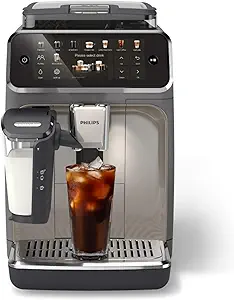 |
Nuova Simonelli Oscar II

| Operation Mode | Semi-Automatic |
|---|---|
| Boiler Type | Heat Exchange Copper Boiler |
| Wattage | 1200 watts |
| Water Source | Pour-Over |
| Water Tank Capacity | 3 liters |
The Nuova Simonelli Oscar II is a compact semi-automatic espresso machine built around a professional heat-exchange copper boiler and manual steam wand, designed for home users who want café-style shots. It accepts ground coffee, offers timed dosing via soft-touch buttons, and uses a 3 L pour-over water tank so you can place filtered water directly into the machine. The copper boiler and 1,200 W heater deliver fast heat recovery and steady steam for milk texturing while the included portafilter, tamper, shot baskets, and milk frother give you the basic tools to pull and finish espresso drinks. Practical benefits include strong temperature stability and the ability to make consecutive drinks without long reheats, plus a reusable filter for lower ongoing cost. Trade-offs are that it lacks an integrated grinder or hot water nozzle and relies on manual steaming technique, so it suits users comfortable with some hands-on work and an external grinder setup. The stainless steel and copper finish give it a pro look but expect to follow the manufacturer guidance on water quality to keep the warranty valid.
Best for: Buyers who want a compact, café-grade semi-automatic machine that prioritizes temperature stability and steam performance and who are comfortable pairing it with a separate grinder and doing manual milk steaming.
Less Ideal for: People seeking an all-in-one countertop solution with an integrated grinder or fully automatic dosing and steaming features should consider other options.
- Professional heat-exchange copper boiler provides fast heat recovery and stable brew temperature
- Manual steam wand delivers good steam power for milk texturing
- Timed dosing and soft-touch buttons make shot preparation repeatable
- Includes essential accessories: tamper, portafilter, milk frother, and shot baskets
- Reusable filter reduces ongoing filter costs
- No built-in grinder so a separate grinder is required for best results
- No hot water nozzle for making Americanos or long blacks
- Requires pour-over water filling and attention to water quality to maintain warranty
Verdict: Choose the Oscar II if you want a compact, pro-grade heat-exchange machine that delivers stable temps and strong steam for serious home espresso making.
Rocket Espresso R58 Cinquantotto

| Operation Mode | Fully Automatic |
|---|---|
| Wattage | 1000 watts |
| Voltage | 120 volts |
| Capacity | 2.5 liters |
| Filter Type | Reusable |
The Rocket R58 Cinquantotto is a high-end, hand-built dual-boiler espresso machine that targets serious home baristas who want café-level temperature stability and steam power. It uses separate brew and steam boilers to keep extraction temperatures steady while providing strong, dry steam for milk work, and a detachable touchscreen PID gives direct control of brew and steam set points plus simple scheduling with an auto-on function. The commercial-style rotary pump lets the machine be plumbed in for continuous water supply, while the 58mm group and bottomless portafilter support advanced dosing and shot inspection. In practice it performs like a small prosumer unit: fast heat-up, reliable pressure for long milk sessions, and visible controls for dialing shots, but it is large and requires some bench space and routine maintenance. The stainless steel build feels durable and classic, though buyers should expect a learning curve to take full advantage of the PID and grinding/ dosing demands needed to extract at peak level.
Best for: Enthusiast home baristas who prioritize temperature stability, steam performance, and precise control when chasing café-quality espresso at home.
Less Ideal for: Casual users who want a compact, plug-and-play countertop appliance or who prefer low-maintenance, fully automatic machines.
- Dual boilers provide stable brew temperature and strong steam simultaneously
- Detachable touchscreen PID allows precise temperature control and scheduling
- Commercial rotary pump supports plumbing in and offers long service life
- 58mm group and bottomless portafilter facilitate advanced shot tuning and visual feedback
- Large footprint requires significant counter space
- Steeper learning curve for dialing shots and routine maintenance
Verdict: Buy the R58 Cinquantotto if you want a hand-built, dual-boiler machine that delivers precise temperature control and commercial-style steam for serious home espresso work.
Breville Barista Pro BES878BSS

| Wattage | 1680 watts |
|---|---|
| Voltage | 120 |
| Coffee Input Type | whole bean, ground |
| Capacity | 2 liters |
| Filter Type | Reusable |
The Breville Barista Pro is a compact semi-automatic espresso machine designed to deliver café-style espresso and textured milk drinks at home. It combines an integrated conical burr grinder with 30 grind settings and dose control so you can grind directly into the portafilter, while the ThermoJet heating system and PID temperature control bring the group to extraction temperature quickly and consistently. The 54mm portafilter, single and double-wall filters, and 9 bar extraction deliver full-bodied shots, and the steam wand produces microfoam suitable for lattes and cappuccinos. The intuitive LCD display guides grinding and extraction which helps shorten the learning curve for newcomers who want more control. Practical benefits include fast heat-up time, built-in dosing that reduces steps between grinding and brewing, and a stainless steel build that cleans easily. Limitations are that tamping and shot timing remain manual so consistent results require some practice, and it lacks fully automatic milk frothing, so hands-on milk texturing is necessary for consistent latte art.
Best for: Buyers who want a high-end, hands-on home espresso setup that speeds workflow with a built-in grinder but still offers manual control for dialing in shots and steam.
Less Ideal for: People who prefer fully automatic, push-button milk drinks or want a completely hands-off espresso experience.
- Integrated conical burr grinder with 30 grind settings and dose control for fresh, precise dosing
- ThermoJet heating with PID control for rapid, stable extraction temperature
- 54mm portafilter and dual/single-wall filters for full-bodied espresso shots
- Powerful steam wand that creates microfoam suitable for latte art
- Clear LCD interface that shows grind and extraction progress to guide use
- Requires manual tamping and shot control, so consistent results need practice
- No automatic milk-frothing system, so milk texturing is hands-on
Verdict: A fast-heating, grinder-equipped semi-automatic that gives serious home baristas the tools to pull café-quality shots and texture milk without relying on fully automatic features.
CASABREWS 5418 PRO Espresso Machine

| Operation Mode | Semi-Automatic |
|---|---|
| Wattage | 1550 watts |
| Voltage | 120 volts |
| Output Pressure | 20 bar |
| Coffee Input Type | Ground |
The CASABREWS 5418 PRO is a small-format semi-automatic espresso machine aimed at home users who want café-style shots quickly. It uses a Flashheat single-boiler system that reaches brew temperature in about five seconds and switches to steam in roughly three seconds, letting you pull a shot and froth milk back-to-back with minimal wait. The 20-bar pump (calibrated to 9 bar for extraction) plus pre-infusion and a built-in pressure gauge help produce consistent crema and give beginners control over shot quality. The machine comes with a 51mm portafilter, single and double baskets, tamper, and other accessories so you can start with ground coffee out of the box. Its stainless steel build is compact and easy to clean, and the removable 34 oz water tank and detachable drip tray add practical convenience. Limitations include the lack of pod compatibility and no built-in cup warmer, and while the fast heat claims are appealing, top-tier commercial machines still offer more thermal stability and longevity for heavy daily use.
Best for: A buyer who wants café-quality espresso and milk drinks quickly on a modest budget and values compact, ready-to-use equipment.
Less Ideal for: Those seeking a commercial-grade machine for heavy daily service, integrated pod convenience, or advanced dual-boiler temperature stability should consider different models.
- Very fast heat-up and near-instant switching between brew and steam
- 20-bar pump with pre-infusion and pressure gauge for better extraction control
- Includes essential accessories (51mm portafilter, filters, tamper) to start brewing immediately
- Compact stainless steel design with removable water tank and drip tray for easy cleaning
- Not compatible with espresso pods or capsules
- Single-boiler design may be less stable than dual-boiler machines during continuous heavy use
Verdict: Buy this if you want a budget-friendly, compact home machine that delivers fast heat-up and pro-style espresso with an included portafilter and tools.
Diletta Bello+ Espresso Machine

| Operation Mode | Semi-Automatic |
|---|---|
| Wattage | 1500 watt-hours |
| Voltage | 120 volts |
| Coffee Input Type | ground |
| Capacity | 3 liters |
The Diletta Bello+ is a hand-assembled heat-exchanger espresso machine aimed at serious home baristas who value steam power and temperature control. It uses a large steam boiler to deliver simultaneous steaming and brewing, while the front-mounted PID lets you monitor and adjust boiler temperature and doubles as a shot timer during extraction. Programmable passive preinfusion up to 10 seconds helps produce more consistent shots, and the stainless steel frame and boiler promise long-term durability. Manual brew and steam controls require a user who wants hands-on operation rather than automated dosing, but that also means you can develop technique and tune shots precisely. The included 58mm portafilter, tamper, and baskets cover basic accessories right away, and an eco mode reduces boiler temperature when idle for lower energy use and faster recovery. Expect a learning curve for dialing in grind and technique, and routine maintenance is necessary for any heat-exchanger machine, but the build quality and control features make this a dependable choice for long-term home use.
Best for: Buyers who prioritize long-term reliability and precise temperature control and are ready to learn manual techniques to get café-quality shots at home.
Less Ideal for: Casual users who want push-button convenience or a fully automatic workflow should consider simpler, more automated machines instead.
- Heat-exchanger boiler lets you steam and brew at the same time
- Front-mounted PID provides precise boiler temperature control and a shot timer
- Programmable preinfusion for improved shot consistency
- Stainless steel case, frame, and boiler for durable, serviceable construction
- Includes 58mm portafilter, tamper, baskets, and brush so you can start brewing immediately
- Fully manual controls require skill and ongoing adjustment to get consistent results
- Heat-exchanger systems need regular maintenance and occasional professional servicing
Verdict: Choose the Bello+ if you want a hand-built, durable heat-exchanger machine with PID control that rewards technique and delivers reliable, café-level performance.
Breville Barista Express BES870BTR
| Operation Mode | Semi-Automatic |
|---|---|
| Wattage | 1600 watts |
| Coffee Input Type | whole bean |
| Capacity | 67 fluid ounces |
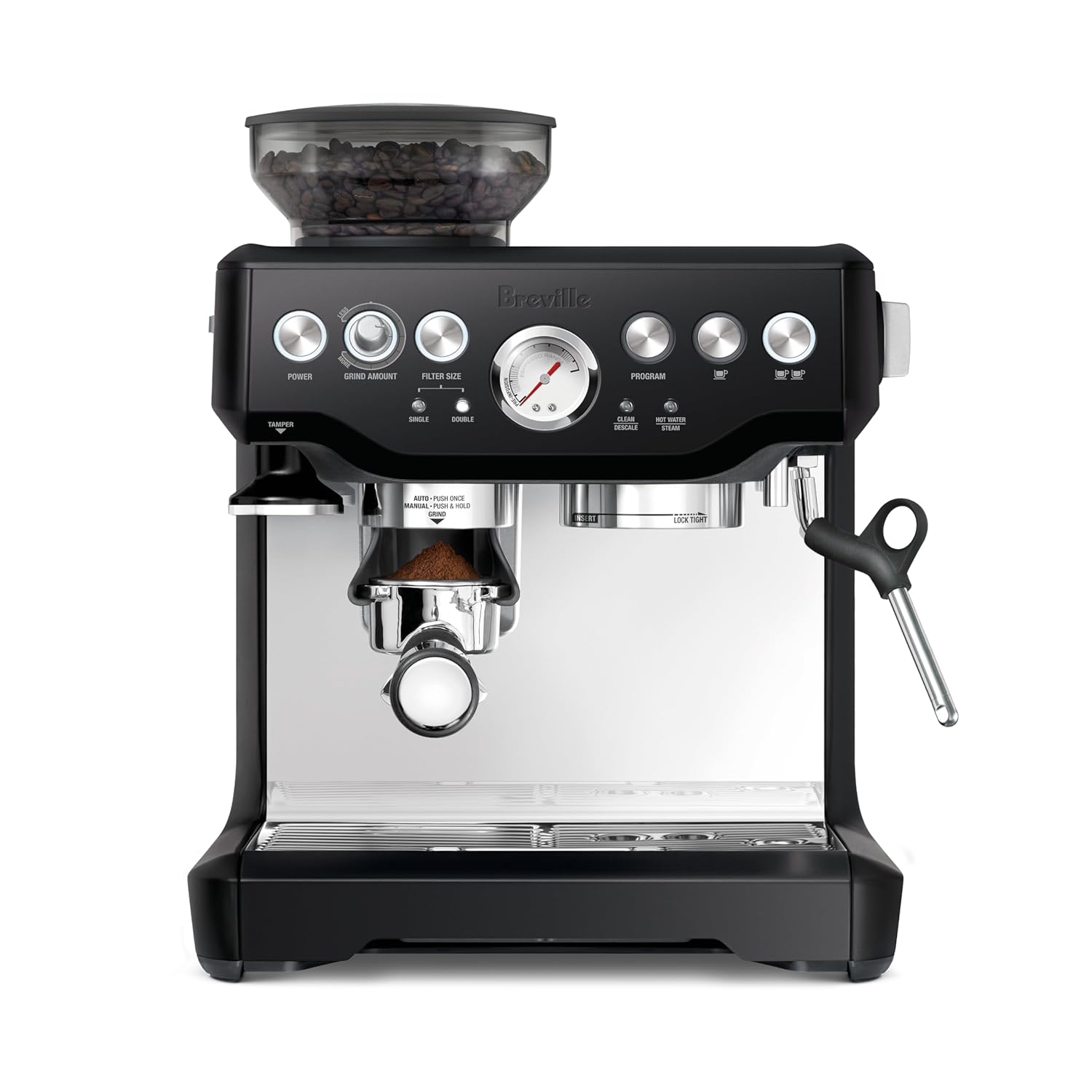
The Breville Barista Express BES870BTR combines an integrated conical burr grinder, PID temperature control, and a manual steam wand to take whole beans to espresso in under a minute. You grind on demand with 16 precision grind settings and dose control that deposits freshly ground coffee into the 54mm portafilter, then use low-pressure pre-infusion and digital temperature regulation for more consistent extraction. The steam wand produces hand-textured microfoam suitable for latte art, and included accessories (tamper, filter baskets, stainless milk jug) make setup straightforward. Practical benefits include compact bench footprint relative to its features, fast heat-up and strong steam power, and the ability to dial in shots for different beans. Important limitations are that it requires manual tamping and some learning to consistently hit ideal extractions and microfoam, and the machine is heavier and more maintenance-intensive than simpler pod or automatic machines. For buyers who value control and quality, it is a capable home barista tool; casual users expecting push-button convenience may prefer an automated alternative.
Best for: Buyers who want hands-on control over grinding, dosing, extraction, and milk texturing to craft cafe-quality espresso and milk drinks at home while valuing verified performance and established reviews.
Less Ideal for: Those who prefer one-touch, fully automatic beverage making or want a low-maintenance, grab-and-go coffee solution.
- Integrated conical burr grinder with dose control for fresh grounds on demand
- PID digital temperature control and low-pressure pre-infusion for more consistent espresso extraction
- Powerful steam wand capable of producing microfoam for latte art
- Comes with essential accessories (54mm portafilter, tamper, milk jug, cleaning tools)
- Requires manual tamping and technique development to get consistent results
- Heavier and needs regular cleaning and maintenance compared with simpler machines
Verdict: Choose the Barista Express if you want a single machine that grinds, doses, and steams to deliver cafe-quality espresso with hands-on control.
PHILIPS 5500 Series EP5544/94
| Operation Mode | Fully Automatic |
|---|---|
| Output Pressure | 15 bar |
| Coffee Input Type | Ground, Whole Bean |
| Capacity | 1.8 liters |
| Wattage | 1500 watts |
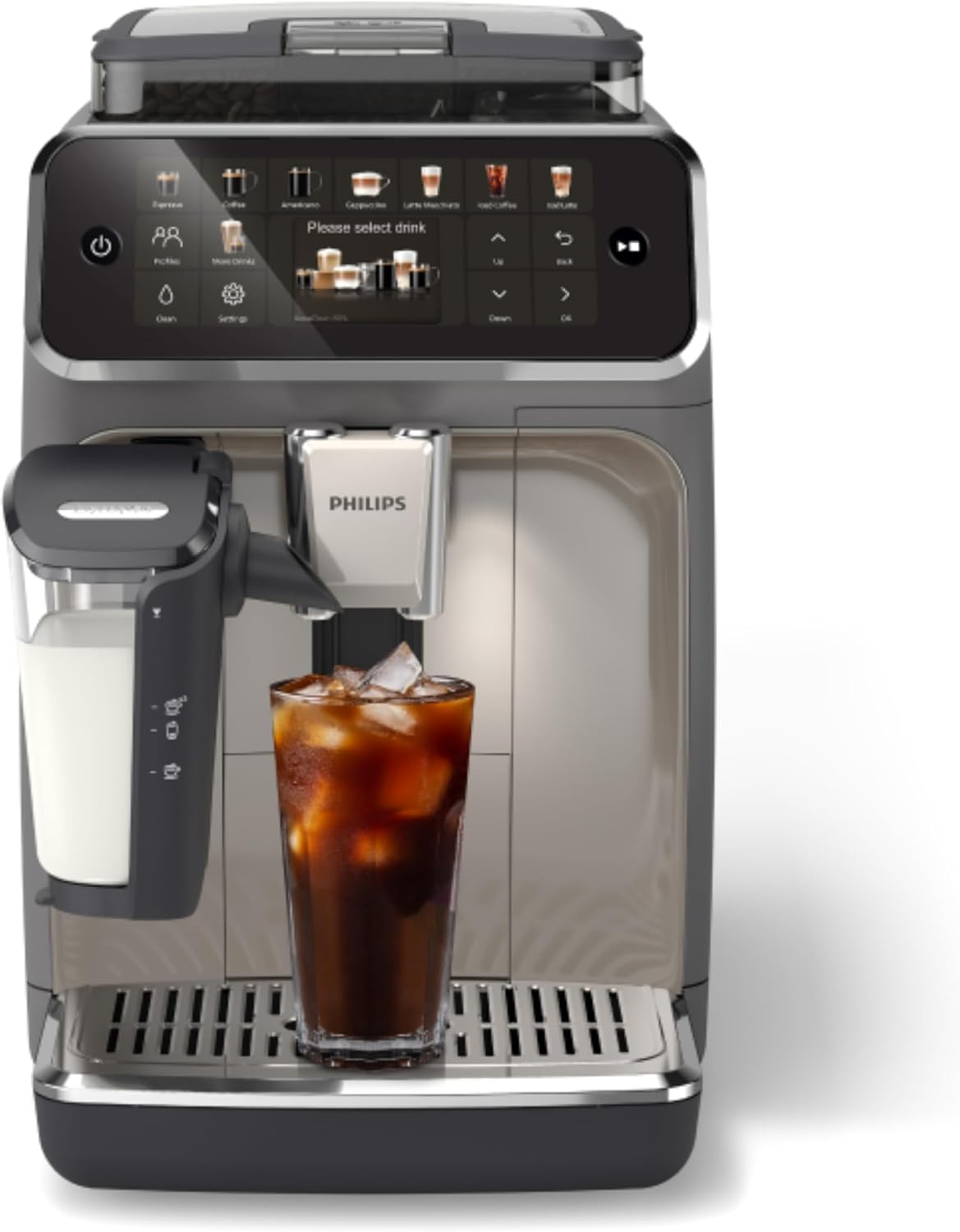
The Philips 5500 Series EP5544/94 is a super-automatic espresso machine designed to grind, tamp and brew with minimal user input. It uses a built-in ceramic grinder and a 15-bar pump to produce espresso and specialty drinks, while the LatteGo milk system froths and dispenses milk automatically for lattes and cappuccinos. The color touch display and saveable profiles let you adjust strength, volume and milk level and recall favorites quickly, and QuickStart brings the machine to brew-ready status in about three seconds. Practical benefits include a nearly hands-free workflow for daily use, a very quiet grind thanks to SilentBrew sound shielding, and an AquaClean filter option that reduces descaling frequency. Limitations to consider are the learning curve for cleaning and maintenance despite the simplified milk unit, and the machine's size and 230 V specification that make it better suited to kitchens with adequate counter space and compatible power. For buyers prioritizing reliable, repeatable cafe-style drinks at home, this machine delivers strong convenience and customization.
Best for: Buyers who want reliable, cafe-style drinks at home with minimal barista skill and value quiet, repeatable automation and saved drink profiles.
Less Ideal for: People who need a compact, travel-friendly espresso solution or who prefer manual control and ritual over automated convenience.
- One-touch operation with 20 presets and saveable profiles for consistent drinks
- LatteGo milk system produces smooth froth and is quick to clean
- Built-in ceramic grinder and 15-bar pump for consistent extraction
- QuickStart and SilentBrew reduce wait time and operating noise
- Requires regular cleaning and maintenance to keep performance and hygiene
- 230 V specification may not be compatible with all households without proper wiring
Verdict: If you want quiet, one-touch espresso and milk drinks with consistent results and saved profiles, the Philips 5500 Series is a top choice.
Choosing the Right High-End Espresso Machine: Key Factors to Consider
Extraction Consistency
Consistent extraction is the most direct determinant of espresso quality. Machines that maintain even water distribution and stable flow rates let you dial in grind size, dose, and yield with predictable results. Variability in extraction leads to swings in taste from shot to shot, making it hard to judge whether taste changes are due to coffee, grind, or the machine itself.
For home baristas a machine that promotes repeatable extraction reduces time spent troubleshooting and improves the success rate for new recipes or single-origin beans.
Temperature Management
Accurate and stable temperature control affects flavor clarity and extraction balance. High-end machines use heat-stable boiler systems, PID controllers, or dual boilers to keep brew temperature within a narrow band. That precision matters because a few degrees can shift perceived acidity, sweetness, and bitterness.
If you plan to pull back-to-back shots or experiment with different roast levels, look for boilers and controls designed to minimize temperature drift and recover quickly between shots.
Steam Power and Milk Texturing
If you make milk drinks, steam pressure and wand design determine how easily you can produce microfoam. High steam power shortens texturing time and lets you create silky microfoam for latte art, while a well-engineered wand gives you both power and tactile control. Weak steam systems force longer texturing times and limit the range of milk textures you can achieve.
Consider how often you will steam milk and whether you prioritize speed, control, or both when evaluating steam systems.
Build Quality and Serviceability
A high-end machine should be built from durable materials and designed to be serviced. Metal components, reliable pumps, and quality seals reduce the need for repairs. Equally important is accessibility: machines that allow routine maintenance tasks such as group-head cleaning, gasket replacement, and descaling without specialized tools are easier to keep in peak condition.
Serviceability also affects total ownership experience. Machines that are difficult to disassemble or rely on proprietary single-use parts tend to cost more in maintenance and downtime.
User Interface and Workflow
The control layout, programmability, and general workflow affect how comfortable and efficient it is to use a machine every day. Some home baristas prefer simple, mechanical controls for tactile feedback, while others want programmable dosing and precise display readouts. Consider how the machine integrates with your grinder, how easy it is to access the portafilter, and whether the group-head ergonomics match your typical routine.
A thoughtful workflow reduces setup time, minimizes wasted coffee, and makes consistent results easier to achieve for both new and experienced users.
Size, Footprint, and Installation Needs
High-end machines come in a range of sizes and may have specific installation requirements. Larger dual-boiler models need more counter space and may require a dedicated electrical circuit. Water supply options vary: some high-end machines support a plumb-in line while others rely on removable reservoirs.
Evaluate the footprint against your available counter space, vertical clearance for cleaning, and whether you prefer a plug-and-play reservoir model or a permanent plumb-in solution to reduce manual refilling.
Boiler Configurations Explained
High-end machines typically use one of several boiler architectures: single heat exchanger, dual boiler, or multiple independent boilers. Each has tradeoffs in terms of temperature stability, steam power, and heat-up time.
Single heat-exchanger machines can produce both brew and steam from one boiler but require careful temperature management for consecutive shots. Dual-boiler designs separate brew and steam duties to maintain steady brew temperature while offering strong steam performance. Multiple independent boilers give the greatest control at the cost of added complexity and often larger footprints.
- Single boiler with heat exchanger: compact and capable, but needs warm-up and cooling strategies.
- Dual boiler: best for simultaneous steaming and brewing with strong temperature stability.
- Independent boilers: top-tier control for advanced users who want discrete tuning for each function.
Dose, Grind, and Group-Head Dynamics
Even the best machine cannot compensate for an inconsistent grind or improper dose. Focus first on a consistent grinder and learn to dial in dose and grind size for the coffee you use most often. The group-head and portafilter design affect how water engages the puck and how easy it is to flush or pre-infuse.
Pre-infusion options and flow-control features available on many high-end machines let you shape extraction and reduce channeling. These functions are particularly helpful when working with delicate single-origin beans or when you want to emphasize sweetness over body.
- Use a stable, high-quality grinder to unlock a machine's potential.
- Adjust dose and distribution to reduce channeling before changing machine settings.
- Leverage pre-infusion and flow control for more predictable extraction on varied beans.
Routine Maintenance and Longevity
Regular maintenance keeps a high-end espresso machine performing reliably. Important tasks include backflushing the group head, descaling where necessary, replacing gaskets and shower screens periodically, and cleaning the steam wand after every use.
Create a maintenance schedule that matches your usage. Heavy daily use requires more frequent professional service intervals. Machines with user-replaceable parts and clear access panels make routine upkeep simpler and less costly over the life of the unit.
- Backflush weekly with appropriate detergent for pressurized systems.
- Purge and wipe the steam wand after each steaming to prevent milk residue buildup.
- Keep a log of part replacements and service dates to track long-term maintenance needs.
Workflow Tips for Faster Mornings
Small workflow adjustments save time and improve shot consistency. Prepare your grinder and portafilter while the machine reaches operating temperature so you can pull shots promptly when the brew temperature is stable. Use a bottomless portafilter during dialing-in sessions to spot channeling early.
Organize tools and supplies near the machine: tamping mat, distribution tool, dosing cup, and a dedicated pitcher for milk. Efficient layout reduces movement and helps keep extraction times consistent when making multiple drinks.
- Warm the group head with a blank shot or short flush before brewing.
- Pre-weigh doses when dialing in to speed adjustments.
- Keep commonly used supplies within arm's reach to shorten drink prep time.
Choosing Between Manual and Programmable Controls
Control philosophy is a personal choice. Manual lever and rotary-style machines provide hands-on feedback that many enthusiasts value for tactile control. Programmable machines with PID displays and programmable volumetric doses reduce variability and make repeatable recipes easier.
If you plan to experiment frequently or share the machine with others who prefer simple presets, programmable controls can offer convenience. For purists who enjoy the craft of pulling shots manually, mechanical interfaces may provide a more satisfying experience.
- Programmable dosing saves time and reduces human error.
- Manual interfaces offer direct feedback and often simpler repairability.
- Consider who will use the machine and how much they will rely on presets versus manual control.
How We Chose the Best High-End Espresso Machine
We focused on attributes that directly affect brewing consistency, durability, and user control. Primary evaluation criteria included extraction consistency, temperature management and boiler design, steam power and milk texturing ability, build quality and serviceability, and user interface plus workflow efficiency. Each machine had to demonstrate competent performance across these dimensions in spec sheets and manufacturer documentation. We excluded entry-level and semi-automatic units that lack precise temperature control or adequate steam pressure. Super-automatic machines were not considered if they do not allow manual dosing or stepless grind adjustment, since the target audience prioritizes hands-on shot tuning. We also filtered out machines with poor documented serviceability or limited parts availability. The final shortlist balances machines that are easy to dial in with those that deliver repeatable results under regular home use.
Our full evaluation process is outlined in our review methodology.
FAQ
How important is a PID controller on a high-end machine?
A PID controller gives you precise control over brew temperature and reduces fluctuations between shots. It is particularly valuable if you roast or use beans that respond to small temperature shifts, but even casual users appreciate the consistency it provides.
Do I need a plumb-in water line for a high-end machine?
A plumb-in line simplifies continuous use and avoids frequent reservoir refills, but it also requires proper water filtration and installation. For many home setups, a removable reservoir combined with regular water treatment is sufficient.
How often should I descale or service a high-end espresso machine?
Descaling frequency depends on water hardness and usage. Light to moderate home use may need descaling every few months, while heavy use or hard water environments require more frequent attention. Regular visual checks and following manufacturer maintenance guidance are the best approach.
Can a high-end machine improve espresso made with a basic grinder?
A high-end machine can make extraction more stable, but grind consistency is essential. A poor grinder will limit the machine's ability to produce consistent shots, so investing in at least a competent burr grinder is recommended.
Are dual boilers worth it for home users?
Dual boilers offer simultaneous brewing and steaming with excellent temperature control, which is valuable for frequent milk drink preparation and consistent shot timing. For users who rarely steam milk or prefer smaller footprints, a single heat-exchanger machine may be adequate.
Final Verdict
Choosing a high-end espresso machine means balancing extraction stability, steam performance, and long-term serviceability against space and workflow needs. Prioritize temperature control and consistent extraction first, then match steam power and interface style to how you prepare drinks. Be realistic about maintenance and installation requirements so the machine fits your daily routine. Focus on the criteria that matter most to your brewing style and kitchen setup, and you will end up with a machine that rewards regular use with better, more consistent espresso.