
Note: This article contains affiliate links. If you click on these links and make a purchase, we may earn a small commission at no extra cost to you. This helps support our research and content. Read our full affiliate disclosure here.
If you need strong, focused airflow to cool big rooms, garages, or workshops, choosing the right High Velocity Fan matters. These fans are designed to move a lot of air quickly and withstand heavier use than typical household fans, so pick a model that matches your room size, mounting needs, and noise tolerance. This guide shortlists the top High Velocity Fans across common home and utility use cases and explains the practical tradeoffs buyers face. Below you will find compact picks for portable cooling, options built for continuous operation, and models suited to mounting or floor use, with evaluation across airflow, durability, and ease of placement.
Top Picks at a Glance
| Best Overall The best all-around choice for most situations | DREO DR-HPF013 Pedestal Fan |  |
| Best Quality Built to a higher standard if you want something more solid | HiCFM 20" Metal Floor Fan |  |
| Best Value The sweet spot between price and what you get | Amazon Basics 20" High Velocity Fan |  |
| Best Budget The cheapest option that still gets the job done reliably | Honeywell TurboForce HT-904 |  |
| Top Rated A top-rated pick with lots of positive feedback | XPOWER P-230AT Mini Air Mover |  |
| Most Popular A crowd favorite that many people choose with confidence | DREO Tower Fan 307 |  |
| Best Seller A high-volume bestseller chosen again and again | Lasko Pivoting Pro 12" Fan |  |
DREO DR-HPF013 Pedestal Fan

| Number of Speeds | 8 |
|---|---|
| Noise Level | 28.2 db |
| Wattage | 36 |
| Air Flow Capacity | 1000 cfm |
| Motor Type | Brushless |
The DREO DR-HPF013 is a high-velocity pedestal air circulator designed to move a lot of air quietly across a whole room. It uses a brushless DC motor and a three-blade TurboPoly design to deliver up to 1000 CFM and claims coverage up to about 90 feet, which makes it suited for bedrooms, living rooms, or kitchens where a fast airflow is needed. Controls are available on a top touch panel or the included remote, and features like 8 speed levels, an 8-hour timer, auto mode that adjusts speed with temperature, 90° horizontal oscillation and a 105° manual tilt make it flexible for directing air where you need it. The fan is freestanding with adjustable height and a detachable grille and blade for easier cleaning, and a built-in aroma pad adds a small extra convenience. At 36 watts and a measured noise level around 28 dB on low speeds, it balances power with reasonable quiet operation, though the strongest settings will be noticeably louder and the plastic construction may feel less premium than metal alternatives.
Best for: Buyers who want a powerful yet reasonably quiet room circulator that covers large living spaces and offers flexible controls and positioning.
Less Ideal for: Those seeking an industrial-grade metal high-velocity fan or a nearly silent unit for very noise-sensitive bedrooms should consider other specialized options.
- High airflow rated at 1000 CFM for whole-room circulation
- Brushless DC motor for efficient, quieter operation
- Multiple controls including remote, touch panel, timer, and auto mode
- Adjustable height, wide oscillation and large tilt range to target airflow
- Detachable grille and blades for easier cleaning
- Plastic construction may feel less durable than metal high-velocity fans
- Top speeds are louder despite low-speed quiet performance
Verdict: Choose this DREO pedestal fan when you need strong, directed whole-room airflow with convenient controls and quieter low-speed performance.
HiCFM 20" Metal Floor Fan

| Number of Speeds | 3 |
|---|---|
| Wattage | 150 watts |
| Air Flow Capacity | 5300 cfm |
| Motor Type | brushless |
| Power Source | AC |
The HiCFM 20" metal floor fan is a compact high-velocity unit built for heavy-duty airflow in garages, workshops, basements, and similar spaces. It uses a 1/5 HP permanently lubricated motor and metal blades to push up to roughly 5300 CFM across three manual speeds, giving you a lot of directed breeze for cooling, ventilation, or speeding dry times. The fan can sit freestanding, tilt vertically through 360 degrees for targeted airflow, and includes hardware if you want to wall-mount it instead of floor placement. Practical benefits include a long power cord for flexible positioning and a powder-coated metal housing designed to resist corrosion in tougher environments. Expect audible motor noise at higher speeds since this is a high-CFM industrial-style fan and there are no electronic speed presets or remote controls. Control is simple push-button/manual switching, which keeps the design rugged but means fewer convenience features. For someone focused on raw performance and durability, this fan delivers strong, reliable airflow in a compact footprint.
Best for: Buyers who prioritize maximum airflow and rugged build for workshops, garages, or commercial spaces and want a no-nonsense high-performance fan.
Less Ideal for: People seeking quiet, decorative, or feature-rich home fans with smart controls or remote operation should consider other models.
- High airflow capacity up to 5300 CFM for strong ventilation and cooling.
- All-metal construction with powder-coated finish for durability in workshop or commercial settings.
- Permanently lubricated 1/5 HP motor designed for continuous use.
- 360 degree tilt and optional wall-mount hardware for flexible airflow direction.
- Three simple speed settings and a long power cord for versatile placement.
- No electronic controls, timer, or remote for convenience.
- Can be loud on higher speeds due to high-velocity operation.
Verdict: Choose this fan when you need compact, industrial-strength airflow and a durable metal build for performance-focused workshop or commercial use.
Amazon Basics 20" High Velocity Fan

| Number of Speeds | 3 |
|---|---|
| Wattage | 125 watts |
| Air Flow Capacity | 3542 cfm |
| Power Source | Corded Electric |
| Specification Met | ETL |
This 20-inch high velocity floor fan is built for moving a lot of air in garages, workshops, gyms, and other large indoor areas. Its 125W motor and three aluminum blades produce a rated 3,542 CFM at the highest setting, while a three-speed rotary control and adjustable tilt head let you aim airflow where it is needed. The all-metal housing and ETL listing make it durable and appropriate for commercial use, and tool-free assembly means you can get it running quickly. In practice it is loud on high speed, which is expected for this class, and it is a single-purpose circulation fan rather than a quiet or decorative room fan. The unit is free-standing and corded, so placement is flexible but requires an outlet nearby. If you need rugged, no-nonsense airflow to cool a large space or move air for ventilation, this fan delivers the power and build quality to do that reliably.
Best for: Buyers who prioritize strong, reliable airflow and durable construction for cooling or ventilating large indoor spaces and want a straightforward, heavy-duty fan rather than a quiet or decorative unit.
Less Ideal for: Those seeking a quiet bedroom fan, a decorative living-room fan, or a portable battery-powered cooler should look elsewhere.
- High airflow capacity of 3,542 CFM for rapid circulation in large spaces
- Commercial-grade metal construction and aluminum blades for durability
- Three-speed rotary control and adjustable tilt head for directed airflow
- ETL-listed safety compliance suitable for commercial environments
- Louder operation on high speed compared with household fans
- Requires a nearby power outlet since it is corded and free-standing
Verdict: Choose this fan when you need powerful, commercial-grade airflow to cool or ventilate large indoor spaces reliably.
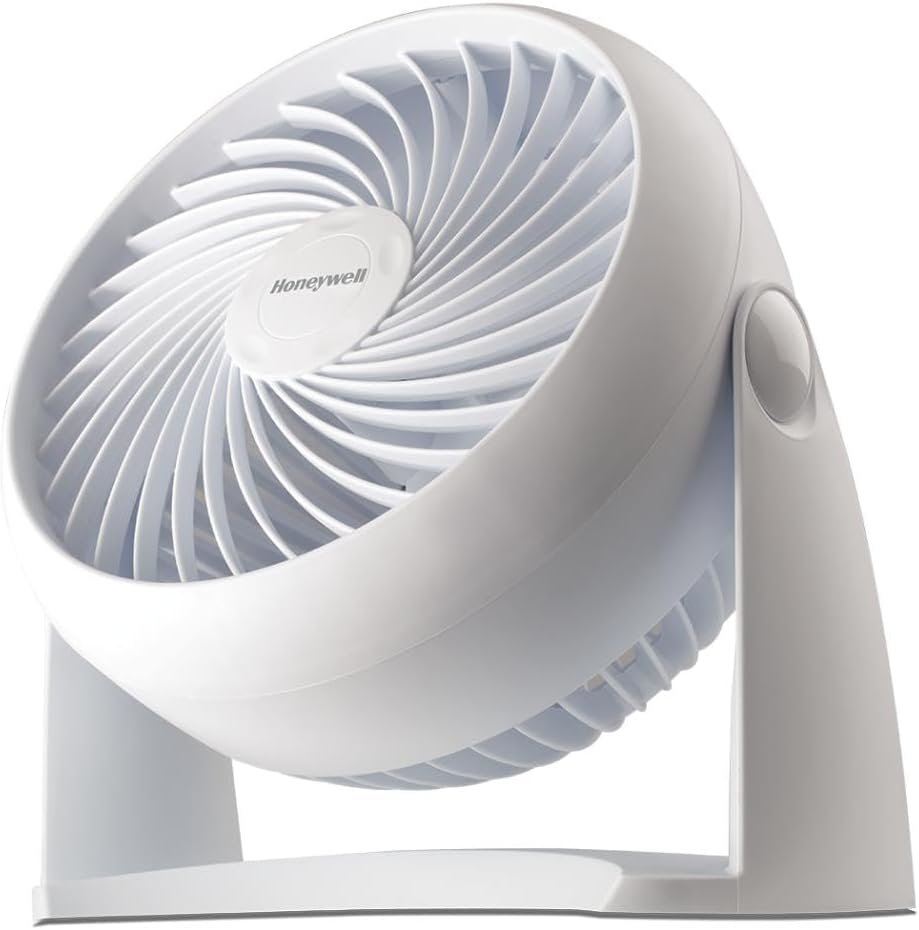
Honeywell TurboForce HT-904
| Power Source | Corded Electric |
|---|---|
| Number of Speeds | 3 |
| Air Flow Capacity | 185 cfm |
| Noise Level | 25 db |
| Motor Type | Brushless |
The Honeywell TurboForce HT-904 is a small, portable air circulator designed to move a lot of air from a compact footprint. It uses an aerodynamic turbo design and a brushless motor to push up to 185 cfm, and the 90-degree pivoting head lets you aim airflow where you need it for cooling or improved room circulation. Controls are simple push-button operation with three speeds, and the unit is quiet enough for bedrooms or home offices with a listed noise level around 25 dB. Its lightweight plastic build and included cord make it easy to set on a desk, shelf, or mount on a wall. Limitations include a basic feature set with no remote, timer, or oscillation and a small fan size that is best for personal to small-room use rather than cooling large open areas. For buyers focused on straightforward, effective airflow without extra bells and whistles, this model is an efficient, low-cost option.
Best for: Buyers who want an affordable, no-frills high-velocity tabletop fan to boost personal cooling or improve room circulation without extra features or complexity.
Less Ideal for: If you need whole-room cooling for large open spaces, smart controls, or advanced features like oscillation and timers, consider a larger or feature-rich model instead.
- Powerful turbo design delivers strong directed airflow up to 185 cfm
- Brushless motor for reliable operation and efficient performance
- Compact, lightweight and portable for tabletop, floor, or wall mounting
- Three simple speeds and 90° pivoting head for precise airflow direction
- Relatively quiet operation suitable for bedrooms and home offices
- No remote control, timer, or oscillation feature for hands-off operation
- Basic plastic construction may feel less premium than larger units
Verdict: A compact, budget-friendly high-velocity tabletop fan that delivers strong, directed airflow for personal cooling and room circulation.
XPOWER P-230AT Mini Air Mover

| Air Flow Capacity | 925 cfm |
|---|---|
| Wattage | 150 watts |
| Number of Speeds | 3 |
| Voltage | 115 |
| Motor Type | AC induction motor |
The XPOWER P-230AT is a compact, utility-grade air mover designed for fast surface drying and focused ventilation in tight spaces. It produces up to 925 CFM from a 1/4 HP AC induction motor while drawing only about 2.3 amps, and offers three speed settings plus a 3-hour timer for hands-off runs. The unit stacks for storage, has four tilt positions (0, 20, 45, 90 degrees) to direct airflow, and includes two onboard power outlets and a 12A circuit breaker so multiple units can be chained together without extra cords. Its lightweight plastic housing and integrated handle make it easy to carry to bathrooms, crawl spaces, vehicle interiors, or small restoration jobs. Important limitations are its plastic construction, which is robust but not as heavy-duty as metal-frame professional blowers, and the noise level typical of high-velocity movers. For anyone who needs reliable, repeatable airflow in small to medium drying and ventilating tasks, this model balances power and portability well.
Best for: Buyers who prioritize dependable, repeatable drying and ventilation for small restoration, janitorial, or home projects and want a portable unit that can be linked with others for larger jobs.
Less Ideal for: Customers needing an all-metal industrial-grade blower for continuous heavy construction use or those who require ultra-quiet airflow for living spaces.
- High peak airflow up to 925 CFM for fast surface drying
- Three speed settings plus a 3-hour timer for controlled runtime
- Built-in power outlets and daisy chain capability to run multiple units
- Stackable, lightweight design with multiple tilt positions for targeted airflow
- Energy-efficient 1/4 HP AC motor that draws low amperage
- Plastic housing is durable but less rugged than metal commercial frames
- Typical high-velocity noise level that may be intrusive in quiet settings
Verdict: A reliable, portable high-velocity air mover that delivers professional-level airflow and daisy-chain flexibility for repeatable drying and ventilating tasks.
DREO Tower Fan 307

| Number of Speeds | 8 |
|---|---|
| Modes | Normal, Natural, Sleep, Auto |
| Oscillation | 90° |
| Wattage | 36 watts |
| Motor Type | brushless DC motor |
The DREO Tower Fan 307 is a compact 36-inch oscillating floor fan built around an upgraded brushless DC motor that pushes strong airflow while keeping noise low. It offers eight speed settings and four modes including Normal, Natural, Sleep, and Auto, so you can dial in anything from a gentle bedroom breeze to a higher-velocity boost; the unit supports remote and touchpad control for easy adjustments. With 90 degree oscillation and a claimed airflow capacity for broad room coverage, it pairs well with an air conditioner to circulate cool air more effectively. Practical touches include a timer, removable rear grille and impeller for easier cleaning, and ETL safety certification. On the downside the fan runs on standard corded power and lists voltage at 240 volts which may matter for some regions, and the plastic construction means it is lightweight but less premium-feeling than metal alternatives. For buyers focused on quiet, adjustable oscillating cooling in bedrooms or living rooms, this model balances airflow and low noise in a small footprint.
Best for: Buyers who want a quiet, adjustable tower fan that delivers wide oscillating coverage and easy remote control for bedrooms and living spaces backed by strong customer feedback.
Less Ideal for: People seeking a heavy-duty, industrial-strength fan or a premium metal build should consider sturdier floor or bladeless alternatives.
- Brushless DC motor for efficient, high-velocity airflow with lower noise
- Eight speed levels and four modes for flexible comfort settings
- 90° oscillation spreads air across a wide area for better room coverage
- Includes remote and touch controls plus a timer for convenient operation
- Removable rear grille and impeller simplify cleaning and maintenance
- Plastic construction feels less durable compared with metal fans
- Corded operation and listed voltage may limit regional compatibility
Verdict: A feature-rich, quiet oscillating tower fan that gives flexible speeds and modes for effective bedroom and living-room cooling.
Lasko Pivoting Pro 12" Fan

| Power Source | Corded Electric |
|---|---|
| Number of Speeds | 3 |
| Air Flow Capacity | 289 cfm |
| Motor Type | Brushless |
| Noise Level | 59.3 db |
The Lasko Pivoting Pro 12" is a small but powerful utility blower that delivers up to 289 CFM across three speeds, making it useful for cooling people, drying floors or paint, and ventilating garages or workshops. Its pivoting head offers roughly 270 degrees of adjustability so you can aim airflow up, down, or at an angle to target a specific spot, and the built-in carry handle and 10-foot cord make it easy to move and place where needed. Two grounded power outlets on the housing are a practical touch for job-site use because they let you power tools nearby without extra extension cords. The fan is ETL listed, includes a circuit breaker/reset for protection, and uses a brushless motor for reliable operation. Trade-offs are its basic three-speed rotary control and a noise level around 59 dB on high, so it is louder than quieter room fans and has no timer or remote; those are typical for a compact high-velocity blower but worth noting if silent operation or fine control matter. For straightforward, heavy airflow in work or utility spaces this fan is straightforward and dependable.
Best for: Buyers who prioritize dependable, high-volume airflow for garages, workshops, basements, or job sites and want a simple, safety-minded appliance that works right out of the box.
Less Ideal for: If you need whisper-quiet operation, precise speed control, or remote/timer features for bedroom use, look at quieter indoor fans designed for living spaces instead.
- High airflow up to 289 CFM for fast cooling and drying
- 270-degree pivoting head to precisely aim the air stream
- Two built-in grounded outlets to power tools or devices nearby
- Long 10-foot power cord and carry handle for easy placement and transport
- ETL listing and motor protection with circuit breaker for safer operation
- No remote, timer, or advanced speed settings beyond the three rotary positions
- Relatively loud at higher speeds compared with household circulation fans
Verdict: Choose this fan when you need a compact, safety-minded blower that delivers strong, directed airflow for drying and ventilating utility spaces.
Choosing the Right High Velocity Fan: Key Factors to Consider
Airflow Capacity and Coverage
Airflow capacity determines how quickly a High Velocity Fan can change the air in a room and create perceptible cooling. Look for manufacturers' airflow ratings and compare how wide and far the airstream projects, because a high CFM concentrated in a narrow beam differs from broad, room-filling circulation.
Consider room size and typical placement. A fan that excels at focused, long-throw airflow is ideal for workshop benches or drawing heat away from a single area, while fans with wider dispersion work better for living spaces. Matching airflow to space prevents buying a unit that is too weak or unnecessarily large for your needs.
Build Quality and Materials
Durable construction matters for fans expected to operate in garages, basements, or commercial-style spaces where dust, bumps, and extended runtimes are common. Metal housings, reinforced blades, and sealed motor housings resist wear and tear better than light plastic components.
Also evaluate guard design and fasteners. A sturdy safety grill, secure tilt mechanisms, and corrosion-resistant finishes increase lifespan and reduce maintenance in humid or dusty environments.
Mounting Options and Placement Versatility
High Velocity Fans are useful when they can be positioned exactly where airflow is needed. Check whether a model supports floor placement, wall mounting, ceiling mounting, or comes with an adjustable tilt base. Portability features like handles and compact footprints can make a heavy-duty fan practical to move between rooms or job sites.
The ability to change mounting angle and to lock positions without rattling affects real-world usefulness. If you plan to use a fan permanently on a wall or ceiling, confirm the mounting hardware and clearance requirements align with your space.
Noise and Comfort During Operation
High-speed fans naturally produce more noise than casual household fans. Noise level becomes an important factor if the fan will operate near living areas, home offices, or overnight. Look for models with aerodynamic blade design and motor speed controls that let you balance airflow against sound.
Consider the type of noise as well. A steady, lower-frequency hum is often easier to tolerate than sharp or rattling sounds, which can indicate build issues. If you need prolonged operation in occupied spaces, prioritize models with quieter operation at the speeds you intend to use most.
Continuous-Use Reliability and Motor Protection
Many buyers run High Velocity Fans for extended periods. Motors designed for continuous duty, with thermal protection and adequate ventilation, reduce the risk of overheating and premature failure. Look for fans with thermal cutoff or sealed bearings to handle long runtimes.
Serviceability matters too. Models with accessible motor housings, replaceable parts, and clear maintenance guidance will last longer and be easier to keep running under heavy use.
Where High Velocity Fans Work Best
These fans excel where concentrated, high-volume airflow is required. Typical use cases include garages, workshops, covered patios, and large open-plan rooms where moving hot or stagnant air quickly provides the biggest comfort benefit. They are also useful for drying floors, ventilating smoky or dusty spaces, and cooling specific workstations or equipment.
- Focused long-throw airflow for benches and machinery
- Wide-dispersion models for whole-room circulation
- Portable options for temporary cooling or drying tasks
Mounting and Installation Tips
Plan mounting with clearance and airflow direction in mind. For wall or ceiling mounts, ensure the fan has secure hardware and that the mounting surface can handle vibration. When placing on the floor, use rubber feet or vibration isolators to reduce noise transfer to the structure.
If you intend to use a fan in a fixed location for long periods, angle the head to maximize cross-ventilation rather than blowing against a wall; this amplifies circulation and reduces hot spots.
- Confirm mount ratings and fastener types
- Allow clearance for airflow and maintenance access
- Use isolation pads to limit vibration transmission
Managing Noise and Vibration
Minor vibration or whine is common at high speeds, but excessive shaking or intermittent rattles indicate poor assembly or loose fittings. Secure all grill screws and tilt-locks during setup and recheck after a few days of operation. Choosing models with balanced blades and thicker guards typically reduces perceptible vibration.
If noise is a concern, place the fan farther from occupied seating and use lower speeds during periods when quiet is important. Angling the fan to create indirect circulation can maintain effectiveness while lowering direct airflow at ear level.
- Tighten mounting hardware after initial run-in
- Prefer balanced-blade designs and shielded grills
- Lower speed or distance reduces perceived loudness
Energy Use and Long-Term Operating Cost
High Velocity Fans consume more power at top speeds than smaller room fans, but they can be more efficient than running air conditioning when used strategically. Use timed operation or thermostatic controls where available to avoid needless runtime. Comparing motor efficiency and speed control options helps predict long-term energy use.
For continuous-use applications, look for motors with sealed bearings and effective ventilation. These features reduce friction losses and heat buildup, which helps keep operating costs stable over time.
- Use thermostats or timers to limit run time
- Check motor type and bearing sealing for long-term efficiency
- High airflow at low energy cost comes from efficient motor and blade design
How We Chose the Best High Velocity Fan
We evaluated High Velocity Fans against concrete, buyer-focused criteria that matter for heavy-duty cooling tasks. Our selection filters prioritized measurable airflow performance and distribution patterns, since moving the most air efficiently is the primary purpose of these fans. Durability and construction quality were assessed to ensure reliable operation in workshop, garage, and high-use home environments. We also considered mounting and placement flexibility because many buyers need fans that can sit on the floor, be angled on a stand, or be wall-mounted safely. Noise and motor heat under prolonged operation were examined to balance cooling effectiveness against comfort and longevity. Energy efficiency and motor protection features were included so continuous-use scenarios do not lead to premature failure. Excluded were small, low-output personal fans and designs intended solely for aesthetic or light-duty bedroom use. We focused on units built to move air across larger spaces and to handle frequent or extended operation. The final list reflects those filters and the specific dimensions buyers typically report as most important for heavy-use fans.
Our full evaluation process is outlined in our review methodology.
FAQ
How do I match a High Velocity Fan to my room size?
Start by estimating the cubic footage of the room, then choose a fan with airflow sufficient to create noticeable circulation across that distance. For workshops and garages prioritize long-throw models; for open living spaces choose wider dispersion. Placement and angling are as important as raw CFM when matching fan to room.
Can I mount a High Velocity Fan on the ceiling?
Many models support ceiling or wall mounting but check the manufacturer's mounting rating and required clearances. Ensure the mounting surface is rigid and vibration-resistant, and use proper hardware to secure the fan for continuous operation.
Will a High Velocity Fan be too loud for a bedroom?
High Velocity Fans are typically louder than bedroom fans when run at top speed. If quiet operation is critical, choose models with low-noise designs or plan to run them at lower speeds and position them away from sleeping areas to reduce direct sound exposure.
How often should I maintain a high-velocity unit?
Regular maintenance depends on usage and environment. In dusty or workshop settings check and clean grills and blades monthly and inspect motors and bearings every few months. In cleaner environments a quarterly check and annual lubrication or service is usually sufficient.
Are metal guards safer than plastic guards?
Metal guards tend to be more durable and resist deformation better than plastic, which helps maintain blade clearance and safety over time. However, properly designed plastic guards can also be safe if they are reinforced and meet relevant safety standards.
Final Verdict
Prioritize airflow pattern, build quality, and long-term reliability when choosing a High Velocity Fan. Match the fan's throw and dispersion to how you use the space, and consider mounting options that let you direct air where it matters most. Balance noise and power by planning for the speeds you will use most often and by favoring models with proven motor protection. With those tradeoffs in mind, you can select a fan that delivers strong, dependable cooling for large or demanding spaces.