
Note: This article contains affiliate links. If you click on these links and make a purchase, we may earn a small commission at no extra cost to you. This helps support our research and content. Read our full affiliate disclosure here.
If you want fresher, more flavorful coffee, a dedicated home coffee roaster lets you control roast level, freshness, and flavor development. Choosing the right roaster matters because batch size, temperature control, and ease of use all change the roasting outcome and how often you will roast. This guide covers seven shortlisted home coffee roasters that suit a range of experience levels, from beginners testing green beans to experienced hobbyists dialing in single-origin profiles. We evaluated machines for roast consistency, capacity, user controls, and cleanup to help you pick the best roaster for your routine. Read on for the key factors that separate dependable, repeatable roasters from hobby units that require too much fuss.
Top Picks at a Glance
| Best Overall The best all-around choice for most situations | MAGO MAGA Roma Pro Coffee Roaster |  |
| Best Quality Built to a higher standard if you want something more solid | Kaffelogic Nano7 Coffee Roaster |  |
| Best Value The sweet spot between price and what you get | JIAWANSHUN Home Coffee Roaster FBA066 |  |
| Best Budget The cheapest option that still gets the job done reliably | Kllkmmws Home Coffee Roaster |  |
| Top Rated A top-rated pick with lots of positive feedback | Fresh Roast SR800 Coffee Roaster |  |
| Most Popular A crowd favorite that many people choose with confidence | Nuvo Eco Ceramic Handy Coffee Roaster |  |
| Best Seller A high-volume bestseller chosen again and again | Fresh Roast SR540 | 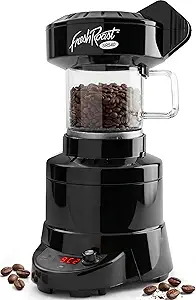 |
MAGO MAGA Roma Pro Coffee Roaster

| Capacity | 0.3 kg |
|---|---|
| Power Source | AC adapter |
| Operation Mode | Semi-Automatic |
| Coffee Input Type | green coffee beans |
| Filter Type | Reusable |
The Roma Pro is a compact home coffee roaster designed to take green beans through hot-air roasting in batches up to 300 g. It offers both automatic profiles for straightforward, repeatable roasts and a manual mode for fine-tuning temperature and timing, with a digital display that toggles between Celsius and Fahrenheit. The double-layer glass viewing window and improved bean bin door switch on version 1.6 make monitoring and handling easier, while the built-in auto-cooling and chaff collection help preserve flavor and reduce smoke during and after a roast. Practical features like the timer, reusable filter, and AC power make it suitable for kitchen countertop use, and CE/ETL certifications speak to basic safety compliance. Limitations include the modest 300 g capacity for those who want larger batches and the fact that it only roasts green beans rather than brewing coffee, so it is an extra step in the home coffee workflow.
Best for: Home coffee enthusiasts who want a reliable, user-friendly way to roast fresh small batches and experiment with roast profiles without professional equipment.
Less Ideal for: People who need larger commercial-sized batches, those wanting an all-in-one machine that also brews coffee, or users who prefer manual drum roasting for very large volumes.
- Auto and manual roasting modes let beginners use presets and experienced users craft profiles
- Digital display with °C/°F switch and timer for clear roast control and repeatability
- Transparent double-layer glass window for live monitoring of roast color
- Auto-cooling and efficient chaff collection minimize over-roasting and smoke
- 300 g batch capacity is small for roast-at-once gifting or larger households
- Designed only to roast green beans and does not brew coffee
Verdict: Choose the Roma Pro if you want a compact, certified home roaster that makes consistent, small-batch roasted beans easy to produce with both automatic and manual control.
Kaffelogic Nano7 Coffee Roaster

| Wattage | 1400 watts |
|---|---|
| Capacity | 120 g |
| Human Interface Input | Touchscreen |
| Power Source | Electric |
The Kaffelogic Nano7 is a small, programmable electric roaster aimed at serious home roasters and sample labs. It handles green coffee batches from about 50 g (with the Boost Kit) up to 200 g, with a recommended everyday batch around 100–120 g green, and offers touchscreen controls plus PC software for saving and sharing roast profiles. The unit uses PID temperature control with a look-ahead and gain scheduling system and lets you adjust both temperature and fan speed to refine development and roast consistency. Practical benefits include a tiny footprint that fits on a countertop, quick setup with preloaded recipes, and the ability to create repeatable profiles for small-batch experimentation. Limitations are the small batch size compared with larger commercial machines and the 14 pound weight that makes it less portable than toy roasters; also the Boost Kit is required to access the full low and high end of the stated batch range. For someone focused on control and consistent micro-batches, the Nano7 delivers lab-style features in a compact package.
Best for: Serious home roasters and hobbyists who prioritize precise control and reproducible small-batch results for experimentation and profile development.
Less Ideal for: People who need higher throughput or larger batch roasting for cafes or bulk production should consider larger commercial roasters instead.
- Programmable PID temperature control with look-ahead and gain scheduling for precise, repeatable roasts
- Adjustable fan speed and temperature allow fine tuning of roast development
- Compact countertop footprint suitable for home kitchens and small labs
- Includes software to save and share roast profiles and comes with basic accessories like bean scoop and chaff collector
- Small maximum batch size compared with larger roasters limits output for higher-volume users
- Full 50–200 g range requires purchasing the Boost Kit add-on
Verdict: The Nano7 puts lab-grade PID control and adjustable airflow into a compact home roaster for buyers who want precise, repeatable small-batch roasting.
JIAWANSHUN Home Coffee Roaster FBA066
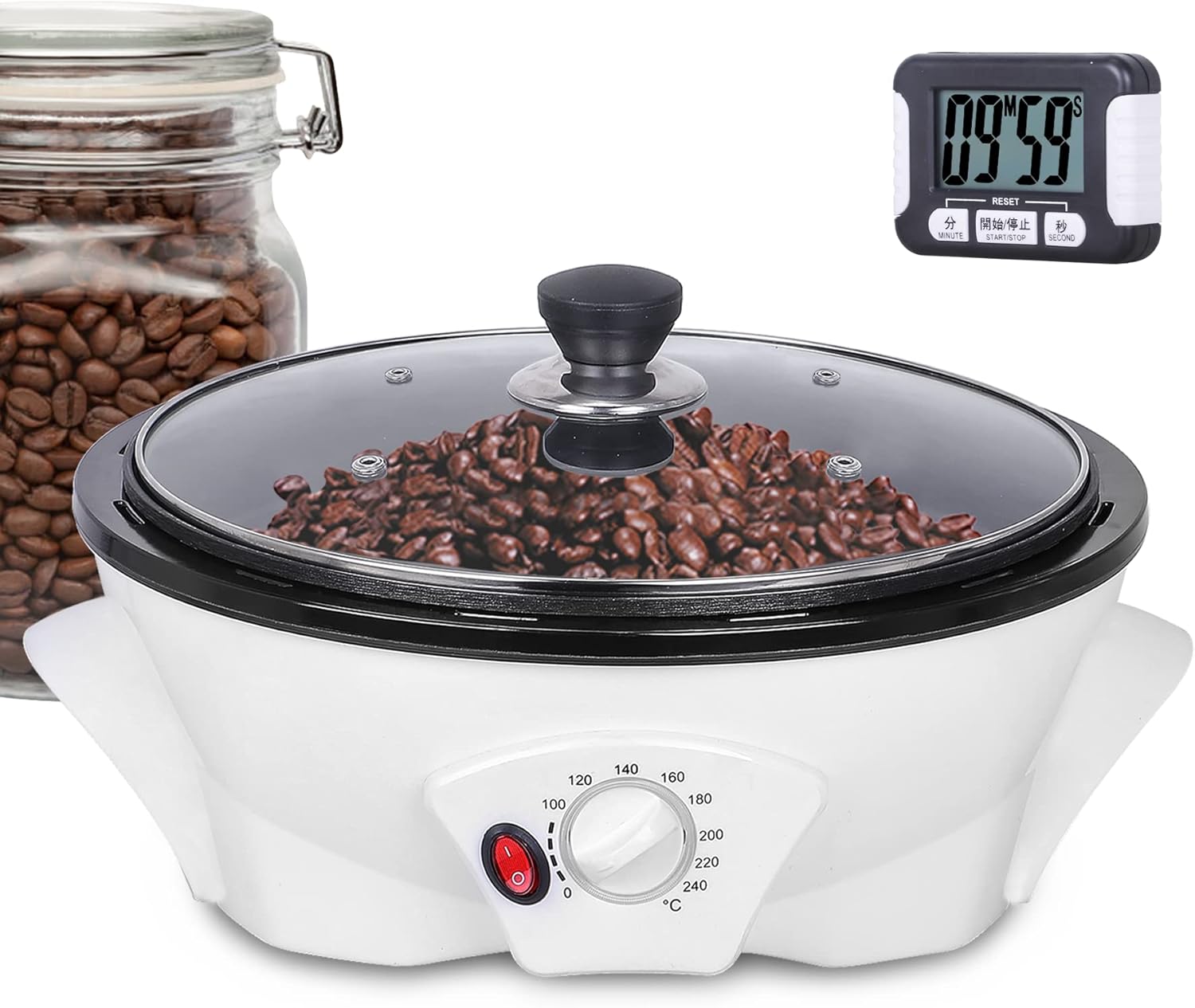
| Capacity | 500g / 1.1 lb |
|---|---|
| Wattage | 1200 W |
| Voltage | 120 volts |
| Temperature range | 0–240℃ |
This JIAWANSHUN roaster is a straightforward small-batch machine designed for home users who want to roast beans from green to light, medium, or dark. It uses a 1200W heater and an automatic stirring rod to rotate beans during roasting, and the clear glass lid with ventilation holes lets you monitor color development without opening the unit. Built-in temperature control (0 to 240°C) and a timer make repeatable sessions easier for beginners, and the honeycomb nonstick interior wipes clean for routine maintenance. The manufacturer recommends 300–500g for the most even results even though the listed capacity is about 500g/1.1 lb, so you may need to run slightly smaller batches for best uniformity. It also doubles as a quick roaster for nuts and seeds. Expect some learning to nail roast profiles, and the plastic and glass construction means it is best used on a stable countertop rather than heavy-duty commercial cycles.
Best for: Home roaster buyers who want an affordable, user-friendly machine to experiment with fresh small-batch roasting and learn basic roast control.
Less Ideal for: People who need high-volume, continuous commercial roasting or a heavy-duty metal machine for daily production should look elsewhere.
- Adjustable temperature control up to 240°C for light to dark roast flexibility
- Integrated timer and one-key operation simplify repeatable roasts for beginners
- Automatic stirring rod promotes even bean rotation during roasting
- Clear glass lid lets you watch roast color and aroma development
- Nonstick honeycomb interior is easy to wipe clean after use
- Recommended effective batch size is smaller than maximum capacity for best evenness
- Plastic and glass construction is less durable than metal-bodied roasters
Verdict: A compact, beginner-friendly home roaster that delivers flexible temperature control and easy, small-batch roasting for enthusiasts looking to roast at home.
Kllkmmws Home Coffee Roaster

| Power | 800W |
|---|---|
| Voltage | 110V |
| Capacity | 500g/1.1lbs |
| Adjustable Temperature Range | 0-240°C/32-464°F |
This tabletop coffee roaster is a simple, budget-friendly way to roast small batches of raw coffee beans at home. It uses a honeycomb pot bottom and a stirring bar to promote even heating while a glass lid with ventilation holes lets you observe color and aroma changes during the roast. You set temperature with a rotary knob (32 to 464°F) and the 500g (1.1 lb) drum handles modest café-level batches that are useful for experimenting with roast profiles. The unit is made of polypropylene with a glass cover, includes side handles for easy moving, and runs on a standard 110V, 800W corded supply. Expect practical benefits such as faster home roasting than pan methods and clearer visual control of roast stages, but be aware it lacks advanced digital controls, automated cooling, and likely needs close monitoring for fully consistent results at the lower capacity range noted in the manual. For home hobbyists on a tight budget it delivers core roasting capability without extras.
Best for: Home coffee hobbyists who want an inexpensive way to roast small batches and experiment with roast stages without investing in pro equipment.
Less Ideal for: People seeking precise, repeatable results, automated roasting cycles, or large commercial throughput should consider higher-end electric or drum roasters.
- 500g capacity suitable for small home or light commercial batches
- Adjustable temperature range up to 240°C for flexible roast profiles
- Glass lid with ventilation holes lets you watch roast progress
- Compact, portable tabletop design with side handles for easy movement
- No digital controls or automated cooling, so roasts require manual attention
- Body material is polypropylene rather than metal, which may affect long-term durability
Verdict: A no-frills, low-cost tabletop roaster that lets budget-minded home users roast modest batches and learn roast control without complex electronics.
Fresh Roast SR800 Coffee Roaster

| Roast capacity | 6–8 oz (170–226 g) per batch |
|---|---|
| Heat settings | 9 levels |
| Fan speed | 9 levels |
| Timer | Adjustable via knob |
The Fresh Roast SR800 is a compact home coffee roaster built for people who want control over small, frequent batches. It roasts 6–8 ounces of green beans in under 10 minutes inside a clear glass chamber so you can watch color development, and a single push-turn knob adjusts heat, fan speed and time across nine settings while the digital display shows temperature in real time. The unit includes an automated cool-down stage and a three-stage cooling process to halt roasting quickly and capture chaff, which helps with cleaner handling and faster turnaround between batches. Its straightforward controls make it accessible to beginners but the wide range of adjustments also supports experienced roasters dialing in specific profiles. Trade-offs are the small batch size — it is designed for home use rather than larger batch roasting — and the learning curve to consistently reproduce precise roast levels since manual tweaking of heat and fan is required.
Best for: Home coffee enthusiasts who prioritize consistent, reliable small-batch roasting and want a machine that offers real-time control and visible feedback during the roast.
Less Ideal for: People who need larger daily output or fully automated profile roasting for commercial or high-volume use should consider larger or more automated machines.
- Visible glass roasting chamber for watching roast color development
- Adjustable heat and fan with nine power levels for fine control
- Digital real-time temperature display for monitoring roasts
- Fast roast cycle and built-in cool-down for quick batch turnaround
- Small 6–8 oz capacity limits output for larger households or entertaining
- Requires hands-on adjustment and practice to achieve repeatable roast profiles
Verdict: Buy this if you want a dependable, small-batch home roaster that gives real-time temperature feedback and hands-on control for consistent results.
Nuvo Eco Ceramic Handy Coffee Roaster

| Material Type | Ceramic, Cowhide |
|---|---|
| Capacity | 70 g |
| Handle Material | Ceramic |
The Nuvo Eco Ceramic Handy Coffee Roaster is a simple, all-ceramic vessel with a waffle-like interior that helps distribute heat for small-batch home roasting. You load 30–70 grams of green beans (30 g is recommended for best results), heat the roaster over a stovetop or open flame, and rotate or shake it so the waffle pattern promotes even exposure. The ceramic construction is heat-resistant and gives a neutral surface for roast development, and the rear hole allows exhaust and makes the characteristic popping sounds of roasting audible. Because it is manual, you get direct control over roast speed and can watch color and aroma changes closely, but that also means it takes practice to achieve consistent results and requires active tending during the roast. The unit is compact and easy to clean compared with drum or electric roasters, but it is strictly for tiny batches and does not include any timers, temperature control, or cooling mechanism. For casual home roasters who want a low-tech way to try small experimental roasts, it is practical; for those seeking repeatable, larger batches or more automation, a dedicated electric roaster is a better fit.
Best for: Home coffee hobbyists who want a low-tech, hands-on way to experiment with tiny test roasts and prioritize direct control over automation and footprint.
Less Ideal for: People who need consistent, unattended roasting, larger batch capacity, or built-in roast profiling should choose an electric or drum-style home roaster instead.
- 100% ceramic body provides neutral heating surface and is heat resistant
- Waffle-shaped interior promotes more even agitation and exposure of beans
- Small footprint and lightweight for easy storage and quick test batches
- Simple design makes it easy to clean and maintain
- Very small capacity limits you to micro-batches and frequent repeats
- No built-in temperature control, timer, or cooling feature so results depend on user skill
Verdict: Buy this if you want an inexpensive, all-ceramic tool for hands-on micro-batch coffee roasting and experimenting with roast technique.
Fresh Roast SR540
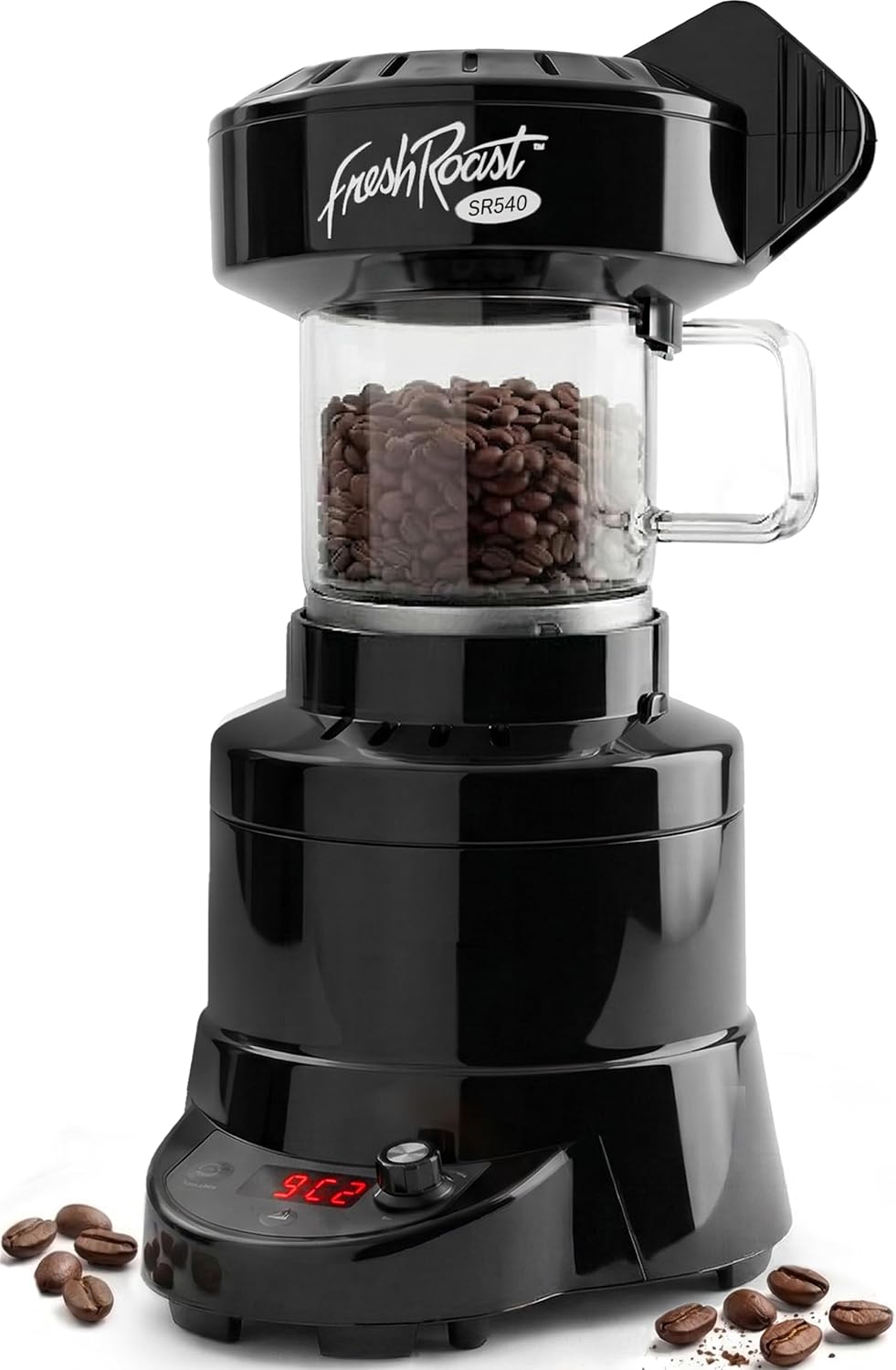
| Model Number | SR540 |
|---|---|
| Included Components | Chaff Basket, Glass Roasting Chamber |
| Unit Count | 1 Count |
| Item Form | Whole Bean |
The Fresh Roast SR540 is a countertop home coffee roaster designed for small-batch, rapid roasting of green beans. You load about 3–4 ounces into the glass roasting chamber, use the single push-turn knob to adjust one of nine heat levels and one of nine fan speeds, and watch the beans change color through the clear chamber while a real-time temperature display helps you monitor progress. The unit combines roasting and an integrated cool-down workflow and includes a chaff basket for cleaner operation. Its compact size and quick roast cycle make it convenient for daily use when you want freshly roasted coffee without a long learning curve. Important limitations are the small batch capacity, which is intended for daily personal use rather than making large quantities, and the lack of advanced automated roast profiles, so results depend on the user dialing in heat and fan settings. For someone who values control and fresh small-batch roasts, the SR540 is a practical, easy-to-learn machine.
Best for: Buyers who want daily-fresh, small-batch coffee and prefer hands-on control over automated systems, especially those easing into home roasting without committing to large or complex equipment.
Less Ideal for: People who need to roast larger volumes for groups or commercial purposes or who want fully automated, one-button roast profiles for repeatable results without manual adjustments.
- Fast small-batch roasting delivers a 3–4 oz roast in under 10 minutes
- Nine heat levels and nine fan speeds give fine-grained manual control
- Clear glass chamber lets you watch roast development in real time
- Integrated cool-down and included chaff basket simplify cleanup
- Small capacity unsuitable for brewing for larger households or entertaining
- No automated roast profiles so consistent results require user practice
Verdict: The SR540 is the go-to compact roaster for anyone who wants quick, small-batch control over freshly roasted coffee at home.
Choosing the Right Home Coffee Roaster: Key Factors to Consider
Roast Consistency and Heat Management
Consistent temperature and even heat distribution are essential because they determine how uniformly beans develop. If one side of the drum or chamber runs hotter, you will get mixed flavors in a single batch rather than a coherent profile.
Look for machines that offer stable temperature feedback, reliable heating elements, and a design that promotes even air flow or drum rotation. For home use, predictability from roast to roast matters more than absolute speed; being able to reproduce a preferred profile is the real benefit.
Batch Size and Capacity
Batch size affects both convenience and flavor. Small-capacity roasters let you roast just what you need to stay fresh, but very small batches can be inefficient if you drink a lot of coffee. Larger mini-batch roasters reduce the number of roast cycles you must run, but may take longer to reach desired roast levels and require more cooling time.
Consider how many cups you brew per week and whether you prefer to roast daily, weekly, or sporadically. Matching roaster capacity to your consumption pattern helps avoid stale roasted beans and wasted energy.
Control Features and Programmability
Control options range from simple heat knobs to fully programmable roast curves. Manual controls give direct feedback and can be ideal for users who like hands-on roasting. Programmable models let you save profiles and automate temperature ramps, which helps when duplicating complex roasts or running multiple batches consistently.
Decide whether you want the flexibility to experiment with roast curves or prefer presets that simplify the process. Digital readouts, logging, and app connectivity are useful but not necessary for good results.
Cooling Performance and Chaff Management
Effective cooling stops the roast at the intended point and preserves the desired flavor. Poor cooling will let residual heat push beans further along the roast curve, producing darker notes than intended. A good roaster will have a dedicated cooling cycle or an efficient airflow system to remove heat quickly.
Chaff management also matters. Models that collect chaff into a removable tray reduce cleanup time and lower the risk of smoke and flare-ups. Consider how easy it is to empty and clean chaff collectors when choosing a roaster.
Ease Of Cleaning And Maintenance
Regular maintenance affects both safety and long-term performance. Accessible interiors, removable trays, and parts that can be wiped down make routine cleanup less of a chore. Models with sealed bearings or hard-to-reach components may require professional servicing over time.
Frequent cleaning of cooling fans, chaff trays, and the roast chamber keeps smoke and oil buildup from affecting flavor. Choose a design that matches how much time you are willing to spend on upkeep.
Safety Features And Noise
Home roasters should include safety measures such as automatic shutoff, clear ventilation, and thermal protection to avoid overheating. Noise level is another practical factor since some machines run loud fans or motors that can be disruptive in an apartment or open-plan home.
Consider whether you need a quieter model for shared living spaces and verify that the roaster provides straightforward safety indicators and reliable shutoff behavior.
Types of Home Roasting Technologies
Home roasters use a few basic heating and agitation methods. Drum roasters tumble beans inside a heated drum, which promotes very even contact heat and predictable development. Air roasters suspend beans in a hot airflow, producing fast, even surface roasting with a lighter, brighter cup in many cases. Hybrid designs combine drum motion with forced air to balance conductivity and convective heat.
Each method changes the flavor outcome and the tactile process. Drum units often give more traditional, rounded profiles, while air-focused roasters accentuate brightness and clarity. Pick the technology that aligns with the flavor range you want to explore.
- Drum roast: even contact heat, slower development
- Air roast: fast convective heating, brighter cup
- Hybrid: aims to combine evenness and clarity
Setting Up Your Roasting Space
Plan for ventilation and heat tolerance when placing a roaster. Even small home units will produce smoke and chaff, so position the machine near an open window or under a range hood if possible. Keep the roaster on a heat-resistant surface and maintain clearances from combustible materials.
Have a stable, level surface for the machine and a separate area for cooling roasted beans. A small metal tray for cooling and a clean, dry container for storing roasted beans help streamline the process and keep your kitchen organized.
- Use a well-ventilated area or hood
- Keep the roaster on a heat-resistant surface
- Allow space for cooling and chaff collection
Basic Roast Profiles and What They Mean
Roast profile describes how temperature changes during the roast and how long beans spend at each stage. Lighter roasts preserve acidity and origin character, while medium roasts balance body and sweetness. Dark roasts reduce acidity and increase bittersweet, roasty notes. The roast level you choose should match your brewing method and flavor goals.
Learning to read color, aroma, and audible cues like first and second crack helps you stop the roast at the desired point. Many home roasters include visual or audible indicators to assist with timing.
- Light: origin clarity, higher acidity
- Medium: balance of sweetness and body
- Dark: pronounced roast flavors and more body
Developing Roast Skills Over Time
Roasting is a craft that rewards practice. Start with small batches and consistent green-bean samples so you can compare runs and iterate. Keep notes on temperature ramps, timing for first crack, and roast end temperature to refine your approach.
Taste each batch after a couple of days once gases have stabilized, and adjust your next roast based on the cup profile. Over time you will learn which adjustments produce brighter acidity, more sweetness, or fuller body.
- Record roast curves and times
- Taste after rest to evaluate true profile
- Adjust one variable at a time for clear feedback
Storing Roasted Beans for Best Flavor
Freshly roasted beans release carbon dioxide and are best used after a short rest period and within a limited window for peak flavor. Store roasted beans in airtight containers away from light and heat to slow flavor degradation.
Avoid refrigeration. Instead, portion beans into small containers if you will not consume them quickly. For most home roasters, planning roast frequency to match consumption preserves freshness without requiring special storage solutions.
- Store in airtight, opaque containers
- Rest beans 24 to 72 hours for peak flavor
- Roast to match consumption rate
How We Chose the Best Home Coffee Roaster
Our selection focused on machines that deliver reliable results in a home setting while remaining practical to own. We prioritized roast consistency by checking for stable temperature control and even heat distribution, since uneven roast is the most common cause of disappointing results. Capacity and batch size were next, because a roaster must match how much coffee you drink and how often you will roast. We also evaluated control and programmability, looking for models that let you adjust roast curves or at least manage temperature and airflow. Usability and safety were included, covering ease of loading and unloading, clear controls or presets, cooling performance, and built-in safety cutoffs. Finally, durability and maintenance were considered, focusing on materials, ease of cleaning, and accessibility of parts that see regular wear. We excluded commercial or industrial machines and any units intended only for large-scale production. Also omitted were appliances that require extensive external modification to roast properly. The final picks balance consistent roast performance, manageable batch sizes for home use, and straightforward operation so buyers can focus on flavor rather than troubleshooting hardware.
Our full evaluation process is outlined in our review methodology.
FAQ
How much green coffee should I roast per batch?
Batch size depends on your consumption and the roaster capacity. Many home roasters handle between 100 and 500 grams per roast. Roast smaller batches if you prefer very fresh beans or larger ones if you drink a lot and want fewer roast cycles.
How long does a roast typically take on a home machine?
Typical roast times range from about 8 to 20 minutes depending on the technology and desired roast level. Air roasters tend to be faster, while drum roasts often take longer for fuller development.
Do I need special ventilation to roast at home?
Some ventilation is recommended because roasting produces smoke and chaff. Using a kitchen hood, opening a window, or running a small exhaust fan makes the process cleaner and reduces indoor smoke odor.
How soon can I cup or brew roasted beans?
Freshly roasted beans benefit from a short degassing period. Most roasts taste best after 24 to 72 hours. Very light roasts sometimes shine earlier, while darker roasts may stabilize sooner.
What maintenance does a home roaster require?
Regular cleaning of chaff trays, cooling trays, and accessible interior surfaces prevents buildup that affects flavor and airflow. Check moving parts and seals periodically and follow the manufacturer's storage and cleaning recommendations to prolong service life.
Final Verdict
When choosing a home coffee roaster, prioritize consistent heat management and a capacity that matches how often you will roast. Decide early whether you want manual control for hands-on experimentation or programmability for repeatable profiles. Balance ease of cleaning, effective cooling, and reasonable noise levels with the flavor outcomes you want to explore. With the right roaster and some practice, you will be able to produce reliably tasty coffee that highlights the beans you select.