
Note: This article contains affiliate links. If you click on these links and make a purchase, we may earn a small commission at no extra cost to you. This helps support our research and content. Read our full affiliate disclosure here.
Picking the right Home Trash Compactor matters because it changes how often you take out garbage, how much space you use, and how neat your kitchen stays. A good compactor reduces bag volume, controls odors, and fits cleanly into standard cabinet openings so it does not create installation headaches. This guide highlights the top shortlists in the category and explains the features that matter most. We evaluated units for compaction force, footprint and installation needs, noise, and long-term reliability. Read on to see the picks and the reasoning behind each choice.
Top Picks at a Glance
| Best Overall The best all-around choice for most situations | Joseph Joseph Titan Trash Compactor |  |
| Best Quality Built to a higher standard if you want something more solid | TAMP-IT Next Gen Manual Trash Compactor |  |
| Best Value The sweet spot between price and what you get | Waste Smasher Manual Trash Compactor |  |
| Best Budget The cheapest option that still gets the job done reliably | Mrhbyl 20" Manual Trash Compactor |  |
| Top Rated A top-rated pick with lots of positive feedback | TAMP-IT HandyPress Hand Tamper |  |
| Most Popular A crowd favorite that many people choose with confidence | Relaxdays Manual Waste Compactor |  |
| Best Seller A high-volume bestseller chosen again and again | AMENER Manual Trash Compactor |  |
Joseph Joseph Titan Trash Compactor

| Capacity | 90 liters |
|---|---|
| Power Source | Manual |
| Installation Type | Freestanding |
The Titan is a freestanding manual trash compactor designed to shrink household waste so you empty bins less often. You load a standard or the supplied IW4 liner, step on the foot pedal and the patented compaction mechanism compresses rubbish to roughly one third of its original volume, turning about 8 gallons of loose waste into 24 gallons compacted capacity. The unit includes a replaceable carbon odor filter in the lid and a lid-stay plus rear handle to ease liner changes and moving. Stainless-steel surfaces are fingerprint-resistant for easier upkeep, and Joseph Joseph says the pedal and compaction assembly are tested for long life and covered by a 10-year guarantee. Because it is manual there is no electricity, but compaction requires physical force and may not suit users who prefer automatic operation. It is also a tall, single-purpose bin, so it works best in kitchens that can accommodate its footprint rather than under-counter installations.
Best for: Buyers who want a durable, low-maintenance way to cut how often they take out kitchen waste and who prefer a simple, non-electric solution that reduces liner use.
Less Ideal for: Those who need a compact unit for tight cabinet spaces or who prefer hands-free electric compaction should look elsewhere.
- Reduces trash volume by about 66% to cut liner use and frequency of emptying
- Built-in replaceable carbon odor filter controls smells
- Hygienic compaction design keeps only the inside of the bag in contact with waste
- Durable foot-pedal compaction system tested for long life and backed by a 10-year guarantee
- Manual operation requires physical effort and may not be as convenient as electric compactors
- Large freestanding footprint may not fit tucked-away or under-counter locations
Verdict: If you want a robust, non-electric way to cut trash volume and liner use, the Titan delivers reliable manual compaction and built-in odor control.
TAMP-IT Next Gen Manual Trash Compactor
| Power Source | Manual |
|---|---|
| Installation Type | Freestanding |
| Material Type | Plastic or Lightweight Metal |
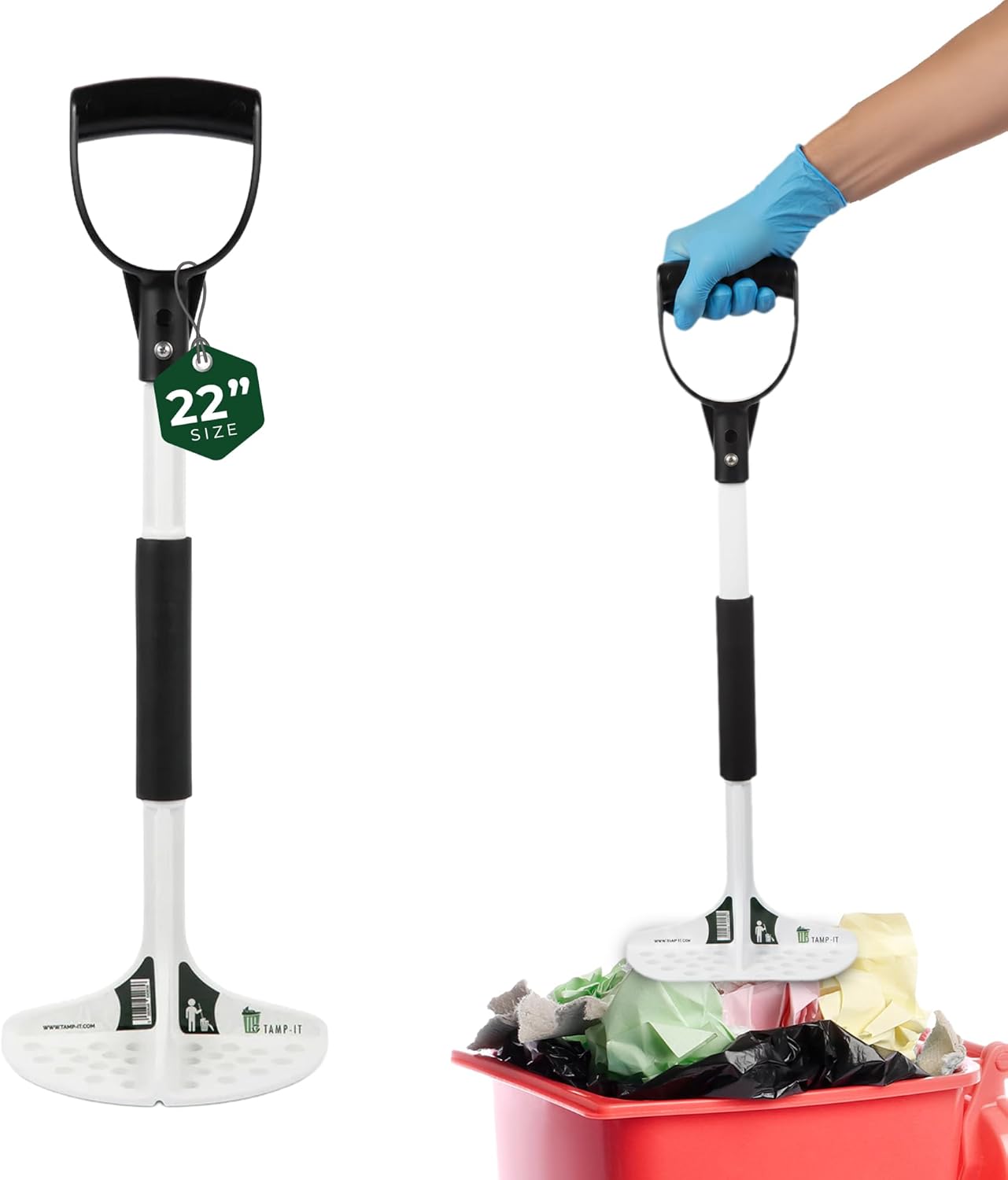
The TAMP-IT Next Gen Manual Trash Compactor is a simple, handheld tamper that compresses trash and yard debris to expand bin capacity and reduce trips to the dumpster. You use it by placing the base plate over loose waste in a trash can or dumpster and pressing down with the D-handle to flatten and compact contents. Its heavy-duty construction and ergonomic D-handle give secure leverage for repeated presses, and the freestanding, manual design requires no power or installation. Practical benefits include lower disposal frequency, less bag waste, and cleaner, more efficient trash areas in kitchens, yards, or light commercial settings. It also doubles as a ground tamper for soil and gravel in garden tasks. Limitations are that compaction relies on user strength and technique, it is slower than powered compactors for very large-volume sites, and it may be less effective on uneven or tightly packed loads where mechanical compression is needed.
Best for: Buyers who want a low-cost, maintenance-free way to reduce trash trips and maximize bin capacity using a durable manual tool for home or small commercial sites.
Less Ideal for: Facilities that need fast, high-capacity mechanized compaction or users who need an electric, automated solution should choose a powered compactor instead.
- No power required so it works anywhere and needs no installation
- Sturdy D-handle design provides good leverage for manual compaction
- Portable and freestanding so it adapts to trash cans, dumpsters, and outdoor use
- Also useful as a ground tamper for yard and gardening tasks
- Effectiveness depends on user strength and is slower than motorized compactors
- Not suited for very large commercial volumes where mechanized compaction is required
Verdict: Buy this if you want a rugged, portable manual tool to reliably shrink trash volume and cut disposal trips without power or installation.
Waste Smasher Manual Trash Compactor

| Material Type | Plastic |
|---|---|
| Installation Type | Freestanding |
| Included Components | 1 Manual Trash Compactor |
| Item Weight | 1.8 pounds |
The Waste Smasher is a simple hand-held trash compactor designed to reduce the volume of kitchen waste by roughly half through manual compression. You press the device over bagged garbage to flatten and compact soft waste, then hang it on the built-in hook or set it freestanding when not in use. Its recycled plastic construction and smooth surfaces make it dishwasher-safe and easy to wipe clean, and because it needs no power it works anywhere in the home and adds no ongoing energy cost. The unit is lightweight and portable, so it is best for regular kitchen use to stretch bag capacity and reduce trips to the curb. Expect straightforward performance with softer, non-rigid trash; it will not shred or mechanically process bulky or very dense items and requires some elbow grease for full compaction. If you want an energy-free, low-maintenance way to get more use from each bag, this keeps the process quick and tidy.
Best for: Buyers who want a low-tech, no-energy solution to get more capacity from household trash bags and cut down on curbside trips and bag waste.
Less Ideal for: Households that generate large amounts of heavy, rigid, or bulky waste that needs mechanical compaction or automated systems.
- Reduces trash volume up to about 50% for more efficient bag use
- No power required so it works anywhere and has no operational cost
- Built-in hook and freestanding design for easy storage and access
- Dishwasher-safe smooth plastic makes cleaning simple and hygienic
- Manual operation requires physical effort and is less effective on rigid or bulky items
Verdict: A compact, energy-free tool that reliably shrinks everyday kitchen waste so you use fewer trash bags and make fewer trips to the curb.
Mrhbyl 20" Manual Trash Compactor

| Material Type | Metal |
|---|---|
| Power Source | Manual |
| Item Dimensions D x W x H | 5.5"D x 5.5"W x 20"H |
This all-metal, 20-inch manual trash compactor is a simple mechanical tool for compressing everyday waste to free up bin space and cut down on bag changes. You press the long handle to push the metal plate down against coffee cups, cans, food scraps, and yard clippings, and the included silicone base lets you stand it upright for storage. Its metal construction and handle are built for durability and resist rust better than plastic alternatives, and because it is manual there are no batteries or motors to maintain. The unit is easy to clean with a rinse and fits most common trash cans thanks to a 5.5-inch base diameter. Expect straightforward operation and steady compaction, but remember it requires physical effort and is not meant for very heavy-duty industrial use or compressing hard rigid items. For basic kitchen and outdoor household use it succeeds as a low-cost way to reduce trash volume and frequency of disposal.
Best for: Buyers who want a low-cost, no-frills way to reduce household trash volume and cut down on bag changes with a durable manual tool.
Less Ideal for: People looking for an automated or heavy-duty commercial compactor or users who need to compress very large or rigid items should consider other solutions.
- All-metal construction for durability and rust resistance
- Manual operation so no batteries or power required
- Compresses mixed household and yard waste to reduce bag usage
- Includes silicone base for stable upright storage and cleaner floors
- Requires manual physical effort to compact trash
- Not suitable for compressing very hard or large rigid items
Verdict: A durable, budget-friendly manual compactor that cuts household trash volume without electricity.
TAMP-IT HandyPress Hand Tamper

| Material Type | Fiber Re-inforced composit plastic |
|---|---|
| Included Components | Handypress Tamp-it |
| Model Number | TIHH1 |
The TAMP-IT HandyPress is a simple, manual trash compactor that uses a 10 x 6 inch tamping surface and an ergonomic handle to compress garbage and recyclables by hand. It is used by placing the head over trash in a bin and pressing down to flatten contents, which helps reduce overflow and stretch bag life without bending or direct contact. Built from fiber-reinforced composite plastic, the HandyPress aims to deliver heavy-duty performance without the weight of a metal tamper, and the folding hook makes it easy to hang on a wall or bin when not in use. In practice the wide head distributes pressure evenly so you do not need repeated strikes to get good compaction, and the non-slip handle improves control during use. Limits are that it is a manual tool so very dense or large loads still require multiple presses, and it does not replace powered compactors for commercial high-volume needs. For home kitchens, garages, and small commercial bins it is a durable, low-effort solution to keep waste areas neater and reduce trips to the dumpster.
Best for: Buyers who prioritize a reliable, low-maintenance way to reduce trash volume in homes, garages, and small commercial bins and want a durable manual tool that stores easily.
Less Ideal for: Large commercial operations or users who need automatic or high-capacity powered compaction should choose a motorized compactor instead.
- Wide 10 x 6 in tamping surface distributes pressure for efficient compaction
- Ergonomic non-slip handle for comfortable grip and better leverage
- Fiber-reinforced composite construction balances strength with lighter weight
- Folding hook for convenient storage on walls, cabinets, or bins
- Manual operation requires repeated presses for very dense or bulky waste
Verdict: A dependable, no-frills manual tamper that reliably expands bin capacity and cuts bag changes for home and light commercial use.
Relaxdays Manual Waste Compactor

| Capacity | 240 liters |
|---|---|
| Power Source | Manual |
| Material Type | Steel |
This manual waste compactor is a simple, hang-on steel press designed to squeeze down household trash in conventional bins from 60 to 240 liters. You hang the unit on the bin hinge when not in use, lower the lever and push the compression plate down to reduce the volume of plastic, paper and residual waste. Its powder-coated steel construction feels sturdy for light-to-moderate daily use and the lever mechanism is built to require little force, so pressing is straightforward for most adults. The design is entirely mechanical so there are no electrical parts to fail and it helps lower how often you need to take out the trash, which can save on disposal costs. Expect limitations typical of manual compressors: it does not compact heavy, wet or very dense items as effectively as powered units, and large or oddly shaped refuse can be awkward to position under the plate. Installation is basic but mounting hardware is not included, so plan for a short setup step. For buyers wanting a low-tech, durable way to cut bag changes, this is an effective budget option.
Best for: Buyers who want a no-frills, durable way to reduce how often they empty household trash and prefer a low-maintenance mechanical solution backed by real-user feedback.
Less Ideal for: Those who need maximum compression for heavy, wet, or industrial waste or who prefer an automatic, powered compactor with higher throughput.
- Solid powder-coated steel construction for durability
- Fits standard household bins from 60 to 240 liters
- Simple lever mechanism that requires little force to operate
- Mounts on the bin hinge and stores out of the way when not used
- Manual operation limits effectiveness on very heavy or wet waste
- No mounting hardware included requiring separate fasteners
Verdict: A durable, low-tech manual compactor that reliably reduces household trash volume for buyers seeking a simple, maintenance-free way to cut bag changes.
AMENER Manual Trash Compactor

| Material Type | Metal |
|---|---|
| Power Source | Manual |
| Installation Type | Freestanding |
This all-metal manual trash compactor is a simple hand-operated tool for reducing the volume of everyday household and yard waste. You place it over trash items and press down using the ergonomic grip and palm-bottom design to flatten cans, cups, wrappers, leaves and small branches, which helps fit more into a bin or bag and cuts down on trips to the dumpster. The compactor is freestanding with an anti-slip rubber base and a screw-fixed rod for stability, and its detachable parts make it straightforward to store or rinse clean after use. Because it is fully manual with no batteries or motors, it is low maintenance and reliable for routine kitchen or outdoor use. Limitations are its physical operation—it requires manual force so it is not suitable for heavy industrial compaction—and the fixed size means very large items will not fit under the plate.
Best for: Buyers who prefer reliable, low-maintenance tools and want a straightforward, non-electric way to reduce household or yard waste volume with predictable performance.
Less Ideal for: Users who need power-assisted or high-capacity compaction for commercial use or very large bulky items should consider powered or industrial solutions instead.
- Durable all-metal construction resists cracking and rust.
- Ergonomic grip and palm-bottom design reduce wrist strain during pressing.
- Anti-slip rubber base and screw-fixed rod improve stability while compacting.
- Detachable parts and simple rinse-clean design make maintenance easy.
- Requires manual effort so it can be tiring for large or frequent loads.
- Limited to items small enough to fit under the press plate.
Verdict: A simple, durable manual compactor that reliably shrinks everyday household and yard waste without electricity or complex upkeep.
Choosing the Right Home Trash Compactor: Key Factors to Consider
Compaction Force and Cycle Consistency
Compaction force is the single most important factor for a Home Trash Compactor because it determines how much waste volume you actually eliminate. Higher and more consistent force means denser, flatter trash cakes and fewer bag changes. Variability between cycles can leave soft or bulky waste uncompressed, reducing the unit's utility.
When evaluating force, consider both the rated pressure and how that force is delivered during a cycle. Units with smoother, controlled cycles tend to make more uniform cakes and put less stress on mechanical components, which helps longevity.
Cabinet Fit and Installation Requirements
Measure the planned cabinet opening and compare it to the compactor's external dimensions and mounting options. Some compactors are designed for full-depth cabinet cavities while others require shorter depths or special trim kits. Door swing, drawer front compatibility, and under-counter clearances affect whether the unit can be flush-mounted or will need modifications.
Think about access for maintenance when choosing a size. A unit that is easier to remove for service or filter replacement reduces future hassle. Also confirm whether the compactor needs dedicated electrical circuits or can share a standard kitchen outlet.
Noise, Vibration, and Cycle Speed
Noise level and vibration matter if your kitchen is adjacent to living spaces or if you run the compactor frequently. A high-force compactor can still be acceptable if it isolates vibration and runs smoothly. Look for models that advertise quiet operation or include vibration-damping mounts.
Cycle speed is also a tradeoff. Faster cycles are convenient but can generate more noise and stress components. Slower, controlled cycles may be quieter and more reliable, so consider how often you will use the compactor when weighing speed against acoustic performance.
Odor Control and Hygiene Features
Odor control is crucial because compactors concentrate waste. Sealing quality around the drawer, integrated odor traps, and easy-to-clean surfaces all reduce persistent smells. Removable liners or dedicated compactor bags can simplify emptying and cleanup.
Materials that resist staining and smooth internal surfaces make it easier to wipe away residue. Some units provide activated-carbon filters or venting features; these are helpful but require replacement, so factor ongoing maintenance into the choice.
Durability, Maintenance, and Serviceability
A Home Trash Compactor should have durable drive components and an accessible service path. Check how easily you can access motors, switches, and seals for inspection or repair. Simple mechanical systems with fewer electronic controls can be more reliable over many years.
Consider the availability of replacement parts and the typical maintenance steps such as seal replacement or motor brush checks. Units that make routine tasks like cleaning, filter swaps, and seal replacement straightforward will cost less in time and hassle over their lifetime.
User Controls and Safety Features
User controls should be intuitive and safely positioned to prevent accidental activation. Features like automatic shutoff if the drawer is opened, lockout modes, and clear cycle-status indicators increase daily safety and reduce misuse. Some compactors include multiple compaction settings to handle different waste types safely.
Safety interlocks and manual overrides are important for households with children or pets. Also check how clearly the manufacturer documents safe use and maintenance procedures; good documentation reduces the risk of improper operation.
Where a Home Trash Compactor Makes the Biggest Difference
A Home Trash Compactor benefits households that generate a lot of non-recyclable kitchen waste, like food scraps in thick packaging or frequent takeout. It is also helpful in smaller homes where reducing bag changes frees up time and lowers how often you haul waste to an outdoor bin.
Compactors are less useful if your waste stream is primarily recyclable materials that do not compress well or if you already have an efficient curbside schedule. Think about your typical weekly trash volume, kitchen layout, and whether you value quiet operation over maximum compaction.
- Best for kitchens with moderate to heavy non-recyclable waste
- Valuable where cabinet space is limited and trips to the outdoor bin are inconvenient
- Less helpful if most household waste is recyclable or composted
Installation Tips to Avoid Common Pitfalls
Before purchasing, measure the cabinet opening, check for plumbing or wiring inside the cavity, and verify the door or drawer front configuration. Some compactors require clearance behind the unit for electrical connections or ventilation. If you are not comfortable modifying cabinets, plan to work with a qualified installer.
Confirm whether the unit requires a dedicated electrical circuit or a grounded outlet nearby. Leave enough space to remove the compactor for service without damaging cabinetry. Use vibration pads or mounting hardware recommended by the manufacturer to reduce noise transfer into the cabinet structure.
- Verify depth, width, and clearances before buying
- Check electrical requirements and routing
- Plan for service removal and vibration isolation
Common Maintenance Tasks and Schedules
Routine cleaning extends the life of a compactor and helps control odors. Wipe the interior after each bag change, inspect door seals monthly, and replace odor filters per the manufacturer's interval. Lubricate moving parts only as recommended and avoid harsh solvents that can degrade seals.
If the unit uses replaceable liners or bags, choose the specified size and gauge for best performance. Keep a small toolkit and the compactor's manual handy so you can troubleshoot simple issues like a jammed ram or a blown fuse without delay.
- Wipe interior and seals after emptying
- Inspect seals monthly and replace as needed
- Use recommended liners and follow filter replacement intervals
How to Evaluate Noise and Vibration in Your Home
Look for manufacturer noise ratings if provided, but also consider placement. A compactor in a densely built cabinet can transmit vibration into adjacent drawers and walls. If possible, listen to a unit in operation or read user notes about acoustics for real-world context.
If quiet operation is a priority, prioritize units with vibration dampers and slower, controlled cycles. Installing pads or isolators between the compactor and cabinet can further reduce noise transmission.
- Check for vibration-damping features
- Prefer controlled, steady cycles over quick, noisy ones
- Use isolation pads to reduce cabinet transmission
Bag Options and Waste Handling Strategies
Using the correct bag or liner affects compaction performance and ease of emptying. Heavier-gauge bags resist tearing during compaction, while purpose-built compactor liners simplify the disposal process. Evaluate how easy it is to load and secure a bag before each cycle.
Also consider household habits. Pre-sorting recyclables and compostables reduces how often you need to run the compactor and improves overall waste management. A compactor that integrates well with your bagging routine will be more convenient over time.
- Choose heavy-gauge or purpose-made compactor liners
- Test bag installation and removal before finalizing a purchase
- Pair compaction with recycling and composting routines
How We Chose the Best Home Trash Compactor
We started by focusing on features and specifications that directly affect daily use of a Home Trash Compactor. First, compaction force and cycle consistency determine how much volume each bag will save and whether dense waste compacts reliably. Second, installation and cabinet fit are essential because many buyers install these units into existing kitchen cabinetry or standard flush openings. Third, noise and vibration during the compaction cycle affect whether the unit is practical for open-plan homes. Fourth, reliability and serviceability were considered by looking at common failure points and ease of access for routine maintenance. Fifth, odor control and sealing features matter because a compactor that traps smells reduces the need for extra odor-management steps. We excluded specialty or commercial-grade compactors designed for heavy daily use and units without clear specification sheets or consumer-service support information. Our process prioritized realistic, household-oriented performance metrics and user-facing features rather than marketing claims. The criteria we used to shortlist models are reflected in the scoring labels below and guided decisions about which units are suitable for different kitchen layouts and usage patterns.
Our full evaluation process is outlined in our review methodology.
FAQ
How often will I need to empty a compactor drawer?
It depends on household waste volume and the compaction force. In many average households, a compactor reduces bag changes to once or twice a week. Larger families or heavy-waste households may still need more frequent emptying.
Can a compactor be installed under any kitchen cabinet?
Most Home Trash Compactors fit standard under-counter cabinet openings, but precise depth, width, and front-panel options vary. Measure the cavity and check clearance for electrical and any plumbing before assuming fitment.
Are compactors noisy during operation?
Noise levels vary by design. Some units are engineered for quieter cycles with vibration isolation, while others can be louder during compaction. Placement and mounting method also influence perceived noise in living areas.
What maintenance does a Home Trash Compactor require?
Regular tasks include wiping the interior, checking and replacing seals or filters, and inspecting the drive components for wear. Using recommended liners and following the maintenance schedule extends the unit's service life.
Will compacting waste increase odors in my kitchen?
Compaction concentrates waste, which can increase odors if seals and filters are inadequate. Choosing a unit with good sealing and odor-control features, and maintaining cleanliness, helps keep smells under control.
Final Verdict
When choosing a Home Trash Compactor, prioritize compaction force, cabinet fit, and noise performance based on how you use your kitchen. Strong compaction and reliable cycles reduce bag changes, but if you live in an open floor plan, noise and vibration control may matter more than maximum force. Consider installation clearances and ease of maintenance to avoid surprises after purchase. Balance the tradeoffs between compacting performance and day-to-day convenience. Focus on models that match your cabinet dimensions, offer straightforward service access, and include effective odor-control features to get the most useful, long-lasting solution for your home.