
Note: This article contains affiliate links. If you click on these links and make a purchase, we may earn a small commission at no extra cost to you. This helps support our research and content. Read our full affiliate disclosure here.
If you run a forced air furnace, adding a whole-house humidifier can make indoor air feel warmer, reduce dry-skin and nasal irritation, and protect woodwork. Choosing the right humidifier for forced air furnace systems matters because installation complexity, control accuracy, and maintenance needs vary and affect long-term performance and cost. This guide shortlists the seven best humidifiers for forced air furnace setups and explains the practical tradeoffs you should consider. We evaluate installation and mounting, humidity control precision, water use and maintenance, and compatibility with typical duct and furnace arrangements. Read on to find a humidifier that fits your home and lifestyle.
Top Picks at a Glance
| Best Overall The best all-around choice for most situations | Honeywell Home HE280A Humidifier |  |
| Best Quality Built to a higher standard if you want something more solid | Aprilaire 700 Whole-House Humidifier |  |
| Best Value The sweet spot between price and what you get | GeneralAire 3200M Evaporative Humidifier |  |
| Best Budget The cheapest option that still gets the job done reliably | AIRCARE Space-Saver Evaporative Humidifier |  |
| Top Rated A top-rated pick with lots of positive feedback | Aprilaire 600M Whole-House Humidifier |  |
| Most Popular A crowd favorite that many people choose with confidence | AIRCARE MA1201 Console Humidifier |  |
| Best Seller A high-volume bestseller chosen again and again | Honeywell QuietCare HCM350B |  |
Honeywell Home HE280A Humidifier

| Capacity | 1 gallons |
|---|---|
| Floor Area | 4000 square_feet |
| Operation Mode | Evaporative |
| Voltage | 24 volts |
| Wattage | 200 watts |
The HE280A is a duct‑mounted bypass flow‑through humidifier meant to be installed on a forced‑air furnace to add moisture throughout a home. It uses an evaporative pad and Honeywell's PerfectFLO water distribution tray to reduce water use and help keep the unit cleaner, and the built‑in humidistat automates on/off control to hold your chosen humidity level. Typical installation is on the warm air supply or return duct and requires access to a floor drain for the unit's drain line. In real use the HE280A covers large homes (manufacturer rates up to 4,000 sq ft for newer houses), lowers static and helps protect wood floors and furniture, and its touch control and 24‑hour runtime make operation straightforward. Expect lower maintenance versus some competitor modules, but you will need furnace‑side access for installation and periodic pad replacement. It is practical for whole‑home humidity management but not a plug‑and‑play room unit, and drain and duct access are required for proper operation.
Best for: Homeowners with forced‑air heating who want automated whole‑house humidity control and are willing to install a duct‑mounted unit on their furnace.
Less Ideal for: People who need a portable or plug‑in room humidifier or who lack access to a floor drain and ductwork for installation.
- Covers whole‑home humidification for homes up to about 4,000 sq ft when installed on a forced‑air furnace
- PerfectFLO tray reduces water use and helps distribute water evenly
- Built‑in humidistat with touch control automates humidity maintenance
- Flow‑through evaporative design helps limit microorganism buildup and reduces maintenance frequency
- Requires professional or DIY furnace/duct access and a floor drain for installation
- Needs periodic replacement of the evaporative pad and routine checks of the drain line
Verdict: Choose the HE280A when you want a low‑maintenance, water‑saving whole‑house humidifier that installs on a forced‑air furnace to reliably control home humidity.
Aprilaire 700 Whole-House Humidifier

| Capacity | 18 gallons_per_day |
|---|---|
| Floor Area | 4200 square_feet |
| Operation Mode | Evaporative |
| Voltage | 120 volts_of_alternating_current |
| Control Method | Remote |
The Aprilaire 700 is a fan-powered, evaporative whole-house humidifier intended for installation on a forced-air furnace to humidify large homes. It feeds water over a replaceable Water Panel and uses the built-in fan to draw heated air through the panel so moisture is carried into the duct system; the package includes a 24 VAC transformer, automatic digital control with outdoor sensor, and a Model 35 water panel. Typical use is set-and-forget: install on the furnace, set the humidistat, and the automatic control adjusts output based on indoor relative humidity and outdoor temperature. Practical benefits include wide coverage up to about 5,300 sq ft and a high capacity of 18 gallons per day, which is useful in very dry climates or large houses during the heating season. The built-in fan and included outdoor sensor help maintain consistent humidity without constant manual adjustment. Trade-offs are that it requires professional-style installation to tie into the furnace and a floor drain for runoff, and you will need to replace water panels seasonally and plan for plumbing and electrical hookups during installation.
Best for: Buyers who prioritize robust, room-to-room humidity control for large homes and want an automatic furnace-mounted system that maintains set humidity levels with minimal daily attention.
Less Ideal for: Those who need a portable or plug-in humidifier, have no access to a floor drain, or prefer a unit they can install without modifying HVAC plumbing and wiring.
- High capacity 18 gallons per day suitable for large, tightly built homes
- Automatic digital control with outdoor sensor keeps indoor humidity balanced
- Built-in fan pulls furnace air through the evaporative panel for effective distribution
- Includes necessary installation components such as 24 VAC transformer and valves
- Requires professional-style installation and plumbing to the furnace and floor drain
- Needs seasonal replacement Water Panels which adds ongoing maintenance cost
Verdict: A high-capacity, automatic furnace-mounted humidifier built to deliver consistent whole-house humidity for large homes with professional installation.
GeneralAire 3200M Evaporative Humidifier

| Capacity | 12 gallons per day |
|---|---|
| Floor Area | 3200 square_feet |
| Operation Mode | Evaporative |
| Filter Type | Wick |
| Power Source | Corded Electric |
The GeneralAire 3200M is a bypass-style evaporative humidifier intended for installation on forced-air furnace systems to raise indoor humidity across larger homes. It uses a flow-through wick filter and the included MHX3C manual humidistat to control output, and its 12 gallons-per-day capacity and 12-hour runtime mean it can deliver steady moisture without frequent refills. Installation is light and compact compared with older whole-house units, and the low 12-watt electrical draw keeps operating power minimal. Maintenance centers on replacing the wick filter and occasional cleaning of the water distribution components, which is straightforward for anyone comfortable working on furnace-mounted accessories. The unit is mechanically simple so it is reliable, but it lacks automatic electronic humidistats or smart controls and depends on manual adjustment for precise seasonal tuning. Buyers should also plan for occasional filter replacement and periodic seasonal servicing to prevent mineral buildup if using hard water.
Best for: Homeowners who want a reliable, low-power furnace-mounted humidifier that provides whole-house humidity control and who prefer a straightforward, serviceable mechanical unit over smart features.
Less Ideal for: People who want fully automatic, app-controlled humidification or those without a forced-air furnace should consider alternate solutions.
- Designed for forced-air furnaces and sized for up to 3200 sq ft coverage
- Includes MHX3C manual humidistat for basic humidity control
- Evaporative wick design reduces white dust compared with ultrasonic models
- Compact, lightweight design makes installation and servicing easier
- Low power consumption at 12 watts
- No built-in electronic or Wi-Fi humidistat for automatic precise control
- Requires periodic wick filter replacement and cleaning to maintain performance
- Bypass evaporative design needs a functioning furnace blower to distribute humidity
Verdict: A practical, low-power evaporative humidifier that delivers whole-house moisture for forced-air furnaces without frills but with reliable, serviceable performance.
AIRCARE Space-Saver Evaporative Humidifier

| Capacity | 6 gallons |
|---|---|
| Floor Area | 2300 square_feet |
| Operation Mode | Evaporative |
| Control Method | Remote |
| Runtime | 70 hours |
The AIRCARE Space-Saver is an evaporative whole-house humidifier built for long runtimes and simple operation. It uses a 6-gallon tank and wick filter to humidify spaces up to roughly 2,300 square feet, with three fan speeds, analog controls paired with a digital display, and a remote for adjusting output from across the room. Typical use is filling the tank, seating the wick filter, and letting the unit run on a chosen speed; at lower speeds it can run up to about 70 hours between fills. The evaporative design means it passively disperses moisture without ultrasonic mist, so you get stable, natural humidity without visible white dust. Practical benefits include the large water capacity for multi-day operation, easy control options, and a replaceable wick filter for basic maintenance. Limits are that it is a sizable plastic cabinet and relies on wick filtration so it needs periodic filter replacement and cleaning; it also requires a power cord and is not a steam-style or ultrasonic humidifier, which some users prefer for speed or quieter operation.
Best for: Buyers who prioritize long run times and straightforward, low-maintenance humidification for whole-house or forced-air systems on a budget.
Less Ideal for: Users who need the quietest possible operation, instant high-output mist, or a very compact tabletop unit for a single small room.
- Large 6-gallon tank supports long run times between refills
- Covers up to 2,300 sq ft, suitable for whole-house or multi-room use
- Remote control plus digital display and three fan speeds for easy adjustments
- Evaporative wick system avoids white dust and provides steady, natural humidity
- Requires regular wick filter replacement and periodic cleaning
- Bulkier footprint compared with portable tabletop humidifiers
Verdict: A cost-conscious choice for adding steady, long-lasting humidity to larger homes and forced-air systems without fancy bells and whistles.
Aprilaire 600M Whole-House Humidifier
| Capacity | 17 gallons_per_day |
|---|---|
| Floor Area | 4000 square_feet |
| Operation Mode | Evaporative |
| Voltage | 24 volts_of_alternating_current |
| Control Method | Touch |
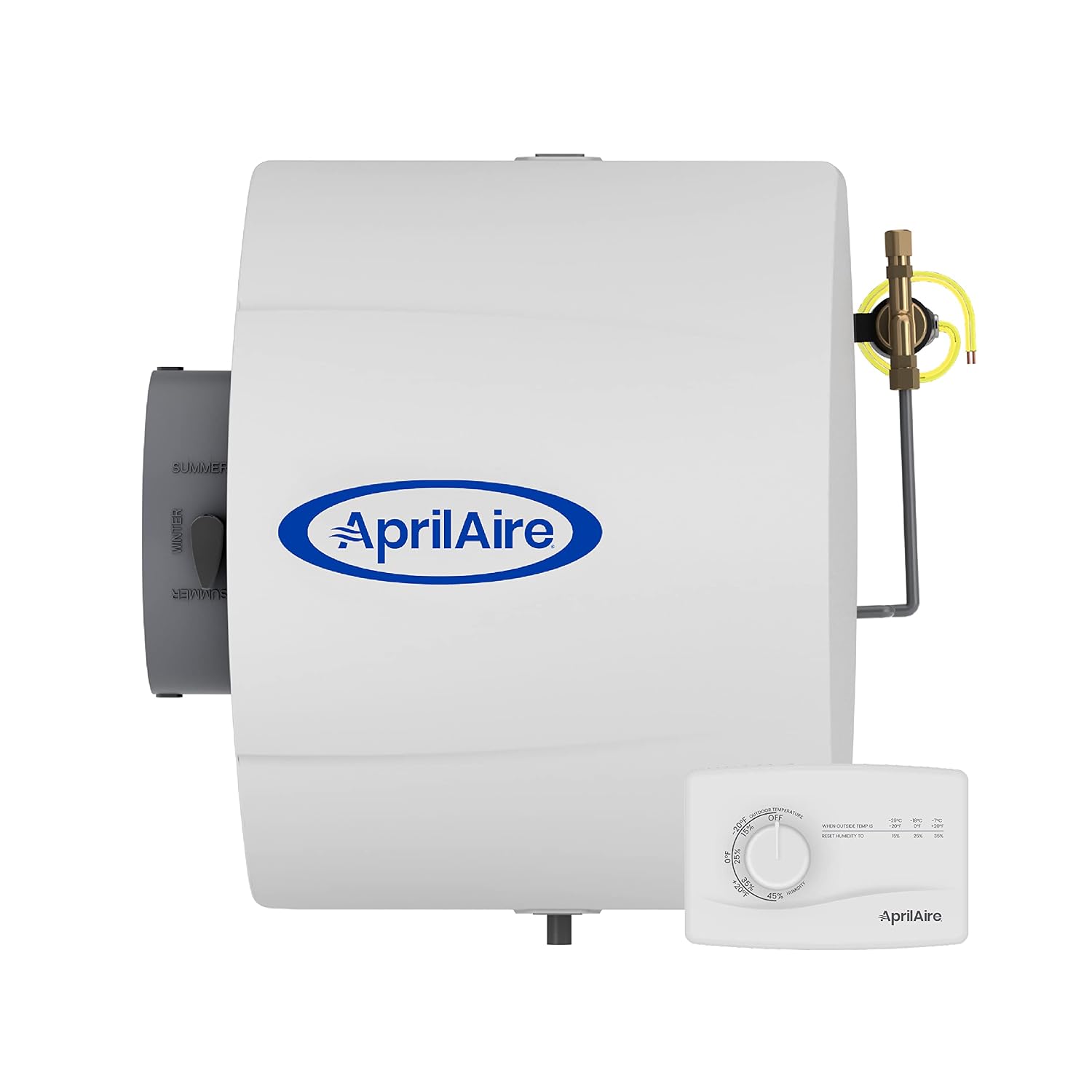
The Aprilaire 600M is a furnace-mounted bypass evaporative humidifier built for whole-house humidification. It fits into a forced-air HVAC duct and uses a water panel evaporator and the furnace blower to distribute humidity naturally, with a manual control and built-in humidistat for set-and-forget operation. Notable features include a labeled bypass damper for easy summer/winter positioning, a 24 VAC transformer and solenoid valve included, and a high output rated at 17 gallons per day for large homes. In practice it delivers steady humidity without moving parts in the airstream, which keeps operation quiet and reliable. Installation requires basic HVAC plumbing and wiring and the unit uses replaceable water panels that need seasonal changes, so there is some routine maintenance. The control is manual rather than automated via Wi-Fi or advanced scheduling, so expect simple, dependable performance rather than smart features.
Best for: Buyers who prioritize a proven, durable whole-house solution that integrates with a forced-air furnace and want steady, quiet humidity control without reliance on smart features.
Less Ideal for: People who want plug-and-play portable units, app-based control, or those unwilling to perform seasonal maintenance and basic installation work.
- High capacity 17 gallons per day output suitable for large homes
- Built-in bypass damper labeled for summer and winter simplifies seasonal setup
- Includes humidistat, transformer, valve, and water panel for complete installation
- Evaporative design runs quietly and uses the furnace blower to distribute moisture
- Manual control lacks smart features or automated remote monitoring
- Requires periodic replacement of water panels and basic HVAC installation skills
Verdict: A rugged, high-capacity bypass humidifier made for reliable, quiet whole-house humidification on forced-air furnace systems.
AIRCARE MA1201 Console Humidifier

| Capacity | 3.6 gallons |
|---|---|
| Floor Area | 3600 square_feet |
| Operation Mode | Evaporative |
| Runtime | 36 hours |
| Control Method | Touch |
The AIRCARE MA1201 is a whole-house console evaporative humidifier intended for forced-air furnace systems or large open areas up to about 3,600 square feet. It moves dry air across a saturated wick filter and offers a 3.6 gallon tank that can run up to 36 hours on lower settings, four fan speeds plus an auto mode, and a digital humidistat so the unit maintains a target humidity without constant adjustment. Practical touches include refill and filter indicators, built-in casters for repositioning, and an auto shutoff when the tank is empty or the set humidity is reached. Because it is an evaporative design with a wick filter, it traps mineral deposits and avoids the white dust typical of ultrasonic units, but it does require periodic wick replacement and occasional cleaning. The unit is relatively high-wattage and sizable, so it suits a basement, furnace closet, or utility area rather than a small bedroom. For buyers who prioritize reliable, measurable whole-house humidity control, it performs as a robust, low-tech solution that emphasizes long runtime and simple maintenance.
Best for: Buyers who want a practical, measurable way to humidify an entire forced-air system or large living area and who value long runtime and simple digital control backed by existing customer feedback.
Less Ideal for: People seeking a compact, quiet bedroom humidifier or a near-silent ultrasonic unit for small rooms should consider smaller or different technology options.
- Designed for large coverage up to 3,600 sq. ft., suitable for whole-house use
- Digital humidistat and auto mode maintain target humidity without constant monitoring
- Long runtime with a 3.6 gallon tank—up to 36 hours between refills
- Evaporative wick filter reduces mineral spray and is easier to keep clean than some alternatives
- Requires periodic wick replacement and cleaning to maintain performance
- Relatively large and high-wattage, so not ideal for small rooms or tight spaces
Verdict: A heavy-duty evaporative console humidifier that reliably keeps large forced-air homes at a set humidity with long runtime and simple digital controls.
Honeywell QuietCare HCM350B

| Capacity | 1.1 gallons |
|---|---|
| Operation Mode | Evaporative |
| Control Method | Touch |
| Filter Type | Wick |
| Runtime | 24 hours |
The Honeywell QuietCare HCM350B is an evaporative cool-mist humidifier designed to add invisible moisture to medium bedrooms and kids rooms while running quietly overnight. It uses a 1.1-gallon self-standing tank and a wick filter to lift and hold targeted humidity levels, and the integrated UV feature helps reduce minerals in the water before misting. Controls are touch-based and the unit is rated to run up to 24 hours on a fill, which makes it convenient for continuous overnight use. Practical benefits include dishwasher-safe water-touch parts for easier cleaning and the recommendation to use genuine Honeywell replacement wicks to maintain performance. The humidifier's fan-like sound is soft enough for bedroom use but is audible, so it will not be truly silent. This evaporative design also means humidity output depends on ambient airflow and will not directly replace whole-house furnace humidification equipment, but it provides dependable localized relief for dry air in rooms served by forced-air systems.
Best for: Buyers who prioritize reliable, low-maintenance bedroom humidification and want a risk-averse, well-known brand solution for medium rooms and nursery use.
Less Ideal for: People seeking a true whole-house furnace humidifier replacement or a completely silent unit should consider other solutions.
- 1.1-gallon tank provides up to 24 hours runtime for overnight operation
- Evaporative wick filtration with UV technology reduces minerals in the mist
- Dishwasher-safe parts that contact water simplify cleaning
- Touch controls and a quiet, fan-like sound suitable for bedrooms
- Evaporative output depends on room airflow and is not a substitute for whole-house furnace humidifiers
- Requires genuine replacement wicking filters for best performance
Verdict: A dependable, easy-to-clean evaporative humidifier that delivers overnight moisture for medium bedrooms and nurseries with minimal fuss.
Choosing the Right Humidifier for Forced Air Furnace: Key Factors to Consider
Installation & Compatibility
How the humidifier mounts to a furnace or duct and what wiring it needs directly affects installation cost and complexity. Some units attach to the warm-air plenum while others mount in a return or supply duct; each approach has implications for airflow, access, and sealing. You should confirm electrical requirements, whether the humidifier needs a 24V control connection to the furnace humidifier terminal, and if the product supports a simple on/off relay or requires an integrated control board.
Compatibility matters because improper mounting or inadequate clearance can reduce efficiency and increase noise. If you plan to DIY, prioritize models with straightforward instructions and common mounting templates. If a professional installer will do the work, look for units that provide clear mounting dimensions and wiring diagrams to minimize labor time.
Humidity Control & Sensor Accuracy
Accurate control determines how well the humidifier maintains a set relative humidity without overhumidifying. Models that include adjustable humidistats or support external digital controllers give you finer control and reduce cycling. Sensor placement is also important: a thermostat-mounted sensor or a remote humidity probe located away from supply registers will report more representative room conditions than one mounted directly on the furnace.
Poor control can cause condensation in ductwork or on windows in cold weather, so choose systems with reliable feedback and clear calibration options. Look for units that allow setting target humidity levels and that respond smoothly to changes, avoiding frequent short on/off cycles that waste water and wear components.
Water Efficiency and Output Capacity
Humidifiers for forced air furnaces vary widely in how much moisture they deliver and how efficiently they use water. Output capacity should match your home size and typical winter dryness. Undersized units will run constantly without reaching setpoints, while oversized units may cycle and create uneven humidity. Check the rated gallons or liters per day and compare that to your square footage to estimate suitability.
Water efficiency also affects operating cost and maintenance. Evaporative pad systems typically use less energy but require periodic pad replacement and can trap minerals. Steam-type systems deliver higher output in a smaller footprint but consume more power. Consider local water hardness because mineral buildup increases maintenance needs and can reduce efficiency over time.
Maintenance Requirements
Routine maintenance affects total cost of ownership and how reliably the humidifier performs. Maintenance tasks include replacing pads or cartridges, cleaning water trays, inspecting solenoid valves, and flushing scale from steam generators. Components that are easy to access and designed for tool-free servicing reduce upkeep time and the chance of skipped maintenance.
Also consider the availability and longevity of consumables such as pads or filters. Systems that provide clear maintenance intervals and simple parts replacement processes tend to stay in service longer and require fewer service calls. If you have hard water, expect more frequent cleaning or the need for a water treatment accessory.
Noise, Durability, and Build Quality
Noise level matters if furnace closets are near living spaces. Some humidifiers operate nearly silently, while others have noticeable fan or valve noise. Inspect build quality cues like the robustness of plastic housings, quality of fittings, and the presence of corrosion-resistant components in water-exposed areas.
Durability also ties to warranty terms and ease of getting replacement parts. Durable electrical connectors, reliable solenoid valves, and corrosion-resistant hardware reduce the likelihood of failures. Choose models with straightforward diagnostics or service indicators to simplify troubleshooting if issues arise.
Whole-House Vs. Bypass and Fan-Powered Options
Forced air humidifiers come in different functional designs, most commonly bypass, fan-powered, and steam. Bypass units use furnace airflow to move moisture into the ductwork and are generally quieter and lower in energy use. Fan-powered units include a small blower to force air through the wet medium, which increases output and responsiveness but may add noise and slightly higher energy use.
Steam units generate moisture directly and can deliver high output in smaller housings. They are typically chosen for large homes or situations where humidity needs to be raised quickly. Each design has tradeoffs in installation location, power requirements, and maintenance, so match the type to your home size and performance needs.
- Bypass: low noise, relies on furnace airflow, simpler installation when space allows
- Fan-powered: higher output and faster response, slightly louder
- Steam: highest output, smaller duct footprint, higher electrical demand
Sizing a Humidifier for Your Home
Sizing depends on the humidifier's output rating and the air volume and leakiness of your home. Manufacturers often provide coverage guidelines in square feet based on typical winter indoor/outdoor conditions. Estimate the required gallons per day by considering the degree of dryness you experience at typical outdoor temperatures.
Under-sizing leads to constant operation and frustration, while over-sizing offers little practical benefit and can create humidity control problems. When in doubt, plan for a unit with a modest margin above your calculated need rather than the largest available model.
- Match gallons-per-day output to home size and typical winter conditions
- Account for tightness of the building envelope and occupancy levels
- Consider seasonal variation; some systems offer adjustable output
Placement, Access, and Service Space
Where the humidifier is installed affects serviceability and effectiveness. Installations in cramped furnace closets or above drop ceilings can make filter and pad changes awkward and increase the chance of missed maintenance. Ensure there is sufficient clearance for routine tasks and for any wiring or plumbing connections.
A location that allows easy access to the water supply, drain, and control wiring shortens service times and reduces labor costs for professional installations. If you expect to do your own servicing, prioritize models with front or top access panels and clear replacement part paths.
- Verify clearance for pad replacement and water line access
- Ensure drain and shutoff valves are reachable
- Avoid locations where leaks could damage finished spaces
Water Quality, Treatment, and Scale Control
Hard water accelerates mineral buildup in evaporative pads and steam generators, reducing efficiency and increasing maintenance. Some humidifiers include scale reduction features or are compatible with water softening or filter accessories. Evaluate the water treatment options available for a model and the frequency of recommended descaling.
If water hardness is high in your area, plan on additional maintenance or select a design that simplifies mineral management. Routine flushing cycles, removable trays, or replaceable scale cartridges can mitigate the impact of minerals.
- Check recommended maintenance intervals for scale-prone components
- Look for removable parts that simplify descaling
- Consider compatibility with inline filters or softeners
Controls and Integration with Home Systems
Controls range from basic mechanical humidistats to integrated digital controllers with remote probes and scheduling. More advanced control options let you set different humidity targets based on outdoor temperature or integrate with home automation systems. Evaluate whether you need a standalone humidistat or a model that ties into your furnace control circuit.
Integration affects both convenience and safety. Properly configured controls prevent overhumidification during cold weather by adjusting targets based on outdoor temperature or by locking out operation under certain conditions. Choose a control scheme that matches your comfort priorities and technical confidence.
- Basic humidistats are simple and reliable
- Digital controllers offer finer control and scheduling
- Outdoor-temperature compensation prevents condensation issues
How We Chose the Best Humidifier for Forced Air Furnace
Our selection process prioritized factors that most affect performance and ownership for humidifiers used with forced air furnaces. We favored units that offer reliable humidity control and clear integration options for common furnace and duct configurations. Installation complexity was a key filter: we included products that support standard wiring and duct connections or come with clear instructions for professional installation. Maintenance demands were another primary criterion. We prioritized designs with accessible water paths, replaceable pads or cartridges, and parts that limit mineral buildup. Water efficiency and output capacity matter for homes of different sizes, so we considered documented moisture output rates and recommended square footage coverage. Control flexibility and sensor accuracy were important: models with adjustable humidistats or support for automatic digital control scored higher. We excluded specialty or niche devices designed only for evaporative coolers, portable room humidifiers, or systems that require custom duct fabrication. Units that lacked basic safety features like overflow prevention or that relied entirely on proprietary consumables with unclear availability were also set aside. The final list balances ease of installation, control accuracy, maintenance practicality, water efficiency, and compatibility with typical forced-air furnace installations.
Our full evaluation process is outlined in our review methodology.
FAQ
How do I know what humidifier capacity I need for my home?
Capacity is based on gallons per day output relative to your home size and typical winter conditions. Check the manufacturer's coverage guidance, estimate how dry your indoor air gets at common outdoor temperatures, and choose a unit with enough output to reach your target humidity without constant runtime.
Can I install a furnace humidifier myself?
A homeowner with basic plumbing and electrical skills can handle some installs, but many installations require 24V control wiring or modifications to ductwork. If you are uncertain about wiring, cutting ducts, or maintaining airtight seals, hiring a qualified technician reduces risk of leaks or control issues.
How often do humidifier pads or components need replacing?
Replacement intervals depend on water quality and usage but often fall in the 6 to 24 month range for evaporative pads. Steam components may need periodic descaling and occasional part replacement. Regular inspection and following the manufacturer's maintenance schedule help prevent performance decline.
Will a humidifier damage my furnace or ductwork?
When properly installed and controlled, a humidifier should not harm the furnace or ducts. Risks arise from overhumidification, which can cause condensation in ductwork or on cold surfaces. Proper sizing, placement, and control strategies minimize those risks.
What maintenance is most important to keep a humidifier working well?
Key tasks include periodic pad or cartridge replacement, cleaning or flushing water trays and steam chambers, checking solenoid valves and drain lines, and verifying humidistat calibration. Addressing mineral buildup promptly extends component life and maintains output efficiency.
Final Verdict
Choosing the right humidifier for a forced air furnace comes down to balancing installation complexity, control precision, and ongoing maintenance. Prioritize models that match your home size and supply reliable humidity control with accessible maintenance paths. If water hardness or high output needs are factors, weigh the higher maintenance of evaporative systems against the energy and output profile of steam units. Focus on proper sizing, clear installation instructions, and control features that prevent overhumidification. With those priorities in mind, you can select a humidifier that improves comfort and protects your home without adding undue upkeep or installation risk.