
Note: This article contains affiliate links. If you click on these links and make a purchase, we may earn a small commission at no extra cost to you. This helps support our research and content. Read our full affiliate disclosure here.
If you run a gas furnace, adding the right humidifier can make winter indoor air more comfortable and protect woodwork and houseplants. A humidifier sized and configured for a furnace distributes moisture through forced-air ducts, offering whole-house humidity control rather than small, temporary relief from a portable unit. Choosing the right option matters because improper capacity, poor installation compatibility, or high maintenance can lead to uneven humidity, wasted energy, or frequent servicing. This guide distills the top shortlisted humidifiers for gas furnace setups and explains the decision factors we used. Read on to see which models suit different home sizes, installation preferences, and maintenance tolerances before you check the product summaries below.
Top Picks at a Glance
| Best Overall The best all-around choice for most situations | Aprilaire 500M Whole-House Humidifier |  |
| Best Quality Built to a higher standard if you want something more solid | Venta LW45 Original Humidifier |  |
| Best Value The sweet spot between price and what you get | AIRCARE Space Saver 6-Gallon Humidifier |  |
| Best Budget The cheapest option that still gets the job done reliably | SPT 1-Gallon Evaporative Humidifier SU-4023B |  |
| Top Rated A top-rated pick with lots of positive feedback | Aprilaire 600M Whole-House Humidifier |  |
| Most Popular A crowd favorite that many people choose with confidence | AIRCARE MA Console Humidifier |  |
| Best Seller A high-volume bestseller chosen again and again | Vornado Evap40 Humidifier |  |
Aprilaire 500M Whole-House Humidifier

| Capacity | 12 gallons_per_day |
|---|---|
| Floor Area | 3000 square_feet |
| Operation Mode | Evaporative |
| Voltage | 24 volts_of_alternating_current |
| Control Method | App |
The Aprilaire 500M is a furnace-mounted evaporative humidifier that routes water over a replaceable water panel while your HVAC system moves warmed air across the panel to distribute humidity throughout the home. It is installed on the furnace's air handler and includes a manual humidistat, 24 VAC transformer, valves, and a Model 10 water panel so you can set indoor relative humidity by hand. The unit's 12 gallons-per-day capacity and stated coverage up to roughly 3,600 sq. ft. make it suitable for larger tight-build homes, and the bypass-style design is quiet in operation. Maintenance is straightforward but requires seasonal replacement of the AprilAire water panel and connection to a drain for condensate. Control is manual rather than automatic smart control, so you should expect to make seasonal adjustments yourself or pair it with a compatible humidistat for automated management. The product ships with installation components and is a durable, factory-quality option for whole-house furnace humidification when you prefer a proven evaporative approach.
Best for: Buyers who want a durable, furnace-mounted evaporative humidifier to humidify an entire home and who prioritize reliable, whole-house performance over smart automation.
Less Ideal for: Renters, users who need plug-and-play portable units, or anyone unwilling to install or commission a furnace-mounted system should consider a different type of humidifier.
- Designed for whole-house installation to humidify up to about 3,600 sq. ft.
- 12 gallons per day evaporative capacity suitable for cold, dry climates.
- Includes manual humidistat, 24 VAC transformer, valves and one season’s water panel for quick startup.
- Quiet bypass-style operation when paired with the furnace blower.
- Simple maintenance with a single replaceable water panel per season.
- Manual control requires hands-on adjustment or separate automatic humidistat for automated humidity management.
- Requires professional-style installation and a floor drain for condensate in some installations.
Verdict: Choose the Aprilaire 500M when you want a proven, high-capacity furnace-mounted evaporative humidifier to reliably humidify a whole home up to roughly 3,600 sq. ft.
Venta LW45 Original Humidifier

| Capacity | 3 gallons |
|---|---|
| Floor Area | 600 square_feet |
| Operation Mode | Evaporative |
| Wattage | 8 watts |
| Control Method | Touch |
The Venta LW45 uses cold evaporative humidification to raise indoor humidity in rooms up to about 600 square feet without producing visible mist or using replaceable filters. A rotating disk stack in the 3-gallon reservoir exposes water to airflow so clean evaporation humidifies the room; the design is intended for continuous operation and to maintain a target 40–60% relative humidity. Controls are touch-based and the unit draws very little power at 8 watts, so it can run day and night to protect wood furniture, instruments, and reduce static. Because it is filter-free and designed for tap water, maintenance is mainly periodic cleaning of the reservoir and disk assembly rather than swapping filters. The LW45 is large and built for whole-room performance rather than portable spot use, and its runtime and output are tuned to avoid over-humidifying open spaces; expect a more subtle, steady rise in humidity compared with warm-mist or ultrasonic models that produce visible vapor. Users who want exact digital humidity control or compact bedside units may prefer alternatives with built-in humidistats or smaller footprints.
Best for: Buyers who prioritize reliable, continuous whole-room humidification and low operating cost for large living spaces or homes with gas furnaces that need steady humidity control.
Less Ideal for: People who need a compact bedside unit, immediate visible vapor, or precise built-in humidistat control should consider smaller ultrasonic or digital-humidistat models.
- Filter-free evaporative design reduces ongoing filter costs and maintenance.
- Large 3-gallon reservoir supports extended continuous operation for large rooms.
- Covers up to 600 sq ft, suitable for living rooms, open-plan areas, and adjacent spaces.
- Low power draw (8 watts) allows economical continuous use.
- Hygienic cold evaporation method reduces visible mist and mineral aerosol when used with tap water.
- Bulky footprint intended for whole-room use rather than bedside or travel.
- No integrated digital humidistat for precise automatic humidity control.
Verdict: Choose the Venta LW45 when you want low-maintenance, energy-efficient, whole-room evaporative humidification for large spaces served by a gas furnace.
AIRCARE Space Saver 6-Gallon Humidifier

| Capacity | 6 gallons |
|---|---|
| Floor Area | 2700 square_feet |
| Operation Mode | Evaporative |
| Wattage | 1000 watts |
| Control Method | Touch |
The AIRCARE Space Saver is an evaporative whole-house style humidifier built for large areas up to about 2,700 sq ft, using a 6-gallon reservoir and a 1043 wick to deliver continuous output. It runs from a 120V corded connection and offers touch digital controls plus an automatic humidistat that stops the unit when the set humidity is reached or when the tank is empty. The wick filter and Trapmax filter protection reduce mineral and buildup issues typical of evaporative designs, and included casters make moving and positioning the unit easier. Typical use is room-to-room humidification or running in a basement or furnace room to increase whole-house humidity when paired with forced-air circulation. Downsides are the relatively high wattage and the need to replace wick filters periodically, and it is a bulky, heavier unit that requires space and routine maintenance compared with small cool-mist humidifiers. For homes with gas furnaces this model can be positioned near return ducts or in central areas to take advantage of the furnace airflow for wider distribution.
Best for: Buyers who prioritize effective humidification for large homes or whole-house distribution and want straightforward digital controls and an auto shutoff for low-maintenance operation.
Less Ideal for: People needing a compact, travel-friendly, or near-silent bedroom humidifier should consider smaller cool-mist units instead.
- Large 6-gallon tank supports extended runtime for big spaces
- Digital touch controls with auto humidistat for set-and-forget operation
- Evaporative wick system and Trapmax protection reduce mineral buildup
- Caster wheels and included components simplify placement and setup
- Requires periodic replacement of wick filters
- Relatively high power draw at 1000 watts
- Bulky and heavy compared with portable tabletop humidifiers
Verdict: Choose this evaporative 6-gallon unit when you need robust, controllable humidification for large homes and want a set-and-forget digital humidistat that works with furnace airflow.
SPT 1-Gallon Evaporative Humidifier SU-4023B

| Capacity | 3.7 liters |
|---|---|
| Floor Area | 270 square_feet |
| Operation Mode | Evaporative |
| Filter Type | Wick |
| Runtime | 4 hours |
The SPT SU-4023B is an evaporative, cool-mist humidifier that uses a wick filter and a small fan to add moisture and circulate it through rooms up to roughly 270 square feet. It is typically filled via the top or by removing the tank for a quick refill and runs on corded power with simple touch control and a single-knob style interface for selecting three speeds. The included wick filter traps minerals so you should not get white dust on surfaces, and the unit has a low-water indicator with automatic shutoff for safety. Practical benefits include low maintenance compared with ultrasonic units because the wick captures deposits, and an essential oil compartment for light fragrance. Important limitations are a relatively short runtime around four hours per fill on higher settings and the need to replace wick filters periodically; output and distribution are modest, so it works best in a single room rather than whole-house humidification tied to a furnace. If you want a low-cost, straightforward evaporative option for a bedroom or office, this is a solid choice, but it is not designed for large open areas or continuous whole-home use.
Best for: Buyers looking for an inexpensive, low-maintenance evaporative humidifier for a bedroom or small living space who prioritize simple operation and mineral filtration.
Less Ideal for: Those who need continuous whole-house humidification through a gas furnace system or large open areas should choose a dedicated furnace humidifier or a higher-capacity unit.
- Wick filter captures minerals to prevent white dust
- Top and tank refill options for convenient filling
- Low-water indicator with auto shutoff for safety
- Simple touch/knob controls with three fan speeds
- Limited runtime of about 4 hours per tank on higher settings
- Designed for single-room use, not whole-house humidification
- Requires periodic replacement of wick filters
Verdict: A budget-friendly, low-maintenance evaporative humidifier that prevents white dust and is well suited to single rooms, not whole-house furnace humidification.
Aprilaire 600M Whole-House Humidifier
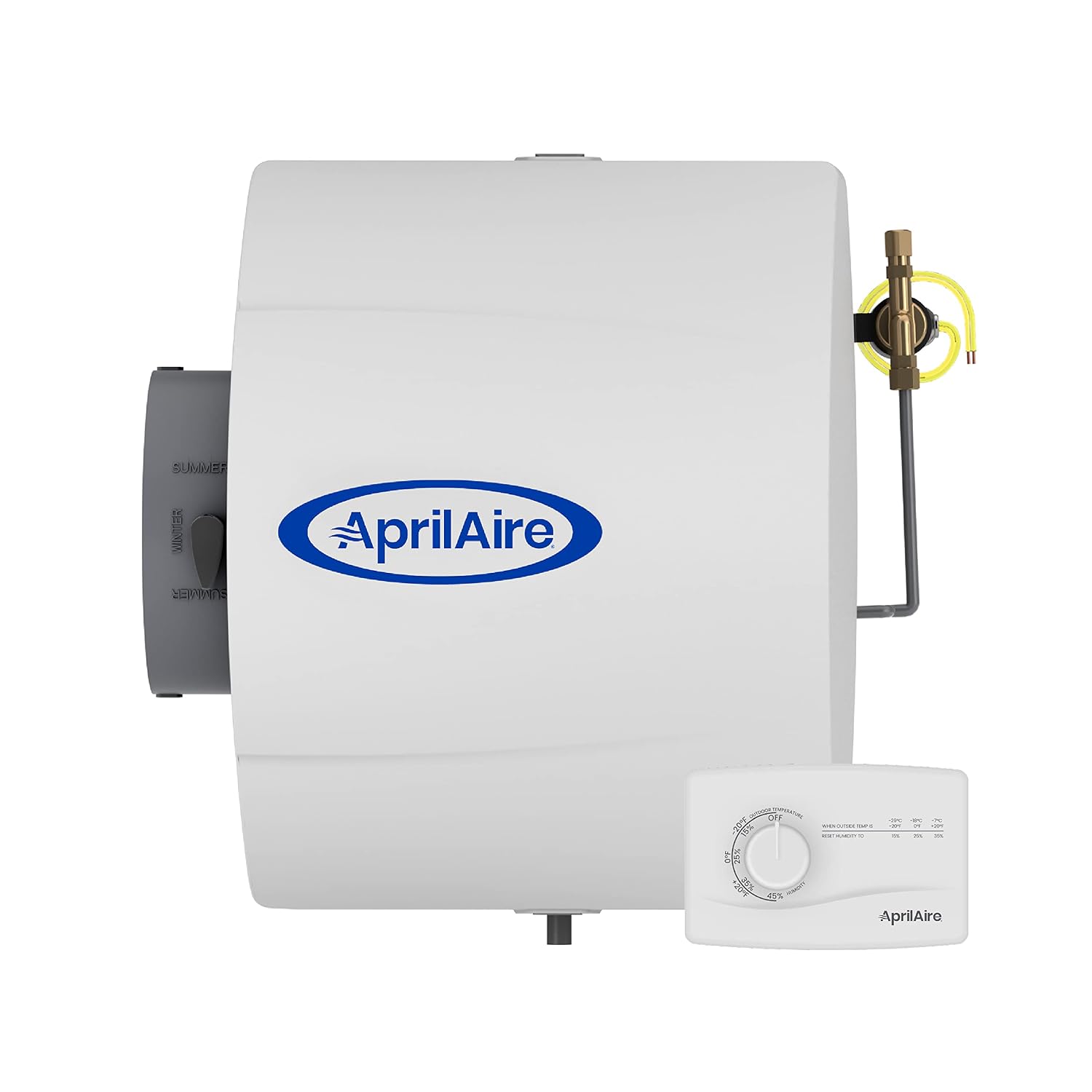
| Capacity | 17 gallons_per_day |
|---|---|
| Floor Area | 4000 square_feet |
| Operation Mode | Evaporative |
| Power Source | ac |
| Voltage | 24 volts_of_alternating_current |
The Aprilaire 600M is a bypass-style whole-house humidifier that mounts to a forced-air furnace and uses an evaporative water panel to add moisture to HVAC airflow. It is typically installed in the supply or return plenum and wired to the included 24 VAC transformer and manual humidistat, letting you set a target humidity and let the furnace push humidified air through ductwork. Notable features include a built-in bypass damper to simplify installation, a 17 gallon-per-day capacity for large homes, and an included water panel, solenoid valve, transformer, sensor, and manual control. The evaporative filter design is quiet in operation and requires a seasonal water-panel change and occasional valve inspection, which keeps maintenance straightforward but not maintenance-free. Because the unit is manual it does not automate with smart thermostats, so it is a practical choice where simple, reliable humidity control and long service life are priorities rather than smart features or hands-off automation.
Best for: Buyers who prioritize long-term dependability and straightforward furnace-integrated humidification for larger homes and want a complete, factory-quality kit that minimizes installation guesswork.
Less Ideal for: If you want app-based, automated humidity control or a plug-and-play portable humidifier for a single room, this hardwired furnace unit is not the right choice.
- High moisture output suitable for large homes up to about 4,000–5,000 sq ft
- Built-in bypass damper simplifies installation and reduces extra parts
- Includes transformer, control, valve, sensor, and water panel for a complete furnace-mounted kit
- Evaporative water panel produces quiet, natural humidification
- Manual humidistat requires user adjustment rather than offering automatic smart control
- Seasonal replacement of the water panel and basic valve maintenance are required
Verdict: Choose the Aprilaire 600M when you need a high-capacity, workhorse furnace-mounted humidifier that emphasizes reliable, low-complexity performance for whole-house humidification.
AIRCARE MA Console Humidifier

| Capacity | 3.6 gallons |
|---|---|
| Floor Area | 3600 square_feet |
| Operation Mode | Evaporative |
| Runtime | 36 hours |
| Wattage | 1650 watts |
The AIRCARE MA1201 is a console evaporative humidifier built to raise humidity across large homes and basements served by gas furnaces. It moves dry air through a saturated wick filter and uses a digital humidistat to maintain a set humidity level, with four fan speeds, an auto mode, and a refill/filter indicator for routine upkeep. The 3.6 gallon tank and up to 36 hours runtime mean fewer fill cycles for continuous winter use, and included casters make it easy to position near furnace return ducts or central living areas. Because it is evaporative and uses a wick filter, it naturally limits minerals in the mist but does require periodic wick replacement and cleaning. At 1650 watts it draws noticeable power while running high, and as a whole-house console it takes floor space that may not suit smaller rooms. For homes with gas furnaces looking to stabilize whole-house humidity, this unit delivers steady, automatic control, but expect regular wick maintenance and a modest energy draw compared with small portable humidifiers.
Best for: Buyers who want a reliable, whole-house humidifier to stabilize indoor humidity tied to a gas furnace and who prioritize automatic control and long runtime over compact size.
Less Ideal for: People who need a quiet, compact humidifier for a single small room or who want a near-maintenance-free ultrasonic unit.
- Designed for large coverage up to 3,600 sq. ft., suitable for whole-house humidification
- Digital humidistat with customizable humidity settings and auto mode for hands-off control
- 3.6 gallon tank and up to 36 hours runtime reduces refill frequency
- Wick filter design traps minerals and simplifies cleaning compared with ultrasonic units
- Casters included for easy placement and mobility
- Evaporative wick requires periodic replacement and filter maintenance
- Higher power draw at 1650 watts compared with smaller portable humidifiers
- Console footprint needs floor space and may not fit smaller rooms
Verdict: A solid whole-house evaporative console humidifier that provides automatic, long-run humidity control for homes with gas furnaces.
Vornado Evap40 Humidifier
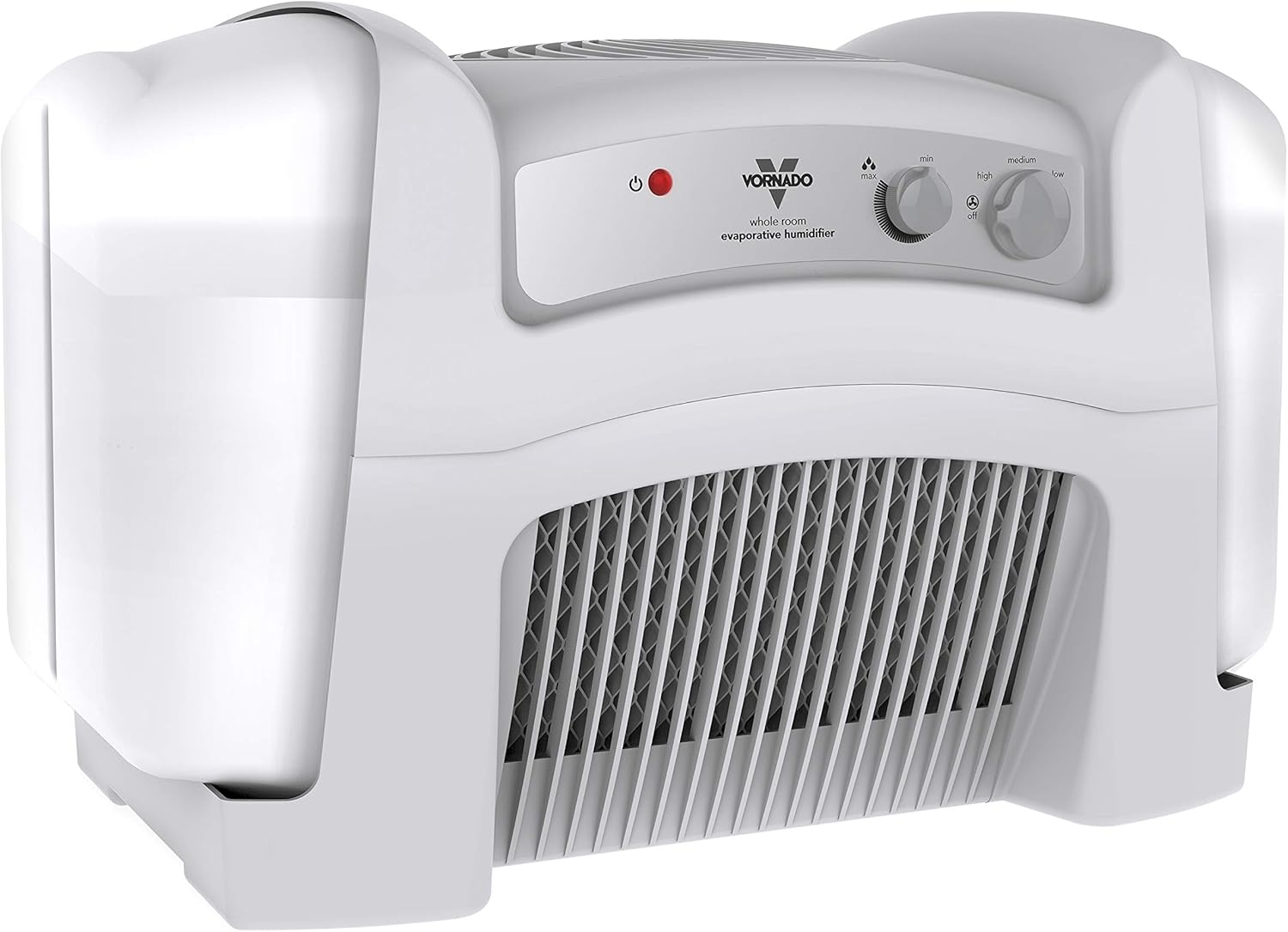
| Capacity | 4 gallons |
|---|---|
| Coverage | 1,000 sq. ft. |
| Operation Mode | Evaporative |
| Wattage | 43 watts |
| Control Method | Touch |
The Vornado Evap40 is an evaporative whole-room humidifier built for large spaces, using dual wick filters and Vornado's Vortex airflow to circulate humidity evenly across up to 1,000 square feet. It includes two 2-gallon removable tanks (4 gallons total) for long runtime and fewer refills, a built-in humidistat for setting target humidity, and three fan speeds for quick or quiet operation. Because it is evaporative, it does not produce visible mist, which reduces the risk of surface condensation near the unit and makes it more appropriate for homes with gas furnaces where mist-free distribution is preferred. Maintenance is straightforward: replace or clean the wick filters periodically and refill the tanks through the removable sections. Limitations include the need for regular filter replacement and slightly larger footprint and weight compared with small ultrasonic models, and it requires proper placement and airflow to achieve the advertised whole-room coverage. For buyers focused on steady, natural humidification across large rooms, the Evap40 is a practical, low-hassle option.
Best for: A risk-averse buyer who wants steady, natural humidification for large living areas or homes with a gas furnace and prioritizes predictable, low-mist performance and simple controls.
Less Ideal for: Buyers who need a compact, lightweight travel or single-room ultrasonic humidifier or those unwilling to perform periodic filter maintenance should consider other options.
- Large 4-gallon dual-tank capacity for long continuous run times
- Vortex airflow circulates humidified air broadly for more even room coverage
- Built-in adjustable humidistat for automatic humidity control
- Evaporative, wick-based operation produces no visible mist, reducing surface condensation
- Requires periodic wick filter replacement and cleaning
- Larger and heavier than compact ultrasonic models
Verdict: Choose the Evap40 when you want reliable, mist-free whole-room humidification with long runtime and automatic humidistat control for a gas furnace home.
Choosing the Right Humidifier for Gas Furnace: Key Factors to Consider
Home Size and Humidification Capacity
Matching humidifier capacity to the conditioned square footage is fundamental. Undersized units will struggle to reach target humidity, leaving rooms dry, while oversized units can cause condensation and wasted water. Look for manufacturer guidance on maximum square footage or grains per pound ratings and compare that to your home's heated area.
Consider seasonal extremes in your climate. If your home experiences very cold, dry winters, choose a unit with more capacity or plan to run it more consistently. Also account for ceiling heights and open-plan layouts, which increase the effective volume that needs humidifying.
Installation Type and Duct Compatibility
Humidifiers for gas furnaces come in different mounting styles, such as bypass, fan-powered, or steam-assisted. Each requires different duct connections and may sit on or next to the furnace cabinet. Confirm the unit's mounting options match your furnace layout and available space.
Check how the humidifier interfaces with existing ductwork and whether it needs a dedicated bypass duct or specific clearances. Some installations are simpler for DIY-savvy owners, while others require professional HVAC work. Knowing the installation complexity ahead of purchase prevents surprises at install time.
Control and Wiring Compatibility
Controls determine how the humidifier maintains target humidity. Basic systems use a mechanical humidistat; more advanced units accept electronic humidistats or integrate with HVAC controls. Ensure the humidistat type is compatible with your furnace wiring and thermostat arrangement.
If you want seasonal adjustments or remote control, verify the unit supports those control options. Wiring should be straightforward and documented, and the humidifier should offer clear guidance for common control setups to avoid improper hookups that could affect furnace operation.
Maintenance Requirements and Access
Regular maintenance keeps humidifiers hygienic and operating efficiently. Consider how often you must replace pads, filters, or panels and how easy those parts are to access. Units that require awkward disassembly increase the chance of skipped maintenance.
Also evaluate how the humidifier handles mineral deposits if you have hard water. Some designs use disposable pads, while others require periodic descaling. Factor in part availability and the expected frequency of visits to keep the system running.
Water Use and Drainage
Humidifiers vary in water consumption and how they manage drainage. Bypass and fan-powered evaporative units typically use a steady water feed and reject some water down the drain, while steam models vaporize water more efficiently but may use more energy.
Inspect how the unit handles condensate and whether a drain line is required. Proper slope and access to a drain are necessary for reliable operation. In homes without convenient drains, compressor or steam options that minimize drain needs may be preferable.
Safety and Materials Durability
Because these units connect to water and the furnace, materials and safety features are important. Look for corrosion-resistant tanks and housings, reliable float or shutoff valves, and clear overflow protection to reduce leak risk. Durable construction lowers the chance of midwinter failures.
Also consider whether the unit has safeguards against microbial growth, such as antimicrobial-treated pads or designs that limit standing water. Easy-to-clean surfaces and removable components help maintain healthy indoor air quality over time.
Bypass Vs Fan-Powered Vs Steam: Which Style Fits Your Furnace
The three common styles each have tradeoffs. Bypass units rely on furnace air movement and are simple and quiet, but they depend on a bypass damper and sufficient airflow. Fan-powered evaporative units actively push air through a wet panel and can humidify more aggressively, which helps in larger homes. Steam humidifiers produce moisture independently of furnace airflow and are compact, making them useful where duct routing is limited.
When choosing, prioritize the style that fits your furnace's airflow characteristics and the available space. If you have limited ductwork or need precise humidity control, steam options may be worth the extra complexity. For straightforward, low-maintenance whole-house humidifying, bypass styles are often the easiest to integrate.
- Bypass: quiet, low electricity, relies on furnace airflow
- Fan-powered: higher output, works when furnace fan is off if designed so
- Steam: independent of airflow, precise control, typically higher energy use
Preparing Your Home for Installation
Before you install a humidifier, measure the available space around the furnace and inspect ductwork for potential bypass routing. Identify a water supply near the furnace and a suitable drain path, and confirm the furnace cabinet has the clearance needed for the unit type you intend to mount.
Also evaluate the location of your humidistat. Wall-mounted humidistats should be placed where they read representative room air, not near exterior doors, sources of moisture, or direct sunlight. If wiring runs will be long, plan conduit or cable routing in advance to avoid last-minute complications.
- Measure furnace cabinet and duct clearances
- Locate nearby water supply and reliable drain
- Plan humidistat placement and wiring routes
Common Maintenance Tasks and Schedules
Most furnace humidifiers require seasonal attention. Expect to replace evaporative pads or filters annually or per manufacturer guidance. Inspect water lines, valves, and drain fittings for mineral buildup at least once a heating season, and clean accessible panels to prevent dust and biofilm accumulation.
Steam models may require less frequent pad changes but can need routine descaling depending on water hardness. Keeping a small maintenance schedule posted near the furnace helps ensure tasks are not missed and extends the service life of the humidifier.
- Replace pads or filters at recommended intervals
- Check water valves and drains for deposits
- Clean exterior and interior panels yearly
Control Options and Smart Integration
Basic humidistats maintain a set target humidity and are sufficient for many homes. If you want more precise control, look for units that accept electronic humidistats or integrate with home automation systems. Some systems offer multiple sensors for different zones, which can balance humidity in multi-level homes.
When integrating with smart thermostats or home systems, ensure wiring compatibility and that the humidifier control signals are supported. Proper control prevents excessive operation and helps avoid condensation on windows and cold surfaces.
- Mechanical humidistats: simple and reliable
- Electronic controls: finer adjustment and programmability
- Smart integration: optional, verify compatibility before purchase
Dealing With Hard Water
Homes with hard water may experience faster mineral buildup in humidifier pads and drain lines. Consider units that use replaceable pads designed for easier cleaning or models that allow for periodic descaling. Some homeowners route softened water to the humidifier to reduce deposits, but that requires coordination with whole-house water treatment.
If you choose to use softened water, confirm the humidifier's documentation about compatibility. In some cases, softened water can extend pad life but may change conductive properties in steam systems, so review guidelines before altering the water supply.
- Replace pads more frequently with hard water
- Consider water-softening or descaling maintenance
- Verify manufacturer guidance on water treatment
How We Chose the Best Humidifier for Gas Furnace
We shortlisted humidifiers that are designed for integration with gas furnace forced-air systems and evaluated them across concrete, buyer-relevant dimensions. Key evaluation criteria included humidification capacity relative to conditioned-square-footage, installation and mounting options for common ductwork and furnace housings, and control compatibility with standard humidistats and furnace wiring. We also measured expected upkeep: ease of filter or pad replacement, frequency of routine maintenance, and the accessibility of serviceable parts. Safety and build quality were assessed by looking for robust water-handling components and straightforward drain arrangements to reduce leak risk. Energy and water efficiency were considered through how humidification is achieved and how much water typical operation consumes. Products were excluded if they were only portable room units or required nonstandard furnace modifications. We avoided models that lack clear installation pathways for typical gas furnace systems or that do not provide capacity information. The resulting picks reflect units that meet installation practicality, performance for home sizes, maintenance needs, and safety concerns.
Our full evaluation process is outlined in our review methodology.
FAQ
How do I size a humidifier for my home?
Sizing depends on heated square footage, ceiling height, and how dry your climate is. Use the manufacturer's capacity guidelines or grains-per-pound ratings and err on the side of slightly higher capacity in very cold climates.
Can I install a furnace humidifier myself?
Some homeowners can handle basic installations that use existing bypass ducting and water lines, but many installations require precise duct modifications, electrical wiring, and reliable drain routing. If you are unsure about furnace wiring or ductwork changes, professional installation is recommended.
How often do I need to replace the pads or filters?
Typical evaporative pads are replaced annually or per the manufacturer's schedule, but homes with hard water or heavy use may need more frequent changes. Regular visual checks during the heating season help you catch excess mineral buildup early.
Will a humidifier affect my gas furnace performance?
A properly installed humidifier should not negatively affect furnace operation. It works with the furnace's airflow or runs independently in the case of steam units. Correct wiring and control setup is important to avoid unintended interactions.
Is a steam humidifier better than an evaporative one?
Steam units provide independent and often more precise control, which is useful for tight spaces or exacting humidity needs, but they can use more energy and be more complex to service. Evaporative units are simpler and often lower maintenance for whole-house applications.
Final Verdict
Choosing the right humidifier for a gas furnace comes down to matching capacity to home size, picking an installation style that fits your ductwork and space, and planning for realistic maintenance. Prioritize units that offer compatible controls with your furnace wiring and straightforward access for routine pad or filter changes. Balance the desire for precise control against installation complexity. A reliable, well-matched humidifier will maintain comfortable indoor humidity through winter while minimizing maintenance and water waste, so focus on capacity, installation flexibility, and upkeep when deciding.