
Note: This article contains affiliate links. If you click on these links and make a purchase, we may earn a small commission at no extra cost to you. This helps support our research and content. Read our full affiliate disclosure here.
Selecting the right infrared heater for a garage makes the space usable year-round, keeps tools and plastics safer from cold damage, and reduces the chill that slows projects. You want a unit that warms quickly, covers the parts of the garage you actually use, and stands up to dust, intermittent use, and garage-level humidity. This guide shortlists the top infrared heaters for garages across common use cases and installation types. We evaluated each option against practical considerations like heat coverage, mounting options, durability, and safety so you can find a model that fits your workspace. Read on for a clear overview of what to expect and which features matter most.
Top Picks at a Glance
| Best Overall The best all-around choice for most situations | Heat Storm Phoenix HS-1500-PHX |  |
| Best Quality Built to a higher standard if you want something more solid | Veito Blade 1500W |  |
| Best Value The sweet spot between price and what you get | DR. Infrared Heater DR-968 |  |
| Best Budget The cheapest option that still gets the job done reliably | SONBION Infrared Quartz Heater LSG13 |  |
| Top Rated A top-rated pick with lots of positive feedback | sundate Hanging Patio Heater |  |
| Most Popular A crowd favorite that many people choose with confidence | Heat Storm Phoenix HS-1500-PHX-WIFI |  |
| Best Seller A high-volume bestseller chosen again and again | DR. INFRARED HEATER DR-238 |  |
Heat Storm Phoenix HS-1500-PHX

| Heating Method | Infrared Quartz |
|---|---|
| Power Source | Corded Electric |
| Heat Output | 5200 british thermal units |
| Number of Speeds | 2 |
| Max Temperature Setting | 40 °C |
The Heat Storm Phoenix HS-1500-PHX is a compact infrared quartz heater that can be used on the floor or mounted to a wall, making it useful when floor space is limited in a garage or small workshop. It offers two power modes, 1,500 watts for faster heating and 750 watts for lower-energy operation, and a built-in thermostat with an LED display to help maintain a set ambient temperature. The unit uses Heat Storms patented heat exchanger to deliver soft, convection-reduced warmth that is reportedly safe to touch, and it includes a remote for convenient control. Practical benefits include simple plug-and-play installation, removable feet for floor use, and a child lock and tip-over switch for safety. Important limitations are the need for a dedicated circuit if other high-draw tools are present and the modest single-room coverage, so it works best as a zone heater rather than a whole-garage solution.
Best for: Someone who wants a compact, wall-mountable infrared heater to warm a specific work zone or small garage area and values easy controls and safety features.
Less Ideal for: People seeking to heat a large open garage or multiple zones at once should choose a higher-capacity or multi-unit solution instead.
- Two power modes (1,500 W and 750 W) let you choose between higher heat output and lower energy use
- Wall-mountable or freestanding with removable feet to save floor space
- Built-in thermostat with LED display and included remote for easy temperature control
- Safety features such as child lock and tip-over switch and a cool-to-touch grille
- Requires a dedicated circuit if other high-draw devices are on the same circuit
- Intended for single-room or small-area heating rather than whole-garage coverage
Verdict: A compact, wall-mountable infrared heater that delivers adjustable, safe heat for a single garage work zone or small shop.
Veito Blade 1500W

| Heat Output | 1500 watts |
|---|---|
| Power Settings | 375W to 1500W (4 levels) |
| Protection Rating | IP55 |
| Voltage | 120 volts |
The Veito Blade 1500W is a slim carbon-fiber infrared heater intended for wall or ceiling fixed installation in garages, patios, and indoor rooms. It delivers near-instant radiant heat that warms people and objects rather than air, comes with a remote-operated digital thermostat, a 9-hour timer, and four power settings from 375W to 1500W for flexible output. IP55 weatherproofing and a heavy-duty mounting bracket let you install it in semi-exposed garage or outdoor locations, and safety features include overheat and tip-over protection when used with the standalone base option. Because it is fanless it operates quietly and without circulating dust, which is helpful in workspaces. The unit is compact and energy efficient for spot heating, but as a fixed, directional infrared panel it is best for targeting zones and will not replace central heating for large, poorly insulated garages.
Best for: Someone who needs fast, efficient spot heating in a garage or workshop and values quiet, targeted radiant heat with precise control.
Less Ideal for: Buyers looking to uniformly heat large or poorly insulated garages as a primary heat source should consider higher-capacity or forced-air solutions instead.
- Carbon infrared element provides quick, direct radiant heat without fans or blowing dust
- IP55 rating and heavy-duty mounting hardware suitable for semi-exposed garage or patio installation
- Remote control with digital thermostat, 9-hour timer, and four power levels for precise heat management
- Fanless, quiet operation that preserves indoor air quality in enclosed workspaces
- Directional infrared design provides effective spot heating but is less effective at evenly warming large, poorly insulated garages
- Fixed mount installation limits portability compared with plug-and-play portable heaters
Verdict: Choose the Veito Blade 1500W if you want fast, quiet, energy-efficient spot heating in a garage or workshop with weatherproof fixed mounting and precise remote control.
DR. Infrared Heater DR-968

| Wattage | 1500 Watts |
|---|---|
| Heating Coverage | 576 square feet |
| Number of Speeds | 3 |
| Voltage | 120 |
| Amperage | 12.5 A |
The DR. Infrared Heater DR-968 combines a quartz infrared tube and a PTC element with a high‑pressure, low‑noise blower to deliver fast, evenly distributed heat for a single large room or enclosed workspace. It is typically used as a freestanding portable heater on caster wheels and has an electronic thermostat with Auto, Low (1000W), and High (1500W) modes plus a timer and remote control for convenient temperature management. Notable features include tip‑over and overheat protection, a long 6‑foot cord, and a claimed heating coverage up to about 576 square feet, which makes it suitable for garages, workshops, or large rooms where you want direct radiant warmth without blasting dry air. Practical benefits are rapid warmth, quieter operation than many fan heaters, and programmable auto mode that cycles between power levels to save energy. Limitations are that true garage performance depends on how enclosed and insulated the space is, and like all 1500W plug‑in heaters it cannot replace hardwired high‑output shop heaters for very cold, uninsulated garages.
Best for: Buyers who want a portable, energy‑aware infrared heater to warm enclosed garages or workshops during short sessions and prefer a quieter, thermostat‑controlled unit with safety features.
Less Ideal for: People needing to heat large, uninsulated garages continuously or replace a hardwired shop heater should consider higher‑capacity, purpose‑built garage heaters instead.
- Dual heating system (PTC + quartz) for faster, more efficient heat transfer
- Auto energy mode and thermostat that cycle between power levels to save electricity
- Built‑in safety features including tip‑over and overheat protection
- Quiet high‑pressure blower for broader heat distribution without much noise
- 1500W plug‑in limit means reduced effectiveness in very cold or uninsulated large garages
- Performance depends on enclosure and insulation; not intended as a permanent whole‑garage heating solution
Verdict: A portable, thermostat‑controlled 1500W infrared heater that delivers fast, quiet radiant heat for enclosed garages and workshops where a plug‑in solution is sufficient.
SONBION Infrared Quartz Heater LSG13

| Heating Method | Radiant |
|---|---|
| Heating Element | Halogen |
| Power Source | ac |
| Number of Speeds | 2 |
| Indoor Outdoor Usage | Indoor |
The SONBION LSG13 is a small, portable infrared quartz heater intended to deliver targeted radiant warmth for garages, home offices, and other indoor spots. It uses halogen/quartz heating elements to produce near-instant heat and offers two power settings (reported as 500W/250W in product details) so you can choose lower energy use or faster heating. The unit is lightweight and tabletop/pedestal style with a foldable holder for easy placement or storage, and built-in tip-over and overheat protection add basic safety during unattended operation. Because it radiates heat instead of blowing air, the heater runs quietly and preserves room humidity while warming people and nearby surfaces directly. Limitations are its small footprint and modest wattage, which make it suitable for close-range heating of a single workstation or small garage area rather than whole-bay warming, and there is no thermostat or remote control on the basic model.
Best for: Buyers who want an inexpensive, portable infrared heater to provide quick, quiet spot heating in a small garage workspace or near a workbench.
Less Ideal for: People needing to heat an entire garage or larger workshop should choose a higher-wattage or whole-space heater instead.
- Fast radiant heat from quartz/halogen elements for near-instant warmth
- Two power settings allow lower energy use or stronger output
- Quiet operation that does not blow air and helps maintain humidity
- Built-in tip-over and overheat protection for safer indoor use
- Compact, lightweight design with foldable holder for easy storage
- Modest wattage and small size limit effectiveness for heating large garage spaces
- No built-in thermostat or remote control for precise temperature regulation
Verdict: A budget-friendly, compact infrared heater that delivers fast, quiet spot heat for a small garage workspace.
sundate Hanging Patio Heater

| Heat Output | 1500 watts |
|---|---|
| Heating Element | Carbon Fiber Heating Tube |
| Mounting Type | Ceiling Mount |
| Indoor Outdoor Usage | Outdoor |
| Power Source | ac |
This hanging infrared heater uses a 1500W carbon fiber tube to deliver near-instant radiant warmth aimed at people and objects rather than heating air, which makes it well suited to spot‑heating in garages and covered outdoor areas. It mounts from the ceiling with the included adjustable chain and runs on a standard 120V outlet for simple plug‑and‑play installation, while the fanless design keeps operation whisper‑quiet and avoids blowing dust. The unit is weatherproof and has overheat and tip‑over protections, plus a remote control and digital display for easy adjustment from across the space. Because it radiates heat directly, it provides fast comfort for work areas or social spots without warming the whole garage. Limitations are typical of fixed, ceiling‑mounted infrared units: coverage is directional so it works best positioned over the primary work or seating area, and it will not replace whole‑garage HVAC in very large or poorly insulated spaces.
Best for: Buyers who prioritize a reliable, fast spot‑heating solution for a garage or covered work area and want a low‑noise, durable infrared unit that saves floor space.
Less Ideal for: People seeking whole‑garage heating for very large, uninsulated spaces or users who need portable, floor‑standing heaters for changing layouts.
- Quick radiant heat from a 1500W carbon fiber tube for near‑instant warmth
- Ceiling mount saves floor space and focuses heat where needed
- Fanless operation is quiet and reduces dust circulation
- Weatherproof design and safety protections for covered outdoor use
- Remote control and digital display for convenient adjustments
- Radiant heat is directional so it does not evenly heat large or fully open garages
- Ceiling installation is fixed and may require hardwiring or secure mounting for optimal placement
Verdict: A dependable ceiling‑mounted 1500W infrared heater that delivers fast, quiet spot heat for garages and covered work areas.
Heat Storm Phoenix HS-1500-PHX-WIFI
| Power | 1500 W |
|---|---|
| Voltage | 110 volts |
| Heating Method | Infrared |
| Heating Coverage | 150 ft² primary, 750 ft² secondary |
| Max Temperature Setting | 99 °F |
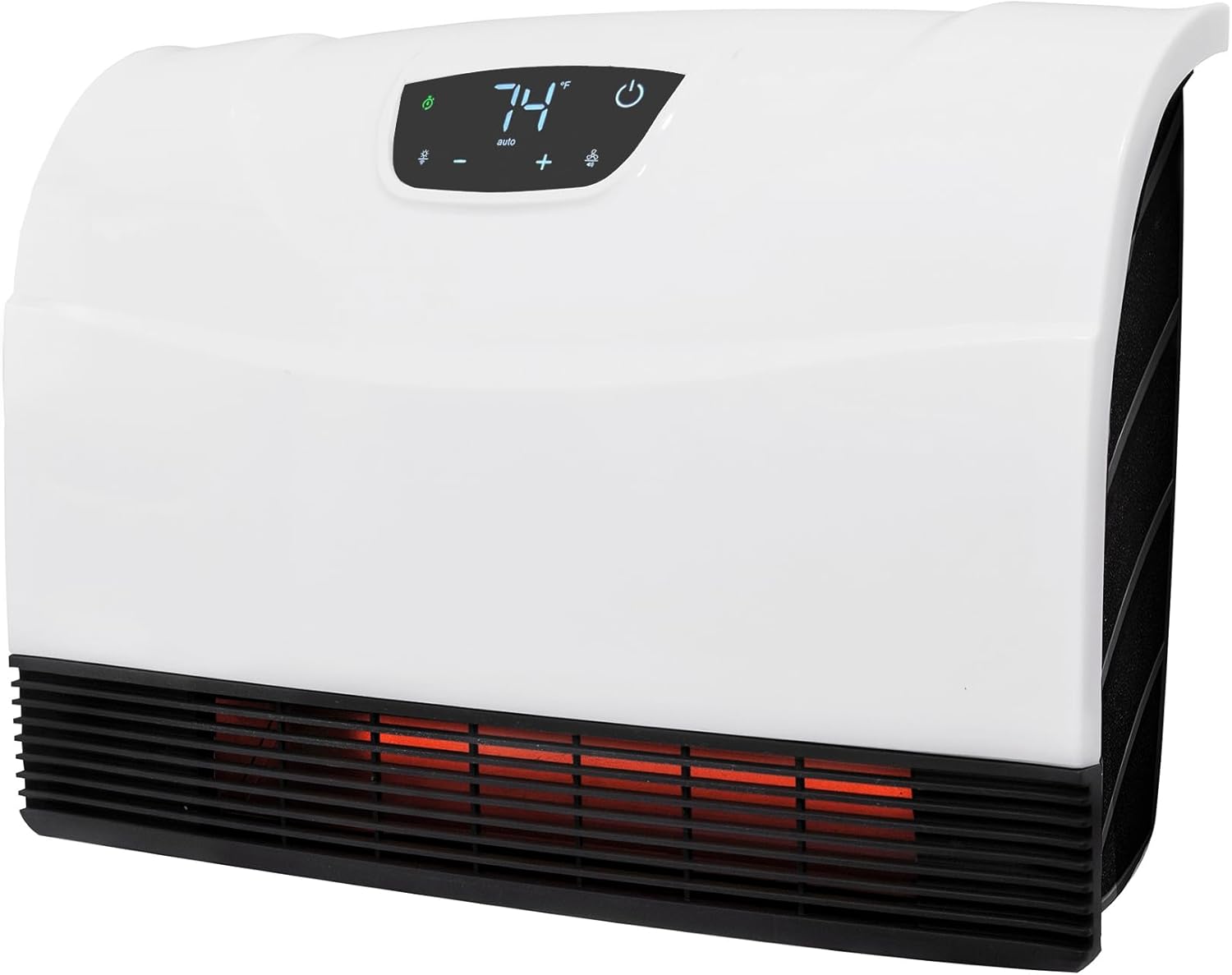
The Heat Storm Phoenix HS-1500-PHX-WIFI is a 1500 watt infrared wall heater intended to save floor space while delivering focused radiant warmth. It mounts to a wall and plugs into a standard 110 V outlet, making installation straightforward for a garage or small workspace; when mounted over the outlet the cord can be routed inside the unit for a neater look. The built-in Wi‑Fi and one-touch Bluetooth setup let you control temperature and schedules from a phone, and the included remote and touchscreen thermostat provide local control. Its radiant heating method warms people and surfaces directly rather than just heating air, which helps a single person working in a cold garage feel comfortable quickly. Safety features called out include a cool-to-touch grill and tip-over shutoff for models with feet, and washable filters help with dust in workshop environments. Limitations are that it is sized for zone heating—listed primary coverage is around 150 sq ft—so it will not replace a whole-garage HVAC system in larger or poorly insulated spaces.
Best for: Buyers who want a compact, wall-mounted heater to provide targeted warm-up for a small garage, workshop, or zone where quick infrared heat and remote scheduling matter.
Less Ideal for: People seeking to heat an entire large or poorly insulated garage or who need a high-capacity whole-space HVAC replacement should consider larger dedicated garage heating systems instead.
- Wall-mount design saves floor space and keeps the unit out of work areas.
- Wi‑Fi plus remote and touchscreen let you schedule and control heat remotely.
- Infrared radiant output warms people and surfaces quickly for spot heating.
- 1500 W power fits standard household circuits without special wiring.
- Washable filter helps reduce dust buildup in garages or workshops.
- Designed for zone/spot heating and not effective as a sole heater for large or poorly insulated garages.
- Maximum temperature and coverage are limited compared with higher-capacity garage heaters.
Verdict: A compact wall-mounted infrared heater with Wi‑Fi control that is a strong choice for targeted garage or workshop spot heating.
DR. INFRARED HEATER DR-238

| Power settings | 900W / 1200W / 1500W |
|---|---|
| Voltage | 120 volts |
| Number of speeds | 3 |
| Mounting type | Wall Mount, Ceiling Mount |
| Certification | ETL Listed |
The DR-238 is a corded 120V carbon infrared heater intended for spaces like garages, patios, and workshops where targeted, instant radiant heat is needed. It offers three output settings (900W, 1200W, 1500W) so you can dial heat to the task, and it mounts to a wall or ceiling with the included brackets for a permanent, out-of-the-way installation. The unit is IP55-rated and built from anodized aluminum, which helps resist weather exposure when used in covered outdoor or semi-open garage environments. A high-reflectivity aluminum reflector and carbon lamp focus warmth onto people and work areas rather than wasting energy heating the whole volume of a garage. Controls are simple and include a remote for on/off and power setting changes. Important limits are that this is a radiant infrared unit, so it heats surfaces and occupants best when unobstructed rather than raising ambient air temperature quickly across a large, fully open garage, and it has no integrated thermostat for automatic temperature control. For risk-averse buyers the ETL listing and IP55 rating provide clear safety signals for indoor and covered outdoor installation.
Best for: Buyers who prioritize a safe, hard-mounted infrared heater for occasional to frequent spot heating in a garage or covered patio and who prefer a straightforward, factory-quality unit with basic remote control.
Less Ideal for: If you need automatic temperature regulation, whole-bay air heating, or a portable plug-and-play heater to move between multiple rooms, choose a different solution.
- Three power settings (900W, 1200W, 1500W) for adjustable output
- Includes wall and ceiling mounting brackets and a remote for convenient installation and control
- IP55 rating and anodized aluminum construction for weather resistance in covered outdoor or garage settings
- High-reflectivity aluminum reflector concentrates heat for efficient radiant warming
- No built-in thermostat so it cannot automatically maintain a target temperature
- Radiant design heats people and surfaces best and is less effective at quickly warming large volumes of air in fully open garages
Verdict: A reliable, hard-mounted carbon infrared heater that delivers focused, adjustable radiant warmth for garages and covered outdoor spaces.
Choosing the Right Infrared Heater for Garages: Key Factors to Consider
Heat Coverage and Output
Understand how much of your garage a heater can effectively warm. Heat output is usually given in watts or BTUs and should be matched to the volume of the space you plan to use, not the total square footage if you only heat a workspace. Larger garages or high ceilings need higher output and better directional control.
Also consider the pattern of infrared heat. Some heaters project a narrow beam of intense warmth suitable for a workbench area while others give broader, softer coverage. Picking the right coverage reduces run time and keeps the work area comfortable without overheating tools or creating hot spots.
Mounting and Placement Options
Decide whether you want a wall-mounted, ceiling-mounted, or portable floor unit. Permanent mounts free up floor space and provide consistent directional heating for work areas. Portable units give flexibility to reposition heat where needed but usually require clear floor space and safe power access.
Look for adjustable brackets, pivoting heads, or multiple mounting points if your layout changes. Installation complexity and clearances for combustible materials are also important considerations for safe placement in a garage environment.
Durability and Environmental Resistance
Garages expose heaters to dust, occasional moisture, and impacts from tools or vehicles. Choose units with metal housings, sealed electronics, and protective grills that resist dust buildup. Corrosion-resistant finishes or powder-coated exteriors extend service life when humidity or road salt is present.
Serviceability matters too. Models with accessible heating elements or straightforward wiring simplify repairs and maintenance. Inspect whether the design permits routine cleaning without voiding warranties.
Safety Features
Safety features are essential in garages where combustibles, flammable liquids, and vehicle fumes may be present. Look for overheat shutoff, tip-over protection for portable units, grounded plugs, and clear minimum-clearance guidelines. An enclosed element and robust grill reduce the risk of accidental contact or ignition.
Also review any certifications or safety testing claims. Built-in thermostats and timers help avoid continuous operation and reduce fire risk by ensuring the heater cycles appropriately instead of running unattended for long periods.
Control and Usability
Controls should be intuitive and durable for a workshop environment. Rotary knobs and hard switches are often more reliable with gloved hands than touch panels. Multiple power settings or variable thermostats let you fine-tune comfort and running cost.
Remote control or app connectivity can be useful if you warm the garage from a distance before arriving, but basic manual controls are sufficient for many users. Consider lamped indicators for power and heat status so you can confirm operation at a glance.
Energy Efficiency and Operating Cost
Because garages are often poorly insulated, you will likely run a heater intermittently rather than continuously. Look for efficient radiant designs that put heat where you need it rather than raising the air temperature across the whole volume. Thermostatic control and zoned heating strategies reduce energy consumption.
Compare output per watt and consider timers or programmable schedules to avoid wasted run time. Efficient directional infrared units can be significantly cheaper to run for short tasks compared with heaters that try to heat the entire garage air volume.
Choosing the Right Size for Your Garage
Estimate the usable heating zone rather than the entire garage volume if you usually work in a single bay or at a bench. Measure ceiling height and distance from the heater to the work area to determine required output and beam pattern.
For high-ceiling garages, aim for models with stronger directional output or pair ceiling installations with reflectors to focus the infrared energy downward. If you plan to warm a vehicle occasionally, allow for a larger buffer because heat will dissipate over a larger surface area.
- Measure the area and ceiling height before choosing output ratings
- Prefer directional beams for bench or workstation heating
- Consider multiple smaller units for even coverage over one large high-ceiling bay
Installation Tips and Clearance
Follow the manufacturer's clearance guidelines for combustible materials. Maintain recommended distances from painted surfaces, fuels, and storage areas. Ensure mounts are rated for the heater weight and that wiring meets local electrical codes.
Use professional installation for hardwired or ceiling-mounted units to ensure secure anchoring and correct electrical wiring. For DIY installs, choose locations with minimal splatter or tool-impact risk and avoid placing heaters directly above flammable solvents or rags.
- Check clearances for side, rear, and top of the heater
- Use dedicated circuits for high-draw units
- Anchor ceiling or wall mounts to studs or framing
Maintenance and Winter Care
Regularly remove dust and debris from grills and element housings to preserve output and prevent hotspots. For ceiling or high-wall installations, schedule cleaning at least once per season or after significant dusty projects.
Inspect wiring, brackets, and mounting hardware before each winter season. Replace frayed cords and repair any loose connections promptly. If the heater has replaceable elements or filters, keep spares on hand to minimize downtime.
- Vacuum external grills and use compressed air for deeper dust removal
- Test safety shutoffs and thermostats annually
- Store portable units indoors when not in use for long periods
Using Heaters Safely Around Vehicles and Flammables
Avoid directing concentrated heat at fuel tanks, open containers, or areas where vapors may collect. Maintain ventilation when running a heater in a closed garage, especially if vehicles are present or if you use chemicals that emit fumes.
Position heaters to warm people and work surfaces rather than vehicle interiors. If warming a vehicle for a short time, keep the heater at a safe distance and monitor operation.
- Keep heaters away from stored gasoline, paints, and oily rags
- Ensure cross-ventilation if engines are running or solvents are in use
- Never leave high-output heaters unattended for extended periods
Smart Controls and Scheduling
Programmable thermostats and timers let you pre-heat the workspace on a schedule without wasting energy. For occasional use, simple timers are sufficient to limit run times. For frequent use, consider units with reliable thermostatic control to maintain a consistent working temperature.
Remote control or integration with a home automation system can add convenience but should not replace basic manual safety checks each time the unit is used.
- Use timers to avoid running the heater longer than needed
- Prefer mechanical controls if you wear gloves often
- Consider remote start for warming the space before arrival
How We Chose the Best Infrared Heater for Garages
We focused on attributes that matter for heating garages and workshop spaces where cold temperatures, dust, and intermittent use are common. Selection filters included coverage capability, mounting and placement flexibility, durability in dusty or semi-outdoor conditions, and built-in safety features. We prioritized units with clear heat output specs and multiple control options so buyers can match capacity to typical garage volumes. Energy efficiency and user controls were weighted to favor heaters that deliver measurable heat for the least reasonable run time. Durability criteria emphasized construction quality, IP or dust-resistance ratings where available, and proven thermal components rather than decorative finishes. Excluded from consideration were units designed solely for indoor living rooms or small personal spaces with low output, and any heater lacking basic safety features such as tip-over protection, overheat sensors, or grounded power connections. We also excluded specialty radiant panels intended only for patio use unless they had explicit specifications for enclosed spaces. The resulting picks reflect a balance of usable heat coverage, ruggedness, safety, and control suited to garage workflows.
Our full evaluation process is outlined in our review methodology.
FAQ
Can an infrared heater safely warm an uninsulated garage?
Infrared heaters can warm people and work surfaces effectively in uninsulated garages, but they will not raise overall air temperature quickly. For large or uninsulated spaces, expect higher run times and consider directional units or localized heating rather than relying on a single unit to heat the whole space.
Where is the best place to mount an infrared heater in a garage?
Mounting above or behind the primary work area is usually best so the heat projects toward benches and occupants. Ceiling-mounted units with a downward angle or wall brackets that allow tilt give the most useful coverage while keeping the heater out of the way.
Are infrared heaters safe to use around vehicles and stored materials?
They are safe when you follow clearance guidelines and avoid pointing heat at flammable materials. Maintain ventilation when engines or solvents are present and keep a safe distance from fuel containers and oily rags to reduce fire risk.
How often should I clean and service a garage infrared heater?
At minimum, clean grills and accessible surfaces once per heating season, and inspect mounts and wiring annually. More frequent cleaning is warranted after dusty projects or if the heater is used in a particularly dirty environment.
Do infrared heaters work well in garages with high ceilings?
High ceilings reduce the effectiveness of units that radiate heat broadly. For tall spaces, choose heaters with strong directional output or install multiple units lower in the workspace to ensure heat reaches occupants and work surfaces.
Final Verdict
Prioritize matching heat output and beam pattern to the specific zones you need to warm in a garage. Installation type, safety features, and durability should guide your selection as much as raw wattage. Expect tradeoffs between portability and focused coverage: portable units offer flexibility while mounted units provide more consistent directional heating. Focus on reliable safety controls, practical mounting solutions, and ease of maintenance when choosing an infrared heater for a garage. With the right balance of coverage, protection, and controls, you can keep your workspace comfortable and safe throughout colder months.